On June 24, the official opening of the 8th ADA International Education Conference took place through the joint partnership of ADA University and the Ministry of Science and Education, Azernews reports.
Day: June 24, 2025
Armenia slams OIC resolutions
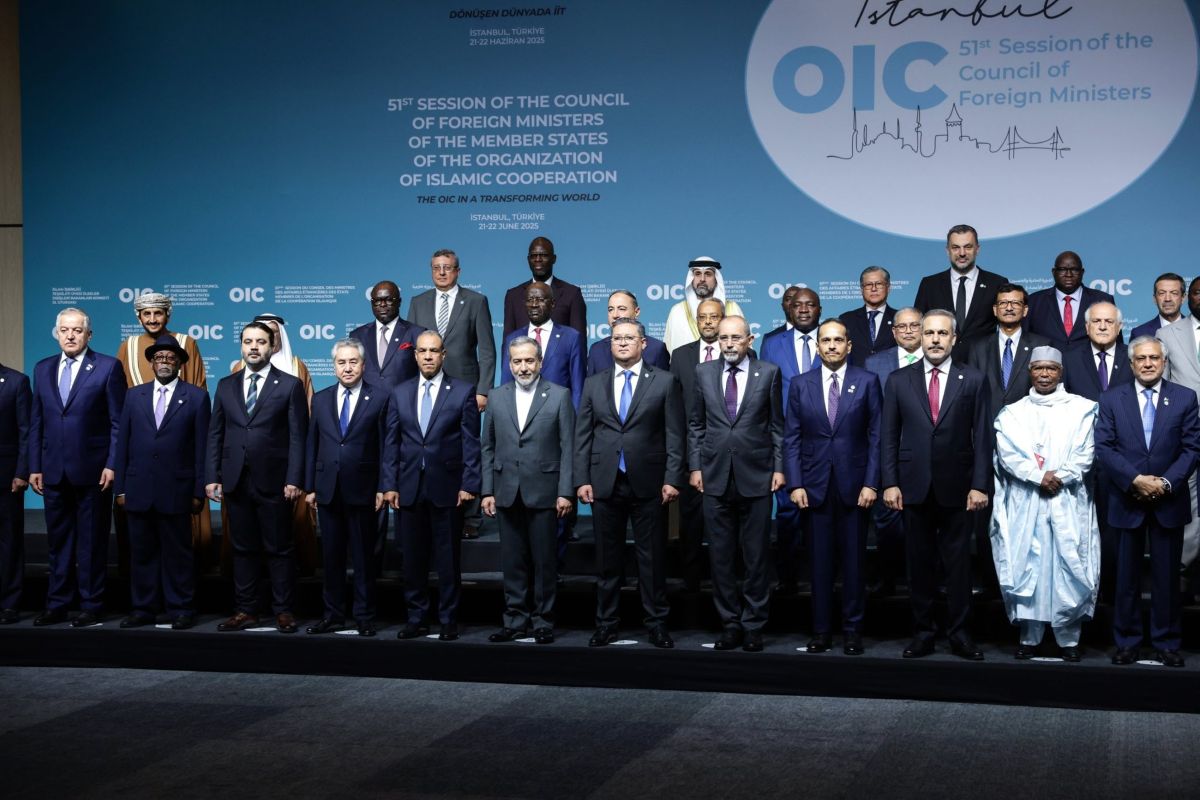
Following a ministerial conference, member states of the Organisation of Islamic Cooperation (OIC) adopted the “Istanbul Declaration” and a series of resolutions initiated by Azerbaijan, including one asserting “the right of return” for Azerbaijanis allegedly “forcibly displaced from the territory of present-day Armenia.”
The OIC documents condemned Armenia’s alleged denial of the rights of the so-called “Western Azerbaijan” community.
Armenia’s foreign ministry denounced the resolutions as “distorted and highly one-sided,” stating they “contradict the logic and interests of long-term peace in the region.”
Yerevan said the discourse around “Western Azerbaijan” is a thinly veiled territorial claim on Armenia’s sovereign land, disguised as a human rights concern.
The Ministry of Foreign Affairs calls on the member states of the Organization of Islamic Cooperation that have joined the aforementioned declaration and resolutions to review and resolutely reject biased initiatives that target Armenia’s territorial integrity and sovereignty and jeopardize the normalization process between Armenia and Azerbaijan.
Local political analysts described the foreign ministry’s response as “accurate and justified,” though criticised the Armenian government for previously failing to counter Baku’s persistent disinformation.
The OIC includes 56 countries, among them Armenia’s neighbours—Turkey, Azerbaijan and Iran—as well as four CIS states: Kazakhstan, Kyrgyzstan, Tajikistan and Uzbekistan.
- “No diplomatic breakthroughs”: Pashinyan and Erdogan meet in Istanbul
- “Baku must not be allowed to exploit Iran–Israel escalation”: Yerevan’s position
- “Yerevan’s proposals on unblocking dispel Baku’s concerns,” Armenian officials believe
What else is mentioned in OIC resolutions
The members of the Organisation of Islamic Cooperation also address the normalisation of Armenian-Azerbaijani relations. In particular, they welcome the agreement on the terms of a peace treaty. At the same time, they call on Armenia to “overcome the remaining legal and political obstacles preventing its signing, and to stop undermining the sovereignty and territorial integrity of Azerbaijan.”
Azerbaijan has set two preconditions for signing the peace treaty: the dissolution of the OSCE Minsk Group, which had been working on resolving the Karabakh conflict, and amendments to Armenia’s constitution. The constitution contains a reference to the Declaration of Independence, which in turn cites a joint resolution of the Supreme Council of the Armenian SSR and the National Council of Nagorno-Karabakh from 1 December 1989 “on the reunification of the Armenian SSR and Nagorno-Karabakh.” Baku considers this to be a territorial claim.
Yerevan denies this interpretation. It also considers constitutional reform an internal matter. At the same time, Armenia’s prime minister believes the new constitution may omit the reference to the declaration. Armenia is also not opposed to dissolving the Minsk Group, but the government believes a joint appeal to the OSCE on the matter should take place in parallel with the signing of the peace treaty.
The Istanbul Declaration calls on member states and Islamic financial institutions to support “the reconstruction and demining of the liberated territories [of Nagorno-Karabakh] to ensure the dignified return of internally displaced persons expelled from their lands as a result of Armenian aggression.”
The OIC also condemns:
- “war crimes, genocide and crimes against humanity committed by Armenian armed forces in the Azerbaijani city of Khojaly in February 1992”
- “acts of vandalism committed by Armenia against Islamic cultural heritage on the territory of Azerbaijan”
Armenia urges OIC members to “reconsider their position”
Armenia’s Foreign Ministry expressed “deep disappointment with the distorted and highly one-sided wording contained in the Istanbul Declaration and the resolutions adopted at Azerbaijan’s initiative.”
The ministry reiterated its long-standing position that Baku’s promotion of the “Western Azerbaijan” concept amounts to a territorial claim on Armenia’s sovereign land:
“It is worth recalling that “Western Azerbaijan” refers to Azerbaijan’s own western regions—namely, Qazakh, Tovuz, Aghstafa, Gadabay, Dashkasan, Kalbajar, Lachin, Gubadli, Zangilan, and Nakhichivan. There is no such place as “Western Azerbaijan” on the territory of the Republic of Armenia—nor can there be.”
The ministry also responded point by point to other issues raised by OIC member states in the documents adopted in Istanbul.
On Azerbaijanis who lived in Soviet-era Armenia
“Regarding Azerbaijanis living in Soviet Armenia, they voluntarily left Armenia in the final years of the USSR, managing to sell or exchange their property or receive compensation from the Armenian government.
Unfortunately, the same cannot be said for the fate of Armenians in Azerbaijan—in Baku, Sumgait, and other places, where massacres and forced displacement of Armenians took place.
The most recent manifestation of this in our region was witnessed by the world in the fall of 2023, when over 115,000 Armenians were forced to flee Nagorno-Karabakh subjected to ethnic cleansing.“
On events in Khojaly, which Baku refers to as “genocide”
“The misinterpretation of the Khojaly events also causes astonishment. The true history of crimes against humanity is well-known and directly refutes any accusations against the Republic of Armenia.”
On Armenian-Azerbaijani peace treaty
“It is regrettable that the adopted declaration, deviating from the statements made by OIC members in March of this year and subsequently regarding the conclusion of the Agreement on establishment of interstate relations and peace between Armenia and Azerbaijan, contains one-sided assertions about the preconditions existing on the path to signing the agreement.
We draw the attention of OIC members to the fact that Armenia has expressed its readiness to sign the Agreement without any delay, proposing to start consultations on the venue and date of its signing, as well as offering constructive solutions to address a number of issues raised by Azerbaijan.
It would be more logical for partners interested in establishing peace in the region to urge Azerbaijan to sign the agreement without unnecessary delay, refraining from creating artificial obstacles in this process.”
On “destruction” of Azerbaijan’s cultural monuments
“Ignoring the ongoing destruction of Armenian cultural heritage under Azerbaijani control and the systematic acts of vandalism against it, the resolution frames the issues with religious connotation, thereby fueling false and dangerous narratives. Armenia’s respect for and careful treatment of Islamic cultural heritage is well known and easily provable.”
The statement also notes that there is now a genuine opportunity to establish peace in the South Caucasus.
“There is a genuine opportunity to establish peace in the South Caucasus, and any such approach demonstrated by an international organisation does not contribute to the effective realization of that opportunity. The Republic of Armenia remains committed to the strategy of implementing the peace agenda and expects from its international partners, including the Organization of Islamic Cooperation support for the efforts to establish lasting and sustainable peace between Armenia and Azerbaijan.”
Expert commentary
Tatevik Hayrapetyan, an expert on Azerbaijan, wrote on her Facebook page:
“If Armenia’s Foreign Ministry had been actively engaged in diplomatic, political and informational efforts following Aliyev’s speech on 24 December 2022 — in which he introduced the expansionist concept of ‘Western Azerbaijan’ — then they would not now be ‘deeply disappointed’ by the dangerous wording in the ‘Istanbul Declaration’ adopted at the recent OIC ministerial conference.
They should be deeply disappointed in themselves — for either lacking the skill or the will to act. The spread of this expansionist concept is a direct result of their INACTION.”
Political commentator Hakob Badalyan observed:
“The Foreign Ministry’s statement is absolutely accurate and to the point. What’s equally disappointing is that member states of the OIC include countries like Iran, Egypt, and Qatar — countries frequently visited by the Armenian prime minister’s wife and high-ranking officials as part of their foundation’s work.
But here’s the key question: did Armenia anticipate these risks and engage diplomatically with these states, or with other OIC members that maintain friendly ties with Armenia? Did the Armenian Foreign Ministry try to prevent the adoption of such resolutions or their wording?
For instance, Nikol Pashinyan was in Istanbul just a day before the OIC conference. Was this issue raised during his meeting with the Turkish president? Did Ankara bring up the resolutions it was set to adopt the following day? Let’s not forget, Turkey was chairing the OIC meeting in Istanbul.
Perhaps it suits the Armenian government to portray the situation as one where ‘everyone is ganging up’ on Armenia. But that is precisely what state policy and diplomacy are for — to prevent that from happening. Armenia must engage those with whom it has good relations. It must work with countries that are not only willing to stand apart from the group, but also capable of blocking or voting against such documents.”
We all wanted to start “a newspaper.”
For many years, newsstands across Georgia offered a poor selection. There were one or two moderate newspapers that somehow survived national aversion from the print press. But their spotlight was long lost to more sensationalist headlines from a slowly growing variety of conservative, conspiratorial publications. These were so bored with the absence of rivalry that their editors waged wars among each other over how to translate “deep state” into Georgian correctly: finding the right words for this new, all-explaining phenomenon was an urgent matter. There was an even bigger selection of crossword newspapers, in Georgian or Russian. There were also a couple of Russian women’s magazines, a solitary issue of National Geographic, and a series of fancy-looking editions of Forbes, Burda, and Entrepreneur.
“That one newspaper”, however, was missing: the talk of the town, something that liberals would buy but would also attract a broader range of readers, something we’d all be discussing or fighting about the next day. The trouble was that we didn’t (want to) believe readers still existed. Nobody reads these days, we’d tell ourselves, everyone’s into podcasts now, and social media favors reels. At least nobody will pay for a paper – that’s not how poor Georgia works.
But then the next day, we’d feel this renewed, inexplicable urge to start a “newspaper.” It became our liberal savior complex: a newspaper with the right facts and views that you’d distribute among senior citizens “in the regions,” to the men playing backgammon and wearing flat caps, to the women sitting on the porches during short breaks from their invisible round-the-clock labor, with faces tired and heads covered. The images of good but naive citizens, curiously leafing through big papers and immediately cured of the propaganda disease, lived rent-free in our minds.
There were one or two attempts to actually print things out. They went nowhere, perhaps because they were half-attempts and more resembled brochures than the products of an ambitious media project. The publication of those real “good newspapers” was delayed indefinitely. The newspaper that would reform us, that would humanize us all, was left pending forever. It was delayed so long that, by the time those newspapers were finally printed, all of them were either about political prisoners – or by political prisoners.
Here is Nini and the Dispatch newsletter with a weekly editorial column about what bothers Georgia.
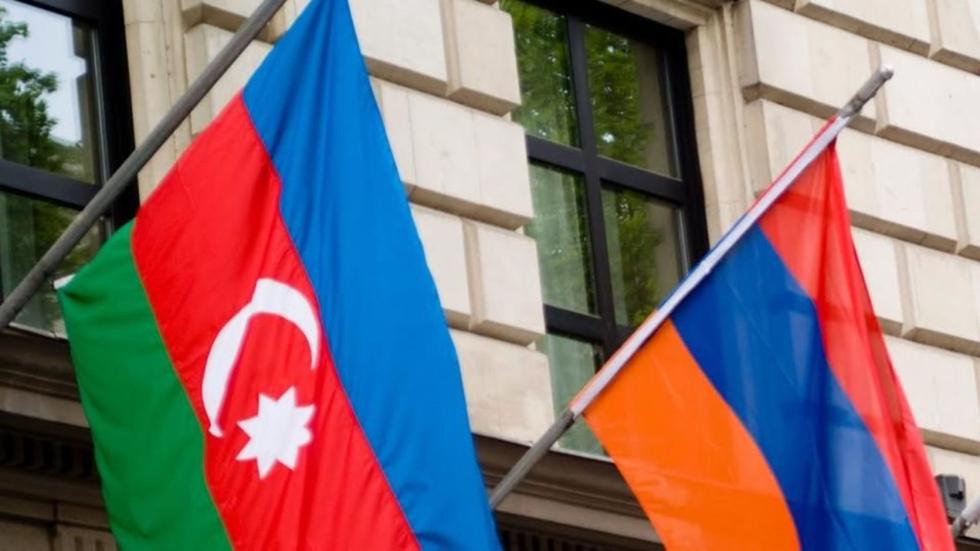
The newspaper has now been everywhere. It first appeared at daily rallies on Rustaveli Avenue, distributed in front of Parliament. There was Cell 101, a paper published by Zviad Tsetskhladze — the activist and law student detained on group violence charges, who turned 20 behind bars. Batumelebi, a popular media outlet that has covered the coastal Adjara region since 2001, also returned to its original print form after its founder, Mzia Amaghlobeli, was imprisoned.
Then came another special issue — Letters of Political Prisoners to the Citizens of Georgia — which gradually made its way beyond downtown Tbilisi, reaching distant neighborhoods of the capital and towns across eastern and western Georgia. A group of activists, including family members of detained protesters, delivered the papers by hand, bringing to life the scenes that those newspaper dreamers once imagined.
The articles are good to read. Those in Batumelebi special issues, for example, provide summaries of political prisoners’ cases, combining details of the charges and context with more intimate glimpses into the lives of inmates before they ended up behind bars. These well-crafted features, co-written by Amaghlobeli’s colleagues from different outlets, help fill the widening gaps left by an increasingly strained online media, which found less time for storytelling artistry while caught in a constant cycle of reacting to news, events, disinformation, and growing attacks on the press.
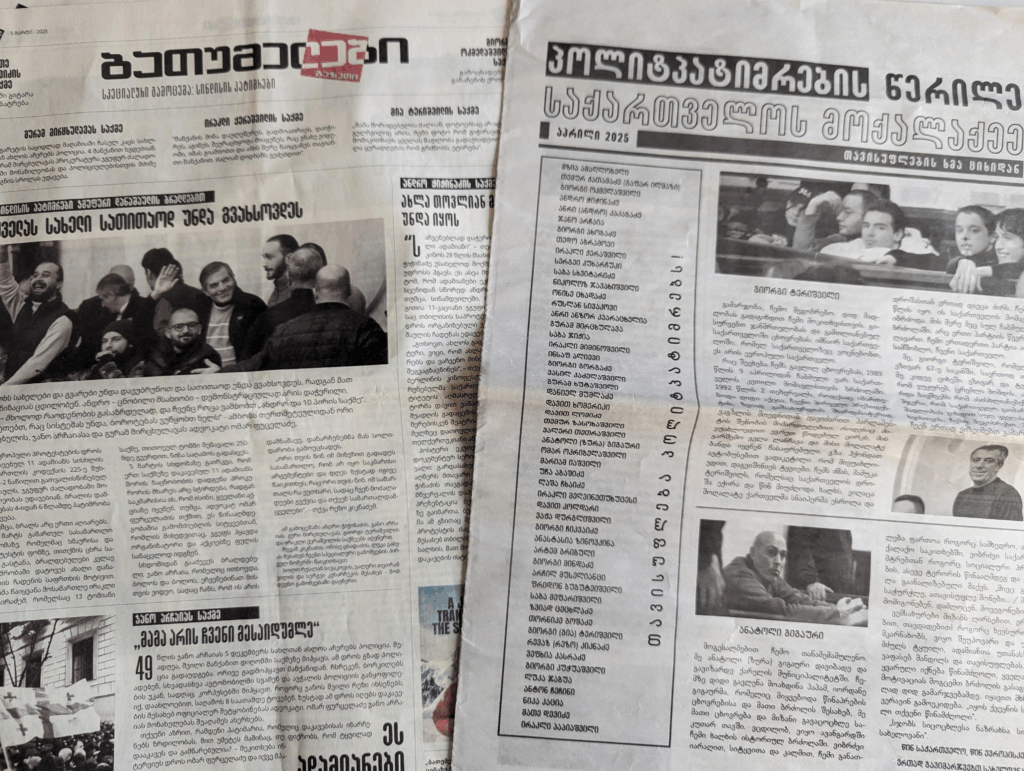
The papers are here to fight many wars, but their main battle is against statistics. “We need to return the names and surnames to these people, because they try to dehumanize them,” a lawyer is quoted on the front page of one of the Batumelebi special issues, under the courtroom photo of what’s become known “Eleven Prisoners of Conscience,” one group of protesters detained over group violence charges.
The names are easy to forget. Nearly seven months into non-stop resistance, each week has felt worse than the last. Every week, something happens for the first time: a protester arrested, a journalist jailed, a politician detained, a woman imprisoned, an activist locked up for “insult,” a critic fined over a Facebook post, someone’s home raided, an NGO inspected, a protester convicted, a repressive law introduced, another repressive law adopted, a politician sentenced, another politician sentenced, three politicians convicted, four… First comes an event, then it becomes a trend, and before you know it, it can be reduced to just a number.
In Another Life
“None of this would be happening if we’d started that newspaper,” we sometimes joke in Civil.ge office. We, too, once had that newspaper dream. We even started writing and planning, but we never believed enough or tried hard enough. But is the none-of-it part truly a joke?
Newspapers aren’t the only projects that everyone thought were needed, but that only became possible in darker times. As the protests dragged on, things we once thought were impossible suddenly became possible. People learned to crowdfund as key civil society initiatives were stripped of vital funds. A stable progressive political project emerged from daily rallies, after many years of everyone arguing it was impossible despite a clear need: there were not many leftists around, those that were around were busy fighting each other, and even if they had united, with so little funds they’d never stand a chance against big money.
But desperate times also mean greater hurdles. The newspaper boom has yet to spark a true reading culture or a commercially viable, reader-funded model. The progressive project — the Movement for Social Democracy — is still far from becoming a fully functioning political party, and the current repressive climate suggests the authorities may not allow it. And while crowdfunding efforts are everywhere, anyone thinking of launching something long-term, hoping to survive on citizen donations, still has to think twice, especially when so many who would gladly help have already lost their incomes.
Another reason we are not there yet is that Georgians are still figuring out where they are exactly with the protests. Is this a long-term battle, where resistance becomes life? Or are they simply waiting for the right moment, for that implosion, that awakening after which everything returns to “normal” in a matter of days? The shock and confusion leave many in a state of ever-deepening reactive numbness, making it harder to mobilize, organize, or take initiative.
And still, would any of this be happening if we had all committed to those dream newspaper projects? We’ll never know. But if someone, somewhere, is contemplating a project they believe is vital for a better society, for better politics, but thinks they can’t afford it, trust us: you can afford it.
You’re just not desperate enough. Yet.