
A group of Japanese residents filed several lawsuits against Meta Platforms Inc. because of fraudulent advertising on Facebook, of which they became victims, Azernews reports.
Day: October 29, 2024

Impact of Georgian Elections on Armenia
Armenian political analyst Gurgen Simonyan suggests that if Georgia opts for a Eurasian path, Armenia could face various challenges, “ranging from road access and food security to arms imports.” At the same time, Armenia could gain greater support from the West as the sole partner in the region. This would specifically involve diplomatic backing, economic assistance, and defense support.
“Previously, Georgia and Armenia stood together. But if Georgia takes the path of dictatorship, only democratic Armenia will remain. You can’t imagine how significantly its importance could grow. At the same time, Armenia must show resolve and strength so that the West can implement its support policies here,” emphasized the political analyst.
Discussing the post-election situation in Georgia, Simonyan did not rule out various possible outcomes—even a revolution. He believes that the course of events will depend on “the will of the Georgian people, the scale of external actors’ interference, and several other factors.”
- The Eurasian Georgia?
- “Men’s milk, women’s pads, the trial of the opposition” – a pre-election interview with Bidzina Ivanishvili
- Regional transportation routes: How Georgia’s transit role is changing in light of new realities
- Georgia holds significant military and political importance for Armenia.” Opinion from Yerevan
Here’s the English translation:
On October 26, parliamentary elections were held in Georgia. According to the Central Election Commission, the ruling party, Georgian Dream, received 54 percent of the votes. However, exit poll results were significantly lower—around 42 percent.
Four opposition forces also entered parliament, collectively garnering approximately 38 percent of the votes. They have refused to recognize Georgian Dream‘s victory and announced their decision to forfeit their parliamentary seats.
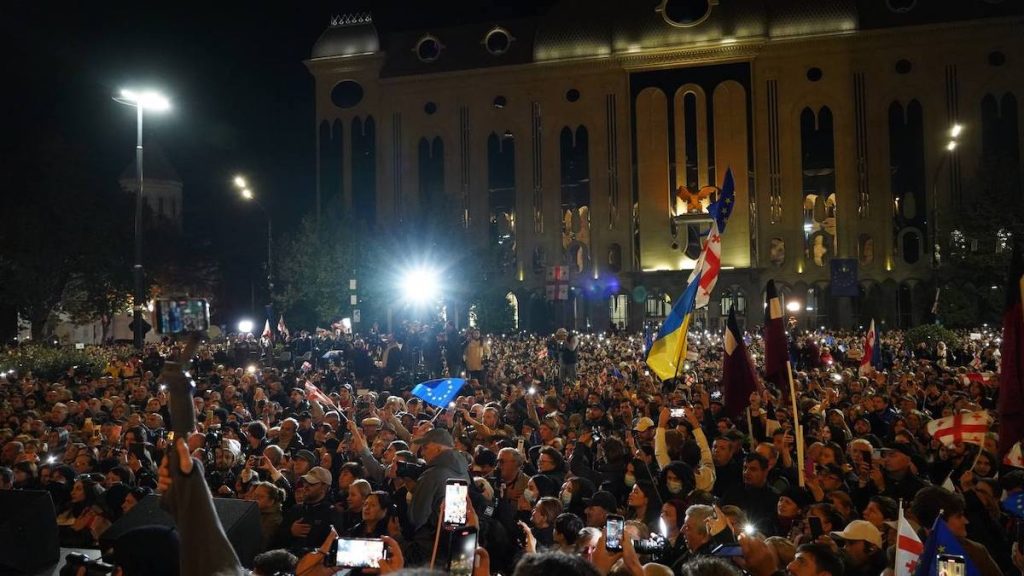
Georgian President Salome Zourabichvili has also stated that the parliamentary election results were falsified. She described the elections as a “Russian special operation.” After the election, an opposition rally in Tbilisi drew more than 100,000 participants.
Here’s the English translation:
Commentary
Political analyst Gurgen Simonyan considers it telling that foreign ministers from many European countries are concerned about the situation in Georgia, and international observers have reported numerous violations both during the election campaign and on election day. The Georgian president and opposition also refuse to recognize the parliamentary election results. However, Simonyan suggests waiting for the final report from the OSCE/ODIHR observer mission.
According to Simonyan, if election fraud is confirmed, Georgian Dream is not legitimately gaining power but rather seizing it:
“If it’s determined that power has been usurped, a change of power may occur not through elections, but through a revolutionary path. Such a scenario cannot be ruled out. In cases of power usurpation, revolutions become part of the country’s political agenda. But we should wait and see how events unfold.”
Simonyan believes that the founder of Georgian Dream, Bidzina Ivanishvili, “serves Russia’s foreign policy interests”:
“It’s no coincidence that Tbilisi received congratulatory messages first from authoritarian countries: Hungary, Russia, and Azerbaijan. Western policy could shift; there are already signs of this. Blinken’s statement could be interpreted as: we may overlook election fraud if you meet your obligations and lead Georgia on a European path. Things will become clear soon, and this factor will act as a litmus test.”
Simonyan reminds that the Georgian Prime Minister announced plans to begin moving towards the West starting next year. He believes cooperation between Washington and Tbilisi is possible if Georgian authorities take the necessary steps for this, such as repealing the foreign agents law.
When asked if Armenia would still hold Western interest as a partner if it pursued European integration without Georgia, the analyst responded:
“This could even be more successful, more appealing than with Georgia. Armenia could take a leading role in the region. Armenia has significant infrastructure, and Western presence in Armenia means presence in the South Caucasus. Iran, Turkey, Azerbaijan—these are not democratic states; they’re genuine dictatorships. I think Armenia could serve as a lifeline for the West here.”
According to Simonyan, if Georgia chooses a Eurasian path, Armenia’s importance would grow. However, Yerevan must do its homework for this:
“There needs to be a strategic policy, something the current authorities aren’t ready for. They find it easier to walk hand-in-hand with a dictatorial Georgia than to undertake broad Western reforms that would boost the Armenian state’s resilience.”
At the same time, Simonyan is confident that if Georgia falls under Russian influence, Armenia will face serious issues:
“These issues include road access, food security, and arms imports through Georgian territory. Armenia’s authorities must strategically reassess their approaches and seek alternative methods and routes to connect with the world. For instance, they could consider air routes or even routes through Turkey, should diplomatic relations be established and closed borders opened between the two countries.”
Follow us – Twitter | Facebook | Instagram
Impact of Georgian Elections on Armenia
On October 29, the Eastern Partnership Civil Society Forum (EaP CSF) Steering Committee issued a statement expressing concern over the conduct of the October 26 parliamentary elections in Georgia and calling for the non-recognition of the official results.
“We call for the non-recognition of these election results by the international community, until an impartial investigation is conducted. The 2024 elections in Georgia, held for a first time under a fully proportional system, were intended to increase democratic representation and transparency. However, reports from civil society, as well as both local and international observers, show that the process was deeply flawed with systemic manipulation, voter and observer intimidation, breaches in vote secrecy, and political bias of the Central Election Committee (CEC), among many other issues,” said Lasha Tugushi, EaP CSF Steering Committee Co-chair.
The EaP CSF Steering Committee notes that vulnerable groups, minorities, public sector workers and citizens in rural areas were “particularly targeted” by the ruling party, which officially won more than half of the votes.
The statement says, “We, the EaP CSF Steering Committee members, stand in solidarity with the people of Georgia in their fight for a democratic and transparent society, and a European future. We urge all stakeholders, including the Georgian government, the EU and the international community, to support Georgia’s fight for democracy by ensuring that all Georgian citizens’ voices have been listened to and respected during the 26 October elections.”
The EaP Civil Society Forum Steering Committee recommends:
International and EU Election Observation Missions to publish detailed reports and make unequivocal statements on all observed irregularities during both the pre-election period and election day, offering transparency on alleged electoral fraud;
International community, including EU and U.S. institutions, to demand accountability and withhold election recognition until a full investigation is conducted;
U.S. government to impose sanctions, including asset freezes, visa restrictions, and travel bans on individuals and entities involved in electoral fraud and voter intimidation under the MEGOBARI Act;
EU institutions to tie future financial aid to Georgia to electoral integrity and thorough investigations into alleged fraud during the 26 October 2024 legislative elections;
EU Member States to exert diplomatic pressure on Georgia, including summoning Georgian ambassadors and issuing unified statements holding the government accountable for election misconduct;
Georgian courts and the judicial system to promptly investigate and prosecute all reported electoral fraud cases, regardless of political affiliations;
Georgian authorities to repeal restrictive laws that limit civil society and independent media, such as the Foreign Agents Law, and protect freedom of speech and press.
Georgian civil society organizations to continue advocating for their rights, oppose electoral fraud, and seek international support to safeguard CSO activities against state harassment.
The donor community to increase flexible support to local civil society in Georgia, especially considering the impact of alleged electoral fraud on independent CSO and media sectors.
Also Read: