The Armenian Parliament has ratified the border delimitation regulations
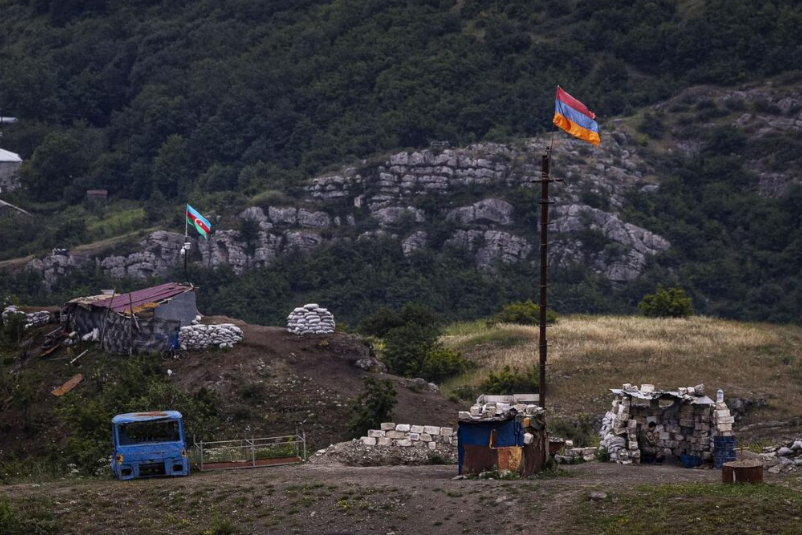
The Armenian Parliament ratified joint commission regulations on the delimitation of the Armenia-Azerbaijan border. The opposition factions “I Have Honor” and “Hayastan” (Armenia) did not participate in the discussion or the vote. However, the ruling “Civil Contract” faction had enough votes to ratify the document.
The parliamentary opposition views the process as unconstitutional and illegal. Opposition members also do not rule out the possibility that Azerbaijan might refuse to ratify the joint commission regulations. The ruling party, however, has no such concerns. Should this happen, they explain, the document simply will not come into force.
“If the ratification process is not completed by one of the sides or reservations are made regarding the document, there will be no exchange of notifications, and the process will be halted,” emphasized Deputy Prime Minister Mher Grigoryan.
A heated discussion on the content of the regulations took place in Armenia’s National Assembly the day before. Members of the Foreign Affairs Committee debated the project for about three hours․ And in the end, the committee issued a positive conclusion—again, thanks to the ruling majority’s votes. During this session, Deputy Prime Minister Mher Grigoryan provided detailed explanations about the process, including why no specific map is mentioned in the regulations for the delimitation.
According to Grigoryan, “there is no single definitive map of the border”; rather, maps from various years exist, and the delimitation process may involve not only Soviet General Staff maps.
The heads of the border delimitation commissions, Mher Grigoryan and Shahin Mustafayev, signed the regulations on August 30, 2024. The document is based on a protocol agreed upon by both parties on April 19, according to which the sides will rely on the Alma-Ata Declaration during the delimitation process. This means both parties mutually recognize the administrative boundaries as they stood at the time of the Soviet Union’s collapse. On September 26, Armenia’s Constitutional Court confirmed that the obligations outlined in the regulations are in line with the country’s constitution.
This international agreement will become a “guarantee of Armenia’s territorial integrity”
Deputy Prime Minister Mher Grigoryan explained to the parliament that, according to Article 5 of the regulations, a future international agreement on the state border will be signed between Armenia and Azerbaijan:
“It will undergo the necessary domestic procedures, after which the protocol describing the border will come into force as an integral part of this international agreement.”
Grigoryan emphasized that establishing the international legal foundations of the state border through this document will serve as an important legal guarantee for the security and territorial integrity of the country.
“Relying on a single map would be risky”
The commission regulations state that “all cartographic documents relevant to the process will be used during the delimitation.” Opposition members find this problematic, arguing that the document should specify the exact years of the maps being referenced.
“The General Staff of the Soviet Armed Forces created maps between 1974 and 1978. This map consists of around 20 parts, all of which underwent review in 1979. However, relying solely on the General Staff’s map, depending on the terrain, scale, and open spaces, is risky. Yes, I believe that relying on a single map would be very risky at this stage, or at any stage. A complete map of the Armenia-Azerbaijan border does not exist.”
Recently, the 1976 map has been frequently mentioned. According to the Deputy Prime Minister, it only concerns the Tavush region, while the 1978 map is more suitable for the delimitation of the Syunik region. Mher Grigoryan did not specify which “relevant maps” are available to both sides, only stating that he is willing to discuss the issue in a closed session.
To journalists, the Deputy Prime Minister confirmed that “not only the General Staff maps of the Soviet Armed Forces will be used in the delimitation process”:
“There are questions that cannot be answered by the General Staff maps.”
“We are not aiming to draw a new border”
Mher Grigoryan also responded to opposition members who accused the government of agreeing to border changes, arguing that such changes could only occur through a referendum:
“We are not aiming to draw a new border. Our task is to restore the borders, based on maps that have legal force.”
The Deputy Prime Minister emphasized that the map used in the delimitation process should be “topographic, professional, created by an authority with such powers, and based on legal documents that were binding for both Armenia and Azerbaijan at that time.”
The opposition’s doubts remain unanswered
Armen Rustamyan, a member of “Hayastan” faction, stated that their faction did not receive satisfactory answers to their concerns during the Foreign Affairs Committee meeting and their doubts remain unresolved.
He pointed out that the National Assembly is moving forward with ratifying the regulations, while no parallel process is taking place in Azerbaijan. In his view, this is illogical:
“We have always spoken about synchronized processes. But now we are ratifying the regulations, and we cannot rule out that Azerbaijan may not ratify it or might do so with reservations unacceptable to us. We are creating risks for our country.”
The opposition member declared that the “Hayastan” faction would not participate in this “illegal process,” as their participation could be interpreted as recognizing its legitimacy.
The “I Have Honor” faction also boycotted the session. According to its leader Hayk Mamijanyan, such documents do not require the ratification process currently underway:
“Therefore, these actions are aimed at justifying potential future concessions by the Republic of Armenia.”
It is still unknown which territories will be next in the delimitation process
This is a question Armenian authorities have been frequently asked in recent months. Prime Minister Nikol Pashinyan responded that the order of the process will be determined by the heads of the border delimitation commissions.
Deputy Prime Minister Mher Grigoryan does not yet have an answer. He explained that the “next section for delimitation has not yet been discussed.” Grigoryan emphasized that the decision must be made by consensus, not unilaterally:
“No principle has been defined for selecting sections. There is only one definition, which I believe is a real agreement: the issue should be resolved by consensus.”
Before the ratification of the regulations, Yerevan and Baku carried out delimitation along the Tavush-Gazakh section. According to Grigoryan, this was the most complex area. Which is why, after lengthy discussions, they decided to begin the process from this region.
Follow us – Twitter | Facebook | Instagram
The Armenian Parliament has ratified the border delimitation regulations