In today’s evolving global landscape, the role of diplomats extends beyond traditional statecraft. Recognizing this dynamic shift, a visionary team has launched the Certified Economic Diplomat Programme. This eight-week online training initiative, designed with quarterly cycles of theory and practice, equips current and aspiring diplomats with essential economic diplomacy skills. Tailored for those whose home, passion, or professional interest lies in Africa, the program redefines the role of diplomats within the continent and beyond.
A Legacy of Excellence
The core team, led by Prof. Elvis Cornerstone, President of Accra Business School and the Institute of Economics & Finance (IEF) in Ghana, brings over two decades of diverse experience in academia, consultancy and financial services across Europe, Africa and Asia. The team’s portfolio is truly impressive; spanning from economic diplomacy initiatives, development financing (including loan portfolios with the African Development Bank), and facilitating high-level engagements between public and private sector leaders to stimulate investment opportunities. Additionally, the team possesses expertise in credit risk management and provides consultancy for international organizations, diplomatic missions, governments, and private sector entities.
The Institute of Economics & Finance: A Beacon of Excellence
IEF, a premier business training school in that part of the world, empowers professionals and graduates to demonstrate exceptional leadership. Since 2016, IEF has successfully organized training programs for companies and professionals across diverse fields. The institute’s mission is to align its programs with dynamic global trends in economics and finance, addressing challenges and gaps between academia and the real world.
IEF’s faculty consists of consultants with advanced degrees and decades-long experience. This blend of theory and practical expertise is central to IEF’s data-driven and community-centered approach. The consultants’ combined experience provides a rich reservoir of knowledge and solutions.
Gate to Africa: The Certified Economic Diplomat Programme
The Certified Economic Diplomat Programme addresses the need for modern diplomats to adapt to the changing global diplomacy landscape. As diplomats represent their home countries’ policies and interests, there is an increasing demand for them to possess a deep understanding of economic affairs to attract investments and promote their nation’s economic interests abroad. Notwithstanding, many diplomats lack experience in economic diplomacy, and their educational backgrounds do not always align with their roles. This programme fills that gap by providing comprehensive training on the latest trends in diplomacy.
Designed for professionals working or aspiring to work in foreign affairs ministries, government institutions, commerce chambers, investment promotion agencies, and international organizations, the programme prepares participants for new realities in foreign affairs. It emphasizes the economic aspects of diplomacy, helping diplomats attract investments and promote their nations’ economic interests.
A Comprehensive Curriculum
The eight-week online training program offers a curriculum that redefines diplomats’ roles, focusing on economic diplomacy, state sovereignty in international economic relations, globalization, and competition for foreign direct investment. Participants will explore the influence of international economic standard-setting organizations and the role of countries in foreign policy and diplomacy. The course includes engaging learning exercises led by experienced academics and diplomats.
A Commitment to Excellence
IEF ensures a seamless onboarding process and provides continuous support throughout the training. Graduates of the programme will be well-rounded professionals capable of driving economic growth and stability in their home countries. They will use their diplomatic positions creatively and persuasively, enhancing their nations’ resilience in the face of global challenges.
Conclusion
In today’s interconnected world, economic diplomats play a crucial role. Under Professor Elvis Cornerstone’s visionary leadership, the Certified Economic Diplomat Programme by IEF is poised to shape the next generation of diplomatic leaders. This initiative addresses gaps in economic diplomacy and sets a new standard for the future, preparing diplomats to navigate global economic complexities effectively, but also serves as the meeting ground for the non-Africans as the most comprehensive gate to Africa.
The mesmerizing IEF flagship, brimming with insights and wisdom, rhythm and color, passion and vision, sets sail in early August 2024. Everyone is welcome aboard.
As the 2024 Lok Sabha election results pour in, the BJP, led by Prime Minister Narendra Modi, is anticipated to secure a third consecutive term, with the National Democratic Alliance (NDA) nearing 300 seats. However, this electoral success comes at a time when India is grappling with stark economic disparities: rising unemployment rates juxtaposed against a surge in the number of Indian billionaires.
The opposition alliance, Indian National Developmental Inclusive Alliance (INDIA), has failed to present a credible alternative, leaving voters skeptical of its ability to address these critical issues. While the BJP’s campaign, marked by Modi’s extensive public engagements, has resonated with many voters, the growing wealth gap and persistent joblessness highlight the critical socio-economic challenges for the next government. This election not only reaffirms the BJP’s political dominance but also underscores the urgent need for policies that bridge the economic divide and ensure inclusive growth for all Indians.
The 2024 elections have been a testament to the BJP’s formidable campaign machinery. Prime Minister Narendra Modi’s tireless efforts, including over 200 public meetings and numerous rallies, have solidified the party’s standing. In stark contrast, the opposition alliance, INDIA, which includes a fragmented Congress, has struggled to present a united front. Despite gains in some constituencies, the INDIA bloc has failed to capture the public’s imagination or offer a coherent vision for India’s future, highlighting its ineffectiveness and disunity.
India’s economic landscape is marked by a troubling paradox. On one hand, unemployment rates have been steadily rising, exacerbated by factors such as technological disruptions, global economic uncertainties, and policy missteps. On the other hand, the number of Indian billionaires has soared, driven by booming stock markets, favorable tax policies, and the growth of new industries. This stark wealth gap has significant social implications, leading to increased social tensions and undermining the promise of equitable growth.
India’s richest billionaire, Mukesh Ambani, recently threw a lavish pre-wedding party for his son, underscoring the nation’s growing wealth disparity. The event, which featured a performance by Rihanna and cost around $150 million, epitomizes the opulence of India’s elite. Mumbai now boasts a record number of billionaires, surpassing Beijing as Asia’s “billionaire capital.” This rise in wealth is seen by some as evidence of economic success under Prime Minister Narendra Modi, who is seeking a third term by promoting a narrative of prosperity. However, this narrative ring hollow for the millions of Indians who continue to struggle with unemployment and economic insecurity. As ‘The Guardian’ reports, “Modi builds highways but where are our jobs?”: rising inequality looms over India’s election.
The INDIA alliance has been particularly ineffective in addressing the economic issues facing the country. Lacking coherent economic policies and a unified strategy, the alliance has failed to propose concrete solutions for job creation or wealth distribution. Public perception of INDIA’s economic management is overwhelmingly negative, with many viewing the alliance as out of touch and unable to understand the complexities of India’s economic challenges. Their campaign lacked the focus and energy required to convince voters that they could bring about meaningful economic change.
Over the past two terms, the BJP has implemented a range of economic policies aimed at fostering growth and development. Initiatives like “Make in India,” GST reforms, and various infrastructure projects have had mixed results. While these policies have spurred economic activity in certain sectors, they have not sufficiently addressed the issue of job creation. The benefits of economic growth have largely accrued to the wealthy, leaving a significant portion of the population struggling with underemployment and low wages. Nonetheless, the BJP has shown a willingness to engage with these issues, unlike the INDIA alliance, which has remained largely ineffective.
Many argue that India’s economic growth under Modi is uneven, with significant disparities between the rich and the poor. Despite claims of poverty reduction, many economists question the accuracy of the government’s data. Rising inflation and lack of jobs continue to strain the lower half of the population, threatening Modi’s popularity as the country passes through elections. In rural areas like Maharashtra’s Melghat, poverty is stark. Many villagers, reliant on irregular agricultural work, struggle to survive despite government welfare programs. Promises of job creation have not materialized, leading to widespread skepticism among jobless youth. The frustration is palpable, with many feeling left behind by the government’s focus on development for the wealthy. As Modi campaigns for re-election, the growing wealth gap and unemployment challenge his narrative of inclusive economic growth.
As the BJP prepares for a third term, it faces significant challenges in addressing the country’s economic disparities. Tackling unemployment will require innovative strategies, such as investing in skill development, promoting entrepreneurship, and creating a conducive environment for small and medium enterprises. Bridging the wealth gap will necessitate comprehensive policy measures, including progressive taxation, enhanced social safety nets, and targeted economic opportunities for the disadvantaged.
The 2024 Lok Sabha elections highlight the BJP’s continued political strength and the electorate’s faith in Narendra Modi’s leadership. However, this mandate comes with the responsibility to address the critical issues of rising unemployment and the widening wealth gap. The INDIA alliance’s inability to provide effective economic solutions underscores the necessity for a strong, focused government. As the BJP embarks on its third term, the focus must shift towards fostering inclusive growth and ensuring that the benefits of economic progress are shared equitably across all sections of society. The path ahead demands a delicate balance between promoting economic development and achieving social justice, a challenge that will define India’s future trajectory.
Donald Trump could turn America’s spy services into weapons of “retribution” against domestic political opponents, skew intelligence findings in favor of authoritarian leaders and undermine information sharing with U.S. allies if he wins a second term, more than a dozenformer intelligence officers, Western officials and lawmakers tell NBC News.
Given Trump’s track record during and after his first term, including his public remarks lambasting the intelligence services, his alleged mishandling of classified information, his vows to seek vengeance against his political opponents, and plans by his allies to purge large numbers of career civil servants deemed to be members of a “deep state” cabal, former intelligence officers worry that the spy agencies could suffer irreparable damage.
“I’m very concerned. And I think almost every one of my former colleagues and current colleagues in the intelligence community is very concerned,” said a former national security official who served under Trump. “I haven’t talked to a single senior person who said, ‘Oh, it’s overblown. Don’t worry, he’ll be fine.’”
This article is based on interviews with more than a dozen former intelligence officers — many of whom worked in the Trump administration and had face-to-face meetings with the then-president — as well as Western officials and members of Congress.
There are few legal parameters defining the president’s power over the intelligence agencies, and Trump would have tremendous leeway if he chose to expand the number of political appointees at the Office of the Director of National Intelligence, the CIA and other agencies, according to Glenn Gerstell, who worked as general counsel for the National Security Agency from 2015 to 2020.
When it comes to the president’s authority over the intelligence community, “the law allows for a hell of a lot of discretion” and Trump would have “a pretty free hand,” he said.
“If a determined president, supported by a group of senior aides who will both support and enable him and not object, wishes to do his bidding throughout the entire executive branch, there are few practical limits on his ability to do so, unless Congress has the political will to step in,” Gerstell said. “The law is going to be pushed pretty far before it’s actually going to produce a counterreaction.”
Supporters of Trump say dire warnings about the future of the intelligence community in a possible second term are hysterical and overblown, and that his record at the White House shows that he strengthened the spy agencies.
Brian Hughes, senior adviser to the Trump presidential campaign, said it was President Joe Biden and his administration that had injected partisan politics into the intelligence agencies, not Trump.
“There is rich irony in hearing some of the deepest, deep-state voices sudden concern for the institution of legitimate national security intelligence,” Hughes said in an email. “These are some of the same people who routinely worked to undermine American democracy and push the ‘Russia hoax’ to disrupt an American election. Now to hear them criticize a meaningful discussion focused on ensuring a Constitutionally-based national security pathway, and yet again push patently political lies for the corrupt administration they serve is outrageous.”
The biggest question looming over a possible second Trump administration is whether the president or his team would attempt to turn the intelligence agencies against his domestic political opponents, which would violate laws that expressly forbid using the spy services against Americans.
Perhaps the most notorious example of a president crossing that line is Richard Nixon, whose administration had the CIA gather intelligence on domestic protesters against the Vietnam War. Nixon also tried unsuccessfully to enlist the help of the CIA to quash an FBI investigation into the burglary of the Democratic National Committee headquarters at the Watergate Hotel.
Trump and some of his former deputies have fueled speculation about drastic actions with talk of vengeance against those who they say pose a threat to America’s democracy. Trump said at a rally last year that “for those who have been wronged and betrayed, I am your retribution.” And the former president also has pledged to name a special prosecutor to “go after” Biden and his family.
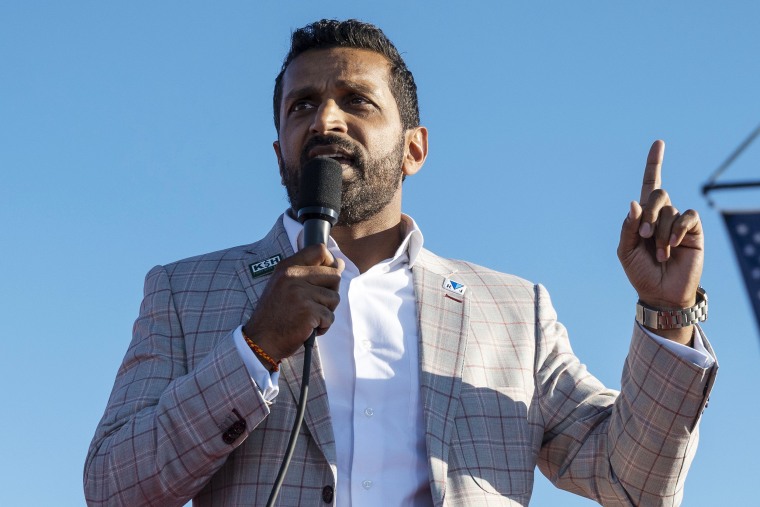
Kash Patel speaks at a rally in Nevada on Oct. 8, 2022.José Luis Villegas / AP file
Kash Patel, who worked at the Justice and Defense departments during the Trump administration and who at one point was considered for the post of deputy director of the CIA, said in December that a second Trump administration would “go out and find the conspirators not just in government, but in the media” over the 2020 election. Trump lost the election to Biden, but Patel and Trump insist without evidence that the election was “stolen.”
Trump’s campaign has distanced itself from Patel’s remarks.
Fears among allies
Foreign allies, anxious about keeping their intelligence sources safe, already are worried about the implications of a second Trump term and could discreetly scale back how much information they share with their U.S. counterparts about intelligence gathering methods, former officials and lawmakers said.
The cooperation and trust between the U.S. and allied intelligence agencies have been forged over decades. Washington relies heavily on its foreign intelligence partners to help track terrorist threats, navigate international crises and prepare for possible conflicts. But Trump’s return to the White House could jeopardize those relationships, former officials said.
“I think some of our allies may withhold intelligence information on subjects such as Russia,” said a former career CIA officer who oversaw clandestine operations in Europe. “And they would do it very carefully. They would ratchet it back so it doesn’t look so obvious, for fear of retribution.”
Trump has been accused of having a cavalier attitude to sensitive or secret information, and is facing federal charges that he mishandled classified documents he kept after leaving the White House and then allegedly obstructed the government’s attempt to reclaim them. Prosecutors say Trump took more than 300 classified files to his Mar-a-Lago estate in Florida. The former president has vehemently denied any wrongdoing and called the case an attempt to undermine his re-election bid.
Boxes of records stored in a bathroom and shower at Trump’s Mar-a-Lago estate in Florida in an image in the federal indictment against former President Donald Trump.Justice Dept. via AP
The allegations about Trump’s mishandling of classified information, and his consistent praise and refusal to condemn Russian President Vladimir Putin, would cause U.S. partners to think twice about relaying intelligence related to Russia, former officials said.
Protecting sources is a bedrock principle for all intelligence work, and no government would be ready to jeopardize that, the former CIA officer said.
“The one thing any intelligence community cares about most is source protection,“ the former officer said. “No ally is ever going to come out and say we’re going to turn off intel sharing, but a friendly service would be remiss if such source protection concerns are not of paramount concern, given Trump’s affinity for Putin.”
James Clapper, former director of national intelligence and former director of the Defense Intelligence Agency, said U.S. allies will be “apprehensive about sharing intelligence revelatory of their sources and methods, particularly if you have somebody that’s obviously pretty careless about protecting security information.”
No more ‘adults’
When Trump entered office in 2017, he arrived without having served in the military or any branch of government.
“As a result, he had no experience handling classified information or working with military, diplomatic, or intelligence programs and operations. Trump had traveled abroad but, by his own account, did not often read,” reads a history of presidential briefings published by the CIA’s Center for the Study of Intelligence.
Having publicly disparaged the intelligence agencies even before he was sworn in, Trump’s relations with the spy services have always been difficult. At times, intelligence officials who delivered analyses that did not fit the White House’s agenda were berated by angry aides, according to two former intelligence officers.
But during Trump’s time at the White House, senior figures in his Cabinet, military and in the intelligence community — dubbed the “adults in the room” — managed to steer him away from what they believed were ill-informed or risky ideas, sometimes by persuading him otherwise or delaying decisions.
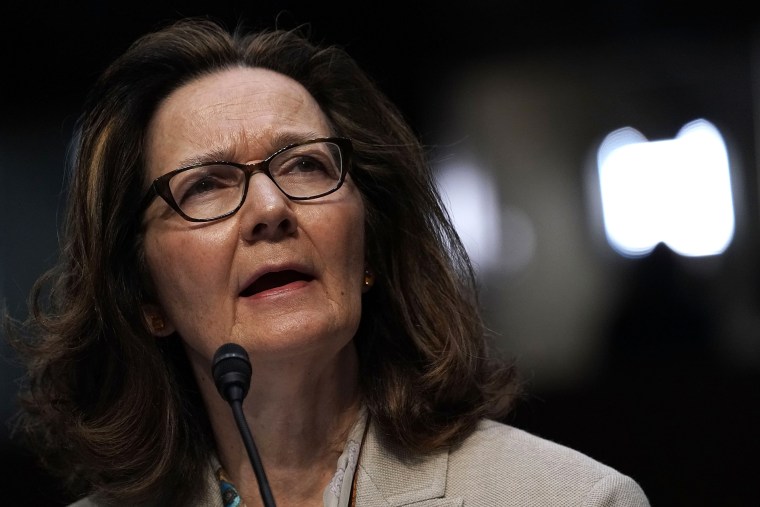
Gina Haspel speaks during her 2018 confirmation hearing to be CIA director.Alex Wong / Getty Images file
One of them was Gina Haspel, a career intelligence officer who served as CIA director in the tumultuous second half of Trump’s presidential term, from 2018-2021. She helped insulate the spy agency’s workforce from political pressure, according to former intelligence officials.
“She knew how to manage Trump, how to flatter him and how to call in her chips when the moment called for it,” said one former colleague.
Clapper called Haspel “one of the most impactful directors in the history of the agency simply because of how she protected it.”
But a career intelligence officer will likely not get the nod for the director’s job at the CIA in a second Trump presidential term, as Trump has signaled he wants deputies who have demonstrated strong political allegiance to him.
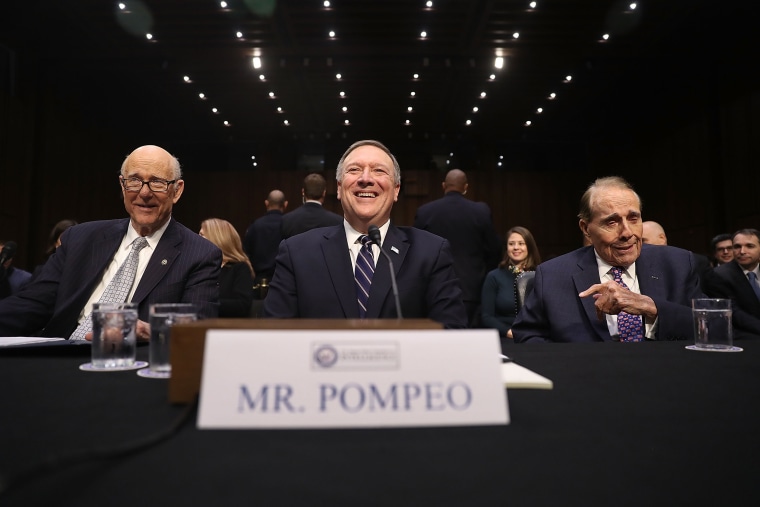
Sen. Pat Roberts, R-Kan., Rep. Mike Pompeo, R-Kan., and former Sen. Bob Dole, R-Kan., take their seats during Pompeo’s confirmation hearing to head the CIA in January 2017.Joe Raedle / Getty Images file
Trump’s supporters at the Heritage Foundation think tank and elsewhere are advocating that he shake up the federal bureaucracy by replacing tens of thousands of civil servants with political appointees in government agencies, which would include the 18 federal intelligence agencies. In the closing months of the Trump administration, the White House attempted such an effort with a new executive order but the Biden administration quickly reversed it.
“I think there will be more political appointees, but I don’t know how many more,” said one former official who served in the Trump administration and who is in close contact with Trump’s team.
The former official said it would be reasonable for Trump to assert control over the intelligence community in a second term through political appointees, to ensure the intelligence agencies carry out the president’s policies without bureaucratic subterfuge.
“No matter what side you’re on politically, you should want political control because we don’t want this country to become a security state,” the former official said.
The Heritage Foundation’s proposed outline for action if Trump is elected, titled “Project 2025,” calls for the president-elect to promptly choose a deputy director of the CIA, who would not need Senate confirmation, and could “immediately begin to implement the President’s agenda.”
“Additional appointees should be placed within the agency as needed to assist the Director in supervising its functioning,” the report states.
The document also calls for breaking “the cabal of bureaucrats in D.C.” by moving some directorates in the CIA outside of northern Virginia, where the headquarters is located.
Robert Litt, who served as general counsel for the Office of the Director of National Intelligence from 2009 to 2017, said inserting political appointees into the management of the spy agencies in unprecedented numbers could distort the way intelligence is analyzed and lead to illegal or ill-advised decisions.
“I think it would be a very, very bad thing for the intelligence community and for the nation if the intelligence community was dominated by a group of political loyalists,” he said.
“One is the risk that intelligence analysis will not be called down the middle,” Litt said. “And the other is the risk that the intelligence agencies will be directed to do things that are either unlawful or inappropriate.”
Worst-case scenarios
In a second Trump White House, China would remain the top priority for the intelligence agencies, as it was for the last Trump administration and the current Biden administration, said the former official close to Trump’s team. A mission center at the CIA dedicated to Iran likely would be restored, and a Trump White House would look to cut back on in-house analytical teams within ODNI, the former official said.
The Heritage document, echoing an argument often employed by Trump and his supporters, asserts that former intelligence officials have injected politics into the work of the spy agencies in an attempt to promote the idea that Trump’s campaign in 2016 allegedly colluded with Russia and to play down allegations of possible corruption against Biden’s son Hunter Biden.
The Heritage policy blueprint calls for security clearances to be revoked for any former intelligence officials who “discuss their work in the press or on social media without prior clearance” from the director of national intelligence. It also calls for an “audit” of all cases of “past politicization and abuses of intelligence information.”
Former intelligence officials are divided over whether a worst-case scenario — with the spy services targeting domestic political opponents — could take place, and if it did, how the intelligence workforce and courts would respond. Much will depend on whom Trump names as the leaders of the intelligence agencies and the Justice Department. Former Republican Rep. Devin Nunes, a staunch supporter of Trump who was an outspoken critic of the investigation into possible ties between the Trump campaign and Russia, is seen as a possible candidate for CIA director. John Ratcliffe, the former Texas congressman who served as director of national intelligence under Trump, could be asked to return to the DNI’s job.
One former senior intelligence official said for all its shortcomings, the intelligence community would not be easily converted into a domestic spying service, and that many of the career officers would refuse to follow unlawful orders.
“They would be pretty resistant to turning it on the American people,” the ex-official said.
A more likely scenario could be a steady degradation of the intelligence agencies, in which experienced staff resign or are sacked and morale declines, with unpredictable consequences for intelligence gathering and the country’s national security, the former official said.
Other former officials say Trump has never respected the norms and guardrails meant to safeguard America’s democracy, and that there is no guarantee he won’t venture into Nixonian territory.
“I would not say anything is off the table when it comes to Donald Trump, including the most potentially damaging and egregious violations of practice, if not law itself,” said John Brennan, who served as CIA director under President Barack Obama and is an outspoken critic of Trump.
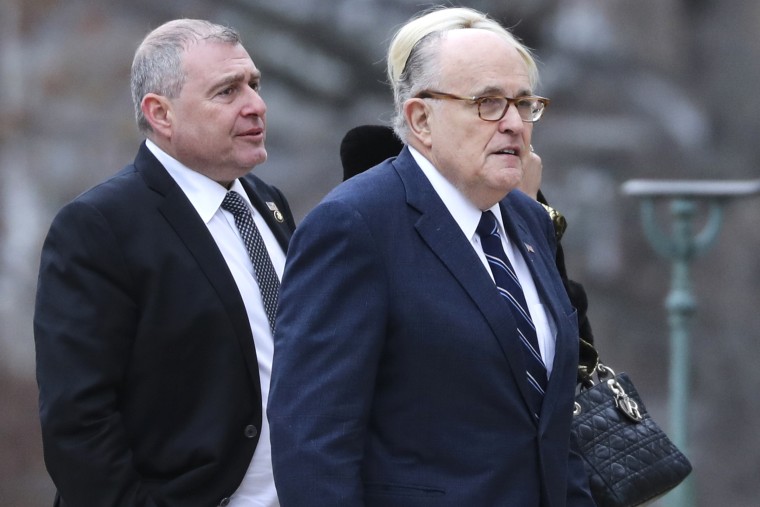
Rudy Giuliani, right, and businessman Lev Parnas, who was Giuliani’s fixer in Ukraine, pictured in Washington, D.C., in 2018.Alex Edelman / AFP via Getty Images file
Former officials point out that Trump sent his personal lawyer, Rudy Giuliani, to Ukraine in a bid to dig up dirt on Biden, his political opponent. Next time, the former officials said, perhaps a similar mission would be handed to the CIA, though presented under the guise of legitimate intelligence gathering.
Miles Taylor, who worked as a senior official at the Department of Homeland Security during the Trump administration, said the secrecy that underpins intelligence work could also enable an administration to hide the true purpose of a particular order and make it extremely difficult for an employee to blow the whistle if they deem it inappropriate.
“A number of people at senior levels are very concerned that they will get asked to do things they consider unethical but not illegal,” Taylor said.
But unlike other parts of the government, there would be “few remedies to sound the alarm” because so much relevant information is classified, said Taylor, who has warned publicly of the risks of a second Trump presidency.
Contemplating a possible second Trump term, many intelligence officers are looking at securing assignments abroad or leaving for the private sector, Taylor said.
“A lot of them are thinking if Trump wins, it’s a really good time to move on,” he said.
A handful of current and former employees at OpenAI and other prominent artificial intelligence companies warned that the technology poses grave risks to humanity in a Tuesday letter, calling on companies to implement sweeping changes to ensure transparency and foster a culture of public debate.
The letter, signed by 13 people including current and former employees at Anthropic and Google’s DeepMind, said AI can exacerbate inequality, increase misinformation and allow AI systems to become autonomous and cause significant death. Though these risks could be mitigated, corporations in control of the software have “strong financial incentives” to limit oversight, they said.
Because AI is only loosely regulated, accountability rests on company insiders, the employees wrote, calling on corporations to lift nondisclosure agreements and give workers protections that allow them to anonymously raise concerns.
The move comes as OpenAI faces a staff exodus. Many critics have seen prominent departures — including OpenAI co-founder Ilya Sutskever and senior researcher Jan Leike — as a rebuke of company leaders, who some employees argue chase profit at the expense of making OpenAI’s technologies safer.
Daniel Kokotajlo, a former employee at OpenAI, said he left the start-up because of the company’s disregard for the risks of artificial intelligence.
“I lost hope that they would act responsibly, particularly as they pursue artificial general intelligence,” he said in a statement, referencing a hotly contested term referring to computers matching the power of human brains.
“They and others have bought into the ‘move fast and break things’ approach, and that is the opposite of what is needed for technology this powerful and this poorly understood.”
Liz Bourgeois, a spokesperson at OpenAI, said the company agrees that “rigorous debate is crucial given the significance of this technology.” Representatives from Anthropic and Google did not immediately reply to a request for comment.
The employees said that absent government oversight, AI workers are the “few people” who can hold corporations accountable. They noted that they are hamstrung by “broad confidentiality agreements” and that ordinary whistleblower protections are “insufficient” because they focus on illegal activity, and the risks that they are warning about are not yet regulated.
The letter called for AI companies to commit to four principles to allow for greater transparency and whistleblower protections. Those principles include a commitment to not enter into or enforce agreements that prohibit criticism of risks; a call to establish an anonymous process for current and former employees to raise concerns; supporting a culture of criticism; and a promise to not retaliate against current and former employees who share confidential information to raise alarms “after other processes have failed.”
The Washington Post in December reported that senior leaders at OpenAI raised fears about retaliation from CEO Sam Altman — warnings that preceded the chief’s temporary ousting. In a recent podcast interview, former OpenAI board member Helen Toner said part of the nonprofit’s decision to remove Altman as CEO late last year was his lack of candid communication about safety.
“He gave us inaccurate information about the small number of formal safety processes that the company did have in place, meaning that it was basically just impossible for the board to know how well those safety processes were working,” she told “The TED AI Show” in May.
The letter was endorsed by AI luminaries including Yoshua Bengio and Geoffrey Hinton, who are considered “godfathers” of AI, and renowned computer scientist Stuart Russell.
Daniel Kokotajlo, a former researcher in OpenAI’s governance division, is an organizer of a group of former and current employees who say the company has a reckless culture.Credit…Jason Andrew for The New York Times
The Shift
A group of current and former employees are calling for sweeping changes to the artificial intelligence industry, including greater transparency and protections for whistle-blowers.
Daniel Kokotajlo, a former researcher in OpenAI’s governance division, is an organizer of a group of former and current employees who say the company has a reckless culture.Credit…Jason Andrew for The New York Times
A group of OpenAI insiders is blowing the whistle on what they say is a culture of recklessness and secrecy at the San Francisco artificial intelligence company, which is racing to build the most powerful A.I. systems ever created.
The group, which includes nine current and former OpenAI employees, has rallied in recent days around shared concerns that the company has not done enough to prevent its A.I. systems from becoming dangerous.
The members say OpenAI, which started as a nonprofit research lab and burst into public view with the 2022 release of ChatGPT, is putting a priority on profits and growth as it tries to build artificial general intelligence, or A.G.I., the industry term for a computer program capable of doing anything a human can.
They also claim that OpenAI has used hardball tactics to prevent workers from voicing their concerns about the technology, including restrictive nondisparagement agreements that departing employees were asked to sign.
“OpenAI is really excited about building A.G.I., and they are recklessly racing to be the first there,” said Daniel Kokotajlo, a former researcher in OpenAI’s governance division and one of the group’s organizers.
The group published an open letter on Tuesday calling for leading A.I. companies, including OpenAI, to establish greater transparency and more protections for whistle-blowers.
Other members include William Saunders, a research engineer who left OpenAI in February, and three other former OpenAI employees: Carroll Wainwright, Jacob Hilton and Daniel Ziegler. Several current OpenAI employees endorsed the letter anonymously because they feared retaliation from the company, Mr. Kokotajlo said. One current and one former employee of Google DeepMind, Google’s central A.I. lab, also signed.
A spokeswoman for OpenAI, Lindsey Held, said in a statement: “We’re proud of our track record providing the most capable and safest A.I. systems and believe in our scientific approach to addressing risk. We agree that rigorous debate is crucial given the significance of this technology, and we’ll continue to engage with governments, civil society and other communities around the world.”
A Google spokesman declined to comment.
The campaign comes at a rough moment for OpenAI. It is still recovering from an attempted coup last year, when members of the company’s board voted to fire Sam Altman, the chief executive, over concerns about his candor. Mr. Altman was brought back days later, and the board was remade with new members.
The company also faces legal battles with content creators who have accused it of stealing copyrighted works to train its models. (The New York Times sued OpenAI and its partner, Microsoft, for copyright infringement last year.) And its recent unveiling of a hyper-realistic voice assistant was marred by a public spat with the Hollywood actress Scarlett Johansson, who claimed that OpenAI had imitated her voice without permission.
But nothing has stuck like the charge that OpenAI has been too cavalier about safety.
Last month, two senior A.I. researchers — Ilya Sutskever and Jan Leike — left OpenAI under a cloud. Dr. Sutskever, who had been on OpenAI’s board and voted to fire Mr. Altman, had raised alarms about the potential risks of powerful A.I. systems. His departure was seen by some safety-minded employees as a setback.
So was the departure of Dr. Leike, who along with Dr. Sutskever had led OpenAI’s “superalignment” team, which focused on managing the risks of powerful A.I. models. In a series of public posts announcing his departure, Dr. Leike said he believed that “safety culture and processes have taken a back seat to shiny products.”
Neither Dr. Sutskever nor Dr. Leike signed the open letter written by former employees. But their exits galvanized other former OpenAI employees to speak out.
“When I signed up for OpenAI, I did not sign up for this attitude of ‘Let’s put things out into the world and see what happens and fix them afterward,’” Mr. Saunders said.
Some of the former employees have ties to effective altruism, a utilitarian-inspired movement that has become concerned in recent years with preventing existential threats from A.I. Critics have accused the movement of promoting doomsday scenarios about the technology, such as the notion that an out-of-control A.I. system could take over and wipe out humanity.
Image
Ilya Sutskever, an OpenAI founder and former chief scientist, recently left the company. He had been on the company’s board and had voted to oust Sam Altman, the chief executive, last year.Credit…Jim Wilson/The New York Times
Mr. Kokotajlo, 31, joined OpenAI in 2022 as a governance researcher and was asked to forecast A.I. progress. He was not, to put it mildly, optimistic.
In his previous job at an A.I. safety organization, he predicted that A.G.I. might arrive in 2050. But after seeing how quickly A.I. was improving, he shortened his timelines. Now he believes there is a 50 percent chance that A.G.I. will arrive by 2027 — in just three years.
He also believes that the probability that advanced A.I. will destroy or catastrophically harm humanity — a grim statistic often shortened to “p(doom)” in A.I. circles — is 70 percent.
At OpenAI, Mr. Kokotajlo saw that even though the company had safety protocols in place — including a joint effort with Microsoft known as the “deployment safety board,” which was supposed to review new models for major risks before they were publicly released — they rarely seemed to slow anything down.
For example, he said, in 2022 Microsoft began quietly testing in India a new version of its Bing search engine that some OpenAI employees believed contained a then-unreleased version of GPT-4, OpenAI’s state-of-the-art large language model. Mr. Kokotajlo said he was told that Microsoft had not gotten the safety board’s approval before testing the new model, and after the board learned of the tests — via a series of reports that Bing was acting strangely toward users — it did nothing to stop Microsoft from rolling it out more broadly.
A Microsoft spokesman, Frank Shaw, disputed those claims. He said the India tests hadn’t used GPT-4 or any OpenAI models. The first time Microsoft released technology based on GPT-4 was in early 2023, he said, and it was reviewed and approved by a predecessor to the safety board.
Eventually, Mr. Kokotajlo said, he became so worried that, last year, he told Mr. Altman that the company should “pivot to safety” and spend more time and resources guarding against A.I.’s risks rather than charging ahead to improve its models. He said that Mr. Altman had claimed to agree with him, but that nothing much changed.
In April, he quit. In an email to his team, he said he was leaving because he had “lost confidence that OpenAI will behave responsibly” as its systems approach human-level intelligence.
“The world isn’t ready, and we aren’t ready,” Mr. Kokotajlo wrote. “And I’m concerned we are rushing forward regardless and rationalizing our actions.”
OpenAI said last week that it had begun training a new flagship A.I. model, and that it was forming a new safety and security committee to explore the risks associated with the new model and other future technologies.
On his way out, Mr. Kokotajlo refused to sign OpenAI’s standard paperwork for departing employees, which included a strict nondisparagement clause barring them from saying negative things about the company, or else risk having their vested equity taken away.
Many employees could lose out on millions of dollars if they refused to sign. Mr. Kokotajlo’s vested equity was worth roughly $1.7 million, he said, which amounted to the vast majority of his net worth, and he was prepared to forfeit all of it.
(A minor firestorm ensued last month after Vox reported news of these agreements. In response, OpenAI claimed that it had never clawed back vested equity from former employees, and would not do so. Mr. Altman said he was “genuinely embarrassed” not to have known about the agreements, and the company said it would remove nondisparagement clauses from its standard paperwork and release former employees from their agreements.)
In their open letter, Mr. Kokotajlo and the other former OpenAI employees call for an end to using nondisparagement and nondisclosure agreements at OpenAI and other A.I. companies.
“Broad confidentiality agreements block us from voicing our concerns, except to the very companies that may be failing to address these issues,” they write.
They also call for A.I. companies to “support a culture of open criticism” and establish a reporting process for employees to anonymously raise safety-related concerns.
They have retained a pro bono lawyer, Lawrence Lessig, the prominent legal scholar and activist. Mr. Lessig also advised Frances Haugen, a former Facebook employee who became a whistle-blower and accused that company of putting profits ahead of safety.
In an interview, Mr. Lessig said that while traditional whistle-blower protections typically applied to reports of illegal activity, it was important for employees of A.I. companies to be able to discuss risks and potential harms freely, given the technology’s importance.
“Employees are an important line of safety defense, and if they can’t speak freely without retribution, that channel’s going to be shut down,” he said.
Ms. Held, the OpenAI spokeswoman, said the company had “avenues for employees to express their concerns,” including an anonymous integrity hotline.
Mr. Kokotajlo and his group are skeptical that self-regulation alone will be enough to prepare for a world with more powerful A.I. systems. So they are calling for lawmakers to regulate the industry, too.
“There needs to be some sort of democratically accountable, transparent governance structure in charge of this process,” Mr. Kokotajlo said. “Instead of just a couple of different private companies racing with each other, and keeping it all secret.”
Daniel Kokotajlo, a former researcher in OpenAI’s governance division, is an organizer of a group of former and current employees who say the company has a reckless culture.Credit…Jason Andrew for The New York Times
The Shift
A group of current and former employees are calling for sweeping changes to the artificial intelligence industry, including greater transparency and protections for whistle-blowers.
Daniel Kokotajlo, a former researcher in OpenAI’s governance division, is an organizer of a group of former and current employees who say the company has a reckless culture.Credit…Jason Andrew for The New York Times
A group of OpenAI insiders is blowing the whistle on what they say is a culture of recklessness and secrecy at the San Francisco artificial intelligence company, which is racing to build the most powerful A.I. systems ever created.
The group, which includes nine current and former OpenAI employees, has rallied in recent days around shared concerns that the company has not done enough to prevent its A.I. systems from becoming dangerous.
The members say OpenAI, which started as a nonprofit research lab and burst into public view with the 2022 release of ChatGPT, is putting a priority on profits and growth as it tries to build artificial general intelligence, or A.G.I., the industry term for a computer program capable of doing anything a human can.
They also claim that OpenAI has used hardball tactics to prevent workers from voicing their concerns about the technology, including restrictive nondisparagement agreements that departing employees were asked to sign.
“OpenAI is really excited about building A.G.I., and they are recklessly racing to be the first there,” said Daniel Kokotajlo, a former researcher in OpenAI’s governance division and one of the group’s organizers.
The group published an open letter on Tuesday calling for leading A.I. companies, including OpenAI, to establish greater transparency and more protections for whistle-blowers.
Other members include William Saunders, a research engineer who left OpenAI in February, and three other former OpenAI employees: Carroll Wainwright, Jacob Hilton and Daniel Ziegler. Several current OpenAI employees endorsed the letter anonymously because they feared retaliation from the company, Mr. Kokotajlo said. One current and one former employee of Google DeepMind, Google’s central A.I. lab, also signed.
A spokeswoman for OpenAI, Lindsey Held, said in a statement: “We’re proud of our track record providing the most capable and safest A.I. systems and believe in our scientific approach to addressing risk. We agree that rigorous debate is crucial given the significance of this technology, and we’ll continue to engage with governments, civil society and other communities around the world.”
A Google spokesman declined to comment.
The campaign comes at a rough moment for OpenAI. It is still recovering from an attempted coup last year, when members of the company’s board voted to fire Sam Altman, the chief executive, over concerns about his candor. Mr. Altman was brought back days later, and the board was remade with new members.
The company also faces legal battles with content creators who have accused it of stealing copyrighted works to train its models. (The New York Times sued OpenAI and its partner, Microsoft, for copyright infringement last year.) And its recent unveiling of a hyper-realistic voice assistant was marred by a public spat with the Hollywood actress Scarlett Johansson, who claimed that OpenAI had imitated her voice without permission.
But nothing has stuck like the charge that OpenAI has been too cavalier about safety.
Last month, two senior A.I. researchers — Ilya Sutskever and Jan Leike — left OpenAI under a cloud. Dr. Sutskever, who had been on OpenAI’s board and voted to fire Mr. Altman, had raised alarms about the potential risks of powerful A.I. systems. His departure was seen by some safety-minded employees as a setback.
So was the departure of Dr. Leike, who along with Dr. Sutskever had led OpenAI’s “superalignment” team, which focused on managing the risks of powerful A.I. models. In a series of public posts announcing his departure, Dr. Leike said he believed that “safety culture and processes have taken a back seat to shiny products.”
Neither Dr. Sutskever nor Dr. Leike signed the open letter written by former employees. But their exits galvanized other former OpenAI employees to speak out.
“When I signed up for OpenAI, I did not sign up for this attitude of ‘Let’s put things out into the world and see what happens and fix them afterward,’” Mr. Saunders said.
Some of the former employees have ties to effective altruism, a utilitarian-inspired movement that has become concerned in recent years with preventing existential threats from A.I. Critics have accused the movement of promoting doomsday scenarios about the technology, such as the notion that an out-of-control A.I. system could take over and wipe out humanity.
Image
Ilya Sutskever, an OpenAI founder and former chief scientist, recently left the company. He had been on the company’s board and had voted to oust Sam Altman, the chief executive, last year.Credit…Jim Wilson/The New York Times
Mr. Kokotajlo, 31, joined OpenAI in 2022 as a governance researcher and was asked to forecast A.I. progress. He was not, to put it mildly, optimistic.
In his previous job at an A.I. safety organization, he predicted that A.G.I. might arrive in 2050. But after seeing how quickly A.I. was improving, he shortened his timelines. Now he believes there is a 50 percent chance that A.G.I. will arrive by 2027 — in just three years.
He also believes that the probability that advanced A.I. will destroy or catastrophically harm humanity — a grim statistic often shortened to “p(doom)” in A.I. circles — is 70 percent.
At OpenAI, Mr. Kokotajlo saw that even though the company had safety protocols in place — including a joint effort with Microsoft known as the “deployment safety board,” which was supposed to review new models for major risks before they were publicly released — they rarely seemed to slow anything down.
For example, he said, in 2022 Microsoft began quietly testing in India a new version of its Bing search engine that some OpenAI employees believed contained a then-unreleased version of GPT-4, OpenAI’s state-of-the-art large language model. Mr. Kokotajlo said he was told that Microsoft had not gotten the safety board’s approval before testing the new model, and after the board learned of the tests — via a series of reports that Bing was acting strangely toward users — it did nothing to stop Microsoft from rolling it out more broadly.
A Microsoft spokesman, Frank Shaw, disputed those claims. He said the India tests hadn’t used GPT-4 or any OpenAI models. The first time Microsoft released technology based on GPT-4 was in early 2023, he said, and it was reviewed and approved by a predecessor to the safety board.
Eventually, Mr. Kokotajlo said, he became so worried that, last year, he told Mr. Altman that the company should “pivot to safety” and spend more time and resources guarding against A.I.’s risks rather than charging ahead to improve its models. He said that Mr. Altman had claimed to agree with him, but that nothing much changed.
In April, he quit. In an email to his team, he said he was leaving because he had “lost confidence that OpenAI will behave responsibly” as its systems approach human-level intelligence.
“The world isn’t ready, and we aren’t ready,” Mr. Kokotajlo wrote. “And I’m concerned we are rushing forward regardless and rationalizing our actions.”
OpenAI said last week that it had begun training a new flagship A.I. model, and that it was forming a new safety and security committee to explore the risks associated with the new model and other future technologies.
On his way out, Mr. Kokotajlo refused to sign OpenAI’s standard paperwork for departing employees, which included a strict nondisparagement clause barring them from saying negative things about the company, or else risk having their vested equity taken away.
Many employees could lose out on millions of dollars if they refused to sign. Mr. Kokotajlo’s vested equity was worth roughly $1.7 million, he said, which amounted to the vast majority of his net worth, and he was prepared to forfeit all of it.
(A minor firestorm ensued last month after Vox reported news of these agreements. In response, OpenAI claimed that it had never clawed back vested equity from former employees, and would not do so. Mr. Altman said he was “genuinely embarrassed” not to have known about the agreements, and the company said it would remove nondisparagement clauses from its standard paperwork and release former employees from their agreements.)
In their open letter, Mr. Kokotajlo and the other former OpenAI employees call for an end to using nondisparagement and nondisclosure agreements at OpenAI and other A.I. companies.
“Broad confidentiality agreements block us from voicing our concerns, except to the very companies that may be failing to address these issues,” they write.
They also call for A.I. companies to “support a culture of open criticism” and establish a reporting process for employees to anonymously raise safety-related concerns.
They have retained a pro bono lawyer, Lawrence Lessig, the prominent legal scholar and activist. Mr. Lessig also advised Frances Haugen, a former Facebook employee who became a whistle-blower and accused that company of putting profits ahead of safety.
In an interview, Mr. Lessig said that while traditional whistle-blower protections typically applied to reports of illegal activity, it was important for employees of A.I. companies to be able to discuss risks and potential harms freely, given the technology’s importance.
“Employees are an important line of safety defense, and if they can’t speak freely without retribution, that channel’s going to be shut down,” he said.
Ms. Held, the OpenAI spokeswoman, said the company had “avenues for employees to express their concerns,” including an anonymous integrity hotline.
Mr. Kokotajlo and his group are skeptical that self-regulation alone will be enough to prepare for a world with more powerful A.I. systems. So they are calling for lawmakers to regulate the industry, too.
“There needs to be some sort of democratically accountable, transparent governance structure in charge of this process,” Mr. Kokotajlo said. “Instead of just a couple of different private companies racing with each other, and keeping it all secret.”