
Current situation | Locust Watch in Caucasus and Central Asia Food and Agriculture Organization of the United Nations
Day: June 4, 2024
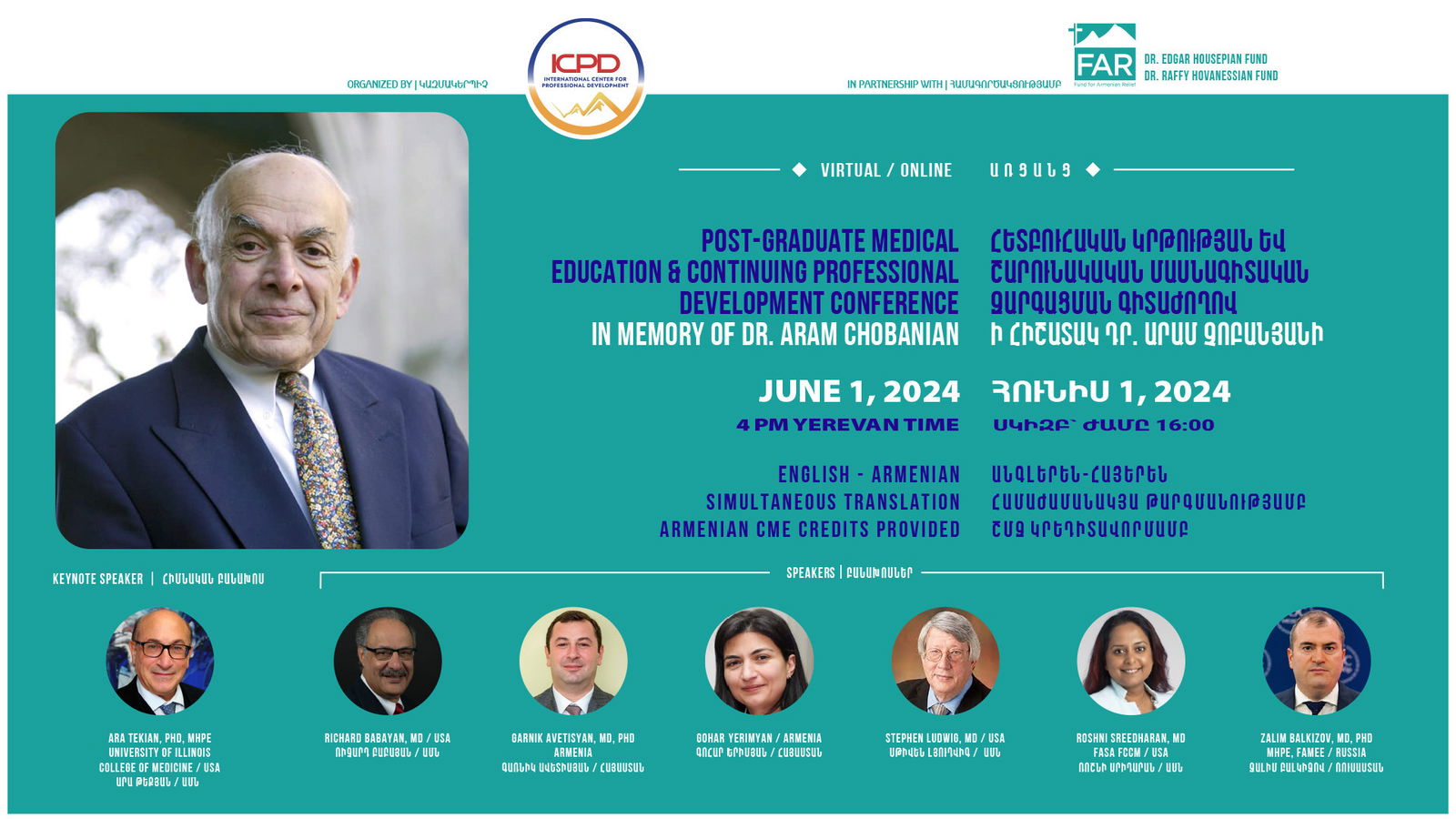
The Post-Graduate Medical Education & Continuing Professional Development Conference, held in memory of Dr. Aram Chobanian on June 1, 2024, was a landmark event, setting a high standard for medical conferences. Organized by the International Center for Professional Development (ICPD) in partnership with the Dr. Edgar Housepian and the Dr. Raffy Hovannisian Funds established at the Fund for Armenia Relief (FAR), the conference featured notable speakers including Dr. Ara Tekian, Dr. Richard Babayan, Dr. Garnik Avetisyan from Yerevan State Medical University and Dr. Gohar Yerimyan from National Institute of Health of Armenia. The bilingual format, including Armenian CME credits, highlighted the organizers’ commitment to inclusivity and professional advancement.
The conference began with Dr. Rafi Avitsian’s opening remarks, paying tribute to Dr. Chobanian’s legacy in medical education. Dr. Richard Babayan followed with a heartfelt reflection on Dr. Chobanian’s contributions. The keynote was delivered by Dr. Tekian, and sessions moderated by Drs. Babloyan and Yaghjyan discussed postgraduate medical education, mentoring and simulation training. Dr. Tekian delivered the keynote speech, discussing graduate medical education’s current state and future directions, particularly their implications for Armenia. A networking session led by Dr. Michael Petrosyan included 13 organizations. The conference’s success led to the proposal of an annual Graduate Medical Education Day in Armenia on the first Saturday of June to enhance specialty education.
In total, 774 guests participated in the conference, with 720 from Armenia, 36 international participants from Canada, France, Germany, the Netherlands, Russia, the United Kingdom and the United States, and 18 from Artsakh, who now live and work in Armenia following the genocide of the Armenians of Artsakh in September of 2023.
The ICPD, founded in 2020 to provide state-of-the-art continuing medical education and make Armenia a regional healthcare science and technology hub, has conducted 12 conferences, including one hybrid and 11 virtual events, alongside numerous webinars. These events have engaged over 6,000 healthcare professionals, predominantly from Armenia and Artsakh, at no cost, providing them with continuous professional development through live conferences, online modules, workshops and simulations.
The ICPD has addressed various critical issues, including the COVID-19 pandemic and post-conflict rehabilitation. Notable conferences include the COVID Pandemic – Lessons Learnt Virtual Conference, which drew over 1,500 participants worldwide, and the Essentials of Pain Management After Trauma symposium, organized in response to the Artsakh War, which attracted approximately 300 healthcare professionals.
Continuing to honor significant contributions to healthcare education, the ICPD has organized specialized symposiums, such as the first Dr. Raffy Hovanessian International Digestive Disease Virtual Conference and the Symposium on Child and Adolescent Mental Health and Neurodevelopmental Disorders, both drawing significant international participation and offering valuable CME credits. The ICPD remains dedicated to advancing healthcare education and practice in Armenia and beyond.
Author information

Guest Contributor
Guest contributions to the Armenian Weekly are informative articles or press releases written and submitted by members of the community.
|
The post Medical education and professional development conference held in memory of Dr. Aram Chobanian appeared first on The Armenian Weekly.
 Armen Avo
Armen Mikayelyan, literary pseudonym Armen Avo, was born in 2002 in Vaghuhas, Artsakh. He received his primary education in his village and in 2019 was admitted to the School of Philology at Artsakh University. In 2020, he enlisted in the army and served in the 44-day war. His older brother also served and was killed in action on September 28, 2020.
Mikayelyan also participated in the defense of the homeland in 2023. After the depopulation and forced exodus of the indigenous Armenians of Artsakh, he moved to Yerevan, Armenia with his family. He published his first collection of poems, “Kez Janachelov Indz Imatsa (Knowing You, I Learned About Myself)” in 2022, and his second book, “As Warm as Blood,” was published recently. His books contain poems about nature and love of the motherland.
“I try to present my words in such a way that the reader ponders and learns something from my words. I am trying to give faith and hope these days, the desire and spirit of struggle and love for the motherland.”
“Our village is draped with blue mountains and deep valleys. It’s a treasure chest of beauty, which made it easy for me to cherish. It opened up the portal to my poet’s soul. If I had been born in the city, I would have been a different person, but the simplicity and purity of the village with its beauty cultivated a love in me that I nurtured with my poetry. I write what is in my heart and give it to the reader. I try to present my words in such a way that the reader ponders and learns something from my words. I am trying to give faith and hope these days, the desire and spirit of struggle and love for the motherland,” Mikayelyan told the Weekly.
Our young and talented Armenian author, who served courageously to protect the homeland, is using his pen to teach the world about the injustices our people have suffered. He’s also using his words to foster hope. We wish him endless success.
Author information
Talar Keoseyan
Talar Keoseyan is a mother, educator and writer. She is the author of Vanna’s Adventures (discusses Armenian traditions and customs); Mom and Dad, Why Do I Need to Know My Armenian Heritage? (a children’s book about being proud of our heritage); Our Tigran and Tigran’s Song (written in honor of Tigran Harutyunyan, a fedayee from the 44 Day War). Talar was a member of the Philadelphia AYF (Papken Suni and Sebouh chapters), as well as Homenetmen, Hamazkayin and ARS. She is currently a member of the La Crescenta “Talin” ARS chapter. She can be reached at talar725@gmail.com or Hokees1111 on Instagram.
|
The post Armen Avo releases second book, “As Warm as Blood” appeared first on The Armenian Weekly.
Vera Arutyunyan, an Armenian Abstract Expressionist painter based in Los Angeles, is renowned for her dynamic use of primary colors, aggressive brushstroke style and fusion of emotions. Her masterpieces have been showcased in some of the world’s most prestigious galleries, collections and auctions. According to the Los Angeles Art Association, Arutyunyan has participated in numerous solo and group exhibitions, biennales and shows in the United States and internationally, including France, Italy, Belgium, Spain, Greece, Russia, Armenia, China, South Korea, Canada, Japan, Ireland, Switzerland and Monaco. I recently had the opportunity to speak with this internationally acclaimed artist about her journey from Armenia to the global art scene, her connection to her homeland, her creative process and the nuances of abstract art.
Milena Baghdasaryan (M.B.): Can you tell us about your journey into the world of abstract art? What drew you to this particular style of painting?
Vera Arutyunyan (V.A.): Over time, my expression has seamlessly intertwined with abstract art, blending thought and language onto the canvas. This fusion has enabled me to explore the intricacies of the mind and emotions, crafting visual poetry through abstract shapes and colors. What drew me to this style of painting is its vibrant palette and expressive brushstrokes. It provides a genuine avenue for me to convey emotions and ideas. Moreover, I’m captivated by the rich history and techniques of this art form, continuously inspired by the mastery of other artists in the field.
M.B.: Abstract art can be quite subjective and open to interpretation. What themes or emotions do you aim to convey through your work?
V.A.: My art is a reflection of my deep understanding of the spiritual and emotional landscapes within me. It’s born from my exploration of life’s philosophical depths and the profound emotions evoked by the world around me. I integrate colors that speak volumes, sometimes louder than spoken words ever could. Is my art abstract? It’s as abstract as the vivid dreams that unfold within my mind.
M.B.: Could you share some insights into your creative process? How do you approach a blank canvas and transform it into a finished piece?
V.A.: The realm of painting is where I reside, even when I’m not physically facing a canvas. In my mind, I’m constantly immersed in a vibrant tapestry of colors and forms. My approach to painting is characterized by a spontaneous outpouring of creativity. I start with brushes but always find myself using my hands directly as the medium, guided purely by instinct and emotion. Surrounded by a whirlwind of discarded paint tubes, accompanied by the rhythmic melody of a familiar symphony echoing my inner turbulence, my art comes to life.
M.B.: Your background in geology is quite unique for an artist. To what extent does your knowledge of geology influence your approach to painting? Do you draw inspiration from geological formations or processes in your artwork?
V.A.: Indeed, geology has been a profound gateway for me to immerse myself in the divine wonders of nature. The mesmerizing interplay of colors and shapes found in minerals has sparked a deep wellspring of inspiration for my artistic endeavors. Exploring the earth’s geological formations, from the rugged cliffs to the delicate crystalline structures, has enriched my understanding of the natural world and ignited my creativity. The intricate patterns and textures found within these geological marvels serve as a visual feast, fueling my imagination and driving my artistic vision.
M.B.: Being an Armenian artist living in the U.S., have you encountered any unique challenges or opportunities in your artistic career?
V.A.: As an Armenian artist living in the United States, my artistic journey is shaped by both challenges and opportunities arising from my cultural background intersecting with my creative pursuits. One challenge I face is balancing the authentic expression of my Armenian heritage with engaging with the diverse cultural landscape of my adopted home. This balancing act requires me to honor my roots while embracing the multicultural influences around me. The vibrant arts scene in the U.S. offers a myriad of platforms and resources for artists to showcase their work and engage with fellow creatives. This environment has provided me with opportunities to collaborate with artists from diverse backgrounds, participate in exhibitions and events, and connect with art enthusiasts who appreciate the unique perspective I bring to the table. However, being an Armenian artist in the U.S. also allows me to share my culture with a broader audience. Through my art, I celebrate Armenian traditions while fostering cross-cultural dialogue and understanding, serving as a bridge between different communities.
M.B.: How does your Armenian heritage influence your art, if at all? Do you incorporate elements of Armenian culture or history into your paintings?
V.A.: You can tell a lot about an artist by their painting. As for my own, I feel that my Armenian heritage does not scream but whispers in the very palette of colors I use. The rich textures unwittingly carry through my ancient culture, with its vibrant history and strong faith. lt is not a byproduct of my culture, but an instinct that brings it to life.
M.B.: You mentioned in one of your interviews that you came to the U.S. with only $27 in your pocket and with a flight ticket for the purchase of which you had to borrow money. As a foreigner, how easy or difficult was it for you to establish yourself and succeed in the American art scene?
V.A.: Establishing myself as an Armenian immigrant in the American art scene posed its challenges, but perseverance and dedication paved the way for success. Growing up in the Armenian capital, Yerevan, I excelled in both art and science. In 1991, with only $27 in my pocket, I moved to the United States to start a new life. Initially, I spoke no English, missed my family and was baffled by aspects of the country’s language, culture and traditions. I turned to painting to express my frustrations and innermost emotions. My dedication and hard work led me to succeed as an engineer and achieve financial security. Simultaneously, I’ve established myself as an internationally well-known artist. Now, I feel a sense of completeness and fulfillment, knowing that my dual passions have flourished and allowed me to make meaningful contributions both professionally and artistically. The trials and tribulations of everyday life have only spurred me to find strength and passion through my faith and my art.
M.B.: Your artwork has gained recognition and been showcased in various prestigious locations around the world, including Paris and New York City. How does it feel to have your art appreciated on such an international scale, and how do different audiences react to your work in various parts of the world?
V.A.: I have earned international acclaim and participated in a variety of solo and group shows, biennales, galleries and museums in the United States, as well as in France, Italy, Spain, Belgium, Greece, Russia, Armenia, China, South Korea, Canada, Japan, Ireland, Switzerland, Monaco…Having my artwork recognized and showcased in prestigious locations around the world is an incredibly gratifying experience. It’s a validation of the countless hours of dedication and passion I’ve poured into my art. To know that my art resonates with audiences on an international scale fills me with a profound sense of pride and accomplishment. The reactions to my work vary depending on the cultural context and the diverse perspectives of the audiences. In some parts of the world, viewers may be drawn to the vibrant colors and bold hand-strokes, while in others, they might connect with the deeper symbolism and emotional depth of my pieces. It’s fascinating to witness how different audiences interpret and appreciate my art through their own cultural lenses, enriching the dialogue surrounding my work. Overall, having my art appreciated on such an international scale is a humbling experience. It reminds me of the universal language of art that transcends borders and connects people from diverse backgrounds. It inspires me to continue pushing the boundaries of my creativity and exploring new avenues of expression that appeal to audiences around the world.
M.B.: Selling art can be a challenging endeavor. How do you navigate the art market and promote your paintings to private and public collectors?
V.A.: Navigating the art market and promoting my paintings to private and public collectors indeed requires a careful strategic approach. I prioritize building and maintaining a strong online presence through my social media platforms. Additionally, I actively participate in art exhibitions, both locally and internationally, to increase visibility and exposure for my work. These events provide opportunities to network with collectors and gallery owners, fostering valuable relationships within the art community. I engage in personalized outreach efforts, reaching out to individual collectors and institutions who may have an affinity for my artistic style or thematic content. In addition to promoting my art through traditional channels, I also find great fulfillment in giving back to the community by donating my artwork to fundraising events. These charitable endeavors serve as an opportunity to support various organizations dedicated to helping children, the elderly and other causes close to my heart. I consider myself incredibly fortunate as an artist, witnessing the success of my work as it finds its rightful place in both private and public collections.
M.B.: What is the best advice you have ever received, and what would be your own best advice to aspiring artists, especially those who are trying to make a name for themselves in the art world?
V.A.: The best advice I’ve ever received is to stay true to myself and my artistic vision, regardless of external pressures or trends. It’s essential to create art that resonates with me personally, as authenticity is what ultimately connects with audiences on a deeper level. For aspiring artists, especially those striving to make a name for themselves in the art world, my best advice would be to persevere and stay dedicated to their art. The road to success in the art world can be challenging and unpredictable, but consistency, passion and resilience are key. Embrace experimentation, continue to grow and evolve as an artist, and don’t be afraid to take risks and push boundaries. Additionally, building a strong network of connections within the art community and seeking out mentorship can provide invaluable support and guidance along the way. Above all, remember that success in the art world is subjective and multifaceted — focus on creating meaningful work that speaks to your unique voice and vision, and the recognition and opportunities will follow.
Author information
Milena Baghdasaryan
Milena Baghdasaryan is a graduate from UWC Changshu China. Since the age of 11, she has been writing articles for a local newspaper named Kanch (‘Call’). At the age of 18, she published her first novel on Granish.org and created her own blog, Taghandi Hetqerov (‘In the Pursuit of Talent’)—a portal devoted to interviewing young and talented Armenians all around the world. Baghdasaryan considers storytelling, traveling and learning new languages to be critical in helping one explore the world, connect with others, and discover oneself. After completing her bachelor’s degree in Film and New Media at New York University in Abu Dhabi, Milena is currently enrolled in an advanced Master of Arts program in European Interdisciplinary Studies at the College of Europe in Natolin.
|
The post The colorful inner worlds of painter Vera Arutyunyan appeared first on The Armenian Weekly.
 Police presence during “Tavush for the Homeland” protests (Photo courtesy of “Tavush for the Homeland”)
The Armenian government had two options to peacefully resolve the popular uprising against the regime:
- Prime Minister Nikol Pashinyan could have resigned, turning over the reins of power to a coalition government, which in six months would hold parliamentary elections and choose a new prime minister.
- Pashinyan could have accepted the offer of the new leader of the opposition, Archbishop Bagrat Galstanyan, to sit down with him and discuss a negotiated solution to the current political crisis.
Regrettably, Pashinyan chose neither one of the above options. He chose to attack the opposition by having his “well-fed” police beat and arrest a large number of protesters, including journalists and even clergymen, some of whom are in a hospital recovering from injuries they suffered at the hands of the police. The prime minister has secured the blind loyalty of the police officers by increasing their salaries several times and giving them constant bonuses. It is said that there are more policemen in the streets of Armenian cities than soldiers protecting the country’s borders.
This is not surprising since Pashinyan, as an incompetent and inexperienced leader, has mismanaged just about every decision he has made in the past six years. He is stubbornly clinging to his seat of power, dealing a mortal blow to the survival of the country.
After initially calling his takeover of power a “velvet revolution,” Pashinyan quickly switched to what he described as a “steel revolution.” Incredibly, he campaigned during the parliamentary elections of 2021 holding a hammer in his hand and promising to bash the heads of his domestic opponents. He also threatened to slam them into the wall and flatten them on the asphalt. Furthermore, Pashinyan boasted that no judge would dare to deviate from his orders. Even though the prime minister claims to be a democrat, his behavior is more like that of a dictator. Pashinyan came to power in 2018, closing down the streets of Yerevan, ordering his followers to block the entrances of the parliament and courthouses, smashing the doors of the state radio station and violating many other laws. However, when the opposition is now peacefully walking in the streets or even on the sidewalks, they are brutally attacked, punched and arrested by the ever-present police.
Not surprisingly, the heads of Azerbaijan and Turkey have expressed their concern about Pashinyan remaining in power. Some Azeri and Turkish analysts even suggested that their countries dispatch armed troops to Armenia to protect Pashinyan, so he can continue making concessions.
Another indication that Pashinyan is working against the interests of Armenia is the support he is getting from the West, because he is doing what they are telling him to do, which is in their interest but contrary to the national interests of Armenia.
Western countries only pay lip service to human rights but maintain good relations with even the most dictatorial regimes in the world. That is why not one critical word has been said by any Western state while Pashinyan’s police are brutalizing Armenia’s citizens.
Fortunately, several non-governmental international organizations have condemned the lack of human rights in Armenia and criticized police brutality.
On May 28, five major non-governmental organizations issued a joint statement against “mass detention” of protesters, “violence against some participants” and physical assault against a member of the Armenian parliament, which is a violation of Armenia law. The five organizations are: Helsinki Citizens’ Assembly Vanadzor Office, Transparency International Anticorruption Center, Protection of Rights without Borders NGO, Law Development and Protection Foundation and Democracy Development Foundation.
The joint statement deplored that Armenian law enforcement officers “continue to engage in unlawful and disproportionate use of force, illegal detentions and violations of the right to liberty during the exercise of the right to freedom of assembly. The use of such methods by the police is the result of a longstanding policy of impunity within the system, leading to the use of violent force becoming the main tool of the police.”
The joint statement further said that citizens have the freedom for peaceful assembly and the right to express their opinions freely “without fear of police violence.”
Reporters Without Borders issued a separate statement calling “for an end to deliberate police violence against reporters.” At least five journalists were targeted by the police.
The U.S. Freedom House also issued a statement saying: “We are concerned by mounting reports of police violence in Armenia. We urge Armenian authorities to investigate this pattern of excessive force and inhumane treatment and work with civil society to foster and implement meaningful reform.”
The most shameful behavior was Pashinyan’s order to obstruct the entry of Catholicos of All Armenians Karekin II into the Sardarabad Memorial on May 28, Armenia’s Independence Day. To make matters worse, the prime minister lied when he was asked why the Catholicos and his entourage of clergy were hindered from placing a wreath at the memorial, a public venue.
All police officers and government officials must be aware that after Pashinyan is gone they will be held responsible for their illegal and anti-Armenian actions.
Author information

Harut Sassounian
California Courier Editor
Harut Sassounian is the publisher of The California Courier, a weekly newspaper based in Glendale, Calif. He is the president of the Armenia Artsakh Fund, a non-profit organization that has donated to Armenia and Artsakh one billion dollars of humanitarian aid, mostly medicines, since 1989 (including its predecessor, the United Armenian Fund). He has been decorated by the presidents of Armenia and Artsakh and the heads of the Armenian Apostolic and Catholic churches. He is also the recipient of the Ellis Island Medal of Honor.
|
The post Pashinyan turned Armenia into a police state appeared first on The Armenian Weekly.