
President Ilham Aliyev: Azerbaijan transports its natural gas to Europe through reliable routes AZERTAC News
Day: May 7, 2024
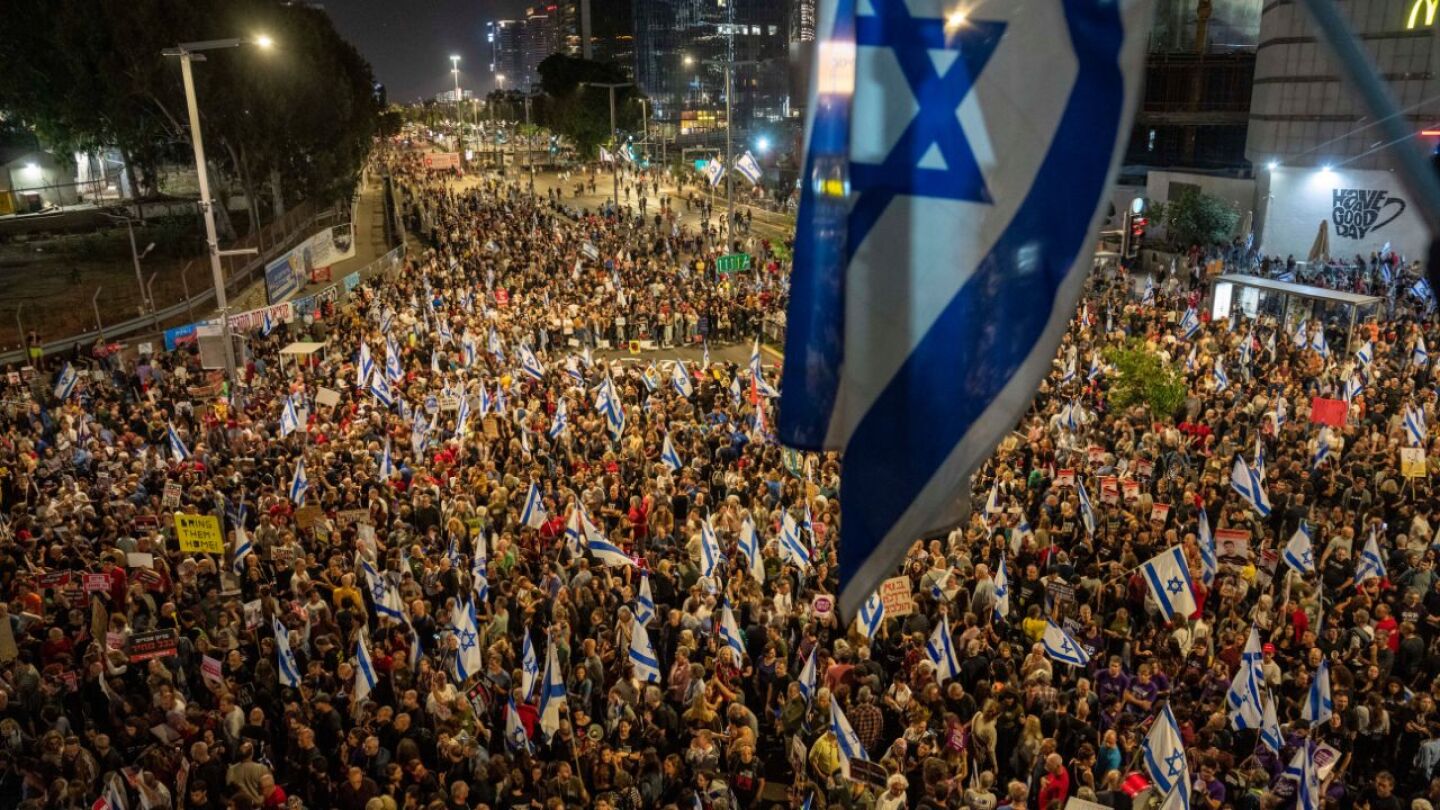
Protesters are demanding the government reach a deal to bring the hostages back from Gaza, for new elections and the resignation of Israeli Prime Minister Benjamin Netanyahu. The demonstration took place as a delegation of the Palestinian militant group Hamas was in Cairo for cease-fire talks with Israel. (AP video by Shlomo Mor)
Protesters are demanding the government reach a deal to bring the hostages back from Gaza, for new elections and the resignation of Israeli Prime Minister Benjamin Netanyahu. The demonstration took place as a delegation of the Palestinian militant group Hamas was in Cairo for cease-fire talks with Israel. (AP video by Shlomo Mor)
Published [hour]:[minute] [AMPM] [timezone], [monthFull] [day], [year]
On May 7, the European Court of Human Rights (ECtHR) released its judgement on the cases concerning the violent dispersal of protests on June 20-21, 2019, known as “Gavrilov’s Night”, finding a failure of proper criminal investigation under the procedural limb of Article 3 (prohibition of torture). The Court holds unanimously that there has been a violation of the procedural aspect of Article 3 and orders the Georgian side to pay damages ranging from EURO 15,000 – 1,800, plus EURO 6,000 for all costs and expenses.
26 Georgian activists and journalists applied to the Strasbourg Court with 5 cases – Berikashvili v. Georgia, Kurdovanidze and others v. Georgia, Baghashvili and others v. Georgia, Svanadze v. Georgia, Tsaava and Kmuzov v. Georgia. The applications against Georgia were submitted to the Court under Articles 3, 10, 11, 13, 34 of the Convention for the Protection of Human Rights and Fundamental Freedoms (some applications were submitted under all of these Articles, while some were submitted under only some of these Articles).
The Court notes that Georgian authorities “promptly” and “on their own initiative” opened the investigation, and recognizes that the complex nature of the criminal investigation posed some challenges for the Government in analyzing the available material in a timely manner. “However, it cannot find that the reasons advanced by the Government are sufficient to justify the failure to make a diligent effort to pursue key lines of inquiry, a situation which has continued for more than four and a half years.”
The Court notes that the Government did not dispute that the applicants’ injuries were caused by rubber bullets. It adds that “the Court cannot overlook the general risk to the lives and health of individuals posed by the improper use of such non-lethal ammunition. Accordingly, the Court finds that all the injuries suffered by the relevant applicants – which were duly documented – were sufficient to bring Article 3 of the Convention into play.”
However, the Court finds the violation of Article 3 only in the procedural part, not in the substantive part, taking into account the complex nature of the investigation, the Covid-19 pandemic that slowed down the investigation process, and also the fact that many applicants applied prematurely. It notes that a substantive analysis cannot be conducted until the end of the government investigation.
Importantly, the ECHR notes that one of the problems the government faces in its investigation is the fact that the officers who fired the rubber bullets that injured people cannot be identified because they are masked and have no identification. “…where the competent national authorities deploy masked police officers to maintain law and order or to make an arrest, those officers should be required to visibly display some distinctive insignia, such as a warrant number. The display of such insignia would ensure their anonymity, while enabling their identification and questioning in the event of challenges to the manner in which the operation was conducted,” – states the Court.
At least 240 people, including about 40 journalists and 80 police officers, were injured in the police dispersal of the anti-occupation rally outside the Parliament building on Rustaveli Avenue in Tbilisi on June 20-21, 2019. Tensions flared in Tbilisi after Sergei Gavrilov, Russian communist MP, addressed the Inter-parliamentary Assembly on Orthodoxy session held in the Georgian Parliament from the Speaker’s seat on June 19, 2019.
Also Read:
In another lengthy social media post on May 4, Parliament Speaker Shalva Papuashvili again attacks the National Endowment for Democracy (NED) and the European Endowment for Democracy (EED) accusing them of lacking transparency and funding what he called a “violent” local NGO, the Shame Movement, and, indirectly, political parties. Papuashvili notes that the EED is run by the MEPs, who “pushed for” the recent resolution criticizing the Georgian government for the Foreign Agents’ law and accuses them of using political levers to advance their interests in Georgia.
Papuashvili’s post is accompanied by a banner of the local CSO “Shame Movement” depicting a Molotov cocktail in the colors of the Ukrainian flag with the stars of the EU flag and the words “I threw it”. The banner, as Papuashvili suggests, points at the fact that such an incident occurred during last year’s March demonstrations in Tbilisi. [The “I threw it” campaign was actually initiated by the “Shame Movement” to support of Lazare Grigoriadis, who was accused of allegedly throwing a Molotov cocktail at the police and setting fire to the police car during the March 7-9 protests against the Foreign Agents Law.]
Papuashvili then goes on to attack the Shame Movement’s funding organizations. He specifically blames the National Endowment for Democracy (NED) and the European Endowment for Democracy (EED) for “funding radicalism and polarisation.”
The Parliament Chair points out Damon Wilson, the President of NED, noting that he called on Georgian NGOs “to persevere in their forceful protest against the Georgian government,” and adding that he had also “promised [the local NGOs] every help in their questionable activities.”
Papuashvili letter also mentions David MacAllister, MEP and Chairman of the Board of Governors of the EED, who expressed solidarity with the protesters in Tbilisi against the foreign agents law.
Papuashvili accuses both donor organizations of being non-transparent. “What unites NED and EED is their funding of such NGOs but also their resistance to the disclosure of their funding activities in Georgia,” he said.
He says that the ruling party dropped the infamous foreign agents law in 2023 only on the understanding that foreign funding would become transparent to the Georgian public. But that has not happened, he says, stressing that NED and EED funding in Georgia is “particularly problematic because it is not transparent.”
Papuashvili further accuses NED and EED of not only being non-transparent, but also of funding political parties in Georgia, claiming that the money given to the “fake NGOs” is used by political parties. “NED and EED also indirectly fund the political parties, as their finances end up in the coffers of the fake NGOs, which are run by these political parties as foreign money-laundering machines that convert foreign democracy assistance into political cash,” alleges Papuashvili.
The Speaker notes that foreign funds also go to “radical organizations” involved in recent “violent” protests in Tbilisi against the foreign agents law, all the while arguing that these organizations “undermine the rule of law,” as “EED money has been used to pay administrative fines for violent resistance to police.”
In addition to David MacAllister, Papuashvili mentioned two other MEPs: Anna Fotyga and Michael Gahler – saying that since they are also EED governors, thus they “use political levers for their specific interests [in Georgia],” adding that they are “keeping the EED projects non-transparent”.
“The organizations that criticize the law on transparency most, are non-transparent themselves,” Papuashvili declares, adding: “We still welcome cooperation with them but NED and EED should focus on what they are created for: promoting democracy and the rule of law, not funding radicalism and polarization.”
Also Read:
On May 7, the Council of Europe’s Committee of Experts on the Evaluation of Anti-Money Laundering Measures and the Financing of Terrorism (MONEYVAL) released its second Enhanced Follow-up Report and Technical Compliance Re-Rating on Georgia, examining the country’s progress in addressing the technical compliance deficiencies identified in the September 2020 assessment and subsequent follow-up reports on its measures to combat money laundering and terrorist financing. As a result of the follow-up, the rating has improved on one recommendation and remained unchanged on eight others.
MONEYVAL is a permanent monitoring body of the Council of Europe, which works on evaluating compliance with international standards and their implementation, in the direction of combating money laundering and terrorism financing. Its previous reports on Georgia were released in 2020, and 2022.
According to the document, Georgia had requested a reassessment of nine of the forty recommendations contained in its comprehensive 2020 Mutual Evaluation Report (in particular R.1, R.6, R.7, R.12, R.15, R.22, R.23, R.28, R.35).
For the remaining recommendations rated as partially compliant (PC) (R.24, R.25) or non-compliant (NC) (R.8), the authorities did not request a re-rating. For now, Georgia is rated “compliant” on seven recommendations, “largely compliant” on 22 recommendations, “partially compliant” on ten recommendations, and “non-compliant” on one recommendation.
When it comes to the recommendation number twelve on politically exposed persons, Georgia’s rating has improved from “partially compliant” to “compliant.” As for the other recommendations, the ratings remain unchanged.
Rating on the recommendation one regarding assessing risks and applying of a risk-based approach has remained the same. “Deficiencies identified in the identification and assessment of ML/TF [money laundering/terrorist financing] risks by Georgia, and application of exemptions have a bearing on the rating,” the authors say.
Speaking of the unchanged rating on recommendation number six which is about targeted financial sanctions related to terrorism and terrorist financing, the report recognizes that Georgia has made a “serious effort” in boosting its compliance with the UN instruments on freezing of terrorist assets. However, there are still some notable weaknesses in the system, particularly concerning the implementation of Targeted Financial Sanctions (TFS) outlined in UNSCR 1373. These include requirements for individuals and organizations to freeze the assets of individuals designated by both the UN and domestic authorities, ensuring protection for legitimate third parties, and promptly communicating designations. In a similar fashion, the rating on recommendation number seven on targeted financial sanctions related to terrorism and terrorist financing remained the same.
The document suggests that Georgia has made significant efforts to follow recommendation number 15 guidelines, focusing on adopting new technologies and regulating VASP [virtual asset service providers] activities. However, there are still some issues, such as applying and adequacy of sanctions and implementing preventive measures and international cooperation.
In its justification not to change the rating on the recommendation number 22 regarding the designated non-financial business and professions (DNFBPs), the MONEYVAL identifies several shortcomings, including the fact that there are no anti-money laundering/combating of terrorism financing requirements for real estate agents and trust and service company providers.
Among other issues, real estate agents and TCSPs lack AML/CFT requirements, which is seen as a moderate issue, impacting the recommendation number 23 compliance.
As for the recommendation number 28, the report reiterates that there is no regulation and supervision of real estate agents trust and service company providers. “There are no, or insufficient, provisions in place to prevent associates of criminals from owning or controlling casinos and sanction are not always available in line with R.35 for failure to comply with AML/CFT requirements. R.28 remains rated partially compliant.”
Recommendation number 35 remained unchanged, including because there was no evidence that civil or administrative sanctions (other than suspension) could be applied to leasing companies and lawyers, and no evidence that appropriate sanctions could be applied to notaries.
“Georgia will remain in enhanced follow-up and will continue to report back to MONEYVAL on progress to strengthen its implementation of AML/CFT measures. Georgia is expected to report back within one year’s time, in December 2024,” the report notes.
On May 7, the European Court of Human Rights (ECtHR) released its judgement on the cases concerning the violent dispersal of protests on June 20-21, 2019, known as “Gavrilov’s Night”, finding a failure of proper criminal investigation under the procedural limb of Article 3 (prohibition of torture). The Court holds unanimously that there has been a violation of the procedural aspect of Article 3 and orders the Georgian side to pay damages ranging from EURO 15,000 – 1,800, plus EURO 6,000 for all costs and expenses.
26 Georgian activists and journalists applied to the Strasbourg Court with 5 cases – Berikashvili v. Georgia, Kurdovanidze and others v. Georgia, Baghashvili and others v. Georgia, Svanadze v. Georgia, Tsaava and Kmuzov v. Georgia. The applications against Georgia were submitted to the Court under Articles 3, 10, 11, 13, 34 of the Convention for the Protection of Human Rights and Fundamental Freedoms (some applications were submitted under all of these Articles, while some were submitted under only some of these Articles).
The Court notes that Georgian authorities “promptly” and “on their own initiative” opened the investigation, and recognizes that the complex nature of the criminal investigation posed some challenges for the Government in analyzing the available material in a timely manner. “However, it cannot find that the reasons advanced by the Government are sufficient to justify the failure to make a diligent effort to pursue key lines of inquiry, a situation which has continued for more than four and a half years.”
The Court notes that the Government did not dispute that the applicants’ injuries were caused by rubber bullets. It adds that “the Court cannot overlook the general risk to the lives and health of individuals posed by the improper use of such non-lethal ammunition. Accordingly, the Court finds that all the injuries suffered by the relevant applicants – which were duly documented – were sufficient to bring Article 3 of the Convention into play.”
However, the Court finds the violation of Article 3 only in the procedural part, not in the substantive part, taking into account the complex nature of the investigation, the Covid-19 pandemic that slowed down the investigation process, and also the fact that many applicants applied prematurely. It notes that a substantive analysis cannot be conducted until the end of the government investigation.
Importantly, the ECHR notes that one of the problems the government faces in its investigation is the fact that the officers who fired the rubber bullets that injured people cannot be identified because they are masked and have no identification. “…where the competent national authorities deploy masked police officers to maintain law and order or to make an arrest, those officers should be required to visibly display some distinctive insignia, such as a warrant number. The display of such insignia would ensure their anonymity, while enabling their identification and questioning in the event of challenges to the manner in which the operation was conducted,” – states the Court.
At least 240 people, including about 40 journalists and 80 police officers, were injured in the police dispersal of the anti-occupation rally outside the Parliament building on Rustaveli Avenue in Tbilisi on June 20-21, 2019. Tensions flared in Tbilisi after Sergei Gavrilov, Russian communist MP, addressed the Inter-parliamentary Assembly on Orthodoxy session held in the Georgian Parliament from the Speaker’s seat on June 19, 2019.
Also Read:
In another lengthy social media post on May 4, Parliament Speaker Shalva Papuashvili again attacks the National Endowment for Democracy (NED) and the European Endowment for Democracy (EED) accusing them of lacking transparency and funding what he called a “violent” local NGO, the Shame Movement, and, indirectly, political parties. Papuashvili notes that the EED is run by the MEPs, who “pushed for” the recent resolution criticizing the Georgian government for the Foreign Agents’ law and accuses them of using political levers to advance their interests in Georgia.
Papuashvili’s post is accompanied by a banner of the local CSO “Shame Movement” depicting a Molotov cocktail in the colors of the Ukrainian flag with the stars of the EU flag and the words “I threw it”. The banner, as Papuashvili suggests, points at the fact that such an incident occurred during last year’s March demonstrations in Tbilisi. [The “I threw it” campaign was actually initiated by the “Shame Movement” to support of Lazare Grigoriadis, who was accused of allegedly throwing a Molotov cocktail at the police and setting fire to the police car during the March 7-9 protests against the Foreign Agents Law.]
Papuashvili then goes on to attack the Shame Movement’s funding organizations. He specifically blames the National Endowment for Democracy (NED) and the European Endowment for Democracy (EED) for “funding radicalism and polarisation.”
The Parliament Chair points out Damon Wilson, the President of NED, noting that he called on Georgian NGOs “to persevere in their forceful protest against the Georgian government,” and adding that he had also “promised [the local NGOs] every help in their questionable activities.”
Papuashvili letter also mentions David MacAllister, MEP and Chairman of the Board of Governors of the EED, who expressed solidarity with the protesters in Tbilisi against the foreign agents law.
Papuashvili accuses both donor organizations of being non-transparent. “What unites NED and EED is their funding of such NGOs but also their resistance to the disclosure of their funding activities in Georgia,” he said.
He says that the ruling party dropped the infamous foreign agents law in 2023 only on the understanding that foreign funding would become transparent to the Georgian public. But that has not happened, he says, stressing that NED and EED funding in Georgia is “particularly problematic because it is not transparent.”
Papuashvili further accuses NED and EED of not only being non-transparent, but also of funding political parties in Georgia, claiming that the money given to the “fake NGOs” is used by political parties. “NED and EED also indirectly fund the political parties, as their finances end up in the coffers of the fake NGOs, which are run by these political parties as foreign money-laundering machines that convert foreign democracy assistance into political cash,” alleges Papuashvili.
The Speaker notes that foreign funds also go to “radical organizations” involved in recent “violent” protests in Tbilisi against the foreign agents law, all the while arguing that these organizations “undermine the rule of law,” as “EED money has been used to pay administrative fines for violent resistance to police.”
In addition to David MacAllister, Papuashvili mentioned two other MEPs: Anna Fotyga and Michael Gahler – saying that since they are also EED governors, thus they “use political levers for their specific interests [in Georgia],” adding that they are “keeping the EED projects non-transparent”.
“The organizations that criticize the law on transparency most, are non-transparent themselves,” Papuashvili declares, adding: “We still welcome cooperation with them but NED and EED should focus on what they are created for: promoting democracy and the rule of law, not funding radicalism and polarization.”
Also Read:
On May 7, the Council of Europe’s Committee of Experts on the Evaluation of Anti-Money Laundering Measures and the Financing of Terrorism (MONEYVAL) released its second Enhanced Follow-up Report and Technical Compliance Re-Rating on Georgia, examining the country’s progress in addressing the technical compliance deficiencies identified in the September 2020 assessment and subsequent follow-up reports on its measures to combat money laundering and terrorist financing. As a result of the follow-up, the rating has improved on one recommendation and remained unchanged on eight others.
MONEYVAL is a permanent monitoring body of the Council of Europe, which works on evaluating compliance with international standards and their implementation, in the direction of combating money laundering and terrorism financing. Its previous reports on Georgia were released in 2020, and 2022.
According to the document, Georgia had requested a reassessment of nine of the forty recommendations contained in its comprehensive 2020 Mutual Evaluation Report (in particular R.1, R.6, R.7, R.12, R.15, R.22, R.23, R.28, R.35).
For the remaining recommendations rated as partially compliant (PC) (R.24, R.25) or non-compliant (NC) (R.8), the authorities did not request a re-rating. For now, Georgia is rated “compliant” on seven recommendations, “largely compliant” on 22 recommendations, “partially compliant” on ten recommendations, and “non-compliant” on one recommendation.
When it comes to the recommendation number twelve on politically exposed persons, Georgia’s rating has improved from “partially compliant” to “compliant.” As for the other recommendations, the ratings remain unchanged.
Rating on the recommendation one regarding assessing risks and applying of a risk-based approach has remained the same. “Deficiencies identified in the identification and assessment of ML/TF [money laundering/terrorist financing] risks by Georgia, and application of exemptions have a bearing on the rating,” the authors say.
Speaking of the unchanged rating on recommendation number six which is about targeted financial sanctions related to terrorism and terrorist financing, the report recognizes that Georgia has made a “serious effort” in boosting its compliance with the UN instruments on freezing of terrorist assets. However, there are still some notable weaknesses in the system, particularly concerning the implementation of Targeted Financial Sanctions (TFS) outlined in UNSCR 1373. These include requirements for individuals and organizations to freeze the assets of individuals designated by both the UN and domestic authorities, ensuring protection for legitimate third parties, and promptly communicating designations. In a similar fashion, the rating on recommendation number seven on targeted financial sanctions related to terrorism and terrorist financing remained the same.
The document suggests that Georgia has made significant efforts to follow recommendation number 15 guidelines, focusing on adopting new technologies and regulating VASP [virtual asset service providers] activities. However, there are still some issues, such as applying and adequacy of sanctions and implementing preventive measures and international cooperation.
In its justification not to change the rating on the recommendation number 22 regarding the designated non-financial business and professions (DNFBPs), the MONEYVAL identifies several shortcomings, including the fact that there are no anti-money laundering/combating of terrorism financing requirements for real estate agents and trust and service company providers.
Among other issues, real estate agents and TCSPs lack AML/CFT requirements, which is seen as a moderate issue, impacting the recommendation number 23 compliance.
As for the recommendation number 28, the report reiterates that there is no regulation and supervision of real estate agents trust and service company providers. “There are no, or insufficient, provisions in place to prevent associates of criminals from owning or controlling casinos and sanction are not always available in line with R.35 for failure to comply with AML/CFT requirements. R.28 remains rated partially compliant.”
Recommendation number 35 remained unchanged, including because there was no evidence that civil or administrative sanctions (other than suspension) could be applied to leasing companies and lawyers, and no evidence that appropriate sanctions could be applied to notaries.
“Georgia will remain in enhanced follow-up and will continue to report back to MONEYVAL on progress to strengthen its implementation of AML/CFT measures. Georgia is expected to report back within one year’s time, in December 2024,” the report notes.