
Armenia’s Economy Minister to visit the USA ARMENPRESS
Day: May 7, 2024
Interested in learning more about Homenetmen? Want to have fun while testing your knowledge of our beloved organization? Follow us on Instagram @homenetmen.east and on Facebook at Homenetmen Eastern Region USA in order to participate in some friendly competition against your fellow kouyrs and yeghpayrs!
Trivia Tuesdays! is hosted by the Homenetmen Eastern Region USA’s Public Relations Committee. Posted on its Instagram and Facebook stories, the biweekly trivia questions are based on specific topics.
Previous themes have included “Navasartian Games,” “Homenetmen Scouting Knowledge” and “Homenetmen History.” Questions are presented with multiple choice options and will then let you know if you answered correctly or incorrectly. Try out the set of questions below!
Proud of your score? Be sure to share your results by tagging Homenetmen Eastern Region USA on Instagram and Facebook!
Have ideas on themes or questions? Reach out via direct message on Instagram or by emailing prc.eusa@homenetmen.org.
Looking forward to seeing you participate in our next Trivia Tuesday night!
Author information
Homenetmen Eastern U.S.
The Armenian General Athletic Union and Scouts, known as “Homenetmen,” is a non-profit organization founded over 100 years ago. Believing in the idea that strong bodies lead to strong minds, Homenetmen has provided Armenian youth across the globe with a moral, physical and psychological education outside the school environment, while also demonstrating richness of the Armenian culture and heritage. Today, Homenetmen is a worldwide organization with over 25,000 members on five continents. On the East Coast U.S., Homenetmen is a thriving organization with 12 chapters and over 900 members, governed by the Homenetmen Eastern Regional Executive.
|
The post Trivia Tuesdays! hosted by Homenetmen Eastern Region USA appeared first on The Armenian Weekly.
Categories
Virtuous mothers
Although honoring mothers may have originated in time immemorial, with the custom of mother worship existing among ancient cultures and primal religions, the history of Mother’s Day in the United States goes back to the early 1870s.
Julia Ward Howe (1819-1910), the American pacifist who wrote “The Battle Hymn of the Republic,” first conceived the idea of a Mother’s Day celebration. Howe was the director of the Perkins School for the Blind in Boston, the founder of the first American women ministers’ group, an abolitionist and a peace activist.
In 1870, five years after the American Civil War, a senseless conflict broke out in Europe, the Franco-Prussian War. Howe wrote a manifesto against that war and had it translated into five languages. She went to peace conferences in Paris and London, yet because she was a woman, they would not permit her to speak. So she rented a hall, advertised and delivered a speech for peace to her own audience. Her efforts resulted in little success.
Howe returned to America with a new idea — Mother’s Day. Linking motherhood, mother earth, womanhood and peace, she asserted that the unconditional love mothers hold for their children invests them with a natural and deep interest in preventing bloodshed.
Howe reasoned that fathers send their sons to war; mothers remain at home to grieve. Who could better symbolize the need for peace than a soldier’s mother? Mother’s Day would serve as a reminder that the world would be a better place if only everyone rose to the challenge of motherhood — nurturing life, fostering peace and giving love.
In 1908, Anna Jarvis of Philadelphia took up the cause and set aside the second Sunday in May to pay tribute to her late mother and honor all mothers. The idea caught on and spread to many cities across the United States. In 1914, President Woodrow Wilson declared the second Sunday in May as Mother’s Day.
 A poster advertising the annual Mother’s Day parade in Pennsylvania in 1915
There are many kinds of mothers — natural mothers, stepmothers, adoptive mothers, foster mothers, mothers-in-law, grandmothers… Sad to say, there are also unappreciated, neglected and even abused mothers.
Whoever they are and whatever their lot in life is, these women know their sublime calling as mothers and rightly deserve our love, affection and appreciation. Honor and praise should be given to them for their matchless love and their irreproachable faith. They have a love that does not grow cold, does not betray and is not depleted.
Their “love is patient, kind…is not self-seeking. It is not easily angered; it keeps no record of wrongs…It always protects, always trusts, always hopes, always perseveres” (I Cor. 13:4-7).
There is a word for that kind of ultimate love — altruism. What is altruism? The dictionary definition is “selfless devotion to the welfare of others.”
Altruism is a description of God’s love. Isaiah quotes God as asking, “Can a mother forget the baby at her breast and have no compassion on the child she has borne? Though she may forget, I will not forget you! See, I have engraved you on the palms of my hands…” (Isaiah 49:15, 16).
Egotism includes the instinct for survival; altruism is an acquired trait. Altruism is more than conscience; it is the one basic fundamental Christian characteristic. Altruism is giving with no ulterior motive. When we give, we do not and cannot expect anything in return.
True motherhood is a total commitment to love. Virtuous mothers express their love through their sacrificial acts, giving up their sleeping patterns and disdaining personal care, pleasures and desires. Their hearts beat in harmony with and for their children. Self-sacrifice and self-denial are characteristics of such a love. Virtuous mothers give graciously and magnanimously on the altar of love and, with their lifestyles, inspire their children.
Their children, in turn, “Arise and call them blessed.”
Author information
Rev. Dr. Vahan Tootikian
Rev. Dr. Vahan H. Tootikian is the Executive Director of the Armenian Evangelical World Council.
|
The post Virtuous mothers appeared first on The Armenian Weekly.
PROVIDENCE, R.I.—More than 100 guests attended the “Continuation of Genocide: The Armenian Struggle” guest lecture hosted by the Providence “Varantian” Armenian Youth Federation (AYF) Chapter on Thursday, May 2, 2024 at Brown University in Providence, Rhode Island.
Upon arrival, guests were welcomed with a spread of homemade Armenian desserts, coffee and other refreshments, accompanied by Armenian folk music playing softly in the background, fostering an atmosphere infused with cultural charm.
The event, which was open to the public, brought together Armenian community members and students from Brown University and nearby Providence College for a lecture that shed light on the historical context of the Armenian Genocide and its impact on the ongoing Armenian struggle for recognition and justice.
In light of recent developments in Armenia, particularly regarding planned land concessions, the Providence “Varantian” AYF Chapter, in collaboration with the Brown Armenian Society, was committed to raising awareness about these underlying issues. The two-part lecture aimed to educate the audience on the history of the Armenian Genocide and spread awareness on the current state of Artsakh, emphasizing its historical context and how recent events there should be recognized as acts of genocide.
 Providence AYF “Varantian” Chapter executive with Dr. Khatchig Mouradian and Dr. Henry Theriault
Providence AYF chair Hagop Taraksian welcomed the crowd and invited chapter executive member Ani Comella to formally introduce the evening’s lecturers.
Dr. Khatchig Mouradian provided the historical context and events surrounding the Armenian Genocide during the first lecture. Mouradian captivated the audience with an innovative presentation, weaving together historical facts and a timeline of the Armenian Genocide, while incorporating photos to convey its profound impact.
An especially impactful photo that Mouradian kept on the screen for a while was one taken by an AP photographer in October 2020 of an Artsakh family’s home on the back of their truck as they were forced to leave their homeland. Mouradian pointed out that this is the story of all displaced peoples. “It is important to note that at no point in history were there no Armenians in Artsakh until September 2023. What the Mongols could not achieve, Azerbaijan did with the support of Turkey,” Mouradian said. “Genocide casts a very long shadow.”
 Dr. Khatchig Mouradian, behind him the photo of the Artsakh family’s home on the back of their truck as they are forced to leave their homeland (Photo: Pauline Getzoyan)
Mouradian said that there are many things that cannot be carried on the back of a truck while fleeing one’s homeland, including land, churches and other cultural monuments, all of which the perpetrator will continue to destroy as a means of cultural erasure and genocide. As his lecture progressed, Mouradian answered three questions about the Armenian Genocide: why the Armenians, why genocide and why then?
Mouradian concluded by reminding attendees that more than 100 years ago, despite the Genocide, Armenians reconstituted their communities and built a nation. “If they could do it then, we can do it now,” he said.
Dr. Henry Theriault delivered the second lecture, educating the audience on the continuing genocide in Artsakh. Theriault skillfully maintained the audience’s interest with an insightful examination of the geopolitical landscape of Armenia and Artsakh, contextualizing the region’s history, the the complete blockade of Artsakh and ongoing atrocities perpetrated against Armenians.
Theriault reiterated that Armenians are indigenous to Artsakh and that for the first time in 2,000 years, there are no Armenians on that land. He provided the history of Artsakh, explaining Stalin’s plan to foment border instability in order to maintain reliance on Moscow and the growth of anti-Armenian prejudice. He outlined the plans that ultimately led to the fall of Artsakh in September 2023. “Azerbaijan was very patient and playing the long game,” Theriault explained, arguing that Armenia became complacent beginning in the 1990s. During that time, “Azerbaijan outsteps Armenia and builds up its propaganda machine and effectively uses caviar diplomacy,” he continued.
 Dr. Henry Theriault with a map of the region from 2020 (Photo: Pauline Getzoyan)
“Do we really think it’s over?” Theriault asked. “The rhetoric is that they plan to eliminate Armenians from the Caucasus. Azerbaijan is now taking land in Armenia.” Theriault concluded by saying that under the current circumstances, it is critical to pursue legal cases against Azerbaijan with an insistence on Armenians’ right to return to Artsakh with security guarantees.
Mouradian and Theriault offered thought-provoking lectures that led to more questions and discussion as the evening concluded.
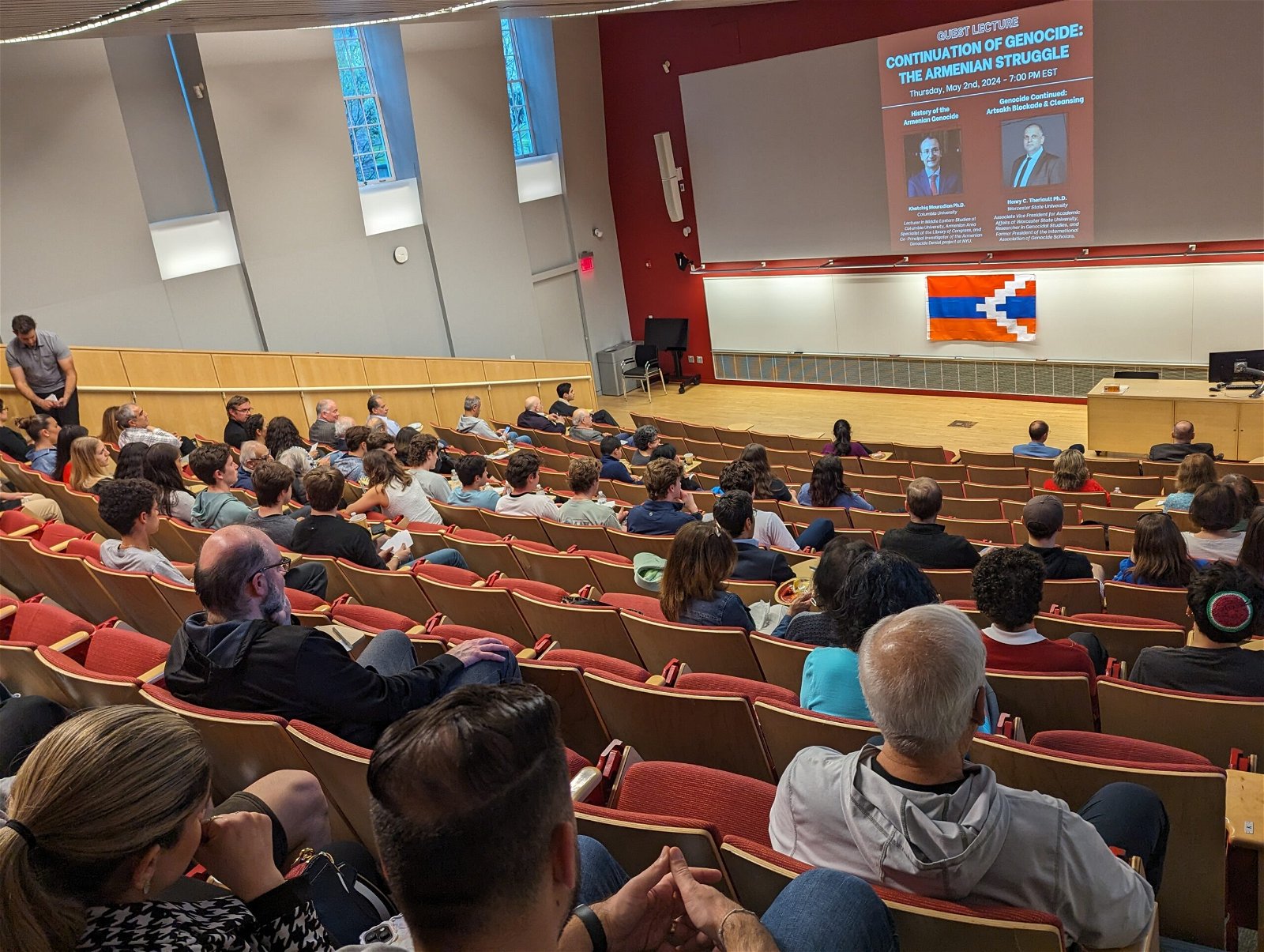 “Continuation of Genocide: The Armenian Struggle” Providence AYF “Varantian” guest lecture at Brown University, May 2, 2024 (Photo: Pauline Getzoyan)
Dr. Mouradian is a lecturer in Middle Eastern, South Asian, and African Studies at Columbia University and the Armenian and Georgian Area Specialist in the African and Middle Eastern Division at the Library of Congress. He also serves as co-principal investigator of the project on Armenian Genocide denial at the NYU Global Institute for Advanced Study. Dr. Mouradian is the author of the award-winning book The Resistance Network: The Armenian Genocide and Humanitarianism in Ottoman Syria, 1915 to 1918. He has published articles and book chapters on concentration camps, unarmed resistance, the aftermath of mass violence, midwifery in the Middle East and approaches to teaching history.
Dr. Theriault is associate vice president for Academic Affairs at Worcester State University, after teaching in its philosophy department from 1998 to 2017 and chairing the department from 2011 to 2017. Dr. Theriault served two terms as president of the International Association of Genocide Scholars (IAGS) from 2017-2019 and 2019-2021. He is lead author of the Armenian Genocide Reparations Study Group’s 2015 final report, Resolution with Justice, and co-authored The United Nations Genocide Convention: An Introduction. Dr. Theriault researches genocide denial, genocide prevention, post-genocide victim-perpetrator relations, reparations and mass violence against women and girls.
Author information
AYF Providence “Varantian” Chapter
Founded in 1934, the Providence “Varantian” Chapter works to unite Armenian youth and organize activities in the Providence, Rhode Island area. The chapter has a Senior and Junior chapter. The Providence “Varantian” Chapter sets out to achieve its goals and objectives throughout the year through events such as the Varantian Ball, Junior Seminar fundraisers, flag raisings on April 24 and support for the Cranston Sports Card Show. The AYF-YOARF’s five pillars (athletic, cultural, educational, political, social) guide this chapter and help keep its membership active and at the forefront of the Armenian Cause at all times.
|
The post Providence “Varantian” AYF hosts lecture with Mouradian and Theriault appeared first on The Armenian Weekly.
Netanyahu: Attacking Rafah necessary to return captives – Selected Articles https://t.co/xYfPN75PLd https://t.co/xOrZHFpYaY
— Michael Novakhov (@mikenov) May 7, 2024


Michael Novakhov’s favorite articles on Inoreader
Israel’s Prime Minister Benjamin Netanyahu says the capture of the Rafah crossing is an “important step” towards “dismantling Hamas”.
Netanyahu added military pressure on Hamas is a necessary condition for “the return of our captives”.
The proposal Hamas agreed to on a ceasefire “falls far short of Israel’s essential demands”, the beleaguered Israeli leader said.
The involvement of both the Americans and Egyptians has made the conflict deeply personal, leading to significant pressure on Israel and Hamas. While Hamas seeks a complete end to the war, Israel is adamant that the conflict is not yet over.
For Benjamin Netanyahu, the situation in Rafah holds immense political significance. Entering Rafah could allow him to claim victory, which is crucial for his political survival. On the other hand, avoiding Rafah could deprive him of this opportunity, leading many to believe that he is not interested in a ceasefire agreement.
Despite American pressure, the negotiations are intricate and extend beyond the immediate Gaza situation. They involve broader regional geopolitical considerations and future plans linked to developments in Cairo. The outcome remains uncertain, and the negotiations are complex.
Al Jazeera’s Stefanie Dekker joins us now from the Jordanian capital, Amman.
Subscribe to our channel http://bit.ly/AJSubscribe
Follow us on Twitter https://twitter.com/AJEnglish
Find us on Facebook https://www.facebook.com/aljazeera
Check our website: https://www.aljazeera.com/
Check out our Instagram page: https://www.instagram.com/aljazeeraenglish/
Download AJE Mobile App: https://aje.io/AJEMobile
#Israel #TelAviv #BenjaminNetanyahu #IsraelHamasDeal #IsraelHamasTruce #Palestine #Gaza #IsraelPrimeMinister #IsraelGazaWar #IsraelHamasWar #GazaWar #Hamas #Rafah #GazaCeasefire #GazaCeasefireDeal #Netanyahu #UnitedStates #IsraeliHostages #IsraeliCaptives #ReleaseTheHostages
Putin Takes Oath as Russian President for the Fifth Time | Vantage with Palki Sharma
Vladimir Putin has taken oath as the president of Russia for a fifth time in an elaborate ceremony at the Grand Kremlin Palace. The inauguration follows Putin’s victory in the recent presidential election, where he secured 87% of the votes. In his inaugural address, Putin offered talks with the West, but “only as equals”. For nearly a quarter of a century, Putin has ruled Russia as prime minister and president. Under his rule, Russia’s economy has stabilised and its great power ambitions are back in play. But has the war in Ukraine spoiled Putin’s calculations? What is Putin’s legacy in geopolitics? Palki Sharma tells you.
—
Russia | Vladimir Putin | President | Grand Kremlin Palace | St Andrew’s Throne Hall | Kremlin | Mandate | Elections | Office | Ukraine | War | Firstpost | World News | News Live | Vantage | Palki Sharma | News
#vladimirputin #russia #ukraine #russiaukrainewar #nucleardrills #president #standrews #kremlin #mandate #elections #office #war #firstpost #vantageonfirstpost #palkisharma #worldnews
Vantage is a ground-breaking news, opinions, and current affairs show from Firstpost. Catering to a global audience, Vantage covers the biggest news stories from a 360-degree perspective, giving viewers a chance to assess the impact of world events through a uniquely Indian lens.
The show is anchored by Palki Sharma, Managing Editor, Firstpost.
By breaking stereotypes, Vantage aims to challenge conventional wisdom and present an alternative view on global affairs, defying the norm and opening the door to new perspectives. The show goes beyond the headlines to uncover the hidden stories – making Vantage a destination for thought-provoking ideas.
Vantage airs Monday to Friday at 9 PM IST on Firstpost across all leading platforms.
Subscribe to Firstpost channel and press the bell icon to get notified when we go live.
https://www.youtube.com/@Firstpost
Follow Firstpost on Instagram:
https://www.instagram.com/firstpost/
Follow Firstpost on Facebook:
https://www.facebook.com/firstpostin/
Follow Firstpost on Twitter:
https://twitter.com/firstpost
Follow Firstpost on WhatsApp:
https://www.whatsapp.com/channel/0029Va6zOIrEQIamseyg762V
Putin sworn in as president for fifth term The Washington Post
________________________________________________
Selected Articles – Michael Novakhov’s favorite articles on Inoreader – The News And Times

Israel’s Prime Minister Benjamin Netanyahu says the capture of the Rafah crossing is an “important step” towards “dismantling Hamas”. Netanyahu added military pressure on Hamas is a necessary condition for “the return of our captives”. The proposal Hamas agreed to on a ceasefire “falls far short of Israel’s essential demands”, the beleaguered Israeli…
Putin Takes Oath as Russian President for the Fifth Time | Vantage with Palki Sharma Vladimir Putin has taken oath as the president of Russia for a fifth time in an elaborate ceremony at the Grand Kremlin Palace. The inauguration follows Putin’s victory in the recent presidential election, where he secured 87% of the votes. In his inaugural address,…
Vladimir Putin is sworn in for his fifth term as president Daily Mail
Russia inaugurated President Putin for another term KATU
Putin’s changing faces: From an uncomfortable-looking unknown in an ill-fitting suit to face-lift-loving dicta Daily Mail
Putin sworn in as president for fifth term The Washington Post
Putin begins new six-year term as president, with more power over Russia than ever PBS NewsHour
Putin orders tactical nuclear weapon drills to deter the West EURACTIV
Watch: Putin inaugurated for fifth presidential term after sham election victory The Independent
Putin’s Fifth Term Starts Amid War, Censorship, Repression and Media Control Kyiv Post
Putin’s new term doesn’t expire until 2030 WPVI-TV
Putin sworn in for 5th term as Russian president CBS News
Israeli delegation in Egypt as Netanyahu says Hamas truce offer ‘very far’ from demands – Al-Monitor
Israeli delegation in Egypt as Netanyahu says Hamas truce offer ‘very far’ from demands Al-Monitor
Biden Again Warns Netanyahu As Rafah Invasion Looms International Business Times
Netanyahu: Hamas offer aimed at ‘sabotaging’ Rafah op, is ‘very far’ from Israeli demands The Times of Israel
Can the ICC Actually Arrest Netanyahu? – Foreign Policy Foreign Policy
How far will Netanyahu go in Rafah to keep his hardline coalition partners onside? – The Independent
How far will Netanyahu go in Rafah to keep his hardline coalition partners onside? The Independent
Israeli tanks enter Rafah: an “important step” according to Binyamin Netanyahu FRANCE 24 English
No prospect of Gaza truce as Netanyahu wants war to go on: PA minister Euronews
Biden warns Netanyahu against major Rafah offensive as divide between the 2 leaders grows Galveston County Daily News
Video Netanyahu vows to go into Rafah despite opposition from Biden ABC News
Netanyahu War Crimes Investigation Puts Biden in Tough Spot Newsweek
Israel’s Netanyahu says Hamas truce proposal far short of essential demands Deccan Herald
Biden warns Netanyahu against major Rafah offensive as divide between the 2 leaders grows Watertown Daily Times
Israeli forces take control of the Gaza side of the Rafah crossing with Egypt Africanews English
Yoav Gallant discusses Rafah op with IDF soldiers at Gaza Strip border The Jerusalem Post
Biden laments ‘absolutely despicable’ rise of antisemitism, slams anti-Israel protesters for ‘forgetting’ Oct. 7 Hamas attack New York Post
PM says terror group’s proposal didn’t include ‘vital demands,’ and negotiating team won’t back down on terms; Hamas warns offer is Israel’s ‘last chance’ The post Netanyahu says Hamas offer aimed to ‘sabotage’ Rafah op as Israeli delegation in Cairo appeared first on The Times of Israel.
Russia said it was responding to ‘provocative statements’ from western officials after the French president last week reaffirmed he was leaving open the option of sending western troops to Ukraine https://t.co/esIp6ePRbc pic.twitter.com/NkEOufEfXM— Financial Times (@FT) May 7, 2024
The News And Times Information Network – Blogs By Michael Novakhov – thenewsandtimes.blogspot.com