
Categories
South Caucasus News

109th Anniversary of Armenian Genocide Commemorated in Times Square


BY TALEEN BABAYAN

As Armenians gathered in Times Square for the 39th year to commemorate the 109th anniversary of the Armenian Genocide, their spirits remained in solidarity with their brethren in Armenia, who continue to persevere in the face of challenges and change.

The notable event, sponsored by the Knights and Daughters of Vartan, and co-sponsored by a number of leading American Armenian organizations, created a communal space for descendants of survivors to remember their ancestors who perished in the Armenian Genocide, and to continue to fight for global awareness and recognition.

Senator Chuck Schumer (D-NY), Senate Majority Leader, who loyally ensures his annual attendance at the Times Square Armenian Genocide Commemoration, acknowledged that the Armenian Genocide does not receive enough attention, even when the Armenian people “experience the repercussions of the genocide today in Armenia.”

Senator Chuck Schumer, Senate Majority Leader (D-NY). Photo credit: Harout Barsoumian-Bars Images

“Your presence shows that year after year you honor the memory of your ancestors whose lives were brutally cut short by the Ottoman Empire a century ago,” he said. “I’m always inspired to see you here as a living, resilient witness to the tragedy and moral outrage of the Armenian Genocide.”

Senator Schumer recounted stories he heard from survivors and their descendants which resonated with him on a personal level, as his ancestors also escaped massacres when Nazis invaded Ukraine during World War II.

“These atrocities are more than just a stain on the nation and those who did it, [as] the world looked away in each case with a blind eye,” he said, which prompted him to sponsor Senate resolutions that called on American presidents “to name the ‘Medz Yeghern’ for what it clearly was — a Genocide.”

“It happened because of you and your hard work, and your moral clarity,” said Senator Schumer reflecting on the overwhelming passage of US affirmation of the Armenian Genocide in Congress in 2019, and subsequent affirmation by President Biden in 2021. “But our work is not yet done, and it’s our duty to speak out against human rights abuses happening today against the Armenian people.”
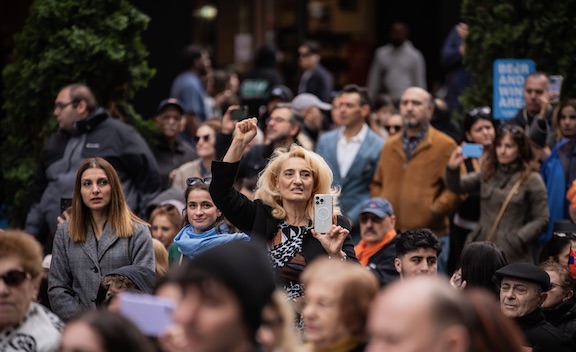
A scene from the 2024 Armenian Genocide Commemoration in Times Square. Photo credit: Harout Barsoumian-Bars Images

Senator Schumer said he “unequivocally condemns” the actions of Azerbaijan, including “their war of aggression in 2020, their cruel and cynical blockade of the Lachin Corridor, and assault on territory resulting in tragic deaths of hundreds of Armenians,” followed by the forced exodus of the ethnic Armenian population from Nagorno-Karabakh.

“I know I’m not alone in saying my mind was cast back to darker days that happened before,” said Senator Schumer, stating his promise that as Senate Majority Leader he will do everything he can to support Armenia and displaced Armenians from Nagorno-Karabakh, including securing funding and calling out human rights abuses, as he “watches these developments like a hawk.”

“We must never turn a blind eye again,” concluded Senator Schumer. “Armenia faces serious challenges, but if history is any guide we know that this small but mighty nation has outlasted authoritarian thugs in the past and will continue to do so because the Armenian nation has not only endured, but prevailed.”

Dr. Michael Rubin, senior fellow at the American Enterprise Institute and Director of Policy Analysis at the Middle East Forum, delivered remarks centered on both past and present history, tying in the current events in Armenia.

Dr. Michael Rubin. Photo credit: Harout Barsoumian-Bars Images

“I’m not here to simply commemorate an old genocide,” said Dr. Rubin, who holds a PhD from Yale University in History and who has testified before Congress over 20 times. “It’s just as important to recognize that we’re here to prevent a new one.”

He highlighted that the US should follow France’s lead, which became the first NATO country to provide arms to Armenia against the growing threats of its neighboring country, and has “made clear Armenia’s sovereignty is not up for debate.”

“Appeasement does not work,” he continued. “It’s great that President Joe Biden kept his campaign pledge to recognize the Armenian Genocide, because ‘never again’ is now.”

“The time is now not only to commemorate the Armenian Genocide, but to recognize that prevention of all future genocides requires a strong and consistent partnership diplomatically, economically, and militarily, with the Republic of Armenia,” said Dr. Rubin.

In her remarks, Dr. Asya Darbinyan, who is a genocide scholar, educator, and Executive Director of the Center for Holocaust, Human Rights & Genocide Education (Chhange) in Lincroft, NJ, focused on the educational aspects of genocide and how it can advance the cause for recognition and mass atrocity prevention.
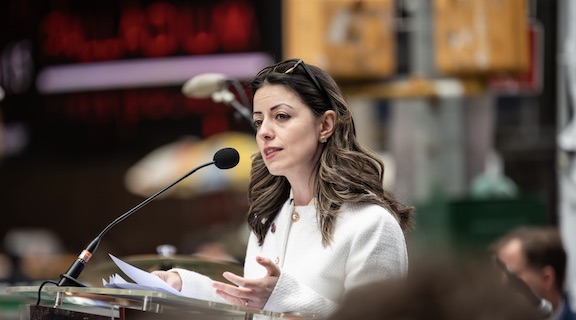
Dr. Asya Darbinyan. Photo credit: Harout Barsoumian-Bars Images

“With official recognition comes the opportunity to speak about genocide openly and boldly, and to promote educational programs,” said Dr. Darbinyan, who earned her doctoral degree in History from the Strassler Center for Holocaust and Genocide Studies at Clark University under the mentorship of Professor Taner Akçam. “Recognition allows the Armenian community and its descendants to move forward with our struggle for justice.”

She elaborated on the need to hold perpetrators accountable and to demand justice when basic human rights violations and dehumanization take place, as well as the importance of sharing photographs, letters, and documents of Armenians prior to the Genocide.

“Show the life of Armenians and their experiences because they were not nameless, faceless victims,” said Dr. Darbinyan. “Each of them had a name, a face, a home, and a story to be told that should be honored and not forgotten.” 

Grand Matron of the Daughters of Vartan, Nancy Berberian Thompson, reflected on the Armenian martyrs who lost their lives and paid tribute to the survivors who found refuge in the US, without forgetting their history.
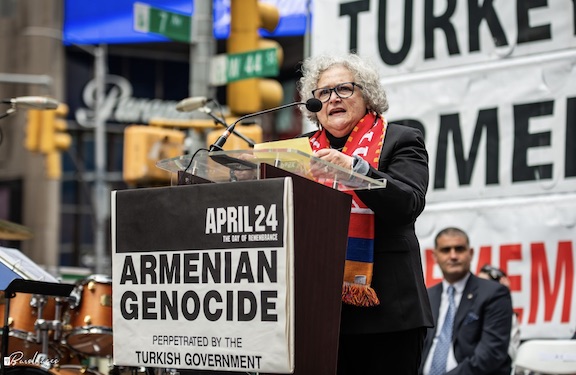
Grand Matron of the Daughters of Vartan Nancy Berberian Thompson. Photo credit: Harout Barsoumian-Bars Images

“When I was younger, we listened to the survivors of the Armenian Genocide and we keep their memories alive,” she said. “Armenians worked hard to be leaders here in the US and help aid Armenia.”

Berberian Thompson expressed the help that Armenia still needs, particularly in the aftermath of the Artsakh war and the displacement of 120,000 Artsakh Armenians. She noted that the Knights and Daughters have raised over $150,000 to assist them and will continue in their efforts.

Grand Commander of the Knights of Vartan, Hunan Arshakyan, emphasized the continuous Azeri aggression against the Armenian people, which serves as a reminder that “the threat towards the Armenian people remains real and present.”
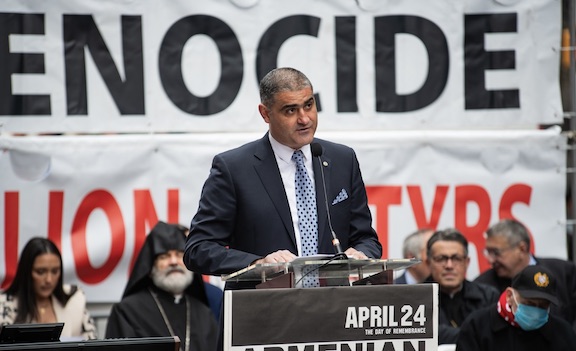
Grand Commander of the Knights of Vartan Hunan Arshakyan. Photo credit: Harout Barsoumian-Bars Images

He expressed that the Knights of Vartan is involved in cultural preservation and humanitarian efforts, serving as a bridge between the diaspora and Armenia.

“To the world, we declare our unwavering attempt to keep fighting for recognition and justice,” said Arshakyan, who emphasized the importance of the younger generations to “uphold our traditions and push forward our legacy.”

“Your energy and commitment are key to securing a future where Armenians can live in dignity and peace,” said Arshakyan. “We will never forget and we will never stop fighting for our right to live as Christian Armenians.”

Canada-based singer Harout Bedrossian and his band, featuring Steve Vosbikian, Jiro Tavitian and Mher Vartanian performed Armenian patriotic songs, including “Giligia,” “Hayer Miatzek,” “Karabakh,” “Artyok Ovker En,” for the audience.
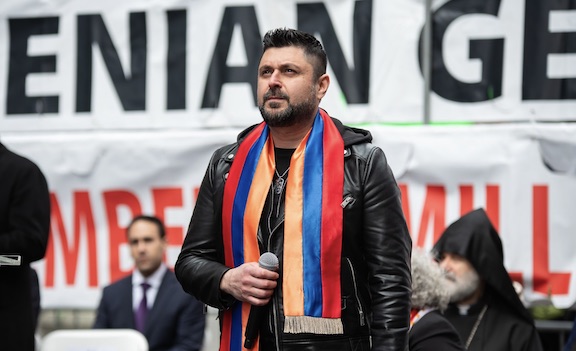
Singer Harout Bedrossian performing in Times Square. Photo credit: Harout Barsoumian-Bars Images
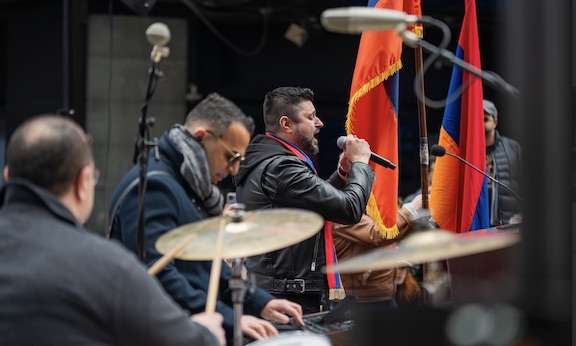
Singer Harout Bedrossian and his band performing in Times Square. Photo credit: Harout Barsoumian-Bars Images

Eastern Prelate Archbishop Anoushavan Tanielian delivered the invocation, and Very Rev. Fr. Simeon Odabashian, who represented the Eastern Primate Bishop Mesrop Parsamyan, delivered the benediction. Very Rev. Fr. Andon Noradounguian, Pastor of the Sacred Heart Armenian Catholic Church, who represented His Excellency Bishop Mikael Mouradian, Primate of the Armenian Catholic Eparchy of the USA and Canada, led a prayer; other clergy in attendance included Very Rev. Fr. Sahag Yemishyan, Vicar General of the Eastern Prelacy and Pastor of Sts. Vartanantz Armenian Apostolic Church.

The Dance Grigorian Ballet School from Lyon, France, under the directorship of Anna Oundjian Grigorian performed an Armenian dance. The Holy Martyrs Armenian Day School students sang the Armenian and American anthems, and “God Bless America” was performed by Nina and Mila DaRocha.

Members of the Dance Grigorian Ballet School performing an Armenian dance in Times Square. Photo credit: Harout Barsoumian-Bars Images

The Knights and Daughters of Vartan have sponsored the Times Square Armenian Genocide Commemoration since 1985, along with the support of a multitude of Armenian American community organizations. This year the event was co-chaired by Haig Gulian, Ari Minnetyan, and Christopher Artun, under the guidance of Chairman Emeritus Hirant Gulian.

David Ojakian (Armenian Assembly of America), Chantelle Nasri (Armenian National Committee of America) and Nanor Hartounian (UCLA’s The Promise Armenian Institute), served as MCs, while Bryan Ardouny, Executive Director of the Armenian Assembly of America served as media spokesperson.

The winners of this year’s Knights and Daughters of Vartan Annual Essay Contest were announced: Sirahn Toufayan, 1st place; Madeline Berberian-Hutchinson, 2nd place; Mia Seferian Vickery, 3rd place; and runner-up Angela Mashuryan.

Co-sponsoring organizations included the Armenian Assembly of America, represented by Bryan Ardouny, Executive Director; Armenian General Benevolent Union, represented by Natalie Gabrelian, Director of Districts, Chapters, and Central Board Administration; Armenian National Committee of America; ADL-Ramgavar Party, represented by Norair Megeurditchian, Chairman of the Eastern District USA; Tekeyan Cultural Association, represented by Hilda Hartounian, Member of the Tekeyan Cultural Association Board of Directors of US and Canada and Chair of the Tekeyan Cultural Association Greater New York Chapter; Armenian Bar Association, represented by Gevorg Karapetyan; as well as the Armenian Missionary Association of America; and the Armenian Council of America.

Participating organizations included the Armenian Network of America, Armenian Youth Federation, Homenetmen Scouts of NY and NJ, Armenian Relief Society, Armenian Church Youth Organization of America, AGBU Young Professionals, Armenian Students Association, Hamazkayin Cultural Association of NY and NJ, and tri-state Armenian college and university clubs.

Categories
South Caucasus News

Spain’s PM Sánchez says he is to announce his decision to resign


Spanish Prime Minister Pedro Sánchez writes on Network X that he is “suspending all his public duties to stop and reflect on the future and decide whether he wants to continue to be at the forefront of politics.”

Categories
South Caucasus News

Türkiye’s President Erdogan, German counterpart Steinmeier meet in Ankara for talks


Turkish President Recep Tayyip Erdogan on Wednesday expressed hope Ankara and Berlin would not encounter obstacles and focus on discussing joint production projects, particularly in the defense sector, Azernews reports, citing Anadolu Agency.

Categories
South Caucasus News

Turkish manufacturer Karmod stresses safety over cost in prefabricated home manufacturing


Turkish building manufacturer Karmod said on Wednesday that security concerns should outweigh price considerations when purchasing prefabricated homes, Azernews reports, citing Anadolu Agency.

Categories
South Caucasus News

Azerbaijani, Kyrgyz presidents attended unveiling ceremony of monument to Chingiz Aitmatov in Baku


President of the Republic of Azerbaijan Ilham Aliyev and President of the Kyrgyz Republic Sadyr Zhaparov have attended an unveiling ceremony of a monument to prominent Kyrgyz writer Chingiz Aitmatov in Baku.

Categories
Audio Review - South Caucasus News

Archbishop Zenon Iarajuli: Foreign Agents Bill Creates Threats of Stigmatization


On April 24, Archbishop Zenon Iarajuli of Dmanisi and Agarak-Tashiri issued a statement on the reintroduced Foreign Agents Bill, emphasizing that if the bill is passed, the non-commercial organizations of the Georgian Church will also be considered foreign agents, and adding that the bill threatens to stigmatize individuals and organizations, which is not only a violation of the Constitution but also of Christian values.

The statement notes that the Foreign Agents draft-aw applies to all non-governmental sectors, including non-commercial legal entities established by the Georgian Orthodox Church, which does not constitute an administrative body under the General Administrative Code of Georgia.

The Archbishop stresses that a Georgian Church cannot be called an “organization that carries out the interests of a foreign power”, because: “It is emphasized in the constitutional agreement that the Church, as a legal entity under public law, must protect its legal obligations to the state and its population. It is not allowed that the church itself creates a condition against the security of society and the state. The Church cannot by itself create a legal entity that poses a danger to the state, especially since it is recognized by the state as the creator of the national world view and values.”

The statement emphasizes that the law, if passed, will violate the Constitution of Georgia and “poses a threat of institutional stigmatization of the Church. Just as the state cannot be the founder of an organization “carrying the interests of a foreign power”, the Church cannot be the founder of an organization “carrying the interests of a foreign power”.

The Archbishop of Georgia questions the necessity of the proposed law, arguing that there are already existing institutions that monitor the financial activities of organizations. He emphasizes the threat posed by Russia, which occupies 20% of Georgian territory, and suggests that the preamble of the law should explicitly address this threat and the countries that recognize the self-proclaimed states in the occupied territories of Georgia. He insists that Georgian laws must distinguish between countries that support Georgian sovereignty and those that recognize the occupied territories as independent.

“The prolonged strongly negative reaction of the society, the unambiguously negative assessment of the relevant institutions of the European Union should be a sufficient argument for the state legislative body to answer the question: what benefits does ignoring the European calls for unity bring to Georgia’s statehood and security?” – reads the statement.

In addition, Archbishop Zenon condemns the proposed legislation’s potential for social stigmatization and argues that it’s unacceptable, especially at the state legislative level. He explains how stigma leads to social rejection and discrimination of individuals and organizations, which can have serious socio-psychological consequences, even life-threatening. It emphasizes that stigmatization is incompatible with a developed society and contrary to Christian teachings and universal human values, and concludes by stating that the law should uphold freedom and civilized principles, in accordance with the understanding of freedom outlined in the Constitution.

“The content of the draft law “On Transparency of Foreign Influence” and the proposed wording of the registration create the danger of stigmatizing citizens, non-governmental organizations, and institutions (including the Church),” – concludes the statement.

Archbishop Zenon has played an important role in negotiating the Constitutional Agreement between the state and the GoC in the early 2000s. However, he has lately been marginalized in Church politics.


On April 3, the parliamentary majority leader of the ruling Georgian Dream party, Mamuka Mdinaradze, announced the reintroduction of the draft law on foreign agents, which was dropped last year after the massive rallies on March 7-9. According to Mdinaradze, the content of the bill remains the same, the only change is in the title: the word “agent” in it has been removed and the title has been replaced with “Organization Pursuing the Interests of a Foreign Power”. The decision has drawn sharp criticism from the civil society and opposition within the country and from Georgia’s international partners. The bill has already been passed in the first hearing.

Also Read:


Categories
South Caucasus News

Archbishop Zenon Iarajuli: Foreign Agents Bill Creates Threats of Stigmatization


On April 24, Archbishop Zenon Iarajuli of Dmanisi and Agarak-Tashiri issued a statement on the reintroduced Foreign Agents Bill, emphasizing that if the bill is passed, the non-commercial organizations of the Georgian Church will also be considered foreign agents, and adding that the bill threatens to stigmatize individuals and organizations, which is not only a violation of the Constitution but also of Christian values.

The statement notes that the Foreign Agents draft-aw applies to all non-governmental sectors, including non-commercial legal entities established by the Georgian Orthodox Church, which does not constitute an administrative body under the General Administrative Code of Georgia.

The Archbishop stresses that a Georgian Church cannot be called an “organization that carries out the interests of a foreign power”, because: “It is emphasized in the constitutional agreement that the Church, as a legal entity under public law, must protect its legal obligations to the state and its population. It is not allowed that the church itself creates a condition against the security of society and the state. The Church cannot by itself create a legal entity that poses a danger to the state, especially since it is recognized by the state as the creator of the national world view and values.”

The statement emphasizes that the law, if passed, will violate the Constitution of Georgia and “poses a threat of institutional stigmatization of the Church. Just as the state cannot be the founder of an organization “carrying the interests of a foreign power”, the Church cannot be the founder of an organization “carrying the interests of a foreign power”.

The Archbishop of Georgia questions the necessity of the proposed law, arguing that there are already existing institutions that monitor the financial activities of organizations. He emphasizes the threat posed by Russia, which occupies 20% of Georgian territory, and suggests that the preamble of the law should explicitly address this threat and the countries that recognize the self-proclaimed states in the occupied territories of Georgia. He insists that Georgian laws must distinguish between countries that support Georgian sovereignty and those that recognize the occupied territories as independent.

“The prolonged strongly negative reaction of the society, the unambiguously negative assessment of the relevant institutions of the European Union should be a sufficient argument for the state legislative body to answer the question: what benefits does ignoring the European calls for unity bring to Georgia’s statehood and security?” – reads the statement.

In addition, Archbishop Zenon condemns the proposed legislation’s potential for social stigmatization and argues that it’s unacceptable, especially at the state legislative level. He explains how stigma leads to social rejection and discrimination of individuals and organizations, which can have serious socio-psychological consequences, even life-threatening. It emphasizes that stigmatization is incompatible with a developed society and contrary to Christian teachings and universal human values, and concludes by stating that the law should uphold freedom and civilized principles, in accordance with the understanding of freedom outlined in the Constitution.

“The content of the draft law “On Transparency of Foreign Influence” and the proposed wording of the registration create the danger of stigmatizing citizens, non-governmental organizations, and institutions (including the Church),” – concludes the statement.

Archbishop Zenon has played an important role in negotiating the Constitutional Agreement between the state and the GoC in the early 2000s. However, he has lately been marginalized in Church politics.


On April 3, the parliamentary majority leader of the ruling Georgian Dream party, Mamuka Mdinaradze, announced the reintroduction of the draft law on foreign agents, which was dropped last year after the massive rallies on March 7-9. According to Mdinaradze, the content of the bill remains the same, the only change is in the title: the word “agent” in it has been removed and the title has been replaced with “Organization Pursuing the Interests of a Foreign Power”. The decision has drawn sharp criticism from the civil society and opposition within the country and from Georgia’s international partners. The bill has already been passed in the first hearing.

Also Read:


Categories
South Caucasus News

AP Headline News – Apr 24 2024 15:00 (EDT)


28013281


Categories
South Caucasus News

The U.S. Sanction proposal to Azerbaijani officials: pressure or punishment?


U.S. sanctions against Azerbaijani officials

A group of American congressmen led by Dina Titus plans to introduce a bill to Congress this week proposing sanctions against Azerbaijan. This information was obtained by a correspondent of the Turan news agency in Washington from sources within Congress.


The bill provides for sanctions against more than 40 Azerbaijani officials — military personnel, judges, investigators, and high-ranking officials, “who have played an active role in undermining the rule of law and human rights in the country.” Among them are representatives of the Ministry of Defense, the Prosecutor General’s Office, the Baku Court for Serious Crimes, the Ministry of Internal Affairs, the State Security Service, the Penitentiary Service, the State Border Service, and the presidential administration.

The bill will urge the Biden administration to make a decision on sanctions against this group of individuals within 180 days in accordance with U.S. law, including the Global Magnitsky Act.

The adoption of such a bill is explained by “the government’s harsh repression against the opposition and serious concerns about human rights violations in Azerbaijan.”

In particular, the arrests of opposition leaders, activists, and individuals critical of the authorities are mentioned, including Gubad Ibadoglu.

The bill also mentions violations of the rights of Armenian prisoners of war. This “seriously questions the commitment of the Azerbaijani government to human rights and its ability to negotiate a fair and lasting peace,” the document says.

Sanctions are expected for several reasons, according to political commentator Arastun Orujlu. However, the main reason is the critical state of human rights in Azerbaijan.

“This is a fact that no one can deny. But this is not a new phenomenon. That is, they should not have been introduced solely because of events that happened this year, and I hope this will not happen. We know that in Azerbaijan, at least over the past seven years, starting with the massacre in Terter, mass crimes have been committed against Azerbaijani citizens,” said Orujlu.

However, he said attention should be paid to the list of individuals targeted by the bill for sanctions. Among them are figures highly respected among the people, such as lieutenant general Hikmet Izzet oglu Mirzayev, a hero of the Second Karabakh War commanding special forces, lieutenant general Enver Efendiyev commanding the ground forces, and colonel Elshan Sanaev, commander of the 218th Commando Brigade.

“These people liberated the Motherland from occupation, and applying sanctions against them is a hostile action against the Azerbaijani people,” the expert said, adding that if ethnic cleansing is mentioned, civilian casualties during operations, both during the Second Karabakh War and the one-day war, were the lowest in the last 80 years since World War II.

Orujlu noted that no state will tolerate armed separatism, and the Azerbaijani government was obliged to put an end to it, as it is its constitutional duty.

As for the prosecutors, they, according to the commentator, found themselves on the “blacklist” not because of persecution of the opposition and dissenters, but because the overwhelming majority of them were investigating the case of prisoners of war of the Armenian armed forces and separatists.

He pointed out that Dina Titus’s mother is of Greek origin and she is a member of the Greek caucus in Congress, which closely collaborates with the ANCA (Armenian National Committee of America) — the largest and most influential Armenian-American organization in the United States. According to him, Titus’s list was presented by ANCA, one of the initiators of the bill.

According to Orujlu, the issue of human rights, as well as the issue of sanctions for human rights violations, unfortunately, is mostly used as a tool of political pressure. They are remembered when there are any problems in the relations between states.

The linking of the policies pursued by the Azerbaijani authorities against the Azerbaijani people, against their rights and freedoms, with the issue of ethnic cleansing of Armenians in Karabakh creates a negative opinion in Azerbaijani society against this act. This is doing a disservice to Azerbaijani society,” the expert notes.


Categories
South Caucasus News

World Weightlifting Championship 2027 to be held in Yerevan