NPR News: 04-24-2024 3PM EDT
Learn more about sponsor message choices: podcastchoices.com/adchoices
 The South Caucasus News - SouthCaucasusNews.com
Spring is in the air, and with that our Genocide commemoration season is upon us. Times have certainly changed since the “great re-awakening” in 1965, when our remembrances were supplemented with activism. Today our cause for justice is a year-round mission and not simply a spirited event in April. There is obvious good news with that evolution, but it also represents a challenge.
In the past, our observances were largely mournful religious gatherings coupled with demonstrations demanding meaningful but distant objectives. Activism was defined primarily as international recognition of the Armenian Genocide. The powerful combination of scholarship and research along with focused advocacy has delivered tangible results in the last 50 years. When this process began, denialist scholarship was rampant, and western politicians often questioned the veracity of the Genocide. The truth has once again taken its rightful place. Major nations and virtually every international organization have formally recognized the crime committed by the Ottoman Turks as genocide. The outliers are isolated as denialists. Perhaps even more significantly, the level of awareness among politicians and the general public has dramatically changed. If you lived in the 1960s or earlier, you can fully appreciate how the environment has improved.
These are changes to applaud and congratulate ourselves for, but let’s not fool ourselves. As Armenians, we see recognition as a de facto prerequisite for reparations. In our view, recognizing the crime is a path to punishing the perpetrator and its successor government. Until that happens, the emotional pain is pervasive. Unfortunately, that is not how the nations of the world see the end point. Most, if not all, view recognition as a correction to a historical error that essentially resolves the issue. They are more interested in seeing the current Turkish and Armenian governments reconcile through formal diplomatic relations and open their shared border than punishing Turkey for its crimes.
The road to recognition was a long one, and the reparations highway is longer. We should always keep in mind the nearly impossible task we achieved of waking up a forgotten world over the last 50 years when considering the probability of reparations. There are two major factors limiting support for reparations by the empathetic world. Unlike the Jews, who were the beneficiary of a “guilt” complex by the freedom loving world after World War II, there was no need in recent times to create an Armenia since the nation state existed and became independent in 1991 during the height of the recognition campaign. The fact that the Armenian nation state represented only 10-percent of Armenia’s historical lands as a result of the Genocide was of little concern to the world. Creating the state of Israel, on the other hand, was considered a form of reparations by western democracies. Statements recognizing the Genocide had little negative impact, except for the pseudo threats from Turkey. Advocating reparations for a crime committed a century ago, however, would require the entanglement of current day geo-political challenges.
The other change is the presence of the Republic of Armenia. The recognition campaign has been driven by the Diaspora for decades, since the Republic became independent only in 1991. Armenia has been preoccupied with survival during most of its tenure, with severe economic challenges, hostile neighbors on three sides and a difficult alliance transition. Of course, the Diaspora continues its advocacy for reparations with sustained passion, because it is a very personal matter. The Diaspora was created out of the murder of the victims and dispossession of the survivors of the Genocide. Every family in Europe, North America, South America or the Middle East has its own story of loss, migration and resilience. They also know that their suffering has gone unpunished, leaving open wounds.
The people in Armenia feel the same way but live in a different geo-political reality. We need to respect that, as difficult as it may seem. Nation states or regional groups such as the European Union and its affiliates view the Diaspora as constituents, but rightfully view the sovereign state of Armenia as a peer according to international law. This is a relatively new dynamic that we have not fully absorbed. This transition has been difficult for the Diaspora, particularly with its decentralized existence. The Diaspora operates in a less constrained political environment than the republic, advocating for what it believes is in the best interests of Armenia and the global Armenian nation. Perhaps this is where we have unanswered questions and need better alignment.
In order for the western Diaspora, particularly, to be more effective, it must be better aligned with Armenia. The issues of financial support from the United States, international Genocide recognition, Artsakh and reparations are all foreign policy matters for the republic. In a perfect state, Diaspora resources would be aligned in support of the policy objectives of Armenia. Of course, there should room for internal disagreement, but public alliances would be solid. We are far from that goal. It is not clear to me how groups such as the ANCA can be optimally effective without a close working relationship with the Armenian embassy. In the absence of that connection, the Diaspora does what it thinks is right, with pure motivations, but works on a parallel basis. Disagreements aside, we must accept the role of Armenia as the recognized party on these matters. Semi-independent efforts with good intentions may not fully help Armenia. Each action we take should be accompanied with an honest assessment of whether we are helping Armenia. In the world of politics, people who disagree find ways to work together.
One of the challenges to consider during the April observances is, how do we keep the message clear, relevant and fresh? Putting our eternal emotional commitment aside, it requires thoughtful assessments to keep an event that began 109 years ago alive. For years, it was a bit depressing to gather each year and mourn. Engaging succeeding generations is always challenging, as their emotional connection to the Genocide fades. The church has done its job with the canonization of the victims of the Genocide. With the Feast of the Holy Martyrs, we no longer mourn the victims, as they have been sainted and are in Our Lord’s heavenly kingdom. We seek intercessions from them through prayer.
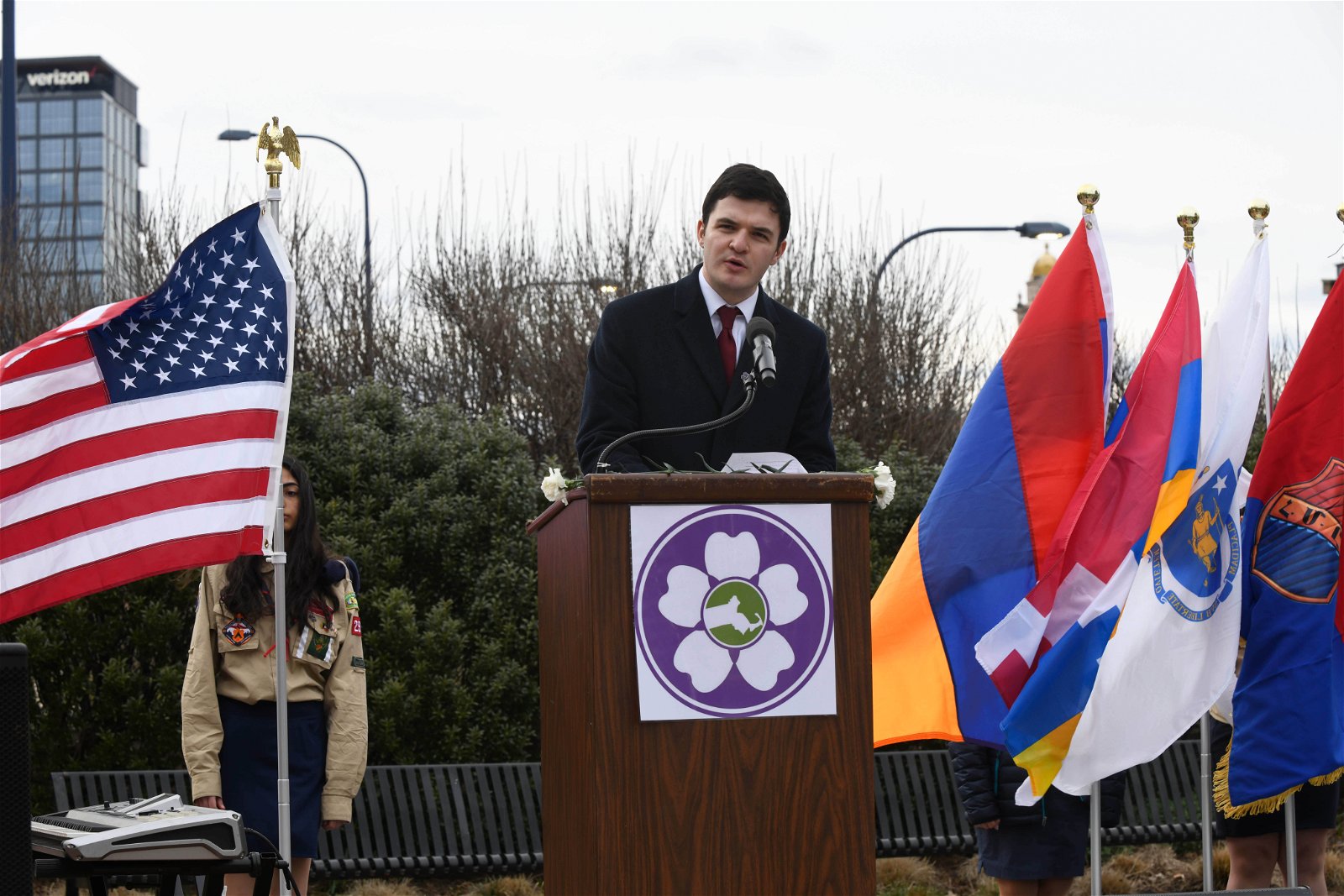 Hagop speaking at the Genocide Observance at the Armenian Heritage Park in Boston, April 20, 2024 (Photo: Ken Martin)
As we now celebrate a feast day in our churches, what remains is activism. Given the unbearable tragedies that the Armenian people have experienced, we run the risk of confusing our non-Armenian audiences. Is it about recognition? Is it reparations? Have the Azeris replaced the Turks as the main enemy? Is the loss of Artsakh and the deportation of 120,000 of our brethren our main concern? What about Western Armenia? What about the threat to Armenia’s eastern and southern borders by the Azeris? We have all attended events recently where literally all of these crimes are presented to the audience. It is overwhelming and lacks direction. I can only imagine what U.S. politicians think during their photo ops, when most of them would be perfectly happy with recognition and friendship with the Turks. Our message must be more than a litany of tragedies.
The theme we must focus on is that the oppression, genocide and atrocities have never stopped. This is what makes 1915 relevant in 2024. The unpunished crime encourages the perpetrator to continue.
The answer lies in synthesizing the experiences into a common theme to support specific objectives. The list is too long for any of our supporters to absorb. Setting priorities does not constitute forgetting anything. It simply means that, in times of crisis, you make adjustments. I began to find some answers this past weekend at the Genocide Observance at the Armenian Heritage Park in Boston. The day was led by Hagop, a young lawyer from the community. I have known him since he was an undergraduate student. He has always possessed a unique maturity and ability to articulate his thoughts. Sifting through some of the more traditional aspects of the program, I found Hagop’s message to be interesting. He encouraged participation on the local level and activism on global issues. We have nothing in the Diaspora without participation in our institutions, organizations and community life. It is the base from which we launch financial support and our connection to the homeland. His other point was to fight ambivalence with activism. Stated more simply, talk is cheap. Although the Diaspora continues to be generous, we also make far too many open-ended comments and criticisms. Our general audiences need direction that is simple and clear. Activism must be based on what one can do tomorrow. Too often at these rallies, there is an outpouring of emotion, but little in terms of practical direction. Over time, people choose not to attend, because they consider it overly redundant. This may explain the modest attendance at many of these events. Without direction, we become programmed to attend only major anniversaries (the 100th, etc.). Connecting our history into a common contemporary theme is one of the few ways to gain political influence.
The theme we must focus on is that the oppression, genocide and atrocities have never stopped. This is what makes 1915 relevant in 2024. The unpunished crime encourages the perpetrator to continue. This is what unites 1915, Western Armenia, Artsakh, Tavush and Syunik in one message. Our priority today must be to secure the homeland with the appropriate support, through the issues of border security and the genocide in Artsakh. Our messaging must contain pinpoint accuracy that integrates the last 109 years into specific, actionable priorities that will secure the homeland. In times of crisis, focus requires prioritizing the message. The homeland is threatened by the same genocidal mentality. Our people have suffered unimaginable atrocities at the hands of a determined enemy. Our uniting interest must be to prevent the loss of our homeland by those who have used genocide to erase Armenians from this world.
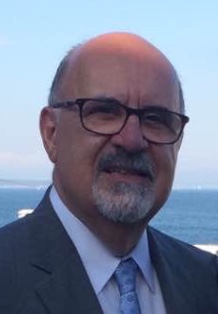
Stepan was raised in the Armenian community of Indian Orchard, MA at the St. Gregory Parish. A former member of the AYF Central Executive and the Eastern Prelacy Executive Council, he also served many years as a delegate to the Eastern Diocesan Assembly. Currently , he serves as a member of the board and executive committee of the National Association for Armenian Studies and Research (NAASR). He also serves on the board of the Armenian Heritage Foundation. Stepan is a retired executive in the computer storage industry and resides in the Boston area with his wife Susan. He has spent many years as a volunteer teacher of Armenian history and contemporary issues to the young generation and adults at schools, camps and churches. His interests include the Armenian diaspora, Armenia, sports and reading.
The post What is our message on April 24, 2024? appeared first on The Armenian Weekly.
Thread from fmr @CIA operations officer & current Congresswoman @RepSpanberger ⬇️ https://t.co/kHgrx2GLrF
— Hayden Center (@mvhaydencenter) April 24, 2024
So sad. @adefty is the world’s leading expert on U.K. parliamentary oversight of intelligence (a hugely important topic). His work on U.K. covert propaganda is genuinely pioneering and a huge influence on my own research. Outrageous to be in this position. https://t.co/RaXoqvSDq8
— Rory Cormac (@RoryCormac) April 24, 2024
russia’s only hope was disinformation and getting us to beat ourselves. They failed. Aid is law, REPO is law, victory is within reach
— Paul Massaro (@apmassaro3) April 24, 2024
BY TALEEN BABAYAN
As Armenians gathered in Times Square for the 39th year to commemorate the 109th anniversary of the Armenian Genocide, their spirits remained in solidarity with their brethren in Armenia, who continue to persevere in the face of challenges and change.
The notable event, sponsored by the Knights and Daughters of Vartan, and co-sponsored by a number of leading American Armenian organizations, created a communal space for descendants of survivors to remember their ancestors who perished in the Armenian Genocide, and to continue to fight for global awareness and recognition.
Senator Chuck Schumer (D-NY), Senate Majority Leader, who loyally ensures his annual attendance at the Times Square Armenian Genocide Commemoration, acknowledged that the Armenian Genocide does not receive enough attention, even when the Armenian people “experience the repercussions of the genocide today in Armenia.”
 Senator Chuck Schumer, Senate Majority Leader (D-NY). Photo credit: Harout Barsoumian-Bars Images
“Your presence shows that year after year you honor the memory of your ancestors whose lives were brutally cut short by the Ottoman Empire a century ago,” he said. “I’m always inspired to see you here as a living, resilient witness to the tragedy and moral outrage of the Armenian Genocide.”
Senator Schumer recounted stories he heard from survivors and their descendants which resonated with him on a personal level, as his ancestors also escaped massacres when Nazis invaded Ukraine during World War II.
“These atrocities are more than just a stain on the nation and those who did it, [as] the world looked away in each case with a blind eye,” he said, which prompted him to sponsor Senate resolutions that called on American presidents “to name the ‘Medz Yeghern’ for what it clearly was — a Genocide.”
“It happened because of you and your hard work, and your moral clarity,” said Senator Schumer reflecting on the overwhelming passage of US affirmation of the Armenian Genocide in Congress in 2019, and subsequent affirmation by President Biden in 2021. “But our work is not yet done, and it’s our duty to speak out against human rights abuses happening today against the Armenian people.”
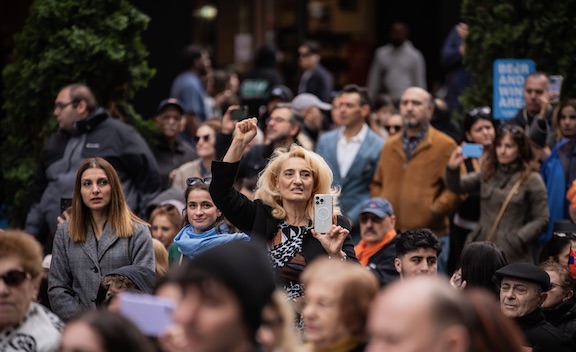 A scene from the 2024 Armenian Genocide Commemoration in Times Square. Photo credit: Harout Barsoumian-Bars Images
Senator Schumer said he “unequivocally condemns” the actions of Azerbaijan, including “their war of aggression in 2020, their cruel and cynical blockade of the Lachin Corridor, and assault on territory resulting in tragic deaths of hundreds of Armenians,” followed by the forced exodus of the ethnic Armenian population from Nagorno-Karabakh.
“I know I’m not alone in saying my mind was cast back to darker days that happened before,” said Senator Schumer, stating his promise that as Senate Majority Leader he will do everything he can to support Armenia and displaced Armenians from Nagorno-Karabakh, including securing funding and calling out human rights abuses, as he “watches these developments like a hawk.”
“We must never turn a blind eye again,” concluded Senator Schumer. “Armenia faces serious challenges, but if history is any guide we know that this small but mighty nation has outlasted authoritarian thugs in the past and will continue to do so because the Armenian nation has not only endured, but prevailed.”
Dr. Michael Rubin, senior fellow at the American Enterprise Institute and Director of Policy Analysis at the Middle East Forum, delivered remarks centered on both past and present history, tying in the current events in Armenia.
 Dr. Michael Rubin. Photo credit: Harout Barsoumian-Bars Images
“I’m not here to simply commemorate an old genocide,” said Dr. Rubin, who holds a PhD from Yale University in History and who has testified before Congress over 20 times. “It’s just as important to recognize that we’re here to prevent a new one.”
He highlighted that the US should follow France’s lead, which became the first NATO country to provide arms to Armenia against the growing threats of its neighboring country, and has “made clear Armenia’s sovereignty is not up for debate.”
“Appeasement does not work,” he continued. “It’s great that President Joe Biden kept his campaign pledge to recognize the Armenian Genocide, because ‘never again’ is now.”
“The time is now not only to commemorate the Armenian Genocide, but to recognize that prevention of all future genocides requires a strong and consistent partnership diplomatically, economically, and militarily, with the Republic of Armenia,” said Dr. Rubin.
In her remarks, Dr. Asya Darbinyan, who is a genocide scholar, educator, and Executive Director of the Center for Holocaust, Human Rights & Genocide Education (Chhange) in Lincroft, NJ, focused on the educational aspects of genocide and how it can advance the cause for recognition and mass atrocity prevention.
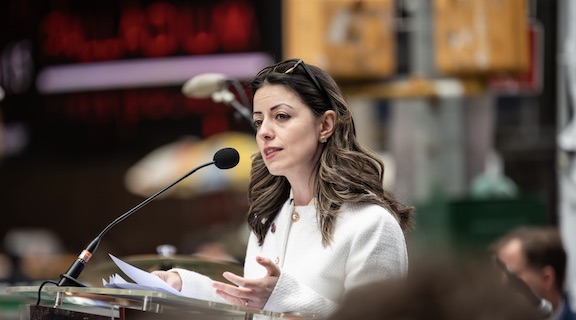 Dr. Asya Darbinyan. Photo credit: Harout Barsoumian-Bars Images
“With official recognition comes the opportunity to speak about genocide openly and boldly, and to promote educational programs,” said Dr. Darbinyan, who earned her doctoral degree in History from the Strassler Center for Holocaust and Genocide Studies at Clark University under the mentorship of Professor Taner Akçam. “Recognition allows the Armenian community and its descendants to move forward with our struggle for justice.”
She elaborated on the need to hold perpetrators accountable and to demand justice when basic human rights violations and dehumanization take place, as well as the importance of sharing photographs, letters, and documents of Armenians prior to the Genocide.
“Show the life of Armenians and their experiences because they were not nameless, faceless victims,” said Dr. Darbinyan. “Each of them had a name, a face, a home, and a story to be told that should be honored and not forgotten.”
Grand Matron of the Daughters of Vartan, Nancy Berberian Thompson, reflected on the Armenian martyrs who lost their lives and paid tribute to the survivors who found refuge in the US, without forgetting their history.
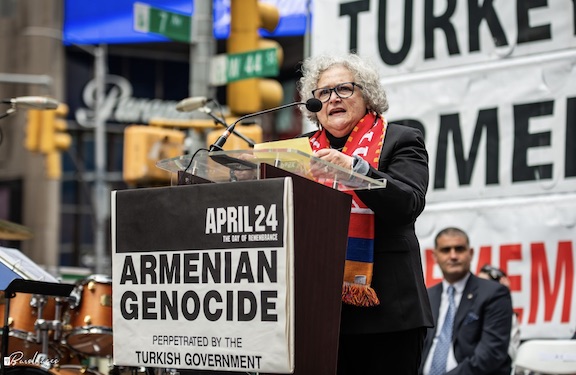 Grand Matron of the Daughters of Vartan Nancy Berberian Thompson. Photo credit: Harout Barsoumian-Bars Images
“When I was younger, we listened to the survivors of the Armenian Genocide and we keep their memories alive,” she said. “Armenians worked hard to be leaders here in the US and help aid Armenia.”
Berberian Thompson expressed the help that Armenia still needs, particularly in the aftermath of the Artsakh war and the displacement of 120,000 Artsakh Armenians. She noted that the Knights and Daughters have raised over $150,000 to assist them and will continue in their efforts.
Grand Commander of the Knights of Vartan, Hunan Arshakyan, emphasized the continuous Azeri aggression against the Armenian people, which serves as a reminder that “the threat towards the Armenian people remains real and present.”
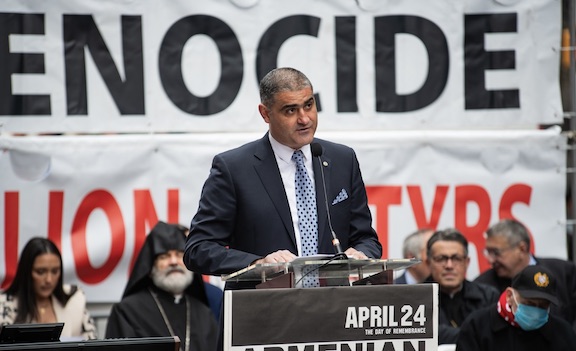 Grand Commander of the Knights of Vartan Hunan Arshakyan. Photo credit: Harout Barsoumian-Bars Images
He expressed that the Knights of Vartan is involved in cultural preservation and humanitarian efforts, serving as a bridge between the diaspora and Armenia.
“To the world, we declare our unwavering attempt to keep fighting for recognition and justice,” said Arshakyan, who emphasized the importance of the younger generations to “uphold our traditions and push forward our legacy.”
“Your energy and commitment are key to securing a future where Armenians can live in dignity and peace,” said Arshakyan. “We will never forget and we will never stop fighting for our right to live as Christian Armenians.”
Canada-based singer Harout Bedrossian and his band, featuring Steve Vosbikian, Jiro Tavitian and Mher Vartanian performed Armenian patriotic songs, including “Giligia,” “Hayer Miatzek,” “Karabakh,” “Artyok Ovker En,” for the audience.
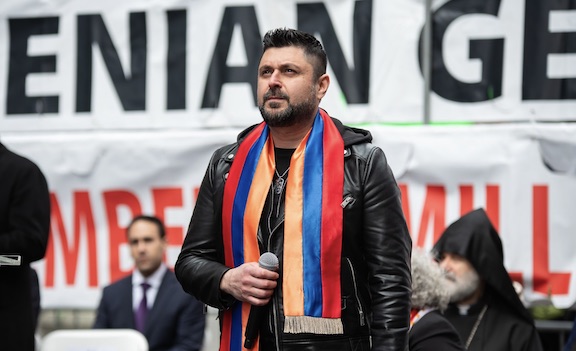 Singer Harout Bedrossian performing in Times Square. Photo credit: Harout Barsoumian-Bars Images
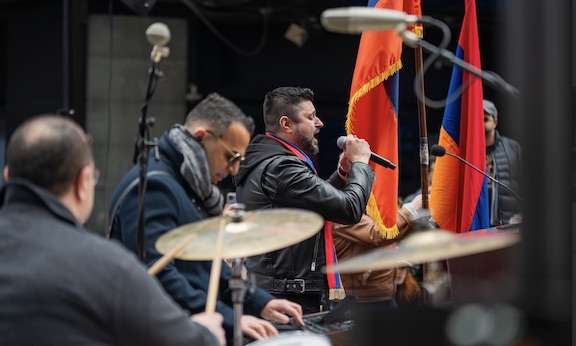 Singer Harout Bedrossian and his band performing in Times Square. Photo credit: Harout Barsoumian-Bars Images
Eastern Prelate Archbishop Anoushavan Tanielian delivered the invocation, and Very Rev. Fr. Simeon Odabashian, who represented the Eastern Primate Bishop Mesrop Parsamyan, delivered the benediction. Very Rev. Fr. Andon Noradounguian, Pastor of the Sacred Heart Armenian Catholic Church, who represented His Excellency Bishop Mikael Mouradian, Primate of the Armenian Catholic Eparchy of the USA and Canada, led a prayer; other clergy in attendance included Very Rev. Fr. Sahag Yemishyan, Vicar General of the Eastern Prelacy and Pastor of Sts. Vartanantz Armenian Apostolic Church.
The Dance Grigorian Ballet School from Lyon, France, under the directorship of Anna Oundjian Grigorian performed an Armenian dance. The Holy Martyrs Armenian Day School students sang the Armenian and American anthems, and “God Bless America” was performed by Nina and Mila DaRocha.
 Members of the Dance Grigorian Ballet School performing an Armenian dance in Times Square. Photo credit: Harout Barsoumian-Bars Images
The Knights and Daughters of Vartan have sponsored the Times Square Armenian Genocide Commemoration since 1985, along with the support of a multitude of Armenian American community organizations. This year the event was co-chaired by Haig Gulian, Ari Minnetyan, and Christopher Artun, under the guidance of Chairman Emeritus Hirant Gulian.
David Ojakian (Armenian Assembly of America), Chantelle Nasri (Armenian National Committee of America) and Nanor Hartounian (UCLA’s The Promise Armenian Institute), served as MCs, while Bryan Ardouny, Executive Director of the Armenian Assembly of America served as media spokesperson.
The winners of this year’s Knights and Daughters of Vartan Annual Essay Contest were announced: Sirahn Toufayan, 1st place; Madeline Berberian-Hutchinson, 2nd place; Mia Seferian Vickery, 3rd place; and runner-up Angela Mashuryan.
Co-sponsoring organizations included the Armenian Assembly of America, represented by Bryan Ardouny, Executive Director; Armenian General Benevolent Union, represented by Natalie Gabrelian, Director of Districts, Chapters, and Central Board Administration; Armenian National Committee of America; ADL-Ramgavar Party, represented by Norair Megeurditchian, Chairman of the Eastern District USA; Tekeyan Cultural Association, represented by Hilda Hartounian, Member of the Tekeyan Cultural Association Board of Directors of US and Canada and Chair of the Tekeyan Cultural Association Greater New York Chapter; Armenian Bar Association, represented by Gevorg Karapetyan; as well as the Armenian Missionary Association of America; and the Armenian Council of America.
Participating organizations included the Armenian Network of America, Armenian Youth Federation, Homenetmen Scouts of NY and NJ, Armenian Relief Society, Armenian Church Youth Organization of America, AGBU Young Professionals, Armenian Students Association, Hamazkayin Cultural Association of NY and NJ, and tri-state Armenian college and university clubs.