

Categories
South Caucasus News

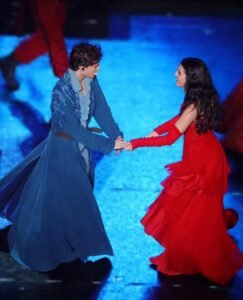
Hakob Ghasabian, the Armenian Roméo of the most famous French musical


Hakob Ghasabian

In the rich history of Roméo and Juliette, the French version of the classic tale that has captivated audiences around the world for two decades, something exciting has happened. Meet Hakob Ghasabian, a young actor of Armenian origin who has taken over the role of Roméo, previously played by Damien Sargue for two decades. 

Ghasabian is no stranger to the stage, having already made his mark in Europe with many remarkable performances. Yet, his journey with Roméo and Juliette was quite a ride, taking him on a whirlwind tour across China for four months, where he performed in 24 cities. 

In my interview with Ghasabian for the Weekly, we discussed what it means to step into such big shoes after Sargue’s long tenure. We talked about bringing his own style to the character, his musical inspirations and his strong connection to his Armenian heritage.


Join me in exploring the story of the Armenian Roméo of the most famous French musical!

Milena Baghdasaryan (M.B.): How does it feel to be the first actor to step into the role of Roméo after Damien Sargue’s 20-year tenure? Did you feel any pressure taking on such an iconic role?

Hakob Ghasabian (H.G.): It was so stressful and yet so exciting for me to be the first, after Damien, to perform as Roméo in the French version of the worldwide story of Roméo and Juliette. When the producer called me to ask if I was interested in playing this role on a huge tour in China consisting of 90 shows, I thought it was a joke, and I couldn’t believe it. It felt like I was dreaming! I had just finished another tour in France with 85 shows in the musical Je vais t’aimer, and I was on vacation thinking about what I would do next when this proposal suddenly came to me. I was so happy…I remember the producer asked me to record the most difficult song of the musical called “J’ai peur,” and I didn’t know this song at all. So, all night long, I worked so hard, recorded it in my studio and sent it to her at 6:00 in the morning. She was impressed and told me to pack my bags, and one month later, we were in Shanghai.
M.B.: In what ways do you believe your portrayal of Roméo differs from Damien Sargue’s interpretation? Are there any elements you specifically aimed to bring to the character?

H.G.: You know, for me, Damien is a mentor, and I wanted to learn everything from him, because he’s an incredible performer. After all these years, he’s still the same hard worker and strong artist he was 20 years ago. Most of all (and this is very important from my perspective), he is such a good person, always radiating good vibes and making people around him feel good and confident. But at the same time, I wanted to portray my version of Roméo and not simply copy his way of doing things, because we are two different artists with different voices, ages and experiences. So, I aimed to portray the young Roméo as he’s depicted in the original story: insecure yet deeply in love. Perhaps I brought a breath of fresh air to the role, because Damien is now 42, whereas I’m 20, so I’m closer to Roméo’s age.

M.B.: What do you hope audiences take away from your performances, both in Roméo and Juliette and in your other musical endeavors?

H.G.: I just want to make people who come to see my shows have a good time, forget about their daily lives and problems for two hours and enjoy the moment. You know, that is our job: the audience is our boss, and we want to make them laugh, sing and sometimes even cry, taking them to another beautiful world, like when you’re watching a movie! Always, my desire is to be sincere and honest with the people who have bought their tickets and come to see the show, including in my artistic approach, because I really enjoy giving 1,000-percent of my energy on stage. Just like that, a two-hour concert seems like 20 minutes to me, because good moments always pass quickly.

M.B.: Have there been any artists or genres that have had a significant impact on your style?

H.G.: When I was young, I always listened to Yanni and his crazy group of musicians from all around the world. They inspired me to start playing the violin, which is my first instrument. I also listened to Queen, The Beatles, Michael Jackson, Celine Dion and Charles Aznavour; they are legends to me. More recently, I love listening to Lewis Capaldi and Shawn Mendes – they’re such talented singers.

M.B.: As someone of Armenian origin, how do you incorporate your cultural background into your art, especially while being in the spotlight on an international stage?

H.G.: As a French singer with Armenian roots and an Armenian surname (Ghasabian), I’m proud to tell people that, as Aznavour said before, I’m 100-percent French and 100-percent Armenian. For me, having these double cultures is a privilege. I always share songs, news and shows that I perform in Armenia on social media, because people are curious to discover my second culture here in France. I have many friends who knew nothing about Armenia and Armenian culture, and now they love it, especially our tasty foods!

M.B.: Hakob, recently you visited Armenia as a member of the delegation of the French Minister of the Armed Forces. Was this your first visit to the country? If so, could you share your impressions and experiences during the visit?

H.G.: It was not my first visit to Armenia, because my family and I used to go on vacation there every year. Additionally, I have performed many times in Yerevan. However, as always, it was wonderful to return to my motherland, feeling the energy of the people, speaking the language and showing the beauty of Yerevan to the French people and the French Ministry of the Armed Forces delegation with me.

M.B.: During the delegation’s visit, were there any moments or interactions that stood out to you as particularly meaningful or impactful, either on a personal level or in terms of diplomatic relations between the two countries?

H.G.: You know, our visit was very emotional, because I felt that our delegation was deeply impacted by the situation in Armenia. They all wanted to show that France and Europe are supporting the Armenian people, and I was deeply touched to be a part of that. I remember when we were at the Tsitsernakaberd memorial, I saw the face of the French Minister becoming so emotional, and the rest of our crew felt the same. It was as if you couldn’t describe the energy of the moment; you could imagine the past, all those victims of the Armenian Genocide, and you feel the pain for them…It was the strongest moment of our visit, I think.

M.B.: How do you perceive the current state of relations between Armenia and France, especially in terms of cultural exchanges and cooperation? Do you believe that your involvement in projects like Roméo et Juliette contributes to strengthening these ties? 

H.G.: I think that France and Armenia are close to each other, and it’s not a new thing. France has always stood with Armenia throughout history, so it’s a beautiful link that we have to maintain, especially nowadays. It’s not only politically, but also in terms of culture. I don’t know if I can help Armenia, but I try to do everything I can by showing that we are a strong and good people spread across the world, but together at the same time.

M.B.: As someone with Armenian roots, do you feel a personal connection to the relationship between Armenia and France? How does this connection influence your work and interactions within both communities?

H.G.: I feel that French people really like Armenians, and it’s amazing here when I mention that I’m half Armenian; everyone tells me, “Oh, we know Charles Aznavour!” I believe we have to be this kind of ambassador for Armenia, just like he was, in our own way – whether as engineers, teachers, doctors, artists, etc. And I know that there are a lot of brilliant Armenians around the world.

M.B.: Looking ahead, do you see opportunities for further collaboration or exchange between Armenia and France, particularly in the fields of culture, arts or entertainment? If so, what areas do you believe hold the most potential for growth and cooperation?

H.G.: Next to my French career, I have different proposals to raise my voice for Armenia – for example, with this visit to Yerevan with the French Minister, or also years ago, and maybe this year by singing for the Howard Karagheusian Foundation, which is doing a great job in Armenia. When I first met Charles Aznavour, he told me, “Don’t forget where you come from to know where you’re going,” so now I always remember that, and I think it’s important for all Armenians to remember.

M.B.: Are there any upcoming projects or collaborations that you’re particularly excited about? What can audiences look forward to from you in the future?

H.G.: At this moment I’m in the studio composing, writing and recording my album with my team, and I start another tour in France in huge arenas with another musical called Starmusical, so I’m now also in rehearsals every day. I want to make a big concert in Yerevan, maybe this year or the next; I would be really happy to do that…Also, this year marks the 100th anniversary of Aznavour, so I’m preparing many concerts here in France, in Yerevan, but also maybe in the United States. So stay tuned! I post all that on my Instagram page @hakoboff or on my Facebook.

M.B.: What is the best advice you have ever received, and what would be your own advice to young Armenian artists?

H.G.: I think the best advice that I’ve received, and I want to share with young people, is to believe in yourself, dream big, find your own path and work hard to achieve your goals. You have to do it yourself; no one will do it for you. Trust yourself, learn from your mistakes and grow. Finally, don’t forget who you are; we’re all different, we’re all special, and we’re all unique.

Author information
Milena Baghdasaryan

Milena Baghdasaryan

Milena Baghdasaryan is a graduate from UWC Changshu China. Since the age of 11, she has been writing articles for a local newspaper named Kanch (‘Call’). At the age of 18, she published her first novel on Granish.org and created her own blog, Taghandi Hetqerov (‘In the Pursuit of Talent’)—a portal devoted to interviewing young and talented Armenians all around the world. Baghdasaryan considers storytelling, traveling and learning new languages to be critical in helping one explore the world, connect with others, and discover oneself. Milena currently studies Film and New Media at New York University in Abu Dhabi.

|

The post Hakob Ghasabian, the Armenian Roméo of the most famous French musical appeared first on The Armenian Weekly.


Categories
South Caucasus News

A doctor in Azerbaijan was fired over Toplum TV – JAMnews


A doctor in Azerbaijan was fired over Toplum TV  JAMnews

Categories
South Caucasus News

USC Marks Inaugural Armenian History Month in April – Armenian News by MassisPost


USC Marks Inaugural Armenian History Month in April  Armenian News by MassisPost

Categories
South Caucasus News

1915 and Artsakh are a continuum – Armenian Weekly


1915 and Artsakh are a continuum  Armenian Weekly

Categories
South Caucasus News

Glimpses into the ARF Photo Archives: Armenian Legionnaires Immortalized – Armenian Weekly


Glimpses into the ARF Photo Archives: Armenian Legionnaires Immortalized  Armenian Weekly

Categories
South Caucasus News

Beyond a warning message from Tehran – Armenian Weekly


Beyond a warning message from Tehran  Armenian Weekly

Categories
South Caucasus News

A heartfelt Musical Armenia concert at Carnegie Hall – Armenian Weekly


A heartfelt Musical Armenia concert at Carnegie Hall  Armenian Weekly

Categories
Audio Review - South Caucasus News

U.S. Senior Advisor on Caucasus Visits Yerevan for Talks


Luis Bono, the United States Senior Advisor for Caucasus Negotiations, arrived in Yerevan on Wednesday for talks with senior government officials.

Bono met with Armenia’s National Security chief Armen Grigoryan, whose office reported that the two “exchanged ideas on the negotiation process for the settlement of Armenian-Azerbaijani relations.”

Reportedly, Grigoryan and Bono also touched on several matters related to U.S.-Armenia relations.

In his meeting with Foreign Minister Ararat Mirzoyan, Bono focused on the security climate in the South Caucasus.

Mirzoyan and Bono discussed the normalization process between Armenia and Azerbaijan, with the Armenian foreign minister highlighting Yerevan’s posturing on the key issues.

“In particular, the importance of adherence to the mutual recognition of territorial integrity based on the Alma Ata declaration of 1991 and the further process of border delimitation based on this declaration and maps with strong legal foundations was stressed,” a statement from Armenia’s foreign ministry said.

Mirzoyan reportedly reiterated Armenia’s approach to opening of regional transport routes, saying that Yerevan is advancing the effort based on the principles of sovereignty, jurisdiction, reciprocity, and equality.

Bono also met with Ruben Rubinyan, Armenia’s special envoy on negotiations with Turkey.

Normalization of relations between Armenia and Turkey were discussed within the context of regional security, according to a foreign ministry statement.


Categories
Audio Review - South Caucasus News

Mamuka Merkviladze: Furtive New Head of the Georgian Interests Section in Russia


On March 11, Prime Minister Irakli Kobakhidze announced new appointments to the Government Administration. According to the changes Giorgi Kajaia, the former head of the Georgian Interests Section at the Swiss Embassy in Russia, has been appointed as the PM’s Special Representative for Relations with Russia.

On the same day, Foreign Minister Ilia Darchiashvili confirmed during the press conference that Mamuka Merkviladze is to succeed Kajaia as the Head of the Georgian Interests Section at the Embassy of Switzerland in the Russian Federation.

The journalist, in particular, inquired about Merkviladze’s alarming ties to Russia and what it would mean for Georgia to have “a member of Putin’s inner circle” representing Georgian interests. FM Darchiashvili replied: “Mr. Merkviladze is a very experienced person, and we are sure that he will fulfill the tasks assigned to him, and I am sure that his experience will help him… I don’t know what facts you are talking about. These are your assessments [to the journalist], interpretations”.

Merkviladze, a Georgian businessman with links to Russia, has kept a fairly low profile. Still, he is currently a shareholder in almost 30 different companies in Georgia. He shares his business with family members, friends, and the families of his friends. He is also the President of the National Shooting Federation, elected in January 2022.

In Russia, Merkviladze is best known for his wife, Tamriko Dudunia. Dudunia is a Russian singer of Georgian origin. Her family left Georgia when she was just two years old and moved to Russia’s western town of Smolensk, close to the Belarus border. She trained as a pediatrician but also sang professionally.

In 2019 she won the all-Russian singing contest sponsored by Russian Defense Minister Sergei Shoigu, “New Star-2019”, which airs on the Russian Defense Ministry’s Zvezda (Star) TV channel. Dudunia was awarded the prize by Shoigu himself. Judging by her social media presence, where she is a medium-scale influencer with some 30,000 Instagram followers, Dudunia is residing in Russia. She is doing her advanced medical internship at the “Central State Medical Academy” subordinated to President Putin’s Administration.

Mamuka Merkviladze: Man of Useful Connections

Vice-President of the Georgian Diaspora in Russia

The information on Mamuka Merkviladze available from open sources is sketchy. It is known that since 2021 he has been the Vice-President of the Moscow-based diaspora organization Federal Georgian National-Cultural Autonomy.

He was one of the people who took part in the meeting of the diaspora leaders in October 2021, initiated by David Tsetskhladze, the President of this organization. At the meeting, it was decided to appeal the “the relevant government agencies” of Georgia and Russia with a request to resume direct flights and introduce a visa-free regime between Russia and Georgia. This indeed happened half a year later, which leads one to believe that the organization provided an official and public relations cover and a pretext to the Kremlin.

The appointment of Merkviladze as the Head of the Georgian Interests Section at the Embassy of Switzerland was also initially announced on the diaspora organization’s Telegram channel and welcomed by its President.

“Merkviladze promised that he would do everything possible to ensure that the Georgian government continues to hear the voice of the Georgian diaspora [in Russia]. He is intimately familiar with the life of Georgians in Russia. He was the vice president of the Federal Georgian National-Cultural Autonomy for several years. This step on the part of the Georgian government is very positive,” – posted Tsetskhladze on March 12.

Apart from having good connections in Russia, Merkviladze is also well-connected in Tbilisi, apparently through his erstwhile affiliation with Bidzina Ivanishvili, Georgia’s richest man and the honorary Chair of the ruling party. He is formally associated with at least three larger-scale infrastructural and one natural resources management initiative, all of which have been controversial.

Director of GR Logistics & Terminals

In 2017-2018, Merkviladze served first as the Deputy Director and later as the Director of GR Logistics & Terminals, a subsidiary of Georgian Railways He was appointed by his close friend and business partner, Davit Peradze, who serves as the Director of the Georgian Railway. Local anti-corruption watchdogs and media representatives have been calling on the government to investigate this nepotism case for years, to no avail.

Notably, Peradze is closely connected with the former Prime Minister of Georgia and the founder of the ruling Georgian Dream party, Bidzina Ivanishvili. In 2007-2011 he worked in various positions in Ivanishvili’s Cartu Group, and in 2014-2017 he was the director of Mtkvari HES Ltd., a hydro-energy project established by Ivanishvili’s Co-Investment Fund. Ivanishvili appointed Peradze as the Director of the Georgian Railway at the end of 2017 to replace Mamuka Bakhtadze, who became the Prime Minister of Georgia and served from 2018 to 2019.

During Merkviladze’s time at GR Logistics, the media reported that the company leased 799 wagons worth USD 64 million to Russia. As a former employee of GR Logistics & Terminals, Nino Lomidze told Rustavi 2 in 2019 that the Georgian Railways had conspired to skip the public auction of these wagons, which were transferred to GR Logistics & Terminals by Peradze’s personal decision.

According to Lomidze, GR Logistics & Terminals later leased the wagons to the Russian Railway Invest Group at a higher-than-market price, but only 58% was paid into the company’s account. She also noted that Georgia took responsibility for paying for the repair of the wagons damaged in Russia and Kazakhstan. The Georgian Railways has denied these allegations.

Merkviladze’s Involvement in Building Multimodal Terminal in Poti

Merkviladze has been involved in strategically important transport infrastructure projects in Georgia. In 2023, Kazakhstan’s PTC Holding LLP signed a contract with Georgian partners, represented by Merkviladze, for the construction of a multimodal terminal in Poti, which was to ensure the transportation of 450,000 TEU (twenty-foot equivalent unit) of cargo per year.

For the implementation of the project, a joint venture Poti Transterminal in which the Georgian side and PTC Holding had equal shares of 50%. The investment value of the Georgian side is USD 10 million. The construction of the terminal was to be completed in 2023, but the works are still in progress.

The construction of the terminal is met with protests from the locals. On March 11 this year, residents of Poti blocked the road leading to the terminal, demanding an immediate halt to the project since they believed that the terminal would process hazardous waste and pose a threat to their health.

Owner of the Company Working on the Balda Canyon Project

In November 2022, the Georgian Agency for Protected Areas announced an auction of the 24,130 square meters of land surrounding the Balda Canyon in the municipality of Martvili (western Georgia region of Samegrelo). LLC Kanioni 350, registered three days before the announcement, was the only company that participated in the controversial auction and subsequently won the tender to build tourist infrastructure, including a visitor center, at least 350 meters of footpath and sidewalk, bridges, overlooks, and a 350-meter-long roller coaster, worth GEL 2.8 million (approx. USD 1.05 million).

Mamuka Merkviladze and his brother, Giorgi Merkviladze are the shareholders of the company LLC Kanioni 350 (Giorgi Merkviladze is also the director of the LLC). The locals of Martvili, who have had unimpeded access to the Balda Canyon all their lives, weren’t informed of the project until three months after the auction. They have been protesting against the project since October 2023, but many of the protesters have faced arbitrary administrative charges and a lack of response from the local government.

Social Justice Center (SJC), a watchdog, has called upon the state authorities to stop the work on the Balda Canyon, citing the illegal auction and the fact that “the company is carrying out the work carelessly, cutting down trees and plants, damaging the natural environment.”

“It is important that the state authorities strengthen the supervision of the ongoing work and assess the current situation in the canyon in order to prevent even greater environmental damage. In addition, since the decision to lease the canyon to a private company was made in violation of the law, it is necessary for the Ministry of Environmental Protection to stop the ongoing work in the Balda Canyon – until an agreement is reached with the local population and the issue is resolved legally,” – said SJC.


Categories
Audio Review - South Caucasus News

Two Sentenced in Sgt. Roin Shavadze’s 2008 Homicide Case


The former deputy head of the then Constitutional Security Department in Adjara and a member of the Special Forces were found guilty by of intentional unlawful detention of Sergeant Roin Shavadze, participation in the group killing of a helpless person, and abuse of power through the use of force. Both men were sentenced to 16 years in prison. The sentence was reduced under the amnesty law and the defendants will have to serve 12 years in prison.

Sergeant Roin Shavadze was a brigade sergeant in the Georgian Ministry of Defense. He participated in a peacekeeping mission in Iraq as part of coalition forces in 2005-2006, during which he received a medal for exemplary service. He also fought in the August War of 2008. On August 16, 2008, Georgian security forces arrested Roin Shavadze in the streets of Batumi, Adjara. Eyewitnesses reported seeing the security officers beating him and calling him “a traitor of this country”, before they put him in a police van. Six hours later, a police officer informed Shavadze’s wife of her husband’s death. According to the official version at the time, Shavadze had been arrested for a drug offence and was fatally injured while trying to escape.

According to the Prosecutor’s Office (POG), to conceal the illegal arrest and murder of Roin Shavadze, the perpetrators devised a false narrative and created a fabricated arrest protocol claiming Shavadze was carrying drugs.

The Prosecutor’s Office also said that the drugs were planted by those involved in the illegal arrest. The perpetrators staged a scenario in which Shavadze allegedly tried to escape from the police van on the way to Tbilisi, thus justifying the use of force against him. The perpetrators then made the killing of Shavadze appear to be in self-defense. According to the prosecutor’s office, the investigation has exposed this false narrative.

On July 28, 2023, the Prosecutor’s Office of Georgia reported that eight people were arrested, and two search warrants were issued on charges of unlawful detention and intentional homicide of Sgt. Roin Shavadze, and abuse of authority related to this case.

According to the Prosecutor’s Office, criminal proceedings have been initiated against a total of 12 people in this case. Investigations are continuing with the aim of identifying and exposing any other persons involved in the crime.

Earlier on November 19, 2020 the European Court of Human Rights (ECtHR) decided on “Shavadze vs. Georgia”. The Court found a violation of the substantive and procedural aspects of Article 2 of the European Convention, which guarantees the right to life. ECtHR further spoke of “the lack of independence and impartiality of the initial investigation” and added that “the criminal investigation into the death of the applicant’s husband has been ineffective and in breach of the respondent State’s procedural obligations under Article 2 of the Convention.”