Categories
South Caucasus News

Joint Press Statement Following 8th EU-Georgia Association Council Meeting


On February 20, the 8th meeting of the EU-Georgia Association Council was held in Brussels for the first time since Georgia became an EU candidate country. The meeting was chaired by EU High Commissioner Josep Borrell, while the Georgian delegation was led by newly appointed Prime Minister Irakli Kobakhidze. EU Commissioner for Neighborhood and Enlargement Olivér Várhelyi also attended the meeting.

Georgia’s EU Candidacy, Nine conditions

The Association Council welcomed the European Council’s “historic” decision to grant Georgia the status of EU candidate country, stating that this “took the EU-Georgia relations to a new strategic level”.

Regarding the nine conditions set by the European Commission for Georgia to move to the next stage of opening accession negotiations, the EU “encouraged Georgia to further progress on reforms”.

It was also stressed that the conditions must be met through “meaningful and irreversible reforms, prepared and implemented in consultation with the opposition and civil society”. The EU side stressed that “Georgia’s progress towards the European Union will depend on its own merit in meeting the accession criteria,” – the press release says.

Reforms, Political Polarization

The press release says that the EU acknowledged the reforms undertaken by Georgia to align its legislation with that of the Union. It is noted that the goal of becoming an EU member is “strongly supported” by the Georgian people, as well as by its government and the political spectrum in general, which has been a “key driver” in the reform process.

The press release says that at the meeting “the EU urged all political actors in Georgia to demonstrate constructive cross-party cooperation and dialogue, overcome polarization and refrain from actions that could further deepen the political tensions and hamper the country’s reform agenda.” In this context, the Association Council praised Georgia’s “vibrant” civil society and underlined the importance of “inclusive, meaningful and systematic engagement with civil society in the policy-making processes.”

Disinformation

According to the press release, discussions at the meeting also focused on the fight against disinformation, anti-EU rhetoric and foreign information manipulation and interference. While noting the government’s efforts, the EU called on Georgia to take meaningful steps in this regard.

State Institutions, Rule of Law, Electoral System

The Association Council stressed the need to ensure the “full independence, accountability and impartiality of all State institutions”, adding that this should be done in line with European standards and the recommendations of the Venice Commission. Discussions at the meeting focused in particular on the judicial, prosecutorial, anti-corruption and monetary institutions, as well as on the need to further improve the implementation of parliamentary oversight, notably of the security services.

The need for further efforts to pursue a comprehensive judicial reform in particular to ensure “the full independence, accountability and impartiality” of all judicial and prosecutorial institutions” is underlined in the document.

The Association Council noted the reforms undertaken to improve electoral framework and called on Georgia to finalize the electoral reform ahead of the upcoming 2024 Parliamentary elections in line with the Venice Commission and OSCE/ODIHR recommendations.

Human Rights Protection

The Association Council welcomed the work undertaken towards the protection of human rights in Georgia, with an emphasis on reforms to ensure gender equality, gender-based and domestic violence, as well as work on legislation related to the rulings of the European Court of Human Rights and the appointment of the Public Defender. The EU underlined the need to continue this work and ensure the enhanced respect of human rights and fundamental freedoms, including the protection of freedom of expression, assembly and media in Georgia.

De-oligarchization

Noting the work undertaken on deoligarachization, the Association Council stressed the need to implement the current Action Plan efficiently through a multi-sectoral systemic approach. the EU welcomed the creation of the Anti-Corruption Bureau, and stressed the importance of its effectiveness and independence. The EU underlined the importance of further efforts to tackle all forms of corruption, including as part of deoligarchization efforts.

CFSP Alignment

The Association Council underlined “the strong expectation [of the EU] for Georgia to substantially increase its alignment with the EU Common Foreign and Security Policy” and called on Georgia to progress towards full alignment.

According to the press release, the meeting discussed “Georgia’s proactive engagement and constructive cooperation in preventing circumvention of EU sanctions against Russia.” In addition, the EU expressed its readiness to further assist Georgia in addressing the challenges it faces as a consequence of Russia’s war of aggression against Ukraine, including in the area of cyber and hybrid threats, and to support the Georgian Armed Forces through the European Peace Facility. Georgia expressed willingness to launch cooperation with the UE specialized agencies as well as to participate in PESCO projects.

Occupation

The EU reiterated its support for Georgia’s sovereignty, independence and territorial integrity within its internationally recognized borders. The discussions also focused on the conflict resolution and the EU’s policy of non-recognition and engagement in Georgia. The sides reaffirmed their commitment to the Geneva International Discussions (GID) and Incident Prevention and Response Mechanisms (IPRMs)

The EU and Georgia expressed concern regarding Russia’s attempts to incorporate the Georgian regions of Abkhazia and Tskinvali region/South Ossetia into Russia’s political, security, military economic, and others spheres. The Council condemned the killing of the Georgian civilian Tamaz Ginturi by Russian forces illegally stationed in Georgia. The sides also discussed the security, humanitarian and human rights situation, including violations of the rights to freedom of movement, property, education in the mother tongue and ethnic discrimination against Georgians.

Economy

The Association Council welcomed Georgia’s post-pandemic economic recovery and its GDP growth. It also praised Georgia’s fiscal and monetary policies against the background of Russia’s war of aggression against Ukraine. Meanwhile, the EU mentioned the National Bank of Georgia and stressed the importance of ensuring the independence and credibility of the country’s main financial institution.

The EU reiterated Georgia’s role as a partners for European energy security, and notably its transit role for Caspian hydrocarbons.

In addition, the sides also discussed issues related to EU-Georgia trade relations, Georgia prospects for joining the EU’s Single Euro Payments Area programs and EU’s roaming system, educational exchange programs, EU’s Civil Protection Mechanism, etc.

Also Read:

Categories
South Caucasus News

Interview with Mel Carvill


As part of the visit, Mel Carvill gave an interview and presented BOGG financial group, spoke of the investment attractiveness of Armenia, discussed the details of the possible transaction and importance of the transaction for both parties. 

Categories
South Caucasus News

NPR News: 02-21-2024 1PM EST


NPR News: 02-21-2024 1PM EST

Learn more about sponsor message choices: podcastchoices.com/adchoices

NPR Privacy Policy


Categories
South Caucasus News

A new approach to save our declining Sunday schools


Why is it that our church infrastructure and our communities are often discussed as interchangeable terms? The church goes beyond the spiritual needs of the diaspora, given the unique relationship between our faith and our heritage. The vast majority of our communities in the diaspora are centered around a local parish with a complement of patriotic, philanthropic and educational organizations. It is rare to see a community in the Armenian diaspora without a functioning church parish. When our survivor generation came to these shores, they brought their familial lifestyle with them, which was centered around the church. Even today, as changing demographics expand our community base into other geographies, the establishment of a new community usually begins with a mission parish. This reflects not only the importance of spirituality in Armenian life, but specifically the importance of the institution itself in sustaining the diaspora. In the absence of the church, our communities would operate as several loosely connected secular organizations. 

The church should never take its communal importance for granted and neither should members of the community. There are several barometers of the sustainable health of the church. We can look to spiritual health, outreach programs, financial stability or parish membership. These are all important and contribute to the overall picture, but I believe that the engagement of the youth is one of the best indicators of vibrancy and the future direction of this institution. Ironically, the youth represent the future but are underrepresented in the decision-making processes of the church. We assume we know what is in their best interests. This is one of the reasons why I am always interested in the health of the Sunday school programs. Traditionally, our Sunday schools are designed to offer Christian education according to the teachings of the Armenian church from preschool through high school. In some parishes, high school students are blended with other programs, such as the ACYOA in the Diocese. Using Sunday schools as a barometer of a community’s health, we should be very concerned. Usually our proxy decisions for the youth work, but in times of rapid change there is dangerous latency. Such is the case with the digital revolution as it relates to education. 

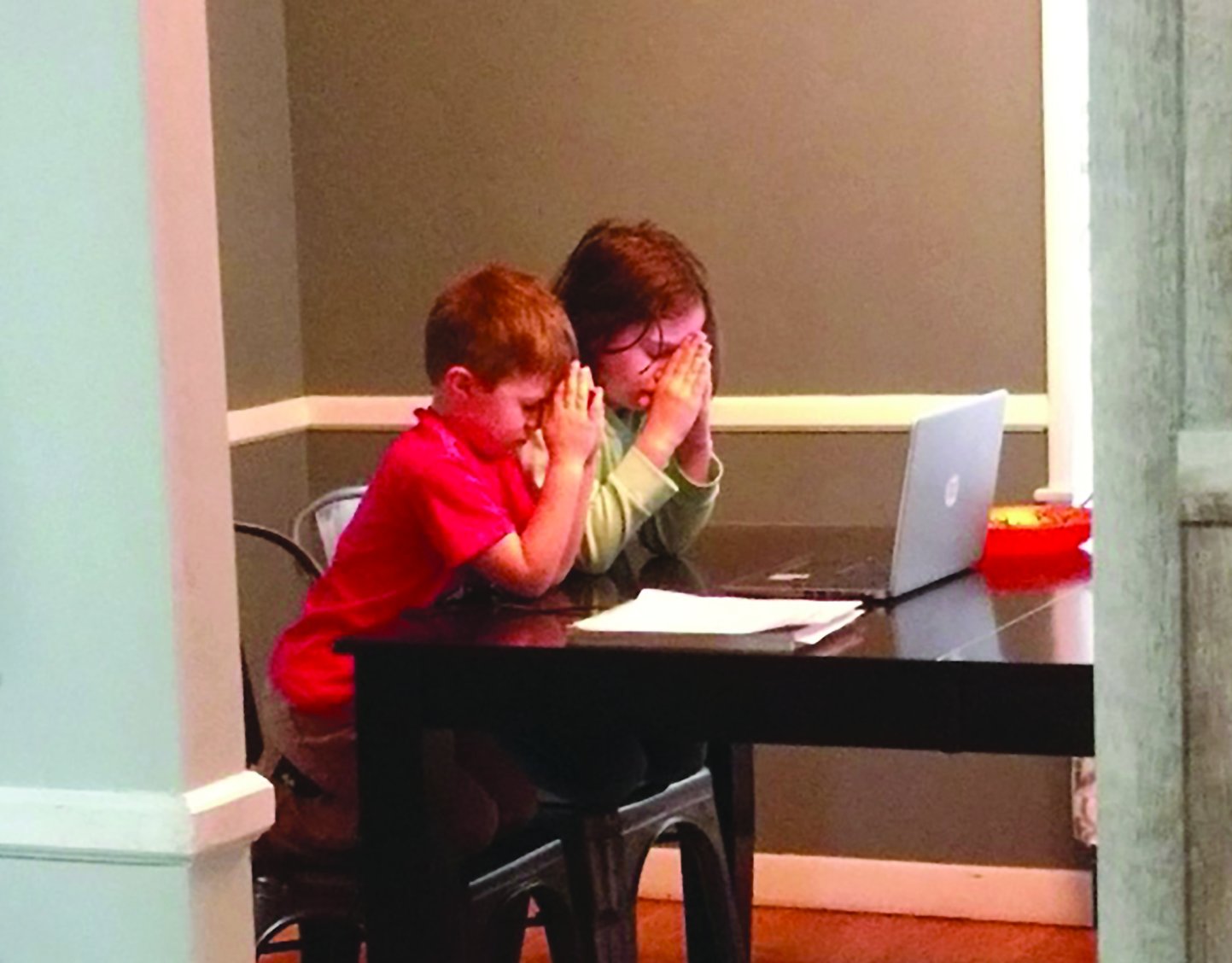
Harry and Elise Markarian of Providence bow their heads in prayer in front of their computer as Sunday School class began in 2021.
Our Sunday schools, whether in the Prelacy or Diocese, have been in decline for a few decades. We can use almost any metric to illustrate the points of regression. The number of students according to registrations has declined consistently since the late 70s. Registration is actually a more forgiving measurement, since it simply tells us who signed up in September but does not account for the inconsistent attendance week to week. We have teachers in every community who prepare lessons weekly only to have the students attend inconsistently. Imagine the challenge of teaching with less kids and a different group week to week. One of the ironies is that a significant emphasis has been put on curriculum and other teaching material. We are well prepared in this area, but it has not slowed the decline. This week I had the pleasure of speaking with someone who taught Sunday school for many years and recalled when the parish Sunday school had 400 students; today, it has a small fraction of that. Unfortunately, this is not an isolated example. Most of our parishes are experiencing this tragedy, and we have parishes that do not have a Sunday school. What can their future be? There are many dedicated volunteers in parishes and staff at our Diocese/Prelacy who have discussed this problem at retreats, teacher training seminars and conventions. The challenge has received significant attention, but we seem to be pushing the wrong buttons. Are we reaching the intended audience?         

The data tells us that Christian education is simply not as important to the current generation. By debating the symptoms, such as competing sports, assimilation or intermarriage, we have provided ourselves rationalizations to explain away the problem. We have not lost the children. There are hundreds who find joy in our schools. We have lost the parents. They are making choices other than a church education for their children. Many cave to the peer pressure that sports on Sundays are vital to their child’s development. I have never understood why our clergy are not more direct with parents, articulating that this is not in their best interests. Our priests can say this as a part of their ministry without being accused of being judgmental. We are trying to solve this problem in our churches through teacher training, curriculum and activities. Yet the problem is in the home. Until we find a way to build spiritual families, they will never understand what they are missing. We ask our families to pray together during meals. How many families even share a meal amid their overly scheduled lives? In recent weeks, I have shared some thoughts about the importance of change for maintaining vitality and relevance. We need a new approach with our Sunday schools. We have pilot programs for church membership and stewardship integration. Why are we not piloting new programs that bring God and the Armenian church into the home for our parents and children? What would that look like? Here are some ideas to consider.

An increasing number of students have no home experience to attract them to church. No connection has been made to draw them to Sunday services. We rely on the commitment of the parents, which is a diminishing proposition. Most parents, however, will prioritize what interests their kids. If there was something exciting happening in their homes relative to Armenian Christian education, it may provide the connection that is missing today. The argument that a church education is more important than conflicting social or athletic events has not worked. Children must discover the value in their homes. 

We love our church, and its future should be our motivation. Our methods must be better aligned to current educational vehicles. This will not alter the theology or the history of our church but open new doors for its acceptance.

Our educational practices must reflect what these children are used to in their daily lives. They are growing up with web-based learning, streaming programs and digital integration. This is how our children are learning during the week in their public or private education. In the simplest form, we must design digital programming for the home that can be viewed by parents and children and open new doors for families. Imagine the possibilities if students connected to streaming platforms, YouTube channels or web-based programs using age appropriate animation and other graphic tools. The children would have weekly programming during a window of time, maybe 2-3 weekdays. Soon it would become a part of their weekly schedule, if done professionally. Episodes would be connected to Sundays for continuity and building interest. Animation is a proven method of building interest and teaching primary grades. Interactive programming would focus on the needs of secondary students. Instead of watching programs that serve as babysitters, older students could equally become hooked on innovative educational programs that focus on Armenian Christian education. Make it fun, connect with characters and tell the stories. Students could receive merchandise of important characters through the Diocese/Prelacy. In addition to a hundred stuffies that kids collect on their beds, there might be a St. Gregory or St. Hripsime. With more children participating in the primary grades, there will be a foundation for transitioning to the secondary grades. This is an area of significant attrition today. These are just a few of the possibilities.

One of the objections to this type of programming is that everything must take place in the church. I am suggesting that in order to achieve a breakthrough, the programming should be under the control of the church but not limited to its four walls. Some of our more traditional leaders do not understand how young minds learn today. I don’t think that any of us in the adult community actually fully understand it, and for this reason, we should consider focus groups with students to feed the development process. It would be a closed loop process of adjusting to what works and what doesn’t. We should ask ourselves: Is it riskier to the health of the church to maintain the same approach or to focus on the core of the issue – the home? This would represent a significant shift in funding, resources and leadership. Programming could be national or regional, thus relieving some of the redundant burden in parishes. A pilot program could be launched in a few parishes before full implementation. There are two critical elements to this strategic shift. The focus will be building interest in the homes that will be reflected in participation, and content will be designed to connect with the existing digital culture that our children understand. We love our church, and its future should be our motivation. Our methods must be better aligned to current educational vehicles. This will not alter the theology or the history of our church but open new doors for its acceptance. We are experiencing a tragedy in that so few have experienced the beauty of our church and what it has to offer. I have heard the term “irrelevant” too often from those who have left the church. It hurts me to the core to observe the gap between ignorance and substance. We must do better if we are to pass a healthy institution on to the future. We are stewards during our time on this earth.

Utilizing different teaching methods does not compromise the essence of who we are. On the contrary, it honors it by providing new avenues of knowledge acquisition. Once our children establish a better connection with an educational opportunity, we will begin to see the creative branches blossom, with our students offering prose and poetry as expressions of their experience. I have watched carefully how my grandchildren learn. It is different from my generation or even my children’s generation. The goal of current educational methods is to establish a passion for knowledge within the students, and once that is established, their self-motivation will take them to new heights. With digital programming, our children will better identify with the content and position themselves for peer expression in the near future. Absorb and express is a powerful two-step method to bring Armenian Christian identity into the fabric of children’s lives. It starts with the will to change our approach.        

Author information

Stepan Piligian

Stepan Piligian

Columnist

Stepan was raised in the Armenian community of Indian Orchard, MA at the St. Gregory Parish. A former member of the AYF Central Executive and the Eastern Prelacy Executive Council, he also served many years as a delegate to the Eastern Diocesan Assembly. Currently , he serves as a member of the board and executive committee of the National Association for Armenian Studies and Research (NAASR). He also serves on the board of the Armenian Heritage Foundation. Stepan is a retired executive in the computer storage industry and resides in the Boston area with his wife Susan. He has spent many years as a volunteer teacher of Armenian history and contemporary issues to the young generation and adults at schools, camps and churches. His interests include the Armenian diaspora, Armenia, sports and reading.

|

The post A new approach to save our declining Sunday schools appeared first on The Armenian Weekly.


Categories
South Caucasus News

Armenian parliament considers changes to domestic violence law


For two weeks now, the Armenian press has been flooded with news about a bill banning virginity testing. The ban would classify virginity testing, a controversial physical exam used to determine if a girl has had sexual relations, as an act of violence. It is part of a broader package of amendments that aims to strengthen Armenia’s current domestic violence law. The bill has gained widespread attention on various social platforms in Armenia, sparking debates over the preservation of national values. 

On February 7, the bill passed its first hearing in the Armenian National Assembly. The purpose of the draft law, according to its authors, is to increase the effectiveness of the prevention of domestic violence and protection of victims. According to the proposal, the existing law will be renamed “On Prevention of Domestic and Household Violence, Protection of Persons Exposed to Domestic and Household Violence, Restoration of Family Unanimity.” 

The amendments clarify and supplement existing definitions in the law to bring them in line with the Armenian Criminal Code. The draft proposes considering children as individuals protected under the law from violence. It also suggests revising terms related to urgent intervention and protective decisions, as well as mandating free or subsidized medical care for victims of domestic violence.

Under the bill, the aggravating factors listed in a number of articles of the Criminal Code will be reviewed, including factors determined by gender, as well as whether the crime was committed by a close relative, partner or ex-partner.

Tsovinar Vardanyan, co-author of the draft and MP of the ruling Civil Contract party, told the Armenian Weekly that this draft “represents a big cultural change” and is mainly preventive in nature. The MP singled out two important principal changes proposed, the first being the use of the term “partner” in the law.

“The need for these changes arose after consultations with non-governmental organizations and discussions with law enforcement officers. I consider it very important to introduce the concept of ‘partner’ in the law. The sphere of influence of our current law is not large and affects only marriages registered by law. When people are engaged or just dating, domestic violence also occurs. By defining the term ‘partner,’ the law will also protect those persons who are in a romantic relationship but are not officially married,” she said.

The second important change, according to the deputy, is to consider persecuting a person as a form of violence. “Almost all women living in Armenia have been persecuted at least once in their lives. The woman is disturbed by some actions, phone calls and messages of the abuser, but she cannot protect her rights, because there is no such law,” Vardanyan said.

Nvard Piliposyan, a lawyer from the Women’s Resource Center NGO, told the Weekly that persecution is a common and widespread phenomenon in Armenia. “There are many applications on this issue, against which we currently do not have any legal remedy, and it is very important that this act be criminalized,” she said.

In the National Assembly, MPs debated whether the Armenian Criminal Code already protects people from the forms of violence raised in the bill. Some members of the opposition argued that the topic was artificially introduced.

Gegham Nazaryan, deputy of the Armenia faction, presented this perspective in a conversation with the Weekly. “For cases of beating and violence, the RA Criminal Code applies, which prohibits beating and violence. That law already protects people from violence. The project introduced by Civil Contract is absurd,” Nazaryan said. 

Vardanyan, the co-author of the project, argued that the Criminal Code cannot provide full protection against domestic violence. “People in relationships are much more vulnerable. Therefore, there is a need for separate protection. In addition, there are many loopholes in our criminal code. For example, persecution as such is not in our laws. Often, people use violence based on ‘adat’ (custom in Armenian), so to speak, and neither the one who uses violence, nor the one subjected to violence, is aware that it is violence,” said Vardanyan.

Piliposyan agreed that the Criminal Code cannot fully protect the victims of domestic violence and that additional changes are needed. “The issue of the subjects between whom the violence takes place has always been the most problematic, because from the beginning, when the Law on Domestic Violence was adopted, the concepts of some relatives and spouses were included, which meant that the law could work in the case of registered marriages. But a number of people were left out of protection, for example, engaged individuals, people who are just dating, as well as LGBT people,” she said. 

Discussions concerning the introduction of the term “partner” have been heated. Opponents to the bill insist that the gender identities and sexual orientations of the partners should be clarified. Nazaryan argued that the bill, by being inclusive of LGBT couples, erodes the “traditional Armenian family, the union of a man and a woman.”

Regarding the debate over the word “partner,” Vardanyan said, “This law, as well as all laws in the Republic of Armenia, should not be discriminatory. Discrimination by any criteria is unacceptable, be it based on gender, race, religion or otherwise. The law protects all groups. The law creates a framework of protection for everyone, regardless of gender identity and orientation.”

“Family values are not defined by law, but domestic violence is clearly defined. This is just an anti-violence project that prevents domestic violence, household violence, and the family is a unit where, unfortunately, cases of violence occur, and the state is simply obliged to protect its citizens,” Vardanyan continued.

The Women’s Resource Center NGO participated in discussions of the project with the deputies. According to Piliposyan, there are many problematic wordings in the project from a legal point of view. “There are weak parts, definitions – for example, the household violence part, which we don’t quite agree with. It is not explained in any way what is domestic violence and what is household violence. From a legal point of view, there may be confusions,” she said, expressing hope that the problematic wording will be corrected during the second reading of the draft.

Despite the continued debate, Vardanyan is hopeful that the draft, which has been in discussion for two years, will be accepted in the second reading. “I am very happy that we have finally reached this stage, because the discussions lasted for a long time. I am not saying that the project is currently in its most perfect form. When the draft is put into practice, the shortcomings will be seen, which will be corrected. But at the moment, important changes have been made,” she said.

Author information

Yelena Sargsyan

Yelena Sargsyan

Yelena Sargsyan is a storyteller and journalist who primarily focuses on women’s rights and LGBTQ+ issues in Armenia. She has contributed her work to various news outlets. She holds a bachelor’s degree in journalism from Yerevan State University and a master’s in Near and Middle Eastern studies from the Institute of Oriental Studies, NAS RA.

|

The post Armenian parliament considers changes to domestic violence law appeared first on The Armenian Weekly.


Categories
(@mikenov) / Twitter

@mikenov: History of espionage


Categories
(@mikenov) / Twitter

@mikenov: History of espionage


Categories
South Caucasus News

The Region in Brief – Armenian Weekly


The Region in Brief  Armenian Weekly

Categories
South Caucasus News

Watch live: France inducts Resistance hero Manouchian into Panthéon – FRANCE 24 English


Watch live: France inducts Resistance hero Manouchian into Panthéon  FRANCE 24 English

Categories
South Caucasus News

Armenia News – NEWS.am


Armenia News  NEWS.am