
Republican Senate candidates hope Menendez charges can end party’s 52-year losing streak New Jersey Monitor
Day: February 14, 2024
Kansas City-Wilbert Harrison-1959 https://t.co/5TxsOAUF0f via @YouTube
— Michael Novakhov (@mikenov) February 14, 2024
Armenian PM attaches importance to development of cooperation with Greece in all spheres – Public Radio of Armenia Public Radio of Armenia – Official Web site
Armenian Economy Minister Resigns, Says It’s Not A Response To Subordinates’ Arrests Radio Free Europe / Radio Liberty
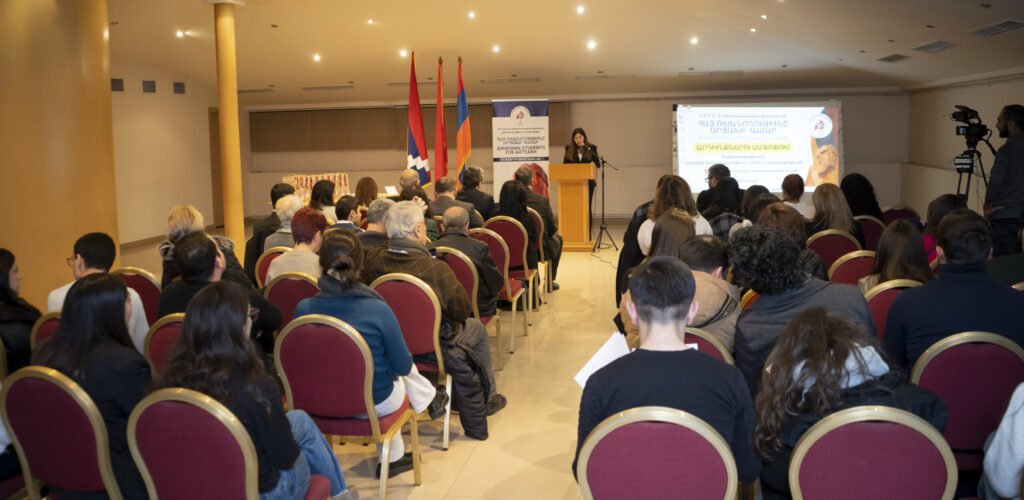 The event concluding the “Armenian Students for Artsakh” Research Competition held at the ARF Aram Manukian Youth Center, Yerevan, February 1, 2024 (Photo: Hakob Kolyan)
YEREVAN—On February 1, the concluding event of the “Armenian Students for Artsakh” Research Competition took place at the ARF Aram Manukian Youth Center in Yerevan. The event was organized by the ARF Bureau Youth Office of Affairs under the auspices of the Ministry of Education, Culture, Science and Sports of the Republic of Artsakh.
The program, initiated in 2023, aimed to harness the professional abilities of Armenian students across various fields to address the Armenian cause, particularly the Artsakh issue. It sought to make the conducted studies available for effective utilization by influential institutions engaged in pro-Armenian activities. In the long term, the initiative strives to analyze issues objectively, foster analytical thinking and develop approaches crucial for mature political thought and activity.
The event was graced by the presence of the Artsakh Republic’s Minister of Education and Culture Norik Mkrtchyan, Artsakh National Assembly deputies Vahram Balayan and Metakse Hakobyan, as well as RA National Assembly deputies Armenouhi Kyureghyan, Christine Vardanyan and Garnik Danielyan.
At the event, top-performing students participating in the program delivered speeches presenting their studies, while their mentors provided testimonials. Twelve individual students and one student group from Armenia, Artsakh, Lebanon, Iran and the United States dedicated themselves to the project.
Special appreciation was accorded to the following two articles, distinguished by their importance and relevance.
- “The destructive impact of the blockade and forcible displacement of Artsakh on the rights and mental state of the children of Artsakh”
- Mentor – Gegham Stepanyan, Human Rights Defender of the Republic of Artsakh
- Student – Datev Davtyan, Republic of Armenia
- “The urgent necessity to preserve the spiritual and non-material heritage of Artsakh”
- Mentor – Father Garegin Hambardzumyan, director of Artsakh’s spiritual and cultural heritage preservation office in the Mother See of Holy Etchmiadzin
- Student – Vahagn Khachatryan, Republic of Artsakh
The following students were recognized as winners.
- First place – recipient of a $1,000 scholarship:
- “Relations between Azerbaijan and Georgia”
- Mentor – Abraham Gasparyan, founding director of Genesis Armenia Center
- Student Group – Hovhanes Ghazaryan, Lilit Yekmalyan, Latush Simonyan, Republic of Armenia
- Second place – recipient of a $750 scholarship:
- “Azerbaijan’s Caviar Diplomacy in Europe”
- Mentor – Heghineh Evinyan, director of the European Armenian Federation for Justice and Democracy
- Student – Narod Noramanian, Holland
- Third place – recipient of a $500 scholarship
- “Relations between Azerbaijan and Israel”
- Mentor – Shahan Kandaharian, editor-in-chief of Beirut Aztag Daily
- Student – Zhanna Vardanyan, Republic of Armenia
At the conclusion, all participants were presented with certificates and gifts.
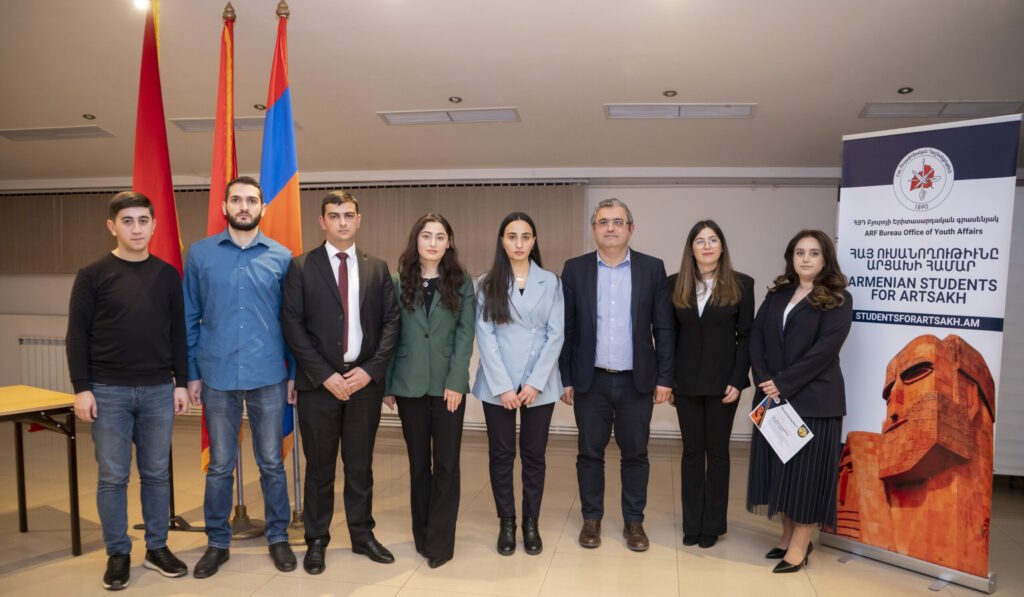 The organizers and winners of the “Armenian Students for Artsakh” Research Competition (Photo: Hakob Kolyan)
The ARF Bureau Office of Youth Affairs extends sincere thanks and gratitude to the donors and mentors of the project.
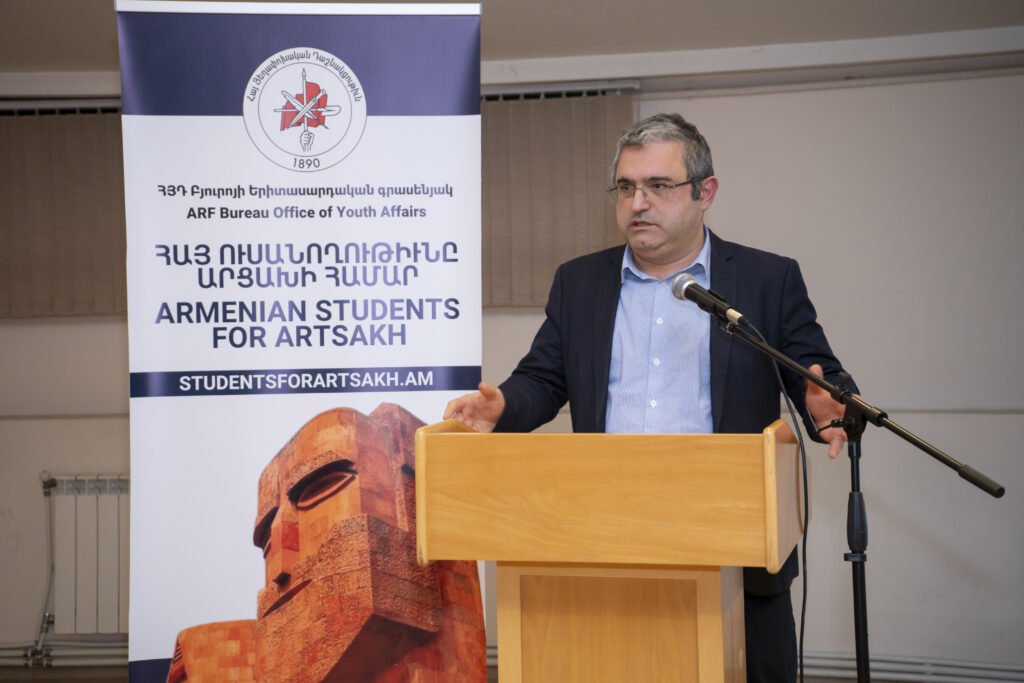 ARF Bureau member Hovsep Der Kevorkian (Photo: Hakob Kolyan)
In his remarks, ARF Bureau member and liaison to youth affairs, Hovsep Der Kevorkian, emphasized the three main focal points of the project: the students, the studies and the institutions dedicated to safeguarding Armenian rights. He highlighted that these studies serve not only as sources of information but also as platforms for recommendations and prospective action. Der Kevorkian underscored the strength of the Armenian people, particularly its students, portraying this project as a modest contribution toward consolidating their potential and enhancing their involvement in national affairs through innovative methods.
He added that some studies delve into how, over the years, Azerbaijan has leveraged various means to achieve its current successes, including stonewalling, diplomatic maneuvers, alliances and other strategies. The pressing question today, he argued, is how Armenians can strengthen the state and halt the gradual erosion of their positions, transforming this trend into a path of growth and recovery leading to new triumphs.
To rally Armenian students around this crucial issue, the ARF Bureau Office of Youth Affairs will continue its mission to encourage their engagement in pro-Armenian activities, prioritizing support for Artsakh and the protection of the rights of Artsakh Armenians.
Author information

Guest Contributor
Guest contributions to the Armenian Weekly are informative articles or press releases written and submitted by members of the community.
|
The post Armenian Students for Artsakh research competition concludes with final event in Yerevan appeared first on The Armenian Weekly.
Let’s talk about our diaspora Armenian communities here in the United States. For well over a century, the term “community” has represented the embodiment of our identity organized in two primary dimensions. There is a geographic component, whereby Armenians from locales such as Watertown, Detroit, Washington, New York and Philadelphia have created an infrastructure with churches, community centers and youth groups. In many cases, the physical buildings are in surrounding towns but serve the “greater” community. This is particularly true in larger communities but has also impacted smaller communities as Armenian families experience suburban sprawl. Our organizations present another dimension of community life. There are local chapters of the AYF, ACYOA, AGBU, ARS and ARF that are an integral part of their local communities and an essential element of a national and international network. This fabric of intercommunal relationships provides the national identity critical to our sustainability.
Consider the thousands of relationships, friendships and projects that are outcomes of our communities. Whether you have experienced the local or national components, our communities are dependent on succeeding generations. Continuity can never be assumed, but is the main objective. This evolution is what I will refer to as generational transition. It is not a singular event but rather a continuous process that involves the aging of one generation and the emergence of the next. Occasionally our communities may self-reflect in a sort of freeze frame to assess the overall health of this transition. This type of reflection is vital to our survival. We constantly hear, “Where are the young people?” or “Who will continue this work?” These questions are usually uttered by the senior generation, who have devoted their lives to a particular mission in our communities and now live to ensure its continuance.
Investing in our generations is our most critical mission. There is nothing more satisfying in our communities than witnessing the blossoming of a new generation that respects our history yet brings its own creativity to the experience.
Actually, the lowest risk approach to sustainability starts when the succeeding generation is in its infancy. Do we bring our children to church when they are young so the church becomes a natural part of their lives, or do we think there’s time while lamenting their absence as adults? Are we disciplined enough to fill our children with the knowledge of their identity and find the cultural niche that they can connect with, or do we complain about a lack of time? These transitions occur, whether we prepare properly or not. When we do not prepare, decline through assimilation takes place. It is an unforgiving process in the diaspora. We do experience recovery and revitalization, but they become more challenging and dependent on visionary active leadership. Many of us from the baby boomer generation have spent a considerable amount of time attempting to inspire and encourage the emerging generation. As we age, there is no better experience than to see a successful generational transition. We tend to spend a great deal of time identifying problems and potential solutions. It is also important to recognize successes. Sharing successes can instill others to take some risk or to make a commitment. Even the most involved and committed individuals were motivated by someone or something at some point in their journey. Sharing those moments should be a priority so they can be valued by others.
It is natural for our communities to focus on challenges, and as a result, to devote much of our public discourse to our problems and their impact. It should be equally natural to celebrate continuity, revitalization and new beginnings. Those blessings are everywhere. We just need to look through the lens of hope to see them. In the last few weeks, I have been fortunate to observe a few that are worth sharing. As I have mentioned in previous columns, I grew up at the St. Gregory parish in Indian Orchard, MA. It is fairly typical of small U.S. diaspora communities that were founded by survivors of the Genocide. It is where I learned the values of faith and heritage that we call our identity. The local population was built on economic opportunities for the generation that was deported from the homeland. Over the years, the economic opportunities have changed, while the professional skills of the new generation expanded. This resulted in some difficult times for the parish, as some moved away and assimilation took its toll on the emerging generation. For those who remained and for others who joined small parishes, it is challenging. A few families can make a substantial difference in the functioning of the community. This year, the St. Gregory parish will celebrate its 90th anniversary with a festive banquet on April 14. The parish is enthused, motivated and innovative. The board of trustees is composed of many of my former Sunday school students. They are dedicated Armenian Christians who have rallied the community forward. A majority of the board members are women, and the group represents a successful generational transition. These smaller parishes do not have the resources of larger ones and rely on multiplexing skills to remain functional as a community. I learned from my father and several other mentors in Indian Orchard that there is equal honor in cleaning tables, working on the grill or chairing the board. There is no job too big or too small for each of us. It’s the same in Granite City, Racine or Whitinsville. Each community, large or small, adds to the unique portfolio we have established. Each community develops its own subculture that is nurtured and altered by the participants. I am very proud of the spirit, leadership and resilience of the current generation at St. Gregory’s. They honor the past, present and future with their dedication. It is amazing what can happen when a few informed and dedicated individuals work together. This is why investing in our generations is our most critical mission. There is nothing more satisfying in our communities than witnessing the blossoming of a new generation that respects our history yet brings its own creativity to the experience.
Our family currently attends the Holy Translators parish in Framingham, MA. It is unique in the sense that the church was consecrated just 20 years ago as a new community. The church has experienced a surge in leadership on the parish council as the emerging generation takes its place. Many of the council members are the sons and daughters of the founding generation from over 20 years ago. With their participation and leadership, a renewed level of energy and creative thought has emerged. Many of the parish council members are in their 30’s and are parents of students of the revitalized Sunday school. We are all aware of the cyclical nature of our parish schools, particularly with smaller communities that depend on the commitment of school-age children and teachers. The availability of teachers was problematic just a few years ago. The parish is now blessed to have young families who are taking an active role in parish life. Many of the parents are not just on the parish council but are also assuming teaching and leadership positions in the Sunday school. With the current leadership demographics on the council, the young people have become a greater programming priority. It illustrates the importance of generational change, not simply to ensure survival but to enable innovation. Even the most dedicated can become stale if there is a gap between the decision makers and emerging generations. Holy Translators just hosted a Poon Paregentan event that was a modernized version of a community musical social gathering. Individuals brought instruments, children learned to dance, tavloo games were played and the young parents led the way. I felt a sense of gratitude to witness the presence of this young core that will lead the way forward. They are the product of parents (now grandparents) focused on their children’s identity and a communal system that produces results.
The Worcester community has always been a central figure in the eastern U.S. diaspora. It was in Worcester where the first Armenian Church, Church of Our Savior, was founded on Laurel St. in 1891 (the original building is still there). Der Tadeos Barseghyan was appointed pastor last year and has brought a resurgence to the parish. The previous pastor, Der Aved Terzian, served with dedication for decades and earned a well-deserved retirement. Der Tadeos is a relatively young priest who relocated from Minnesota and has embraced his new ministry with vigor. Even a casual observer of the parish can observe the increase in activity, both spiritually and socially, with programming related to the youth. Change in our communities is always an opportunity. A new young priest with his family inspires people to look forward with renewed interest. In the Merrimack Valley (Haverhill), a dynamic priest, Der Vart Gyozalyan, has rallied his community to complete the new sanctuary after the community center. A new building draws the interest of people and presents an opportunity for increased participation. The Hye Point parish (the name of the church until the consecration) is an active parish noted for its strong work ethic. Soon their devotion will be rewarded with a beautiful sanctuary.
While we face many challenges to sustain our future, it is important to recognize progress and inspiring results. These examples are representative of transitional improvements that exist in every community. We don’t take the time often enough to define them in that context. I urge everyone to make it a priority to identify your “wins” and share them proudly to expand your foundation. The wisdom of our elders combined with the creative energy of the younger generations have the potential to take us to new levels. There are, however, a few qualifiers. The elder generation must be willing to move aside when appropriate, transfer authority and assume a stronger mentoring role. The younger generation should act like sponges to absorb as much knowledge as they can from their predecessors. The common denominator is simply called respect. Let us continue to identify and solve problems but also learn to celebrate. When our succeeding generations change the paradigm, it is cause for joy. Encourage it, support it and then enjoy it.
Author information
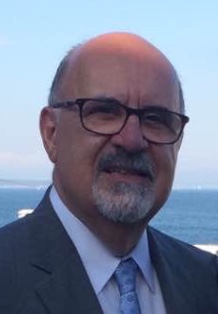
Stepan Piligian
Columnist
Stepan was raised in the Armenian community of Indian Orchard, MA at the St. Gregory Parish. A former member of the AYF Central Executive and the Eastern Prelacy Executive Council, he also served many years as a delegate to the Eastern Diocesan Assembly. Currently , he serves as a member of the board and executive committee of the National Association for Armenian Studies and Research (NAASR). He also serves on the board of the Armenian Heritage Foundation. Stepan is a retired executive in the computer storage industry and resides in the Boston area with his wife Susan. He has spent many years as a volunteer teacher of Armenian history and contemporary issues to the young generation and adults at schools, camps and churches. His interests include the Armenian diaspora, Armenia, sports and reading.
|
The post The joy of witnessing generational transition appeared first on The Armenian Weekly.