
Month: January 2024
Palestinians rejected the Israeli Finance Minister Bezalel Smotrich repeated statement for Palestinians to leave Gaza.
Palestinians have unanimously rejected a peculiar proposal that suggested relocating them from the Gaza Strip. The proposal, described by some as “weird” was put forward by an unidentified entity, raising eyebrows and sparking a wave of speculation among the international community.
Israeli Finance Minister Bezalel Smotrich, one of the senior figures in Israeli Prime Minister Benjamin Netanyahu’s right-wing coalition called on Sunday for Palestinian residents of Gaza to leave the besieged enclave.
This is not the first time that he has given threatening statement towards Palestinians to leave Gaza, but he has also given several controversial statements.
When war criminals can daub canvasses in blithe safety, rake in millions of dollars in after dinner speeches and bore governments to death with their shoddy words of wisdom, the world is not so much as it should be, but merely as it is. Former US President George W. Bush, former British Prime Minister Tony Blair, and tag along bore, former Australian Prime Minister John Howard, remain at large, despite their respective countries wagging fingers of disapproval at authoritarian regimes for defying the rules-based international order. Never a more fitting trio in terms of abusing international law could you find.
In 2003, this culpable troika sneered, ignored and soiled such international institutions as the United Nations, the rule of law, the legacy of the Nuremberg trials, and a number of conventions, by invading Iraq. The country, weakened and crippled by years of sanctions, leaving its hospital system crushed with bulky lists of dead children (all worthwhile, according to the late former Secretary of State, Madeleine Albright), was apparently a mortal threat to Western civilisation.
The Baathist regime, led by Saddam Hussein, was purportedly armed to the teeth with a doomsday inventory of Weapons of Mass Destruction (WMDs) that he was bound to use at any given moment against freedom loving types in Washington, London and Canberra. (It is true he had previously had such weapons, much of it supplied by Western arms corporations with the blessing of intelligence agencies such as the CIA.) He had, apparently, refused to disarm, obdurate in the face of United Nations weapons inspectors. And he had flirted with those evil representatives of cataclysmic eschatology, al-Qaida, despite being hostile to such millenarian groups. The report card, spottier than ever in the shadow of the attacks of September 11, 2001 on the United States, suggested that he had to go. The results: lusty sectarian violence, a catastrophically devastating, often imbecilic occupation by US-led forces, the seeds of emboldened fundamentalism, the offshoot movements such as Islamic State, and multigenerational trauma.
With another new year beckoning, the Australian National Archives have released approximately 240 cabinet papers from 2003 on the decision-making process behind a number of policy decisions. A few snippets are offered regarding road to war. Cabinet’s National Security Committee had kept an eye on developments in Iraq, though the released materials do little to reveal what, precisely, took place in conversations between Howard and Bush.
In September 2002, one document notes how “cabinet noted an oral report by the prime minister on his discussion with the president of the United States on the American position in relation to efforts by Iraq to secure and maintain weapons of mass destruction.” A fortnight later, the then-foreign minister Alexander Downer, is noted as furnishing cabinet with an “oral report” regarding “developments” regarding the proposed UN Security Council resolution on the Saddam regime’s “possession of, and attempts to secure or maintain, weapons of mass destruction, and on the prospects for passage of the resolution”. That such oral revelations were not accompanied by thick, detailed submissions, is telling about the obedient, inevitable train of thinking afflicting the Howard government. A war, started by Washington, would come, and Canberra would be along for the ride.
By March 2003, Howard was demanding action. He informed members of his cabinet that Bush had issued Saddam with an ultimatum of thuggish import. “Saddam Hussein and his sons,” the US president stated, “must leave Iraq within 48 hours. Their refusal to do so will result in military conflict commenced at a time of our choosing.”
Howard was drunk with intelligence assessments from the United States, including such claims that Iraq had put out feelers for yellowcake in Niger. Couple this with such stretched confections as non-state terrorist actors, hankering for WMD spoils from sponsor states, and the prime minister was swooning. In 2013, his cringeworthy apologia given to the Lowy Institute reflected on the fictitious Niger angle as “unmistakable” in its “strength”. Had it been accurate – a sly way of escaping the prosecutor’s legal brief – and Saddam “left in place, only to provide WMDs to a terrorist group, for use against the US, the Administration would have failed in its most basic responsibility to protect the nation.” When crooks of state are found out, they tend to cite public duty as appropriate justification.
As far as legality for any military intervention outside the formal channels of authorisation of a UN Security Council, Howard was armed with a memorandum signed by a first assistant secretary from the Department of Foreign Affairs and Trade and his equivalent from the Attorney-General’s Department. Fantastically and irresponsibly, the cod ordinary advice suggested that Australian involvement in an invasion would be entirely legal, given the Saddam regime’s recalcitrance in not allegedly complying with previous Security Council resolutions. It seems that the public servants in question, instead of offering a panoramic view about the pitfalls of a dangerous adventure in the Middle East, were merely keen to satisfy the bloodletting urges of their political paymasters.
The cabinet minute from March 18, 2003 showed agreement from the Attorney-General with the spurious reasoning of the first assistant secretaries. It also noted that the Australian Governor-General, Peter Hollingworth, holder of that old office of the British empire as the monarch’s representative, had been consulted. Approval from him, however, was not mandatory.
Cabinet, won over with no evident demurral, and previously buttered up by oral reports, approved the measure to commit Australia to another failed military mission of murderous, bungling incompetence. The United States would receive no resistance in getting its pound of Australian flesh for an illegal enterprise, and the Australian public, many of whom had participated in some of the largest anti-war demonstrations the country had ever seen, would be ignored.
For more than 1.000 years all the world’s major calendars have included the year as well as the month and day. This seems normal to us but for most of recorded history calendars only recorded the month and day. The year was counted from the start of a king’s or a dynasty’s rule. When a new king or dynasty came along, a new yearly count was started again.
Only major religions that last for many centuries produce an epochal calendar that can outlast political kingdoms and empires. Thus, all the world’s major calendars today are based on a religious epoch. The oldest of the world’s religious epochal calendars is the Jewish calendar, which is now at 5783.
.
Christians know their calendar starts its epoch from the birth of Jesus.
Muslims know the Muslim calendar begins its epoch with the flight of Muhammad from Makkah to Medina.
Buddhists know that their epochal calendar starts with the enlightenment of Siddhartha while sitting under a Bodhi tree.
But most Jews would be hard pressed to explain what happened 5,784 years ago to begin the Jewish calendar.
By analogy to the Christian, Muslim, or Buddhist calendars one might expect that the Jewish calendar starts with the birth of Abraham or Sarah (the first Jews), or from the Exodus from Egypt (the trans-formative experience of the Jewish people), or from the giving of the Torah at Mount Sinai (the enlightenment of the Jewish people).
But the second century Rabbis who made up the calendar Jews currently use, chose to begin with Adam and Eve i.e. the beginning of written world history.
The word Adam in Hebrew means mankind/Homo Sapiens– the species. The exit of Adam and Eve from the Garden of Eden symbolizes the transition of humanity from a largely nomadic stone age society of hunter-gatherers to a more advanced metal working bronze age society of farmers and village dwellers.
By starting the Jewish calendar with a historical transition that would have a universal impact on all of human society, the second century rabbis followed the lead of the Torah which begins not with Judaism but with urban civilization and recorded history.
All historical dates from the first urban societies that are derived from written records fit into the Jewish calendar. In 3,700 BCE, the first century of the Jewish calendar, researchers recently concluded (Science News 9/21/13) Egypt started to evolve from a migrating population of cattle owners to a farming community of villages and a centralized state.
The earliest writing comes from the Mesopotamian city of Uruk (Genesis 10:10) and dates to about 5,500 years ago i.e. the third century of the Jewish calendar.
The first dynasty in Egypt arose in the 7th century of the Jewish calendar and king Sargon of Akkad (2371-2316 BCE) lived in the 14th century. The first historical dynasty in China, the Shang dynasty, dates back to the 22nd century, about the time that Abraham lived.
Only in the generations after Abraham does Biblical history begin to focus on the religious development of one specific people.
The Jewish calendar is not only the oldest of the world’s calendars, it is the only one that begins with the beginning of recorded human history. Everything prior to the Jewish calendar is prehistory or natural history.
Even more important for non-Jews, knowing that there are several different epochal dates for starting a new year, means that you do not need to put off planning to take a new direction until January 1.
The Buddhist Lunar New Year starts in January/February, the Jewish Lunar New Year starts in September/October and the Muslim New Year starts a week and a half earlier each year.
Don’t procrastinate; a New Year is always on the way.
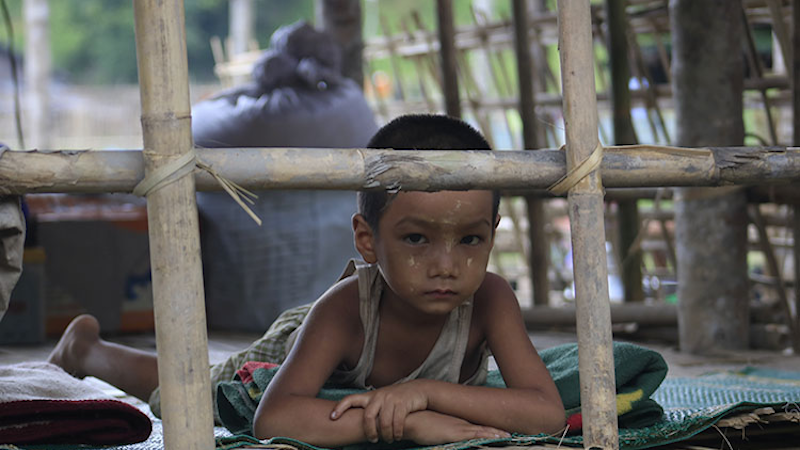
By Khin Khin Ei and Khet Mar
As Myanmar’s civil war approaches its third year, intensified fighting across the country this year between ruling junta forces and resistance fighters has destroyed villages and parts of towns, displacing hundreds of thousands of civilians, most of whom are women and children.
The number of internally displaced persons, or IDPs, reached more than 1 million this year, nearly 11,000 of whom fled to neighboring India and Thailand, according to a United Nations report.
“The lives and properties of our people were destroyed,” said Zin Mar Aung, foreign affairs minister under the parallel National Unity Government, noting the junta’s burning of villages, air strikes targeting civilians and mass killings.
At least 330 women died this year as a result of attacks by junta forces amid the escalation of armed conflict, said Tin Tin Nyo, general secretary of the Women’s League of Burma.
“The number of civilian casualties increased due to artillery attacks and air strikes,” she told Radio Free Asia. “Most of the victims were women, children and the elderly.”
Since the end of October, the number of internally displaced persons also increased, with most being women and children, Tin Tin Nyo said.
“After a country falls under the rule of dictators, it loses the rule of law and justice,” she said, adding that her organization has seen an uptick in gender-based violence, abuse by husbands amid economic decline, and a growing number sex workers.
“These are both visible and invisible challenges,” said the women’s rights advocate. “2023 was full of severe hardship for women.”
‘Lost hope’
Yu Yu, a woman who fled amid armed clashes in eastern Myanmar’s Kayah state, said she has suffered trauma as an IDP.
“We are surviving on the food of donors as we have no jobs,” she said. “We have lost hope.”
Women who left their jobs to join the Civil Disobedience Movement, or CDM, to resist the military rule following the February 2021 coup say they’ve had difficulties making ends meet while caring for children or aging parents.
“My father is 80 years old, my mother is also elderly, [and] they are not in good health,” said Khin May, who used to teach at a private high school in Bago region but quit to join the CDM.
“It is very difficult for us while I have no job,” she said, adding that she believes the resistance forces will triumph over the junta in 2024.
Children have suffered amid the civil war as well, and more than 560 have died since the military seized control from the civilian-led government in the February 2021 coup, according to Aung Myo Min, the NUG’s human rights minister.
Since Dec. 21, four children between the ages of 8 and 11 were killed in Rakhine state’s Mrauk-U township, a 9-year-old child was killed in Namtu in northern Shan state, and a seven-year-old girl died in an attack by junta troops in Sagaing region’s Paungbyin township, according to figures compiled by RFA.
“This is a war crime,” said Aung Myo Min. “It’s everyone’s responsibility to protect children at all times, but we have seen almost every day that killings are taking place where there are children as they sleep alongside their families, as well as the deaths of pregnant mothers.”
Utter despair
The death of children are often directly linked to women dying mid the fighting, said Thandar, head of gender equality and women’s development under the NUG’s Ministry of Women, Youth and Children’s Affairs.
“For example, in Sagaing and Magway regions, grown men are performing revolutionary duties, while the women, the elderly and vulnerable groups like children are fleeing together,” she said. “So, if women are hit, children are hit, too.”
According to Shan Human Rights Foundation based in Thailand, 28 children were killed due to the junta’s attacks from Oct. 27 to Dec. 27 during the the Three Brotherhood Alliance rebel offensive that has put junta forces back on their heels.
Air- and land-based artillery strikes are the most common cause of death, and children are among the mass casualties when such attacks occur, death counts indicate.
On Apr. 19, nearly 20 children under the age of 18 were killed in an air strike during a gathering in Pa Zi Gyi village in Sagaing region’s Kanbalu township. Eleven others died during an attack on Mon Laik IDP camp near the headquarters of an ethnic army in the town of Laiza in Kachin state on Oct. 9.
And eight more children were killed during an aerial bombardment of Vuilu village in Matupi township in western Myanmar’s Chin state on Nov. 15.
Roi Ji, 40, told RFA that she was in utter despair because all five of her children died in the attack on the Mon Laik IDP camp.
“I can’t think about anything anymore,” she said. “I’m in a state of derangement.”
Precarious futures
Children who live in war-torn areas no longer have access to schools or adequate nutrition, and face bleak futures.
Nwe Nwe Moe, a former teacher at Shwebo Technical College who joined the Civil Disobedience Movement and has since become a member of Yinmarbin-Salingyi multi-village strike committee in Sagaing region, said she dare not think about the future of the children living among the chaos of war.
“I’m concerned about whether the children will be able to develop into capable young people because there is no safety, no access to study, health care, or nutritious food for them,” she said. “I have a sinking feeling about those who are in life-threatening and emotionally insecure situations.”
As the bloodshed continues, Aung Myo Min said the NUG is making efforts to protect civilian survivors of attacks and to seek justice for them.
“Since there are air and artillery strikes against the civilians, the NUG’s Ministry of Humanitarian Affairs and Disaster Management is working with administrative organizations on creating bomb shelters for emergencies and providing guidance about not harming children,” he said.

Despite efforts by Ali Khamenei, the Iranian regime supreme leader, to use his warmongering tactics in the region to silence the voice of social protests, the cries of the hungry against the oppressors resonate in the streets of Iran.
On December 27, the strike of the workers of the National Steel Industrial Group in Ahvaz continued for the fifth consecutive day. This week, the workers marched from the company’s premises to Baghaei Square, disregarding the regime’s threats. They chanted, “Threats and prison no longer have any effect,” and “Death to the oppressors, hail to the workers.”
On the same day, the gold traders’ guild also held the fifth day of strike in protest against coercion and unfair taxation. Furthermore, the people of Ardakan, in their third day of protest against air pollution and the expansion of polluting industries that endanger their health, dressed their children in shrouds and continued their demonstrations with anti-regime slogans.
On December 25, retirees of the Telecommunications Company of Iran in Shiraz, Sanandaj, Shahrekord, Khorramabad, Ardabil, Isfahan, Marivan, Tabriz, Arak, Ahvaz, Hamedan, Bijar, Rasht, Sari, Zanjan, Kermanshah, and others gathered once again in front of the local offices of the TCI to protest the lack of attention to their demands. Additionally, nurses in Tehran, Ahvaz, and Qazvin joined the retirees in their protest gatherings.
The intensity of the opposition to tax pressures and the increased exploitation of retirees and workers has caused concern among some officials and government-affiliated media.
On December 24, Mohsen Hashemi Rafsanjani, an Iranian politician, warned about the uprising of the hungry and said, “Today, half of the society and people are living below the poverty line, struggling with economic problems. A prominent example of this is the budget that has been allocated this year.”
Yousef Davoudi, a member of the Majlis (Parliament), expressed his fear of the growing discontent and protest gatherings of the people during the approval of the budget bill of the Raisi government. He said, “With this budget, the value of the national currency will further decline, and the purchasing power of the people will decrease, exacerbating social crises in the country.”
On December 20, another member of Majlis, in protest against Raisi and his budget bill, said, “We came up with a one percent adjustment and homogenization, meaning we take from the pockets of the son and grandson and put it in the pocket of the retiree, which is unacceptable. Now, no financial allocation has been made for any project other than the presidential travel projects.”
The reality is that each provincial trip by Raisi is an expensive project to the tune of billions of rials. According to Rahmatollah Norouzi, members of the Majlis during their visits to various regions of the country, are accompanied by a 500-member security guard, so that “the people keep their distance.”
On December 25, Iran newspaper, which is run by the executive branch, also justified this issue by confirming that “in every trip or presence of the president in different regions, security forces from various divisions of the Islamic Revolutionary Guard Corps (IRGC), law enforcement, emergency services, or IRGC Basij forces are present to ensure the security of the ceremony.”
On December 26, the fourth day of the steel workers’ strike and the outcry of retirees and various segments of society, Mrs. Maryam Rajavi, the President-elect of the National Council of Resistane (NCRI), said, ” Various sectors of Iranian society, including workers, retirees, nurses, and bazaar merchants are incessantly staging strikes and protests against Khamenei and his predatory faction. These incessant protests display the Iranian people’s irreconcilable opposition to the mullahs’ criminal regime.
“As Isfahan’s steel workers cry out, We fight against oppression and injustice,’ these protests coupled with the activities of the Resistance Units will sweep away Khamenei’s bloodthirsty regime.”