
Categories
Audio Review - South Caucasus News

Moody’s Cuts China Credit Outlook, Citing Lower Growth, Property Risks


Ratings agency Moody’s cut its outlook on China’s government credit ratings to negative from stable on Tuesday, in the latest sign of mounting global concern over the impact of surging local government debt and a deepening property crisis on the world’s second-largest economy.

The downgrade reflects growing evidence that authorities will have to provide more financial support for debt-laden local governments and state firms, posing broad risks to China’s fiscal, economic and institutional strength, Moody’s said in a statement.

“The outlook change also reflects the increased risks related to structurally and persistently lower medium-term economic growth and the ongoing downsizing of the property sector,” Moody’s said.

China’s blue-chip stocks slumped to nearly five-year lows on Tuesday amid worries about the country’s growth, with talk of a possible cut by Moody’s denting sentiment during the session, while Hong Kong stocks extended losses. 

China’s major state-owned banks, which had been seen supporting the yuan currency all day, stepped up U.S. dollar selling very forcefully after the Moody’s statement, one source with knowledge of the matter said. The yuan was little changed by late afternoon.

The cost of insuring China’s sovereign debt against a default rose to its highest since mid-November.

“Now the markets are more concerned with the property crisis and weak growth, rather than the immediate sovereign debt risk,” said Ken Cheung, chief Asian FX strategist at Mizuho Bank in Hong Kong.

The move by Moody’s was the first change on its China view since it cut its rating by one notch to A1 in 2017, also citing expectations of slowing growth and rising debt.

While Moody’s affirmed China’s A1 long-term local and foreign-currency issuer ratings on Tuesday — saying the economy still has a high shock-absorption capacity — it said it expects the country’s annual GDP growth to slow to 4.0% in 2024 and 2025, and to average 3.8% from 2026 to 2030.

Moody’s outlook downgrade comes ahead of the annual agenda-setting Central Economic Work Conference, which is expected around mid-December, with government advisers calling for a steady growth target for 2024 and more stimulus.

Analysts say the A1 rating is high enough in investment-grade territory that a downgrade is unlikely to trigger forced selling by global funds. The other two major rating agencies, Fitch and Standard & Poor’s, rate China A+, which is equivalent to Moody’s. Both have a stable outlook.

China’s Finance Ministry said it was disappointed by Moody’s decision, adding that the economy will maintain its rebound and positive trend. It also said property and local government risks are controllable.

“Moody’s concerns about China’s economic growth prospects, fiscal sustainability and other aspects are unnecessary,” the ministry said. 

Struggling for traction

Most analysts believe China’s growth is on track to hit the government’s target of around 5% this year, but that compares with a COVID-weakened 2022 and activity is highly uneven.

The economy has struggled to mount a strong post-pandemic recovery as the deepening crisis in the housing market, local government debt concerns, slowing global growth and geopolitical tensions have dented momentum.

A flurry of policy support measures have proven only modestly beneficial, raising pressure on authorities to roll out more stimulus.

Analysts widely agree that China’s growth is downshifting from breakneck expansion in the past few decades. Many believe Beijing needs to transform its economic model from an over-reliance on debt-fueled investment to one driven more by consumer demand.

Last week, China’s central bank head Pan Gongsheng pledged to keep monetary policy accommodative to support the economy, but also urged structural reforms to reduce a reliance on infrastructure and property for growth. 

Deeper in debt

After years of over-investment, plummeting returns from land sales, and soaring costs to battle COVID, economists say debt-laden municipalities now represent a major risk to the economy.

Local government debt reached 92 trillion yuan ($12.6 trillion), or 76% of China’s economic output in 2022, up from 62.2% in 2019, according to the latest data from the International Monetary Fund (IMF).

In October, China unveiled a plan to issue 1 trillion yuan ($139.84 billion) in sovereign bonds by the end of the year to help kick-start activity, raising the 2023 budget deficit target to 3.8% of gross domestic product (GDP) from the original 3%.

The central bank has also implemented modest interest rate cuts and pumped more cash into the economy in recent months.

Nevertheless, foreign investors have been sour on China almost all year.

Capital outflows from China rose sharply to $75 billion in September, the biggest monthly figure since 2016, according to Goldman Sachs.

($1 = 7.1430 Chinese yuan renminbi) 


Categories
South Caucasus News

Moody’s Cuts China Credit Outlook, Citing Lower Growth, Property Risks


Ratings agency Moody’s cut its outlook on China’s government credit ratings to negative from stable on Tuesday, in the latest sign of mounting global concern over the impact of surging local government debt and a deepening property crisis on the world’s second-largest economy.

The downgrade reflects growing evidence that authorities will have to provide more financial support for debt-laden local governments and state firms, posing broad risks to China’s fiscal, economic and institutional strength, Moody’s said in a statement.

“The outlook change also reflects the increased risks related to structurally and persistently lower medium-term economic growth and the ongoing downsizing of the property sector,” Moody’s said.

China’s blue-chip stocks slumped to nearly five-year lows on Tuesday amid worries about the country’s growth, with talk of a possible cut by Moody’s denting sentiment during the session, while Hong Kong stocks extended losses. 

China’s major state-owned banks, which had been seen supporting the yuan currency all day, stepped up U.S. dollar selling very forcefully after the Moody’s statement, one source with knowledge of the matter said. The yuan was little changed by late afternoon.

The cost of insuring China’s sovereign debt against a default rose to its highest since mid-November.

“Now the markets are more concerned with the property crisis and weak growth, rather than the immediate sovereign debt risk,” said Ken Cheung, chief Asian FX strategist at Mizuho Bank in Hong Kong.

The move by Moody’s was the first change on its China view since it cut its rating by one notch to A1 in 2017, also citing expectations of slowing growth and rising debt.

While Moody’s affirmed China’s A1 long-term local and foreign-currency issuer ratings on Tuesday — saying the economy still has a high shock-absorption capacity — it said it expects the country’s annual GDP growth to slow to 4.0% in 2024 and 2025, and to average 3.8% from 2026 to 2030.

Moody’s outlook downgrade comes ahead of the annual agenda-setting Central Economic Work Conference, which is expected around mid-December, with government advisers calling for a steady growth target for 2024 and more stimulus.

Analysts say the A1 rating is high enough in investment-grade territory that a downgrade is unlikely to trigger forced selling by global funds. The other two major rating agencies, Fitch and Standard & Poor’s, rate China A+, which is equivalent to Moody’s. Both have a stable outlook.

China’s Finance Ministry said it was disappointed by Moody’s decision, adding that the economy will maintain its rebound and positive trend. It also said property and local government risks are controllable.

“Moody’s concerns about China’s economic growth prospects, fiscal sustainability and other aspects are unnecessary,” the ministry said. 

Struggling for traction

Most analysts believe China’s growth is on track to hit the government’s target of around 5% this year, but that compares with a COVID-weakened 2022 and activity is highly uneven.

The economy has struggled to mount a strong post-pandemic recovery as the deepening crisis in the housing market, local government debt concerns, slowing global growth and geopolitical tensions have dented momentum.

A flurry of policy support measures have proven only modestly beneficial, raising pressure on authorities to roll out more stimulus.

Analysts widely agree that China’s growth is downshifting from breakneck expansion in the past few decades. Many believe Beijing needs to transform its economic model from an over-reliance on debt-fueled investment to one driven more by consumer demand.

Last week, China’s central bank head Pan Gongsheng pledged to keep monetary policy accommodative to support the economy, but also urged structural reforms to reduce a reliance on infrastructure and property for growth. 

Deeper in debt

After years of over-investment, plummeting returns from land sales, and soaring costs to battle COVID, economists say debt-laden municipalities now represent a major risk to the economy.

Local government debt reached 92 trillion yuan ($12.6 trillion), or 76% of China’s economic output in 2022, up from 62.2% in 2019, according to the latest data from the International Monetary Fund (IMF).

In October, China unveiled a plan to issue 1 trillion yuan ($139.84 billion) in sovereign bonds by the end of the year to help kick-start activity, raising the 2023 budget deficit target to 3.8% of gross domestic product (GDP) from the original 3%.

The central bank has also implemented modest interest rate cuts and pumped more cash into the economy in recent months.

Nevertheless, foreign investors have been sour on China almost all year.

Capital outflows from China rose sharply to $75 billion in September, the biggest monthly figure since 2016, according to Goldman Sachs.

($1 = 7.1430 Chinese yuan renminbi) 

Categories
Audio Review - South Caucasus News

@anders_aslund: RT by @mikenov: The Ukrainian government has refused to allow opposition leader and former President Petro Poroshenko to travel abroad.…


The Ukrainian government has refused to allow opposition leader and former President Petro Poroshenko to travel abroad.
That is unacceptable.https://t.co/2bSobeLIwH

— Anders Åslund (@anders_aslund) December 5, 2023


Categories
Audio Review - South Caucasus News

@IDF: RT by @mikenov: Hamas deliberately embeds itself among civilians so that Gazans will bear the consequences of Hamas atrocities. Our war is agains…


Hamas deliberately embeds itself among civilians so that Gazans will bear the consequences of Hamas atrocities.

Our war is against Hamas—not the people of Gaza.

We are taking extensive measures to mitigate harm to the civilians that Hamas uses as shields. pic.twitter.com/C5NQetzzRt

— Israel Defense Forces (@IDF) December 4, 2023


Categories
Audio Review - South Caucasus News

@haaretzcom: RT by @mikenov: Rape as a weapon of war: Jewish women call on UN to face Hamas’ sexual violence https://t.co/bJFTaoV55v


Rape as a weapon of war: Jewish women call on UN to face Hamas’ sexual violence https://t.co/bJFTaoV55v

— Haaretz.com (@haaretzcom) December 5, 2023


Categories
Audio Review - South Caucasus News

@TOIAlerts: RT by @mikenov: Live update: France freezes assets of Hamas leader Sinwar https://t.co/ip5QQAtyyr . Click to read ⬇️


Live update: France freezes assets of Hamas leader Sinwar https://t.co/ip5QQAtyyr . Click to read ⬇️

— TOI ALERTS (@TOIAlerts) December 5, 2023


Categories
South Caucasus News

@anders_aslund: RT by @mikenov: The Ukrainian government has refused to allow opposition leader and former President Petro Poroshenko to travel abroad.…


The Ukrainian government has refused to allow opposition leader and former President Petro Poroshenko to travel abroad.
That is unacceptable.https://t.co/2bSobeLIwH

— Anders Åslund (@anders_aslund) December 5, 2023


Categories
South Caucasus News

Economy Minister: “positive” investment dynamics in 2023 saw volume exceed $1bln


investingeorgiadavitashvili.jpeg


Categories
(@mikenov) / Twitter

@mikenov: Russian Ground Troops, Including Chechens, Reportedly Fighting in Syria https://t.co/MssFa5Yc3s https://t.co/O2nxDOtzM6


Categories
Audio Review - South Caucasus News

Russian Ground Troops, Including Chechens, Reportedly Fighting in Syria


The head of the southern Russian region of Chechnya, Ramzan Kadyrov, has denied media reports that he deployed troops to Syria to fight on the side of President Bashar al-Assad. Meanwhile, the Kremlin and the Federation Council, the upper chamber of Russia’s parliament, have been forced to explain footage of Russian forces fighting in Syria recently aired during a prime-time TV show.

The Kremlin has repeatedly claimed that Russia’s involvement in Syria is limited to air support for the Syrian government forces, and that Russian troops have not been, and will not be, involved in ground operations.

But on Sunday, a weekly show on state television hosted by Dmitry Kiselev, the head of Russia’s Sputnik international broadcasting corporation, featured footage of Russian commandos in combat operations in Syria.

Kremlin spokesman Dmitry Peskov refused to comment on the footage, redirecting inquiries to the Defense Ministry.

The head of the Federation Council’s defense and security committee, Viktor Ozerov, did comment on the footage. He claimed the ground operations by Russian special forces in Syria are “aimed at destroying terrorists” and therefore do not require parliamentary approval.

On December 7, the independent Dozhd (Rain) TV channel, citing an unnamed source in the Chechen government, announced that Chechen special forces were being deployed to Syria. Dozhd posted amateur video footage featuring a group of Chechen soldiers identified as “military police” listening to the parting words of Chechnya’s Mufti (highest Muslim authority), Salakh Mejiyev, prior to their departure for Syria.

Speaking in Chechen, Mufti Mejiev says, as translated by Dozhd: “Kadyrov asked Putin to send him there. He said he wishes to go there to save Muslims. I swear by Allah, many wish to go there and our ruler is the first among them. People envy those who are going there, as you are.”

Russia’s Izvestia newspaper reported that two Chechen battalions specially trained to fight terrorists have been deployed to Syria. According to Izvestia’s sources, the Chechen battalions will be providing security for Russia’s military base located in Latakia province.

More denials

In a post on his personal Instagram feed, Kadyrov denied he has dispatched troops to Syria. “It is very well known that Russian forces do not participate in ground operations in Syria.”

Despite Kadyrov’s denial, Radio Free Europe/Radio Liberty posted a video on YouTube last week showing members of Chechnya’s special forces in their signature uniforms and red berets, gathered at the Khankala military base outside the Chechen capital of Grozny. In the video, labeled, in Russian, “Kadyrov’s (i.e. Chechen) special forces deployed to Syria,” the troops chat in their native Chechen (with Russian subtitles).

Experts say this is not the first deployment of Chechens to Syria.

“There are already about 600 Chechen government troops practically since last year,” Milrad Fatullayev, chief editor of the RIA Derbent state news agency told VOA. While there are numerous reliable sources confirming the deployment of Chechen special forces to Syria, there is very little information about the use of Chechen troops in actual combat.

“It is possible they are being used in mopping-up operations and in rough terrain, just like… in Georgia,” Fatullayev said, referring to Russia’s military intervention in Georgia in 2008.

Ironically, it was Ramzan Kadyrov who first announced and then denied the involvement of Chechen government troops in combat operations in Syria.

In an interview with Rossiya-24 state television last February, Kadyrov said that Chechen special forces are fighting the Islamic State group in Syria and Iraq “from within.” He also spoke for the first time of losses those troops are suffering in the Middle East.

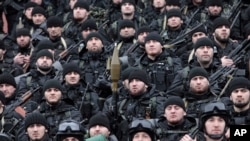
FILE - Chechen special forces listen to Chechnya's regional leader Ramzan Kadyrov (unseen) deliver a speech in Chechnya's capital of Grozny, Russia, Dec. 28, 2014. Some experts believe, if Russia is deploying Chechen forces to Syria, then it is doing so as casualties among Chechens would not cause the same alarm among the general Russian population as deaths of ethnic Russians would.


FILE – Chechen special forces listen to Chechnya’s regional leader Ramzan Kadyrov (unseen) deliver a speech in Chechnya’s capital of Grozny, Russia, Dec. 28, 2014. Some experts believe, if Russia is deploying Chechen forces to Syria, then it is doing so as casualties among Chechens would not cause the same alarm among the general Russian population as deaths of ethnic Russians would.

The Kremlin categorically denied Kadyrov’s claim that Chechen forces are fighting in Syria. After that, Kadyrov’s representative Alvi Karimov declared: “Ramzan Kadyrov never said that Chechen forces are fighting in Syria.”

According to Chechnya’s official television channel, Grozny TV, Chechen special forces have been intensively training under the supervision of the GRU, Russia’s military intelligence agency. In February 2015, the Chechen government started building a training facility for special troops in Chechnya’s Gudermes district.

Pavel Felgenhauer, a senior fellow at the Jamestown Foundation, a Washington-based think tank, believes the Kremlin benefits by the deployment of Chechen troops, given that a “majority of Russians do not really consider Chechnya or the Chechens as truly Russian, so potential Chechen casualties in Syria will not cause unwanted alarm or tension among the general population.”

Meanwhile, the Kavkazsky Uzel (Caucasian Knot) website reported Tuesday that 12 soldiers stationed at the Khankala base in Chechnya have been dismissed from military service for refusing to deploy to Syria. The website cited unnamed “Chechen sources.”