
Day: December 4, 2023
By Will Sellers
As Thanksgiving morphs into Christmas, the December television schedule will be filled with the usual assortment of Christmas classics, not the least of which is Frank Capra’s It’s A Wonderful Life. I’ve lost count of the number of times I’ve seen his movie and unlike some classics that are tiresome, this one always grabs me. The idea of selfless giving is made manifest when the entire community comes to George Bailey’s aid. I think every small business owner secretly views his business as the Building and Loan and himself as George Bailey!
But It’s A Wonderful Life was not Capra’s masterpiece. When it was released in 1946, it was not well received. At all. To truly understand It’s A Wonderful Life, Capra’s pre-war films are a must to see his formula, a formula that exalted the humble everyman taking on the various Goliaths of the age. If you like It’s A Wonderful Life, let me suggest a Capra Trilogy to enjoy with your family over Christmas: You Can’t Take It With You, Mr. Smith Goes to Washington, and Meet John Doe. Each of these movies plants a seed of a theme that culminates in It’s A Wonderful Life. I don’t think you can watch any of these movies without a renewed sense of what it means to be an individual pitted against a soulless property developer, corrupt political leaders, or a manipulative selfish tycoon.
Capra’s movies were released in the middle of the Great Depression. His films were an intentional attempt to give people living in this era a vested interest in that uniquely American system that made Davids believe that Goliaths could be defeated. The doom of the strong was the happiness that radiated from the successes of seemingly powerless little men. Though possessed of limited resources, they had the intangibles that faithful people know as the fruit of the spirit: love, joy, peace patience, kindness, and the like. All of Capra’s movies are morality plays to inspire people to take on the challenges of their lives and to stand up to the shameless bullies who yield power, mainly for power’s sake and the ego that comes with flexing muscles to show off.
The strain of populism so ingrained in the lives of Americans is perfectly reflected in Capra’s films. His focus was on the human actions of the silent majority of quiet, everyday people making decisions based on visions of simple moral clarity. He lifted the permanent things so often neglected compared to the temporary glitz and glamour of material gain. Each film contains a large dose of middle-American values magnified time and again against the traps and situations of a complicated impregnable bureaucratic world. And in each case, the little guy wins, and the big mules not only lose face but are publicly shamed into accepting, if not participating in their own defeat.
These films are in many ways a large mirror reflecting not only the tenor of the times but also the implicit impact of human nature struggling for freedom and self-determination. In short, people can see themselves in these films and identify with the characters. Everyone wants to see the characteristics of the white-hatted hero in themselves, but are reminded by conscience that they possess some of the traits of the villain too. Everyone hopes they will make wise and prudent choices when faced with decisions of moral consequence. Everyone in Capra’s films has a shot at redemption, but not every character accepts the offer; the developing conflicts that are resolved in favor of the common man are what make each film so entertaining.
Capra’s films had consequence when they were initially screened by uplifting average people and giving them hope and a feel-good sense of their significance. Perhaps the greatest tribute to the impact of Capra’s films is that Mr. Smith Goes to Washington was the last American film shown in France after the Nazi occupation. To the consternation of almost all the American political class (including Ambassador Joseph Kennedy), the French were inspired by that film and identified with Jefferson Smith. To the French and others, Mr. Smith encouraged people to see that the greatness of the United States was in the power of the intangibles of lively dissension, vigorous debate, and free speech. In 1940, as the lights of freedom were dimming all over the world, Capra showed America at its best in the person of Jefferson Smith. There is no way to measure the number of French resistance fighters emboldened by this film and encouraged by American ideals. If you liked It’s A Wonderful Life, be inspired by the unabashed patriotic films of Frank Capra. You’ll be motivated and perhaps even challenged to identify with a character to live out the American dream in simple community with others, who also struggle against human nature to find goodness and selfless service in their daily life.
- About the author: Will Sellers was appointed to the Supreme Court of Alabama by Governor Kay Ivey in 2017. He was elected to a 6-year term in 2018. A life-long resident of Montgomery, he graduated from Hillsdale College, magna cum laude, The University of Alabama School of Law, and in 1989 received an LL.M. in Taxation from New York University. Before joining the Court, Justice Sellers was in private practice for 28 years in the areas of taxation, business organizations and corporate and campaign finance. He was a member of Electoral College in 2004, 2008, 2012, and 2016. Justice Sellers has written over 150 opinions. He and his wife Lee have three adult children and one granddaughter.
- Source: This article was published by AIER
European Union’s super bureaucrat Ursula von der Leyen chose April Fools’ Day last year to threaten China that it would suffer “reputational damage” in the world community for backing Russia’s Ukraine war. Being a civilisational state, China let pass that arrogant, presumptuous, egotistic remark.
The concept reeks of neo-colonial mentality. Saudi Arabia’s tryst with reputational damage has been of a different kind. The Kingdom has had spectacular success in overcoming the reputational damage related to the killing of the ex-CIA asset Jamal Khashoggi. It makes a worthy case study for India, which also is haunted by the spectre of reputational damage for allegedly committing trans-border crimes.
From an Indian perspective, there are seven “takeaways” from the Saudi experience. First, Saudi Arabia stood its ground; second, it sought no help from third parties to reach out to the power brokers in DC; third, it seized the initiative to set in motion an investigative mechanism of its own which came up with cognitive reasoning in a very short period of time; four, it followed up by sentencing the Saudi perpetrators of Khashoggi’s murder to imprisonment; five, it didn’t allow the “reputational damage” to impede normal life; six, it turned a new page so that “a new normal” became possible, which is resilient and geared for the long haul that is strengthening the Kingdom’s strategic autonomy; and, seven, in the final analysis, the “decoupling” from the US helped the Saudis to shake off the reputational damage.
Needless to say, the last point is the crux of the matter. Saudi Arabia’s assertion of strategic autonomy has taken myriad forms that caught the Biden Administration by surprise. This was not how Saudi Arabia was expected to behave under pressure with its ponderous decision-making process, the statecraft moving at a glacial pace, its comprador class among the elites only too eager to capitulate and the ruling elite’s unipolar predicament and so on.
But the “new normal” also dictated that Saudi Arabia did not get into an acrimonious brawl with the Biden Administration but instead subjected the latter to benign neglect of a kind that was most hurtful for the US’ interests and regional influence and bruised its vanities of being the only game in town in the Middle East.
In reality, Saudis had no alternative, given the profoundly troubling geopolitical reality that Khashoggi was being groomed by the Deep State in the US for a higher political destiny than that of a mere dissident — and that was something Riyadh couldn’t have tolerated, as the stability of the regime was being threatened from America, which was ironically the Kingdom’s provider of security and a strategic ally of several decades.
It takes years or even a decade to lick into shape a mole so that it can perform as a strategic asset like Khashoggi for the US intelligence, and the fury over his untimely murder surged in media attacks on the Saudi regime — targeting Crown Prince Mohammed bin Salman.
However, as months passed, it became more and more difficult to demonise the Crown Prince under whose watchful eyes, the Kingdom embarked on a historic path of reform. Three major achievements through the past 5-year period can be seen as game changers. First, Vision 2030, the transformative and ambitious blueprint to unlock the potential of the people and create a diversified, innovative, and world-leading nation. The reform programme has already begun to show impressive results.
Two, OPEC+ which was the brainchild of Russian President Vladimir Putin and Saudi Crown Prince Mohammed bin Salman, has liberated the world oil market from the US’ clutches through the past 5-year period and in turn put the two energy superpowers on the driving seat. The transition is hugely consequential in geopolitical terms. Incredibly enough, the new matrix fine-tuning the global market is taking place independent of American leverage. OPEC+ is working effectively, overcoming all external attempts to undermine it.
Three, Saudi Arabia’s induction as a full member of the BRICS — again, with Russian backing — is expected to carry forward the new impulses of the Kingdom’s independent foreign policy, which in turn is expected to galvanise the creation of a new international trade and financial architecture.
Although a sub-plot in this context becomes the normalisation with Iran, which at one stroke created a paradigm shift in the geopolitics of the Middle East region with the regional states steadily doing away with American midwifery in settling their intra-regional issues. A natural consequence of it has been the sharp decline in the US’ regional influence which has become evident during the current Israel-Palestine conflict.
All in all, the Saudi compass is laying the foundations for an emerging regional power that is destined to contribute to the international system and the world order. The US has understood that it lost the plot and is moving with alacrity to mend fences with Saudi Arabia. Biden’s visit to Saudi Arabia in June last year came tantalisingly close to an act of atonement. That was only to be expected.
A few examples from the last month alone testify to the dynamism of Saudi diplomacy and the total collapse of the US’ strategy to “isolate” the Kingdom — visit by Luiz Inacio Lula da Silva, president of Brazil (a BRICS member state, which is due to join OPEC+ in January); winning the bid in a landslide in secret ballots to host the World Expo 2030 (Saudi Arabia won 119 of the 165 votes, easily defeating South Korea and Italy thanks to the huge backing by the Global South); the $7 bn local currency swap agreement with China’s Central Bank (latest sign of strengthening relations with China and a step toward delinking from the petrodollar); leading by example the OPEC+ decision on voluntary cuts of oil production “to ensure a stable and balanced oil market” (revealing at the grouping’s virtual meeting on November 30 that it would be continuing its 1 million barrels per day reduction, ie., roughly 45 percent of total production cut of 2.2 million bpd envisaged); and, of course, placing itself at the front and centre of high-stakes public diplomacy over the Gaza war, with China again as its preferred partner (while a Saudi-Israeli normalisation, which might have been a major foreign policy win for the Biden Administration, has become politically radioactive for Riyadh.)
The moral of the story — especially for countries like India — is that firmness tempered with tact and patience pays. The Saudi secret lies in avoiding nasty confrontation but instead quietly, systematically shaking off the critical dependence on the US by diversifying the Kingdom’s external relations.
The mother of all ironies in all this is that the US not only assassinated a senior Iranian general in a third country and the then president in the White House even bragged about it. Equally, the US took revenge on Osama bin Laden and dumped his corpse in the high seas.
It has kidnapped dozens of Russian nationals travelling abroad and locked them up in prisons in an attempt to persuade them to work for the US intelligence. Now, in June, with a similar objective, the US intelligence kidnapped an Indian transiting through Prague. Evidently, the US intelligence was stalking him on Indian soil.
It is a frightening thought that the Five Eyes may have penetrated the core of the Indian security establishment. Yet, state secretary Blinken vows not to let go India, the US’ indispensable partner for the undoing of China. It almost seems as if he knows something about Indian statecraft that we do not. Indian diplomacy has truly tied itself in knots.
This article was published by Indian Punchline
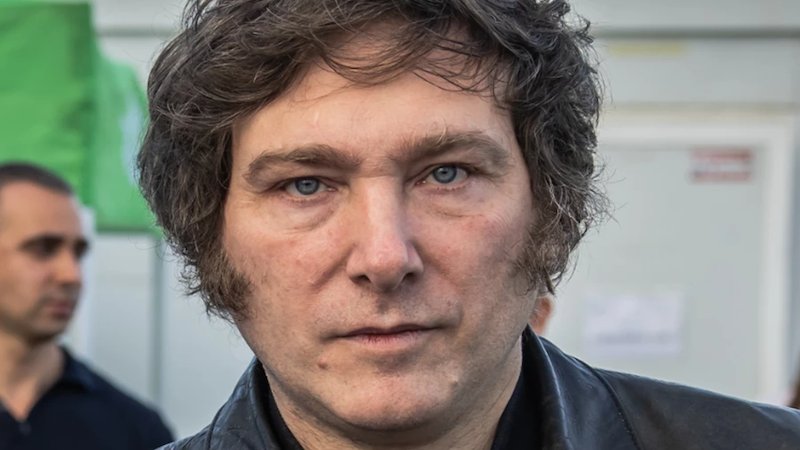
By Jon Miltimore
Argentines elected 53-year-old political outsider Javier Milei as their new president.
Milei, an economist and self-described libertarian, pulled in nearly 56% of all votes counted in his runoff against left-wing rival opponent, Sergio Massa, completing one of the most unlikely presidential victories in modern history.
Milei first stunned the world in August when he managed to pull in 30% of the vote in Argentina’s presidential primary, far above what political prognosticators had anticipated.
“I think these results are surprising even to him,” Pablo Touzon, an Argentine political consultant, told the New York Times in August.
Though Milei fell short in the October general election, receiving 29.9% of the vote to Massa’s 36.6%, he emerged triumphant in the runoff Sunday. His victory clearly stunned the media establishment, which insisted on describing Milei as “far-right” and in the mold of former President Donald Trump.
In truth, Milei is much closer to F.A. Hayek or even Milton Friedman than Trump. He supports abolishing Argentina’s central bank, slashing government spending, and eliminating a slew of government ministries — including the Ministry of Culture; the Ministry of Women, Genders, and Diversity; the Ministry of Public Works; and the Ministry of Transport.
However one chooses to describe Milei, it’s clear his rise marks a total rejection of Argentina’s political establishment after years of economic pain.
Here is the man who was just elected President of Argentina, detailing his plans for the government.pic.twitter.com/RLaglC2OBj
— Spike Cohen (@RealSpikeCohen) November 19, 2023
The poverty rate in Argentina is above 40%. Inflation, meanwhile, has been in the triple digits all year, and it continues to rise. Argentina, the second-largest economy in South America, has battled inflation for decades, but inflation has spiraled out of control in recent years.
In 2011, the exchange rate for one United States dollar was 3.45 pesos. Today, a dollar is exchanged for 352 pesos. (Black market rates for the dollar are much higher.)
Reuters recently reported that inflation has become so bad that many in Argentina can no longer afford to buy new products but instead shop and trade at street markets for used items.
“We simply can’t buy new things,” Maria Teresa Ortiz, a 68-year-old retired worker, told the news agency. “You can’t buy new sneakers, you can’t buy new flip-flops, you can’t buy new jeans, you can’t buy a shirt or a T-shirt either. So you have to look for them at the fairs.”
Americans who think they have little to learn from this spiraling South American country should realize that Argentina was once one of the wealthiest countries in the world.
Historians point out that just before the beginning of World War I, Argentina was richer than the primary European powers, Germany and France, and almost twice as wealthy as Spain. Its per-capita gross domestic product was on par with that of Canada, and up until the Great Depression, it was one of the largest exporters of food in the world.
In 1929, however, Argentina abandoned the gold standard, a move that was followed by new protectionist trade measures. The aftermath of World War II would usher in strongman Juan Perón, giving rise to Peronism, a blend of national socialism and fascism that would dominate Argentina’s political system for the next 75 years.
Argentina’s triple-digit inflation might be new, but its economic dysfunction goes back decades. It defaulted on its debt three times in the last quarter century alone, even as it continued to expand the state’s role in (and grip over) the economy. All of this spelled disaster for Argentines.
“The problem with socialism,” Margaret Thatcher once quipped, “is that you eventually run out of other people’s money.”
This is not technically true, of course. Those in power can just print more money to paint over economic problems instead of addressing them — which is exactly what Argentine politicians did.
This image shows why Javier Milei is Argentina’s new president.
The government destroyed the currency and 40% of the people are now in poverty. pic.twitter.com/1WpVOVcSRT
— Jon Miltimore (@miltimore79) November 20, 2023
The results were catastrophic, and Milei is now being tasked with cleaning up the mess. Hopefully, he succeeds. But it’s also important to understand how Argentines arrived in these dire straits: They believed a lie.
“The state is that great fiction by which everyone tries to live at the expense of everyone else,” the 19th-century economist Frederic Bastiat once observed.
If Americans fall for the same lie — that they can enrich themselves by creating a society that allows them to plunder their neighbor — their economic future will be similar to Argentina’s. And they may not have a Javier Milei to rescue them.
- About the author: Jonathan Miltimore is the Editor at Large of FEE.org at the Foundation for Economic Education.
- Source: This article was published by FEE and first appeared on The Washington Examiner.

By Hsia Hsiao-hwa
Just 10 years after trading his white coat for a place on the mayoral hustings, Taipei Mayor Ko Wen-je, who also heads the four-year-old Taiwan People’s Party, is looking increasingly like a potential challenger to Vice President Lai Ching-te in January’s presidential election.
A recent poll of voters by the Taiwanese Public Opinion Foundation showed Ko has an approval rating of 31.9% compared with 29.2% percent for the ruling Democratic Progressive Party’s Lai and 23.6% for nationalist Kuomintang candidate and New Taipei City mayor Hou Yu-ih.
Earlier polls had shown a healthy lead for Lai and running mate Hsiao Bi-khim, with Ko trailing in third place after plans for a joint Ko-Hou ticket foundered.
The foundation described Ko as “a terrible nightmare that the DPP must not ignore,” adding that Ko’s support is highest among well-heeled white-collar workers, but that he also has similar appeal to Lai among blue-collar voters.
Far from boosting the Lai campaign, the recent collapse of talks between Lai and Hou over a possible “blue-white” joint ticket actually appears to have damaged it, boosting Ko’s approval rating by 6.3 percentage points and leaving Lai’s half a percentage point lower, the foundation said.
With less than 50 days of campaigning left to go before the Jan. 13 election, the result suggests Ko is a wild card candidate who could sway the result in unpredictable ways, the poll of 755 people with a 3.57 percentage-point margin of error and a 95% confidence level found.
“This is likely to be the most unpredictable of all presidential elections so far,” the foundation said. “We won’t know who the winner is until it’s over.”
‘Pithy soundbites
Ko, a former emergency room doctor who gave up medicine for politics 10 years ago, has generally sought to position himself as an outsider capable of toppling the traditional parties.
He has become known for his salty epithets and pithy soundbites, appealing to a broad cross-section of the island’s 23 million population, particularly younger voters.
Yet his critics accuse him of dictatorial leanings, an emperor-complex, a too-relaxed attitude to the threat from China, and of flip-flopping on key elements of his political stance to please whoever happens to be listening at the time.
Ko has described the 1992 consensus between Beijing and the former Kuomintang government that sought to preserve Taiwan’s de facto independence while never challenging China’s territorial claim on the island as “basically getting down on their knees and surrendering.”
“Failure is the norm – success is the exception,” is another Ko-ism, as is his description of politics as “the search for a lost conscience.”
Organ transplant doctor
Ko, 64, who has claimed an IQ of 157, has a fondness for medical metaphors on the campaign trail, and once referred to an opponent as “less capable than an amoeba.”
Born in Hsinchu, Ko began his working life as an emergency and intensive care physician at National Taiwan University Hospital, studying organ transplants in the United States before setting up a transplant team at his hospital, and significantly improving survival rates with his use of ECMO machines.
He quit medicine after an organ was mistakenly transplanted into a patient from an HIV-positive donor, announcing he would run for Taipei mayor in 2014, eventually winning the election with the second highest number of votes ever received.
According to veteran journalist Kang Jen-chun, Ko projects a professional, scientific and rational image, along with pragmatism and a sense of openness and transparency.
“A large proportion of Taiwanese are very eager to find something outside of the [traditional] blue and green [camps],” Kang said. “Voters want politicians to take more action – stuff that is closer to their lives.”
“Ko Wen-je’s seemingly nonsensical comments and jokey approach have gotten young people’s attention.”
Lawmaker Tsai Pi-ru, a nurse at Ko’s hospital who later became his chief of staff in the Taipei municipal government, said: “He doesn’t beat around the bush … and if he says something wrong, he apologizes – the only person in Taiwan politics who does that.”
“He apologizes, seeks to do better, and moves on,” she said, adding that Ko also has a reputation for straight-dealing, and for a formidable work ethic that sees him taking the bus to work at city hall, starting his day at 7.30 a.m., before hosting a lunch party every day at noon.
He also has a reputation for dismantling bottlenecks in the city’s infrastructure in record time, as well as making off-the-cuff, sometimes shocking comments to journalists as he goes about his day.
Kang said this gives him a distinct advantage over Lai and Hou when it comes to the electoral “dog-fights” in Taiwan’s media, although his sharp tongue and whimsical remarks can sometimes get him into trouble.
When taken to task in the past, Ko has referred to himself as “a mortal,” describing his life as “a one-way street with no regrets.”
Nonetheless, by the time he fought his next mayoral election in 2018, his approval rating had plummeted from to 40% after three years in office, and he only defeated his opponent Ting Shou-chung by a narrow margin of some 3,000 votes.
Bully and schemer?
His New People’s Party has been hemorrhaging political support, as his critics accuse him of being a bully and a schemer.
“His neutrality is a kind of nihilism that blows with the zeitgeist,” Ed Lin, lead singer of Taiwan rock band Leather Lattice, wrote of Ko in a June 2023 article titled “Three Beautiful Misunderstandings of Ko Wen-je.”
“He’s good at dodging controversy and bullying the weak,” Lin wrote. “The truth is that he is deeply rooted in patriarchal ideas and vote-counting schemes.”
He said Ko stands for a restoration of authoritarian rule “that undermines democracy.”
A former Taiwan People’s Party activist who asked to be identified only as A, had a similar view.
“The biggest issue is Ko’s dictatorial personality,” A said. “His idols include Mao Zedong and the Yongzheng Emperor [1722-35].”
“He often refers to himself with the royal ‘we’, as if he’s the emperor,” A said, adding that Ko favors divide and rule politics and “palace intrigue.”
Ko also gives favorable treatment to his family members within the party, A said, describing them as “nobles of the court,” while everyone else is expected to be “fans and believers.”
Fascination with Mao
Ko had admitted to a fascination with Mao, and has visited Communist Party sites on a trip to China to learn about party history. He has been photographed by the media gazing at a portrait of Chairman Mao as a young man.
Ko has also raised eyebrows with his parroting of Beijing’s claim that the people of Taiwan and China are “part of the same family,” which it uses to underscore its territorial claim on the island.
“His emergence is very bad for democracy in Taiwan,” A said. “It will set its development back for a long time.”
Yeh, the office worker, said he doesn’t trust Ko either.
“There’s no problem with his intelligence,” Yeh said. “But he lacks presidential gravitas, and his words don’t mean anything – a president should keep their word.”
“But I’m worried that he will be willing to trade it away in any future negotiations with [China],” he said.
Even as a doctor, Ko was no stranger to politics.
A staunch supporter of late former Democratic Progressive Party President Chen Shui-bian, he formed part of a committee that advocated for Chen’s release on medical parole as he served his prison sentence for corruption.
But he later changed his tune, claiming in 2017 that Chen’s illness “was feigned from the start,” as he campaigned for opposition Kuomintang voters in his campaign for re-election as Taipei mayor.
Ko’s grandfather died in the Feb. 28, 1947, massacre of Taiwanese civilians by Kuomintang troops, an event that – much like the 1989 Tiananmen massacre – still carries a huge political and emotional weight in contemporary Taiwanese politics.
But asked to clarify whether he blamed former supreme leader Chiang Kai-shek for the killings, Ko evaded the question, saying he had suffered as much “persecution” by the Democratic Progressive Party, which emerged from the dissident movement that was the legacy of Kuomintang repression.
The island’s pro-democracy movement – known as the Tangwai – started to fight elections against the ruling Kuomintang in the 1970s and 1980s, largely inspired by the 1947 bloodshed and subsequent “white terror” campaigns by the secret police.
Ko supported the 2014 student-led Sunflower Movement that campaigned against a trade deal providing for ever-closer ties with China, and has gone on record as likening the Kuomintang, who signed it, to “cockroaches.”
Yet he also sat down at the negotiating table with former Kuomintang President Ma Ying-jeou, who was accused of undermining the island’s current government on a recent trip to China, in a failed bid to form a “blue-white alliance” to fight the January elections.