Categories
South Caucasus News

Contracts signed for reconstruction of two main irrigation canals


On November 29, the Joint Directorate of Land Reclamation and Irrigation Facilities under Construction signed two contracts for  reconstruction of two main irrigation canals in the low-lying regions of Azerbaijan, which will cost the state budget 33.5 million manats ($19.7 million).

According to the public procurement portal, the contract for…


Categories
South Caucasus News

Iran’s Chief Banker Denies Currency Crisis | Iran International – ایران اینترنشنال


Iran’s Chief Banker Denies Currency Crisis | Iran International  ایران اینترنشنال

Categories
Audio Review - South Caucasus News

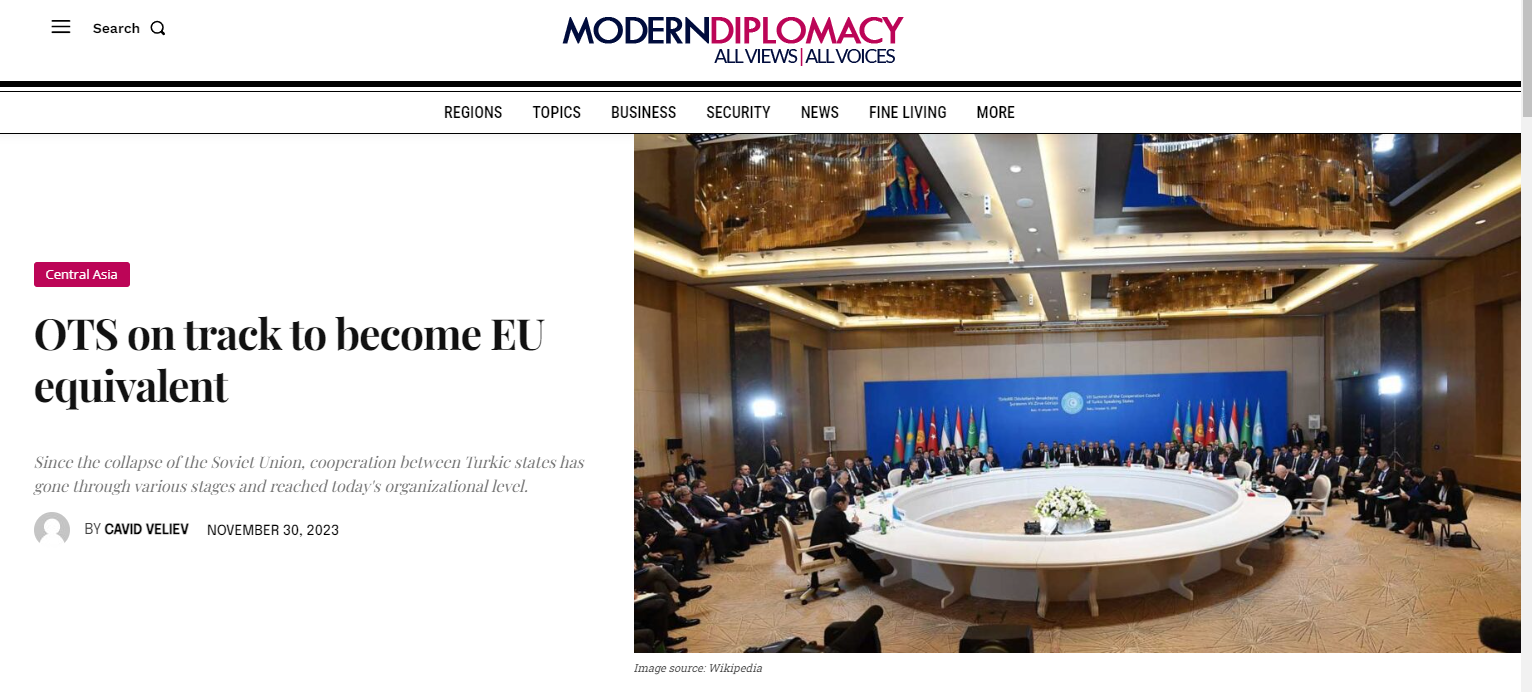
OTS on track to become EU equivalent


On November 3, 2023, the 10th Summit of the Organization of Turkic States (OTS) commenced in Astana, the capital of Kazakhstan. This summit brought together the heads of state and official representatives from both full and observer member countries of the organization. During the summit, the heads of state signed various key agreements, including the OTS Tenth Summit Declaration. Additionally, pivotal decisions were made, such as declaring Astana as the “Turkish World Financial Center” in 2024 and Istanbul as the “Turkish World Financial Center” in 2025. Another significant decision involved granting the Economic Cooperation Organization (ECO) Observer Status before the OTS, demonstrating a commitment to expanded regional cooperation. Numerous other decisions contributing to the organization’s objectives were also signed during this summit.

As a result of the Astana Summit, member states adopted the comprehensive Astana Summit Declaration consisting of 156 articles. In the Astana Declaration, leaders expressed support for the continued institutionalization of the OTS and encouraged the strengthening of cooperation among its members under the umbrella of the OTS Secretariat. This indicates a willingness to merge or coordinate the activities of other subsidiaries that had previously operated with more independence.

The declaration emphasizes cooperation on political, foreign policy, and security issues. Within this context, the parties reaffirm their commitment to enhancing comprehensive cooperation and solidarity among the Turkic States within the framework of the OTS. Regarding economic and sectorial cooperation, the declaration commends the signing of the Agreement Establishing the Turkic Investment Fund (TIF) in Ankara on March 16, 2023. This agreement was signed by Azerbaijan, Turkey, Kazakhstan, and Kyrgyzstan. Notably, it has received approval from the parliaments of all signatory countries except Kyrgyzstan.

Since the collapse of the Soviet Union, cooperation between Turkic states (Azerbaijan, Turkiye, Kazakhstan, Turkmenistan, Uzbekistan and Kyrgyzstan) has gone through various stages and reached today’s organizational level. The initial seeds were planted at the Turkic States leaders’ summit in Ankara in 1992. This early cooperation later evolved into the Cooperation Council of Turkic-Speaking Countries (Turkic Council), formalized through an agreement signed in Nakhchivan in 2009. A significant milestone occurred during the 8th summit in Istanbul in 2021 when the council underwent a transformation. It rebranded itself as an organization, changing its name from the Turkic Council to the Organization of Turkic States (OTS).

The Azerbaijan Karabakh Victory in 2020, involving a founding member of the Organization of Turkic States (OTS), brought heightened attention to the organization. Consequently, interactions among the Central Asian Turkic Republics, Azerbaijan, and Turkey increased both bilaterally and within the framework of the organization. It is possible to say that after the victory, institutionalization and activity within the framework of OTS increased even more. The global geopolitical landscape, marked by the Russia-Ukraine war and the escalating US-China rivalry, has elevated the importance of Central Asia. The consecutive 5+1 meetings held in 2023 involving Central Asian countries, Russia, China, the USA, the EU, Azerbaijan, and Turkey underscore the increasing significance of the Central Asian Turkic states in global politics.

The main issues on the agenda of OTS is deepening and broadening institutionalization; increasing cooperation on foreign policy and security issues; deepening cooperation in the field of economy and trade and increasing cooperation in the field of transportation. Cooperation among the member states based on common culture and history, has now managed to write a common history book up to the 15th century, and studies on the period after the 15th century are currently being carried out. Studies are currently being carried out towards the use of the common alphabet.

The “Turkic World Vision-2040,” identified as a crucial document for the future of the OTS, aims to articulate a comprehensive vision for the establishment of a more effective international system. The vision underscores the importance of creating a cooperative and equitable representation while advocating for the promotion of universal values. In light of the prevailing international uncertainty, the document recognizes that regional organizations, bear increased responsibilities. It emphasizes the necessity for enhanced cooperation among member states to effectively address these tasks and challenges of the contemporary geopolitical landscape.

The document, which defines OTS’s future goals and objectives, is divided into four sections. This document’s ultimate purpose is to create integration and, eventually, unity among Turkish states. Some experts believe the intention is to build a supranational entity similar to the EU. In this perspective, it is feasible to see that the recent talks and agreements reached demonstrate unity and cooperation in many areas.

The Turkic World Vision-2040 has set targets in the field of Economic and Sectoral Cooperation, specifically ensuring the free movement of commodities, capital, services, technology, and people between Member States and strengthening cooperation between various economic regions to encourage intra-regional investments. Harmonization of industrial structures and integration of product markets among member states. Important agreements were made within the Organization in this direction to establish favorable conditions and reduce trade barriers, including the “Freight Transport Agreement,” “Simplified Customs Corridor Agreement,” and “Trade Facilitation Strategic Document.” It was agreed at the ministerial meeting to implement new generation instruments that will strengthen economic and commercial cooperation between countries, such as the signing of the Digital Economy Partnership Agreement between member states and the establishment of the TURANSEZ Special Economic Zone (Turkish special economic zone). The key objective here is to expand regional trade volume to 10% of overall trade volume of member states at this stage.

One of the key aims in the field of transportation and customs was to make the International East-West Central Corridor across the Caspian Sea the quickest and safest transportation route between the East and the West.There are three main reasons for attempts to establish transportation cooperation. First, to be an alternate route in the expanding trade routes between Asia and Europe; second, the closure the northern route due to the Russia-Ukraine war; and third, and most crucially, to boost trade and cooperation among the member states. Because without transportation lines, trade would not grow and economic dependency will not be created. As a result, they began work on the Middle Corridor in 2012. Initially, Azerbaijan and Turkey took the lead in this initiative, Kazakhstan eventually joined to this process too.

Although the OTS was established on a common foundation of culture and history, foreign and security policies have recently gained importance in tandem with the geopolitical transformation. It aims to establish a permanent structure to strengthen political cooperation. In addition to this, it has developed permanent mechanisms at the levels of the foreign ministry, national security councils, and intelligence ministries. Furthermore, at Azerbaijan’s request, the first meeting of heads of state was convened at the level of foreign policy advisors. As a result, the organization may act on common ground on issues affecting Turkic states. For example, they backed Azerbaijan’s territorial integrity and had a unified approach on the Israel-Palestinian conflict.

In recent years, it has also sought to expand multidimensional cooperation with regional and global organizations. The growth of multi-layered cooperation between European institutions, particularly the Visegrad Group, was stated as an objective in the 2040 Vision Act. The purpose in the field of security was to establish a network for cooperation and the exchange of data among Member States in order to address the risks of radicalization, violent extremism, Islamophobia, xenophobia, and terrorism, as well as ensure border security. In short, by focusing on global regionalization opportunities, OTS is transforming itself into a regional player of rising importance.

As outlined in the Turkic World Vision-2040, the primary objective for member countries of the OTS is integration. It can be said that there is a serious political will in all member countries on this issue. Integration will cover cultural, commercial and economic areas. Meanwhile, an agreement was reached to adopt a common foreign and security policy on issues related to the interests of the Turkic world. The declarations from the summit, statements by leaders, and the activities within the framework of the OTS collectively indicate a trajectory that aligns with the European Union (EU). Much like the EU’s model of integration, the OTS seems to be moving toward fostering closer cooperation and unity among its member states, reflecting a shared vision for the future.

https://moderndiplomacy.eu/2023/11/30/ots-on-track-to-become-eu-equivalent/


Categories
Audio Review - South Caucasus News

Strained Relations Between Azerbaijan and the West


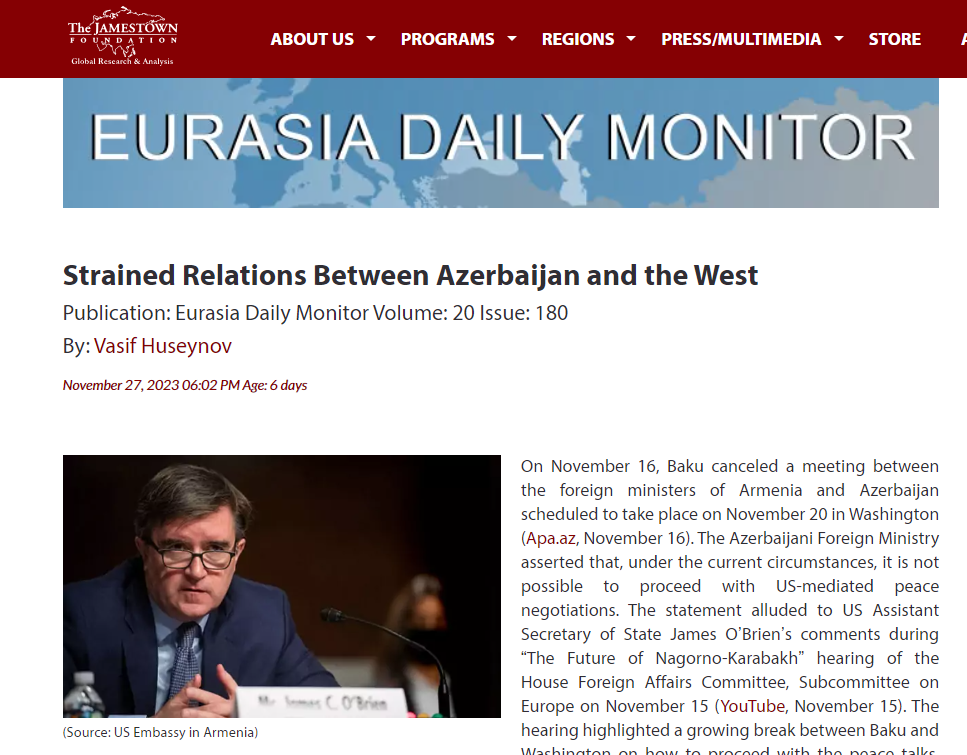
On November 16, Baku canceled a meeting between the foreign ministers of Armenia and Azerbaijan scheduled to take place on November 20 in Washington (Apa.az, November 16). The Azerbaijani Foreign Ministry asserted that, under the current circumstances, it is not possible to proceed with US-mediated peace negotiations. The statement alluded to US Assistant Secretary of State James O’Brien’s comments during “The Future of Nagorno-Karabakh” hearing of the House Foreign Affairs Committee, Subcommittee on Europe on November 15 (YouTube, November 15). The hearing highlighted a growing break between Baku and Washington on how to proceed with the peace talks. Azerbaijan has called for “more regional solutions to regional problems,” while the United States and European Union hope to maintain influence over negotiations between Baku and Yerevan (see EDM, October 25).

O’Brien’s remarks raised eyebrows in Baku. The US official commented on the Armenian-Azerbaijani peace process, bilateral relations between Azerbaijan and the United States, and regional transit projects in the South Caucasus. He stipulated that it cannot be business as usual with Azerbaijan without significant progress in the peace talks: “We’ve canceled a number of high-level visits, condemned [Baku’s] actions, and [canceled] the 907 waiver. We don’t anticipate submitting a waiver until such time as we see a real improvement in the situation” (YouTube, November 15). O’Brien was referencing Section 907 of the Freedom Support Act of 1992. The amendment, adopted on October 24, 1992, bars the United States from offering assistance to Azerbaijan unless Baku takes “demonstrable steps to cease all blockades and other offensive uses of force against Armenia and Nagorno-Karabakh” (Congress.gov, October 24, 1992).

The United States has granted annual waivers for this amendment since 2002. That year, Baku permitted Washington to use its territory to supply US troops in Afghanistan. Hence, O’Brien’s statement stirred ire in Baku. The Azerbaijani Foreign Ministry responded, “It turns out that the US side has always considered the support of Azerbaijan as occasional, while it should be remembered that history has always repeated itself.” The government ministry also reminded Washington of Azerbaijan’s numerous contributions to US counterterrorist efforts following 9/11 (Mfa.gov.az, November 16).

The Azerbaijani government has long considered the 907 amendment a major setback in Azerbaijani-US relations. Baku has consistently criticized the measure because it was adopted when Azerbaijan, not Armenia, was under occupation. Farid Shafiyev, chairman of the Baku-based Center for Analysis of International Relations, recently posted on X (formerly Twitter), “Let’s recall that the 907 amendment was adopted on 24 October 1992—the year when the Azerbaijani city Shusha was occupied by Armenian forces” (Twitter.com/shafiyev_farid, November 16).

O’Brien’s comments on a possible trans-Iranian transit corridor suggest that the US State Department’s strong response may be connected to other regional developments in the South Caucasus (see EDM, November 3). The US official declared, “A future that is built around the access of Russia and Iran as the main participants in the security of the region, the South Caucasus, is unstable and undesirable, including for both the governments of Azerbaijan and Armenia. They have the opportunity to make a different decision now” (YouTube, November 15). He further stressed that Washington prefers a land corridor passing through Armenia’s southern territory. The United States hopes to use such a passage to limit Russian and Iranian involvement in regional transit. Paradoxically, the State Department has not opposed the contract signed between Armenia and Iran on October 23 regarding the construction of a new road between the two countries. The new road is meant to “contribute to the implementation of the North-South project,” a priority for both Moscow and Tehran (Armradio.am, October 23).

Baku responded by emphasizing its focus on regional players taking the lead in peace negotiations. The Azerbaijani Foreign Ministry stated that “it is the sovereign right of Azerbaijan to agree with neighboring countries on how to build communication lines, which also includes an agreement with Iran. … Against this backdrop, Azerbaijan also reconfirms the priority of the ‘3+2’ format (Türkiye, Russia, and Iran “plus” Azerbaijan and Armenia) for the security of the region” (Mfa.gov.az, November 16). The Azerbaijani government has supported revitalizing the “3+3” cooperation platform (that includes Georgia)—currently proceeding in the “3+2” format due to Tbilisi’s non-participation—to deal with regional conflicts.

The format is built on the “regional solutions to regional problems” approach and attempts to ensure that the power vacuum left by declining Russian influence does not transform the South Caucasus into a battlefield for great-power competition (see EDM, October 25). This presages a new security order in the region that is not dominated by any other extra-regional actor. In this, Armenia, Azerbaijan, and Georgia would gain an opportunity to diversify their foreign policy and prevent compromising their sovereignty.

Tensions continue to mount between Azerbaijan and the United States regarding differences in their regional policies. On November 21, Hikmet Hajiyev, foreign policy advisor to the Azerbaijani president, issued a response to a statement from United States Agency for International Development (USAID) Administrator Samantha Power(Twitter.com/HikmetHajiyev, November 21). In a video posted on X, Power announced a package of $4 million in humanitarian aid for the Armenian people who, according to her, were forcibly displaced by Azerbaijan’s military operation in Karabakh (Twitter.com/PowerUSAID, November 21). Hajiyev criticized Power’s statement on multiple fronts. He highlighted her apparent indifference to the challenges faced by internally displaced persons and refugees in Azerbaijan and for supporting the Russian oligarch Ruben Vardanyan, who had served in a senior position in the separatist government in Karabakh. Hajiyev’s statement signaled that Azerbaijan may suspend USAID’s operations in the country.

The current tensions between Washington and Baku could have far-reaching implications for the South Caucasus. In this author’s opinion, it is crucial that both countries seek common ground on how to proceed in peace negotiations with Armenia and how best to handle the Armenians who left Karabakh. Additionally, the question of a transit corridor that connects Azerbaijan’s Nakhchivan exclave with the mainland—either through Iran or Armenia’s southern region—remains a key sticking point between the two sides. An inability to solve these issues along mutually beneficial terms will likely hamper any future efforts to establish peace between Armenia and Azerbaijan and risks straining regional tensions that could lead to a wider conflict.

https://jamestown.org/program/strained-relations-between-azerbaijan-and-the-west/


Categories
Audio Review - South Caucasus News

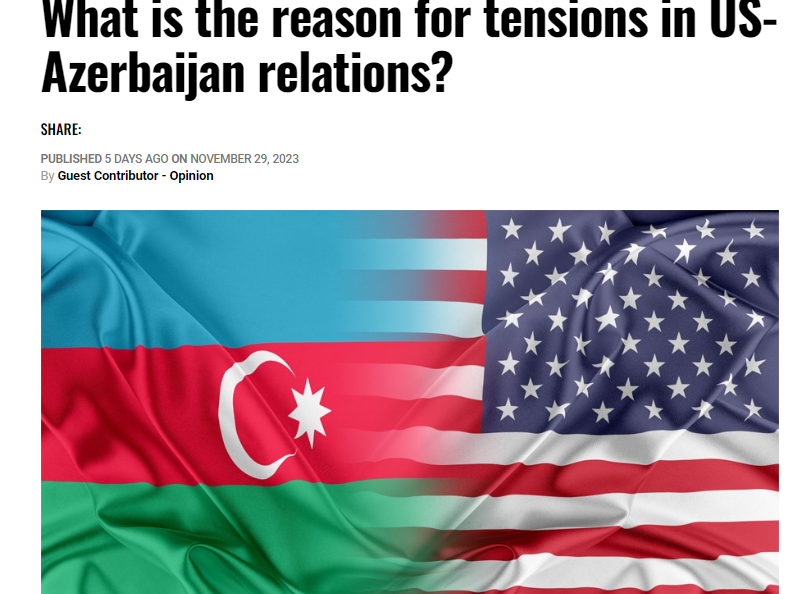
What is the reason for tensions in US-Azerbaijan relations?


After the dissolution of the Soviet Union, the U.S. began to implement a consistent approach and strategy toward the South Caucasus countries. Such a strategy includes strengthening its geopolitical interest and facing up to any challenges from regional powers. To this end, the Republic of Azerbaijan played an important role in shaping of regional economic integration thanks to its geographical position and the availability of energy resources. It is not surprising that Zbigniew Brzezinski, who was U.S. National Security Adviser from 1977 to 1981, called Azerbaijan a “geopolitical pivot” which is very important for the U.S.’s security interest.

It should be noted that the Second Garabagh War has changed the whole geopolitical landscape in the South Caucasus. Azerbaijan ended the long-lasting Armenian occupation, which opened up new opportunities for sustainable peace and full regional economic integration. However, despite positive signals from Baku, Yerevan continued to support illegal armed forces in Khankendi and destabilize the situation on the ground. Following Azerbaijan’s anti-terrorism measures against illegal Armenian armed forces in Garabagh region of Azerbaijan between 19 and 20 September 2023, Baku managed to restore its full sovereignty. The local anti-terrorist activities undertaken by the Azerbaijani armed forces within its sovereign territory were in full compliance with international law, including international humanitarian law.

On the background of such developments, the current Biden administration started to criticize Azerbaijan and even support the separatist ideology in Garabagh region of Azerbaijan. It is worth noting that on 15th November 2023, during a Subcommittee Hearing on the future of Garabagh, James O’Brien, Assistant Secretary, Bureau of European and Eurasian Affairs U.S. Department of State openly condemned Azerbaijan and made a clear pro-Armenian statement. The thoughts that “Azerbaijan’s use of force eroded the trust and raised doubts regarding Baku’s commitment to a comprehensive peace with Armenia” derail the peace process.

In fact, the biased position of the U.S. Congress towards Azerbaijan stared at the beginning of the 1990s by enacting in 1992 Section 907 of the Freedom Support Act, which restricted certain types of direct U.S. assistance to Azerbaijan. Later on January 25, 2002, President Bush waived Section 907 of the Freedom Support Act for 2002, thereby lifting restrictions on US Government Assistance to the Government of Azerbaijan.

This year, the Senate votes unanimously to suspend Azerbaijan’s military assistance, and the Biden administration did not issue a new Section 907 waiver needed to unlock Azerbaijani security assistance. It is worth noting that US administrations have repeatedly issued the waiver since the exemption was introduced in 2002, citing national security concerns. But this time, Washington ignored US geopolitical interests and supported “the Armenian Protection Act of 2023” under pressure from the Armenian National Committee of America (ANCA).

Today, the problems in the U.S.-Azerbaijan relations can be also characterized as Washington’s ambition to control Armenia during Moscow’s temporary absence in the region. The visit of the U.S. House Speaker Nancy Pelosi to Yerevan on September 17th, 2022 in support of Armenia showed clearly that Washington is talking a side in the conflict between two South Caucasus countries.

On the contrary, Azerbaijan, for the most part, has developed a pragmatic and stable relationship with Washington. The president Ilham Aliyev and former president Heydar Aliyev supported bilateral ties between Baku and Washington. Looking back, despite all efforts of the strong Armenian diaspora, the US supported the “Contract of the Century” signed on 20 September 1994, as well as critical energy infrastructure projects such as the Baku-Tbilisi-Ceyhan oil pipeline and the Southern Gas Corridor. These important inter-regional energy projects increased and diversified the US ally’s energy supplies by bringing crude oil and natural gas from the Caspian Sea to the global energy markets.

To this end, Israel, which is a traditional US ally, receives up to 40% of its oil supplies from Azerbaijan. Another example is the Azerbaijan-EU energy cooperation, which is highly important due to the ongoing Russia-Ukraine war. Azerbaijan supports Europe’s diversification efforts and ensures the EU’s energy security.

Under President Ilham Aliyev’s leadership, Azerbaijan has also emerged as America’s reliable regional partner at the world’s uniquely critical crossroads. The Azerbaijani government has always appreciated Washington’s role in the peace process between Armenia and Azerbaijan. Baku welcomed the US mediation when the Secretary of State Antony J. Blinken met jointly with Azerbaijani President Ilham Aliyev and Armenian Prime Minister Nikol Pashinyan in Germany to advance the bilateral peace negotiations between the two sides. Also, on 1st May the Armenian Foreign Minister Ararat Mirzoyan and Azerbaijani Foreign Minister Jeyhun Bayramov met with Antony Blinken in Washington to advance peace talks.

Despite Washington’s anti-Azerbaijani position, it is very important to understand the core of the US-Azerbaijan relationship; Azerbaijan supported the American-led peace operations in the world.  Azerbaijani servicemen serve shoulder-to-shoulder with American soldiers for a peace-keeping mission in Afghanistan.  Also, since the beginning of the American-led peace operation in Afghanistan, Azerbaijan made its infrastructure available to these operations, and its transport infrastructure was used for transiting of non-lethal cargo for coalition forces in Afghanistan. As a key component of the Northern Distribution Network, Azerbaijan for many years has provided uninterrupted multi-modal transit for the coalition forces in Afghanistan. Working closely with the U.S. Transportation Command and the Air Mobility Command, Azerbaijan extended important over-flight clearance, medical evacuation flights as well as landing and refueling operations for U.S. and NATO flights to support ISAF and RSM.

By themselves, all the aforementioned facts clearly show Azerbaijan’s approach to bilateral relations with Washington. Currently, the concern is not that Washington did not issue a new Section 907 waiver, but that the Biden administration causes growing irritation and challenges partnership. The US military aid to Baku mainly aimed to improve Azerbaijan’s maritime security against threats from Tehran. From the American perspective, the Caspian Sea is particularly strategically sensitive because it borders Iran. To be brief, Azerbaijan managed to establish strong and modern armed forces without the US financial aid and became the most powerful army in the region.

In the end, the ongoing Russia-Ukraine war changed the geopolitical landscape in Eurasia. Hence, Washington should support strategic interests in the region rather than support the Armenian diaspora interests. Azerbaijan, with its valuable geographic location and regional diplomacy, is an important actor supporting the US interests in the region. Now, a core principle in bilateral relations should be to structure the negotiations as a win-win for both countries. As argued by George Friedman, geopolitical forecaster and strategist on international affairs and the founder and chairman of Geopolitical Futures: “The U.S. needs Turkey as a counterweight to Iran. The U.S. needs Georgia as a demonstration of its will. The U.S. needs Azerbaijan as its linchpin.”  

https://www.eureporter.co/world/azerbaijan-world/2023/11/29/what-is-the-reason-for-tensions-in-us-azerbaijan-relations/


Categories
South Caucasus News

NPR News: 12-04-2023 3AM EST


NPR News: 12-04-2023 3AM EST

Categories
South Caucasus News

Climate change remains a topping global issue: Armenian President’s speech at COP 28 – ARMENPRESS


Climate change remains a topping global issue: Armenian President’s speech at COP 28  ARMENPRESS

Categories
South Caucasus News

Georgian Pundit: Only Azerbaijan can get Armenia out of its current situation – AzerNews.Az


Georgian Pundit: Only Azerbaijan can get Armenia out of its current situation  AzerNews.Az

Categories
South Caucasus News

ING: Inflation to decrease further in Azerbaijan – APA


ING: Inflation to decrease further in Azerbaijan  APA

Categories
South Caucasus News

Serbia finalizes pipeline construction to import gas from Azerbaijan – Trend News Agency


Serbia finalizes pipeline construction to import gas from Azerbaijan  Trend News Agency