Categories
South Caucasus News

EU Socialists Slam EPP’s ‘Silence’ Over Spanish Far-Right Attacks


EU Socialists Slam EPP’s ‘Silence’ Over Spanish Far-Right Attacks

By Max Griera 

(EurActiv) — EU socialists are “appalled” by the centre-right European People’s Party’s silence in the face of attacks by their partner, Spanish far-right party Vox, against socialist offices in Spain and Brussels, the secretary-general of the Party of European Socialists (PES) said on Thursday. 

Spanish socialists, the PSOE, denounced an attack on their headquarters in Brussels on 10 November, which came after multiple vandalism acts against socialist offices across Spain. 

The attacks followed days of intense protests against Prime Minister Pedro Sánchez, called for by far-right Vox (ECR) and centre-right Partido Popular (EPP), which on several occasions ended up with police intervention. 

“What was striking for me is to see Spanish PP, which is a qualified member of the EPP family, that is hand-in-hand with Abascal and Vox, who are storming headquarters of our political parties, not only in Madrid but even here in Brussels”, Giacomo Filibeck said during an event at Euractiv on Thursday (30 November). 

The socialists have long blamed Spain’s centre-right for allying with the far-right, starting with regional and municipal governmental coalitions in May.

“Friends, if anybody would ever come to break a window in the EPP headquarters or even in the ECR headquarters (…), I would be the first one to comment expressing solidarity”, Filibeck said, adding that instead of solidarity, the socialists only saw “silence”. 

In response, EPP secretary-general Thanasis Bakolas demanded answers from Fillibeck regarding Spanish socialists’ controversial amnesty law deal with Catalan separatists, which helped Sánchez secure a ruling majority and a second mandate as prime minister. 

Bakolas also blamed the socialists for applying double standards, reprimanding the Slovak and Bulgarian party members while, in his words, letting Sánchez undermine Spain’s rule of law. 

“In Spain, we have a fundamental democratic subversion taking place when a major party sells votes and quid pro quo to stay in power. That is something you need to answer,” Bakolas told Filibeck. 

In exchange for support to form a government, Sánchez signed a deal with the Catalan independentist party Junts on 09 November, which included an amnesty law pardoning all people involved in the 2017 independence referendum.

Opposition parties PP, Vox, and Ciudadanos have criticised the deal, saying it undermined Spain’s rule of law and the constitution. 

Their European counterparts – EPP, ECR, and the liberal centrist Renew – have internationalized the issue by raising concerns over the amnesty law in the European Parliament and pressuring the Commission to intervene.

The European Commission announced on Thursday (30 November) that the amnesty law is being reviewed, hours after Spanish Justice Minister Felix Bolaños said that the Commission had “zero worries”, following his meetings with Justice Commissioner Didier Reynder and Commissioner for Values and Transparency Věra Jourová.


Categories
South Caucasus News

Social Media And Counter-Terror Operations – Analysis


Social Media And Counter-Terror Operations – Analysis

By Shashank Ranjan

A counter-terror operation lasting for more than 24 hours in Rajouri’s Kalakote in Jammu and Kashmir on 22–23 November saw five soldiers including two young Indian army officers and Lashkar-e-Taiba’s (LeT) highly-trained ‘commander’ and his associate killed.

Although the intent here is not to carry out a military analysis of the incident, it would be pertinent to mention that officers’ casualty once again reinforces the fact that the Indian army leaders continue to lead the troops by example. The military lessons from this operation will certainly be drawn by the Army to modify its tactics and planning, as applicable. The opinion endeavours to flag the sensitive issue of usage of social media (SM) platforms, especially WhatsApp, during the course of such counter-terror operations. 

Adverse Fallouts 

Social media, as we all know, is very thoroughly abused by the terror outfits towards spread of dis-information as well as for recruitment purposes, among other objectives. The usage of social media platforms by the common people during the course of counter-terror operations, though, does not always portend well. In crisis situations such as natural disasters, messages on social media by the affected sections of people as also by relief providers do prove to be a force multiplier. 

In most cases, SM platforms have been the only way of responding to natural disasters for disseminating real-time information, warnings, coordinating aid and relief and asking for funds, etc. However, given past experience, irresponsible spread of half-baked information on SM platforms could be counter-productive in several ways, especially when a counter-terror operation is in progress.  

Vis-à-vis the recent Kalakote incident, a case in point were messages floating around on WhatsApp that gave finer and specific details concerning the ongoing gun fight between the troops and terrorists. These details, without any veracity, included name of the units involved in operations, location of operations, casualty to own troops to include their identity, etc. Shockingly, these details were in real- time, unofficial and against the norms of stealth and secrecy concerning tactical military operations. The origin of this particular message, amongst others, remained hazy and preceded any kinds of statement from an official source. 

Such messages during an ongoing encounter with terrorists inevitably lead to adverse fallouts. It compromises the operational security by revealing tactics by giving out specific details of mobilisation of units, locations, and the quantum of troops involved. In the said context, the handlers of proxies are able to connect dots and deduce the operational plan of own forces. Such real-time information to the terrorists enables them to adapt their strategies. 

Although not evident in the recent and similar terror incidents, SM updates could create panic among the public and hinder the authorities’ ability to manage the situation effectively, through exaggerated account of losses by a terror strike that may inflame passions. It may also impact the morale of security forces and provide fuel to our adversary to carry out propaganda. 

The reaction of common people, who are oblivious to the facts and cannot possibly appreciate the peculiarity of an unfolding operational situation, could get out of hand in extreme contingencies. This may manifest in display of anger through various means by the locals, instigated by sympathisers of terrorists. 

Last but not the least, this variety of irresponsible message proliferation, adversely affects the families of soldiers that are involved in the operations. As per the norm, the next of kin of a soldier who is killed in action is informed about the loss through proper channel and according to a laid-down military protocol. A passage of information to the concerned family is processed after due verification for sake of authenticity. Information about demise through social media, prior to the same being conveyed officially by the army authorities, is the last thing that any suffering family would prefer. This is about dignity and military ethos. 

Precedence and Counter Measures

Overall, the risks of compromising security and jeopardising the operations that irresponsible messaging could lead to, during such events, is highly problematic. We had seen this trend at its zenith during 26/11 Mumbai attacks, when the holed in terrorists continuously modified their actions, partially on their own initiative and partially due to the directions of their handlers from across the border, after getting status updates from the real-time media coverage. The major difference in context between 26/11 and the present time period is the proliferation of messages on social media platforms like WhatsApp and X (formerly twitter), which is more challenging to control.   

Given the popularity of SM, the army too has not been left untouched by its widespread usage and messaging on SM platforms is rampantly resorted to by its personnel, towards routine functioning. Being a mirror image of the civil society, one cannot blame the army for this. As mentioned, at times, reliance on SM becomes inescapable for everyday functioning of military units in terms of sharing updates and progress of routine activities.  

In view of the above, it is needed that information leaks through social media be taken as the new normal by military planners and adequate measures are taken to mitigate the adverse fallouts, by factoring in such messaging. In addition to sensitising its personnel to obviate pilferage of information, proactive steps require to be planned so as not to let an information void shape up, for the same to be filled up by dis-information. Perhaps there is a requirement to decentralise the information management structure to make the same more responsive to dilute the ill-effects of half-baked messages that swarm the social media platforms during critical times when lives are at stake.

Views expressed are of the author and do not necessarily reflect the views of the Manohar Parrrikar IDSA or of the Government of India.

  • About the author: Colonel Shashank Ranjan, Retd is Professor of Practice at OP Jindal Global University.
  • Source: This article was published by Manohar Parrrikar IDSA

Categories
South Caucasus News

The Rapid Return Of Israel’s Disastrous Policy – Analysis


The Rapid Return Of Israel’s Disastrous Policy – Analysis

By Daniel Pipes

“Everything changed” in Israel on Oct. 7. But did it? Understanding the mistakes that led up to the Hamas massacre provides a basis to evaluate Israel’s long-term response to that day. Contrary to general opinion, I shall argue that the presumptions behind those mistakes remain in place and will not change unless Israelis adopt a radically different attitude toward the Palestinians.

The Road to Oct. 7

Israeli military planners coined a Hebrew term, conceptzia, “the concept,” in the late 1960s. It held that Egypt’s Anwar el-Sadat would not go to war until 1974, when his military had acquired advanced Soviet fighter jets that permitted it to take on the Jewish state’s air force. Israel’s Agranat Commission, which investigated how the Egyptians and Syrians surprised Israel in the Yom Kippur War of October 1973, largely blamed the conceptzia for a blindness to the preparations taking place before its very eyes.

The future commission inevitably analyzing Israel’s unpreparedness on Oct. 7, 2023, will surely blame that surprise on a second erroneous conceptzia. It held that, David Makovsky of the Washington Institute for Near East Policy explains,

under the heavy burden of governing the Gaza Strip, Hamas would feel the need to prove itself through economic performance. Specifically, economic inducements towards Hamas would moderate its foundational belief that Israel is an illegitimate entity whose very existence must be extinguished and its citizens killed. This Israeli conceptzia was driven by many factors, but at its core, it was based on the idea that Hamas was undergoing an organizational evolution in which it would now value even modest increases in living standards in Gaza. Economic advancement would bring calm, as it gave Hamas something to lose.

Note the words “something to lose”: this phrase summarizes the new conceptzia, a belief that Hamas could be bought off or tempered through economic benefits. A headline published days before Oct. 7 captured the depth of this misunderstanding: “IDF and Shin Bet call on government to continue economic activities with Gaza. Senior security officials ask political echelon to increase work permits for Gazans to maintain calm on the border.”[1] Maintain calm. As Col. (res.) Eran Lerman explained just ahead of Oct. 7:

The ruling center-right in Israel takes a “conflict management” approach to the Palestinian issue. They prefer to leave open the prospect that resolution of the Israeli-Palestinian conflict may yet be possible one day, as the region changes and new leaders emerge. But until then, they believe, what Israel should do is ease tensions and improve living conditions for Palestinians in the West Bank and Gaza, while reserving the right to hit back at terrorist activity in a selective and intelligence-driven manner.

The conceptzia transformed blood-curdling threats by Hamas into empty words. The security establishment ignored Fathi Hammad announcing in 2019: “We are sharpening the knives. … If we die it will be when we are killing you [Jews], and we will cut off your heads, Allah willing… We must attack every Jew on the planet – slaughter and kill. … I will die as I blow up and cut – what? The throats of the Jews and their legs. We will tear them to shreds, Allah willing.” Only by completely disregarding such statements could Aryeh Deri, a senior Haredi politician, admit after Oct. 7 that he “never imagined that we were dealing with such murderers who are capable of acting with such cruelty.”

Conversely, those rejecting the conceptzia met with exclusion and scorn. National Security Minister Itamar Ben Gvir complained that his calls for the assassination of Hamas leaders caused him to be barred from cabinet discussions. Itai Hoffman, the chairman of a security organization near the Gaza border, accused the government, “We warned you about the situation. How can it be that you all sat here and kept silent? … You have abandoned us.” A kibbutz member pointed out that his community had only four rifles, adding “We have been screaming for years.” Yehiel Zohar, the mayor of a town near Gaza, complained that senior security officials belittled his warnings, with maps, infiltration routes, and defense plans, about hundreds of murderers entering his town and killing its residents: “Forget about it, it won’t happen.”

Avichai Brodetz, whose family was taken hostage by Hamas, vented bitter frustration at a Likud member of parliament about Hamas:

The army could easily have destroyed them, but the entire conceptzia of the IDF collapsed [i.e., was wrong]. Hamas understood this, and they were far more clever than we were. They carried out an exceptional operation, raped our women, and killed our children because the IDF was not there. This did not happen because of Hamas but because of the conceptzia you used. It would have been so easy to destroy Hamas with tanks and planes – but they simply weren’t there.

When Hamas drilled in plain sight, holding a live-fire exercise of blasting through a mock wall and raiding a mock town, then posted a video of this, Israelis ignored it. As the Jerusalem Post reports, “IDF lookouts who had warned that they were concerned about the situation along the Gaza border in the months before the Oct. 7 attack were told to stop bothering their commanders and even threatened with a court-martial.” A noncommissioned officer specializing in Hamas military doctrine wrote three documents warning about Hamas’ plans, emphasizing its exercises simulating an invasion across the border into Israeli residences and even reporting that senior Hamas officials came to watch the exercises. Her warnings went up the hierarchy, only to be met with the response, “You are imagining it.” A senior IDF officer scorned such warnings as “fantasies” and refused to act on them. Just a day before the attack, a lookout reported seeing suspicious activities but commanders “discounted” her concerns, telling her “Hamas is just a bunch of punks, they won’t do anything.”

Many observers held Prime Minister Benjamin Netanyahu personally responsible for the conceptzia. Thus, Israeli defense analyst Yoav Limor finds that he

promised to eliminate Hamas and claimed that Hamas is the same as ISIS, yet continued to effectively allow the organization to build up through various means, including money, supply trucks, fuel, electricity, labor, and more. He, who saw Hamas as a devil, should have destroyed it, but during his long rule, he did the opposite: It thrived and became a monster. Netanyahu effectively legitimized Hamas, and that allowed a misconception to form around it.

Israeli journalist Nadav Shragai agrees, holding Netanyahu “responsible for the misconception and its outcomes. He is its father, mother, and guardian.” But to be fair, Shragai adds,

it must be noted that almost all of Israel’s highest political and military officials, right and left, and most of the media, too, lined up behind the separation policy, either as a systematic worldview or by acquiescing in it. Almost all of them backed Netanyahu when he refrained from crushing Hamas by land; almost all of them belittled the Hamas threat.

Along those lines, Ben Gvir speaks of a “conceptzia camp” that included former prime minister Naftali Bennett and former IDF chiefs of staff Benny Gantz and Gadi Eizenkot. The conceptzia even had followers among those living closest to Gaza. Hanan Dann, a member of a kibbutz devastated on Oct. 7, explains:

We were glad that workers from Gaza were coming to Israel with work permits to have jobs to meet Israelis, to see that we’re not all “those devils.” We all really believed that things are changing, that Hamas has maybe matured from being this terrorist group to be the grown-up taking responsibility for its people, worrying for its welfare. And that concept really blew up in our face.

To summarize: Israel’s leadership hardly paid attention to the Islamist and jihadi nature of Hamas, believing that Israel’s economic strength, military superiority, and technical advancement moderated Hamas, rendering it less dangerous.

Apparent Changes

The post-Oct. 7 reckoning was brutal. “So many policies and paradigms,” David M. Weinberg of the Misgav Institute writes, “have been proven faulty, phantastic, illusory, and grotesque.” The idea of a Hamas-governed Gaza placated by economic well-being, Martin Sherman of the Israel Institute for Strategic Studies concludes, is but “a hallucinatory pipe dream.”

In reaction to such criticisms, politicians abruptly and radically changed their tune. Netanyahu spoke at least fourteen times of victory and winning. “Victory will take time. … now we are focusing on one goal, and that is to unite our forces and storm ahead to complete victory.” He told soldiers “The entire people of Israel are behind you and we will deal harsh blows to our enemies to achieve victory. To victory!” And: “We will emerge victorious.”

Many others in government followed suit. Defense Minister Yoav Gallant quoted himself informing President Joe Biden that Israel’s victory “is essential for us and for the United States.” To his soldiers, Gallant declared, “I am responsible for bringing victory.” Bezalel Smotrich, the minister of finance, announced the halt “of all budgetary outlays and redirected them to one thing only: Israel’s victory.” He called the goal of Israel’s war with Hamas to be “a crushing victory.” Benny Gantz, a member of the War Cabinet, deemed it “the time for resilience and victory.” The deputy parliamentary speaker called on Israel to “burn Gaza.” An unnamed defense official announced that “Gaza will eventually turn into a city of tents. There will be no buildings.” The minister for heritage endorsed attacking Gaza with nuclear weapons.

Legions of other Israelis also called for victory and the destruction of Hamas:

  • Naftali Bennett, former prime minister: “It’s time to destroy Hamas.”
  • Yaakov Amidror, former national security advisor: Hamas “should be killed and destroyed.”
  • Meir Ben Shabbat, former national security advisor: “Israel should destroy everything connected to Hamas.”
  • Chuck Freilich, former deputy national security advisor (in Ha’aretz): “Israel must now deal Hamas an unequivocal defeat.”
  • Tamir Heyman, former IDF intelligence chief: “We have to win.”
  • Amos Yadlin, former IDF intelligence chief: “We are going to destroy Hamas.”
  • Yossi Cohen, former head of Mossad: “Eliminating Hamas officials is a decision which needs to be made.”

Public figures expressed unprecedented verbal aggressiveness. Gallant called Hamas “human animals” and Bennett called them “Nazis.” Television news anchor Shay Golden went off-script to unload a tirade:

We will destroy you. We keep telling you every day–we are coming. We are coming to Gaza, we are coming to Lebanon, we will come to Iran. We will come everywhere. You must take this into account. Can you imagine how many of you we are going to kill for every one of the 1,300 Israelis that you massacred? The death toll will reach numbers that you have never seen in the history of the Arab nations. … You will see numbers that you never imagined were possible.

A hip-hop anthem promising to rain hell on Israel’s enemies jumped to the #1 spot. A pop singer called for Israel to “Erase Gaza. Don’t leave a single person there.”

And Israel’s voters? The Middle East Forum commissioned poll on Oct. 17[2] found extraordinary support for the destruction of Hamas and for a ground operation to achieve this. When asked “What should be Israel’s primary objective” in the current war, 70 percent of the public answered to “eliminate Hamas.” In contrast, only 15 percent answered to “secure the unconditional release of captives held by Hamas” and 13 percent “disarm Hamas completely.” Remarkably, 54 percent of those Israeli Arabs (or, more technically, voters who supported the Joint List, a radical anti-Zionist Arab party), made “eliminate Hamas” their preferred objective.

Given the option of a ground operation in Gaza to eradicate Hamas or avoiding a ground operation in favor another way to deal with Hamas, 68 percent chose the former and 25 percent the latter. This time, 52 percent of Israeli Arabs concurred with the majority.

In short, a ferociously anti-Hamas and anti-PA mood came to dominate Israeli politics, with only the two left-wing parties (Labor and Meretz) somewhat in opposition. Even a majority of Israeli Arabs recognized the danger that Hamas and the PA pose to their safety and well-being.

Victory had become a matter of consensus, or so it appeared.

Quick Revisions

But did that ferocity signify a fundamental shift in outlook or just a passing surge in emotions? Mounting evidence suggests the latter. American novelist Jack Engelhard noted in late November about the mood in Israel: “I am so damn depressed. … I hardly hear any talk of victory anymore.” Indeed, the robust rhetoric of victory following Oct. 7 ended as abruptly as it began, replaced by negotiating with Hamas over terms for the release of just some of the hostages. More profoundly, Israeli officialdom and public alike showed signs of hastily reverting to the attitudes and policies that had led to Oct. 7.

Those policies rest on two main assumptions: that economic benefits – more work permits in Israel, a larger fishing zone, outside funding – gives Palestinians something to lose, taming them and making them less inclined to aggress; and that an Israel so much mightier and more advanced than its Palestinian enemy can afford to make concessions.

Symptoms of the reversion include the following:

The security establishment approved the entry of 8,000 West Bank workers to Israel, mostly to engage in agricultural work. It did so in response to Israel’s agriculture minister assuring his colleagues that the workers had been vetted and posed no danger. That thousands of workers from Gaza had spied on Israel and made themselves complicit in the Oct. 7 massacre seemed blithely to be forgotten.

On the West Bank itself, Israel’s commanding general there issued oxymoronic orders limiting Arab access that appeared tough but changed very little. As explained by the Binyamin Regional Council, “There is no entry into Israeli towns for Arab workers. They will be permitted to enter industrial areas at night only.” Do marauders and murderers carry out their crimes only in daylight?

The Palestinian Authority (PA) that nominally governs part of the West Bank not only offered full-throated support for the Hamas massacre, but PA President Mahmoud Abbas’s Fatah movement boasted of having played a role in it. The PA also required mosques in its jurisdiction to instruct congregants that exterminating Jews constitutes an Islamic duty. Despite this, the Israeli cabinet continues to send tax monies to the PA. Gallant endorsed this decision, saying that “It is appropriate to transfer, and transfer immediately, the funds to the Palestinian Authority so that they will be used by its forces who help prevent terrorism.” (That theme of economic benefits never seems to die.)

Ben-Gvir tried to loosen the rules of engagement for police officers, permitting them in emergencies to shoot at the legs of aggressors, but Gantz managed to deflect the vote, thereby keeping the more restrictive regulations in place.

Five days after Oct. 7, Israel shuttered its Public Diplomacy Ministry, providing a perfect symbol of Israel’s historically hapless information efforts.

Contrarily, Israel’s communications minister called Al Jazeera, the Qatari television channel, a “propaganda mouthpiece” that incites against Israel and attempted to close down its office in Israel. The government rejected his recommendation, wanting not to upset the Qatari government, which had helped with the release of several hostages, thereby ignoring its role in perpetrating Oct. 7. Yossi Cohen, the former head of Mossad, went further; he favored “refraining from criticizing Qatar.”

Before the massacre; Israel supplied Gaza with 49 million liters of water, or 9 percent of the territory’s daily consumption, through three pipelines. It cut all supplies after the massacre. But that lasted just twenty days, after which Israel reinstated 28.5 million liters through two pipelines. Why not all three? Because Hamas had damaged the third on Oct. 7, necessitating repairs. Not to fear: IDF Col. Elad Goren announced his office had “assembled a team of experts who assess the humanitarian situation in Gaza on a daily basis.” Avigdor Liberman, head of the Yisrael Beiteinu party, called this “simple idiocy.” Fuel supplies also resumed.

Talk of victory did not stop negativism from quickly rearing its head. “I don’t see any kind of victory going out of this mess,” comments Fauda creator Avi Issacharoff. Orly Noy of B’Tselem cries out to her Israeli conationals, “I have no interest in the victory you’re offering me. … I’m ready to admit defeat.”

The principal of a public high school in Tel Aviv devoted 45 minutes to talking to three students who had come to school wrapped in Israeli flags. During the conversation, one student reported, the principal pointed out that other students objected to such a display of patriotism, adding that “if a large number of students came to school wrapped in Israeli flags, he would end this immediately.” So extreme had things become that even the far-left Ha’aretz newspaper ran a story under the headline, “Stop Applauding Hamas for Its ‘Humanity’.”

The Regavim organization warned that the Palestinian Authority has built close to 20,000 structures close by the Green Line, its border with the part of the West Bank under full Israeli control (Area C); it called this phenomenon “frightening and threatening … a real danger; a ticking bomb.” When presented with this information, the security establishment responds now as it did previously to the comparable threat from Gaza: it would rather ignore this topic or dismiss the buildings as organic construction by individuals.

If mid-October polling showed 70 percent wanting to “eliminate Hamas,” in mid-November polling by The Jewish People Policy Institute,[3] a mere 38 percent defined victory as “Gaza is no longer under Hamas control,” a roughly 50 percent drop. Asked about the war’s most important objective, a November poll of Israeli Jews by Hebrew University of Jerusalem researchers found that 34 percent say incapacitating Hamas (and 46 percent the hostages’ return). Asked about making “painful concessions” to secure the hostages’ release, 61 percent expressed a readiness, a near-tripling of the 21 percent ready to do so six weeks earlier. A poll by Israel’s Channel 14 reported a 52-32 percent approval of the hostage agreement. The numbers–38, 34, 32 – are impressively consistent.

Politicians and the security establishment drove previous flights from strategic reality (e.g., the Oslo Accords, the retreat from Gaza) but not this one. Here, the public pushed the destruction of Hamas aside in favor of rescuing the hostages. In the words of one survivor, Nadav Peretz, “We want two things. To see Hamas destroyed and to free the hostages. And right now, the latter outweighs the former.” A mid-November Maariv poll found that the National Unity party headed by Gantz, a former chief of staff and the personification of the security establishment, jumped from 12 seats in the prior election to 43 seats in the next one. According to Nimrod Nir, a psychologist who led the Hebrew University survey research, “Our polling shows that the Israeli people were consistently ahead of the decision makers on this. As they learned about who Hamas was holding and under what conditions, the pressure to do something grew.”

Politicians began seeking ways to square the circle. Former Israeli ambassador to the United States Michael Oren suggested changing the war goal “from annihilating Hamas to securing Hamas’s unconditional surrender,” thereby allowing Hamas to continue to exist. More specifically, he advocated offering Hamas “free passage from Gaza … in return for the hostages’ release.” The talk about destroying Hamas had nearly vaporized.

The Hostage Deal

Speaking of hostages, the biggest reversion concerned them. Israel’s President Isaac Herzog called Hamas “absolute evil,” and then-Republican presidential candidate Tim Scott offered advice to the Israelis, referring to Hamas: “You cannot negotiate with evil. You have to destroy it.” But just 1½ months after the massacre and weeks after the avalanche of calls for the destruction of Hamas, the Government of Israel reached a deal with the jihadi group, thereby undercutting its moral position and relapsing to the negotiating policy that brought about Oct. 7 in the first place.

The contents of the deal only made matters worse, for a desperate Israel made a majority of the concessions. In return for fewer than one-quarter of Israeli hostages being freed, all of them females and children, Israel agreed to: free 150 female and minor security prisoners (i.e., prisoners arrested in connection with offenses bearing on national security); permit an increase in water, food, medicine, and fuel to Gaza; and for four days not send warplanes over southern Gaza, halt drone aerial surveillance for six hours each day, and not attack Hamas.

Consider some implications of these terms:

1. Just a fraction of the hostages implies that the bargaining process will continue indefinitely, with multiple breaks. This suits Hamas’ needs while disrupting the Israeli military campaign. As Col. (res.) Shai Shabtai explains, Hamas’ “continued hold on the hostages has one object: to use endless negotiation in order to undermine the dismantling of its political and military power.”

2. Interrupting surveillance permits Hamas fighters to escape their besieged tunnels or bring supplies into the tunnels.

3. Trading Palestinian security prisoners for Oct. 7 victims confirms Hamas’ argument that a moral equivalency exists between criminals and innocent civilians violently abducted.

In retrospect, that the same leadership team that brought on Oct. 7 also went on to sign the hostage deal hardly surprises: responsibility for the first made it vulnerable to the appeals of hostage families and foreign states. That Netanyahu and others – for example, the commander of the Unit 8200 that gathers about 80 percent of Israeli intelligence[4] – refused to take responsibility only compounded the problem. For Brodetz, the hostage family relative quoted above addressing a Likud member of parliament, the conceptzia still reigns: “You are living in a fantasy and blaming Hamas when it is you yourselves who are to blame. The problem was you. Get that into your heads, and perhaps then you will be able to solve the problem.”

It gets worse. On Nov. 22, Netanyahu very unusually publicly announced that he had instructed Mossad to kill Hamas leaders “wherever they are,” by implication including those in Qatar. When pressed whether the ceasefire agreement with Hamas grants immunity to its leaders, he replied in the negative: “there is no commitment in the agreement to not act in a truce against the leaders of Hamas, whoever they are.” He further added that “such a clause does not exist.” Two days later, however, Georges Malbrunot of Le Figaro newspaper reported that a “generally well-informed source” informed him that Netanyahu assured Qatar at the start of the hostage negotiations that “Mossad would not go to the emirate to kill Hamas political leaders.” The Jerusalem Post then “indirectly confirmed that Israel made commitments to Qatar on this issue.”

It bears noting that not all Israelis place personal concerns over the national interest. Eliahu Liebman, father of the hostage Elyakim Liebman, summed up the dilemma in his valorous protest against the proposed deal: “We want all of our hostages released, and the only way to do that is by attacking the enemy with all of our strength, without interruption and without surrendering to their demands, as if they are the victors.” Tikvah, an organization of families related to hostages, concurs: “The most correct and effective way of retrieving the hostages is by applying uncompromising pressure on Hamas, until the hostages become a liability for Hamas instead of an asset.”

Conclusion

I observed in a late October article that “the inflamed Israeli mood of the moment will likely fade with time, as old patterns reassert themselves and business-as-usual returns.” I was wrong in one respect; it did not take time. Rather, it occurred almost right away, within two weeks. Contrary to the initial impression that “everything changed,” at the time of writing – late November – almost nothing has changed.

This reversion also fits a much larger pattern. From 1882 until the present, the two feuding parties to this conflict have compiled extraordinary records of sterile continuity. The Palestinians maintain a mentality of rejectionism (no, no, and never to everything Jewish and Israeli), while Zionists stick to conciliation (accept us and we will enrich you). The two go around and around, hardly evolving or making progress. Change will only come when Israelis break with the traditional Zionist mentality and seek Israel Victory.

  • About the author: Daniel Pipes (DanielPipes.org, @DanielPipes) is president of the Middle East Forum and author of the just-published Islamism vs. The West: 35 Years of Geopolitical Struggle (Wicked Son). © 2023 by Daniel Pipes. All rights reserved.
  • Source: This article was published by Middle East Quarterly Winter 2024

[1] IDF refers to the Israel Defense Forces; Shin Bet (or Shabak) is Israel’s internal security service.

[2] Shlomo Filber and Zuriel Sharon of Direct Polls Ltd. carried out the poll with 1,086 adult Israelis; it has a statistical sampling error of 4 percent.

[3] By theMadad.com with 666 respondents on Nov. 15-18.

[4] According to one account, that commander neglected his intelligence duties in favor of helping the disadvantaged, dealing with climate change, and various social issues.



Categories
South Caucasus News

Small And Micro Launchers In The NewSpace Era: New Missile Proliferation Risks Or More Of The Same? – Analysis


Small And Micro Launchers In The NewSpace Era: New Missile Proliferation Risks Or More Of The Same? – Analysis

Debut of Astra’s small satellite launcher. Photo Credit: DARPA, Wikimedia Commons

By Kolja Brockmann and Dr Markus Schiller

The global growth of the NewSpace industry, the demand for launch capacity for small satellites and the desire to reduce launch costs are driving the development of small and micro launch vehicles by commercial providers. The dual-use nature of traditional space launch vehicle technology has always been a missile proliferation challenge. With the larger number and diversity of launch vehicle projects pursued by commercial providers in the NewSpace era, the extent of this challenge appears to be changing.

In general, space launch vehicles of all sizes use many of the same, or at least very similar, technologies and major components as ballistic missiles. A lot of the small and micro launch vehicles currently being developed seek to provide a ‘rapid response’ capability—meaning that they are designed to be deployable at short notice and from a variety of launch locations—making them more similar to ballistic missiles. 

This topical backgrounder seeks to create a better understanding of current trends in small and micro launchers and how they contribute to missile proliferation risks. It explains what small and micro launchers are and how their technologies and optimization resemble and differ from those of ballistic missiles. It explores how the availability of small and micro launcher technology could contribute to missile proliferation and how the particular trends in the NewSpace era increase this risk. Finally, it calls on states and industry to work together to reduce the missile proliferation risks linked to small and micro launcher technology.

Figure 1. Cutaway of a small launch vehicle. Source: JAXA Digital Archives.

What are small and micro launchers?

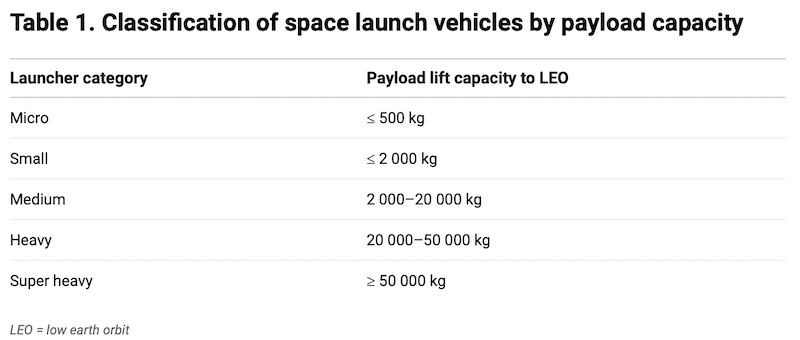
Small (or small-lift) launchers are space launch vehicles usually optimized to carry and insert small satellites into orbit (see figure 1). Space launch vehicles can be classified according to several different characteristics. The most common classification (see table 1) sorts launchers by the weight of the payload they can deliver to low-earth orbit (LEO; c. 160–1000 kilometres altitude). The ‘small’ in small launcher thus refers to the maximum weight of the payload and not the size of the launch vehicle. While there are some variations in definition, small launchers are usually defined as those capable of delivering payloads of up to 2000 kilograms to LEO and micro launchers as those capable of doing so with payloads of up 500 kg. In contrast, the current workhorse of the NewSpace age, SpaceX’s Falcon 9 rocket, is a heavy launcher that can deliver payloads of up to 22 800 kg to LEO. 

Table: SIPRI ©Source: McConnaughey, P. K. et al., ‘Draft Launch Propulsion Systems Roadmap: Technology Area 01’, National Aeronautics and Space Administration (NASA), Nov. 2010, p. 11.

The basic technical characteristics of any launcher, including small and micro launchers, directly result from its mission requirement: to launch a satellite into space. For a satellite to stay in earth orbit, physics dictates that it has to move around the earth at a certain speed, which depends on the altitude. It should also be high enough to not be slowed down by aerial drag from the atmosphere and ideally travel parallel to the earth’s surface. A space launcher must therefore place an artificial earth satellite in LEO at a speed of 7.8 km/second for a 160 km orbit altitude, or 7.35 km/s for a 1000 km orbit altitude. This speed is called circular velocity. A space launcher is a delivery system capable of accelerating its satellite payload to the intended speed, lifting it to the intended altitude and setting it on the intended course. 

Missions and demand for small and micro launchers

With the growth of the NewSpace industry there has been a significant increase in companies offering space-based services, either making use of existing satellite infrastructure or developing and launching new satellite constellations. Advances in satellite technology have made satellites smaller, lighter and to some extent cheaper. With more and more businesses relying on satellites for the services they offer, there is a significant perceived demand for launch services that can be used at short notice and tailored to the delivery of small satellites to specific orbits to enable rapid replacement of dysfunctional satellites. This demand is created by commercial satellite companies, critical infrastructure providers and militaries

There is also a general demand for more launch capacity, as several older heavy launchers have now been retired and there is limited capacity remaining for small satellites to ‘rideshare’ or ‘piggyback’ along with other, primary, payloads, meaning that such spots usually have to be booked several years in advance. Another indicator of the current demand for small launch capacity is that many companies in the advanced stages of developing a launch vehicle claim to have already filled their books for the first scheduled launches. Even so, there may well be insufficient demand to justify the large number of small and micro launchers currently in development.

Small and micro launcher technology and ballistic missiles

Significant differences between the basic missions and operational requirements of small and micro launchers and those of ballistic missiles may lead to very different design choices and varying technical solutions. Throughout the history of rocket development, many ballistic missiles have been converted into space launchers. The very first launch of a satellite in 1957 used an R-7 intercontinental ballistic missile (ICBM), but no space launcher has ever been directly used in a missile role. There are good reasons for this. Ballistic missiles are weapon systems that come with many specific military requirements, while space launchers must optimize their performance capabilities to reach circular velocity. The traditional design choices for space launchers mean that they do not usually lend themselves to conversion into ballistic missiles. However, the technologies used in small and micro launchers are still highly relevant—albeit differently optimized—for an actor undertaking a missile programme. 

Differences between space launchers and ballistic missiles

There are clear differences in the basic requirements of space launchers, including small and micro launchers, and ballistic missiles. Both are delivery systems designed to transport a defined payload to a specific location. A space launcher deploys its payload in a predetermined orbit but, traditionally, the timing of when this happens is secondary and there is less need for accuracy. A ballistic missile, however, must deliver its payload so that it very precisely impacts a predetermined point on (or near) earth’s surface. 

Another difference is the stakes involved. A launch failure in the case of a small or micro launcher merely results in possible reputational and monetary costs, while the failure of a missile launch may have a more or less decisive influence on a military operation, the course of a conflict or the stability of a deterrence relationship. In some cases, missiles are not thoroughly tested for reliability, but this often reflects the fact that they are only intended as policy tokens and are not intended to be used in combat. 

A space launch can usually wait until the probability of success is highest: in perfect weather conditions, with months or even years of preparation, involving a large, dedicated team of experts and with the option of postponement. In contrast, a small team of soldiers, potentially under attack, should ideally be able to launch a missile at any time, in any weather. 

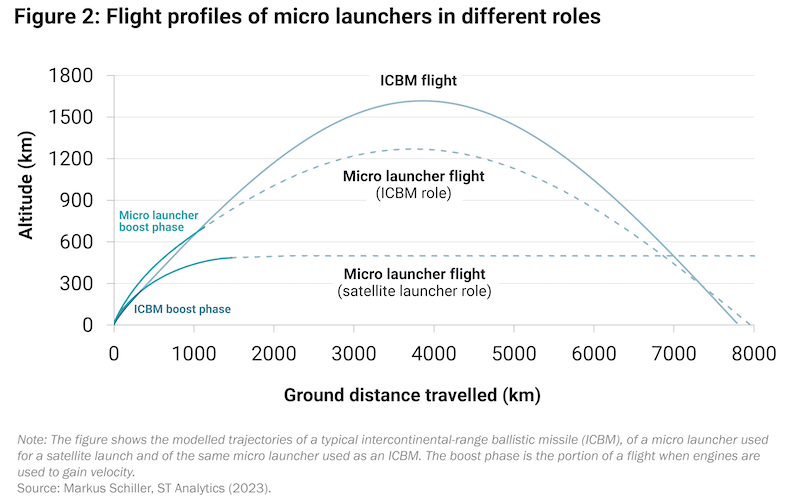
Furthermore, ballistic missiles do not need to reach circular velocity to deliver their payload (see figure 2). Therefore, they do not have to carry along as much propellant as space launchers nor do they have to accelerate to such a high speed, making the technological margins more forgiving. 

Finally, ballistic missiles must be built in advance and then deployed or stored, so that they can be used, potentially in large numbers, in a conflict. This requires the establishment of serial production, with proven functionality and reliability and an extensive test programme. In contrast, space launchers can be developed as prototypes and manufactured for specific missions booked months or years in advance, and the design and production processes can still be adjusted for the next launcher. 

All of these aspects are reflected in the technologies used in small and micro launchers and ballistic missile systems. It is therefore possible to determine whether a rocket in development is intended to be used as a ballistic missile system or a space launcher. Analysing the engineering choices that stand out and the technologies deployed that are of interest for a military missile programme can help make such a determination.

New capabilities pursued in commercial rapid-response launchers

The commercial rapid-response or ‘quick-reaction’ launch vehicles being developed by several NewSpace companies seek to provide the capability to launch satellite payloads into orbit at short notice using small or micro launchers. To achieve this, several companies are developing space launch vehicles with solid rocket motors that can be launched from a road-mobile transporter-erector-launcher or shipped in a small number of standard shipping containers and assembled using minimal support equipment. 

The design choices for these differ in some respects from the traditional space launcher optimization described above and make part of the design of these launchers closer to that of ballistic missiles. For example, they have a reduced observable footprint and preparation time (e.g. for erecting and fuelling) prior to launch.

Proliferation risks linked to small and micro launchers in the NewSpace era

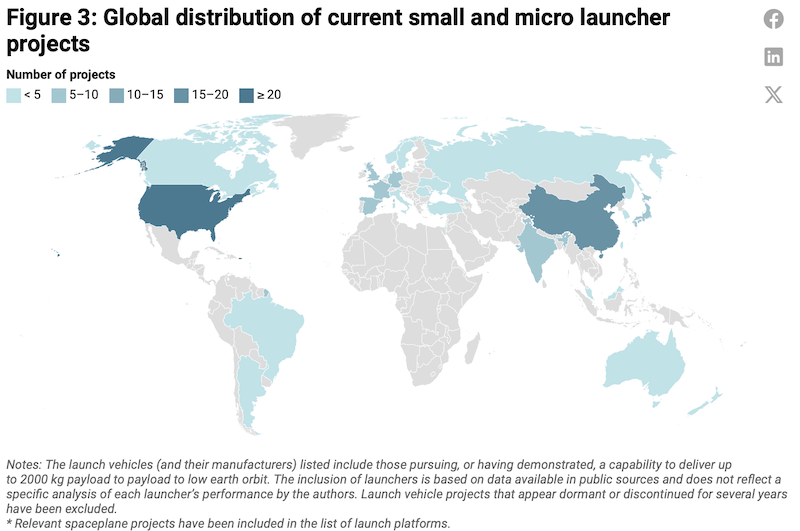
In the NewSpace era, the number of projects developing new small and micro launchers has multiplied. While only a few small and micro launchers have become operational in the last decade, there are currently around 117 ongoing small and micro launcher projects involving companies in 26 countries (see figure 3). 

Developments in the small and micro launcher market over the past decade also show that—despite the growth—some companies working on such projects, representing a considerable share, get bought up by competitors or other interested parties, go bankrupt or otherwise disappear. The geographically diverse pool of increasingly experienced technicians and engineers therefore moves around frequently; when companies close down, assets are sold and engineers are forced to seek new work. Commercial incentives, requirements to share sensitive technology with foreign investors and a lack of cyber security or export control compliance systems can create vulnerabilities, particularly in start-ups with little awareness of proliferation risks and little capacity to implement internal compliance programmes. Consequently, there is a risk that some NewSpace industry activities might inadvertently—or even intentionally—contribute to missile proliferation.

Map: SIPRI ©Source: Data collected by Selma Mustafić (SIPRI Intern) and Kolja Brockmann (SIPRI Researcher). For a reference dataset see Kulu, E., ‘Small Launchers – 2023 Industry Survey and Market Analysis’, Paper for the 74th International Astronautical Congress (IAC2023), Baku, Azerbaijan, 2–6 Oct. 2023.

Possible proliferation scenarios

The nature of today’s small and micro launcher market significantly increases the possible sources from which missile technology could be illicitly procured by state or non-state actors seeking to repurpose it for a military end use. Rather than the use of a small or micro launcher as a crude missile in a one-off attack, the more likely scenario is a state or non-state actor acquiring specific dual-use technology from a commercial provider, for example to overcome a barrier or setback they have experienced in developing a missile system. 

There are a range of possible scenarios in which illicit procurement attempts might exploit vulnerabilities in the small and micro launcher sector. For example, a state (or even a non-state actor) could seek to procure dual-use launch vehicle technology ostensibly for a national space programme or for a company in the local commercial space industry but then divert it to a covert or overt missile programme. In a different scenario, a state could act as a foreign investor in a space company, requesting access to its technology and secretly diverting the technology to a missile programme.

To prevent this happening, small and micro launcher companies and their component suppliers need to be sensitized to such risks and consider such scenarios when exercising due diligence in their engagement with potential investors, development partners and customers. This is particularly crucial but easily forgotten when it comes to the sharing of know-how, technical data or other forms of intangible technology, rather than components and other tangible goods. 

Application of export controls to small and micro launcher technology

One set of tools at states’ disposal to exercise oversight over transfers of dual-use technologies are export controls and related measures. Many of the largest supplier countries of missile technology coordinate missile-related export controls through the Missile Technology Control Regime (MTCR). The MTCR Guidelines—the key principles created by MTCR partners—are ‘not designed to impede national space programs or international cooperation in such programs as long as such programs could not contribute to delivery systems for weapons of mass destruction’. The MTCR control list, which identifies those items that are subject to export licensing requirements, covers all major components and technologies required for rockets as they may pose missile proliferation risks—whether they are developed for small and micro launchers or for missiles.

Despite the broad coverage of the control list, not all rocket technology and related production equipment is listed. Many NewSpace start-ups developing novel small and micro launchers use emerging technologies that are currently not listed, such as additive manufacturing using metals and energetic materials. In those cases, controls may still apply if there is a possible end use for such technologies related to weapons of mass destruction or for conventional military applications in a recipient country under sanctions. However, the implementation of such controls is more challenging, for both exporters and national authorities.

The controls agreed in the MTCR include licensing requirements for transfers of missiles, launchers and other delivery systems capable of delivering a payload to a range of at least 300 km, as well as their major components and required technologies. Small and micro launchers must be capable of reaching circular velocity and lifting their payload to orbit, which means that their range will easily exceed 300 km. Complete small and micro launchers, their major components and required technologies therefore count at least as MTCR Category II items, the export of which requires a licence. 

Export controls are thus important regulatory tools to oversee, and where necessary intervene, in the transfer of missile-related dual-use technologies—and companies in the small and micro launcher sector need to be more aware of their obligations regarding export control compliance. 

Conclusions

The trends linked to the development of small and micro launchers in the NewSpace era accentuate some of the missile non-proliferation risks traditionally posed by space launch vehicles. While they do not fundamentally change the nature of the proliferation challenge, they expand it through the increased number of dual-use launch vehicle technology holders and the increasing pursuit of militarily desirable technology optimizations in rapid-response space launchers.

The most important aspect of addressing the missile proliferation risks posed by trends in small and micro launcher development is engagement with the companies in this sector. This includes raising awareness of the proliferation risks and of export control compliance requirements. Companies must understand how they might inadvertently support a foreign missile programme if they are not diligent when it comes to sharing their technology with investors, development partners and customers—and the economic and reputational risks of having an inadequate internal compliance system. 

States should actively reach out to small and micro launcher manufacturers and their major component suppliers, in an effort to engage in a dialogue about regulatory questions and uncertainties. Such efforts should also be discussed and coordinated in interagency dialogue among the wide range of government agencies that are concerned with different regulatory frameworks that are currently being developed or already apply to activities conducted by NewSpace stakeholders.

About the authors:

  • Kolja Brockmann is a Senior Researcher in the SIPRI Dual-Use and Arms Trade Control programme.
  • Dr Markus Schiller is an Associate Senior Researcher in the SIPRI Armament and Disarmament Research Programme and the CEO of Munich-based consulting company ST Analytics.

Source: This article was published by SIPRI


Categories
South Caucasus News

College Football Playoff rankings predictions: What the final CFP top 25 could look like – NCAA.com


College Football Playoff rankings predictions: What the final CFP top 25 could look like  NCAA.com

Categories
South Caucasus News

Azerbaijan to hold GUAM chairmanship during 2024


In 2024, the chairmanship of GUAM will pass from Ukraine to Azerbaijan, Azernews reports.

Categories
South Caucasus News

Two IRGC members killed in Israeli strike on Syria


Iran’s Islamic Revolutionary Guard Corps (IRGC) on Saturday announced that two of its members were killed by an Israeli strike in Syria, Report informs via Rudaw News.

Categories
South Caucasus News

President Ilham Aliyev participates in event held on occasion of National Day of United Arab Emirates in Dubai


President of the Republic of Azerbaijan Ilham Aliyev has attended an event held on the occasion of the National Day of the United Arab Emirates in the city of Dubai, Report informs via AZERTAC.

Categories
South Caucasus News

See inside £2m Georgian fronted country house with cottage – Suffolk News


See inside £2m Georgian fronted country house with cottage  Suffolk News

Categories
South Caucasus News

@GeorgeDeek: Hamas can tell you exactly how many residential buildings were hit in Gaza, how many people are missing and even how many government buildings were damaged. But they still lie and claim they don’t know how many Israeli hostages are held in Gaza. https://t.co/ONTEx0rHjv


Hamas can tell you exactly how many residential buildings were hit in Gaza, how many people are missing and even how many government buildings were damaged.
But they still lie and claim they don’t know how many Israeli hostages are held in Gaza. pic.twitter.com/ONTEx0rHjv

— George Deek (@GeorgeDeek) December 3, 2023