
Aliyev Presides Over ‘Victory’ Military Parade in Stepanakert; Chides ‘Enemy’ Armenia – Asbarez.com Asbarez Armenian News
Day: November 11, 2023
By Bipandeep Sharma
When most of the global scientific cooperation remains suspended over the Arctic, on 27 September 2023, Xuelong 2, China’s first domestically built scientific icebreaker ship returned to its home port Shanghai, after concluding 13th scientific research expedition to the Arctic.
The ice-breaker also carried an autonomous underwater vehicle (XH1000) developed by Harbin Engineering University. Equipped with domestically developed detection sonars, this polar observing autonomous underwater vehicle surveyed an area of about 7,000 square meters beneath the Arctic ice and conducted multiple under-ice environment detection operations near the Chukchi Sea.1
Scientific Activities
The 13th expedition was mainly focused on undertaking scientific investigations in the Gakkel Ridges and the central section of the Pacific Arctic region. During the journey of about 15,000 nautical miles, Chinese researchers undertook 49 comprehensive marine surveys, deployed five sets of submersible buoys, carried out 142 groups of meteorological soundings tests, established six short-term and one long-term ice stations and deployed 26 sets of quasi-disposable ice-based buoys.
Various types of data was gathered on meteorology, atmospheric composition, aerosols, sea debris, gravity, sea surface temperature, profiling of currents, ship stress and related parameters.2 Apart from this, seabed seismic surveying, magneto telluric surveying and geological sampling from the Arctic Ocean were also conducted.3 About 130 strains of bacteria from seawater and Arctic sediments and around 68 genetic samples of marine flora and fauna for undertaking further research at Chinese laboratories and scientific institutions.4
China claimed that such experimentation and observations are aimed at strengthening its scientific understanding of the Arctic region. It is however pertinent to flag the dual-use implications of the experiments that were conducted. One such experimentation involved the use of Synthetic Aperture Radars (SARs) to observe Arctic region. SARs can be mounted on satellites, high-altitude airships, manned aircraft or unmanned aerial vehicles. They use microwave signals that can penetrate through dust, darkness, clouds and rain to create high-resolution images.5 During the expedition, Chinese scientists used five different frequency bands of SAR to build an integrated testing platform, for conducting sea ice observation by microwave remote sensing.6
Assessment
Chinese scholars claim that the success of the mission demonstrates the credibility and endurance of Xuelong 2 and its onboard polar research equipment, which is seen as a big boost for the country’s domestic manufacturing industries undertaking R&D in polar resilient technologies. Chinese scientists claim that the scientific experiments conducted during this expedition would enable further understanding of multiple processes occurring in the region and help expand the scale of the country’s Arctic research.7
Not only is the scale and size of China’s scientific research activities in the Arctic significantly increasing, as evident from China’s annual expedition to the region, China has also developed some of the most critical dual-use infrastructural capabilities. China’s scientific research in the Arctic remains highly integrated where research activity on one aspect comprehends the other. Research on sea ice is an important parameter for Chinese engineers involved in the design and manufacturing of ice-breakers and other scientific instruments and infrastructure required for Polar Regions.8
Second, deployment of some of the unmanned buoys (domestically developed) on floating Arctic ice floes, that would make observation and record data on various parameters throughout the winters with capabilities to relay this data remotely to various civil–military research institutions in mainland China, is noteworthy. Critical instruments like vector hydrophones, along with multiple sensors deployed on these buoys, apart from undertaking scientific readings beneath Arctic Sea ice, could also be used to detect the movement of submarines and ships in the region.9
Third, each Chinese polar scientific expedition is having multiple dual-use scientific equipment on board manufactured indigenously. Their successful performance on multiple parameters in extreme polar environments helps China undertake extensive R&D. Such technologies not only strengthen China’s domestic technological capabilities but also open up prospects for exports.
Fourth, biological samples collected during this expedition will strengthen and replenish China’s National GeneBank (CNGB) in Shenzhen that has been operational since September 2016. China has ambitions of making this facility as the world’s biggest biological information data centre, and further its capabilities in critical domains such as bio-informatics and gene editing.
Fifth, China claims to be undertaking scientific research in the Arctic to address the global environmental challenges emanating from the region. Its research however remains primarily concerned with the impact of climate change to China’s own national interests. Increasing incidents of flooding and extreme weather patterns pose serious threats to Chinese agriculture which would have future implications for its food and economic security.10 China therefore could not tend to ignore the ongoing transformation in the Arctic region and is seeking to understand the region’s scientific and environmental dimensions.
Sixth, China’s polar research is progressing as per its ‘great leap-style development’ approach. China’s intentions in the Polar Regions are aimed at initially surpassing the capabilities of developing states, followed by efforts to surpass the developed polar states.11
Seventh, as per Part XI of the United Nations Convention on the Law of the Sea (UNCLOS), the portions of the seabed that lies outside the jurisdiction of coastal states, have the status of the “common heritage of mankind” (Article 136) and such areas are not subject to the “claim and exercise of sovereignty or sovereign rights” (Article 137).12 Three Arctic States—Denmark on behalf of Greenland (2014), Canada (2019) and Russia (initially in 2001 and then subsequent revised submissions in 2015, 2021 and 2023)—have made sovereignty claims over the ‘Gakkel Ridge’ that lies in the central Arctic Ocean before the Commission on the Limits of Continental Shelves (CLCS) on which CLCS has not made any decision.
Chinese surveys in ‘Gakkel Ridge’ raise speculations regarding its future intentions in the region, which is extremely rich in polymetallic nodules, polymetallic sulphides and cobalt-rich ferromanganese crusts in its deep seabeds. Research assessments suggest that China’s future approach in such areas could be on two fronts—seek to exploit these critical or rare earth minerals for its domestic needs and seek avenues to export these resources in raw or furnished forms globally.13
Eighth, amid gaps in global scientific cooperation and hung mechanisms of Arctic governance, China’s 13th Arctic expedition for the first time witnessed the cooperation and participation of scientists and researchers from Thailand. The expedition also received bilateral support and cooperation from Russian counterparts who joined Chinese researchers to study local gravity, magnetic force and other physical data during the expedition.14 This shows China’s efforts to emerge as a new player in Arctic affairs and work with like-minded partners in polar research.
Conclusion
Xuelong 2 again set sail (along with Xuelong 115 and a cargo ship Tianhui) for China’s 40th expedition to Antarctic on 1 November 2023. This is the biggest flotilla of research vessels currently enroute to the Antarctic with 460 personnel onboard along with a large amount of logistics and construction material for building China’s fifth research station on Antarctica.16 The scale of China’s ongoing activities and the dual-use nature of its scientific research indicates that it will continue to accrue critical capabilities to strengthen its scientific and strategic objectives in the Polar Regions.
Views expressed are of the author and do not necessarily reflect the views of the Manohar Parrikar IDSA or of the Government of India.
About the author: Mr Bipandeep Sharma is a Research Analyst at the Manohar Parrikar Institute for Defence Studies and Analyses, New Delhi
Source: This article was published by Manohar Parrikar Institute for Defence Studies and Analyses
- 1.Wang Qingchen and Zhu Zhongben, “Harbin Project’s ‘Xinghai 1000’ polar AUV explores the North Pole”, Harbin Engineering University, 2 October 2023.
- 2.Yu Taoran, “China’s 13th Arctic Ocean Scientific Expedition Team Triumphantly Made Important Progress in Independent Equipment Research and Development and Other Aspects”, Shanghai Observer, 27 September 2023.
- 3.Ibid.
- 4.“Chinese Scientists have Completed the First Stage of the 13th Expedition to the Arctic Ocean”, TACC, 14 August 2023.
- 5.Ricardo Rendon Cepeda, “Applications of Synthetic Aperture Radar Satellites to Environmental Monitoring”, Center for Strategic and International Studies (CSIS), 9 November 2020.
- 6.“Chinese Scientists Complete Crucial Researches during Expedition to Arctic Ocean”, CGTN, 20 September 2023.
- 7.“Arctic Expedition Home After Finishing Mission”, China Daily, The State Council People Republic of China, 28 September 2023.
- 8.“The 13th Arctic Ocean Scientific Expedition丨Popular Science: From Theory to Site–The first Line of Sea Ice Research”, Xinhua News, 21 August 2023.
- 9.Heiner Kubny, “China Deploying Acoustic Buoys in Arctic Ocean Triggers Concerns”, Polar Journal, 28 August 2023.
- 10.“China’s Arctic Policy”, The State Council Information Office of the People’s Republic of China, January 2018.
- 11.Anne-Marie Brady, China as a Polar Great Power, Cambridge University Press, 2017, p. 55.
- 12.Lars Kullerud and Oran R. Young, “Adding a Gakkel Ridge Regime to the Evolving Arctic Ocean Governance Complex”, Marine Policy, Vol. 122, December 2020.
- 13.P. Whitney Lackenbauer, Adam Lajeunesse and Ryan Dean, “Why China is Not a Peer Competitor in the Arctic”, Journal of Indo-Pacific Affairs, September–October 2022.
- 14.“Chinese Scientists Carry Out Research at Arctic Ocean Expedition”, CGTN, 8 August 2023.
- 15.The XueLong 1 was initially an ice-strengthened cargo ship purchased by China from Ukraine in 1993. After undertaking several refits and modifications, China converted this into its polar research and resupply vessel.
- 16.China currently maintains four operational research stations in Antarctica. These are the Great Wall Station (1985), Zhongshan Station (1989), Kunlun Station (2009) and Taishan Station (2014).
By Maurizio Bovi
Trading, forecasting, aggregating, and innovating—referred to from here on out as the Four—are activities that people have engaged in since the beginning of humanity. They are part of the human fabric because they stem from mankind’s peculiarities—heterogeneity, inclination to forecast, sociality, and inventiveness. The Four are key social interactions in human life at both the individual and aggregate levels.
In 2022, the value of worldwide global exports amounted to approximately $25 trillion at the current price. Most humans live together in urban areas, while an even larger share belongs to social groups such as families and firms. Virtually everyone must deal with forecasts and innovations (in the role of consumer, saver, voter, taxpayer, worker, and tenant). In a nutshell, the Four are ancestral, vital social interactions that each of us face not only in special moments but, rather, every day.
Why do humans perform the Four? The short answer is because each person has some peculiar gain. While it is easy to recognize the paramount role of innovating activities for both the individual well-being and system-wide performances, some words on the other three affairs seem necessary.
The division of labor allows for specialization, hence higher productivity. However, the division of labor also needs the exchange of what each produces. To the extent that trading is a free choice between partners with the same bargaining power and knowledge, it improves the condition of all participants (otherwise, why choose to trade?). Robinson Crusoe’s story puts forward the idea of the gains from trade. Centuries ago, Venice (a small city, after all) became an economic superpower, exploiting its commercial connections as part of the Silk Road network. Another way to appreciate the advantages of the exchange is to consider that sanctions banning trading activities are aimed at inflicting damages to sanctioned countries. Iran and North Korea are case history.
One way to see the gain from forecasting is considering when expectations are wrong. At the individual level, if someone believes that she has no chance of finding a job (becoming a “discouraged worker”), then she will not adequately prepare herself for the job market or will be apathetic in her job search. This forecast-induced behavior may magnify the likelihood that grim expectations—and real losses—will materialize.
Alongside discouraged workers, poor people may well get trapped in a permanent state of poverty because their own gloomy predictions of improvement steer them to be insufficiently proactive. Ex post guarantees may then reduce ex ante efforts. Finally, if employees/lenders earn fixed wages/interests, underestimating price developments in high-inflation environments would lead them to lose significant purchasing power. Clearly, these individual situations may be so widespread as to affect the economy as a whole. Looking more explicitly at the aggregate level, the gain from correctly forecasting emerges in maintaining stability in the system. Expectations should not diverge too much or for too long from fundamentals.
For instance, in financial markets, the price of a stock must reflect—at least in the long term—the fundamental value of the firm. Bubbles such as the dotcom and the 2008 subprime mortgage crises are points in case. As well known, financial crises often distress the real part of the system determining huge socioeconomic costs. One may then think about intertemporal decisions. These must be such that aggregate demand is not systematically larger than the system-wide fundamental, or natural, capacity of production. Otherwise, again, the system dangerously overdrives.
Since the outset of our species, humans have understood that unity is strength and that there are gains from aggregating. We form several clusters—families, clans, villages, cities, up to the United Nations. For the present aim, cities and firms are particularly critical social aggregations. Aggregating in a city enhances labor division and specialization and, accordingly, productivity and wages, as the so-called urban wage gap indicates.
Cities then have the advantage of a critical mass. The quality and quantity of goods and services available in a big city is much larger than what one can find in a village. Only large cities can afford to sustain the demand for niche products and the high fixed costs of cultural activities such as theaters, museums, and the like. Typically, neither congestion nor high housing prices convinces people to abandon their urban location.
 Figure 1: World economic and demographic growth: Source: Robert E. Lucas, “The Industrial Revolution: Past and Future,” Federal Reserve Bank of Minneapolis, May 1, 2004.
Humans concocted the firm once family and trading became insufficient for their insatiability. The firm is an efficient way to produce. Ronald Coase argued that humans aggregate in firms because of transaction costs—such as the costs and time of creating and maintaining property rights, opening a firm, and finding suppliers and customers. Within a firm, all these costly activities can be easily managed with virtually no negotiations or costs.
Although the Four have a dark side, they can reinforce each other, and their gains sum up, boosting mankind toward big achievements. A prominent instance is the Industrial Revolution, which began in the 1800s. During this period, all the Four were sustained, pushing economic systems to be increasingly innovative, urbanized, and exchange-oriented in a globalized way (forecasting has clear connections with the other three activities). These economic activities allowed humans to escape from the Malthusian trap.
In the 1800s, there was a strong acceleration of patents and patentable inventions per person. A set of innovative businesses were quickly emerging and diffusing across firms.
Cities and productive firms ushered in groundbreaking efforts. Geographical aggregation materialized because most of the innovations required that machinery be centrally located where sources of power were available. Innovation allowed production to become massive, and production was increasingly located in factories. Firms increasingly featured in the economic landscape, and the mechanization of production made urbanization necessary.
 Figure 2: The number of patents awarded through the Industrial Revolution, 1700–1851. Source: “Research and Development,” Our World in Data, OurWorldInData.org/research-and-development. Data from Sean Bottomley, “Patenting in England, Scotland and Ireland during the Industrial Revolution, 1700–1852,” Explorations in Economic History, October 2014.
Until 1800, more than 90 percent of the population of all nations lived in rural areas. By 1900, however, almost half of the inhabitants were urbanized in Western countries. Innovating and trading were tightly intertwined too. Most of the innovations of the period popped up because of the presence of large trading markets. Industries such as cotton and pottery would not have grown to a large scale without the existing system of intercontinental seaborne trade relations.
The advanced products of the British Industrial Revolution quickly invaded foreign markets, reshaping international trade. At the national level, the period witnessed innovations in the way of trading. Marketing and advertising are points in case. Until 1800, there was a long period characterized by persistently low international trade, with the ratio of total trade—exports plus imports—to global gross domestic product never exceeding 10 percent. However, this ratio quickly tripled, reaching 30 percent just before World War I.
It should be clear that, as mentioned, forecasting has tight connections with the other three activities. In a sense, the Industrial Revolution may have also induced different forecasting attitudes. As shown in figure 1, when things tend to move slowly for long periods, one is tempted to give great weight to the past when imagining the future (Malthus docet). However, when dynamics are bubbling—when the present is so different from the past—then inertia and experience contribute less to forecasting.
The Industrial Revolution may have made humans more forward-looking than ever. The contribution of forecasting may also be somewhat inferred from the fact that, as observed, sustained system-wide growth cannot coexist with systematic system-wide prediction errors.
About the author: Maurizio Bovi is currently serving as Research Manager at the Italian National Institute of Statistics (ISTAT), and as adjunct professor of Economics at “Sapienza” University of Rome, where he earned his PhD in economics. Dr. Bovi has published several articles on international journals (Journal of Economic Dynamics and Control, Journal of Evolutionary Economics, Journal of Economic Psychology, Oxford Bulletin of Economics and Statistics, etc.) and chapters in books. A former economic advisor at the Ministry of Economy and Finance of the Italian Government, Dr. Bovi won the “I. Kerstenetzky Award” for the best paper presented at the 2008 CIRET (Centre for International Research on Economic Tendency Surveys) Conference, Santiago, Chile.
Source: This article is published by the Mises Institute and based on Maurizio Bovi’s 2022 book Why and How Humans Trade, Predict, Aggregate, and Innovate, published by Springer.
By W. D. Lakshman
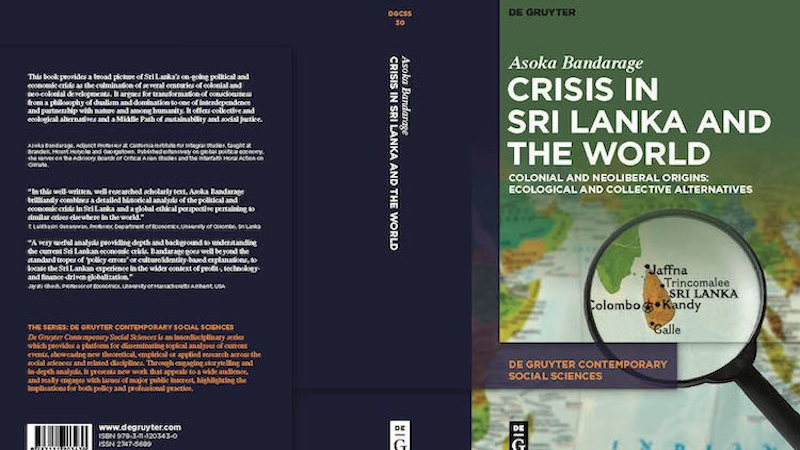
Asoka Bandarage is known for her unconventional approach in several of her publications on development which extensively draw case study material from Sri Lanka. Her examination of the current crisis in Sri Lanka also employs an innovative analytical approach, setting it apart from most existing studies on the subject. Her willingness to depart from convention in this exercise is commendable. Notably, emerging economies like Sri Lanka are increasingly finding themselves in turmoil during this era of neoliberalism. Bandarage’s book, therefore, is a must-read for those seeking alternative methodological stances and more comprehensive perspectives on the analysis of socio-economic crises in emerging economies.
The crisis that emerged in Sri Lanka in 2022 has turned out to be of unprecedented severity, leading the country to declare insolvency and debt default for the first time in its history. At the time of the declaration of insolvency, the government reached out to the IMF for a package of measures to resolve the crisis. At the time of writing, the country has been on an IMF package for about eight months. The IMF package has brought about some changes in the appearance of the crisis. However, many of the fundamental factors, viewed from a holistic angle, that led to the crisis appear to have been further aggravated by the solutions applied. The crisis continues to take its toll on the people in numerous ways.
Most available accounts, including that of the IMF, perceive this crisis as predominantly economic and financial in nature. However, what Sri Lanka is experiencing is a multi-faceted crisis characterized by diverse causes, consequences, and processes.
It encompasses not only economic and financial dimensions but also social, nutritional, and health aspects, political and democratic failures, debt-related challenges, institutional and governance lacuna, bribery and corruption allegations, and ecological concerns. Each of these aspects interacts with the others in complex ways.
The remedial measures taken by the government, according to the IMF-written policy package, addressing as they do only a restricted part of the problem, have now made the crisis a very real and pressing concern for the ordinary people in the country. Regrettably, many analysts, particularly economists and financial analysts, continue to emphasize the economic, financial, and debt-related aspects of the crisis, thus neglecting other important factors of grave relevance.
Some analysts bring some history into consideration in explaining the crisis, but for many of them, the relevant history does not go beyond a few years in the immediate past. Furthermore, many accounts tend to view the crisis as a fundamentally Sri Lankan phenomenon, bringing into analysis only some international influences like fluctuations in oil prices or critical commodity scarcities in the world market, failing to recognize the critical influence of holistically viewed global developments as having pushed the country into this predicament.
In this context, Asoka Bandarage’s Crisis in Sri Lanka and the World (hereafter referred to as Crisis) stands out as a refreshing and much-needed addition to the body of literature addressing the Sri Lankan crisis of the 2020s. She provides a holistic viewpoint, highlighting the multifaceted nature of the crisis and tracing its origins back to Sri Lanka’s historical evolution from colonial times. The Crisis is perhaps the only comprehensive publication written from such a holistic approach so far.
A bird’s-eye view
The book commences with a conceptual overview in Chapter 1, where Bandarage combines different themes that she develops in further detail in subsequent chapters. She places particular emphasis on the historical origins of the crisis.
In Chapter 2, she delves into the development of the plantation economy in Sri Lanka during the colonial era. The subsequent three chapters cover the early post-Independence period (Chapter 3: 1948-77), the early phase of the post-liberalization period (Chapter 4: 1977-2009), and the period immediately preceding the crisis of the early 2020s (Chapter 5: 2009-19).
In this comprehensive historical analysis, Bandarage offers a bird’s-eye view of Sri Lanka’s key socio-political and economic trends over nearly two centuries and their evolving dynamics. She underscores the global influences, originating from diverse sources and with varying degrees of impact, on Sri Lanka’s domestic economy and its trajectory. Within this historical account, Chapters 4 and 5, which cover the closest influences on the early 2020s crisis, hold particular significance.
Chapter 5 delves into the evaluation of geopolitical rivalry, neocolonialism, and political destabilization, exploring the range of international factors influencing the crisis that emerged in the early 2020s. Influences from Chinese, Indian, and U.S. expansionism into the Indian Ocean region, and interventions from international organizations like the UN Human Rights Council (UNHCR). Mainstream reviews of the 2020s crisis do rarely cover as extensive a terrain as this dealing with the international political economy of the Sri Lankan crisis.
A fresh and innovative perspective
Bandarage thus brings in a fresh and innovative perspective, shedding light on uncharted terrain of profound relevance to the subject under consideration. Noteworthy in this regard, is her scrutiny of the contemporary influences of the United States, through diplomatic efforts, to secure agreements signed with Sri Lanka in respect of the Millennium Challenge Corporation (MCC) Compact, the Acquisition and Cross Services Agreement (ACSA), and the Status of Forces Agreement (SOFA).
Chapter 6 encompasses various themes that both characterize and explain the crisis. A central factor is Sri Lanka’s excessive and unbridled debt, particularly its heavy borrowings through International Sovereign Bonds. Bandarage labels this as “debt colonialism” imposed on the country. She also draws attention to the extreme income inequality and widening disparities in the country resulting from decades of neoliberalism.
The adverse impact of these factors has been exacerbated by the crippling effects of COVID-19 during 2020-21 and the political turmoil following the protest movement known as the “aragalaya” against the then incumbent regime. The events set in motion by these protests, culminating in the country’s submission to an IMF program, are well-documented. The rise, during this kerfuffle, of a political leader known for his extreme right-wing views, described by Bandarage as a “long-time US collaborator” (p. 82), to the all-powerful position of the country’s presidency enabled the seamless implementation of the IMF program with minimal resistance from the Sri Lankan government.
Bandarage concludes Chapter 6 by illustrating how the cumulative events led to Sri Lanka’s collapse, not only economically but also politically, socially, culturally, and psychologically. She paints a grim picture, stating, “Forces of global financial and corporate power are not leaving any room for the survival of a local economy or a national government that can meet the needs of its people. The multifaceted crisis is leading to the demise of Sri Lanka’s sovereignty, turning the country into a mere shell of a state, wide open for more external political, economic, and military exploitation” (p. 198). The situation, no doubt, appears dire, but it is worth also noting that Sri Lanka has a history of resilience in overcoming challenges and emerging from crises.
Ecological dimensions
Completing her holistic analysis, Bandarage explores the ecological dimension of the crisis in her final chapter, which has been used to examine ecological and collective alternatives to neoliberal globalization. This chapter hints at some underlying optimism she shares for Sri Lanka’s future. Bandarage seeks “collective and ecological alternatives to the globalized system underlying perennial socioeconomic, cultural, and political crises, war and refugee crises, leading us to an existential crisis” (p. 204).
In alignment with Karl Polanyi’s viewpoint, she argues (pp. 207-8) that allowing the market mechanism to solely determine the fate of human beings and their natural environment would result in the destruction of society. Bandarage draws inspiration from the Middle Path in Buddhist philosophy, proposing it as a non-violent alternative to extremism of all kinds (p. 211). She advocates policies guided by the Middle Path philosophy to achieve the desired ecological and collective alternatives to neoliberal globalization.
Several essential themes developed in the Crisis pertaining to the economic, financial, and indebtedness aspects of the 2020s crisis in Sri Lanka merit attention. These themes resonate with my own thinking and published work and hold significance, as they are often disregarded by independent reviewers and government advisors, both domestic and international, including those from International Financial Institutions (IFIs).
One such theme investigates the influence of extreme socio-economic inequality on the 2020s crisis in Sri Lanka. Inequality has persisted in Sri Lanka since the establishment of mercantile capitalism, i.e., the early stages of the colonial plantation economy. After gaining independence from colonial rule, there were brief spells of dominance of social democratic policies that aimed to reduce inequality. The neoliberal regime introduced in 1977 has exacerbated income disparities offsetting the egalitarian trends of the preceding decade.
This trend towards increasing inequality is a common feature of financialized global capitalism, particularly under neoliberal conditions. The super-rich oligarchy in society, often evading foreign exchange regulations and income and other tax rules, acted with detrimental effects on the country’s foreign exchange receipts and tax revenues, contributing to the foreign exchange and fiscal crises of the 2020s.
The rich trading classes (including large industry owners dependent heavily on imported inputs) and those engaged in the underground economy tend to maintain very large funds offshore. The changes in exchange control laws introduced in 2017 have facilitated these practices. Bandarage describes this behaviour as “plunder” by the country’s super-rich through “intentional, dodgy invoicing and stashing the foreign exchange earnings offshore” (p. 13). She refers to a total of US$ 36.833 billion as funds so kept illegally overseas. More recently, a cabinet minister in the incumbent government mentioned an even larger sum, $53.5 billion, held illegally overseas by Sri Lankan oligarchs (see Island, 24 August 2023). Either figure can be compared with the officially reported total foreign debt of $49.7 billion at the end of 2022 (Central Bank Annual Report, 2022, pp. 185-6).
Furthermore, a significant part of the fiscal deficit issue, lying behind the huge public debt crisis, can be attributed to the non-payment of substantial volumes of tax dues by the wealthiest individuals in society. Tax avoidance and evasion are widely discussed topics. Rich mercantile classes avoid paying not only income tax but also the more revenue-generating indirect taxes of VAT, Import Duty, and Excise taxes.
The next point worth highlighting here is Sri Lanka’s well-known social democratic stance in respect of social policy matters—a matter already referred to briefly. This has been the case even during the post-1977 neoliberal period in matters pertaining to parts of production, trade, and finance. In this respect, the following statement of a leading political analyst is worth citing: ” … (T)he abiding democratic ethos of Sri Lanka (…) has never succumbed to dictatorship of the right or left, despite several civil wars. … This resilient electoral democracy has demonstrated a proclivity for social welfarism. Savage capitalism has never been sustainable here, nor has a foreign policy alien to the values of nonalignment” (Dayan Jayatilleka in the Island, Oct. 26, 2023). This social ethos came to be established in the Sri Lankan political economy from as early as the 1930s. In 1931, a semi-independent governance system was set up, with a legislature (State Council) elected by the people on universal adult franchise and a Board of Ministers, three-tenths of which comprised of elected State Council members.
A strong and widespread left-wing political movement, led by a group of charismatic leaders committed to Marxist thinking and practice, developed in the country from this period onwards. The principal elements of the social democratic stance in social policy, which evolved from this period onwards, was maintained even during the post-1977 neoliberal period. Key aspects of this social democratic ethos include free education, free health services, and the use of consumer and producer subsidies to support the average consumers and small-scale farmers and producers. Although changes have been introduced over time, especially following IMF programs, the social democratic ethos remains robust.
This is a main reason why conventional economic solutions failed to eliminate the dual deficits and debt issues in Sri Lanka. Out-of-the-box thinking is essential to devise mechanisms that the people can accept to address these economic challenges. The IMF Extended Fund Facility of March 2023 further illustrates the challenges of implementing a stabilization package defined and drafted without giving due care to socio-political peculiarities in Sri Lanka. Policymakers and their advisers are well advised to carefully read Bandarage’s Crisis in search perhaps of useful insights into how policy processes could be modified to achieve improved results.
About the author: W. D. Lakshman is Professor Emeritus, University of Colombo
By Harsh V. Pant
A year from now, the US will have a new President but the nation’s electoral challenge is getting curiouser and curiouser. An incumbent President, despite all his efforts, is unable to generate enthusiasm and a potential challenger is unable to get any relief from the courts. And the two main political parties seem rudderless. There are a number of ostensible challengers to President Joe Biden among the Democrats and in the Republican ranks. But no one has been to make a breakthrough of the kind that is usually expected at this stage in the election cycle. American democracy looks stale and tired precisely at a time when it should be leading the march in salvaging the credentials of the western democratic model.
This week’s off-year election results gave the Democrats something to cheer about amid growing doubts pertaining to Joe Biden’s winnability. Abortion emerged as a strong vote-catching issue as Republican leaning Ohio and strongly Republican Kentucky both gave victories to abortion rights advocates. This strong pushback against the overturning of Roe v. Wade by the Supreme Court last year has generated significant enthusiasm within the Democratic Party rank and file to bring their base out and develop coalitions with the moderates. The Democrats are getting mobilised around this issue, thereby even a state like Ohio which Trump had won by eight percentage points in 2020 is now seemingly in play for the Democrats.
These results will certainly bring the bounce back in the Democratic camp but they will do little to assuage the concerns around the candidacy of Joe Biden who is not doing well in opinion polls. His approval rating at 38% reached the lowest point in his presidency this month as concerns about growing inflation and cost of living continue to dominate airwaves. This, despite the fact that Biden has had an impressive legislative record so far with his $1.9 trillion coronavirus relief package, infrastructure investments, support for computer chip plants and taxes on corporations and the high income group to help fund healthcare. Biden’s handling of the economy continues to be the albatross around his administration’s neck. And then there is the issue of his age which has hogged the limelight for quite a while now. Every time Biden makes a public appearance, his age and health concerns take the focus away from his accomplishments. Younger Democrats are also souring on Biden and are dragging down his approval ratings.
What should be even more concerning to the Democrats is the recent poll suggesting that Trump is leading Biden in five of six key battleground states. Though the White House has rejected the polls and has urged caution in taking these polls at face value, the twin challenge of a weakening economy and multiple global crises is fuelling discontent against the incumbent. And these poll numbers have once again brought Donald Trump to the centre stage of the Republican Party. Those who once thought that Trump cannot defeat Biden in general elections are now changing their minds as they find Trump their best bet.
The entire galaxy of leaders in the Republican primary have made electability of Trump their main issue but now find that they cannot challenge Trump on this. Here’s a once defeated US President who had to face two impeachment attempts during his time in office and since departing the White House has been engulfed in a plethora of legal cases. Yet today he is the best bet of the Republicans once again. Even as his court appearances have increased, his support among the Republicans has also been growing. The more he has been targeted by the Democrats, the more endearing he becomes to his base.
Trump has used his courtroom appearances to also burnish his brand by saying controversial things and taking on the judges and the opposing lawyers. He has framed his legal woes as part of a larger design against him – political vendetta to ensure that he doesn’t return to politics. “All Democrats, all Trump haters, all cases that are not good,” he said in the court while answering one of the questions. “Weaponisation, they call it.” Still positioning himself as an anti-establishment candidate, he has leveraged his time in the court to his political advantage by crafting a political narrative that is lapped up by his supporters. He has not bothered to join the three Republican debates so far even as he continues to maintain a 44-point lead among Republicans from his nearest challenger, Florida Governor Ron DeSantis.
The US Presidential elections are still a year away and as these last few years have underlined, the “unknown unknowns” seem to be defining the political landscape more than ever before. With two conflicts raging and China breathing down the neck, strategic and economic challenges will define the trajectory of the Presidential elections. But it is the personalities of Biden and Trump that are going to play an equally important role.
About the author: Professor Harsh V. Pant is Vice President – Studies and Foreign Policy at Observer Research Foundation, New Delhi. He is a Professor of International Relations with King’s India Institute at King’s College London. He is also Director (Honorary) of Delhi School of Transnational Affairs at Delhi University.
Source: This commentary was published by the Observer Research Foundation and originally appeared in NDTV.

In another display of his ability to act independently of Moscow, Chechnya’s Ramzan Kadyrov has given to two new battalions he has raised for fighting in Ukraine the names of North Caucasian heroes Sheikh Mansu and Baysangur of Benoi who fought the Russian imperial advance into the Caucasus.
Not only has this raised eyebrows in Moscow, but also it has raised questions in Chechnya itself because up to now, Kadyrov has downplayed these figures because of the support they still have among Chechens and other North Caucasus, support that could be the basis of challenges to his own position (kavkazr.com/a/geroi-borjby-protiv-rossii-zachem-kadyrov-nazval-bataljony-v-chestj-komandirov-vremen-kavkazskoy-voyny-/32659844.html).
According to a Grozny University historian speaking on condition of anonymity, Kadyrov’s regime very much fears “heroes of former times because they have enormous authority” and because they “can eclipse the Kadyrov family whose cult is being imposed on Chechens.” His view is shared by many in Chechnya.
In Moscow, the reaction has been muted but it far more diverse, perhaps because in the minds of many, Kadyrov’s effort to revive figures from the past including on different sides of the battle line is simply a local application of Putin’s “single stream” approach to the history of Russia, although the Kremlin leader likely wouldn’t tolerate it anywhere else.
Moscow analyst Aleksey Makarkin says that in his view, Kadyrov has taken this step in order to deprive his opponents of the possibility of using these figures from the past against him. But Modest Kolerov, a nationalist commentator, says that what has happened highlights “the weakness of the Kremlin.”
But while some Russian politicians want the Kremlin to reverse Kadyrov’s move, other analysts both there and in the Caucasus see a narrower factor at work: they point out that both of these heroes are members of the same extended family or taip as Kadyrov is and that his use of their names is part of the Chechen leader’s effort to strengthen his taip against all others.