
It Runs In The Family – University of Georgia Athletics Georgia Bulldogs
Day: November 7, 2023
PUTIN’S WAR ON THE WEST economist – Google Search https://t.co/10rBS4I1IZ pic.twitter.com/xvYn7QEMGV
— Michael Novakhov (@mikenov) November 7, 2023
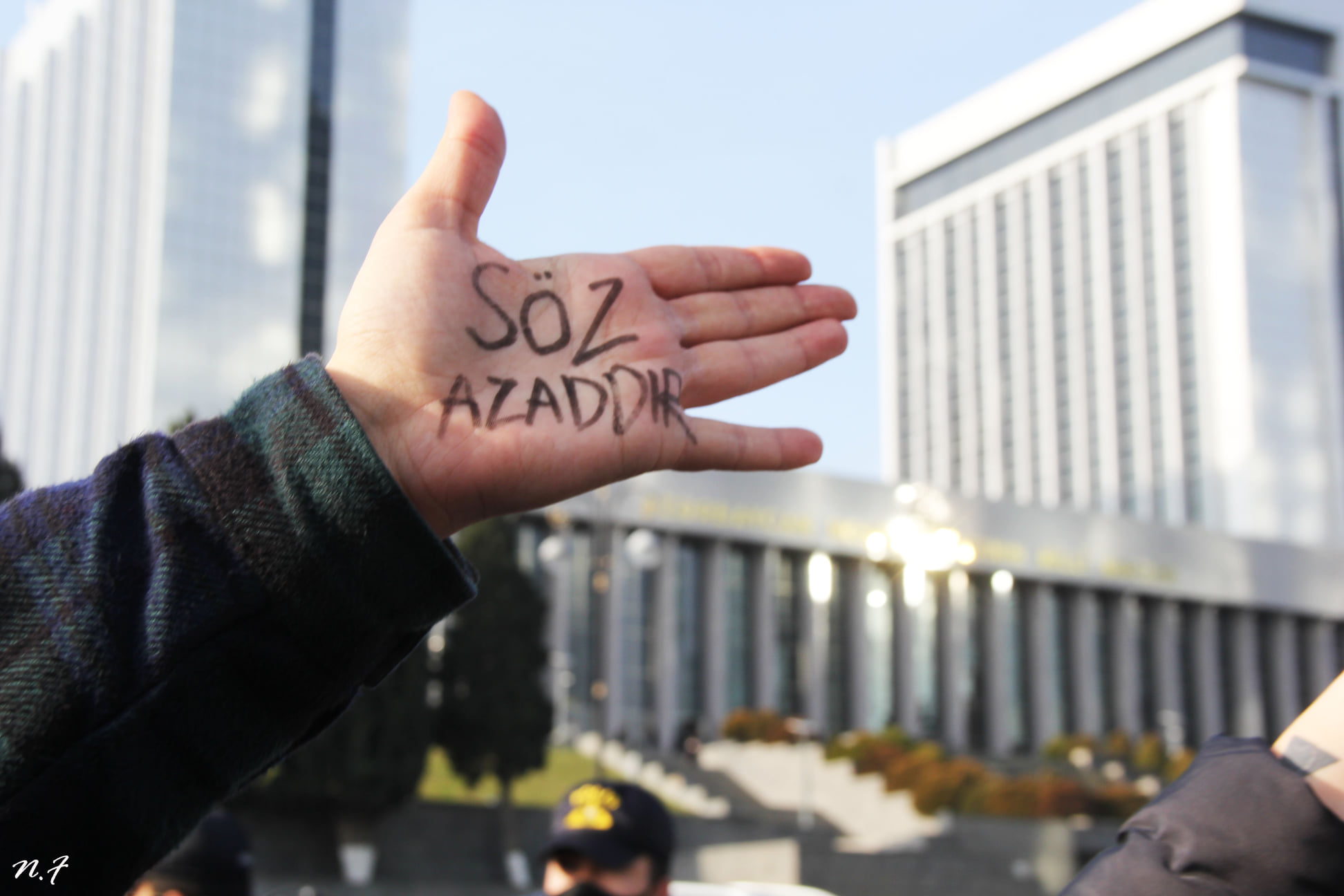
Media law and registry
The Media Development Agency of Azerbaijan has started filing lawsuits against media entities that have not been registered in the media register. Registration started in October 2022, according to the new Law on Media. Some online publications, in order to continue their existence, have declared themselves blogs.
- Former Armenian President Robert Kocharyan’s son became an MP and was released from arrest
- What will the pause in the negotiation process lead to? Commentary from Baku
- On November 8, Georgia will find out whether it will obtain EU candidate status. What’s important to know?
Muhammad Zamanov (Ersoy), head of the dia.az website, has reported that the Media Development Agency has filed a lawsuit with the Baku Court of Appeal to “terminate his activities”. The statement notes that Zamanov did not apply for inclusion of his publication in the register in due time, so his activities as a journalist and the website as a media structure are subject to ban.
“I may be asked, why have you still not applied for inclusion in the register? But what is the use of applying? Similar sites criticizing the government have applied, but in vain, that’s why I did not apply,” Zamanov said in a conversation with Argument.az.
Mohammed Ersoy also said that the site functions now not as a news site, but as “Mohammed Ersoy’s blog”. The law does not contain any provisions regarding the activities of blogs.
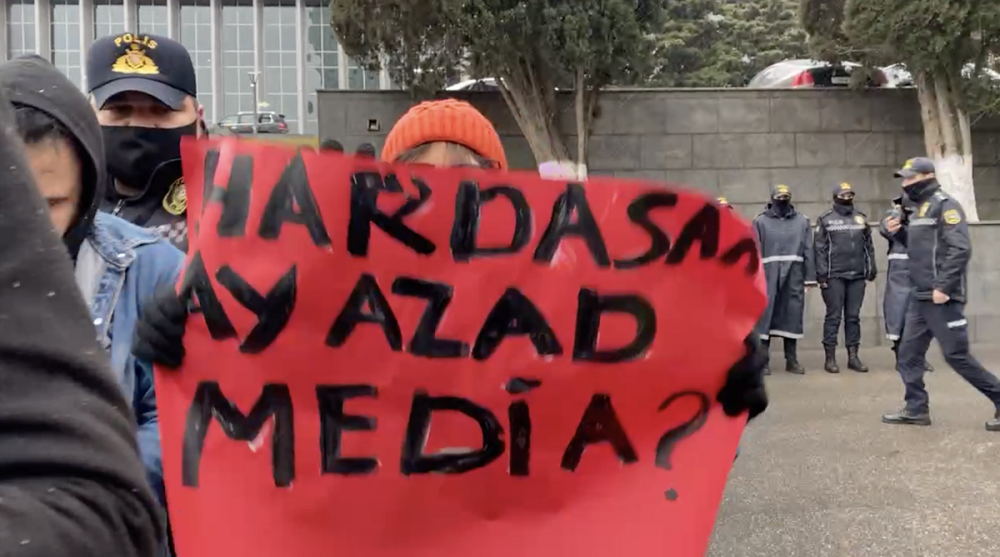
Saida Safiyeva, head of the Communications Department of the Media Development Agency, said in response to Turan’s inquiry that the agency takes measures against media entities as stipulated by its charter.
“These are media outlets that grossly violate the Media Law,” she said, without specifying how many such media outlets there are.
As early as last year, the Media Development Agency said that the legality of the activities of media entities that did not apply for registration would be considered by the court.
Azerbaijani journalists protest Media Registry
Azerbaijani journalists have issued a document assessing the new Media Registry as censorship
The process of registration in the Media Registry of Azerbaijani journalists and media outlets started on October 14, 2022. The registration was conducted for 6 months and was completed in April 2023. During this period, up to 50 websites did not apply for registration, or applied and were rejected.
The Law “On Media”, according to which the registration in the registry is maintained, was adopted on December 21, 2021. On February 10, 2022, President Ilham Aliyev signed a decree “On Implementation of the Law on Media” and it came into force.
On September 26, 2022, the rules for maintaining the media register were approved.
The adoption of these rules sparked protests from a number of independent media outlets, journalists and editors. They believe that the media registry will lead to suppression of freedom of speech in the country.
Journalists and media managers – Shamshad Agha, Ulvi Hasanli and Vugar Gurdganli – appealed to the Constitutional Court, arguing that the law contradicts the Azerbaijani Constitution and the European Convention on Human Rights. The appeal stated that the Constitutional Court should challenge the compliance of the law with the Constitution and the Convention. Despite the fact that several months have passed, the Constitutional Court has not yet considered the suit.
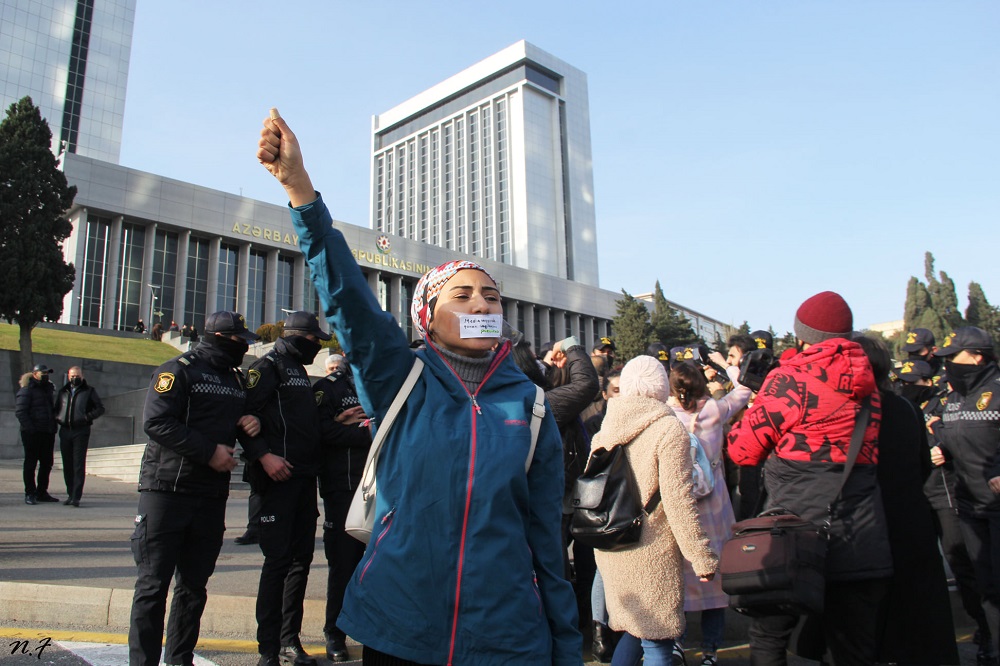
In addition, the Venice Commission gave a negative opinion on the law “On Media”. The Commission’s opinion stated that the law is reactionary and such a law cannot be adopted in a country that is a member of the Council of Europe.
A number of international organizations for the protection of freedom of expression, Council of Europe co-rapporteurs and the Committee of Ministers of the Council of Europe also demanded that the law be changed, citing that it was reactionary.
Armenian-American military cooperation
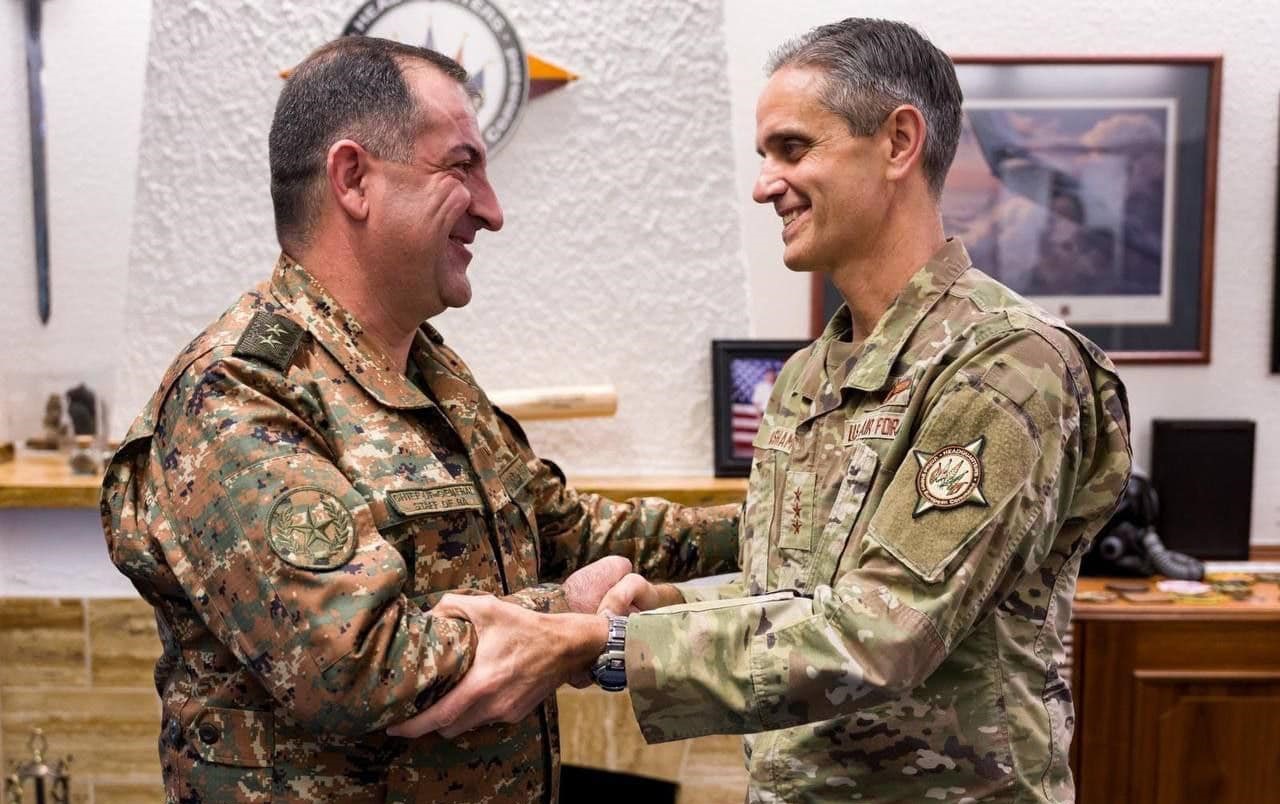
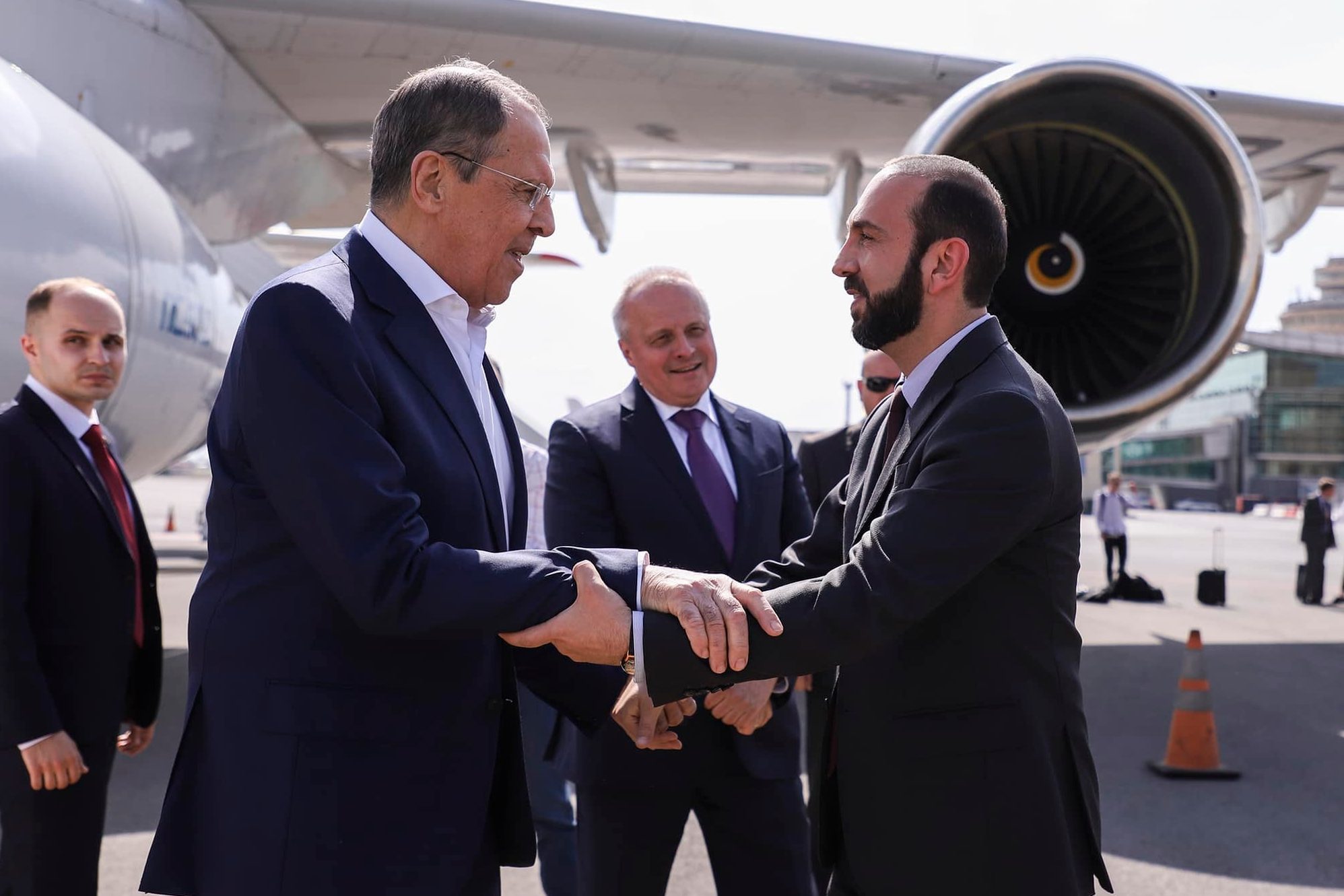
The Chief of General Staff of the Armenian Armed Forces visited the headquarters of the U.S. European Command, which is stationed in Germany. According to the Defense Ministry, during the meeting with Edward Asryan, Deputy Commander of the U.S. Air Force in Europe and Africa Stephen Basham stated that “the U.S. is ready to initiate new areas of cooperation”.
According to political analyst Gurgen Simonyan, this is “a signal that the Americans are extending a helping hand.”
“When Armenia begins to throw off destructive influence, it will be able to modernize and develop its security system with the help of the United States,” he believes.
Armenia expects U.S. support for army reforms
First Deputy Minister and Head of the General Staff, Edward Asryan, visited the headquarters located in Stuttgart at the invitation of the U.S. European Command. He discussed with American partners the possibilities of developing military cooperation and issues related to regional security:
“Edward Asryan presented the details of the reforms underway in the Armed Forces of the Republic of Armenia and the support expected from the U.S. during their implementation.”
It is also reported that Deputy Commander of the US Air Force in Europe, Stephen Basham, stated the readiness of the US to continue both the support of the existing programs and initiate new directions of cooperation:
- “professionalization of the armed forces, strengthening the professional skills of non-commissioned officers,
- modernization of the command and control system,
- peacekeeping,
- military medicine,
- military education,
- combat training, exercises”.
During his visit, Asryan also visited the U.S. Army’s Joint Multinational Readiness Center (JMRC) in Europe and the NCO Academy.
Comment
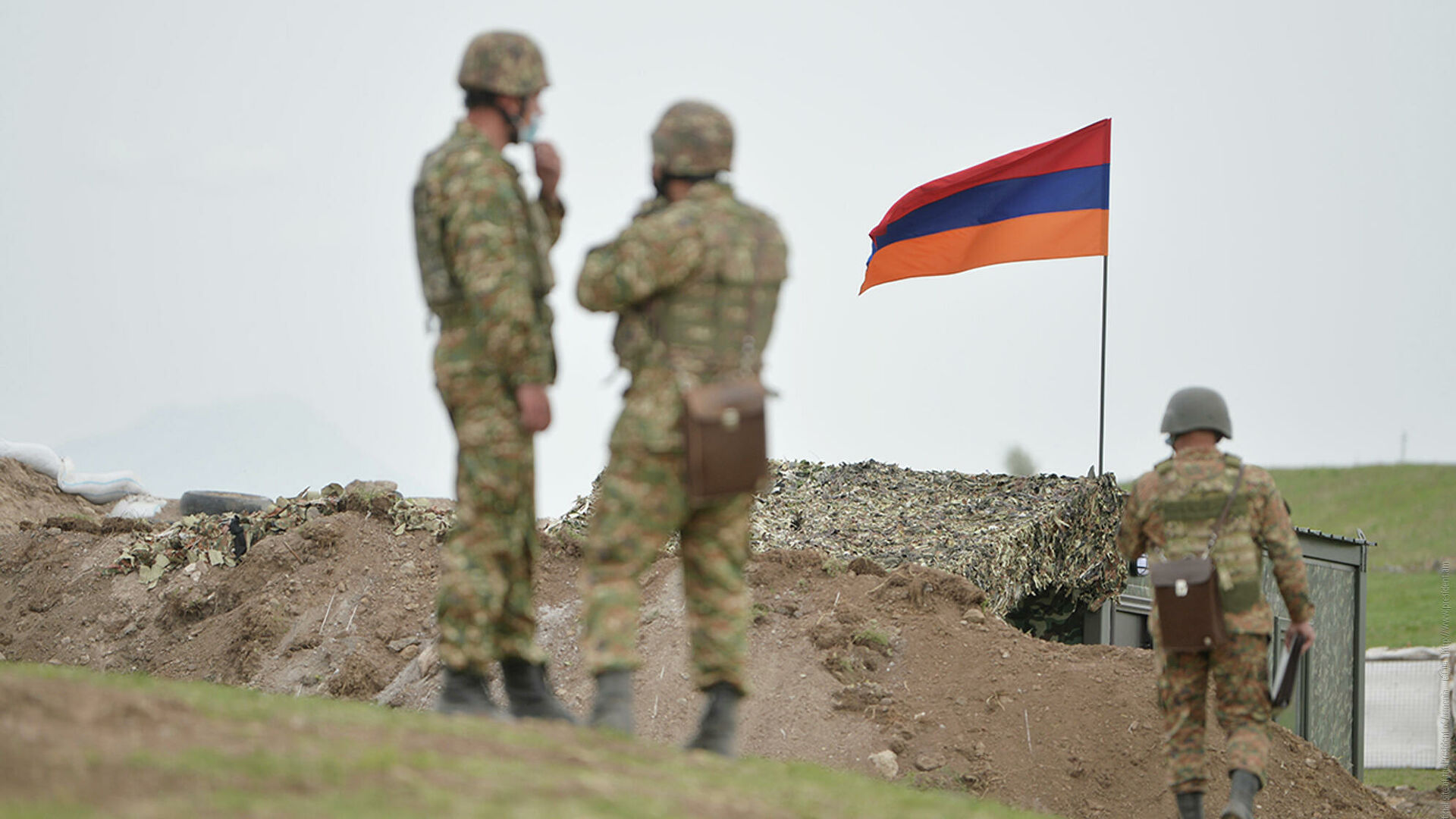
Political scientist Gurgen Simonyan says that cooperation between Yerevan and Washington can be very diverse, depending on the degree of relations and the prospects for the development of strategic relations.
He believes that the talk about initiating new areas of Armenian-American cooperation is a “clear strategic signal” that Armenia will be able to modernize its security system with US support.
“When we talk about military cooperation, everyone thinks that the armies of Western partners will bravely march into the region and protect our state. This cannot happen,” he emphasized.
In the political analyst’s opinion, there is no need to have illusions, and one should realize that “the main defensive force” is Armenia’s armed forces. He explains that the partners “will support as much as our bilateral and multilateral relations will deepen with time”. This refers to both diplomatic and military-technical support.
“In the face of the challenges facing the Republic of Armenia, it is impossible to survive without new approaches to the armed forces. We have no alternative to the modernization leap,” Simonyan believes.
He emphasizes that now there is no place for old-style armies, it is necessary to acquire new technologies, receive modern military education, master technical skills for the use of new types of weapons.
He calls the current situation a transitional period. He is convinced that in case of a new escalation, the West, states friendly to Armenia will closely follow the first clashes.
“If Armenia shows determination and will to fight for its national interests, technological, informational, diplomatic and economic support will not be late. But [U.S.] troops will not enter here,” he says.
Follow us – Twitter | Facebook | Instagram
Armenian-American military cooperation
The murder of Tamaz Ginturi
The body of Tamaz Ginturi, a 58-year-old killed by the Russian military in the Georgian-Ossetian conflict zone, has been returned to his home in Kirbali. Meanwhile, Levan Dotiashvili, who was also apprehended by the same military, is believed to be held in an isolation center in Tskhinvali. During a meeting on November 7, Ossetian representatives asserted that “Ginturi and Dotiashvili attempted to drive a car across the border while intoxicated.”
Kirbali is situated along what is referred to as the occupation line in Georgia. Thus far, no government agency has provided an official account of the events that transpired on November 6 near the Lomisi church. The sequence of events can only be pieced together through the accounts of the victim’s family.
According to Tamaz Ginturi’s relative, Giorgi Doluashvili, he was shot three times in the back and died in his own car.
“He was killed as a righteous man. He went to his father’s grave, and they [the Russian military] forbade him from going there. That’s when they shot him. The car is still there, and he was shot from behind, found dead in the car, which was completely destroyed. He was a tough fighter who fought in August 2008,” Radio Liberty quoted Doluashvili as saying.
One account suggests that Tamaz Ginturi and Levan Dotiashvili visited the cemetery near Kirbali village and then proceeded to the Lomisi temple to light candles. The temple has been within the zone controlled by the Russian military for several years.
It is known that Ginturi and Dotiashvili were traveling in the same car. According to one version, the Russian military initially attempted to arrest Dotiashvili, and when Ginturi tried to escape, they opened fire on him.
The Georgian side learned of the incident through a call from Levan Dotiashvili. The Russian military, who had apprehended him, provided him with Tamaz Ginturi’s phone number and instructed him to call for an ambulance.
Yuri Dotiashvili, the father of Levan, recounted:
“They instructed my son to dial [the emergency service] 112 from the dead man’s phone. He told them that he was okay, but to attend to Tamaz, who was injured. That was the last they heard from him before they took him away. He was wearing a red jacket,” he said.
According to Yuri Dotiashvili, calls can still be made to Tamaz Ginturi’s phone, but there is no response.
Yuri Dotiashvili explained that his son and Tamaz Ginturi had gone to the church to light candles and offer prayers.
“We are aware that the church is currently under Russian control, but it’s not feasible to yield to everything. We have livestock, and I need to tend to the animals in the forest. How can we anticipate where they [the Russian military] are lurking, where they’re concealed, and how to guess their movements? There are no wires, only red ribbons tied to the posts,” he mentioned.
Tamaz Ginturi’s car remains parked near the Lomisi church, where investigative procedures are ongoing.
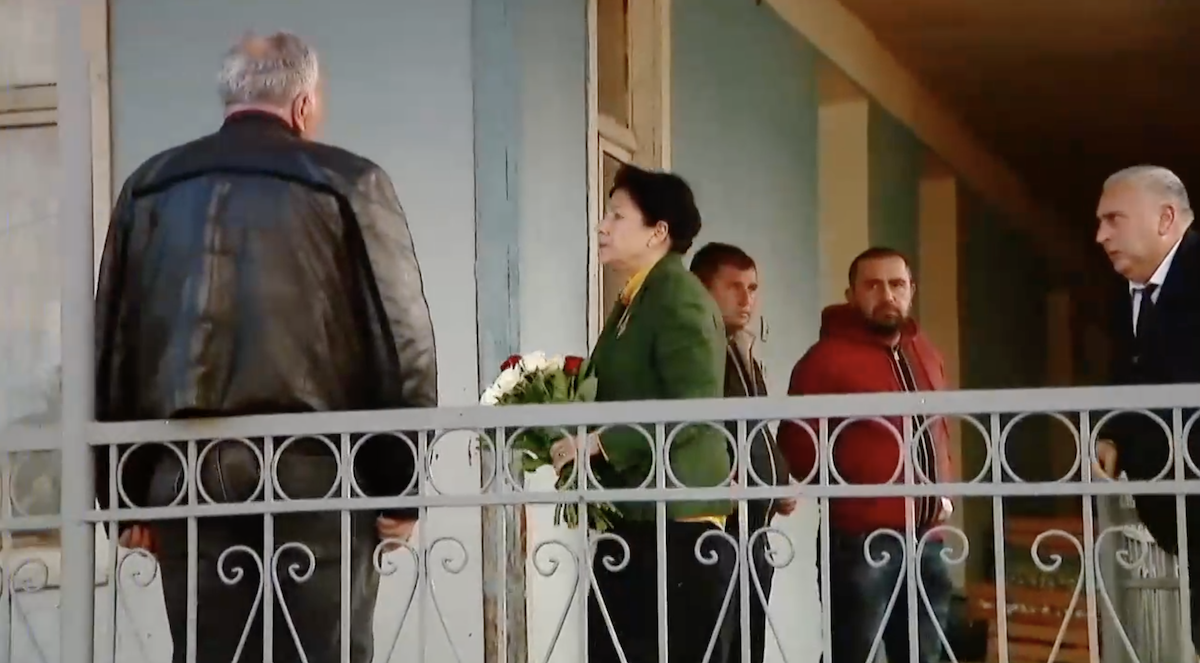
On November 7, President Salome Zurabishvili visited the village to extend condolences to the victim’s family.
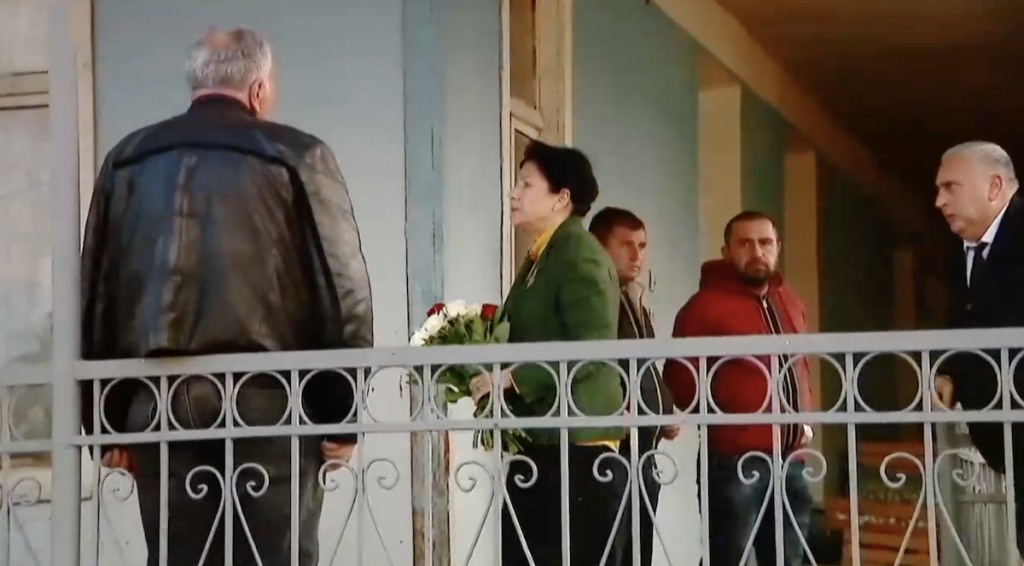 Salome Zurabishvili came to the house of Tamaz Ginturi’s family to express condolences. Freeze frame from the video of “Formula” TV channel
Meeting with the Russian military and the Ossetian side
An extraordinary meeting took place in the village of Ergneti on November 7, following the Georgian government’s request, with representatives from the Russian and Ossetian sides in attendance. Tbilisi’s primary demands were the identification and punishment of those responsible for Tamaz Ginturi’s murder and the safe return of Levan Dotiashvili.
Russian and Ossetian delegates asserted that they are conducting their own investigation into the incident. According to their information, Levan is unharmed and is currently being detained in Tskhinvali.
As of now, the Georgian security service cannot confirm the precise state of Levan Dotiashvili’s health.
The Georgian interior ministry has initiated an investigation under Articles 109 and 143 of the Criminal Code, which pertain to premeditated murder and illegal deprivation of liberty.
“Drunk and with an axe” – the version of the South Ossetian leadership
South Ossetia’s security service has presented the following account of the incident, referring to the individuals involved as “drunk and with an axe”:
“Two intoxicated individuals attempted to drive a car through the border checkpoint. One of them was carrying an axe. Border service personnel initially fired warning shots into the air, followed by shooting at the car’s wheels. Consequently, one of the intruders sustained a severe injury and was transported to Georgia for urgent medical treatment,” the South Ossetian KGB stated in an official release.
In an official announcement, the South Ossetian government characterized Ginturi and Dotiashvili as “radical representatives of the party of former Georgian President Mikheil Saakashvili” who “illegally crossed the state border of South Ossetia by car, penetrating deep into its territory.”
The South Ossetian foreign ministry has expressed its intention to “undertake all legal measures to safeguard its sovereign territory and borders” moving forward. Furthermore, it urged Tbilisi to “initiate collaborative efforts on the delimitation and demarcation of the state border to establish transparent and civilized procedures for border crossings.”
Georgia’s ruling party blames Saakashvili, president blames Russia
Members of the ruling Georgian Dream party have attributed the murder of Georgian citizen Tamaz Ginturi to the previous government, which they claim “allowed the occupation” during Mikhail Saakashvili’s presidency.
President Salome Zurabishvili, in response to the tragedy, has primarily emphasized Moscow’s role, stating, “It is astounding that anyone expects peace negotiations with Russia.”
The Georgian government has appealed to the international community to denounce the killing of a Georgian citizen by Russian occupation forces.
Assessments of Georgian politicians
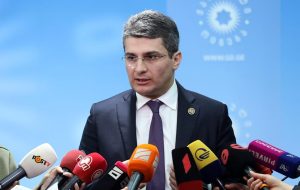
One of the leaders of Georgian Dream, Mamuka Mdinaradze:
“Today, there are attempts to exploit this tragedy by those who left us with this burdensome legacy, those who led the Georgian military into war (referring to the period of Mikhail Saakashvili’s presidency).
We have rectified many of their actions. Despite their knowingly unfounded cases, we have prevailed in both The Hague and Strasbourg courts. Nonetheless, the paramount issue left unresolved by the previous government is the Russian occupation and its repercussions.
Georgia will employ all available and feasible means to ensure that those accountable face justice properly.”
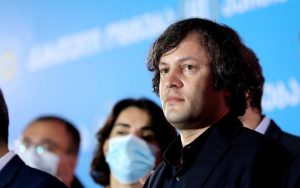
Irakli Kobakhidze, Chairman of Georgian Dream:
“The Russian occupation of Georgian territories is the most burdensome consequence of the treacherous policies of the former government, which we encounter daily.
My heartfelt condolences go out to the family and friends of Tamaz Ginturi. Every effort must be made to hold those accountable responsible.”
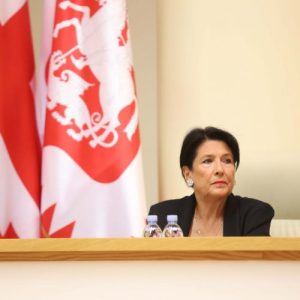
Georgian President Salome Zurabishvili:
“Russia’s long-standing policies persist unabated, with incidents such as murders and abductions of our citizens occurring within our own borders. While Russia brands these actions as part of its peaceful agenda, we’ve witnessed its true behavior on our soil.
Believing in a future with Russia is a profound challenge. Our aspirations are in Europe.”
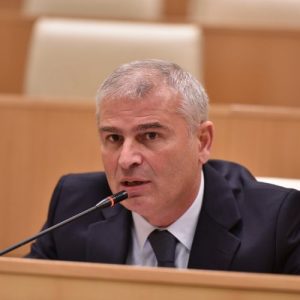
Irakli Kadagishvili, Georgian Dream MP:
“Up to this point, we’ve encountered isolated, tragic incidents. However, there are individuals advocating for heightened confrontation. Escalating the situation could trigger unmanageable developments. Can anyone from the present opposition take responsibility for this? The events in Kirbali are an outcome of their past actions [when they were in power].”
Categories
Putin’s war on the West
HE IS ridiculed for his mendacity and ostracised by his peers. He presides over a free-falling currency and a rapidly shrinking economy. International sanctions stop his kleptocratic friends from holidaying in their ill-gotten Mediterranean villas. Judged against the objectives Vladimir Putin purported to set on inheriting Russia’s presidency 15 years ago—prosperity, the rule of law, westward integration—regarding him as a success might seem bleakly comical.
But those are no longer his goals, if they ever really were. Look at the world from his perspective, and Mr Putin is winning. For all his enemies’ machinations, he remains the Kremlin’s undisputed master. He has a throttlehold on Ukraine, a grip this week’s brittle agreement in Minsk has not eased. Domesticating Ukraine through his routine tactics of threats and bribery was his first preference, but the invasion has had side benefits. It has demonstrated the costs of insubordination to Russians; and, since he thinks Ukraine’s government is merely a puppet of the West (the supposed will of its people being, to his ultracynical mind, merely a cover for Western intrigues), the conflict has usefully shown who is boss in Russia’s backyard. Best of all, it has sown discord among Mr Putin’s adversaries: among Europeans, and between them and America.
His overarching aim is to divide and neuter that alliance, fracture its collective approach to security, and resist and roll back its advances. From his tantrums over the Middle East to his invasion of Georgia and multiple misadventures in Ukraine, Mr Putin has sometimes seemed to stumble into accidental disputes with the West, driven by a paranoid fear of encirclement. In hindsight it seems that, given his outlook, confrontation may have been inevitable. Either way, the contest he insists on can no longer be dodged. It did not begin in poor Ukraine and will not end there. Prevailing will require far more resolve than Western leaders have so far mustered.
What the Kremlin wants
Last year Mr Putin lopped off Crimea, redrawing Europe’s map by force. The war he hallucinated into reality in eastern Ukraine has killed thousands. Even if the ceasefire scheduled for February 15th holds (unlikely, on past form), he seems certain to get what he wants there: a wretched little quasi-state in the Donbas, which he can use to stall and warp Ukraine’s development. Yet these incursions are only his latest bid to bludgeon former Soviet states into submission, whether through energy blackmail, trade embargoes or war. For Mr Putin the only good neighbour is a weak one; vassals are better than allies. Only the wilfully blind would think his revanchism has been sated. Sooner or later it may encompass the Baltic states—members of both the European Union and NATO, and home to Russian minorities of the kind he pledges to “protect”.
The EU and NATO are Mr Putin’s ultimate targets. To him, Western institutions and values are more threatening than armies. He wants to halt their spread, corrode them from within and, at least on the West’s fragile periphery, supplant them with his own model of governance. In that model, nation-states trump alliances, states are dominated by elites, and those elites can be bought. Here, too, he has enjoyed some success. From France to Greece to Hungary he is cultivating parties on Europe’s far right and left: anyone who might lobby for Russian interests in the EU, or even help to prise the union apart (see article). The biggest target is NATO’s commitment to mutual self-defence. Discredit that—by, for example, staging a pro-Russian uprising in Estonia or Latvia, which other NATO members decline to help quell—and the alliance crumbles.
Mr Putin’s stranglehold on his own country means he has time and freedom for this campaign. As he has amply demonstrated, he has no qualms about sacrificing Russians’ well-being to satisfy his coterie’s greed or to further his geopolitical schemes. He persecutes those who protest. And in the echo chamber his propaganda creates, the nationalism he peddles as a consolation for domestic woes is flourishing.
What is to be done?
The first task for the West is to recognise the problem. Barack Obama has blithely regarded Russia as an awkward regional power, prone to post-imperial spasms but essentially declining. Historians will be amazed that, with Ukraine aflame, the West was still debating whether to eject Russia from the G8. To paraphrase Trotsky, Western leaders may not have been interested in Mr Putin, but Mr Putin was interested in them.
The next step is to craft a response as supple as the onslaught. Part of the trouble is that Mr Putin plays by different rules; indeed, for him, there are no inviolable rules, nor universal values, nor even cast-iron facts (such as who shot down flight MH17). There are only interests. His Russia has graduated from harassing ambassadors and assassinating critics to invasions. This is one of his assets: a readiness to stoop to methods the West cannot emulate without sullying itself.
 Russian timeline: The road to 2015
The current version of this quandary is whether, if the latest ceasefire fails, to arm Ukraine. Proponents think defensive weapons would inflict a cost on Mr Putin for fighting on. But anyone who doubts his tolerance of mass casualties should recall his war in Chechnya. If arms really are to deter him, the West must be united and ready to match his inevitable escalation with still more powerful weapons (along, eventually, with personnel to operate them). Yet the alliance is split over the idea. Mr Putin portrays the war as a Western provocation: arming Ukraine would turn that from fantasy to something like fact, while letting him expose the limits of Western unity and its lack of resolve—prizes he cherishes. If fresh Russian aggression galvanises the alliance, arming Ukraine will become a more potent threat. Until that point, it would backfire.
A better strategy is to eschew his methods and rely on an asset that he, in turn, cannot match: a way of life that people covet. If that seems wishy-washy beside his tanks, remember that the crisis began with Ukrainians’ desire to tilt towards the EU—and Mr Putin’s determination to stop them. Better than arms, the West must urgently give Ukraine as much aid as it needs to build a state and realise that dream (and as much advice as it takes to ensure the cash is not misspent or stolen). The IMF deal announced on February 12th should be only a start. Mr Putin wants Ukraine to be a lesson in the perils of leaning West. It should instead be an exemplar of the rewards.
Just as urgently, those former Soviet countries that have joined Western institutions must be buttressed and reassured. If the case for sending arms to the Donbas is doubtful, that for basing NATO troops in the Baltics is overwhelming, however loudly Mr Putin squeals. Western leaders must make it clear, to him and their own people, that they will defend their allies, and the alliance—even if the struggle is covert and murky.
And it isn’t only its allies who appreciate the West’s virtues. So do many Russians, including shameless Putinists who denounce the West’s decadence but exploit its schools and stockmarkets. It is long past time for every Russian parliamentarian and senior official to join the sanctions list. Far from being relaxed as, after Minsk, fellow-travellers may suggest, sanctions must be tightened—and sanctions-busting curtailed (see article). In the end, they will prove a stronger lever than weapons.
At the same time, the West should use every available means to help ordinary Russians, including Russian-sympathisers in the Baltics and Ukraine, learn the bloody, venal truth about Mr Putin. It should let them know that Russia, a great nation dragged down a terrible path, will be embraced when it has rulers who treat the world, and their own people, with respect not contempt, however long that takes.