Day: October 22, 2023
The Russian Wagner Group (ChVK Wagner – ChVK being the Russian abbreviation for PMC Wagner – Private Military Company) is a paramilitary mercenary force. The group first began operations in eastern Ukraine alongside Russian separatists, but its global promulgation began at the beginning of the Russian involvement in the Syrian civil war in late 2015. Together with its activities in Syria, the group was (and possibly is still) involved in operations in Libya, Sudan, Mali, Chad, and Mozambique. The group is engaged, among other things, in securing the oil fields in northwestern Syria for a certain percentage of the revenue from oil production. According to our information, the militia group enjoys 25 percent of the revenue in every oil field it secures.[1]
The mercenaries of the Wagner Group are not evidently subject to military discipline. According to several indications from 2017, they were involved in atrocities and abuse against local Syrian residents. Some of the acts were posted on social media.
The Wagner Group served as a dominant force in the recapture of Palmyra (northeastern Syria) from ISIS in 2016. Many Wagner mercenaries were killed and wounded in a US airstrike in the Deir ez-Zor area in February 2018. Their deaths were an embarrassment for the Russian government, which announced that the Russians killed and wounded in the attack had arrived in Syria “on their own initiative” and unrelated to the Russian military.[2]
There is great ambiguity about how the group was founded and who is behind it. Dmitry Valerievich Utkin, a former paratrooper in the Russian Army’s Special Forces born in 1970, appears to be the main figure and commander of the Wagner Group. Utkin’s sympathy for Nazism bought the organization its name, “Wagner,” named after the revered Nazi composer. [3]
 Dmitry Utkin now
 Dmitry Utkin when he was younger.
The Wagner Group is not directly subordinate to the Russian military hierarchy. The group is an independent organization directly subject to the Russian Ministry of Defense and Russian Intelligence. The number of mercenaries belonging to the Wagner Group is estimated at about 10,000 individuals who have served on various fronts, anywhere the group took part in combat over the past seven years. Not all of the mercenaries mentioned served simultaneously: 10,000 mercenaries retained signed contracts with the Wagner Group over the past few years – with about 2,500 mercenaries serving in Syria.[4]
Contrary to popular belief, many of the mercenaries in the Wagner Group did not serve in the Russian army because they came from remote towns and were therefore not deemed suitable for military service or had criminal records. Joining the Wagner Group allows them unconventional, and infinitely greater economic opportunities than the low wages offered to people like them in the Russian labor market.
 Fyodor Matlakin
Above: Fyodor Matlakin is 36 years old – a longtime mercenary in the Wagner Group. He is originally from the North of the Caucasus. He has a military background, and he has fought alongside Russian separatists in eastern Ukraine.
The Russian government denies any direct organizational contact with the Wagner Group. A tablet device belonging to the Wagner Group was found abandoned in Libya; it contained material indicating that the Wagner Group has prominent access to “state grade” intelligence materials and weapons such as radars that are likely to have been obtained with government support.[5]
 Wagner Group mercenaries in Libya
 The unit’s emblem – ISIS Hunters
As tensions between Russia and Ukraine intensified, and even more so since the Russian invasion (on February 23), reports have increased indicating that some of the Wagner Group’s mercenaries transferred from Syria and North Africa to Ukraine.
According to reports, Wagner Group mercenaries are directly involved in the fighting and are also involved in recruiting and training Syrian locals to send them as proxies to fight in Ukraine. Despite the reports, there is no confirmation of Syrians on the battlefields in Ukraine.
A unit called “ISIS Hunters” operates within the Wagner Group. The unit has been fighting against members of the Islamic State, emphasizing the area of the oil fields in Deir ez-Zor and northwestern Syria. This unit is considered particularly cruel even by Wagner Group standards. It seems that on March 2, the unit was transferred from Syria to Ukraine[6] for one purpose: the assassination of the President of Ukraine – Zelensky.
Further reports indicate that the Russian military collected Wagner Group mercenaries from various bases throughout Syria, such as from the town of Khasham near Deir ez-Zor and As-Suwayda in southern Syria. The mercenaries arrived at the Russian Hmeimim base north of Latakia, and from there, they were flown to the Ukrainian border.[7]

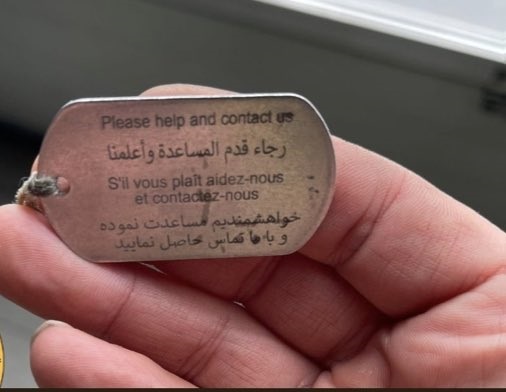
The above photos show dog tags, which Ukrainian intelligence believes belonged to a Wagner Group mercenary killed in action during the fighting in Ukraine. According to the discovered dog tag, one may conclude that these are mercenaries who were transferred from Syria to Ukraine. The dog tags are engraved in four languages (English, Arabic, French, and Farsi): “Please assist and contact” while providing website details and phone number details with a Syrian prefix. From our inquiry, the URL is inactive, and there are no additional details about the phone number.
The Wagner Group is a special proxy force of Russian mercenaries, operating both openly and clandestinely under the auspices of Russian security officials. Ostensibly it is an independent private company, but in practice, it is an organization that receives its resources and guidance from the Russian government. The group allows the Russian government plausible deniability vis-a-vis its actions, hence the advantage in operating it. The Wagner Group operates where there are Russian military interests. Most of its activities until the outbreak of the war in Ukraine were in Syria.
[1] رسالة لـ “الشبيحة” في سوريا: هذا هو راتب مقاتل في “فاغنر” الروسية | SY24 (sy-24.com)
[2] https://amp.france24.com/ar/20180321
[3] https://www.bbc.com/arabic/extra/nYJCjc7HHH/the-lost-tablet-and-the-secret-documents-arabic
[4] https://amp.france24.com/ar/20180321
[5] https://www.bbc.com/arabic/extra/nYJCjc7HHH/the-lost-tablet-and-the-secret-documents-arabic
[6] https://twitter.com/ahmedalasi/status/1499055498594852873?t=LjhpozZKwtp94ueo9fsoIQ&s=08
[7] https://twitter.com/Osalsera3sham/status/1499730205493051392?t=Ocw6VxBP5qqLqEZiXvptNw&s=08

By Waleed Abu al-Khair
In the once empty streets of the Syrian city of Palmyra, a rapidly expanding Russian settlement has emerged, populated and controlled by mercenaries from the Wagner Group and its affiliates, Syrian activists said.
Most of modern Palmyra’s 50,000 residents were displaced by the “Islamic State of Iraq and Syria” (ISIS), and were eventually replaced by Syrian regime-affiliated militiamen, including those from the Wagner Group.
Neglected and in ruins, Palmyra became a “ghost town” of sorts but is now witnessing a burst of activity, with Russian mercenaries, phosphate miners and oil and gas field workers flooding in, in pursuit of influence and revenue.
“Wagner elements are making new moves in the area,” media activist Ammar Saleh told Al-Mashareq. “These movements were observed at Palmyra military airport and parts of the city of Palmyra.”
A Russian mercenary from the Wagner Group guards a hill overlooking the Syrian city of Palmyra. [File]
The Palmyra Hotel, which was turned into the headquarters of the Russian Military Police. [File]
An element of the Wagner Group Russian mercenary force in the archaeological area of Palmyra. [File]
Local residents and activists said they have observed at least 100 new members of the mercenary group in the area, along with aircraft and armoured vehicles.
Russian military aircraft that have landed and remained at the airport include Sukhoi Su-24 fighter jets and Ka-226 and Mi-35M helicopters, Saleh said.
Residents have noticed unusual activity at Palmyra airport and in Palmyra city, where Wagner Group members are concentrated at the northern entrance, which is adjacent to the company’s “security square”, he added.
This is reflective of Wagner’s current focus and priorities, he said, noting that the group’s personnel in Palmyra are primarily protecting Russia’s economic interests in the area.
Protecting profits
The “security square” in Palmyra, which is controlled by Wagner mercenaries and Russian military police, houses Wagner’s military headquarters and barracks, Syrian journalist Mohammed al-Abdullah told Al-Mashareq.
Oil and gas consultants also live there, along with technicians from Evro Polis — a Russian company owned by Yevgeny Prigozhin, an ally of Russian President Vladimir Putin who also owns Wagner.
Evro Polis has secured long-term contracts with the Syrian regime that grant it 25% of the oil and gas revenue generated in the areas under Wagner’s control, al-Abdullah said.
To maximise its profits, the company added special provisions related to operations and re-start of operations performed by its technicians, he said.
The Wagner Group provides technicians with protection at their residences and in their daily travel to and from the gas and oil fields, he said. It also provides “protection” for the fields themselves.
According to al-Abdullah, Wagner mercenaries maintain security in the vicinity of a chemical fertiliser plant on the outskirts of Homs, and around a large number of the phosphate mines in Palmyra.
‘Totally Russian area’
Deir Ezzor activist Jamil al-Abed said the area around Wagner’s security square is expanding “and has become a totally Russian area”.
“People who enter the area hear virtually no language other than Russian,” he said, and about three months ago, Wagner Group personnel began reducing the number of Syrians permitted to enter their area in Palmyra.
Most individuals who are allowed to enter the area are provision suppliers, people who work with the Russians at civilian facilities, and drivers, al-Abed said.
Syrians working for the Wagner Group and some of the groups affiliated with it, especially the so-called “ISIS Hunters”, benefit from a high level of security.
They are housed in the outskirts of the company’s security square and assigned with securing the area, mainly the eastern desert (Badiya) region.
There have been persistent rumours — purportedly based on leaked documents — that Wagner employees are paid significantly more than their Syrian affiliates, al-Abed said.
These reports have sparked a wave of unrest, he said, fuelled by the revelation of other scandals involving Wagner Group elements, such as the theft of antiquities from the Palmyra area.
Categories
NFL streams – Reddit
The original Reddit NFL Streams are now available by the founders of the popular reddit NFL streams . We publish the best list of NFL streams on Reddit, for free! is a free NFL streams community. Backup of reddit NFL streams, you can watch all the matches here for free! Watch NFL live online Reddit without missing a single match.
The French army says it has filmed Russian mercenaries from the paramilitary group Wagner burying bodies near a Malian military base, in an attempt to falsely accuse France’s departing troops of leaving behind mass graves.
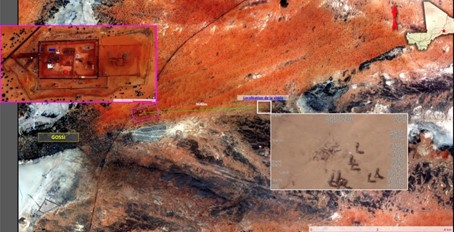
The video shot from a French drone, which shows the behind-the-scenes making of an infox, features white men near the Gossi military base in northern Mali. This military base was returned to the Malian military on Tuesday 19th April.
In a move to discredit the French army and its anti-terrorist operations on the ground, a tweet wrote, “this is what the French left behind when they left the base in Gossi… We cannot keep silent!” accompanied by pixelated images of corpses buried in sand, was published on Thursday 21st April by a certain Dia Diarra. According to the French general staff, this Twitter account is a fake created by Wagner, as it can also be found on a Russian platform.
Unfortunately for the mercenaries of the Wagner group, the French army had positioned a drone in the last 24 hours overlooking the Gossi camp.
In this video, which was made available to the international media, a dozen soldiers with Caucasian features are seen shovelling sand over the bodies, which are in the same position as the ones in the tweet. Dongfeng vehicles used by Wagner and two men filming the mass grave are also visible. According to the French army, comparing the photos published on Twitter and those taken by the drone allows us to grasp the construction of the infox created by Wagner.
If the presence of the drone washes the discredit off the French army this time, the upcoming accusations will certainly reinforce an anti-French sentiment that has been growing in West Africa since 2013.
Even though France responded to Mali’s call for help in 2013 by launching Operation Serval, which was initially militarily successful in pushing jihadist forces out of the north of the country, popular support did not last.
A persistent feeling of insecurity and a public opinion hostile to the presence of the French army for so many years on its territory provided the Malian junta with an ideal scapegoat, and Bamako clearly expressed its wish to see the French troops leave.
Furthermore, the successive appearance of new heads of state due to the recent coups in Mali, Chad, and Burkina Faso, have weakened French alliances throughout West Africa. This lack of cooperation and of trust has allowed the jihadists to conquer several swathes of territory and has opened the door to Russia in the region, through the paramilitary Wagner group.
The Malian transitional authorities have denied the accusations and said that the Russians in the country were military instructors.
The French general army staff warned about information warfare following the pullout from the base, which hosted 300 French soldiers.
Sources: CommonSpace.eu with the Guardian (London), RFI (Paris) and other media outlets
Picture: Aerial view of Gossi and Caucasian individuals observed burying bodies 3.5 kilometres from the military base; Twitter: @EyeonMali

Having sailed 240 km. up the river that will bear his name, Henry Hudson was detained upon his return to England, and for good reason: his cruise was done not in the service of the British Crown, but its colonial rival Holland.
Hudson was so loyal to his benefactors that he found a way to pass his expedition’s report to the Dutch, and thus helped with the establishment of New Amsterdam at his British motherland’s expense.
Hudson’s Englishness emerged the following year when he sailed to the passage between Greenland and Canada under the British flag.
Having entered what will become Hudson Strait, what now is Hudson Bay, the great navigator was blocked by winter’s ice, which stymied his objective to reach a passage to Asia – the destination he was ready to seek once spring arrived and the ice began to melt.
Alas, just when he felt his explorations were ready to climax, the man who so nonchalantly changed loyalties would himself now fall prey to disloyalty’s most dramatic form – mutiny.
Founder of Wagner private mercenary group Yevgeny Prigozhin speaks with Russia’s Deputy Minister of Defense Yunus-Bek Yevkurov, at the headquarters of the Southern Military District of the Russian Armed Forces in Rostov-on-Don, Russia, in this screen grab from a video released on June 24, 2023. (credit: VIA REUTERS)
Refusing to sail further west, demanding instead to return home, Hudson’s crew turned him and his seven loyalists – including his son – and left them adrift. Stranded in James Bay, more than 700 km. north of the future Montreal, the eight were never heard from again.
Such was the inglorious end of that navigator’s juggling of adventure, money, loyalty, and imperium, a grand collapse much like that which post-Communist Russia has now come to face.
Advertisement
The Wagner revolt was doomed from the start
THE MUTINY last week in southern Russia stood little chance of military success.
Yes, on paper rebel leader Yevgeny Prigozhin commanded up to 50,000 troops and also a fair amount of weapons, including some aircraft, according to some reports. And yes, the columns he sent north from the Ukrainian front were some two days’ drive away from Moscow after having already taken Rostov-on-Don without firing a single bullet.
And yes, footage from the field suggested passersby greeted the rebels with no hostility, some even with open applause. And yes, Russian troops are believed to see Prigozhin’s warriors as comrades in arms rather than rivals. And yes, the revolt was declared not against President Vladimir Putin, but against the Defense Ministry and the army’s top brass.
Even so, the rebels were materially outnumbered and topographically exposed while the affront to Putin was too blunt to ignore and too public to contain. Had the mutineers stormed Moscow, they would have been efficiently targeted from the air, and duly slaughtered from the ground.
The question, therefore, is not where this revolt was headed, but where it came from, and what its outbreak means about Russia’s direction during Putin’s 22 years in power, and about the Russian president’s reading of Western civilization which he both envies, loathes, and defies.
THE MUTINY came from the Wagner Group, a strange military mutation built to serve post-Communist Russia’s imperial ambitions while living off of its unique model of capitalism.
Wagner embodied the Russian perversion of capitalism. Yes, its troops were sworn to serve Russia, but in reality, they joined the Wagner Group to make money. They served in places like Syria, where they helped subdue and kill innocent civilians who did nothing to Russia and in many cases could doubtfully locate it on a globe.
In its original form, capitalism meant fostering the free flow of money and goods alongside the equally free flow of ideas, speech, and information, all under freely legislating parliaments, freely assembling parties, and freely ruling courts. That’s not what it meant in post-Communist Russia, where capitalism meant money’s free flow from a muzzled society to an omnipotent regime, and intimidated newsrooms and servile courts.
The regime, at the same time, could not fully trust anyone, because what the people understood from their leaders’ conduct was that, for the right price, anything is sellable and buyable. Mistrust was thus the price of the sudden transition from an era when hardly anything could be bought or sold freely, to its perfect inversion.
That meant anyone’s loyalty to anyone or anything could no longer be assumed as durable, because just like anything could be bought or sold, so could anyone.
That’s why a guy like Prigozhin, who spent nine years in a Soviet prison for burglary, robbery, and fraud, could become a pillar of the post-Communist regime.
A Soviet court’s indictment may or may not have been reliable, but in the new Russia, Prigozhin’s moral record was as irrelevant as morality itself. What mattered was his loyalty, an asset he cultivated shrewdly and deployed skillfully as Putin’s personal cook.
That’s how the cook became a general. He possessed the one arrow that the professional generals did not have in their quivers: trust. That’s how the cook’s employer saw it, especially after his formula worked so well in Syria, from which he emerged vindicated in his belief that anything could be bought – not only loyalty, but also glory, imperium, and history’s salute.
In fairness, it should be noted that such a fundamental misunderstanding of money is not exclusive to communism’s survivors. The other week, British billionaire Hamish Hardin thought money would buy him the kind of submersible fun most people can’t get, only to end up buying a death most people would rather avoid.
Still, Putin’s misunderstanding of money’s role in his own situation was on an entirely different scale, second only to his misunderstanding of history, nationhood, and war.
Now, with his biggest loyalist disappearing into the Belorussian horizon, Vladimir Putin is asking what he, like Henry Hudson in the wilderness of James Bay, will ask for the remainder of his days: How could the people I gave so much booty, glory, and adventure, betray me?
www.MiddleIsrael.net
The writer, a Hartman Institute fellow, is the author of the bestselling Mitzad Ha’ivelet Ha’yehudi (The Jewish March of Folly, Yediot Sefarim, 2019), a revisionist history of the Jewish people’s political leadership.
Wagner Group remains a new headache for Russia in the Middle East Thousands of Russian Wagner Group members continue their military operations in Syria and Libya despite legislative and unofficial demands from the Russian Ministry of Defense to bring them under agency control, which has angered the Russian military.
According to the American website “The Monitor,” Telegram channels affiliated with the Wagner Group are filled with new photos of group fighters “in a raid,” “in convoys,” or “descending from helicopters.” For example, Wagner actively participates in combat operations alongside the Malian armed forces in clashes with the Azawad Liberation Movement in the Gao region. Over the past few weeks, two Wagner Mi-8 helicopters and an An-26 transport plane suddenly crashed in Mali and the Central African Republic, further raising doubts about the group’s position with the Kremlin.
In the Central African Republic, the body of one of the Wagner Group members fell into the hands of a rebel group known as the Return, Rehabilitation, and Reintegration (3R), even without Brigozin, Dmitry Outkin, and Valery Chekalov, who were responsible for combat training and logistics and died in a plane crash on August 23. Wagner is still actively involved in the conflict.
Russian efforts
The American website explained that Russian Deputy Defense Minister Yunus-bek Yevkurov’s diplomatic activity, who visited Wagner’s operational areas in Syria, Libya, Bamako, Mali, Burkina Faso, and the Central African Republic late last month, was not as harmful to Wagner as his Russian counterpart’s tone. The famous conversation with Brigozin during the rebellion.
As far as can be judged through open-source data sources, Russian Deputy Defense Minister Yunus-bek Yevkurov is persuading African authorities to reject direct cooperation with Wagner. In return, official support and technical military cooperation are offered, along with private military companies directly linked to Russian military intelligence.
According to what has been reported, the Russian Army is still considering allowing Wagner soldiers to move to another private military company, Redut, which is working to expand its presence in Syria and initiate work in Libya and Mali. However, this conflicts with the wishes of the Russian Ministry of Defense, as they do not rush to withdraw Russian mercenaries.
A Russian military source stated, “The issue of Wagner’s presence in Syria and Libya is extremely sensitive, and the Russian Ministry of Defense is intensifying efforts to resolve this issue as soon as possible. There are many problems associated with this, such as the ban imposed by Russian agencies on using the Hmeimim Syrian airbase as a transit center and conflicts like those that occurred in mid-September. Also, the Russian authorities have asked their ally, the Syrian government, to reject cooperation with Wagner following the rebellion.”
In the period from September 11 to 12 in Homs, Syria, Russian Air Force nearly shot down a military transport plane belonging to Wagner while it was on its way to landing at the T4 airport. In addition to Russian service members, the plane also carried over 100 Syrian mercenaries recruited by Wagner to fight alongside Haftar.
According to a source familiar with Wagner, Brigozin tried to expand the fleet of aircraft independent of the Ministry of Defense and made several purchases during the Ukrainian campaign.
Telegram channels affiliated with Wagner reported that the situation was managed through negotiations between Yevkurov and the mercenaries who threatened to strike a non-official Russian military facility in Libya. However, the Syrian government, which was asked by Moscow not to assist Wagner in logistics services, has allowed mercenaries access to the T4 airport, recently used by Iranians.
More complex in Syria
The American website explained that while Wagner’s backbone can still maneuver in Africa, the situation in Syria is more complicated due to the presence of official forces and Wagner’s involvement in oil and gas production, according to a source from “The Monitor” with ties to the Russian diplomatic corps.
According to sources close to Brigozin’s former structures, Moscow promised Syrians to drop their debts to the Wagner company if the group leaves and is replaced by the Redut company. However, Damascus still fears disruption of work, and these fears have increased since companies affiliated with Stroytransgaz Construction have reportedly reduced their activities in Syria.
