Categories
Selected Articles

Azerbaijan could reopen Lachin Corridor on certain condition


  • By
    Al Mayadeen English
  • Source: Politico
  • Today 11:34

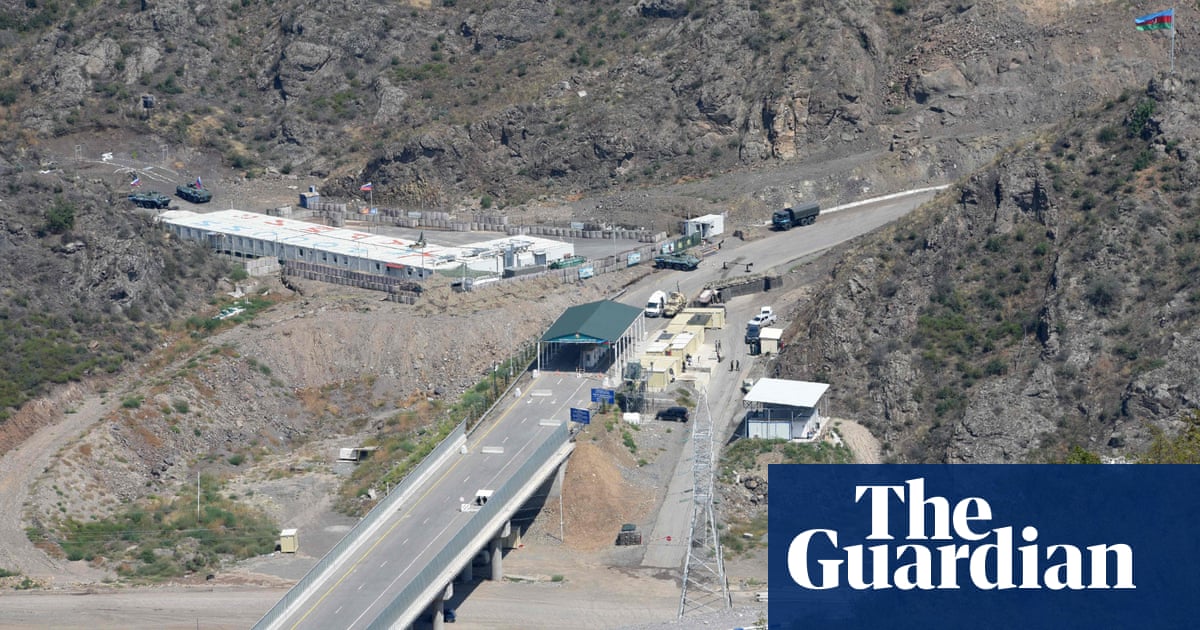
The Lachin Corridor remains closed until now but could reopen as Azerbaijan reassesses its position following hints that Armenia could accept Russian aid through an alternative route that crosses Azerbaijan.

  • Activists block a road from Stepanakert, the capital of Nagorno-Karabakh region of Azerbaijan, to Azerbaijani Aghdam demanding the reopening of the blockaded Lachin Corridor linking Karabakh to Armenia on July 18, 2023. (AFP)
    Activists block a road from Stepanakert, the capital of the Nagorno-Karabakh region of Azerbaijan, to Azerbaijani Aghdam demanding the reopening of the blockaded Lachin Corridor linking Karabakh to Armenia on July 18, 2023. (AFP)

On condition that leaders of Nagorno-Karabakh accept aid from Azerbaijan and not only from Armenia, the Azeri government agreed to reopen the Lanchin corridor linking Armenia to Nagorno-Karabakh, according to information citing a senior Azerbaijani official in POLITICO on Saturday.

The announcement comes after authorities in the Armenian-controlled exclave, also known to Armenians as the Republic of Artsakh, announced earlier in the day that it would accept humanitarian shipments from the Russian Red Cross via an alternative route.

The chosen route was through Aghdam, located within Azerbaijani government-held territory, which pushed Azerbaijan to reconsider its position.

In turn, Hikmet HAjiyev, the foreign policy adviser to Azerbaijani President Ilham Aliyev announced that “Azerbaijan expressed its consent as a goodwill gesture to ensure simultaneous opening” of the Lachin Corridor to allow for the transportation of ICRC cargo, reaffirming that “In the Lachin checkpoint, Azerbaijan’s customs and border regime must be observed.”

The Lanchin Corridor stands as the sole roadway linking Nagorno-Karabakh to Armenia, without which Armenia loses its only access to the self-proclaimed Republic of Artsakh. Consequently, severing this corridor has created hardships in the area, affecting the import of essential resources such as oil, electricity, food, and medical supplies. Nevertheless, both the corridor and the region have garnered international attention, given the substantial interests of multiple stakeholders in this region, which is geographically adjacent to Iran.

Azerbaijan builds up military forces on border: Armenian MoD

The Armenian Defense Ministry stated on Friday, underscoring the precarious situation prevailing at the border with Azerbaijan due to the apparent buildup of Azerbaijani military forces.

The mounting tension has raised concerns, prompting the Armenian Armed Forces to take measures aimed at maintaining stability and deterring potential provocations. “The situation continues to be tense as a result of the accumulation of Azerbaijani armed forces during the last two days. Hence, the Armenian Armed Forces continue to take necessary actions to stabilize it and prevent provocations,” the Armenian MoD said in an official statement. 

This recent escalation follows a recurring pattern of periodic exchanges of fire along the border between Armenia and Azerbaijan. The most significant flare-up in hostilities took place on September 12, 2022, leaving regional observers wary of a possible repeat of such confrontations.

Read more: Moscow summons Armenian envoy, gives him a ‘tough presentation’

Categories
Selected Articles

Armenia, Iran leaders speak amid Yerevan-Baku tensions


1244401334.jpeg?h=199d8c1f&itok=byhFV3ha

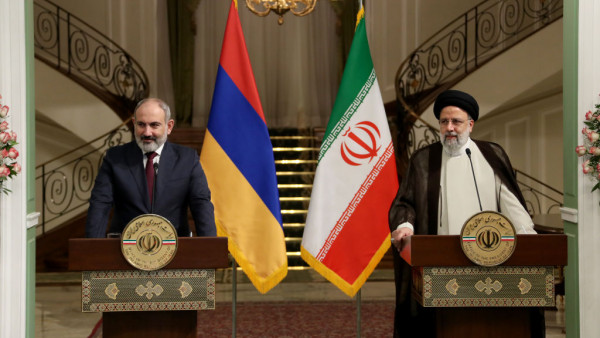
Armenia’s Prime Minister Nikol Pashinyan and Iran‘s President Ebrahim Raisi spoke Saturday, as tensions escalated on Armenia’s border with Azerbaijan.

Pashinyan and Raisi discussed issues including the blockade of the Lachin corridor leading to the Nagorno-Karabakh region by Azerbaijan, and the buildup of the Azerbaijani military around the disputed region, read a statement from the Armenian prime minister’s office released Saturday.

The call was one of a series made by Pashinyan, who also spoke to French President Emmanuel Macron, German Chancellor Olaf Scholz and US Secretary of State Anthony Blinken, among others, according to other statement from the prime minister’s office.

The flurry of calls comes as tensions between Armenia and Azerbaijan increase following Azerbaijan’s blockade of Nagorno-Karabakh by cutting off the Lachin corridor, the only road that connects the enclave to Armenia.

The blockade, which has been ongoing since December 2022, has resulted in food and fuel shortages in the territory.

These tensions have further escalated following the election of Samvel Shahramanyan as the new leader of Nagorno-Karabakh, an act Azerbaijan labelled as “a clear violation of Azerbaijan’s sovereignty and territorial integrity.”

As well as tensions over the current situation with Nagorno-Karabakh, Azerbaijan’s Ministry of Defence claimed that Armenian soldiers opened fire with small arms on its soldiers in the Azerbaijani exclave of Nakhchivan – a claim denied by the Armenian defence ministry.

Armenia and Azerbaijan have had tense relations following both countries independence from the Soviet Union, fighting two wars over the ethnically Armenian territory of Nagorno-Karabakh which is internationally recognised as part of Azerbaijan. 

The most recent all-out war, fought in 2020, resulted in a Russian-backed ceasefire, with much of the Armenian held territory, some of which being outside Nagorno-Karabakh, was ceded to Azerbaijan.

However, the two countries have yet to sign a lasting peace settlement even with mediation efforts from international powers such as the EU, the US and Russia.

Iran has sought to present itself as a mediator in Baku and Yerevan’s longstanding dispute over Nagorno-Karabakh, but Tehran has been accused of sending weapons to the Armenians to support its fight for the territory. Iran has denied such claims.


Categories
Selected Articles

Azerbaijan Denies Deal Reached to Reopen Karabakh-Armenia Road


Hikmet Hajiev, a foreign policy advisor to Azerbaijani President Ilham Aliyev, on Saturday denied that Baku had reached a deal with the breakaway province of Nagorno-Karabakh to simultaneously reopen roads to Azerbaijan and Armenia.

In a message posted on the platform X, formerly known as Twitter, Hajiev said that Baku had offered to simultaneously reopen the roads but that what he called the “illegal regime” in Karabakh had refused. 

Hajiev said that Azerbaijan would maintain “border and customs” control on the Lachin corridor, which links Karabakh to Armenia. He said that the road to Azerbaijan would open for aid shipments for the first time since 1988, a key demand of Baku’s.

Karabakh, which broke away from Baku after a war that spanned the collapse of the Soviet Union, is internationally recognized as part of Azerbaijan, but its 120,000 population is overwhelmingly ethnically Armenian.

Azerbaijani retook large amounts of ground in a 2020 war, leaving Karabakh almost entirely surrounded. In December 2022, Azerbaijani civilians began blockading the last road linking Karabakh to Armenia, causing acute shortages of food, fuel and medicine.

Armenian state news agency Armenpress reported on Saturday that Karabakh officials had bowed to Baku’s demands to reopen the long-closed road to Azerbaijan in return for lifting the blockade on the Lachin corridor.

Armenpress cited Karabakh officials as saying they had agreed to the deal in view of “severe humanitarian problems” in the region.

At the time, Hajiev confirmed to Reuters that the Karabakh authorities had agreed to allow aid shipments from Azerbaijan to enter the territory in return for reopening the road to Armenia.


Categories
Selected Articles

Ukrainian Foreign Ministry Rebukes Putin For Latest Anti-Semitic Comments


A sniper of Ukraine's 3rd Separate Assault Brigade takes a position during a reconnaissance mission near the eastern city of Bakhmut.

A sniper of Ukraine’s 3rd Separate Assault Brigade takes a position during a reconnaissance mission near the eastern city of Bakhmut.

The final declaration of the Group of 20 (G20) major economies in India left Kyiv angry over its refusal to condemn Moscow for its aggression against Ukraine, as new fragments of projectiles appeared to have landed on NATO-member Romania’s territory on September 9.

“We are grateful to the partners who tried to include strong wording in the text,” Ukrainian Foreign Ministry spokesman Oleh Nikolenko posted on Facebook.

“However, in terms of Russia’s aggression against Ukraine, [the] G20 has nothing to be proud of,” he wrote.


RFE/RL’s Live Briefing gives you all of the latest developments on Russia’s full-scale invasion, Kyiv’s counteroffensive, Western military aid, global reaction, and the plight of civilians. For all of RFE/RL’s coverage of the war in Ukraine, click here.

The final declaration revealed the sharp divisions over Russia’s invasion of Ukraine, with host India able to get attendees to agree to a final statement only after softening language on Moscow’s war on its neighbor.

The statement underlined the “human suffering and negative added impacts of the war in Ukraine,” but did not mention Russia’s invasion.

“All states must refrain from the threat or use of force to seek territorial acquisition against the territorial integrity and sovereignty or political independence of any state. The use or threat of use of nuclear weapons is inadmissible,” it said, referencing the UN Charter.

A senior EU diplomat told AP that the bloc had not given up any of its position and said the fact that Moscow had signed on to the agreement was important.

“The option we have is text or no text, and I think it is better [to have a] text. At least if they [the Russians] don’t implement, we know once more that we cannot rely on them,” the diplomat said.

Meanwhile, Kyiv said the toll of the wounded from a Russian missile strike on the Ukrainian city of Kryviy Rih rose to 74, as Ukrainian forces pressed their slow counteroffensive against Russian forces in southern and eastern regions.

Elsewhere, Romanian officials said they had found new drone fragments on the NATO member’s territory near the Ukrainian border for the second time this week. The Defense Ministry said they were “similar to those used by the Russian Army.”

President Klaus Iohannis said in a statement that the fragments indicated “an absolutely unacceptable violation of the sovereign airspace of Romania, a NATO ally, with real risks to the security of Romanian citizens in the area.”

Iohannis added that he had a phone call with NATO Secretary-General Jens Stoltenberg to inform him of the new finding and that he had received assurances of the alliance’s support.

Moscow did not comment on the report.


Photo Gallery:

Eighteen months into Russia’s full-scale invasion, Ukraine is struggling to build momentum in the counteroffensive taking place over three fronts, with the primary push coming south of Orikhiv, in the southern Zaporizhzhya region.

While some Western allies have expressed frustration with the slow pace of the effort, now in its third month, Ukrainian troops have shown glimpses of success in breaching the Russian defensive lines.

Kyiv also claimed “partial success” in the east, near the obliterated Donetsk region city of Bakhmut, which Russia captured earlier this year.

And in Crimea, Russian-installed authorities in the city of Simferopol called a blaze at a military post a “domestic fire” and not the result of an attack by Ukrainian drones.

Full details of the blaze were not immediately available. Kyiv has not commented.

A main goal of Ukraine’s southern counteroffensive is to drive toward the peninsula and eventually retake the region, which was illegally annexed by Russia in 2014.

Kyiv estimates that Russia has deployed more than 420,000 soldiers in areas it controls in the east and south of Ukraine, deputy intelligence chief Vadym Skibitskiy said on September 9.

“The Russian Federation has concentrated more than 420,000 servicemen in our territories that are temporarily occupied, including Crimea,” Skibitskiy said at a conference in Kyiv. The figure “does not include the Russian National Guard and other special units that maintain occupation authorities on our territories.”

Ukraine is almost entirely dependent on Western military aid and equipment to wage its defense against the Russian invasion. Kyiv has repeatedly pressed the United States and other allies for more powerful weaponry, such as F-16 fighter jets, which could be put into service next year.

Kyiv has also sought supplies of long-range, U.S.-designed Army Tactical Missile Systems, which have a greater distance for striking at Russian targets.

The United States has been reluctant to send the weapons, but unnamed U.S. officials told ABC News that the systems, known as ATACMS, or “attack-ems,” were likely to be supplied in the end.

“They are coming,” one anonymous official told ABC News on September 8. A second official said the missiles were “on the table” and likely to be included in an upcoming weapons package.

Japan’s foreign minister arrived in Kyiv on September 9 in an unannounced visit aimed at showing support for Ukraine.

Yoshimasa Hayashi met with Ukrainian President Volodymyr Zelenskiy and agreed to begin talks on potential security guarantees and to cooperate on reconstructing Ukraine’s economy, Japan’s Foreign Ministry said.

Japan has joined the West in supporting Ukraine and imposing sanctions on Russia. However, it does not allow the supply of weapons, under long-standing pacifist government policies.

It’s the first visit by a Japanese foreign minister to Ukraine since Russia’s full-scale invasion in February 2022.

Ukrainian Foreign Minister Dmytro Kuleba in a joint news conference thanked Hayashi for his country’s support and that he wanted the foreign minister “and the entire Japanese people to know that the Ukrainian people remember and will never forget the humanitarian aid.”

With reporting by Reuters and AP

Categories
Selected Articles

Nagorno-Karabakh routes reopen in Lachin corridor deal, say Azeri and Armenian sides


6016.jpg?width=1200&height=630&quality=8

Azerbaijan’s government and separatist Armenians in Nagorno-Karabakh appeared to strike a deal reopening two disputed transport links including a key route known as the Lachin corridor.

The moves – initially reported by Armenia’s Armenpress state news agency and confirmed by Azerbaijan – appear at least partly to grant the latter’s decades-old demand to restore transport links between Azeri government-held territory and Nagorno-Karabakh, where Armenians seized control in the 1990s.

Karabakh is recognised globally as part of Azerbaijan, but has been controlled by its population of about 120,000 ethnic Armenians since a war that coincided with the breakup of the Soviet Union in the 1980s and 90s.

Azerbaijan recaptured large swathes of Nagorno-Karabakh in a 2020 war, and for the past nine months has exerted pressure by restricting access to Armenia through the Lachin corridor.

Armenpress cited Karabakh authorities as saying that they had “decided to allow access of the Russian goods to our republic through the town of Askeran”, referring to a Karabakh town close to the frontline with Azerbaijan.

“At the same time, an agreement has been reached to restore humanitarian shipments by the Russian peacekeepers and the International Committee of the Red Cross along the Lachin corridor,” the Armenpress report said, referring to the area through which the road linking Karabakh to Armenia passes. It said the move was driven by “severe humanitarian problems” in the blockaded region.

Hikmet Hajiyev, a foreign policy adviser to Azerbaijan’s president, Ilham Aliyev, told Reuters on Saturday that a deal had been struck to open roads between Armenia and Azerbaijan.

He stressed that the roads would be opened simultaneously and added that an Azerbaijani checkpoint on Lachin corridor to Armenia would remain.

Azerbaijan had previously accused Armenia of using the corridor to smuggle weapons, and of rejecting an offer to reopen the roads simultaneously.

The apparent deal came on a day Karabakh’s parliament chose a new president of its self-proclaimed independent republic, a move Azerbaijan has denounced as illegal, amid days of escalating tensions between Baku and Yerevan.

Azerbaijan has a close relationship with Turkey, while Armenia has historically held close ties with Russia, which sent peacekeepers to the area and promised to keep the Lachin corridor open as part of a peace deal that ended the 2020 war. Armenia has lately complained that Moscow failed to live up to its assurances, leading him to seek wider international support.

Azerbaijan said on Saturday that Armenian forces had fired on its troops overnight, and that Azerbaijan army units took “retaliatory measures”. Armenia denied the incident.

The Armenian government said its prime minister, Nikol Pashinyan, held phone conversations on Saturday with the leaders of France, Germany, Iran and Georgia, and with the US secretary of state, Antony Blinken. Azerbaijan said its foreign minister discussed the situation with a senior US state department official, Yuri Kim.

According to Armenia’s government, Pashinyan told the foreign leaders that tensions were rising on the border, and that Azerbaijan was concentrating troops there and around Nagorno-Karabakh. Azerbaijan has denied this, while accusing Armenia of similar steps.

On Saturday, Karabakh’s separatist parliament elected Samvel Shahramanyan, a military officer and former head of the territory’s security service, as its new president, replacing an incumbent who resigned a week ago.

In a speech to parliament, Shahramanyan called for direct negotiations with Azerbaijan, and for transport links to Armenia to be restored.

Azerbaijan’s foreign ministry called the ethnic Armenian leadership of Karabakh a “puppet separatist regime” and said the vote was illegal. “The only way to achieve peace and stability in the region is the unconditional and complete withdrawal of the Armenian armed forces from the Karabakh region of Azerbaijan and the disbandment of the puppet regime.”

Both Ukraine and Turkey condemned the election, and expressed support for Azerbaijan’s claim to Karabakh. The EU said it did not recognise the election, but that Karabakh residents should “consolidate around the de facto leadership” in talks with Armenia.

In the capitals of both Armenia and Azerbaijan, residents told Reuters they feared a new war between the two countries.

“We will probably have martyrs again,” said Mansura Lahicova, a woman in the Azerbaijani capital, Baku. “I have two sons who have reached military age. I hope it will be a victory and that everything calms down.”

In Armenia’s capital, Yerevan, a resident who gave his name as Hayk accused Azerbaijan of wanting to start another war.

“I hope this does not happen, but if it does, all of us, all friends and brothers, are ready to go to war. Last time we buried our friends, now it’s our turn.”

With Reuters


Categories
Selected Articles

Artsakh President: Stepanakert must hold talks with Baku


default.jpg

The constitutional rules for appointing a new president during a transitional phase in the event of a vacancy in the incumbent president’s office due to martial law are aimed to prevent immediate presidential and extraordinary parliamentary elections when a democratically elected president prematurely leaves office with unfinished pre-election plans, the newly elected President of Artsakh Samvel Shahramanyan stated in his speech.

“Dear Speaker of the National Assembly and members of Parliament!

The Basic Law of the Republic of Artsakh proclaimed Artsakh a sovereign, democratic, legal, and social state and established that power in the Republic of Artsakh belongs to the people, who exercise it through free elections, referendums, as well as in other ways provided for by the Constitution and laws.

The norms enshrined in the Constitution provide for certain counterbalance mechanisms designed to ensure the coordinated and uninterrupted operation of all branches of government. The institution of the president has its place in this system, whose task is to take responsibility in overcoming existing challenges. To realize the latter, it is extremely important to soberly assess reality and dispel illusions.

Dear members of parliament, I am not going to set out the election program in its classical sense. It is evident that the purpose of constitutional norms regarding the election of a new president during a transitional period in the event of a vacancy in the office of the incumbent president under conditions of martial law was to ensure that if the president, elected through direct democracy, prematurely departs from office for any reason and their pre-election plans remain unfinished, the country does not immediately proceed to presidential and extraordinary parliamentary elections.

The latest phase of the Artsakh conflict, which began on September 27, 2020, and was frozen by a trilateral agreement on November 9, not only made it impossible to implement the election program of the current president, but also gave rise to a number of new pressing problems.

Therefore, in the current situation, a candidate applying for the position of president should focus more on overcoming the crisis situation, solving ontological, security and humanitarian problems facing the state. The main provisions of the latter and the envisioned outcomes of the proposed actions have already been discussed during meetings held with the factions.
I would like to thank all the deputies who took part in the discussions for the questions raised, opinions and proposals expressed, as well as concerns voiced.

At the same time, I thank all the political forces that nominated my candidacy for the National Assembly.Dear MPs, the essence of the vision presented to you can be summarized in the following brief formulation: strengthening the state and maintaining internal stability, protecting Artsakh’s right to self-determination, ensuring its free life and security, promoting the economic development of the country, gradually improving the social situation of the people and strengthening the rule of law.

What challenges is Artsakh facing now?

Dear deputies, I am not revealing a secret when I say that the partial and then complete blockade of the Republic of Artsakh by Azerbaijan since December 12, 2022 has created a number of problems for the republic.

There is no doubt that the geopolitical conflict between Russia and the West and the Russian-Ukrainian war are influencing the current situation. This conflict is reflected in our region, considering the settlement of the Artsakh issue as part of the steps taken against each other within the framework of this conflict.

By reevaluating its security concept in light of post-war realities, the Republic of Armenia has effectively shifted away from its long-term role as the guarantor of Artsakh’s security and adopted an approach known as the “peace agenda.” The core of this agenda is the recognition of Azerbaijan’s territorial integrity, including Artsakh, with the condition of safeguarding the fundamental rights and the rights of Artsakh Armenians.

In turn, Azerbaijan, taking advantage of the fact that international players have not taken objective steps, is gradually violating the provisions of the Tripartite Statement of November 9, 2020 and increasing pressure on Artsakh in order to implement its own “integration” program. At the same time, Azerbaijan continues to trumpet on all international platforms that the Artsakh conflict has already been resolved, that there is no such thing as Nagorno-Karabakh, and the issue of ensuring the rights and freedoms of local Armenians is an internal issue of its country.

On the contrary, prominent players in global politics are satisfied only by the daily increasing volume of concerns, exhortations and appeals. The implementation of decisions of international and European courts of human rights also remains incomplete. It is obvious that not a single international player is currently interested in applying harsh measures to influence Azerbaijan. Moreover, there is a belief that it is realistic to engage Stepanakert in discussions regarding the integration agenda.

In other words, we can state that the rights and legitimate interests of the Armenians of Artsakh are not protected within the framework of international law. Accordingly, I consider our ideas and expectations regarding international law to be unrealistic and divorced from reality, since it is obvious that international politics, geopolitics, even wars do not occur within the framework of international law.

The above leaves Artsakh no other choice but to try to find intermediate solutions based on the situation,” said the President of Artsakh Republic.

Even though Russia and the collective West hold opposing views on the conflict, it’s important to acknowledge that there is global consensus on certain aspects of the Artsakh conflict, including the following:

1) The Artsakh conflict has not been resolved, as Azerbaijan claims, therefore Nagorno-Karabakh is a disputed territory that should receive a specific status.

2) Artsakh and Armenia must have direct transport links – the [Berdzor] Lachin Corridor. Contrary to Baku’s claims, the latter has been closed for a long time and should be opened. Other regional roads should also be launched, but they cannot replace the Lachin Corridor or be considered as an alternative to it.
3) Stepanakert should negotiate with Baku. Moreover, in this matter, both the Russian Federation and the collective West are ready to provide a platform and act as a mediator, which Azerbaijan is categorically opposed to.

The above-mentioned points are the basis for building Artsakh’s foreign policy within this framework. Therefore, the priority of the future president should be to transform Stepanakert from an object for resolving the Artsakh conflict into a subject of negotiations. At the same time, depending on the scale of the issues currently being discussed, the format of negotiations can be either multilateral or bilateral. The only mandatory condition should be the organization of negotiations by a third country with its guarantee of implementation of the agreements reached.


Categories
Selected Articles

Artsakh President: Stepanakert must hold talks with Baku


default.jpg


Categories
Selected Articles

Edmon Marukyan: Why Azerbaijan tried to send ‘humanitarian aid’ if there is no siege, hunger in Nagorno-Karabakh?


default.jpg

Edmon Marukyan, Ambassador-at-Large of Armenia, countered Azerbaijani presidential aide Hikmet Hajiyev’s false statement that the Lachin corridor is not blocked and there is no blockade in Nagorno-Karabakh.

“During an interview with Arab News, [Azerbaijani president] Aliyev’s assistant Hikmet Hajiyev said that the Lachin corridor is not blocked and there is no blockade in Nagorno Karabakh. By this, Azerbaijan wants to deceive the international community about the fact that the Lachin Corridor is illegally blocked, which has been confirmed by such renowned international organizations as the Human Rights Watch, the UN Security Council and confirmed by the interim decisions of the UN International Court of Justice that the corridor is blocked and the people are starving. After all, if the Lachin Corridor is not blocked and there is no siege and hunger in Nagorno Karabakh, as Aliyev’s aide claims, then why did Azerbaijan send that mysterious humanitarian aid to Aghdam?” Marukyan wrote on X—former Twitter.

!

This text available in   Հայերեն and Русский

Print


Categories
Selected Articles

Georgian, Armenian PM’s discuss situation along Armenia-Azerbaijan border


geo-armenian-pms-call-pressoffic.jpg

The situation along the Armenia-Azerbaijan border was discussed on Saturday in a phone call between the Georgian Prime Minister Irakli Garibashvili and his Armenian counterpart Nikol Pashinyan.

Garibashvili highlighted the importance of ensuring peace and stability in the South Caucasus region, and noted the significance of regulating the situation through peaceful negotiations, the Government Administration said.

The Government Head said Georgia was “always ready” to help maintain regional peace and stability.


Categories
Selected Articles

UPDATE 1-Azerbaijan denies deal reached to reopen Karabakh-Armenia road


yahoo_default_logo-1200x1200.png

(Added context)

By Felix Light and Nailia Bagirova

TBILISI, Sept 10 (Reuters) – Hikmet Hajiev, a foreign policy advisor to Azerbaijani President Ilham Aliyev, on Saturday denied that Baku had reached a deal with the breakaway province of Nagorno-Karabakh to simultaneously reopen roads to Azerbaijan and Armenia.

In a message posted on the platform X, formerly known as Twitter, Hajiev said that Baku had offered to simultaneously reopen the roads but that what he called the “illegal regime” in Karabakh had refused.

Hajiev said that Azerbaijan would maintain “border and customs” control on the Lachin corridor, which links Karabakh to Armenia. He said that the road to Azerbaijan would open for aid shipments for the first time since 1988, a key demand of Baku’s.

Karabakh, which broke away from Baku after a war that spanned the collapse of the Soviet Union, is internationally recognised as part of Azerbaijan, but its 120,000 population is overwhelmingly ethnically Armenian.

Azerbaijani retook large amounts of ground in a 2020 war, leaving Karabakh almost entirely surrounded. In December 2022, Azerbaijani civilians began blockading the last road linking Karabakh to Armenia, causing acute shortages of food, fuel and medicine.

Armenian state news agency Armenpress reported on Saturday that Karabakh officials had bowed to Baku’s demands to reopen the long-closed road to Azerbaijan in return for lifting the blockade on the Lachin corridor.

Armenpress cited Karabakh officials as saying they had agreed to the deal in view of “severe humanitarian problems” in the region.

At the time, Hajiev confirmed to Reuters that the Karabakh authorities had agreed to allow aid shipments from Azerbaijan to enter the territory in return for reopening the road to Armenia. (Reporting by Felix Light in Tbilisi and Nailia Bagirova; editing by Guy Faulconbridge)