Categories
Selected Articles

Armenia official on Azerbaijan military buildup at border: Risk of escalation exists


default.jpg

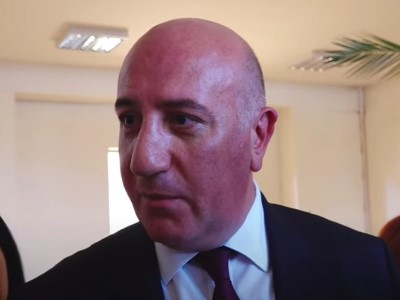
The Ministry of Defense (MoD) of Armenia also announced the information about the [Azerbaijani military] buildup. And in order to avoid excessive stress, other things, it is desirable to follow the official information, we publicize everything. Arman Sargsyan, Deputy Minister of Defense of Armenia, told this to reporters Monday in the National Assembly.

Regarding the remark that there are videos showing that Azerbaijan is stockpiling offensive weapons at the border with Armenia, the deputy defense minister said: “I will not say professionally, it is clearly visible there, and it seems that they are artillery means, it is a number of military equipment. It has been talked about; I don’t want to talk about it one more time. I will only urge you to follow our information, we regularly provide information immediately in case of certain escalations or up to fire from small firearms. The MoD [of Armenia] naturally takes steps within its authority to not destabilize the situation in the region and in terms of not having any negative impact on the general situation. Our region is such that there is a risk of escalation, but we, as a state, must take steps so that it does not come to escalation, in general, to major military actions.”

!

This text available in   Հայերեն and Русский

Print


Categories
Selected Articles

US-Armenia Peacekeeping Exercises Underway: Spokesperson – Barron’s


US-Armenia Peacekeeping Exercises Underway: Spokesperson  Barron’s

Categories
Selected Articles

Wider Europe Briefing: Russia Sanctions Survive A Key Legal Challenge And Georgia’s EU Bid Hangs By A Thread – Radio Free Europe / Radio Liberty


Wider Europe Briefing: Russia Sanctions Survive A Key Legal Challenge And Georgia’s EU Bid Hangs By A Thread  Radio Free Europe / Radio Liberty

Categories
Selected Articles

Prime Minister Pashinyan’s wife meets with members of the Armenian community of Ukraine in Kyiv


Prime Minister Pashinyan's wife meets with members of the Armenian community of Ukraine in Kyiv
12:10, 8 September 2023

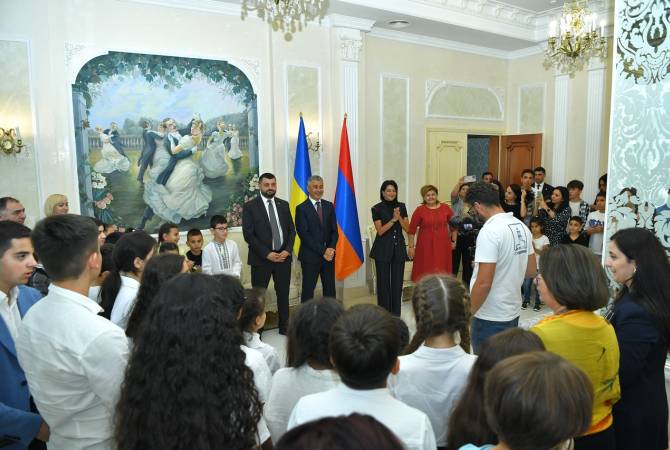
YEREVAN, SEPTEMBER 8, ARMENPRESS. Prime Minister Nikol Pashinyan’s wife Anna Hakobyan has met in Kyiv with members of the Armenian community of Ukraine.

The meeting was attended by Armenian families, together with their children, living in Kyiv, Odessa, Dnipro, Cherkasy, Kirovohrad, Sumy, Khmelnytskyi, Chernihiv oblasts, as well as the city of Kryvyi Rih.

Hakobyan talked with the children, asked them how they were overcoming the days of war. The Armenian children were interested in the life in Armenia, and what the children in Armenia are doing.

Asked on the security situation, Hakobyan said that although the situation in Armenia is difficult, it is not as difficult as in Ukraine, and at the same time she said that the Armenian government is doing everything possible to establish peace. The children asked Hakobyan what steps Armenia is taking to have closer relations with Ukraine, and Hakobyan said that’s the reason of her visit. The children said they want to visit Armenia very much and Hakobyan suggested them to continue their education in Armenia.

All attendees, both adults and children, said they’re impatiently waiting for the opportunity to travel to Armenia.

Hakobyan conveyed to the children the Armenian government’s humanitarian aid (smartphones and computers).

The members of the Armenian community of Ukraine thanked Hakobyan for the meeting and said that the whole community has been waiting for the meeting for many years.

Anna Hakobyan underscored the importance of achieving sustainable peace, in Armenia, in Ukraine and elsewhere around the world.

The Armenian PM’s spouse then met with the Armenian embassy staff, as well as renowned Ukraine-based Armenian filmmaker Roman Balayan and painter Boris Yeghiazaryan.


Categories
Selected Articles

President Ilham Aliyev Receives Israeli Minister Of Agriculture Via … – MENAFN.COM


President Ilham Aliyev Receives Israeli Minister Of Agriculture Via …  MENAFN.COM

Categories
Selected Articles

Ilham Aliyev received Minister of Agriculture and Rural Development of Israel


President of the Republic of Azerbaijan Ilham Aliyev has received Minister of Agriculture and Rural …

Categories
Selected Articles

Armenia official on Azerbaijan military buildup at border: Risk of escalation exists


default.jpg

The Ministry of Defense (MoD) of Armenia also announced the information about the [Azerbaijani military] buildup. And in order to avoid excessive stress, other things, it is desirable to follow the official information, we publicize everything. Arman Sargsyan, Deputy Minister of Defense of Armenia, told this to reporters Monday in the National Assembly.

Regarding the remark that there are videos showing that Azerbaijan is stockpiling offensive weapons at the border with Armenia, the deputy defense minister said: “I will not say professionally, it is clearly visible there, and it seems that they are artillery means, it is a number of military equipment. It has been talked about; I don’t want to talk about it one more time. I will only urge you to follow our information, we regularly provide information immediately in case of certain escalations or up to fire from small firearms. The MoD [of Armenia] naturally takes steps within its authority to not destabilize the situation in the region and in terms of not having any negative impact on the general situation. Our region is such that there is a risk of escalation, but we, as a state, must take steps so that it does not come to escalation, in general, to major military actions.”

!

This text available in   Հայերեն and Русский

Print


Categories
Selected Articles

Biden Elevates US Relationship With Vietnam


c-38.png?fit=800%2C450&ssl=1

By Anita Powell

President Joe Biden on Sunday affirmed that the United States and Vietnam would elevate their relationship to a “comprehensive strategic partnership” — a move the White House described as “unprecedented and momentous,” and that brings the U.S. level with its main adversary, China, which has the same upper-tier diplomatic status with Vietnam.

“Vietnam and the United States are critical partners at what I would argue is a very critical time,” Biden said during his first meeting after arriving to a triumphant welcome in Vietnam’s verdant capital, Hanoi, where thousands of residents watched his motorcade pass by. “I’m not saying that to be polite. I’m saying it because I mean it from the bottom of my heart.”

“Vietnam will continue to strengthen its ties to the U.S. and other international partners in the spirit of Ho Chi Minh after Vietnam achieved its independence,” said Nguyen Phu Trong, the general secretary of the Communist Party of Vietnam, who is considered the nation’s most powerful and respected political official.

“Vietnam is a friend, a reliable partner and a responsible member of the international community,” he added.

Neither spoke overtly about Beijing’s increased ambitions or its apparent moves, through a new map, to claim territory that Vietnam claims.

“The Vietnamese want a stronger relationship with the United States,” John Kirby, director of strategic communications for the National Security Council, told VOA on the sidelines of the trip. “The Vietnamese share many concerns that the United States has, both economically and from a security perspective in the region. We share a lot of interests; we also have a shared perspective of some of the challenges including the course of behavior of the PRC. It’s really quite a stunning turn of events over recent decades to see our two countries working together this closely.”

This is a big step from a nation that only established relations with the U.S. in 1995, and which has carefully calibrated its relationship with its powerful northern neighbor, China.

In recent years, that bond has strengthened.

Trong and Biden have met before. Trong was the first Vietnamese Communist Party leader to ever visit the U.S., in 2015, and he was hosted for dinner by then-vice president Biden.

The elevation from comprehensive partnership to comprehensive strategic partnership is significant. Vietnam counts only four other nations on that level: China, Russia, India and South Korea.

The difference “sounds like word soup to those of us in the U.S., but for Vietnam, a communist state with a pretty rigid kind of Leninist hierarchy of diplomatic relations, this stuff actually matters,” said Gregory Poling, a senior fellow with the Center for Strategic and International Studies in Washington.

“Vietnam has a very clear hierarchy of diplomatic relations,” said Poling, who also serves as director of the Southeast Asia Program and Asia Maritime Transparency Initiative at the CSIS.

“There’s also rumors they may do that for Japan and Australia as well, all of which suggests that the Vietnamese are willing to take a bit of retaliation from China now to make that happen,” he added. “And that will send a message, I think, up and down the Vietnamese government that senior levels are committed to a closer relationship with the Americans, so everybody get on board.”

Bich Tran is a postdoctoral Fellow at the National University of Singapore’s Lee Kuan Yew School of Public Policy. Tran said the relationship was “due for an upgrade.”

“An official upgrade will empower Vietnamese officials in engaging with their American counterparts,” she said. “This year is considered the best time to do so because it marks 10 years of comprehensive partnership and 50 years of diplomatic relations. An upgrade will entail deeper security cooperation between the two countries and Vietnam’s commitment to further improve its human rights record.”


Categories
Selected Articles

G-20 Summit: India Successfully Passes New Delhi Declaration – OpEd


The world media has been continuously saying for the last one or two years that if the G-20 is included in India, then it will happen, but there would be no declaration. Russia had already warned that if it were criticized, it would block the Delhi Declaration, while Western countries were also adamant regarding Ukraine.

But very good news has come out: A Great Victory for India: The Delhi Declaration has been accepted at the 18th G-20 Summit. The Prime Minister posted on Twitter: “History has been created with the adoption of the New Delhi Leaders’ Declaration. United in consensus and spirit, we pledge to work collaboratively for a better, more prosperous, and harmonious future. My gratitude to all fellow G20 members for their support and cooperation”. 

This is a wonderful thing, and this work can only be done by a country like India, which enjoys good relations with both Western countries and Russia. Basically, the issue was: world leaders will come to India, but will they agree on declaration documents? The Western countries that led America wanted Russia to be condemned in this declaration, and Russia wanted that it not be condemned regarding Ukraine. Finally, this declaration was accepted. And the most unique thing was that India played the reverse card here.

India told the western countries that we would not condemn Russia excessively in this New Delhi Declaration. When the G-20 was held in Indonesia in 2022, Zelensky was invited as a guest, and he called Russia bad, and many things were written in the declaration about Russia. In comparison to the previous G-20 summits, there was no condemnation of Russia in the New Delhi Declaration. New Delhi told the western countries that it would not condemn Russia in this New Delhi Declaration. At many places where the nuclear threat was talked about, Russia’s name was removed, and this is a geo-political gift from India to Russia. We don’t know why Vladimir Putin did not come to the India G-20; if he had, it would have been a big victory for him. Putin himself enjoyed all this because the declaration was accepted and the western countries did not even raise any objections.

When Dr. Jaishankar was asked about what was discussed in the last G-20 summit in Indonesia, in which Russia was criticized a lot, he replied, “Bali was Bali. This is Delhi.”

When we look at the document of the Delhi Declaration, a very interesting thing comes to light: Ukraine has been mentioned only four times in it. Whereas, in comparison, Ukraine was mentioned 42 times in the previous G-20 declaration. But this does not prove that India took advantage of Russia or gave less importance to Ukraine. When an entire summit is focused on just one war, decisions on other important issues like climate change, education, the economy, and investment are not taken.

It is very clear from the list that, compared to the previous G-20 Summit, this G-20 Delhi Summit has been very successful. There were 73 outcomes in the Delhi Declaration (2023), while there were 27 outcomes in Bali (2022); before that, there were 36 outcomes in Italy (2021) and 22 in Saudi Arabia (2020), meaning it is clear that if we look at the outcomes of the previous G-20 summits, this time India hosted the G-20 summit. Such a successful summit has never been seen.

And this became successful only when New Delhi said that we want the war to stop and we want peace, but now let us talk about many other important issues that are even more important for the whole world. In this connection, the African Union was recognized as a member of the G-20, due to which the G-20 has now changed to the G-21. Along with this, many other decisions have also been taken, including the creation of the India-Middle East-Europe Economy Corridor and the Global Bio-Fuel Alliance. Also, the G-20 satellite will be launched to study climate change.

Since the Ukraine war has been going on for over 500 days, what if it continues for many more years and all the important issues are not discussed? We have to move on. India has achieved a very important political victory by getting the Delhi Declaration passed by all the countries at this summit.


Categories
Selected Articles

Cooperation Of CIA And Al-Qaeda In Chechen Wars – Analysis


d-9.png?fit=800%2C450&ssl=1

After the terrible war in Bosnia and Herzegovina ended at the end of 1995 with the desired outcome for the USA, an outcome that will make Bosnia and Herzegovina an unfinished country and a permanent crisis hotspot, the Americans, as the only superpower, could focus stronger attention on other crisis hotspots.

The most important crisis area of all for the United States in the second half of the 1990s was the Russian Muslim republic of Chechnya, along with the former Soviet Union territories bordering Russia, Turkey, and Iran. It was in these areas that the Americans, with the help of their CIA secret service, tried to influence the political-economic processes that were intended to weaken the Russian Federation with the aim of preventing Moscow from regaining the geopolitical power and influence it had during the USSR.

During the Clinton administration in the 1990s, geophysical testing by Halliburton and other major American and British oil companies determined the existence of vast deposits of crude oil and natural gas in the Caspian Basin between Azerbaijan, Kazakhstan, Russia, Turkmenistan and Iran. While the USSR existed, almost all of these areas were under the control of the Kremlin, but since 1991, many of them have come under the sovereignty of the newly formed states.

The dispersion of valuable energy resources over a wide area near Russian territory gave the USA an opportunity to turn its neighbors against Russia. Western oil companies such as British Petroleum and Amoco sought to assume primacy in Russia’s energy isolation policy. Estimates by Western geophysicists stated that the oil reserves of the Caspian Basin amount to about 200 billion barrels, which was the amount of oil reserves almost equal to Saudi Arabia. The US Department of Energy has estimated the natural gas reserves of the Caspian Basin equal to those of North America. The market value of oil and gas reserves amounted to trillions of dollars, so it is understandable that American policymakers turned their gaze towards Eurasia.

The US-Azerbaijan Chamber of Commerce was founded in 1995 to lobby the Clinton administration for US engagement in the Caspian region, including the Caucasus. That chamber included powerful people like the executive director of the Halliburton company, Dick Cheney, who, as vice president in George W. Bush’s administration, will direct the US towards interventions in Afghanistan and Iraq. The chamber was headed by former Secretary of State and Texas political broker James Baker III. And there were also Zbigniew Brzezinski, Henry Kissinger and Brent Scowcroft. What was that all about?

The only pipeline that transported oil from Baku to the west passed through the capital of Chechnya, Grozny. It had a capacity of 100,000 barrels per day, was 146 km long and dates back to the Soviet era. It transported Azeri oil through Dagestan and Chechnya to the Russian port of Novorossiysk on the Black Sea. That oil pipeline was the main obstacle to the alternative route of the American and British oil companies, which, of course, wanted to avoid transport through Russia.

Therefore, it is not surprising that the Caucasus and the Chechen war there intrigued American leaders. In 1998, President Bill Clinton tasked Richard Morningstar and Matt Bryza with developing a US energy strategy in the Caucasus and the Caspian Sea. The US government’s idea was to build pipelines independent of Russia from the Caspian Lake through the southern part of the Caucasus region to Europe. Bryza and Morningstar played a crucial role in the construction of the Baku – Tbilisi – Ceyhan pipeline (a project of the American-Azerbaijan Chamber) that will transport oil from Baku, Azerbaijan through Georgia to Turkey and the Mediterranean. Both were closely associated with Dick Cheney and Richard Perle (a former government official and supporter of the use of Mujahideen in the fight against the Soviets in Afghanistan).

Historically, Chechnya was home to moderate Sufi Muslims who believed that religion was a private matter and not a political category. However, with the support of the CIA, there was a radicalization of Chechen and other Muslims in the nearby area. CIA agents began operating in the early 1990s in Azerbaijan and then spread to Dagestan and Chechnya. The CIA helped transfer radical Islamic fundamentalists (Mujahideen from Afghanistan) who were under the control and command of Osama bin Laden to Chechnya. These moves expanded Al-Qaeda’s political base in former Soviet territories.

Bin Laden installed his jihadist partner Ibn al-Khattab as commander (emir) of the Mujahideen in Chechnya. He fought side by side with Chechen Islamist rebel leader Shamil Basayev. Ibn al-Khattab was born in Saudi Arabia and fought alongside the Mujahideen in Afghanistan during the 1980s. According to some information, he was involved in the arrival of Islamic fundamentalists in the war in Nagorno-Karabakh, while he personally participated in the civil war in Tajikistan. Also, al-Khattab participated in the war in Bosnia and Herzegovina together with other Mujahideen, although little is known about this.

In all these endeavors, Islamic fundamentalists either had the direct support of the CIA or the CIA tolerated their activities for higher purposes. The government of Saudi Arabia, in agreement with America, gave large financial aid to al-Khattab’s Chechen war against Russia, that is, to his organization, the International Islamic Brigade. In the Caucasus Mountains, the International Islamic Brigade numbered around 1,500 jihadists recruited in Chechnya, Dagestan, Saudi Arabia and other Muslim areas. Since the mid-1990s, bin Laden has financed radical Chechen rebel leaders like Basayev and al-Khattab with a grandiose sum of around several million dollars a month, which has made it impossible for moderate Chechen rebels to influence.

Official and unofficial structures of Saudi state publicly supported the war in Chechnya and declared the resistance of part of the Chechens to the Russian government a legitimate act and a holy war, a jihad. Private Saudi donors sent money to al-Khattab and his Chechen comrades. Jihadists wounded in war clashes were sent to Saudi hospitals for treatment. Former FBI agent, Ali Soufan, said: “The United States was on the Muslim side in Afghanistan, Bosnia and Chechnya. And in addition, the Muslim forces supplied weapons, money, equipment and all necessary means.”

The CIA used its planes to transport Afghan and other Mujahideen to the Caucasus, from where they were transferred illegally across the Georgian border to Chechnya. Another base for training and equipping Chechen terrorists was located in Turkey, which was also a member of the NATO alliance. During these times, the Saudi intelligence service and the CIA worked closely with bin Laden and other Islamist terrorists.

Back in 1991, during the negotiations between the American oil company Chevron and the government of Kazakhstan, the leaders of Central Asia were approached by leading representatives of the American and British oil companies. The then US President George H.W. Bush actively supported the plans of the American oilmen regarding exploitation, control of oil sources in the Caspian region and the construction of a pipeline that will transport Caspian oil and gas to the West, bypassing Russia. In the same year, Heinie Aderholt, Richard Secord and Ed Dearborn (veterans of American secret operations in Laos and Nicaragua) arrived in the Azeri capital, Baku, under the guise of the oil company MEGA Oil. Bush gave his support to the idea of a pipeline project that would transport oil from Azerbaijan through the Caucasus to Turkey. The pipeline would be under the informal but real control of the US.

MEGA Oil planes transported jihadists to the Caucasus to instill terror, violence and chaos along the Russian oil pipeline line in Chechnya and Dagestan and put Azerbaijan and Azeri oil under American jurisdiction by building the BTC: Baku – Tbilisi – Ceyhan pipeline. The BTC pipeline from Azerbaijan through Georgia to Turkey was finally completed in 2006. MEGA officials conducted military training for islamic radicals in Azerbaijan. It is assumed that they gave members of the Azeri government “brown bags of cash” and established an air link modeled after Air America, which quickly and efficiently collected hundreds of jihadists in Afghanistan and secretly transported them to the Caucasus.

The Afghan or Taliban politician and war leader, Gulbuddin Hekmatyar, was still collaborating with Osama bin Laden at the time and mobilized Afghan mercenaries to fight against the Russian state in Chechnya and the Armenian rebels in Azerbaijan. Hekmatyar used his new connections and positions to, with the full knowledge of the US, ship Afghan heroin to neighboring and Western drug markets. Drugs were smuggled through Baku to Chechnya, Russia and North America. Baku has turned into a transportation hub for Afghan heroin for the Chechen mafia.

U.S. intelligence services remained deeply involved in the Chechen conflict until Al-Qaeda’s terrorist attack on the U.S. on September 11, 2001. According to then-director of the U.S. Congressional Task Force on Terrorism and Unconventional Warfare, Yossef Bodansky, the U.S. was actively involved in “another anti-Turkish jihad, with the intention of supporting and strengthening the most poisonous anti-Western Islamist forces”.

Bodansky revealed that in December 1999, US government officials participated in an official meeting in Azerbaijan where special programs were discussed for training and equipping Mujahideen from the Caucasus, South and Central Asia, etc. In addition, they agreed to help private American security companies and Turkey, Jordan and Saudi Arabia to Chechen fighters and foreign Islamists. It was planned to incite riots and new long-term conflicts in the spring of 2000. Bodansky revealed that official Washington believed that the jihad in the Caucasus was preventing Russia from using the oil route because of the violence.

The fiercest conflicts in Chechnya ended in the spring of 2000 after powerful operations by the Russian army. The Russians achieved a costly military victory. The exact numbers of dead and missing in the Chechen wars, which were largely fueled by the CIA, are not yet known, but estimates range from 25,000 to 50,000 dead or missing, mostly civilians. The Russians lost over 14,000 soldiers in the First Chechen War, and about 7,000 soldiers in the Second Chechen War. Jihad in Chechnya did not succeed, but the Baku – Tbilisi – Ceyhan oil pipeline project, which bypasses Russia and sends oil to Europe, succeeded.