Categories
Selected Articles

As The EU Pushes Georgia To End Political Polarization, The Government Impeaches The President


TBILISI — When the European Union cracked open its door to Georgia last year, it made its invitation to formal candidate status conditional on the country reducing the polarization that has long vexed its domestic politics.

But before Brussels makes its critical decision on Georgia’s candidacy in October, the country is embroiled in yet another bitter internal power struggle.

President Salome Zurabishvili is on a tour of Europe that so far has taken her to Berlin, Brussels, and Paris to promote Georgia’s EU candidacy. But the Georgian Constitution requires the president — whose position is largely symbolic — to get permission from the government before conducting any foreign policy activities. According to the government, Zurabishvili asked for permission for the trip but was refused.

On the same day that she was warmly greeted in Brussels by European Council President Charles Michel, who praised her “personal commitment to advancing the European perspective of Georgia,” back at home she was in trouble. The ruling Georgian Dream party announced on September 1 that it intended to launch impeachment proceedings against Zurabishvili.
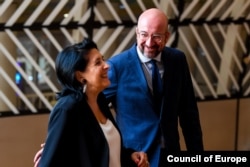
Zurabishvili and European Council President Charles Michel in Brussels on May 30


Zurabishvili and European Council President Charles Michel in Brussels on May 30

Party officials have accused her of not promoting the country’s EU candidacy but herself. Party Chairman Irakli Kobakhidze said that the nominally independent Zurabishvili was acting in concert with Georgia’s political opposition to undermine the government: “They are doing everything so that Georgia is not given candidate status; this is their main interest. [While] at the same time, if the country is given candidate status, Salome Zurabishvili will try her best to attribute this decision to herself.”

Georgian Dream officials have acknowledged that they don’t have the votes in parliament to carry out the impeachment. But the demonstrative effort is a sign of the political jockeying that is intensifying as the EU decision looms: As Georgians gain confidence from recent signals that their bid may be successful, attention in Tbilisi is turning to who does and does not deserve credit for the potentially landmark decision.

Georgia applied for EU candidate status shortly after Russia’s 2022 invasion of Ukraine, along with Ukraine and Moldova. While those two latter countries were awarded candidate status in June 2022, Georgia was instead given an EU “perspective” and a list of reforms it should implement. In addition to tackling political polarization and other issues, the European Commission has recommended Georgia address judicial reform, increase the fight against corruption and organized crime, and commit to “de-oligarchization.” In October, the EU will decide — based on its perception of the progress Georgia has made on those reforms — whether to award it candidate status.

Many in Georgia’s political opposition and anti-government civil society groups argue that the government’s efforts leave much to be desired. They point to the government’s spotty implementation of the EU-demanded reforms, as well as a series of foreign policy moves that have called into question the country’s once ironclad devotion to a Euro-Atlantic orientation. The critics argue that a positive decision from the EU would thus allow Georgian Dream to claim credit it doesn’t deserve and could boost the party ahead of parliamentary elections in 2024. They say the EU should advance Tbilisi’s membership prospects but in a way that frames the gesture as an acknowledgment of Georgians’ national will to become part of Europe rather than anything their government did.

“We are asking the European structures to give us the status, but make it very clear that the status was given to the Georgian people and Georgian society, and it was not deserved by the government,” said Keti Khutsishvili, the executive director of the Open Society Foundation of Georgia, part of the network of civil society groups founded by financier and philanthropist George Soros.

The country’s largest opposition party, the United National Movement, is going to launch a campaign in Europe for a decision from Brussels “to keep Georgia on the path to EU membership, but, at the same time, to allow the Georgian people to elect a pro-European, rule-of-law government,” said the party’s secretary for international relations, Zurab Chiaberashvili.
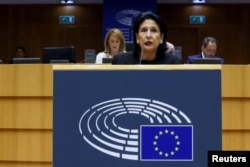
Zurabishvili speaks during the plenary session at European Parliament in Brussels on May 31.


Zurabishvili speaks during the plenary session at European Parliament in Brussels on May 31.

Georgian Dream, meanwhile, accuses the opposition and Zurabishvili of trying to sabotage the EU bid for their own gain and argues that a positive decision from Brussels should be credited only to them. In comments criticizing the president’s tour, Prime Minister Irakli Gharibashvili said the party deserves “exclusive” credit for advancing Georgia’s European aspirations.

Zurabishvili has become a particular target for Georgian Dream’s ire, given her increasingly outspoken role. While she has few formal powers, her popularity has risen as she has voiced strongly pro-Western and pro-Ukrainian views even as the ruling party has adopted an increasingly transactional stance with its Western partners and even dabbled in anti-Western conspiracy theories. Most controversially, the government mooted a “foreign agent” law — which Zurabishvili said would bring Georgia “closer to the flawed Russian model and not to the European model” — before huge street protests forced the party to back down.

Despite the EU demands that the country reduce it, Georgian Dream sees polarization as one of its most useful political tools, said Vano Abramishvili, an analyst and head of the Peace Program at the Tbilisi-based NGO Caucasian House. And Zurabishvili’s rising stature has made her a threat to the party, especially with elections coming up next year. “Zurabishvili is very popular and she might do something on her own, like form a political party or something, and they want to destroy her,” Abramishvili told RFE/RL.
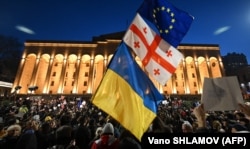
Thousands of demonstrators marched through the Tbilisi on March 8 to protest against government plans to introduce a "foreign agent" law reminiscent of Russian legislation used to silence critics.


Thousands of demonstrators marched through the Tbilisi on March 8 to protest against government plans to introduce a “foreign agent” law reminiscent of Russian legislation used to silence critics.

Zurabishvili’s disobedience of the government orders to stay home — epitomized by a viral Instagram post of her grinning widely on a speeding German train — cemented her popularity among pro-Western Georgians. It represents a remarkable turnaround from when she was elected in 2018, when that same bloc dismissed her as a Georgian Dream puppet. But not long after she was elected, Georgian Dream began to tack in an antidemocratic direction, and she gradually began to push back against the party. And when the government responded timidly to Russia’s 2022 invasion of Ukraine, she spoke forcefully at pro-Ukraine rallies.

During her tenure, her popularity ratings have risen significantly: Early in her time in office, in 2019, 57 percent of respondents in a poll from the U.S.-based National Democratic Institute saw her unfavorably, versus 36 percent who saw her favorably. The same poll, in March of this year, found those numbers had changed to 47 and 48, respectively, making her one of only three Georgian political figures with a net positive favorability rating.

The friendly reception she is receiving in European capitals demonstrates that her star is rising there, as well. And the impeachment proceedings against her will not help Georgia’s case, said Sonja Schiffers, the director of the Tbilisi office of the German-based Heinrich Boell Foundation.

Georgian Dream Chairman Irakli Kobakhidze (second right) has said Zurabishvili was acting in concert with Georgia's political opposition to undermine the government. (file photo)


Georgian Dream Chairman Irakli Kobakhidze (second right) has said Zurabishvili was acting in concert with Georgia’s political opposition to undermine the government. (file photo)

“If you would want to trust that the government acts in good faith and genuinely wants to get candidacy, then it’s quite unbelievable to start this process now,” Schiffers told RFE/RL. “So, I think this is another really big dubious incident after the foreign agent law and it puts the status into question.”

The European Commission, the EU’s executive body, is slated to report on Georgia’s progress in its annual enlargement report, which will also assess Moldova’s and Ukraine’s bids to join the bloc. Then in December, the EU’s 27 member states will vote on whether to advance Georgia’s application.

It remains far from a given how the commission will decide, but pro-European Georgians have been cheered by recent signals coming from Brussels, impeachment drama notwithstanding. European Council President Michel has recently advocated speeding up the enlargement process and has pointedly included Georgia in his remarks.

The EU’s foreign policy chief, Josep Borrell, is visiting Tbilisi on September 7-8 in what appears to be a hastily organized bid to shore up Tbilisi’s chances for advancement. He will meet with Zurabishvili, Gharibashvili, and other officials.

“Borrell’s visit is a clear sign that the European Union is trying, it’s grasping at straws with Georgia, trying to take every opportunity to give Georgia status,” political analyst Khatuna Lagazidze told RFE/RL’s Georgian Service. “Borrell would not come to say no,” she said, but added that the case for a positive decision still needed to be strengthened.

Ahead of the visit, Borrell was asked by Georgian news website Civil.ge about Zurabishvili’s impeachment, and he gave her a clear endorsement: “We appreciate the president’s commitment to European values and her European vision for Georgia. Unity is more important than ever,” he said. The implications for Georgia’s politics will likely be on the mind of policymakers in Brussels as they make their decision. “It’s a tough call, because if you give Georgia candidacy, it’s almost rewarding this government, which is backsliding on democracy. And [the government] can say, ‘See, we got us the invitation.’ But if you don’t give it to them, then they’re going to say, ‘The West doesn’t want us, so there is only Russia,'” said Brian Whitmore, a fellow at the Atlantic Council think tank, in an interview with RFE/RL’s Georgian Service. “There is no good option here.”

While the European Commission should not weigh the Georgian domestic political implications of its decision too heavily, it may seek to use language that minimizes the benefit that the government can extract from a positive decision, Schiffers said. For example, it could say that it is advancing Georgia’s application “despite the lack of implementation” of the reforms.

“I expect that they will be explicit about this,” she said.

Categories
Selected Articles

Azerbaijan assures Iran it does not seek military conflict with Armenia: spokesman


TEHRAN, Sept. 11 (Xinhua) — Iranian Foreign Ministry spokesman Nasser Kanaani said on Monday that Azerbaijan’s officials have sent a message to Tehran stressing that they do not seek to take any military action against Armenia.

Kanaani made the remarks at a weekly press conference in Iran’s capital Tehran, responding to a question about the recent rise in tensions between Azerbaijan and Armenia.

Iran is in constant contact with both sides and is concerned about the possibility of a conflict, Kanaani said.

Kanaani emphasized that Iran is committed to the security of its borders and against any change in the region’s geopolitical conditions and internationally recognized borders, calling for both Azerbaijan and Armenia to respect each other’s territorial integrity and refrain from moves to escalate tensions.

Kanaani’s comments come amid rising tensions between Armenia and Azerbaijan over the mountainous region of Nagorno-Karabakh last week.

Azerbaijan said on Saturday that Armenian forces had fired on its soldiers overnight and that Azerbaijan army units had responded by taking “retaliatory measures.” Armenia denied the incident.

The two countries have been at loggerheads over Nagorno-Karabakh since 1988. They fought a war over the region in the early 1990s, which ended with a ceasefire in 1994.

A new round of armed conflict broke out along the contact line on Sept. 27, 2020, before Russia brokered a ceasefire on Nov. 9, 2020. Enditem

Follow China.org.cn on Twitter and Facebook to join the conversation.
ChinaNews App Download


Categories
Selected Articles

Azerbaijan assures Iran it does not seek military conflict with … – china.org.cn


Azerbaijan assures Iran it does not seek military conflict with …  china.org.cn

Categories
Selected Articles

Azeri disinformation goes ‘beyond all reason’ with false accusations of animal-borne bomb attack, warns Nagorno-Karabakh


Categories
Selected Articles

Kremlin responds to PM Pashinyan, says no plans to leave South Caucasus


Kremlin responds to PM Pashinyan, says no plans to leave South Caucasus
14:50, 5 September 2023

YEREVAN, SEPTEMBER 5, ARMENPRESS. Moscow has responded to Armenian Prime Minister Nikol Pashinyan’s recent statement that Russia itself is leaving the South Caucasus with its actions or inactions.

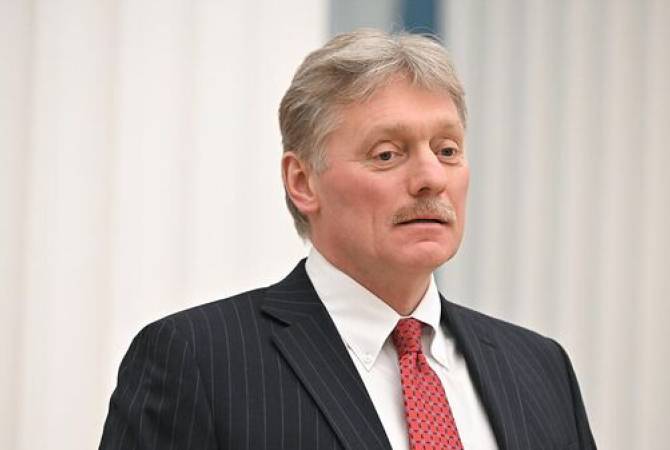
Kremlin spokesperson Dmitry Peskov, reacting to the statement, said that Moscow has no plans to leave the region.

“We have deep respect for Prime Minister Pashinyan, we appreciate the working and very constructive relations between him and President Putin, but we can’t agree with those narratives. Russia doesn’t plan to go anywhere. Russia continues to play a consistent, very important role in stabilizing the situation and ending the conflict. In this context, what matters is the commitment of all regional countries to the trilateral statements on Nagorno-Karabakh. There’ve been new developments that have somewhat changed the situation, but this doesn’t mean that Russia is somehow deviating from its activity,” Peskov told reporters.

Peskov said that more Armenians live in Russia than in Armenia itself. Mentioning Armenia’s participation in integration processes, Peskov said that “Armenia has become the CIS champion with its pace of development.”


Categories
Selected Articles

‘Banned without explanation’: The special prohibitions faced by Azerbaijan’s ‘political prisoners’


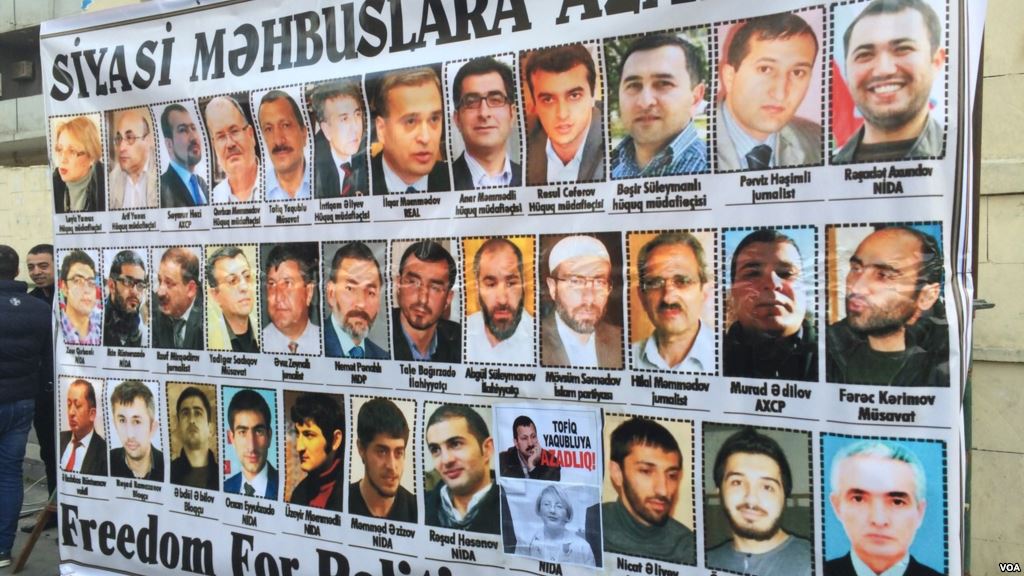
A poster saying ‘Freedom to political prisoners’ (Voice of America)

While Azerbaijan’s authorities deny that there are political prisoners in the country’s prisons at all — local and international rights groups disagree. Many former prisoners and their families complain that those locked up on political grounds face not only an unjust deprivation of their liberty, but special prohibitions such as on reading and speaking with their families.  

According to the Centre for the Protection of Political Prisoners, an Azerbaijani rights group, there are 150 political prisoners being held in Azerbaijan.

International human rights groups such as Amnesty International, Human Rights Watch, and Freedom House, frequently issue harsh statements against the Azerbaijani government over the arrest and detention of journalists, activists, and opposition politicians.

Despite this, the authorities deny the very existence of political prisoners in the country.

A prohibition on reading

Atlas Huseynova says that she constantly brings books to her son in prison, but not all of them are delivered to him.

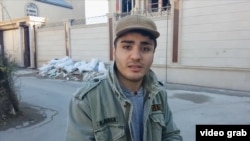
Huseynova’s son, Ilkin Rustamzadeh, has already served more than six years in prison after protesting against deaths in the Azerbaijani army.

Rustamzadeh, a member of the pro-democracy NIDA youth movement, was arrested in 2013 and charged with ‘inciting violence and organising mass disorder’, charges Human Rights Watch called ‘bogus’.

‘Several times we tried to deliver some books [to Rustamzadeh]. Some of them were allowed and some were sent back. Last time they didn’t allow any of them. The books were not political, they were selections from world literature. But they banned them without any explanation’, Huseynova tells OC Media.

Tofig Yagublu an opposition politician from the Musavat Party, was detained on charges of organising riots in Ismayilli in 2013. He was released in a presidential amnesty in 2016.

According to Yagublu, all prisoners in Azerbaijan face restrictions, but control over political prisoners is much stricter.

‘For example, if political books are brought to a criminal or a drug dealer, no restrictions are applied. They only check the books for drugs inside. But when a political prisoner asks for a book, they immediately look at the content and at the name of a book’, Yagublu tells OC Media.

‘The true reason for such restrictions is imposing control. It is a special order by the authorities here.’

Yagublu says that artificial barriers are put in place aiming to keep the prisoners tense.

‘When I was in prison, they did not allow us to buy opposition newspapers. In Kurdakhani prison No 10, seven detainees united and demanded newspapers for a long time. After a while, our complaint was satisfied’, says Yagublu.

‘We were given only one hour for reading, but it was physically impossible to read two newspapers between seven people in an hour’, he says.

Azerbaijani lawyer Fariz Namazli says that there is an official list of books prohibited by law, but according to him, in many cases non-listed books are also banned, something he says is illegal.

Namzali told OC Media that in his own observations, this is usually applied to people detained for political reasons.

A communication ban

Investigative journalist Afgan Mukhtarli was kidnapped in Georgia in May 2017, before showing up a day later in Azerbaijani custody and sentenced to six years in prison accused of smuggling cash, illegal border crossing, and resisting police.

[Read on OC Media: The Afgan Mukhtarli case: an investigation stalled?]

Although by law Mukhtarli has the right to talk to his family every week, his wife, Leyla Mustafayeva, says that recently he has been able to make calls just once a month.

‘At first we could not speak with him for a month. Later, the calls were continuous and every week he called at approximately the same time. But in the last few months, I was able to speak to him only once’, Mustafayeva tells OC Media.

Mustafayeva says her husband is forbidden from reading books at all.

Natig Adilov, chief spokesperson for the opposition Azerbaijan Popular Front Party (APFP), says that three members of the party arrested in May — Babak Hasanov, Agil Ali Muharram, and Ruslan Nasirli — were not able to talk to their families by phone for four months.

‘Every prisoner has the right to talk to their families every four days. Lawyers are appealing, but they are deprived of these rights without any justification’, Adilov tells OC Media.

‘Even prisoners who have committed serious crimes have this opportunity, but not political prisoners. This biased attitude proves that these arrests are politically motivated’, he concludes.

‘Crushed and abandoned’

Ali Hasanov, assistant to the President on social and political affairs, told the media in February that the problems of political prisoners and political pressure were far worse in Western countries.

‘Azerbaijan is a democratic state, and according to the norms of the constitution, the independent activity of the legislative, executive, and judicial authorities is ensured in the country’, he said.

‘Therefore, we do not accept biased statements that diminish the image of the branches of government, certain state bodies on the basis of some “facts”’.

According to Mehman Sadigov, the head of State Penitentiary Service, prison authorities do not deprive any prisoners of their legal rights, and only books  ‘promoting religious and racial extremism and immorality’ are prohibited.

‘All books brought to prisoners by relatives and friends are checked by overseers, and if these books are allowed by law, they are delivered to a prisoner, if not, they are returned’, Sadigov tells OC Media.

‘We do not differentiate political prisoners from other prisoners, moreover, there is no understanding of “political prisoners”. In general, they are all prisoners, and the law is equal for all of them’.

Sadigov said the Penitentiary Service encouraged prisoners to read and enhance their intellectual abilities. For this reason, according to him, prison libraries are constantly being enriched both at the expense of the state and with support from NGOs .

Journalist Rauf Mirgadirov, who spent several years in jail himself on espionage charges, agrees that there are well equipped libraries in Azerbaijani prisons.

‘There are very good libraries in prisons, there are even serious political books’, Mirgadirov tells OC Media.

‘The main purpose of the prohibition against reading for political prisoners or the ban on speaking with families is to shake them psychologically’.

Mirgadirov says that prisoners are unlikely to be able to join the political processes from prison, and the government likely knows this. Instead, he says the goal is to ‘create direct psychological tension. They want intellectuals to feel crushed, abandoned.’

‘Another reason is to create information shortages for political prisoners who are interested in reading’, Mirgadirov adds.


Categories
Selected Articles

#IlhamAliyev – Ilham Aliyev: FREE BLOGGER ELVIN ISAYEV AND OTHER POLITICAL PRISONERS!


#IlhamAliyevIlham Aliyev

FREE BLOGGER ELVIN ISAYEV AND OTHER POLITICAL PRISONERS!

The News And Times Information Network – Blogs By Michael Novakhov – thenewsandtimes.blogspot.com

Categories
Selected Articles

Thousands Rally In Baku Calling For Release Of Political Prisoners


Thousands of demonstrators have taken to the streets of the Azerbaijani capital to call for the release of a jailed anticorruption blogger and other people they consider political prisoners.

The protesters taking part in the sanctioned rally in Baku on January 19 demanded President Ilham Aliyev’s government release Mehman Huseynov and other political prisoners.

Police said some 2,800 people took part in the rally, though opposition organizers said the figure for the number of demonstrators was around 20,000.

The National Council for Democratic Forces, an umbrella group of opposition parties, organized the rally.

Security forces said there were no violent incidents at the event. Police checked participants for weapons before allowing them to attend the demonstration.

Protesters held signs saying “Freedom For Political Prisoners” and “We WIll Win,” among others.

A resolution was adopted at the end of the demonstration calling for all political prisoners to be freed and that activists who were detained on the eve of the protest action also be released.

Rally organizers said about 100 activists had been detained by police ahead of the demonstration, with most of them still being held.

Azerbaijani officials reject the notion that there are political prisoners in the country.

Speakers at the rally also criticized what they called widespread corruption in the state government.

Ilqar Mammadov, the head of the opposition REAL Party who was recently released from prison, said “if Azerbaijan was a true republic then the…serious problems of Azerbaijan would be discussed in the [parliament].”

He also pointed out that Azerbaijan’s neighbors, Georgia and Armenia, had become progressively more democratic than Azerbaijan in recent years.

Calls for Huseynov’s release have intensified inside and outside Azerbaijan since he was targeted with a new charge late last month, just weeks before his expected release from prison.

He is accused of “resisting a representative of the authorities with the use of violence dangerous to [the representative’s] health and life.”

Huseynov himself and several other political prisoners have started hunger strikes in protest.

Mehman Huseynov (file photo)


Mehman Huseynov (file photo)

Huseynov is already serving a two-year prison term on libel charges that he and his supporters considered to be politically motivated. He was originally arrested and charged with slandering a police officer.

Huseynov has also alleged that he has been tortured while in prison.

Rights groups and Western governments have urged the Azerbaijani authorities to release political prisoners for years, and have accused the government of fabricating criminal cases to stifle dissent and media freedom.

Aliyev, who has ruled the oil-producing former Soviet republic of almost 10 million people with an iron fist since shortly before his long-ruling father’s death in 2003, has shrugged off the criticism.


Categories
Selected Articles

US-Armenia Peacekeeping Exercises Underway: Spokesperson


afp-metadata-default.jpg

By AFP – Agence France Presse

September 11, 2023

  • Order Reprints
  • Print Article

Armenia launched joint drills with US peacekeeping forces on Monday, US military officials said, in the latest sign of the ex-Soviet republic’s drift from its traditional ally Russia.

“Exercise Eagle Partner’s opening ceremony has kicked-off” at Zar training centre near Yerevan, involving some 85 US soldiers and 175 Armenian troops, US Army Europe and Africa Spokesperson told AFP, days after Moscow summoned Armenia’s ambassador over the exercises and rising tensions.

mkh-im/jbr/yad

The Barron’s news department was not involved in the creation of the content above. This story was produced by AFP. For more information go to AFP.com.
© Agence France-Presse

Armenia launched joint drills with US peacekeeping forces on Monday, US military officials said, in the latest sign of the ex-Soviet republic’s drift from its traditional ally Russia.

An error has occurred, please try again later.

Thank you

This article has been sent to


Categories
Selected Articles

Blinken: US is deeply concerned about rapidly deteriorating humanitarian situation in Karabakh


default.jpg

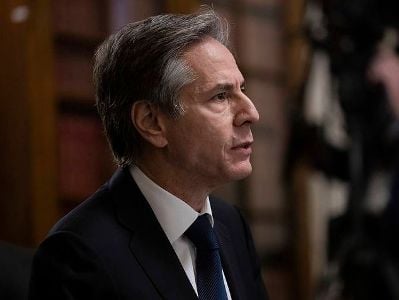
The United States is deeply concerned about the rapidly deteriorating humanitarian situation in Nagorno-Karabakh. This is noted in a press statement by US Secretary of State Antony Blinken.

“We note that humanitarian supplies are positioned near both the Lachin and Aghdam routes, and we repeat our call for the immediate and simultaneous opening of both corridors to allow passage of desperately needed humanitarian supplies to the men, women, and children in Nagorno-Karabakh. We also urge leaders against taking any actions that raise tensions or distract from this goal. The use of force to resolve disputes is unacceptable.

“In light of the recent increase in tensions in the South Caucasus, the United States will continue to strongly support efforts by Armenia and Azerbaijan to resolve outstanding issues through direct dialogue, with the aim of achieving a dignified and enduring peace. We reiterate that any peace agreement between Armenia and Azerbaijan must protect the rights and security of the residents of Nagorno-Karabakh. We also encourage dialogue between Baku and residents of Nagorno-Karabakh.

“The United States further reaffirms the only way forward is peace, dialogue, and the normalization of relations between Armenia and Azerbaijan on the basis of mutual respect for each other’s sovereignty and territorial integrity,” the aforesaid press statement added.

!

This text available in   Հայերեն and Русский

Print