Categories
Selected Articles

Russian defence minister wants action to counter ‘provocations’ from US drones in Black Sea


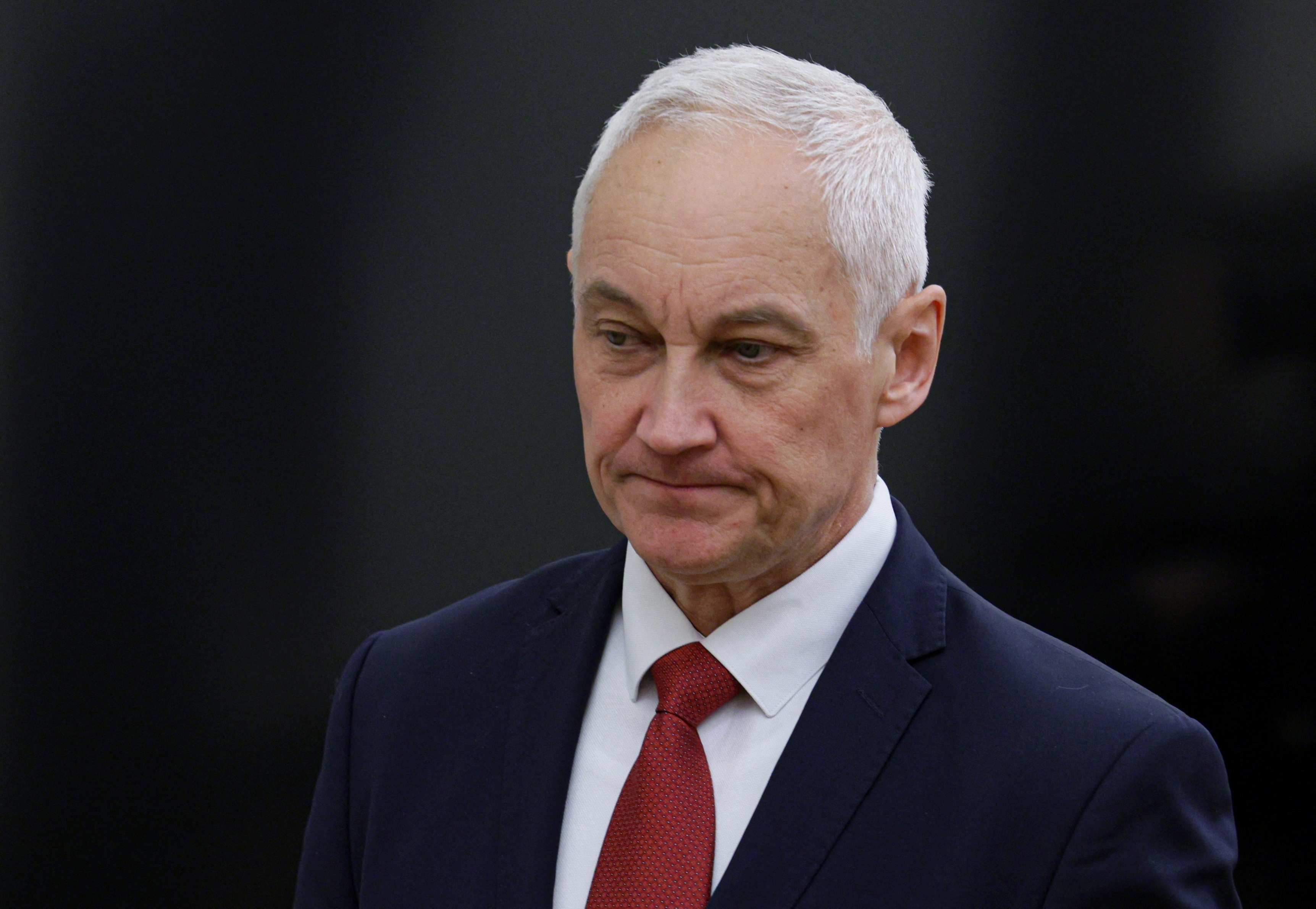
Russian Defence Minister Belousov attends a meeting of Russian President Vladimir Putin with commanders of troops of military districts, in Moscow
Russian Defence Minister Andrei Belousov attends a meeting of Russian President Vladimir Putin with commanders of troops of military districts, in Moscow, Russia May 15, 2024. Sputnik/Gavriil Grigorov/Pool via REUTERS/File Photo Purchase Licensing Rights, opens new tab

MOSCOW, June 28 (Reuters) – Russian Defence Minister Andrei Belousov has ordered the army’s General Staff to come up with proposals on how to promptly deal with “provocations” by U.S. strategic drones operating over the Black Sea, the defence ministry said on Friday.

The ministry said in a statement that it had noted increased activity in the area from U.S. drones which it said were carrying out reconaissance and gathering targeting information for high-precision Western weapons used by Ukraine to strike Russian facilities.

“This demonstrates the increasing involvement of the United States and NATO countries in the conflict in Ukraine on the side of the Kyiv regime,” the defence ministry said.

“Such flights multiply the likelihood of airspace incidents with Russian aircraft, which increases the risk of a direct confrontation between the (NATO) alliance and the Russian Federation.”

It said that NATO countries would be responsible for any such incidents.

The statement did not mention Crimea, the Black Sea region which Moscow annexed from Ukraine in 2014. But Russian military facilities in Crimea have been repeatedly targeted by Ukrainian forces, including with Western missiles.

Sign up here.

Reporting by Reuters
Editing by Andrew Osborn

Our Standards: The Thomson Reuters Trust Principles., opens new tab


Categories
Selected Articles

Nobody won that debate, but Biden lost ground


?url=https%3A%2F%2Fcalifornia-times-brig

WASHINGTON — 

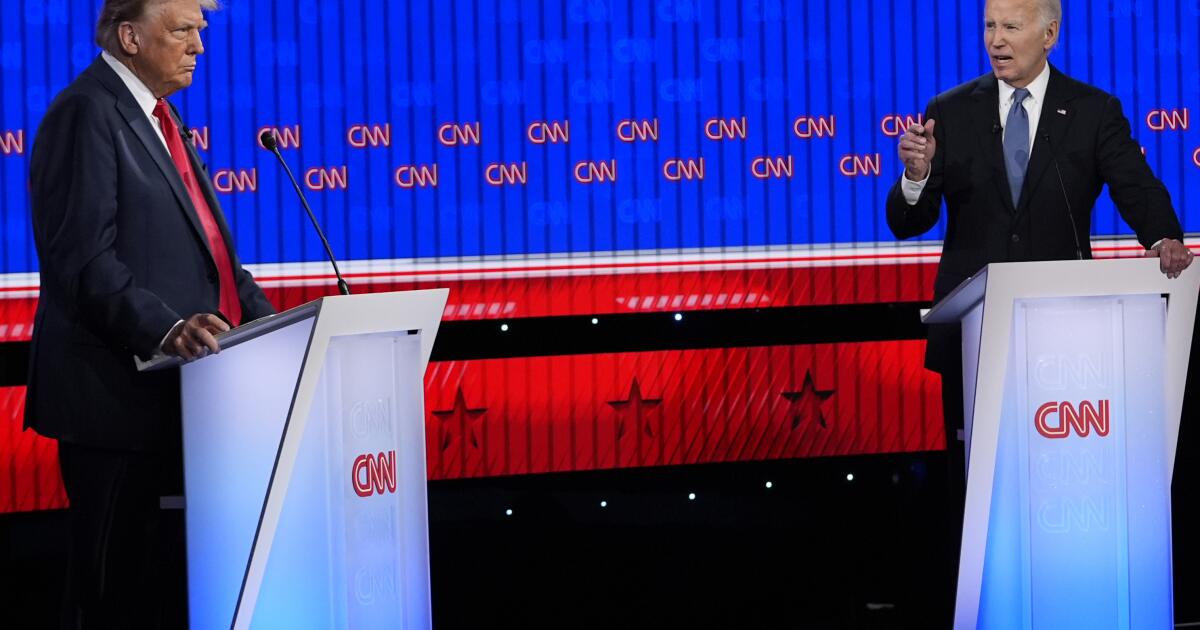
When two flawed presidential candidates, President Biden and former President Trump, met in their high-stakes debate Thursday night, each hoped to pass a test in voters’ eyes. Both failed — but Biden’s stumbles, fairly or not, are likely to cost him more than Trump’s.

Biden needed to quell concerns that he’s too old to serve effectively for another four years. His stumbling, occasionally incoherent performance fell far short. He looked every one of his 81 years — markedly less vigorous and crisp than the commanding figure who delivered an effective State of the Union address about four months ago.

Trump, who is 78, needed to look and sound presidential to appeal to voters who doubt his temperament and his stability. He needed to avoid his self-indulgent temptation to claim that every election he loses was rigged and every legal setback he suffers was politically motivated. He failed, too.

The 90-minute debate was a dispiriting race to the bottom, pitting a tongue-tied octogenarian against a pathological liar. Undecided voters looking for a positive reason to vote for one or the other were unlikely to find enlightenment.

But that doesn’t mean it was a tie. If it had been a boxing match — an apt analogy, given its flurries of verbal punches — a referee would probably have awarded Trump a win on points, for two reasons.

First, Biden came into the debate as the candidate who needed to shake up the campaign. Trump has led recent national polls by a hair, but he is clearly ahead in most of the half-dozen battleground states that will decide the election. Biden hoped to change that, so he needed a win.

Second, while Trump missed an opportunity to appeal to undecided voters and expand his support, he did a more effective job than Biden of presenting his favorite talking points. Many of them were untrue and some were nonsensical, but most went unrebutted by either Biden or CNN’s moderators, who had sworn off fact checking for the evening. That left Trump no worse off than when he started.

A debate’s impact often comes down to a few memorable moments. Many voters didn’t watch at all, and some who tuned in didn’t stay for all 90 minutes. But over the next week or two, some of their worst moments will be played and replayed, magnifying their effect.

A few examples of each candidate’s worst moments may convey the flavor of the evening. (A list of their best moments would be sparse.)

Biden’s voice was hoarse and halting, especially early in the debate. He appeared to lose his train of thought more than once; his voice trailed off at the end of several answers. He ended one tangled explanation of his tax proposals with the puzzling phrase: “if we finally beat Medicare.” After another such moment, Trump seized the opportunity to make sure viewers noticed, saying: “I really don’t know what he said at the end of that sentence. I don’t think he knows what he said, either.”

Trump lied with his customary enthusiasm, reeling off bogus claims he has honed in dozens of stump speeches. He said he produced “the greatest economy in the history of our country” during his term as president, but that isn’t true under any definition of economic success. He claimed Democratic states are routinely killing infants “after birth,” a luridly inaccurate description of late-term abortion. He claimed Biden’s immigration policies have allowed “18, 19, could be 20 million” undocumented migrants into the country, a wild exaggeration, and that the Biden administration is “putting them on Social Security and Medicare.” (It isn’t.)

All those whoppers are familiar to anyone who has sat through any of Trump’s rallies; all have been debunked. But there were too many for Biden to knock down one at a time, so he responded: “Everything he just said was a lie.”

And Trump ducked any question he didn’t want to answer — including whether he will abide by the result of the election. “If it’s a fair and legal and good election, absolutely,” he said — but instantly undercut that semi-pledge by claiming that the 2020 election was riddled with fraud. (It wasn’t.)

There are vast differences between these two candidates on important issues before the country, and voters deserved a debate that illuminated their choice. This was not that debate.

Instead, it was a missed opportunity for both candidates — and one that not only damaged Biden’s chances of shaking Trump’s lead, but was certain to reopen the barely suppressed debate among Democrats over whether they have their best possible nominee.

With four months remaining before election day, the race undoubtedly has more twists and turns to come. But Thursday’s debate was surely a pivotal moment — a setback for Biden that he must now try to repair.

Read more from columnist Doyle McManus on Trump and California:


Categories
Selected Articles

Глава МВД РФ прилетел в Нью-Йорк для участия в саммите ООН – DW – 27.06.2024


Министр внутренних дел РФ Владимир Колокольцев прилетел в Нью-Йорк для участия в IV саммите руководителей органов полиции государств – членов ООН (UNCOPS-2024). Об этом в среду, 26 июня, сообщила пресс-секретарь министерства Ирина Волк. Саммит пройдет 26-27 июня, его цель – обсуждение вопросов по укреплению международной безопасности и сотрудничеству национальных полиций и полиции ООН.

На полях саммита запланированы встречи Колокольцева с заместителем генерального секретаря ООН по миротворческим операциям Жан-Пьером Лакруа, а также двусторонние встречи с некоторыми главами делегаций правоохранительных органов иностранных государств, сообщила Волк. 

Колокольцев: ООН должна дать оценку удару ВСУ по Крыму

В ходе встречи Колокольцев призвал ООН “дать должную оценку” ракетному удару украинских войск по Крыму 23 июня, в результате которого четыре человека погибли и более 140 пострадали. По словам Волк, министр выразил уверенность, что “все ответственные” за эту атаку “понесут неотвратимое наказание”.

Глава МВД России также заявил о попытках некоторых западных государств исключить РФ из Интерпола “в обход всех уставных документов Организации”, он указал на “политизацию существующих международных площадок” и “проявления русофобских настроений в мире”.

Колокольцев подчеркнул, что МВД РФ открыто к сотрудничеству “по всему спектру вопросов миротворческой деятельности”.

Колокольцев находится под санкциями США

Министерство финансов США в 2018 году ввело персональные санкции в отношении Владимира Колокольцева. В связи с полномасштабным вторжением РФ в Украину Колокольцев был включен в еще один санкционный список Минфина США. Согласно американскому законодательству лицам, попавшим под ограничения, запрещен въезд на территорию США.


Categories
Selected Articles

Attempted coup in Bolivia fails after president calls on country to mobilize in defense of democracy


Bolivian President Luis Arce stared down a short-lived attempted coup on Wednesday, after calling on the public to “organize and mobilize” in defense of democracy as soldiers and armored military vehicles withdrew from surrounding government buildings in La Paz.

Bolivia has a long history of political instability, including military coups, and the failed takeover comes as the landlocked South American country of about 12 million people struggles with a spiraling economic crisis that has sparked street protests.

“We cannot allow coup attempts to take Bolivian lives once again,” Arce said from the presidential residence, Casa Grande, as the attempted coup got underway. “We want to urge everyone to defend democracy.”

In dramatic scenes broadcast on Bolivian television, Arce could be seen confronting the former army chief Gen. Juan José Zuniga, who led the coup attempt, as he stormed into the presidential palace hallway.

“I am your captain, and I order you to withdraw your soldiers, and I will not allow this insubordination,” Arce told Zuniga, according to the Associated Press.

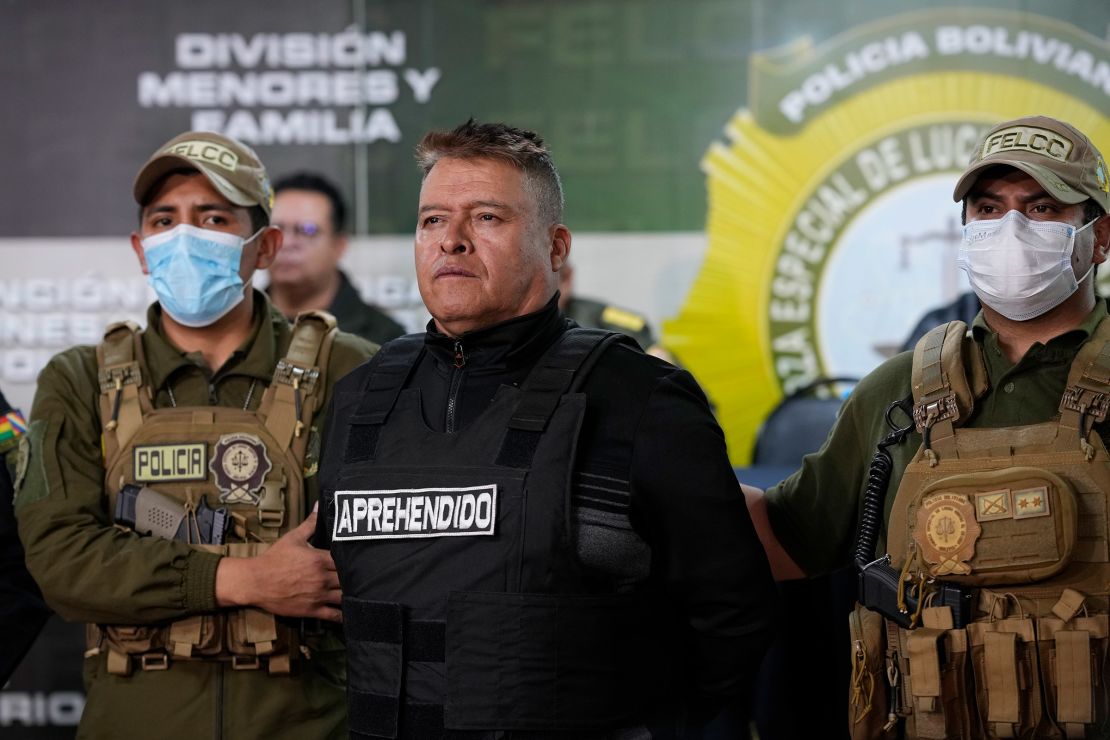
Zuniga, who was dismissed as commander of the Bolivian army just a day earlier, was later detained and seen being forced into a police vehicle, according to local media. His current whereabouts are unknown.

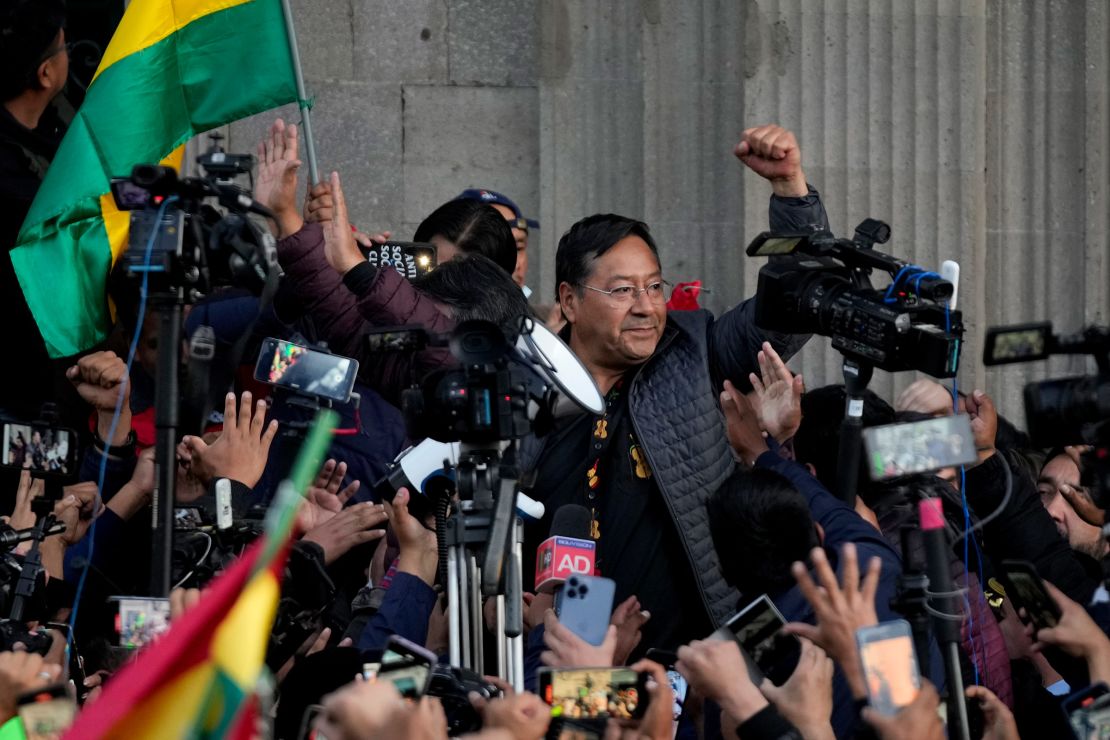
Bolivian President Luis Arce raises a clenched fist, surrounded by supporters and media, outside the government palace in La Paz, Bolivia, on June 26, 2024.

Late Wednesday, Bolivian Defense Minister Edmundo Novillo told a news conference the armed forces were “under control.”

“We now have total and absolute control over our armed forces. Everything is under control now. We urge the population that everything goes back to normal,” he said, according to state-run Bolivia TV.

The attempted coup was widely condemned by the Bolivian government and international leaders. Bolivia’s Attorney General’s Office said it has launched a criminal investigation against Zuniga and “all the other participants” involved in the incident.

Bolivia’s latest political showdown comes as tensions rise over plans by leftist former president Evo Morales to run for reelection against one-time ally Arce in general elections next year.

Meanwhile, the country is contending with an economic crisis marked by dwindling foreign currency reserves, particularly the US dollar, and shortages of fuel and other basic necessities.

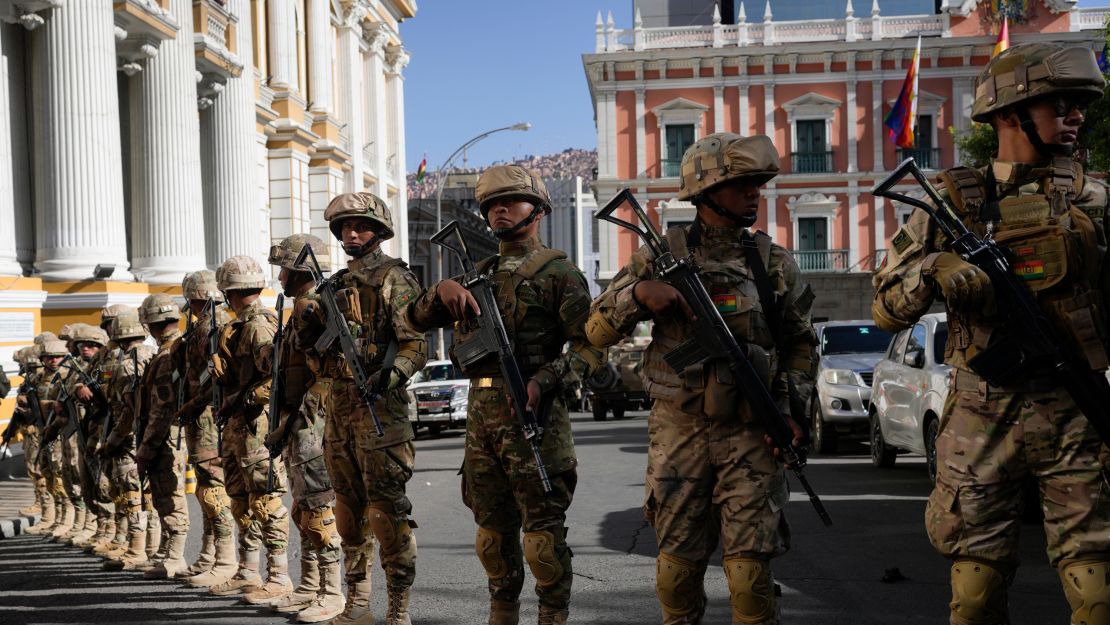
Earlier Wednesday, footage from the scene showed armed soldiers occupying Murillo Plaza, a main square in La Paz where the national executive and legislative offices are located.

Armored vehicles were seen ramming into the doors of Bolivia’s government palace, according to the Associated Press, as former president Morales, who is a member of Arce’s Movement to Socialism (MAS) party, said on X that a “coup d’état is brewing.”

Video also showed some civilians facing off with soldiers in Murillo Plaza during the coup attempt.

Bolivian police hold the detained Juan Jose Zuniga, former general commander of the army, in La Paz, Bolivia, on June 26, 2024.

Prior to his detention, former army chief Zuniga addressed reporters in the square on Wednesday, flanked by soldiers, saying, “We want to restore democracy,” as he spoke of the country’s economic woes. He had earlier been dismissed reportedly for threatening to block a bid by Morales for reelection.

“The people have no future, and the army has the courage to look out for the future of our children, the well-being and progress of our people,” he said.

He vowed “to free all political prisoners” including former president Jeanine Anez, currently imprisoned for what the courts said was her role in deadly protests that erupted after her ascension to power in 2019.

Amid the chaos, President Arce announced new military commanders, including Zuniga’s replacement as army chief, Gen. José Sánchez.

The situation appeared to have been defused when Sánchez ordered the soldiers in the square to return to their units.

“I order all personnel mobilized in the street to return to their units,” Sanchez said from a podium at the presidential palace to cheers and applause.

Armed vehicles were seen leaving Murillo Plaza soon after, according to footage from Bolivia TV. Arce also announced new heads of the navy and the air force.

CNN is trying to contact Bolivia’s government for comment.

Morales, who publicly split from his former ally Arce, resigned as president in 2019 following mounting protests over accusations of election fraud; at the time, he claimed he was forced out in a coup.

Before his dismissal, former army chief Zuniga had reportedly said Morales should not be able to return as president, and threatened to block him if it happened.

Gustavo A. Flores-Macías, professor of government and public policy at Cornell University, told CNN the attempted coup reflects widespread discontentment in the country.

“What is happening in Bolivia is that broad sectors of society, across social strata, across all levels, are very unhappy with the way things are, especially on the economic front. And, we have an election coming in 2025,” he said.

In that election, Arce and Morales “seemed to be in this collision course. Both of them angling to become the next president,” he added.

Soldiers block the street in front of the presidential palace, right, and the Legislative Assembly, left, in Plaza Murillo in La Paz, Bolivia, on June 26, 2024.

Bolivia’s Attorney General’s Office launched a criminal investigation against Zuniga later on Wednesday, with the Prosecutor’s Office saying on X that “all the other participants” involved in Wednesday’s events in La Paz would also be investigated.

The Attorney General’s Office said it will make “all the necessary efforts” to identify all persons involved and further investigate the attempted coup and impose the “maximum punishment on those responsible.”

Fredy Mamani, former deputy foreign minister of Bolivia and ally of Morales and Arce, told CNN that despite the “undemocratic” nature of “the tanks, the uniformed soldiers and taking the square… it is essential to highlight that the Bolivian people are united in the face of any coup d’etat.”

News of the attempted coup was roundly condemned by international and regional leaders, including Paraguay’s President Santiago Peña, Mexico’s president, and the European Union.

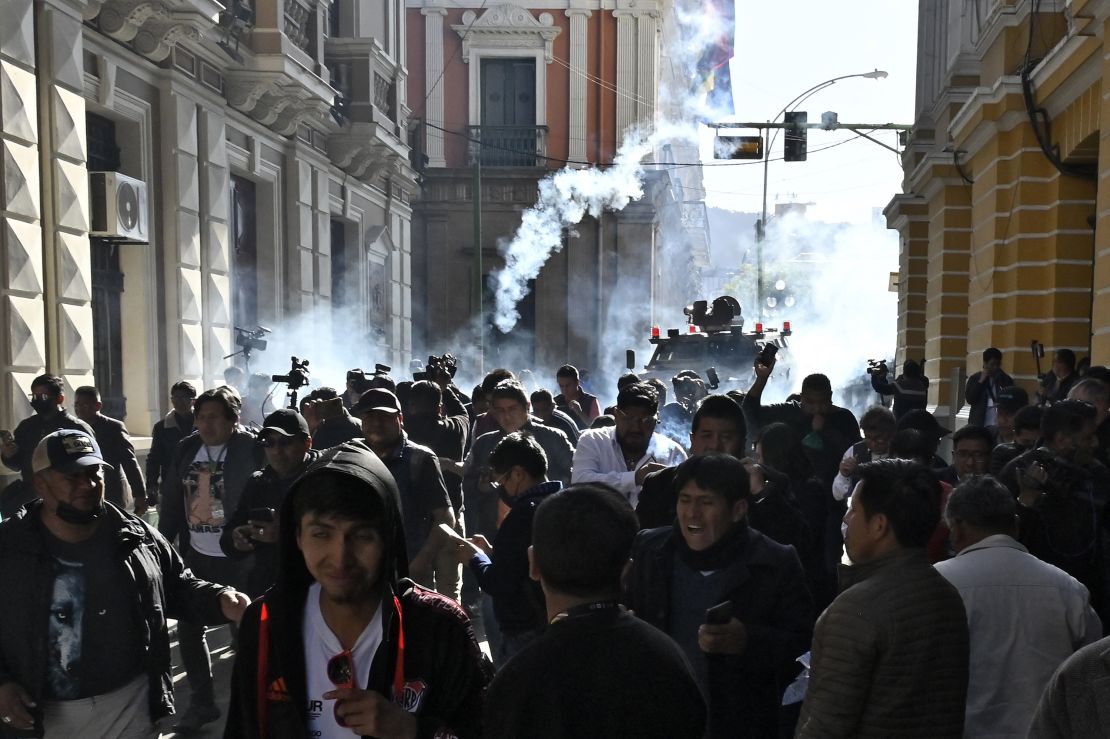
Military troops fire tear gas at people outside the Quemado Palace at the Plaza Murillo in La Paz on June 26, 2024.

“We express our support for democracy in our brother country and to the legitimate government of Luis Arce,” Chile’s President Gabriel Boric said on X.

The US Embassy in La Plaz said it was “closely monitoring the situation.”

“We reject any attempt to overthrow the elected government and ask for respect for the constitutional order,” an embassy statement said on X.

The secretary general of the pan-American Organization of American States (OAS), Luis Almagro, condemned the mobilizations in the “most energetic way,” on X, saying the “army must submit to the legitimately elected civil power.”

The EU said it opposed “any attempt to disrupt the constitutional order in Bolivia and overthrow democratically elected governments,” adding it stands in solidarity with the Bolivian government and its people, according to a post from European policy chief Josep Borrell on X.

This story has been updated with additional developments.


Categories
Selected Articles

Coup attempt in Bolivia fails as president urges people to mobilize against democracy threat


LA PAZ, Bolivia (AP) — Armored vehicles rammed the doors of Bolivia’s government palace Wednesday in an apparent coup attempt against President Luis Arce, but he vowed to stand firm and named a new army commander who ordered troops to stand down.

The soldiers later pulled back as supporters of Arce waved Bolivian flags and cheered in a central square.

In a video of Arce surrounded by ministers in the palace, the Bolivian leader said: “Here we are, firm in Casa Grande, to confront any coup attempt. We need the Bolivian people to organize.”

Image

Military Police gather outside the main entrance as an armored vehicle rams into the door of the presidential palace in Plaza Murillo in La Paz, Bolivia, Wednesday, June 26, 2024. (AP Photo/Juan Karita)

Arce confronted the general commander of the army — Juan José Zúñiga, who appeared to be leading the rebellion — in the palace hallway, as shown on video on Bolivian television. “I am your captain, and I order you to withdraw your soldiers, and I will not allow this insubordination,” Arce said.

Before entering the government building, Zúñiga told journalists in the plaza: “Surely soon there will be a new Cabinet of ministers; our country, our state cannot go on like this.” But, he said, “for now” he recognizes Arce as commander in chief.

Image

FILE – Bolivian President Luis Arce attends an Indigenous ritual before delivering his annual state of the nation address at the presidential palace in La Paz, Bolivia, Jan. 22, 2024. Armored vehicles rammed into the doors of Bolivia’s government palace Wednesday, June 26, 2024, as a top government official warned of a coup attempt. (AP Photo/Juan Karita, File)

Zúñiga did not explicitly say he’s leading a coup, but in the palace, with bangs echoing behind him, he said the army was trying to “restore democracy and free our political prisoners.”

In a message on his X account, Arce called for “democracy to be respected.” It came as Bolivian television showed two tanks and a number of men in military uniform in front of the government palace.

“We cannot allow, once again, coup attempts to take the lives of Bolivians,” he said from inside the palace, surrounded by government officials, in a video message sent to news outlets.

An hour later, Arce announced new heads of the army, navy and air force amid the roar of supporters. Video showed troops setting up blockades outside the government palace.

“I order all that are mobilized to return to their units, said the newly named army chief José Wilson Sánchez. “No one wants the images we’re seeing in the streets.”

Soon after troops and armored vehicles start pulling back from Bolivia’s presidential palace.

The leadership of Bolivia’s largest labor union condemned the action and declared an indefinite strike of social and labor organizations in La Paz in defense of the government.

The incident was met with a wave of outrage by other regional leaders, including the Organization of American States; Gabriel Boric, the president of neighboring Chile; the leader of Honduras, and former Bolivian leaders.

Bolivia, a country of 12 million people, has seen intensifying protests in recent months over the economy’s precipitous decline from one of the continent’s fastest-growing two decades ago to one of its most crisis-stricken.

The country also has seen a high-profile rift at the highest levels of the governing party. Arce and his one-time ally, leftist icon and former President Evo Morales, have been battling for the future of Bolivia’s splintering Movement for Socialism, known by its Spanish acronym MAS, ahead of elections in 2025.


Categories
Selected Articles

Putin dealt a double blow in Europe


Two international bodies have on the same day accused Russia of carrying out war crimes and human rights violations in Ukraine.

The International Criminal Court (ICC) pretrial Chamber said on Tuesday it had issued arrest warrants for former Russian Defense Minister Sergei Shoigu and Chief of the Russian Army General Valery Gerasimov for “the war crime of directing attacks at civilian objects” in Ukraine.

On the same day, the European Court of Human Rights (ECHR) Grand Chamber said Moscow had committed human rights violations in Crimea in the decade since the beginning of its illegal occupation of the peninsula in February 2014.

Meanwhile, a lawyer for an international human rights group whose report this month outlined how Putin’s forces had employed starvation tactics during the siege of the southern city of Mariupol in 2022, told Newsweek that “food and objects indispensable to survival are being weaponized across the conflict” by Russia.

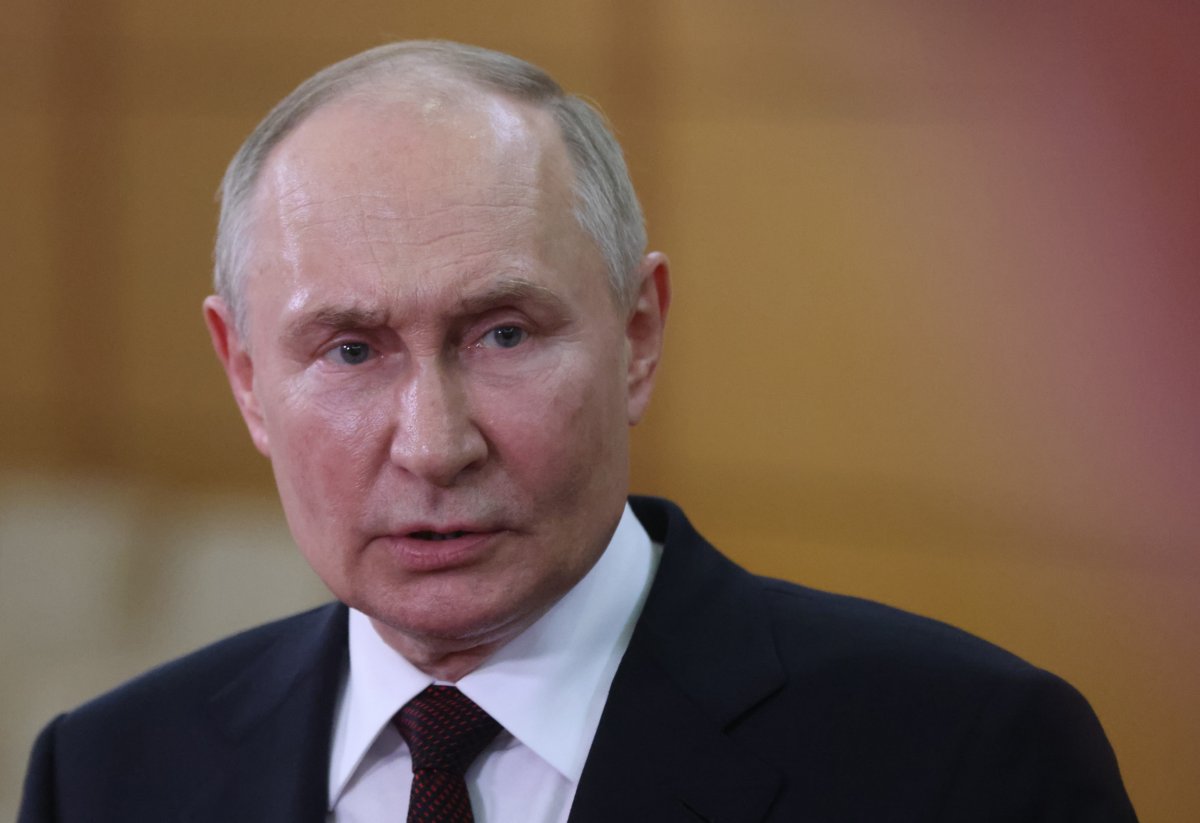
Russian president Vladimir Putin

Russian president Vladimir Putin on June 20, 2024, in Moscow. On June 25, 2024, two international bodies accused Russia of human rights violations and war crimes in Ukraine.
Getty Images

In its statement released Tuesday, ICC judges said there were grounds that the suspects were responsible for missile strikes carried out against the Ukrainian electric infrastructure “from at least 10 October 2022 until at least 9 March 2023.”

Newsweek has contacted the Kremlin and the Russian defense ministry for comment on the decisions by both bodies. Russia’s Security Council, which Shoigu now heads, called the ICC arrest warrants “hot air” since the court’s jurisdiction did not cover Russia and “part of the West’s hybrid war” against Russia.

The ICC report was damning in its criticism of Shoigu and Gerasimov, accusing them of causing incidental harm to civilians and damage to civilian objects and inhumane acts.

These are violations of the Rome Statute that established the court in the Hague that relies on its 124 members to arrest anyone under a warrant.

It is the latest war crimes accusation linked to Putin and his inner circle. In March, 2023, the ICC issued an arrest warrant for Putin over the alleged abduction of children from Ukraine, a claim which Moscow has dismissed.

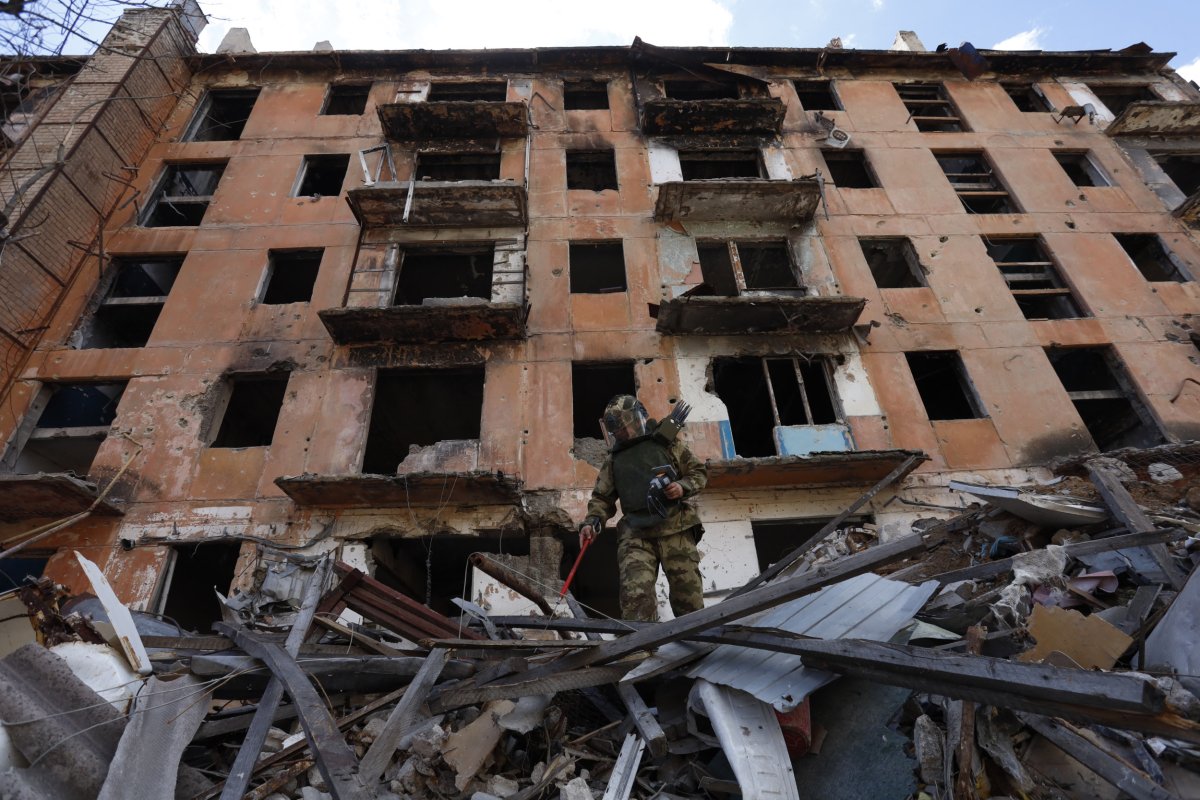
Mariupol, Ukraine

A Russian sapper checks a ruined building in Mariupol, in Russian-controlled Ukraine. A report in June says Russian forces employed starvation tactics in their 2022 siege of the southern port city.
Getty Images

Siege of Mariupol

This month, the group Global Rights Compliance (GRC) released a report which it said proved that Russian forces had starved Ukrainians in the southern city of Mariupol in the siege that lasted until May 20, 2022.

Drawing on satellite imagery, pictures, videos, public statements and digital data, the group concluded that Russian forces had targeted water, food and medical supplies in a deliberate tactic of starvation before they seized the port city.

It found that 450,000 civilians were targeted with all water, electricity and gas supply cut off. Ukrainians were forced to drink from puddles, radiator batteries, and melted snow, while food distribution points, medical facilities and humanitarian corridors were bombed.

“What is the most shocking is the findings showed the strategy Russian forces pursued in starving the civilian population as a means to accelerate the capitulation of Mariupol,” said Naomi Prodeau, report’s co-author and lawyer on the GRC’s starvation mobile justice team.

“Attacks on civilian populations, attacks on civilian objects, attacks on hospitals—some of those constitute attacks on objects indispensable to the survival of civilians,” she told Newsweek.

She said that such tactics were employed in other sieges by pro-Russian forces prior to Mariupol, such as in Aleppo, where Moscow intervened in the Syrian civil war, “so there were prior instances of these tactics before Mariupol.”

“There are strong indicators that Russian and pro-Russian forces employed similar siege tactics and starvation tactics in northeastern regions at approximately the same time as the siege of Mariupol,” she said. “It demonstrates that this is a tactic that is regularly employed and deployed against Ukrainian civilians.”

“Food and objects indispensable to survival are being weaponized across the conflict beyond siege tactics,” she added.

The ECHR Grand Chamber said on Tuesday that since 2014 when Putin seized Crimea, Russia had committed human rights violations on the peninsula, including the ill-treatment of Ukrainian soldiers, persons of Ukrainian ethnic origin, journalists and members of the Turkic Crimean Tatar minority.

After its full scale invasion in 2022, Russia was expelled from the Council of Europe, of which the ECHR is part and its ruling was welcomed by the Ukrainian foreign ministry which called it a “crucial milestone.”

Meanwhile, the GRC is taking its evidence to the ICC Office of the Prosecutor of the International Criminal Court to build a larger war crimes case against Putin.

Prodeau said that similar to genocide, the crime of starvation requires a specific intent to attack objects indispensable to civilian survival, and specific intent to starve that population, “which is a higher bar.”

“Under that standard, if Russian or pro-Russian forces knew that in the ordinary course of events, civilians would starve, that qualifies as intent,” she said. “There has never been a prosecution for the war crime of starvation before international courts,” she said, “it’s an underappreciated crime and is hard to prove.”

Correction: 6/26/24, 9 a.m. ET: This article was updated to correct the date of the end of the siege of Mariupol to May 20, 2022.

Newsweek is committed to challenging conventional wisdom and finding connections in the search for common ground.

Newsweek is committed to challenging conventional wisdom and finding connections in the search for common ground.


Categories
Selected Articles

Is Putin’s Ukraine obsession distracting from a rising threat at home?


It’s the same narrative that was used just a few months ago when armed militants killed 145 people at the Crocus City Hall concert venue near Moscow, even though an affiliate of the Islamic State claimed responsibility.

Instead of investigating how Russia’s intelligence services could have missed an attack of such significance, Moscow immediately accused Kyiv and its Western allies of helping to orchestrate it. Such accusations reinforce the Kremlin’s public narrative that the West is the biggest existential threat to the security of ordinary Russians.

But two major terrorist attacks happening so close together “will raise questions about whether the war in Ukraine has distracted the Kremlin from what is happening inside Russia,” said Neil Melvin, the director of international security studies at the Royal United Services Institute, a London-based think tank.

Melvin added that the re-emergence of violence in Dagestan this week is a threat to regional stability in the North Caucasus and to Putin’s claim to have restored order there.

The Kremlin did not always try that hard to quash narratives around violent Islamism.

Dagestan is a predominantly Muslim region of Russia in the North Caucasus. Extremist violence increased there in the early 2000s in the wake of two wars waged by Russian forces in neighboring Chechnya. Those conflicts allowed Putin to claim to have brought peace and stability to the turbulent region and burnish his image as Russia’s guarantor of security.

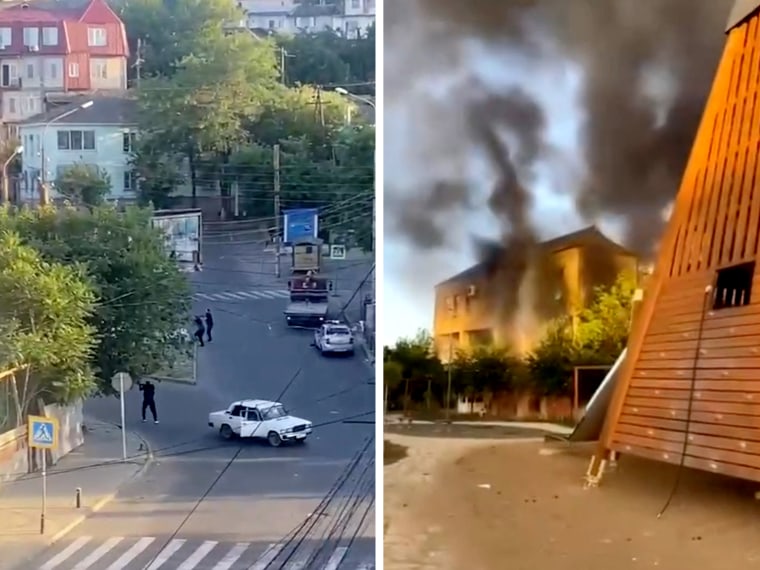
The street of Makhachkala in southern Russia and plumes of smoke rising from a building in Derbent, Russia, on Monday.The street of Makhachkala in southern Russia and plumes of smoke rising from a building in Derbent, Russia, on Monday.Reuters

But more recently, Dagestan — like other ethnic minority regions — has borne the brunt of Putin’s sometimes unpopular efforts to mobilize men for the Ukraine war. The region also made headlines in October when an anti-Israeli mob stormed the airport in the Dagestan capital of Makhachkala after a passenger flight arrived from Israel just weeks after the Oct. 7 attack. 

In the past, the Kremlin has blamed “international terrorism” and “jihadism” for fresh outbreaks of violence in Russia’s Caucasus, bringing it in line with Western countries facing similar threats, said Michael Clarke, a visiting professor of war studies at King’s College London. “But since 2022, the Kremlin has worked hard to imply that these attacks are somehow inspired from outside and more specifically that they lead back to Kyiv, however tenuously,” he said. 

On Monday, Dagestan Gov. Sergei Melikov suggested authorities knew who was behind the attacks and what their goals were, but he stopped short of naming any perpetrators, mentioning only what he said were internationally controlled “sleeper cells.” 

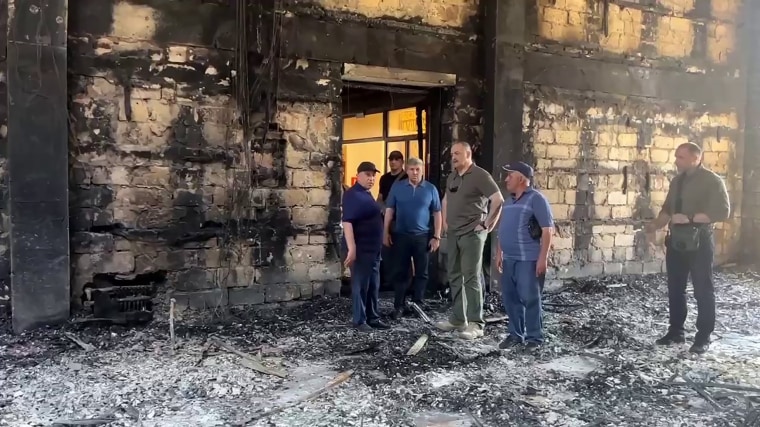
Russia Dagestan AttacksOfficials inside a burned-out synagogue in Derbent, Dagestan, on Tuesday.AFP – Getty Images

Opaque and mixed messaging has also been a feature of official responses to previous terrorist attacks on Russian soil.

Days after the Crocus City Hall attack in March, Putin said it was carried out by “radical Islamists” but questioned who directed them. Two weeks after that, he said Russia could not have been targeted by “Islamic fundamentalists” because it’s a “unique example of interfaith agreement and unity.”

The denial may have meant “the security services’ distraction by the war in Ukraine was not amended after the Crocus City Hall attack,” said Harold Chambers, a political analyst specializing in Russia at Indiana University Bloomington. 

Notably, after Sunday’s attack, Russian state media reported that a local official, Magomed Omarov, had been relieved of his post and expelled from the ruling United Russia party. Those reports claimed that Omarov’s son and nephew took part in the attacks. The allegations, if true, will raise uncomfortable questions for the Kremlin. 

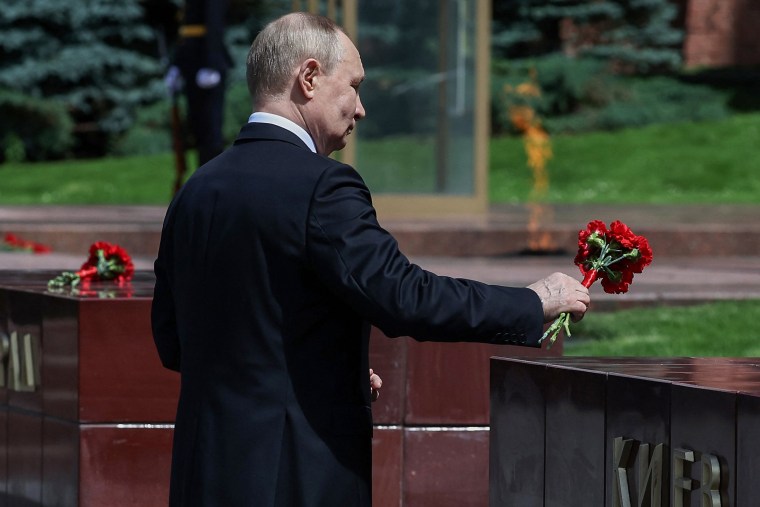
Putin Wreath Laying CeremonyPutin during a wreath laying ceremony in the Alexandrovsky Garden in Moscow earlier this month. Alexander Kazakov / AFP – Getty Images

“The higher status of the most recent Dagestan militants indicates that the counterterrorism landscape in the North Caucasus has shifted significantly,” Chambers said.

State Department spokesperson Matthew Miller told reporters Monday he did not have any assessment of who perpetrated the attack. Three U.S. officials told NBC News that no branch of ISIS has publicly taken credit for the attack but that other local extremist groups may be responsible.

Telegram channels associated with the ISIS affiliate group that carried out the attack at Crocus praised Sunday’s attack by “our brothers from the Caucasus,” but they did not claim responsibility.

The Washington-based Institute for the Study of War argued that the Islamic State group’s North Caucasus branch, Vilayat Kavkaz, likely was behind the attack, describing it as “complex and coordinated.”


Categories
Selected Articles

Biden pardons potentially thousands of ex-service members convicted under now-repealed gay sex ban


?url=https%3A%2F%2Fassets.apnews.com%2Ff

WASHINGTON (AP) — President Joe Biden pardoned potentially thousands of former U.S. service members convicted of violating a now-repealed military ban on consensual gay sex, saying Wednesday that he is “righting an historic wrong” to clear the way for them to regain lost benefits.

Biden’s action grants a pardon to service members who were convicted under the Uniform Code of Military Justice’s former Article 125, which criminalized sodomy. The law, which has been on the books since 1951, was rewritten in 2013 to prohibit only forcible acts.

Those covered by the pardon will be able to apply to receive proof that their conviction has been erased, petition to have their discharges from the military upgraded and move to recover lost pay and benefits.

“Today, I am righting an historic wrong by using my clemency authority to pardon many former service members who were convicted simply for being themselves,” Biden said in a statement. “We have a sacred obligation to all of our service members –- including our brave LGBTQI+ service members: to properly prepare and equip them when they are sent into harm’s way, and to care for them and their families when they return home. Today we are making progress in that pursuit.”

The president’s use of his pardon powers is occurring during Pride Month and his action comes just days before he is set to hold a high-profile fundraiser with LGBTQ donors in New York on Friday. Biden is trying to rally support within the Democratic-leaning community ahead of the presidential election.

Administration officials declined to say why Biden did not act on the pardons sooner.

This is the third categorial pardon by Biden — using his clemency powers to cover a broad group of people convicted of particular crimes — after moves in 2022 and 2023 to pardon those convicted federally for possessing marijuana.

The White House estimates that several thousand service members will be covered — the majority convicted before the military instituted the “Don’t Ask, Don’t Tell” policy in 1993 that eased the way for LGBTQ troops to serve if they didn’t disclose their sexual orientation. That policy was repealed in 2011, when Congress allowed for their open service in the military.

Service members convicted of nonconsensual acts are not covered by Biden’s pardon action. And those convicted under other articles of the military justice code, which may have been used as pretext to punish or force-out LGBTQ troops, would need to request clemency through the normal Department of Justice pardon process.

Biden had previously ordered the Department of Veterans Affairs to move to provide benefits to service members who were other than honorably discharged because of their sexual orientation, gender identity or HIV status.


Categories
Selected Articles

Biden pardons potentially thousands of ex-service members convicted under now-repealed gay sex ban – The Associated Press


Biden pardons potentially thousands of ex-service members convicted under now-repealed gay sex ban  The Associated Press

Categories
Selected Articles

US journalist Evan Gershkovich appears in Russian court for start of spy trial – The Times of Israel


US journalist Evan Gershkovich appears in Russian court for start of spy trial  The Times of Israel