posted at 21:00:10 UTC via news.am
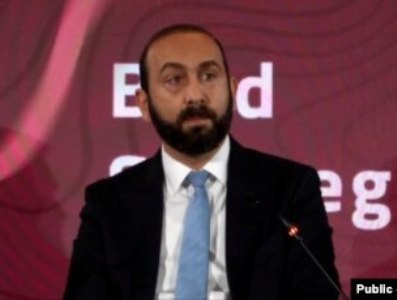
Tension persists on the Armenian-Azerbaijani border and on the Artsakh contact line, Armenian Foreign Minister Ararat Mirzoyan told news outlet “Azatutyun.”
“Basically, we have always said that in case of such unpredictable behavior from Azerbaijan, tension should always be expected, both in Nagorno-Karabakh and on the borders of the Republic of Armenia,” Mirzoyan emphasized, continuing. “We have seen several invasions into the territory of the Republic of Armenia […] and the occupation of the territories of Armenia, and also constant threats, hate speech, also towards Nagorno Karabakh, brought the population of Nagorno Karabakh to the brink of a humanitarian disaster, and yes, we always expect tension.
Now you are wondering what we are doing. We are actively working with international partners, I’m sure you are keeping track of everything, you see statements, calls and, of course, legal decisions of the International Court. We must continue to work like this until Azerbaijan enters the constructive field, because we want peace, and we want long-term peace. We want recognition of territorial integrity, but at the same time a mutual recognition, since you know that Azerbaijan must recognize our borders, there is such an agreement, but so far the President of Azerbaijan refuses to make public statements on this matter […],” Mirzoyan said.
When asked whether the main, fundamental differences remain after Yerevan and Baku again exchanged options for a peace treaty, he replied: “Differences remain. Of course, it would be wrong to say that there is no progress from edition to edition, the text is being polished, I once said that all points are important, but nevertheless, the text can be conditionally divided into vitally important and not so vitally important points. But, of course, there are still fundamental disagreements on the most vital, most significant issues. We must continue to negotiate, continue to work.”
Regarding the introduction of an international mechanism into the Baku-Stepanakert dialogue, the head of the RA Foreign Ministry said, “We are confident that all issues related to Nagorno-Karabakh should be discussed between representatives of Nagorno-Karabakh and official Baku, and everyone else in the world can only play the role of facilitators. Why an international mechanism? We think that even if this dialogue begins between official Baku and Stepanakert, still, left alone in the same room, Baku will try to conduct this conversation in the form of an ultimatum, dictate demands and conditions. I don’t think there will be a big, real and sincere dialogue if there is no international presence, and even I may doubt the continuity of these meetings and dialogue. And this is where some kind of international mechanism is needed.”
When asked whether this international mechanism is a “red line” for Yerevan, the FM replied, “Principles are a red line. We want real solutions to be given to real problems, and we are confident that a dialogue is the best way to do this. Why under international auspices? To make dialogue more effective, that’s all. The red lines are the final results.”
Regarding the map, according to Ararat Mirzoyan, “a dialogue is taking place that did not exist before, in an atmosphere of greater mutual understanding.” “We see positive signals, at the same time I want to say again that not only are the exchange of ideas and specific agreements not being implemented, but the leadership of Azerbaijan is either changing its mind or is currently playing some kind of a diplomatic game,” he concluded.
posted at 20:58:01 UTC via armenpress.am
 11:33, 17 September 2023
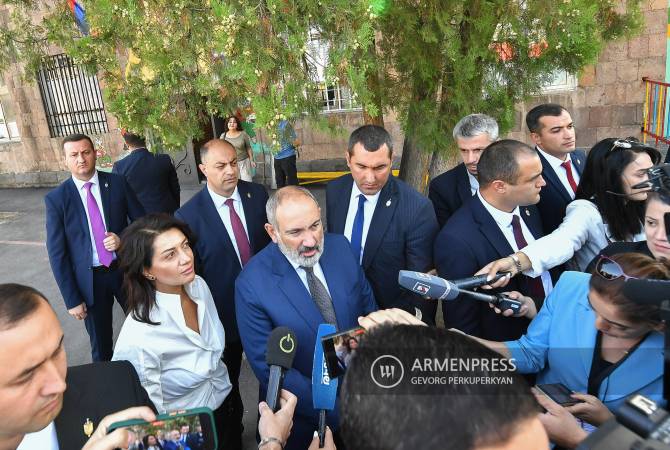
YEREVAN, SEPTEMBER 17, ARMENPRESS. Prime Minister Nikol Pashinyan on Sunday said he was unsure that Azerbaijan actually has the political will to start direct dialogue with Stepanakert despite Baku’s public statements.
Asked on the possible launch of an international mechanism for dialogue between Stepanakert and Baku, Pashinyan said that international colleagues are intensively working in this direction.
“First of all, this is the reason that I continue to urge our colleagues in Stepanakert, and also have hope, that they will be involved in that dialogue. Of course, my call is addressed also to Baku, because that dialogue won’t take place if one of the parties doesn’t want it. And unfortunately, it’s not like we can see that desire being fully expressed by Baku,” Pashinyan told reporters.
He noted that Baku, nevertheless, has expressed that desire on the official level. However, several meetings that had been planned eventually failed to take place. “I am not sure that Baku, aside from public statements, actually has real political will to carry out that dialogue,” PM Pashinyan said.
posted at 20:56:58 UTC via rferl.org
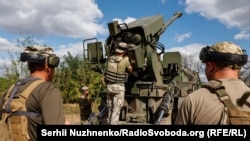
Ukrainian soldiers prepare to fire from the 2C22 Bohdan self-propelled howitzer toward Russian positions in eastern Ukraine.
Kyiv said it was continuing offensive operations against Russian forces in the east and south as alarms sounded throughout Ukraine on September 16, while Ukrainian President Volodymyr Zelenskiy thanked Western and other allies for helping to make “significant progress” with “defense agreements and other support packages” for his embattled nation.
Meanwhile, Russia rejected Ukrainian claims of retaking a strategic village in the Donetsk region as its full-scale invasion of Ukraine approached its 20th month, while the Kremlin also said defense forces had shot down two drones outside Moscow overnight.
Separately, Washington confirmed plans for potentially crucial support-building meetings next week between Ukraine’s visiting president and U.S. political leaders.
RFE/RL’s Live Briefing gives you all of the latest developments on Russia’s full-scale invasion, Kyiv’s counteroffensive, Western military aid, global reaction, and the plight of civilians. For all of RFE/RL’s coverage of the war in Ukraine, click here.
Around midday, air alerts sounded in a number of regions of Ukraine as the country’s military warned of the threat of ballistic attacks on population centers.
The alarms blared in the capital, Kyiv, as well as in the Chernihiv, Cherkasy, Poltava, Kharkiv, Dnipropetrovsk, Mykolayiv, and Zaporizhzhya, and Odesa regions.
A series of blasts was reported in the Kharkiv region, although information on possible casualties or damages was initially unavailable.
The Ukrainian General Staff said on September 16 that its forces were conducting defensive operations in eastern and southern Ukraine and offensive operations around Melitopol and Bakhmut.
It claimed “success” in the Klishchiyevka area of the Donetsk region.
Ukrainian Digital Transformation Minister Mykhaylo Fedorov, who has participated in building up his country’s advanced fighting abilities, warned Moscow’s military that following recent attacks on Russian naval targets in the Black Sea, “There will be more drones, more attacks, and fewer Russian ships. That’s for sure.”
Governor Roman Starovoit of Russia’s Kursk region said on Telegram on September 16 that Ukrainian forces shelled a village in Russia’s Kursk region, killing a 30-year-old civilian.
He also said that 17 Ukrainian projectiles had struck a village in the Korenevsky District of the Kursk region, causing damage but no injuries.
The Ukrainian side routinely avoids commenting on the increasing number of attacks inside Russian territory by unmanned aerial vehicles.
Russian media outlet RBC said in late August that it had tallied more than 500 claims by Russian authorities of drone attacks inside Russia since the full-scale invasion of Ukraine began 18 months ago. In 110 cases, casualties or damage were reported.
Russia’s Defense Ministry also rejected the Ukrainian military’s claim from earlier in the week that Kyiv’s forces had recaptured the village of Andriyivka, near Bakhmut in the Donetsk region, where a Russian-backed separatist group called the Donetsk People’s Republic operates.
“The enemy did not abandon plans to capture the city of Artyomovsk of the Donetsk People’s Republic and continued to conduct assault operations…unsuccessfully trying to oust Russian troops from the population centers of Klishchiyivka and Andriyivka,” the Russian ministry said in its daily briefing, according to Reuters.
RFE/RL can’t independently confirm battlefield claims by either side in areas of the heaviest fighting in Ukraine, and censorship and strictures on the media seriously hinder reporting in Russia.
Reports have suggested that pressure from the United States and other allies has mounted on Ukraine to demonstrate success in the ongoing major counteroffensive it launched in June. Zelenskiy and other Ukrainian officials have pushed back on criticisms about the pace of the Ukrainian military’s push to retake Russian-occupied areas of southern and eastern Ukraine.
Early this month, Ukrainian President Volodymyr Zelenskiy announced that he had replaced Ukraine’s defense minister because “new approaches” were needed.
In his nightly video address, Zelenskiy on September 16 thanked his nation’s allies for their continued support In the fight against the Russian invasion.
“This week, we’ve made significant progress in implementing existing defense agreements and other support packages,” Zelenskiy said.
“Denmark, thank you for the new defense package, which is already the 12th package. Equipment, ammunition, and missiles for our air defense,” he said.
“Germany, thank you for the new batch of military aid. Belgium, your participation in our pilot training is approved. Thank you! Norway, your decision to provide additional funding for Ukraine’s recovery. It’s crucial. Thank you!”
He also singled out the United States and South Korea for their support.
U.S. national-security adviser Jake Sullivan confirmed on September 15 that President Joe Biden will host Zelenskiy in Washington on September 21 for what will be their third meeting at the White House.
WATCH: U.S. Ambassador to the OSCE Michael Carpenter tells RFE/RL how Zelenskiy could use a meeting with Biden next week to press the case for further military support.
Both Biden and Zelenskiy are slated to address the 78th session of the UN General Assembly next week, and Zelenskiy is expected to use his in-person appearance with U.S. and world leaders to rally support and plead for advanced weapons and ammunition to aid his country’s ongoing counteroffensive to retake Ukrainian territory occupied by Russian forces.
Sullivan also said Zelenskiy will visit the U.S. Capitol, where he can meet “congressional leaders from both parties to make the case that the United States has been a great friend and partner to Ukraine throughout this entire brutal war.”
The U.S. Congress is currently debating Biden’s request to provide as much as $24 billion in military and humanitarian aid for Ukraine.
U.S. Army General Mark Milley, chairman of the Joint Chiefs of Staff, told reporters on September 16 that any help from Pyongyang is not likely to make a major difference in Moscow’s war effort.
“Would it have a huge difference? I’m skeptical of that,” Milley said, adding that while any weapons assistance would be of concern, “I doubt that it would be decisive.”
With reporting by Reuters
posted at 20:54:30 UTC via iwf.sport
Lasha Talakhadze had to work hard to win his seventh straight world title, and he will have to work harder yet to hold off his challengers, according to his coach.
Five men in the super-heavyweight A Group, the final session of the 2023 IWF World Championships in Riyadh, made a total of 450kg or more to put Talakhadze under more pressure than usual.
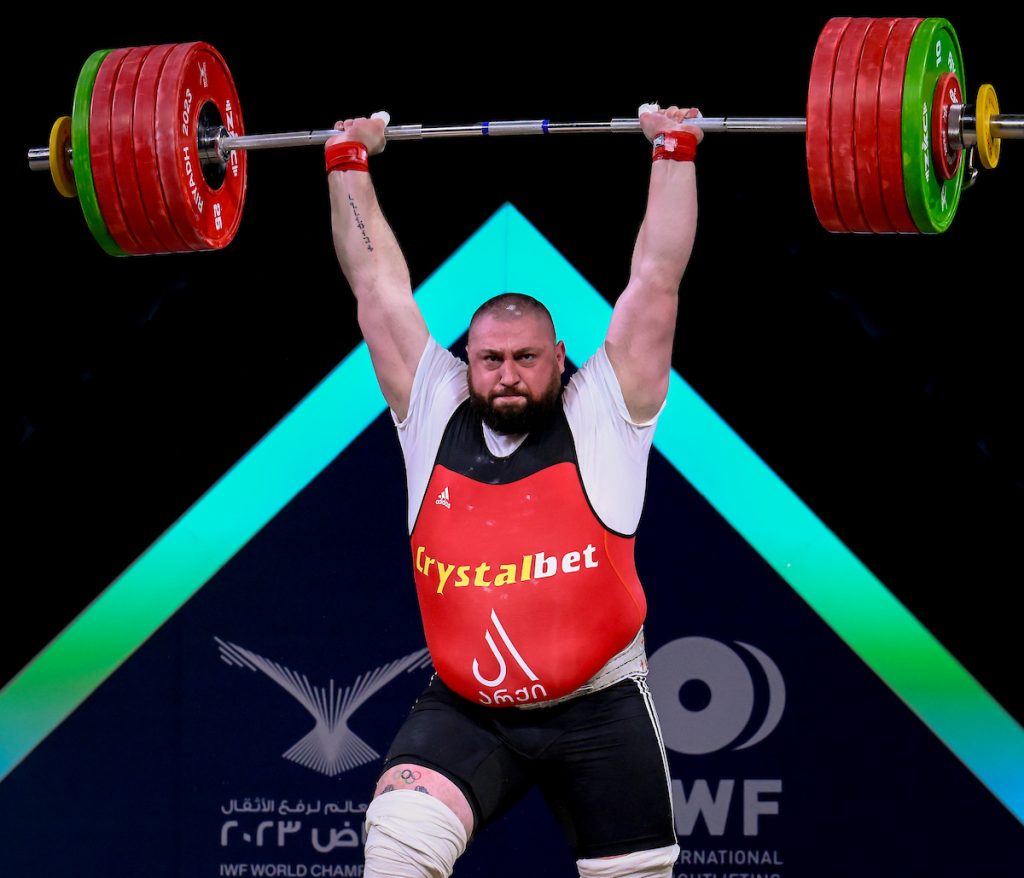 Lasha Talakhadze (GEO)
The Georgian made 220-253-473 ahead of the Armenian Varazdat Lalayan on 212-248-460 and Gor Minasyan, lifting for Bahrain, on 213-246-459.
The others on 450kg or more were Ali Davoudi from Iran and Simon Martirosyan from Armenia. Davoudi was desperately close to taking clean and jerk gold. He just failed with his final attempt at 255kg and finished 203-249-452.
Martirosyan, who weighed 47kg less than Talakhadze on 130kg, made 200-250-450. All five of the 450-plus group failed with their final attempt.
“I like it very much to have others who are close to me, I’m happy with that,” said Talakhadze, world record holder and double Olympic champion.
When he failed with his last lift at 260kg – up 3kg, at his own request, on the number suggested by his coach Giorgi Asanidze – it made no difference to the result because Talakhadze was 13kg clear.
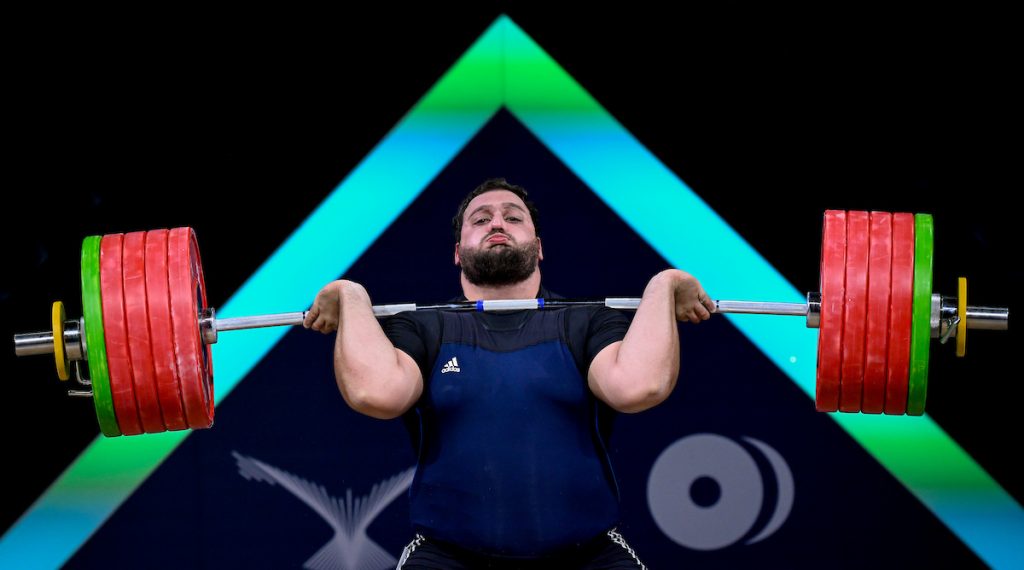 Varazdat Lalayan (ARM)
“It’s not such a big weight for me – I must do better and I will make it next time,” he said.
Asanidze believes he will have to if he is to extend his winning run which started at the 2015 World Championships.
“The others are closing in on Lasha. The standard he showed today will not be enough any more,” said Asanidze.
“He was not at his very best here, but the only thing that mattered today was for him to be champion again. He will have to regain top form next time.”
Talakhadze had slightly strained his left wrist in attempting that last lift and will have time to recover because he will weigh in without lifting at the next qualifier in Qatar in December, Asanidze said. He will return to competition in February at the European Championships.
Eduard Ziaziulin from Belarus, competing as an Individual Neutral Athlete, made a respectable 201-230-431 despite failing with his last two attempts and goes straight into the top 10 in the rankings.
There was glory and pain for 19-year-old Ali Rubaiawi, who also made the top 10 from the B Group.
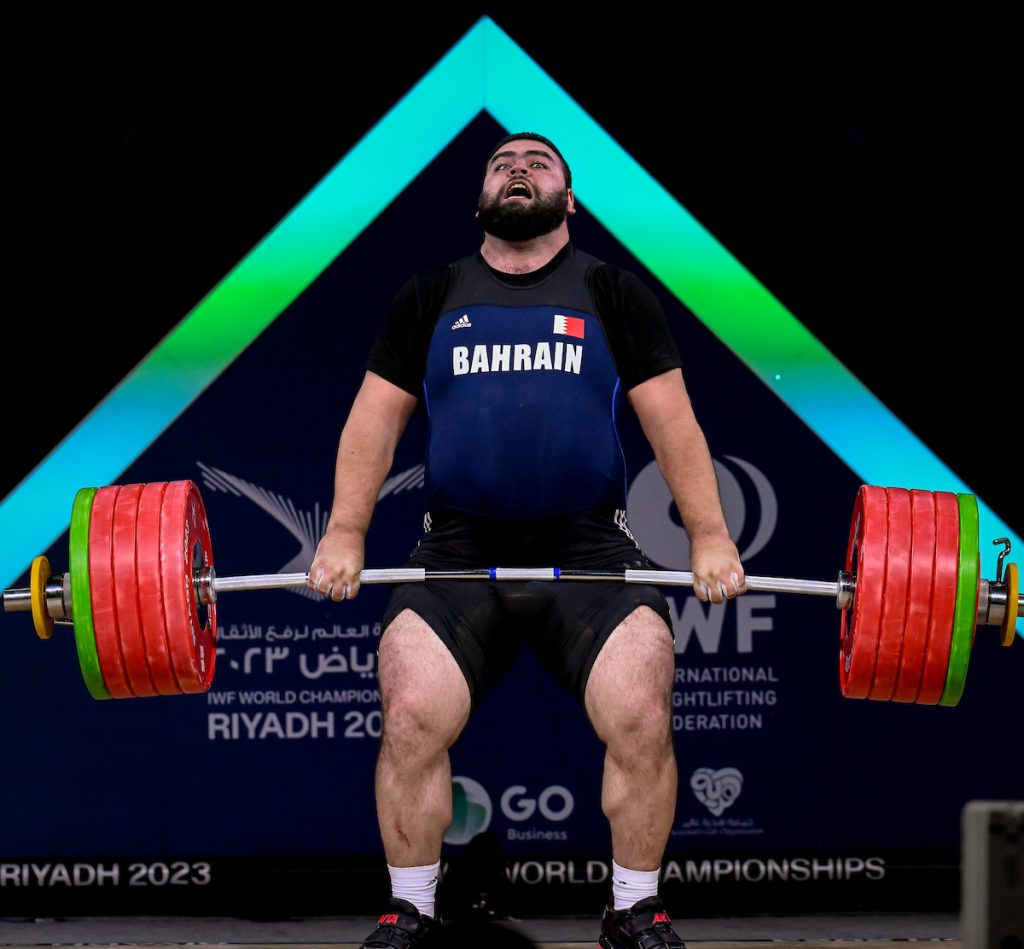 Gor Minasyan (BRN)
After Qasim Hasan had won Iraq’s first World Championships gold medal in any Olympic sport in the 96kg snatch last Wednesday, Rubaiawi became the first Iraqi weightlifter to claim a junior world record.
He did it with the last lift of the snatch session on 198kg, and started well in clean and jerk on 221kg. But a few minutes later Rubaiawi was on a stretcher, heading for hospital after suffering a painful quadriceps injury on his second attempt.
Despite the injury, Rubaiawi improved his best qualifying total by 30kg on 198-221-419 and moved into the top 10 in the Paris rankings.
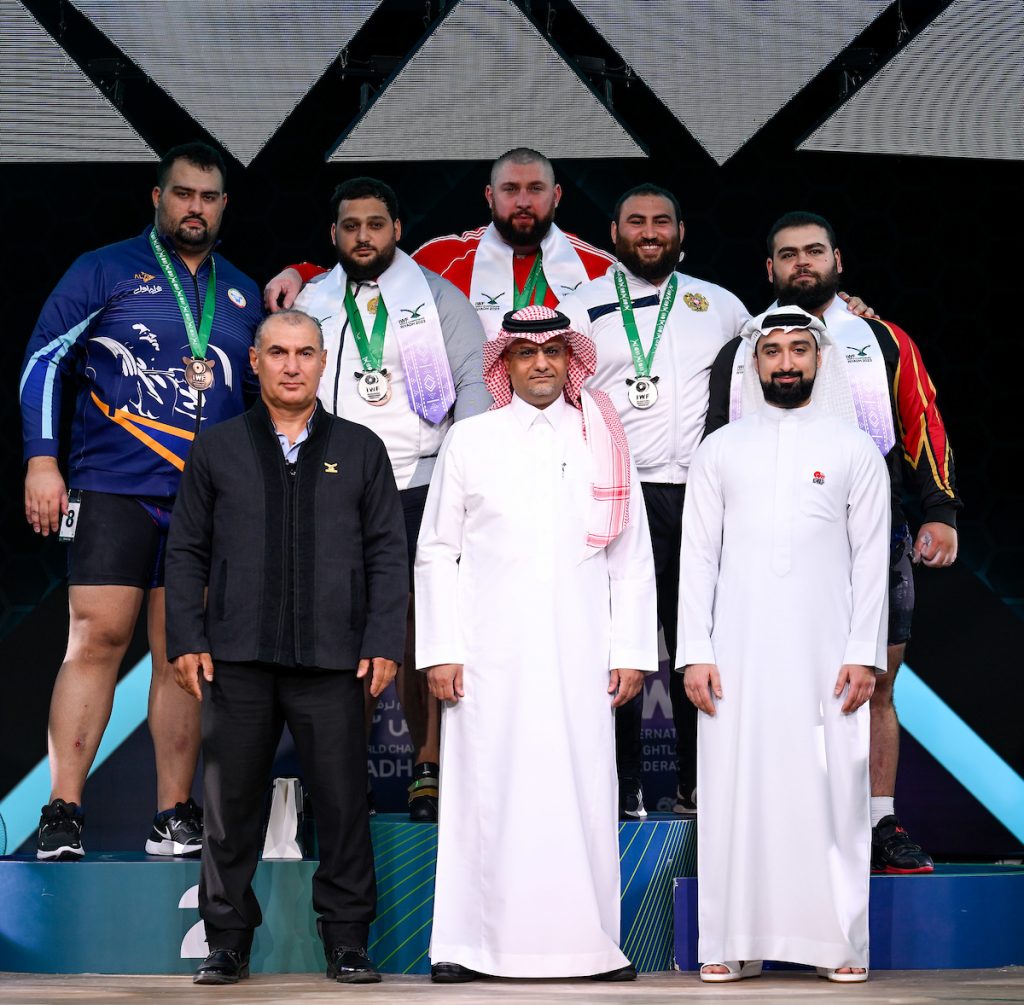 The men’s +109kg podium
Another B Group lifter to make a big gain was Lee Jaesang from Korea. The 28-year-old missed his second clean and jerk but the last one at 241kg to finish 175-241-416 and move within 2kg of top-10 team-mate Jo Seongbin in the long list.
The rankings are expected to be updated on the IWF website in the next few days.
By Brian Oliver, Inside the Games
Photos by Giorgio Scala/Deepbluemedia
posted at 20:50:24 UTC via barrons.com

By AFP – Agence France Presse
September 17, 2023
- Order Reprints
- Print Article
Armenian separatists in Azerbaijan’s breakaway enclave of Nagorno-Karabakh on Sunday agreed on delivery of humanitarian supplies through the territory controlled by Baku, marking the first step towards de-escalation in the volatile region.
Armenia has accused Azerbaijan of fuelling a humanitarian crisis in Nagorno-Karabakh after Baku blocked last year the sole road linking the mountainous region with Armenia, the Lachin corridor policed by Russian peacekeepers.
Azerbaijan has rejected the accusation, arguing Nagorno-Karabakh could receive all the supplies it needed via Azerbaijan.
Baku has said that the separatist authorities had simply refused its proposal to simultaneously reopen both the Lachin corridor and the Aghdam road which connects Nagorno-Karabakh with the rest of Azerbaijan.
On Sunday, the separatist government said it has agreed to allow “simultaneous deliveries of humanitarian cargo” via both routes.
It said that unspecified “mediators are working to organise a meeting with the official representatives of Artsakh (Armenian name of Nagorno-Karabakh) and Azerbaijan in order to alleviate the tense humanitarian and security situation in the republic.”
The foreign ministry in Baku said it was notified by the International Committee of the Red Cross that the separatist authorities “have agreed on parallel supplies of humanitarian cargo as of September 18 (Monday).”
The European Union and United States have called for the reopening of Lachin and Aghdam routes for humanitarian aid as Nagorno-Karabakh experienced shortages of food and medicine.
The months-long crisis as well as Baku’s deployment of troops near Nagorno-Karabakh and along the border with Armenia have sparked fears of a fresh all-out conflict between the arch-foes who have fought two wars for control of the region.
Six weeks of fighting ended in autumn 2020 with a Russian-brokered truce that saw Armenia cede swathes of territory it had controlled since the 1990s.
The two sides have been unable to reach a lasting peace settlement despite mediation efforts by the European Union, United States and Russia.
mkh-fa-im/yad
The Barron’s news department was not involved in the creation of the content above. This story was produced by AFP. For more information go to AFP.com.
© Agence France-Presse
Armenian separatists in Azerbaijan’s breakaway enclave of Nagorno-Karabakh on Sunday agreed on delivery of humanitarian supplies through the territory controlled by Baku, marking the first step towards de-escalation in the volatile region.
An error has occurred, please try again later.
Thank you
This article has been sent to
posted at 20:08:49 UTC via thespec.com
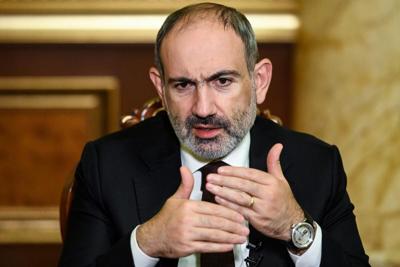
Armenian Prime Minister Nikol Pashinyan. Gwynner Dyer argues he is fooling himself if he thinks the U.S. or Russia will help Armenia in its current predicament.
Torstar file photo
posted at 17:50:24 UTC via azernews.az
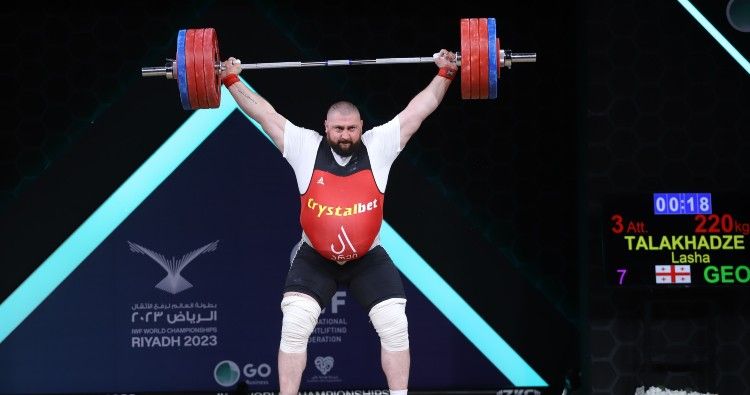
Georgia’s Weightlifting Olympic Champion, European Champion and record-breaking athlete Lasha Talakhadze became a seven-time winner of the World Championship on Sunday, after winning the event in Saudi Arabia’s capital city of Riyadh, Azernews reports, citing Agenda.
Talakhadze has claimed three gold medals in the +109 kg weight category after lifting 220 kg in snatch, 253 kg in clean and jerk, and 473 kg in total.
The Georgian athlete also became a seven-time European Champion in April in Yerevan.
Talakhadze was named the 2022 European Weightlifter of the Year, making him the first Georgian athlete to earn the honour.
—
Follow us on Twitter @AzerNewsAz
posted at 14:46:11 UTC via news.am

Work is underway to organize a meeting between official representatives of Artsakh and Azerbaijan, says the message spread by the Artsakh Information Headquarters.
“We also inform you that the mediators are working to organize a meeting with the official representatives of Artsakh and Azerbaijan in order to alleviate the tense humanitarian and security situation in the Republic.”
posted at 10:51:55 UTC via registercitizen.com

TALLINN, Estonia (AP) — The majority party that dominates the parliament in Georgia has launched a campaign to impeach the country’s president, even though the effort appears unlikely to succeed.
The Georgian Dream party, which is increasingly at odds with President Salome Zourabichvili despite endorsing her election in 2018, announced the effort last week. It said Zourabichvili violated the constitution by travelling to European Union countries without the government’s permission.
The party also took offense at recent comments by Zourabichvili, saying it believes they undermine Georgia’s aspirations to join the EU.
“She also said the most disturbing thing — that Georgia did not deserve (EU) candidate status last year. After that, of course, we do not need any more evidence for her credibility to be simply lost. We had no other motivation” for the impeachment initiative, Prime Minister Irakli Garibashvili said Monday, according to Georgian media.
Impeachment needs support of 100 of the 150 members in the parliament; Georgian Dream and its allies have 84 seats.
Zourabichvili is increasingly at odds with Georgian Dream, including the party’s ties to Russia. When Georgia restored flights to Russia this year, she vowed not to travel on the state airline in protest.
The Georgian presidency, which has notably limited powers, is to switch in 2024 from being a directly elected position to one chosen by a college of electors that includes members of parliament.
posted on Sep 16 2023 18:50:10 UTC via azernews.az

Editorial
It is clear that the policy pursued by the United States is based only on its own interests, and hypocrisy, betrayal, and treachery have risen to the level of state policy.
On one hand, the United States supports the territorial integrity of Ukraine, Moldova and Georgia, considers Abkhazia and South Ossetia as part of Georgia, Transnistria as part of Moldova, Donbas and Crimea as an integral part of Ukraine, and also supports these countries on all international platforms, on the other hand, the United States did not provide any support to Azerbaijan, whose territory had been under the invasion for almost 30 years. Moreover, it took steps that suited the interests of invader Armenia.
If a small part of the support provided to Ukraine today had been provided to Azerbaijan, our lands would not have stayed under the invasion so long.
As a co-chair of the OSCE Minsk Group, the United States also did not conduct any work; the co-chairs made tourist trips and made routine statements. This organization and one of its co-chairs, the United States, did everything possible to keep the conflict frozen for many years. Millions of dollars were allocated annually to the so-called regime in Garabagh under the guise of mine clearance. The separatists visited the United States and raised funds under the name “aid to Garabagh.” It was in the USA that the department of the criminal regime of Garabagh was created. Representatives of the regime visited America and held meetings at various levels. All this is an indicator of the US attitude towards resolving the Armenian-Azerbaijani conflict. Although support for Azerbaijan’s territorial integrity was expressed on the surface, behind the scenes support was given to the separatist regime in Armenia and Garabagh.
The United States, as a hegemonic power, created the image of an enemy that would frighten the international system in order to dictate its will to the whole world, and declared Islam the main enemy of the “civilized world.” This is a country where Islamophobia has risen to the level of state policy, it has not only interfered in the internal affairs of various countries in the name of fighting terrorism but has also targeted Muslim countries. As a result of the “Arab Spring” scenario, governments in the Middle East were overthrown and civil conflicts were encouraged. Countries such as Iraq and Libya were attacked, where such a scenario was impossible.
After creating an image of Iraq as having “nuclear weapons”, they invaded the country, killing one million Iraqis, destroying cities and villages, taking control of the country’s national wealth, and continuing to plunder it so far.
The civil conflict that began in Libya after the overthrow of Muammar Gaddafi still cannot subside. The killing of millions of people, the destruction of economic infrastructure, cities and villages in the Middle East, and the fact that this problem will continue for many years is the result of the “democracy” that America brought to the East.
Today, the United States which is considered the country responsible for the shameful scandals at Abu Ghraib and Guantanamo Bay for the torturing and murdering of Muslims, presents itself as a “patron of human rights.”
All points of tension in the world are created according to the desires and plans of the United States. All political games have one goal – to ensure American interests in any region or country and to control and exploit the resources of the region or country. The US is not interested in democracy, human rights, peace and stability. Most of South America, Africa, and Asia became a testing ground for American political games.
Azerbaijan has also been suffering from US geopolitical games for many years. In our country, attempts were made to carry out coups d’etat. Consistent work was carried out in the direction of financing and training the political opposition, involving the NGO sector and the media in political games, that is, in a word, creating an atmosphere of civil disobedience in the country. The main goal of this country is to form a government in Azerbaijan that is unquestioningly subordinate to the interests of the United States and to legitimize the invasion of Azerbaijani territories. However, these attempts and numerous plans did not come true.
The United States tried to “Syrianize” Azerbaijan and several times prepared a plan for “color revolutions” to prevent the country from strengthening, developing, and liberating occupied Garabagh. But thanks to the unity of the government and the people, none of these evil plans came to true.
Realizing that after the 44-day war, the unity of the government and the people in Azerbaijan has strengthened, today the United States is changing its tactics and is trying to use not the opposition, which is in trouble, but LGBT which is a great threat to national values, “feminists” who promote immorality, and people “NO TO WAR”, trying to devalue the Victory in the Patriotic War. The US also provides funds to these groups through USAID, and these groups are led by Samantha Power, who has pro-Armenian, anti-Turkish, and anti-Azerbaijani positions.
Azerbaijan managed to resist any pressure and liberated its lands from occupation on its own. Of course, the existence of Azerbaijan with such strength and courage does not correspond to the interests and goals of the United States, France, and other similar countries. Therefore, today official Washington is not making serious efforts to resolve the problem between Armenia and Azerbaijan, but is only creating an illusion.
According to the agreement reached at the last meeting in Washington, on September 1, roads in the region should have been opened and the Agdam-Khankendi road should have been operational. Although Blinken asked for the opening of both the Lachin and Aghdam roads during negotiations with the Azerbaijani leadership, the US stepped back from its position rather than put pressure on the Armenian leadership and separatists in Garabagh who resisted the agreement. Today, both the State Department and Congress are talking only about the need to open the Lachin road.
Unable or unwilling to satisfy the separatist group, the United States is now trying to accuse Azerbaijan of lack of courage and hypocrisy.
We have also witnessed the hypocrisy of the United States regarding the “elections” in Garabagh- after the “elections” on September 9, leading states and organizations declared that they did not recognize the illegal regime and its “elections,” but Washington chose to remain silent. Only after pressure from Azerbaijan, the US State Department at the level of its ordinary representative obliged to verbally declare that it did not recognize the “elections.”
A representative of the US State Department sent Louis Bonin to the region, but this visit did not contribute to solving problems in the region and was inconclusive. Because the US is insincere in its intentions and is not interested in peace. Otherwise, US State Department representative Yuri Kim would not have spoken about the non-existent “rights of the people of Nagorno-Garabagh” in his speech in Congress. The United States ignores today’s realities and is making serious efforts to legitimize the military junta in Garabagh.
In fact, today the United States, together with France, is a party that does not allow the process of reintegration of the Armenian minority in Garabagh, and stimulates revanchist forces in Armenia. Thanks to such an open pro-Armenian policy of France, today Paris is completely isolated from regional processes and has lost hope of mediation. If this happens, the same fate awaits the United States, which behaves in the region as Christian missionaries.
It would be naivity to think that Armenia will be benefitted from the current hypocritical policy of the USA. This policy will not benefit anyone. An obstacle to the reintegration process is created in Azerbaijan with the Armenian minority living in its territory, and Armenia becomes a “second Ukraine”. The United States, which incited Ukraine to war with Russia and manipulated the supply of weapons and ammunition to make Kyiv completely dependent on itself, has actually sacrificed Ukraine today. After the death of tens of thousands of Ukrainians, the destruction of cities and villages, and the occupation of almost 25 percent of the country, the United States now wants to force Ukraine to come to terms with its territorial occupation. Just as he tried to push Azerbaijan to come to terms with the occupation of its lands for 30 years.
In this war, in which Ukraine is sacrificed, the USA earns a lot of money and takes complete control of the European gas market with LNG (liquefied natural gas). Due to the damage to the environment, LNG, which is almost as dangerous as black coal, has begun to dominate the European market, but so far no environmental organization, ecoactivists, etc. cannot raise voices to protest.
The situation in which the USA is dragging Ukraine reminds us of the war in Georgia in 2008. Even then, the USA, which incited M. Saakashvili to war with Russia, later backed out, as a result of which Moscow officially formalized the occupation of Georgian territories under its control.
The US tried to turn Turkiye into a “second Syria” and attempted a coup in 2016 by the FETO organization it created and financed. Only thanks to the determination of the Turkish leadership and the support of the people, Turkiye was able to escape from this danger. But even today, terrorist organizations fighting against Turkiye receive instructions, weapons and funding directly from the United States.
The United States, which destroyed Afghanistan and then returned to power the Taliban, which it shamefully fled and declared terrorists, but in fact created itself, shows its true nature at every step by implementing projects of this type. During the 20-year occupation, America did not build a single road or school in Afghanistan.
—
Follow us on Twitter @AzerNewsAz
posted on Sep 16 2023 17:56:55 UTC via atlanticcouncil.org
Russia’s war against Ukraine has wrought major upheaval across Eurasia, forcing countries to search for new partners as they seek security and stability. Some Eurasian countries are looking to strengthen ties with the United States to maintain regional security and to develop new economic opportunities. Azerbaijan, for example, has sought to further its partnership with the United States on the two countries’ shared strategic interests.
Relations between the United States and Azerbaijan have historically centered on energy transit, most significantly the Baku-Tbilisi-Ceyhan oil pipeline and the Southern Gas Corridor. In July 2022, Baku signed a new memorandum of understanding with the European Union (EU) to increase Azerbaijani gas exports to the EU from 12 billion cubic meters (bcm) per year to 20 bcm by 2027. Officials in Brussels certainly see the importance of diversifying energy imports away from Russia—European Commission President Ursula von der Leyen called Azerbaijan a “reliable” partner in the bloc’s renewed emphasis on energy security.
But Azerbaijan’s geography means it is also a gateway to the countries of Central Asia and the Trans-Caspian International Transport Route (TITR), also known as the Middle Corridor, that connects Europe with China via Central Asia and the South Caucasus. The Middle Corridor provides Europe with a critical alternative to trade routes that pass through Russia and Belarus, the so-called Northern Corridor.
At the same time, the Middle Corridor provides the inverse opportunity for Central Asian countries to reduce dependency on transit through Russia to the European market. It is in Washington’s strategic interest to help develop alternative trade routes between Europe and Central Asia that minimize opportunities for Russian malign interference along the way.
Moreover, Azerbaijan and the United States share a set of strategic interests that may only grow in the coming years. Washington should resist the calls from some commentators to distance itself from Baku. Russia’s war on Ukraine has shaken stability in the South Caucasus, and Moscow may try to claw back influence in the region at the expense of regional peace and security. Greater US engagement with Baku should reinforce a platform for peace between Azerbaijan and Armenia. Stronger US-Azerbaijan ties can also help counter threats to shared interests emanating from Moscow and Tehran.
The United States has been a major mediator between Armenia and Azerbaijan since the early years of the two countries’ conflict over the Karabakh region of Azerbaijan that began in the 1990s. This mediating role gained new importance and urgency following the Second Karabakh War, which ended in November 2020 with Azerbaijan liberating Karabakh and much of its surrounding territory.
While the situation remains tense, leaders in both Armenia and Azerbaijan have worked hard to build lasting peace. Baku and Yerevan have reached important achievements to this end, with one set of peace talks mediated by Russia and a second negotiating platform with the EU and the United States. The turning point came in May, when Armenian Prime Minister Nikol Pashinyan recognized Karabakh as part of Azerbaijan in the EU-mediated summit in Brussels, following US-mediated talks weeks earlier between the two countries’ foreign ministers in Washington. There are even signs the long-standing dispute over access to the Lachin road is improving, with new reports that humanitarian aid is reaching Karabakh via the Aghdam road.
The peace process is, however, fraught with major challenges.
Some political groups in Armenia and in the diaspora continue to pressure the Pashinyan government against acknowledging Azerbaijan’s internationally recognized sovereignty over Karabakh. Separatist leadership in Karabakh refuses to integrate the region into Azerbaijan and recently undertook unrecognized “elections.” These authorities also receive financial and diplomatic support from Kremlin-connected individuals.
A peace treaty signed via Western mediation and built upon the recognition of Karabakh as part of Azerbaijan would deal a severe blow to Russia’s influence in the region. Such a treaty would create preconditions for the withdrawal of Russia’s peacekeeping mission from the Karabakh region where it was deployed after the 2020 war and, generally, deprive Moscow of one lever of influence against Baku.
This contradiction in the interests of Azerbaijan and Russia has at times strained relations between them. By voicing a plan not to extend the Russian peacekeeping mission beyond 2025 and by investing more in the Western-mediated track of negotiations, Baku regularly challenges Russia’s policies vis-à-vis the peace process.
Azerbaijan stands out as a rare post-Soviet state that has provided humanitarian and political support to Ukraine in the context of the country’s fight against Russian aggression. Azerbaijan has so far sent almost thirty million dollars’ worth of humanitarian aid, including free fuel to ambulances and vehicles operated by the State Emergency Service of Ukraine and power transformers and generators. Azerbaijan’s independent foreign policy course has drawn “bewilderment” from Russia’s foreign ministry and nuclear threats from its political circles.
The Azerbaijani government’s stance on Russia’s war of aggression against Ukraine contrasts with the policies of two of its neighbors, Armenia and Iran. Investigations and media reports in Europe and the United States have uncovered how Armenia and some other post-Soviet countries have been assisting Russia to import prohibited goods. Officials both in the United States and the EU have listed Armenia among the states that help Russia to circumvent Western sanctions. Armenia only belatedly sent a small package of humanitarian aid to Ukraine in early September.
Iran has been one of Russia’s most strident military allies in its war, providing Moscow with thousands of Shahed drones that terrorize Ukrainian civilians and helping the Kremlin evade Western sanctions. In October 2022, an Iranian military commander Yahia Rahim Safav reportedly said that Armenia may buy Shahed drones. Baku has long opposed Tehran’s brazenly aggressive foreign policy, even as Iran’s ties with Armenia and Russia may be growing. Significantly, Baku has also redoubled its support for Israel—a major US ally—despite Iran’s anti-Israel threats and increasingly militaristic posture in the region.
The time is right for the United States to strengthen its relationship with Azerbaijan and take the historic opportunity to pursue peace and break ground on a new template for regional stability.
Vasif Huseynov is the head of the Western Studies department at the Center for Analysis of International Relations (AIR Center), a think tank founded by the government of Azerbaijan. He is also a lecturer at Khazar and ADA universities in Baku, Azerbaijan.
Further reading
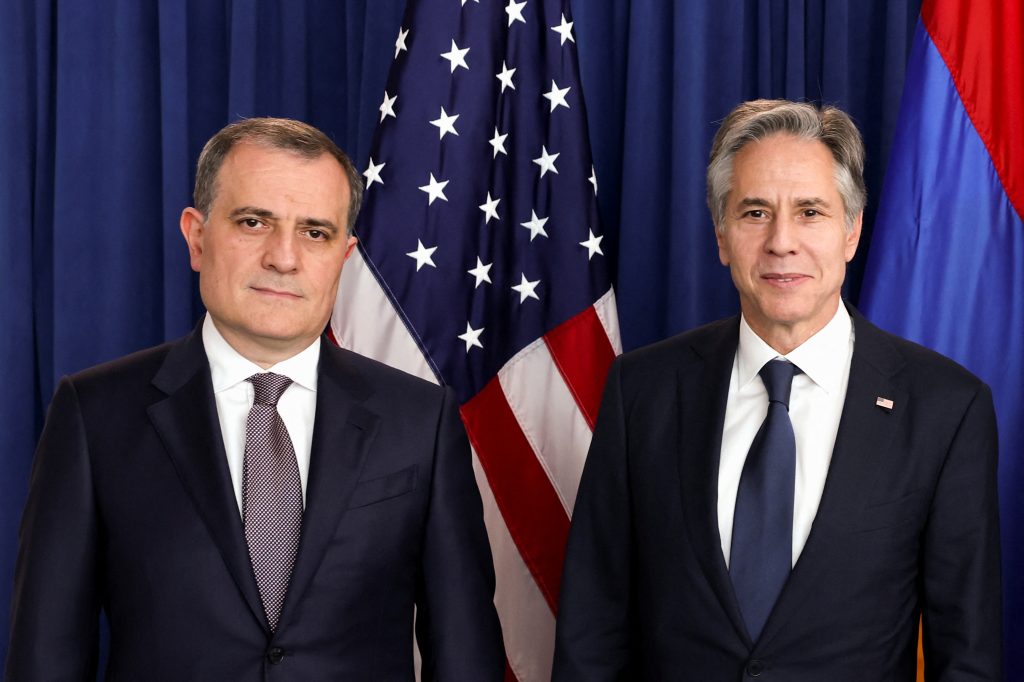
Image: U.S. Secretary of State Antony Blinken hosts Armenian Foreign Minister Ararat Mirzoyan (not pictured) and Azerbaijani Foreign Minister Jeyhun Bayramov for talks at the George Shultz National Foreign Affairs Training Center in Arlington, Virginia, U.S., June 29, 2023. REUTERS/Evelyn Hockstein
posted on Sep 16 2023 17:37:22 UTC via bigthink.com
Proto-Indo-European (PIE) is a language that gave rise to many others. About 46% of humans, well over three billion people, are native speakers of an Indo-European language. But where did PIE first arise, and who spoke it: pastoralists from the Pontic steppe straddling eastern Europe and west Asia or agrarians from Anatolia in Turkey? The answer to that question has been eluding anthropologists for ages. And now, researchers in the journal Science suggest a third place: the Lesser Caucasus, primarily found in Armenia, Azerbaijan, and parts of eastern Turkey and southern Georgia.
PIE is both the deadest and most alive of languages. The last speaker died thousands of years ago, and if it was ever written down, we don’t know about it. The only evidence of PIE’s existence are the traces it left in the languages that descended from it.
We say “only,” but that is a lot of evidence. Modern descendants of PIE include not only English, Spanish, and Russian, but also Persian, Hindi, Bengali, and dozens more. Indo-European is by far the largest language family in the world. Sino-Tibetan, which includes Mandarin Chinese, is a distant second, with about 1.3 billion native speakers.
For the better part of a century, linguists have been looking for clues to the origin of Indo-European from within the languages themselves. Using phylogenetic analysis — phylogenetics is the study of evolutionary relationships over time, be they organisms or languages — they have reconstructed a vocabulary for PIE that gives us an idea of the culture of the people who spoke it. We know they had words for bear (bʰérōs) and goose (h₂énos), willow (wélə) and honey (méli), and peat (péḱus) and enclosure (h₂órtos).
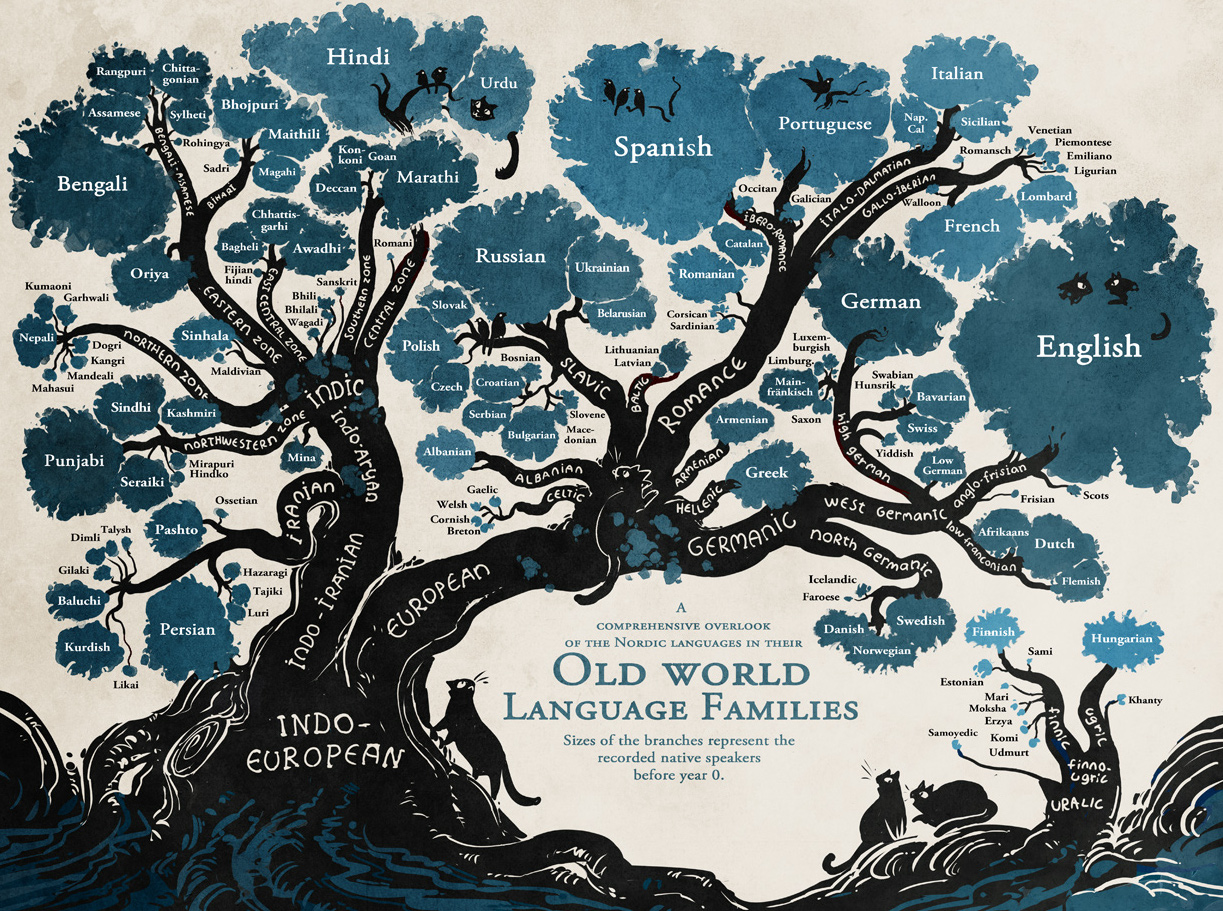 The language families descended from Proto-Indo-European beautifully rendered as the branches of a tree, with each leaf approximating the relative numbers of native speakers of each language. (Credit: Stand Still, Stay Silent by Minna Sundberg)
Based on such evidence, two schools of thought emerged. One proposed that PIE originated some 6,000 years ago in the Pontic-Caspian steppe located north of the Black and Caspian Seas, in the flatlands that stretch from northeast Romania via southern Ukraine and southwestern Russia into the furthest west of Kazakhstan. The nomadic pastoralists who lived here tamed the horse, allowing them to migrate far and wide. This is called the steppe or kurgan hypothesis, the latter after the local word for the prehistoric burial mounds that dot the area.
Other scholars posit an older and more southerly beginning for PIE: around 9,000 years ago in Anatolia. Also known as Asia Minor, this peninsula bordered by the Black, Aegean, and Mediterranean Seas is the westernmost extension of Asia. Today, it is the Asian part of Turkey. The theory is that the language piggybacked on the spread of agriculture from here to large parts of the Old World.
The kurgan hypothesis is the more widely accepted of the two. Many of its proponents think that PIE speakers, kurgan builders, and the ancient Yamnaya culture are actually one and the same. However, conflicting evidence from previous phylogenetic analyses has prevented either hypothesis from completely knocking out the other.
So, the Max Planck team constructed a new dataset of core vocabulary from 161 Indo-European languages that was more comprehensive and balanced than previous samples. Using recent advances in phylogenetic analysis, they were able to estimate that PIE was approximately 8,100 years old, and that five main branches had already split off around 7,000 years ago.
The study’s results fit poorly with both the kurgan and Anatolian hypotheses. As a solution, the researchers propose a third possibility: an early homeland for PIE immediately south of the Caucasus, with one migration veering off north into the steppe. There, PIE speakers established a “secondary homeland,” from where Indo-European entered the rest of Europe beginning 5,000 years ago, courtesy of the Yamnaya and later expansions.
 Map showing the spread of Indo-European according to the kurgan hypothesis: from the Pontic steppe (dark green) to an area covering most of Europe and large parts of Asia (light green). Note the non-Indo-European language islands in Europe, representing Finnish, Estonian, Hungarian, and Basque. (Credit: Joe Roe, after Wolfgang Haak, CC BY-SA 4.0)
By offering a hybrid of the farming and pastoralist theories about the spread of Indo-European, the south-of-Caucasus hypothesis suggests a solution for an enigma that has dogged the study of Indo-European for about 200 years. Wolfgang Haak, group leader at the department of archaeogenetics at the Max Planck Institute for Evolutionary Anthropology, said:
“Aside from a refined time estimate for the overall language tree, the tree topology and branching order are most critical for the alignment with key archaeological events and shifting ancestry patterns seen in the ancient human genome data. This is a huge step forward from the mutually exclusive, previous scenarios, towards a more plausible model that integrates archaeological, anthropological, and genetic findings.”
Strange Maps #1220
Got a strange map? Let me know at [email protected].
Follow Strange Maps on Twitter and Facebook.
posted on Sep 16 2023 16:34:41 UTC via news.am
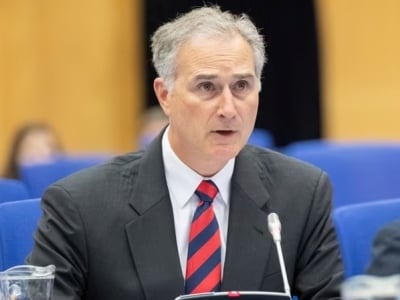
Senior Advisor to the US State Department for Negotiations in the South Caucasus, Louis Bono, met with Azerbaijani Foreign Minister Jeyhun Bayramov, the Press Service of the Azerbaijani Foreign Ministry reports.
“During the meeting, the situation in the region, normalization and peace process between Azerbaijan and Armenia, current threats and challenges were discussed,” the statement said. Bayramov told Bono that “the obstacle to the implementation of the agreement on the simultaneous opening of the [Akna-Stepanakert] Agdam-Khankendi and [Berdzor] Lachin Corridor, reached during the conversation between Azerbaijani President Ilham Aliyev and US Secretary of State Antony Blinken on September 1, is Armenia and the illegal regime it created.”
At the same time, Bayramov began to deny the fact of the blockade and humanitarian crisis in Artsakh.
“Jeyhun Bayramov emphasized the unacceptability of international partners, including the United States, repeating the claims of the Armenian side, despite their well-informed understanding of the situation in the region. He further highlighted that despite Armenia’s ongoing military and political provocations, its worldwide defamation campaign against Azerbaijan, and its support for separatism on our territories, Azerbaijan continues to maintain a constructive stance. […] The head of the Azerbaijani Foreign Ministry expressed regret that the unfounded allegations of Armenia, which it spreads in order to divert attention from the presence of Armenian armed forces in Azerbaijani territories and mislead the international community, were reflected in the speech of the acting US Assistant Secretary of State for European and Eurasian Affairs Yuri Kim”, the statement further reads.
posted on Sep 16 2023 15:13:31 UTC via washingtonpost.com

You’re reading an excerpt from the Today’s WorldView newsletter. Sign up to get the rest free, including news from around the globe and interesting ideas and opinions to know, sent to your inbox every weekday.
The firsthand accounts are harrowing. There’s no food on shelves in stores. Children stand for hours in bread lines to help feed their families. Mothers walk for miles in search of cooking oil and other provisions. Electricity, gas and water are in short supply. Ambulances can’t whir into motion for lack of fuel. Clinics report a surge in miscarriages in pregnant women who are malnourished, anemic and consumed by stress.
Such is the apparent state of the isolated and increasingly desperate ethnic Armenian enclave in Nagorno-Karabakh, whose 120,000 people are enduring what local authorities and a host of international experts describe as a blockade at the hands of Azerbaijan, the country within which the territory sits. Armenia and Azerbaijan have fought multiple wars over Nagorno-Karabakh after the collapse of the Soviet Union and the advent of their independent nation-states. Though recognized by the international community as part of Azerbaijan, Nagorno-Karabakh and some areas surrounding it have been governed for decades by a separatist ethnic Armenian entity.
For the entirety of this year, Azerbaijan has restricted movement along the Lachin corridor, the sole route connecting Armenia directly to the enclave, which Armenians refer to as Artsakh. The restrictions intensified this summer, with the International Committee of the Red Cross unable to deliver humanitarian assistance to the region and trucks with hundreds of tons of supplies stranded on the roads. The plight of the afflicted communities led Luis Moreno Ocampo, a former chief prosecutor of the International Criminal Court, to publish an opinion earlier this month determining that the conditions of starvation inflicted on the enclave’s ethnic Armenians was an act of genocide. He cited an article in the Genocide Convention that referred to “deliberately inflicting on the group conditions of life calculated to bring about its physical destruction.”
“The idea of genocide is not just about killing, but about removing people from the land,” Moreno Ocampo told me during a phone call this week. In his report, he wrote: “There are no crematories, and there are no machete attacks. Starvation is the invisible genocide weapon. Without immediate dramatic change, this group of Armenians will be destroyed in a few weeks.”
On Wednesday, the situation was discussed at an emergency session of the United Nations Security Council. Various officials, including U.S. ambassador to the United Nations Linda Thomas-Greenfield, called on Azerbaijan to “restore free movement through the corridor.” Armenian foreign minister Ararat Mirzoyan said the deprivation imposed on the enclave was a form of warfare that would lead to the “ethnic cleansing of the people of Nagorno-Karabakh.”
That sentiment was echoed in Washington by a handful of U.S. lawmakers. “Azerbaijan’s systematic ethnic cleansing of the people of Nagorno-Karabakh through a large-scale and unprovoked invasion is unconscionable,” Sen. Alex Padilla (D-Calif.) told me, referring to the territory seized by Azerbaijan during a lopsided six-week war in 2020 that saw thousands die. “Particularly egregious is their weaponization of the blockade to starve the people of Nagorno-Karabakh and block humanitarian assistance.”
Responding to these charges, Yashar Aliyev, Azerbaijan’s U.N. envoy, described talk of a blockade as “unfounded and groundless allegations” and said his government was subject to an Armenian “campaign” to “manipulate and mislead the international community.” Officials in Baku claim that the restrictions on movement along the Lachin corridor, which is supposed to be administered by Russian peacekeepers, are necessary to stop, among other things, the illicit supply of arms from Armenia into the enclave. They point to the intransigence of the de facto authorities in Nagorno-Karabakh, who have refused the delivery of supplies through an alternate eastern road from Azerbaijan.
“An administration of occupation is blocking the Azerbaijani government’s provision of food and medicine to an Azerbaijani region. Tellingly, nowhere in the Ocampo report is this mentioned,” wrote Hikmet Hajiyev, top foreign affairs adviser to Azerbaijan’s long-ruling President Ilham Aliyev. “Claiming they are under threat while engineering a crisis to galvanize the international community’s support is intended to convince the world that Azerbaijanis and Armenians cannot live together, as we once did.”
With diplomatic corps we are on the entrance of Agdam-Khankandi highway and railway. Only highway’s daily capacity is 17.000 vehicles. Azerbaijan is building roads not walls for reintegration of armenian residents of Karabakh but they put road blocks and barriers. pic.twitter.com/P3v3J59Fxv
— Hikmet Hajiyev (@HikmetHajiyev) August 16, 2023
The impasse reflects the profound gulf between the two sides. Some analysts believe that Azerbaijan, wealthier and reinforced by Turkish and Israeli arms, is pressing its considerable advantage with the world distracted by the war in Ukraine to apply intolerable pressure on the separatist enclave in its midst. Armenia and Azerbaijan have been locked in rounds of negotiations over a lasting peace settlement that would normalize ties and find an acceptable accommodation over the status of Nagorno-Karabakh.
But the current crisis has highlighted the existential fears and deep-seated enmities felt on both sides. As Armenians around the world raised the alarm over the plight of blockaded Nagorno-Karabakh, Azerbaijani media focused on the discovery of a mass grave of Azerbaijani people in the city of Shusha, dating back to the battles of the 1990s and the area’s occupation by ethnic Armenian forces. The city was “liberated” by Azerbaijan in the brief 2020 war, which saw Baku’s forces seize significant swaths of territory captured by Armenian troops in the earlier phase of the conflict.
Now, some ethnic Armenians who fled Shusha — known to Armenians as Shushi — in 2020 find themselves in even more dire straits. One of those is Alvina Nersesyan, a resident of the enclave and mother, who briefed reporters on a virtual call organized by Armenian officials on Thursday. She described the “fearful” bread lines in Stepanakert, the enclave’s de facto capital, known in Azerbaijan as Khankendi, and lamented that she doesn’t “even say the words for sweets anymore,” lest she upset her deprived children who are “too small to understand the situation.”
The immediate hardships are recognized by diplomats elsewhere. “Access to food, medicine, baby formula and energy should never be held hostage,” Thomas-Greenfield said Wednesday. “We urge the government of Azerbaijan to restore free movement through the corridor.”
“U.S. officials believe that Armenians in Nagorno-Karabakh are managing to survive only because of backyard gardens and other home-produced food,” wrote Post columnist David Ignatius. “They fear that within two months, as winter approaches, the population could face starvation. Armenians dread a repetition of the Ottoman genocide of 1915, an ever-present historical memory for Armenians around the world.”
Moreno Ocampo summoned that deep, bitter history, noting that hundreds of thousands of Armenians who perished more than a century ago were driven from their homes by Ottoman forces and left to die of hunger. “Starvation was the weapon of the genocide in 1915 and now Azerbaijan is using starvation against Armenians,” he told me. “It’s tragic but history is repeating, and that’s why humanity has to react.”
posted on Sep 16 2023 15:12:24 UTC via thenewsandtimes.blogspot.com
Activists protest in front of the U.N. Office in Yerevan, Armenia, on Aug. 16. (Karen Minasyan/AFP/Getty Images)
The firsthand accounts are harrowing. There’s no food on shelves in stores. Children stand for hours in bread lines to help feed their families. Mothers walk for miles in search of cooking oil and other provisions. Electricity, gas and water are in short supply. Ambulances can’t whir into motion for lack of fuel. Clinics report a surge in miscarriages in pregnant women who are malnourished, anemic and consumed by stress.
Such is the apparent state of the isolated and increasingly desperate ethnic Armenian enclave in Nagorno-Karabakh, whose 120,000 people are enduring what local authorities and a host of international experts describe as a blockade at the hands of Azerbaijan, the country within which the territory sits. Armenia and Azerbaijan have fought multiple wars over Nagorno-Karabakh after the collapse of the Soviet Union and the advent of their independent nation-states. Though recognized by the international community as part of Azerbaijan, Nagorno-Karabakh and some areas surrounding it have been governed for decades by a separatist ethnic Armenian entity.
Residents of Nagorno-Karabakh say it’s getting harder to access food and medicines following a months-long Azerbaijani blockade of the region. (Video: Reuters)
For the entirety of this year, Azerbaijan has restricted movement along the Lachin corridor, the sole route connecting Armenia directly to the enclave, which Armenians refer to as Artsakh. The restrictions intensified this summer, with the International Committee of the Red Cross unable to deliver humanitarian assistance to the region and trucks with hundreds of tons of supplies stranded on the roads. The plight of the afflicted communities led Luis Moreno Ocampo, a former chief prosecutor of the International Criminal Court, to publish an opinion earlier this month determining that the conditions of starvation inflicted on the enclave’s ethnic Armenians was an act of genocide. He cited an article in the Genocide Convention that referred to “deliberately inflicting on the group conditions of life calculated to bring about its physical destruction.”
“The idea of genocide is not just about killing, but about removing people from the land,” Moreno Ocampo told me during a phone call this week. In his report, he wrote: “There are no crematories, and there are no machete attacks. Starvation is the invisible genocide weapon. Without immediate dramatic change, this group of Armenians will be destroyed in a few weeks.”
On Wednesday, the situation was discussed at an emergency session of the United Nations Security Council. Various officials, including U.S. ambassador to the United Nations Linda Thomas-Greenfield, called on Azerbaijan to “restore free movement through the corridor.” Armenian foreign minister Ararat Mirzoyan said the deprivation imposed on the enclave was a form of warfare that would lead to the “ethnic cleansing of the people of Nagorno-Karabakh.”
That sentiment was echoed in Washington by a handful of U.S. lawmakers. “Azerbaijan’s systematic ethnic cleansing of the people of Nagorno-Karabakh through a large-scale and unprovoked invasion is unconscionable,” Sen. Alex Padilla (D-Calif.) told me, referring to the territory seized by Azerbaijan during a lopsided six-week war in 2020 that saw thousands die. “Particularly egregious is their weaponization of the blockade to starve the people of Nagorno-Karabakh and block humanitarian assistance.”
Responding to these charges, Yashar Aliyev, Azerbaijan’s U.N. envoy, described talk of a blockade as “unfounded and groundless allegations” and said his government was subject to an Armenian “campaign” to “manipulate and mislead the international community.” Officials in Baku claim that the restrictions on movement along the Lachin corridor, which is supposed to be administered by Russian peacekeepers, are necessary to stop, among other things, the illicit supply of arms from Armenia into the enclave. They point to the intransigence of the de facto authorities in Nagorno-Karabakh, who have refused the delivery of supplies through an alternate eastern road from Azerbaijan.
“An administration of occupation is blocking the Azerbaijani government’s provision of food and medicine to an Azerbaijani region. Tellingly, nowhere in the Ocampo report is this mentioned,” wrote Hikmet Hajiyev, top foreign affairs adviser to Azerbaijan’s long-ruling President Ilham Aliyev. “Claiming they are under threat while engineering a crisis to galvanize the international community’s support is intended to convince the world that Azerbaijanis and Armenians cannot live together, as we once did.”
The impasse reflects the profound gulf between the two sides. Some analysts believe that Azerbaijan, wealthier and reinforced by Turkish and Israeli arms, is pressing its considerable advantage with the world distracted by the war in Ukraine to apply intolerable pressure on the separatist enclave in its midst. Armenia and Azerbaijan have been locked in rounds of negotiations over a lasting peace settlement that would normalize ties and find an acceptable accommodation over the status of Nagorno-Karabakh.
But the current crisis has highlighted the existential fears and deep-seated enmities felt on both sides. As Armenians around the world raised the alarm over the plight of blockaded Nagorno-Karabakh, Azerbaijani media focused on the discovery of a mass grave of Azerbaijani people in the city of Shusha, dating back to the battles of the 1990s and the area’s occupation by ethnic Armenian forces. The city was “liberated” by Azerbaijan in the brief 2020 war, which saw Baku’s forces seize significant swaths of territory captured by Armenian troops in the earlier phase of the conflict.
Now, some ethnic Armenians who fled Shusha — known to Armenians as Shushi — in 2020 find themselves in even more dire straits. One of those is Alvina Nersesyan, a resident of the enclave and mother, who briefed reporters on a virtual call organized by Armenian officials on Thursday. She described the “fearful” bread lines in Stepanakert, the enclave’s de facto capital, known in Azerbaijan as Khankendi, and lamented that she doesn’t “even say the words for sweets anymore,” lest she upset her deprived children who are “too small to understand the situation.”
The immediate hardships are recognized by diplomats elsewhere. “Access to food, medicine, baby formula and energy should never be held hostage,” Thomas-Greenfield said Wednesday. “We urge the government of Azerbaijan to restore free movement through the corridor.”
“U.S. officials believe that Armenians in Nagorno-Karabakh are managing to survive only because of backyard gardens and other home-produced food,” wrote Post columnist David Ignatius. “They fear that within two months, as winter approaches, the population could face starvation. Armenians dread a repetition of the Ottoman genocide of 1915, an ever-present historical memory for Armenians around the world.”
Moreno Ocampo summoned that deep, bitter history, noting that hundreds of thousands of Armenians who perished more than a century ago were driven from their homes by Ottoman forces and left to die of hunger. “Starvation was the weapon of the genocide in 1915 and now Azerbaijan is using starvation against Armenians,” he told me. “It’s tragic but history is repeating, and that’s why humanity has to react.”
posted on Sep 16 2023 12:46:00 UTC via azernews.az
First they start on a positive note, then they start to reveal their true hypocritical nature. However, for the time being, we are not talking about France, or a group of pro-Armenian officials represented at the UN. This time we are talking about the Minister of Foreign Affairs of Belgium, Hadja Lahbib, who first identified himself as a diplomat and later revealed her true prejudice against Azerbaijan.
A couple of days ago, when the information about her visit was spread, the Belgian Minister of Foreign Affairs showed a more positive position regarding the resolution of the ongoing Armenian-Azerbaijani tension in the South Caucasus. However, Lahbib, who started her first trip from Armenia, somehow damaged the reputation of the European Union with her diplomatic illiteracy. It is likely that Hadja Lahbib did not even look at the agenda related to the region prior to her visit to the South Caucasus. After all, why look? Because everyone believes that Hadja Lahbib is successfully following the path of French diplomats.
A Belgian “diplomat” in Armenia meets with the soldiers of an occupying state crushed under the iron fist and presents them with flowers. Lahbib’s French-style action presented her purpose and position to the public at the first moment.
Perhaps she has never asked herself the question on whose territory that soldier whom she hugged before fought and received the deserved punishment. Lahbib completely devoted herself to Armenia, stepping on the diplomatic behavior of Charles Michel, the President of the Council of Europe, in Brussels. Whatever the reason that made her to this request, it was not received unambiguously for Azerbaijan.
The Belgian Minister of Foreign Affairs, who participated in the briefing in Yerevan, demonstrated her insidious behavior and even attepted to send a note against the Azerbaijani Foreign Minister Jeyhun Bayramov: “The rights and security of the population of “Nagorno-Karabakh” must be respected, let me remind my Azerbaijani colleague about this .”
The next corrupt pro-Armenian example of Europe has astrayed so much that she did not even respect the opinion of the President of the Council of Europe Michel about recognizing the territorial integrity of Azerbaijan.
You probably won’t take my criticism wrong. Indeed, Azerbaijan has no prejudice against Lahbib. We have never seen her contribution to conflict resolution before. But what we have seen is that Lahbib is indeed biased towards conflicts.
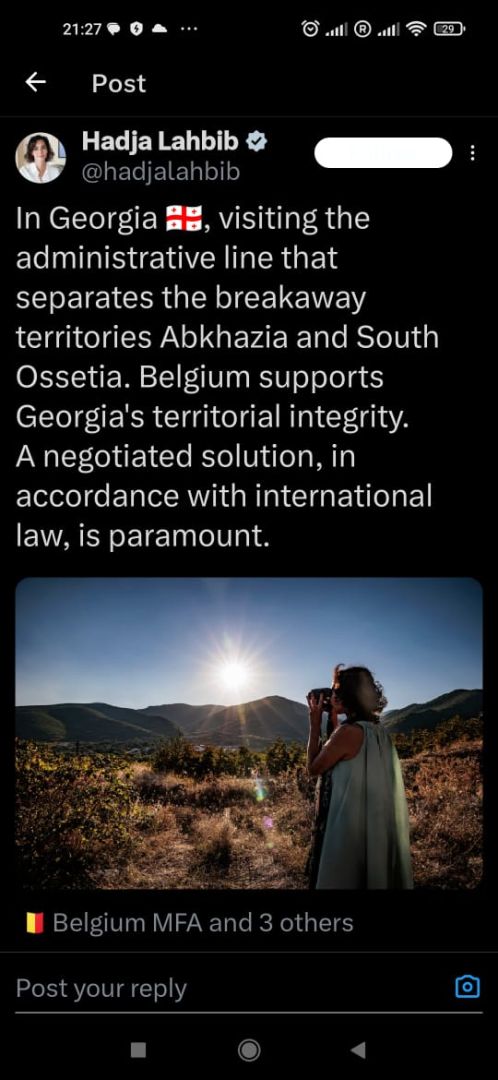
It would not be wrong to say that the issue of Georgia in the South Caucasus is at the same level as Garabagh. It is good that Hadja Lahbib one in her lifetime could express an honest and objective position on this issue. Following the European Union mission team, the so-called diplomat, who was watching the territories with binoculars in her hand, allegedly demanded the recognition of Georgia’s territorial integrity within the framework of international laws. The question is, what is the problem with Azerbaijan, Mrs. Hadja? Why don’t your binoculars show Garabagh correctly? We have no doubt that Abkhazia and South Ossetia are occupied territories, and so is it, according to your opinion; then why is Garabagh strange to your statement?
You say that there is no question of self-determination of peoples in Abkhazia and South Ossetia. But when it comes to Garabagh, your opinions change 180 degrees, and you are not ashamed to even express biased opinions. But we were ashamed for you. We are ashamed that you, as a diplomat, destroyed the image of the Council of Europe and the Parliament of the European Union and masterfully demonstrated your diplomatic illiteracy. At least you should be abashed to refuse to come to Azerbaijan after your rascal behavior. You deserve to bow only to the invading soldier. I am afraid to say that even though Azerbaijan remains true to its diplomatic culture while coming here, the spirits of our Martyrs over these lands will not leave you alone. So we strongly advise you not to come at all. Maybe this will calm your “honor” and “conscience” sold for some pennies…
—
Elnur Enveroglu is AzerNews’ deputy editor-in-chief, follow him on @ElnurMammadli1
Follow us on Twitter @AzerNewsAz
posted on Sep 16 2023 12:33:57 UTC via cepa.org
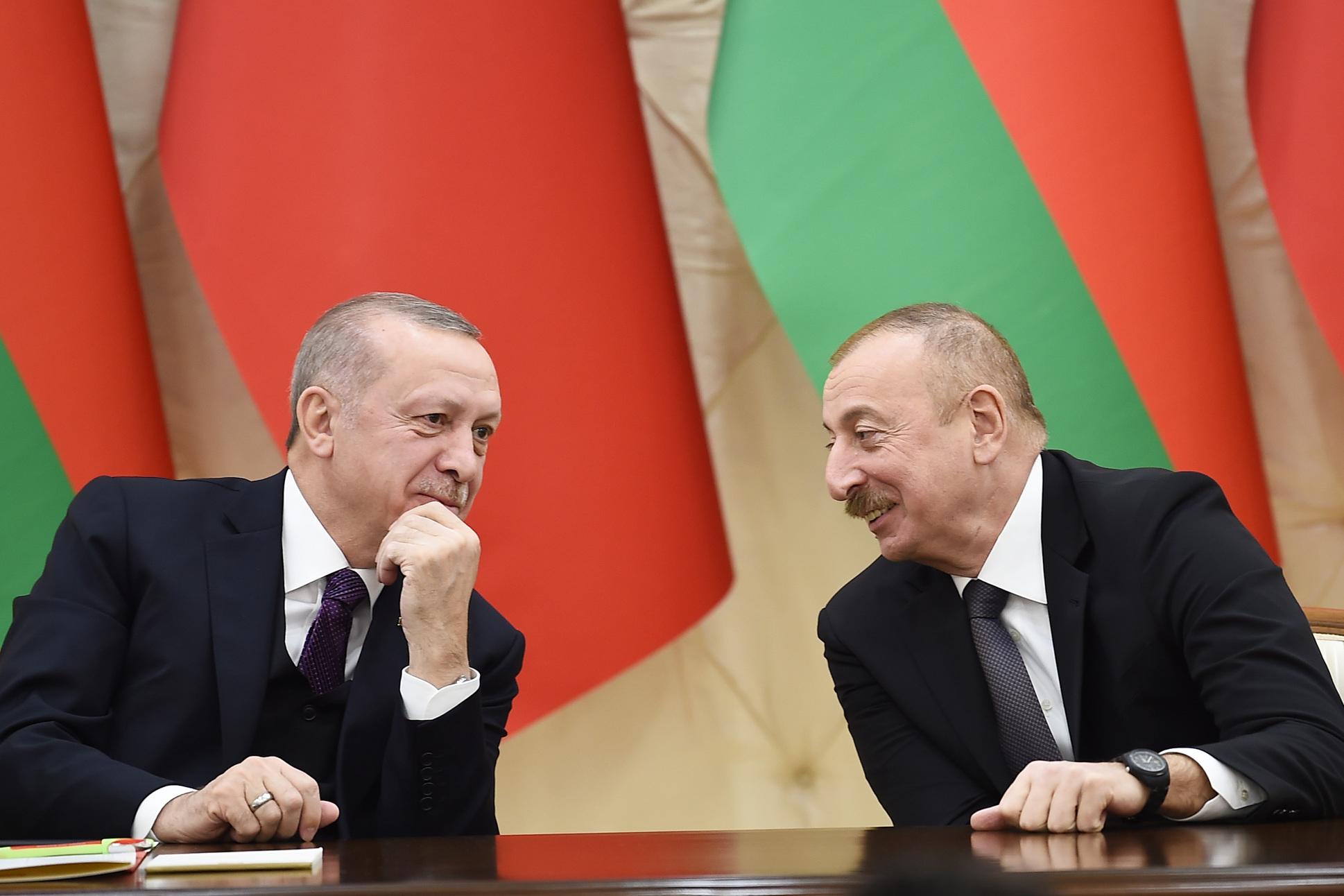
Turkey’s brinksmanship in the South Caucasus puts a spotlight on tensions within NATO.
On Friday, the foreign ministers of Armenia and Azerbaijan flew to Moscow for ceasefire talks. A “humanitarian ceasefire” was announced earlier this week, but at the time of writing appears to have broken down. “Let those holding talks in Moscow know that it’s our territory and we won’t be making any concessions,” Azerbaijan’s president, Ilham Aliyev remarked of the prospects for peace on Friday, foreshadowing this week’s renewed violence. Currently at an advantage, Azerbaijan has little incentive to return to the negotiating table.
In the past, when tensions around Nagorno-Karabakh flared up, neither side gained sufficient advantage to force the other side into concessions. By default or design, Moscow has ended up as an arbiter. This time, however, Turkey seems to be tipping the scales in Azerbaijan’s favor, with the other two regional powers, Russia and Iran, pleading for peace. In an unlikely turn, Western leaders today find themselves in the unlikely position of being more aligned with governments in Moscow and Tehran than their own NATO ally.
Aggressively backing Azerbaijan is in line with Turkey’s increasingly assertive, interventionist foreign policy developed under President Recep Tayyip Erdoğan. Turkey has pursued unilateral military interventions in Syria and Libya, pressured Greece and Cyprus over expanding maritime borders, and is now backing Azerbaijan’s territorial cause in the South Caucasus. Its military interventions in Syria and Libya have been condemned by many European countries, and with French leadership, the EU has threatened Turkey with sanctions over the Mediterranean maritime border dispute.
The security guarantees afforded by its NATO membership may be emboldening Turkey to use military force when it knows that deterrence keeps adversaries at bay. Especially in the South Caucasus, it’s conceivable that Turkey’s strategists are calculating they can escalate conflicts without fear of Russia directly retaliating on Turkish soil. Early last week, Turkey’s foreign minister was downright dismissive of Russian calls for an immediate ceasefire on his visit to Baku.
Russia has every reason to want to do something about Turkish behavior. As Samuel Ramani, a DPhil candidate in the Department of Politics and International Relations at the University of Oxford, pointed out, “[Russia] views Turkey’s seamless integration of Syrian proxy militias alongside the Azerbaijani military as worrisome, as that show that Ankara could mobilize Syrians for its own purposes effectively in more places that just Libya.” Unanswered provocations send signals of their own.
That said, Turkey does not have a completely free hand in the region either. Earlier in the conflict, Armenia accused Turkey of shooting down one of its military jets, which Turkey vehemently denied. Armenia is a member of the Collective Security Treaty Organization (CSTO), a Russian-led alliance modeled on its North Atlantic adversary. The CSTO is often dismissed as a paper tiger, but its existence complicates the calculus of all the players. Russia’s prestige in the region, as well as its credibility as a security provider, is on the line, and we do not know to what extent Turkey is willing to test these commitments. For now, the CSTO’s involvement is mostly a question of escalation—whether there is a credible threat on Armenian soil. The CSTO’s treaty obligations do not extend to Nagorno-Karabakh (which is not part of Armenia and which even Armenia has not recognized as independent), so there is ample gray area for Turkey to act. Known tensions between Putin’s regime and the government of Nikol Pashinyan could also prompt Turkish brinksmanship.
Get the Latest
Sign up to receive regular emails and stay informed about CEPA’s work.
Neighboring Iran is the other uneasy and interested spectator in the region. The country has enjoyed a close relationship with Armenia, but it has a sizeable Azeri minority living within its borders (representing 16% of Iran’s total population, more than the total number living in Azerbaijan proper). The leadership in Tehran cannot afford to alienate either side. At the same time, it also wants to avoid spillover of regional violence and is eyeing Turkey’s presence at its borders. So despite attempts to signal a neutral stance, Iran has allowed Russia to transport military supplies through to Armenia.
Nicole Grajewski, an international security fellow at Harvard’s Belfer Center, noted Iran’s seriousness in taking on a mediator role in alleviating the conflict, but highlighted the geostrategic difficulties facing any settlement. While Russia and Iran would prefer a return to the pre-July status quo and may want to re-freeze the conflict as quickly as possible, Turkey has incentives to push on for longer. Part of the motivation is domestic; saber-rattling nationalists upset with Turkey’s humiliation in the current Greece talks need to be deflected. But, Ramani says, Turkey does not want to risk pushing Russia and Iran away simultaneously, thereby both further intensifying its international isolation and straining peace negotiations in Syria.
Thus far, the West has gone missing in the conflict. This is attributable to a lack of on-the-ground presence on the one hand, as well as to uncertainty at getting involved in a complicated fight where Turkey, Russia, and Iran already dominate. Still, allowing a NATO member to court conflict so openly hardly seems like optimal policy. CEPA’s Lauren Speranza thinks NATO needs to find a way to help de-escalate the situation at a higher level, as the United States tried to do with Russia in Syria. For better or for worse, Erdoğan’s Turkey is an ally, and the Alliance will have to stand by it. The goal has to be to avoid an unintended escalation spiral should either Russia or Turkey somehow miscalculate.
Letting Russia, Turkey and Iran take the lead on brokering peace—or another ceasefire—may be the best available option, even if prospects for a lasting agreement are dim under such leadership. Western leaders, however, can’t afford to be complacent. Even the best-case outcome in Nagorno-Karabakh should lead to serious soul-searching in the Alliance. Having an erratic and increasingly authoritarian regime as a partner poses risks all its own.
Europe’s Edge is CEPA’s online journal covering critical topics on the foreign policy docket across Europe and North America. All opinions are those of the author and do not necessarily represent the position or views of the institutions they represent or the Center for European Policy Analysis.
Europe’s Edge
CEPA’s online journal covering critical topics on the foreign policy docket across Europe and North America.

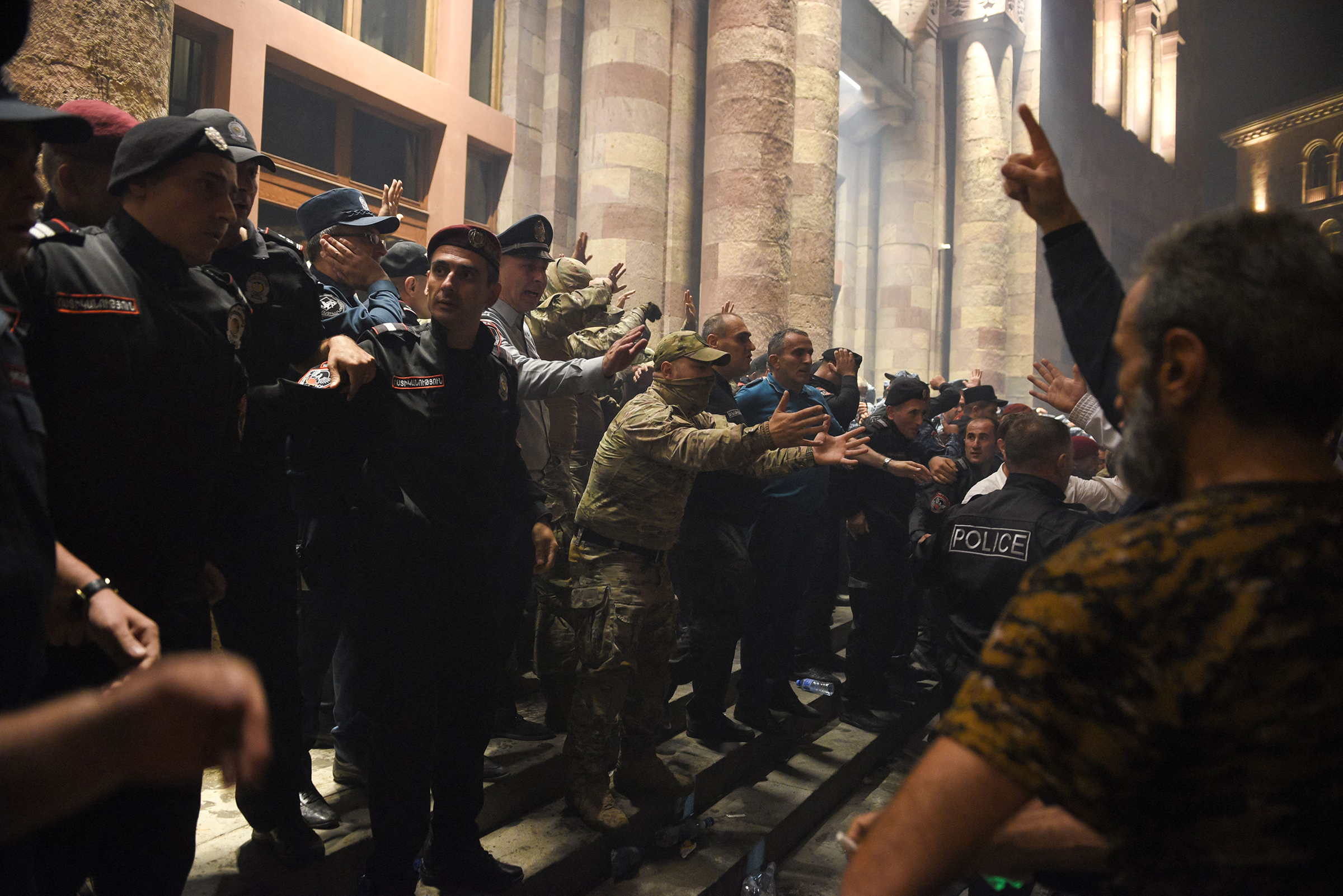 Protesters clash with police as they call on Armenian Prime Minister Nikol Pashinyan to resign in central Yerevan on Sept. 19. Azerbaijan launched a military operation against the the disputed Nagorno-Karabakh region, warning it would “continue until the end” in the territory.Karen Minasyan—AFP/Getty Images