Categories
Audio Review - South Caucasus News

Armenian, French FMs discuss situation created in Nagorno Karabakh as a result of Azerbaijani aggression


Armenian Foreign Affairs Ararat Mirzoyan had a meeting with the Minister of Europe and Foreign Affairs of the French Republic Catherine Colonna, on the sidelines of the 78th session of the UN General Assembly in New York.

In follow-up to discussions and the urgent session of the UN Security Council on September 21, the situation created by Azerbaijan’s aggression against the people of Nagorno Karabakh was discussed.

Reference was made to the general security situation created in the South Caucasus, as well as to the issues of interaction within the framework of international organizations, the RA-EU partnership agenda.


Categories
Audio Review - South Caucasus News

Senator Gary Peters leads Congressional delegation to Armenia


U.S. Congressional Delegation led by Senator Gary Peters (D-MI) visits Armenia on September 22-25, the U.S. Embassy in ARmenia informs.

Senator Peters will meet with Prime Minister Pashinyan, Speaker of the National Assembly Alen Simonyan, Deputy Foreign Minister Paruyr Hovhannisyan and other stakeholders to discuss U.S.-Armenian relations and the impact of Azerbaijan’s recent military actions on the Armenian population of Nagorno-Karabakh.

He will participate in a wreath laying ceremony at the Armenian Genocide Memorial. Senator Peters will also travel to Syunik to meet with local officials and discuss the security and humanitarian challenges.


Categories
Audio Review - South Caucasus News

The Daily Beat: 22 September


Reporting before the parliament, Economy Minister Levan Davitashvili revealed that Chinese-Singaporean and Swiss-Luxemburg consortia are among the finalists of the Anaklia Deep Sea Port private partnership selection competition. According to Levan Davitashvili, no Russian companies participated in the selection competition.


Head of the Office of Sanctions Coordination at the US Department of State, Ambassador James O’Brien, reacted to the NBG’s recent decision over the US-sanctioned Partskhaladze, stressing that the independent National Bank is crucial to the country’s robust economy. In a written communication with Georgian online media outlet Accentnews, Ambassador O’Brien said he is concerned with the NBG’s decision and warned of the sanctions risk for those who conduct transactions with individuals and entities under international sanctions, including former Prosecutor General Otar Partskhaladze.


Opposition representatives and civic activists held a protest rally in front of the parliament building, expecting Interior Minister Vakhtang Gomelauri, summoned by the parliamentary opposition through an interpellation procedure over the Shovi tragedy. Under the banner reading “Arrest the Russian Agent Otar Partskhaladze,” demonstrators called for prosecuting FSB-linked Otar Partskhaladze” and an investigation into the Shovi tragedy, citing allegations of government negligence.


Interior Minister Vakhtang Gomelauri dismissed the allegations raised by the parliamentary opposition over the failure of early warning and delays in the rescue operation during the Shovi landslide. Minister Gomelauri further claimed that the rescue operation would not be safe at night even with a modern helicopter, noting that the Ministry’s Mi-8 helicopter is used in search and rescue operations. Parliamentary opposition believes that the lack of an early warning system and delays in the rescue efforts contributed to the Shovi tragedy, accusing the minister of unprofessionalism and negligence.


Parliament adopted the controversial Defense Code, overhauling the compulsory military service. Under the revised Defense Code, effective from 2025, all conscripts will be under the exclusive jurisdiction of the Defense Ministry, departing from previous practice.  The revised Defense Code also foresees a substantial fee increase for postponing conscription, allowing for only one one-year deferral for conscripts under 25.


Late Friday evening, a member of the Tbilisi City Council from the opposition United National Movement (UNM), Irakli Edzgveradze, was assaulted and severely beaten in the Gldani district of Tbilisi, allegedly by the ruling Georgian Dream (GD) supporters. Edzgveradze claimed the attack was a follow-up to the confrontation between him and Tbilisi Council’s GD member Kote Zarnadze. According to media reports, several UNM members, including ex-leader Melia, were also beaten and detained by the police.


A source close to Russia-occupied de facto Tskhinvali authorities revealed to the local media outlet “Sapa Tskhinval” that restoring the transit route from Georgia to Russia through South Ossetia under equal conditions is entirely acceptable and even crucial for Tskhnvali. According to some Russian online media outlets, the possibility of restoration of the transit route through South Ossetia was discussed at the Russo-Georgia Business Council held in Vladikavkaz.


Categories
Audio Review - South Caucasus News

Negotiations underway between Nagorno-Karabakh and Azerbaijan on withdrawal of troops


Negotiations underway between Nagorno-Karabakh and Azerbaijan on withdrawal of troops
15:07, 22 September 2023

STEPANAKERT, SEPTEMBER 22, ARMENPRESS. Negotiations brokered by Russian peacekeepers are underway between Nagorno-Karabakh representatives and the Azerbaijani side on organizing a process of withdrawal of troops and ensuring the return of evacuated citizens to their settlements after the military aggression, the Nagorno-Karabakh InfoCenter reported.

The procedure of entering and exiting NK for citizens is also under discussion.


Categories
Audio Review - South Caucasus News

US Pledges New Aid for Haiti, Urges UN to Authorize Security Mission


The United States on Friday unveiled $65 million more in help for Haiti’s police and urged the U.N. Security Council to formally back the deployment of a multinational security mission to help the Caribbean country fight crippling gang violence.

Speaking at a meeting in New York to address the security situation in Haiti, U.S. Secretary of State Antony Blinken said the mission, led by Kenya, could deploy “within months.”

“We really have no time to lose,” Blinken said.

Haiti last year asked for help to combat violent gangs that have largely overrun the capital Port-au-Prince. The council could vote as soon as next week, diplomats said, on a U.S.-drafted resolution supporting a multinational police deployment.

While not providing any troops, Blinken said the Biden administration will work with the U.S. Congress to provide $100 million to back the multinational mission with logistical and financial assistance. This could include intelligence support, airlift, communications and medical support, he said.

The $65 million announced Friday will aim to bolster the Haitian police capacity to dismantle the gangs, Blinken said. The U.S. was also imposing new visa bans on former and current Haitian officials whom Blinken said were enabling the violence.

Washington supports Kenya’s vision for a three-part security mission that includes helping Haitian police, ensuring security for static installations and thoroughfares and strengthening law enforcement in the long term, Blinken said.

Kenyan President William Ruto told the General Assembly on Thursday: “We must not leave Haiti behind.”

Countries have been wary of supporting the unelected administration of Prime Minister Ariel Henry, who has said fair elections cannot be held with the current insecurity. Haiti has been without any elected representatives since January.

“My interim government is determined to hold elections as soon as practically possible,” Henry told the General Assembly on Friday, adding that security in Haiti had deteriorated to a “critical point” as “criminals feel that they are all powerful.”

“I am asking for help to allow Haitians to stay in their homes,” he said, again requesting “help to bolster the national police of Haiti so that it can truly respond to the challenges it faces” and for Security Council authorization for that help.

Haiti’s most powerful gang leader this week called for the armed overthrow of Henry, urging Haitians to take to the streets against the unelected government.

U.N. Secretary-General Antonio Guterres said in a report to the council last month that a “robust use of force” by a multinational police deployment and the use of military assets were needed to restore law and order in Haiti and disarm gangs.

A multinational police deployment would not be a U.N. mission.


Categories
Audio Review - South Caucasus News

Sudan’s Army Chief Says He Favors Negotiated Settlement to War


Sudan’s army chief said Friday he had not sought military support on a recent regional tour and that his preference was for a peaceful solution to the conflict that has killed thousands and displaced millions of civilians.

General Abdel Fattah Burhan also said in an interview with Reuters that he had asked neighboring states to stop sending mercenaries in support of the paramilitary Rapid Support Forces.

War between the army and the RSF broke out in mid-April over plans for a political transition and the integration of the RSF into the army, four years after long-time ruler Omar al-Bashir was overthrown in a popular uprising.

“Every war ends in peace, whether through negotiations or force. We are proceeding on those two paths, and our preferred path is the path of negotiations,” Burhan said on the sidelines of the United Nations General Assembly in New York.

Burhan added that he believed that stalled talks by Saudi Arabia and the United States in Jeddah could still succeed.

Burhan has made a series of foreign visits in recent weeks after remaining in Sudan for the first months of the war. The purpose was to seek solutions, not military support, though he had asked other states to block external help that he asserts the RSF is receiving, he said.

“We asked our neighbors to help us monitor the borders to stop the flow of mercenaries,” Burhan said.

RSF leader Mohamed Hamdan Dagalo, known as Hemedti, said in a video speech released Thursday to coincide with an address by Burhan to the U.N. General Assembly that he was ready for a cease-fire and political talks.

Previous claims by both sides that they want peace and are ready for cease-fires have failed to stop bloodshed.

Witnesses say the army’s bombardments have caused civilian casualties and that the RSF is responsible for widespread looting, sexual violence and other abuses, as well as participating in ethnically targeted attacks in Darfur.

Burhan on Friday dismissed accusations against the army as propaganda by its rivals. The RSF has denied it is behind the violence in Darfur and will hold its men accountable for abuses.

Burhan said that army deployment in El Geneina, which suffered the worst mass killings in Darfur, has been limited, hindering their ability to respond.

The violence peaked after the governor of West Darfur was killed June 14. Burhan said he told the governor to seek protection at a military camp, but the governor rejected that.

“The armed forces present in El Geneina are not sufficient in number to spread out in every area,” he said.


Categories
Audio Review - South Caucasus News

Top Russian Officer Among Troops Killed During Azerbaijan’s Attack On Nagorno-Karabakh


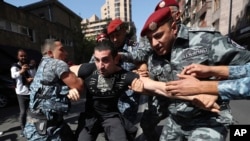
Police officers detain a demonstrator during a protest against Prime Minister Nikol Pashinyan in Yerevan on September 22.

Police officers detain a demonstrator during a protest against Prime Minister Nikol Pashinyan in Yerevan on September 22.

YEREVAN — Dozens of people have been detained as anti-government protests continued in the Armenian capital on September 22.

Armenian police said after noon local time that 84 people had been detained and charged with disobeying police orders. Armenian opposition groups later claimed some 350 supporters had been detained.

The developments came after opposition leaders called for street blockades and other protest actions to be held on September 22 in an effort to force Prime Minister Nikol Pashinian from power.

Protesters have vowed to continue their action until Pashinian is removed and have said they plan to disrupt a meeting of his cabinet expected later in the day.

Police, who have used stun grenades during clashes with demonstrators since protests began in Yerevan on September 20, had warned that they would implement “special measures” if the clashes continued.

Police reportedly detained one of the protest organizers, Andranik Tevanian, during the demonstrations on September 22. The former parliamentarian was released after being questioned by the Investigative Committee.

Tevanian said during demonstrations on September 21 that “with disciplined and united efforts” Pashinian’s ouster as prime minister “will happen in a very short time, even within days.”

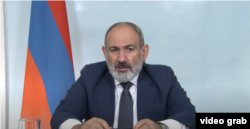
Embattled Armenian Prime Minister Nikol Pashinian


Embattled Armenian Prime Minister Nikol Pashinian

A son of Armenia’s former President Robert Kocharian, Levon Kocharian, was among the detained protesters. His lawyer said law enforcement officers “severely beat” his client during his apprehension.

Pashinian has come under criticism for the government’s response to Azerbaijan’s lightning offensive earlier this week against Nagorno-Karabakh, an Azerbaijani territory that has a large ethnic Armenian population.

Azerbaijan has claimed that the offensive, which it describes as an “anti-terrorist operation,” has brought the breakaway region back under its control.

Pashinian told his government on September 22 that Yerevan would accept an influx of ethnic Armenians if they chose to leave Nagorno-Karabakh, but that such a massive resettlement would only occur if it became impossible for them to remain there.

Demonstrators have decried what they call inadequate government support for the ethnic Armenians in Nagorno-Karabakh, while opposition leaders have announced plans to initiate impeachment proceedings against Pashinian.

As anti-government demonstrators blocked roads and assembled in Yerevan’s central Republic Square on the morning of September 22, Pashinian expressed hope that ethnic Armenians living in Nagorno-Karabakh can remain there.

WATCH: Thousands of ethnic Armenians gathered at Nagorno-Karabakh’s only airport where Russian peacekeepers are based. They were seeking protection and possible transit to Armenia following two days of fighting.

Azerbaijan, meanwhile, has reportedly indicated it envisages an amnesty for Armenian fighters in Nagorno-Karabakh who give up their arms amid a tentative cease-fire that stopped the fighting, which broke out when Azerbaijani forces launched a 24-hour military offensive on September 19-20.

“Even with regard to former militaries and combatants, if they can be classified in such a way, and even for them we are envisaging an amnesty or alluding to an amnesty as well,” Hikmet Hajiyev, a foreign policy adviser to Azerbaijani President Ilham Aliyev president, told Reuters.

Hajiyev also said that ethnic Armenians in Nagorno-Karabakh have asked for humanitarian aid, which he said would begin to arrive on September 22. Media reports said at least four trucks with aid were seen headed toward Nagorno-Karabakh along the Agdam corridor that runs through Azerbaijan.

Hajiyev said that Baku seeks the peaceful reintegration of Karabakh Armenians.

The ethnic Armenian leadership of Nagorno-Karabakh said on September 22 that an agreement had also been reached for humanitarian aid to be trucked in from Armenia. The leadership said, however, that there had been no deal on security guarantees sought by Karabakh Armenians in exchange for giving up their weapons, or regarding a possible amnesty proposed by Baku.

On September 21, representatives of Azerbaijan and the ethnic Armenian leadership of the breakaway region failed to reach a breakthrough during closely watched “reintegration” talks in the western Azerbaijani city of Yevlax.

The two sides exchanged accusations and denials over reports of gunfire and apparent cease-fire violations in Nagorno-Karabakh’s de facto capital, Stepanakert, but more meetings are expected.

Separatist leaders in Nagorno-Karabakh said in a statement following the meeting that they were ready to continue talks with Azerbaijani authorities.

“The parties especially stressed the need to discuss all existing issues in a peaceful environment, noting the readiness to continue meetings,” the statement said.

Pashinian said on September 22 that the situation remains tense in Nagorno-Karabakh, internationally recognized as part of Azerbaijan but which has enjoyed de facto independence since breaking away in a war in the 1990s.


Photo Gallery:

During a short but bloody war in 2020, Azerbaijan recaptured much of the territory as well as seven surrounding districts that had been controlled since the 1990s by ethnic Armenians with Yerevan’s support.

Some 120,000 ethnic Armenians live in Nagorno-Karabakh, and Pashinian on September 22 expressed optimism that they can get a real opportunity to return to their homes. At the same time, Pashinian noted a dire humanitarian crisis continues in Nagorno-Karabakh.

In a nationwide address on September 21, Aliyev declared victory in the offensive launched by his forces on September 19 after Baku accused “Armenian sabotage groups” for two separate deadly explosions in areas of Nagorno-Karabakh that are under the control of Russian peacekeepers.

The same day, UN Security Council members including the United States, Turkey, Russia and France called for peace, while Armenian and Azerbaijani officials traded barbs.

Armenian Foreign Minister Ararat Mirzoian, who called for the emergency meeting, accused Baku of an “unprovoked and well-planned military attack” and said Azerbaijan was likely to use force against civilians in Nagorno-Karabakh again unless prevented by global powers.

Azerbaijani Foreign Minister Jeyhun Bayramov countered by accusing Yerevan of spreading misinformation, insisting that Baku had carried out an anti-terrorism operation against Armenian forces.

The offensive was halted on September 20 after Karabakh’s ethnic Armenian leadership accepted a cease-fire proposal by the Russian peacekeeping mission, although sporadic fighting has been reported.

Nagorno-Karabakh human rights ombudsman Gegham Stepanian has said that at least 200 people, including 10 civilians, were killed and more than 400 others were wounded in the fighting.

RFE/RL could not independently confirm the casualty figures.

Azerbaijan’s Prosecutor-General’s Office on September 21 said six Russian peacekeepers had been killed during Baku’s military offensive, five “by mistake” by Azerbaijani forces and one by Karabakh Armenian fighters.

With reporting by Reuters and TASS

Categories
Audio Review - South Caucasus News

Artsakh Defense Army Disarms, Withdraws from Positions


The Artsakh Defense Army on Friday withdrew from its positions as part of a deal reached on Thursday when representatives from Stepanakert and Baku met in Yevlakh.

The disarming of the armed forces was also part of a Russian-brokered ceasefire agreement, backed by the Artsakh authorities, which ended Azerbaijan’s latest large-scale attack on Artsakh that left 200 people dead and hundreds injured, homeless and displaced.

“In fulfilling of the agreements on the cessation of hostilities reached through the mediation of the command of the Russian peacekeeping troops, the delivery of weapons and ammunition to the units of the Nagorno-Karabakh Defense Army has begun, under the supervision of Russian servicemen,” the Russian peacekeeping mission announced in a post off the Telegram social media site.

“The armed formations of Karabakh are withdrawing from their positions as part of the agreements reached during the meeting in Yevlakh. As of today, more than 800 firearms, grenades, mortars, guided anti-tank missiles and MANPADS have been surrendered,” the Russia peacekeeping mission added.

Based on the agreement, Russian peacekeeping forces will replace the Artsakh Defense Army at those positions.

Artsakh authorities said on Friday that there were no concrete results yet from talks with Azerbaijan on possible security guarantees or an amnesty that Baku is supposedly proposing.

“These questions must still be resolved,” David Babayan, the advisor of ArtsakhPresident Samvel Shahramanyan told Reuters. “There are no concrete results yet.”

Russian peacekeeping armored vehicles in Artsakh

“The situation is difficult – humanitarian questions need to be resolved. Agreement has been reached for a humanitarian convoy to come from Armenia via the Lachin corridor,” Babayan said.

Asked whether or not the Armenians of Artsakh were on the move, Babayan said there was no large-scale movement of people as the region was effectively under siege.

“The Lachin corridor does not work as it should,” he said. “At the present time, other questions need to be resolved.”

“The situation is very difficult: the people are hungry, there is no electricity, no fuel – we have many refugees.”

Reuters also reported that Baku may be considering amnesty for Artsakh soldiers who lay down their arms.

Azerbaijani presidential foreign policy adviser Hikmet  Hajiyev told Reuters that Baku is envisioning an amnesty for those Nagorno-Karabakh fighters who gave up their weapons.

“Even with regard to former militaries and combatants, if they can be classified in such a way, and even for them we are envisioning an amnesty or alluding to an amnesty as well,” Hajiyev said.
Karabakh Armenian rights would be respected as part of their integration into Azerbaijan, he said, adding that they had requested humanitarian support as well as oil and gasoline supplies. Three cargos of humanitarian help would be delivered to the region on Friday, he said.

“Currently we are seeing that some individual army groups and officers that made the public statements that they won’t come to our terms and will continue resistance,” Hajiyev said. “But we do not see that to be the biggest challenge, and big security challenge. Of course this will cause certain challenges and difficulties but not on a such a big scale.”


Categories
Audio Review - South Caucasus News

Armenia Urges UN Security Council to Prevent Ethnic Cleansing in Artsakh, Deploy Peacekeepers


Foreign Minister Ararat Mirzoyan on Thursday urged the United Nations Security Council to act and prevent ethnic cleansing in Artsakh and send UN-mandated peacekeepers there to maintain the security and stability.

Mirzoyan was speaking at a special session of the UN Security Council, which was called at the initiative of France, to address the large-scale military attack on Artsakh on Tuesday.

The majority of diplomats representing member states, including the United States, France, Germany and others, condemned Baku for its brazen attacks against the population of Artsakh and called on Baku to immediately reopen the Lachin Corridor and unlock access of humanitarian assistance to the people of Artsakh.

Also speaking that special Security Council session was the European Union’s foreign affairs chief, Josep Borrell, who warned Baku against the forced displacement of the Armenian population in Artsakh.

In his address, Mirzoyan said that the intensity and cruelty of the Azerbaijani attack against Nagorno-Karabakh makes it clear that Azerbaijan’s intention is to complete the ethnic cleansing of the Armenian population of Nagorno-Karabakh.

Below is the complete text of Mirzoyan’s statement.

Mr. President,
Distinguished colleagues,

I thank the Security Council for convening this urgent meeting to discuss the security and humanitarian situation in Nagorno-Karabakh stemming from unprovoked and well-planned military attack by Azerbaijan.

While the UN General Assembly’s session is underway and all the members of international community are gathered here to look for ways to maintain peace and security worldwide, while we all speak about the imperative to condemn use of force, prevent further loss of human lives caused by man-made disasters, while each of us comes here to contribute to peace, in our region in South Caucasus on 19th September Azerbaijan unleashed yet another large-scale offensive against the people of Nagorno-Karabakh, in blatant violation of the international law and Trilateral Statement of November 9, 2020. Literally the whole territory of Nagorno-Karabakh, Stepanakert and other cities and settlements came under intense and indiscriminate shelling with use of missiles, heavy artillery, combat UAVs and aviation, including prohibited cluster munition. The intensity and cruelty of the offensive makes it clear that the intention is to finalize ethnic cleansing of the Armenian population of Nagorno-Karabakh. 

Outcomes of this large-scale military operation clearly reveal their atrocious nature. Yet they are very preliminary as due to the targeted attacks against critical infrastructure, such as electricity stations, telephone cables and  stations and internet equipment, the population is completely cut-off from each other and is deprived of the possibility to present the real-time situation on the ground. Also, Azerbaijani troops control main roads in Nagorno-Karabakh which makes it impossible to visit and get information on the ground. 

For the time being there are confirmed cases of more than 200 killed and 400 wounded, including among civilian population, women and children, also accepted today by the
Azerbaijani Ministry of Foreign Affairs. More than ten thousand persons became forcibly displaced, including women, children, and elderly, who stay in the open air, without food and other means for subsistence. Thousands of families have been separated. Add to this around twenty thousand displaced persons from the 2020 war to see that there are enormous humanitarian needs on the ground.

People are still starving due to the severe shortages of food imposed by the ongoing 10-month blockade.

The healthcare system has been paralyzed. Hospitals have no electricity and are in a critical shortage of medicine. People are deprived of the opportunity to receive even first aid. Without fuel, ambulances cannot operate to take the wounded to hospitals.

The images coming from Nagorno-Karabakh are truly shocking: women, children, elderly people left without shelter and food, moms desperately trying to find their lost children, wives crying from fear that Azerbaijan may imprison their husbands. It’s hard to believe that all this is happening not a hundred years ago but today in front of the international community in the 21st century. The social media is full of Armenians from Nagorno-Karabakh searching for their children or relatives. The children that suddenly appeared to stay in shelters or even streets continue crying and asking their parents to take them home, refusing to recognize that they do not have a home anymore. During the shelling an eight-year boy has gone missing in one of the settlements of Nagorno-Karabakh, his brother ten years old was killed and his body has not been even possible to take out from the village. The other brother was injured. These are only examples of numerous cases. In the eyes of Azerbaijan these children are terrorists, and Azerbaijan’s actions, missiles, armored vehicles, artillery and UAVs were directed against those children, their parents and grandparents. 

The Azerbaijani social media segment is full of calls to find the missing children and women, to rape them, dismember and feed them to dogs. Azerbaijani users are sharing the profiles of Armenian women from Nagorno-Karabakh on social media making biddings on who will get those women to rape, when they are taken under Azerbaijani custody.

Colleagues, 
This was feasible, the clear signs were there. We have been alarming for a long time now. The international community refused to take it seriously enough. 

The current aggression came as a culmination of a 10-months-long blockade of the Lachin corridor and forced starvation imposed on the people of Nagorno-Karabakh. Severe shortage of food, medicine, fuel, natural gas, electricity and other essential goods had already brought the vulnerable people of Nagorno-Karabakh to the brink of humanitarian catastrophe. One should be naive to think that this was not precisely thought through ever since or even before the institutionalization of the inhumane blockade with the aim of bringing down the will and ability of the people of Nagorno-Karabakh to resist and maintain their lives and livelihood in their ancestral homeland. The Azerbaijani aggression that unfolded with explicit barbarity and deliberate targeting of civilian populations and infrastructure was the final act of this tragedy aimed at the forced exodus of the people of Nagorno-Karabakh.

  • When the International Court of Justice on February 22 and July 6, 2023, adopted legally binding orders and they were disrespected by Azerbaijan- this Council as an august body meant to ensure the implementation of ICJ orders failed to react adequately,
  • When Azerbaijan blocked the Lachin cCorridor and we called for urgent meeting of the UNSC in December 2022 – this Council failed to react adequately, 
  • When in April Azerbaijan installed illegal check-point in the Lachin cCorridor and later started to kidnap people, including ones under the protection of international humanitarian law,- international community failed to undertake adequate measures,
  • When Armenia called again for another UNSC urgent session in August 2023 – warning about the fragile security and humanitarian situation and calling the Council to use its toolbox to address all the issues and not let people of Nagorno-Karabakh behind, this Council failed to react adequately,

During the days prior to September 19’s Azerbaijani aggression when Armenia was raising alarm about feasible use of force by Azerbaijan and seeking for concrete measures and actions to prevent this scenario – international community reacted to our warning with skepticism.

Now when Azerbaijan has already restarted to use force against the people of Nagorno-Karabakh, when these this people are forcefully deported from their houses and are at danger to be forcefully deported from their homeland, when many who have been defending their families and their right to live in freedom and dignity in their homeland for the last 30 years are at danger of mass arrests and prosecution, when we have a situation where there is not an intent any more, but clear and irrefutable evidences of policy of ethnic cleansing and mass atrocities – the Security Council of the United Nations must act.

Despite accepting all demands of the Azerbaijani side in order to stop the bloodshed and ongoing talks today, the people of Nagorno-Karabakh were again subjected to attacks using different caliber weapons and mortars, thus forcing the civilians once again to seek shelter in the basements. We believe such attacks and further persecutions will continue unless there is a clear international action. 

By the way, regarding the mentioned demands, I would like to state very clearly and unequivocally that the Republic of Armenia was not part of those discussions and we resolutely reiterate that the claims and references to the presence of any military personnel of the Armed Forces of the Republic of Armenia in Nagorno-Karabakh do not correspond to reality. 
In this attempt we clearly see the intention of some actors to involve the Republic of Armenia in military actions thus transferring the hostilities into our sovereign territories. The position of Armenia firmly remains the same: we should establish peaceful relations based on mutual recognition of sovereignty and territorial integrity, which certainly cannot be anyhow misinterpreted and used as a license for mass atrocities, including ethnic cleansings in Nagorno-Karabakh. The rights and security of the Armenian people of Nagorno-Karabakh must be properly addressed and internationally guaranteed.

There is also another very important aspect regarding the parties involved. As I noted some of you in your statements still make general calls to the sides of conflict. This approach and this terminology are not relevant any more. There are no more sides of the conflict but perpetrators and victims. There is no more conflict but a real danger of atrocity crime. Is it still possible to prevent it now? We are here because we believe so. Because we still believe in humanity, in international law and in the ability of the Security Council to act decisively when lives of thousands are at stake.

Mr. President, 
Against this backdrop, time and again, I appeal to the Security Council to demonstrate its credibility and reputation by undertaking the following urgent measures:

  • To condemn the resumption of hostilities and targeting of civilian settlements and infrastructure,
  • To demand full compliance with obligations under the international humanitarian law, including those related to the protection of civilians, in particular women and children, and critical civilian infrastructure;
  • To immediately deploy an interagency mission by the UN to Nagorno-Karabakh with the aim to monitor and assess the human rights, humanitarian and security situation.
  • To ensure unimpeded access of the UN agencies and other international organizations to Nagorno-Karabakh in line with the humanitarian principles.
  • To ensure full cooperation of the parties in good faith with the International Committee of the Red Cross to address the consequences of the military actions, including the removal and identification of the bodies, search and rescue of personnel missing in action, release of POWs, safe and unimpeded delivery of humanitarian assistance, in strict compliance with the international humanitarian law. 
  • To ensure the return of persons displaced in the course of the recent aggression, as well as persons and refugees displaced as a result of 2020 war, to their homes in the territory of Nagorno- Karabakh and adjacent regions under the monitoring and control of the UN relevant agencies, as it was foreseen in the Trilateral Statement of November 9, 2020.
  • To ensure immediate restoration of vital supplies, including food, medicine, fuel, gas and electricity.
  • To demand the immediate restoration of freedom and security of movement of persons, vehicles and cargo, along the Lachin corridor, in line with the ICJ orders.
  • To ensure a sustainable international mechanism of dialogue between representatives of Nagorno-Karabakh and official Baku to address the issues related to rights and security of the Armenians of Nagorno-Karabakh.
  • To demand exit of any Azerbaijani military and law-enforcement bodies from all civilian settlements in Nagorno-Karabakh NK to exclude panic, provocations and escalation, endangering civilian population until the results of the negotiations.
  • To exclude punitive action against Nagorno-Karabakh NK political and military representatives and personnel.
  • Create a possibility for a United Nations-mandated Peacekeeping Force to keep stability and security in Nagorno- Karabakh.

Finally, 
Mr. President,
Dear colleagues,

Let me mention that today we celebrate the Day of Independence of the Republic of Armenia and let me congratulate my compatriots on this very important and symbolic occasion. 

And I thank you.”


Categories
Audio Review - South Caucasus News

Baku Uses Pashinyan’s Remarks to Rebut Armenia and Criticism at U.N. Security Council


YEREVAN (Azatutyun.am)—The Azerbaijani government has cited a statement by Prime Minister Nikol Pashinyan to reject Armenian and Western criticism of its military offensive in Nagorno-Karabakh that displaced a large part of the region’s population.

Pashinyan insisted on Thursday that “there is no direct threat to the civilian population of Karabakh” after two days of heavy fighting that left dozens of Karabakh civilians dead and caused thousands of others to flee their homes. His statement sharply contrasted with what Armenian Foreign Minister Ararat Mirzoyan said during an emergency session of the UN Security Council just a few hours later.

Mirzoyan accused Azerbaijani forces of committing atrocities as part of “ethnic cleansing” in Karabakh planned by Baku. He pointed to “shocking” reports of children killed and unaccounted for and thousands of families displaced as a result of the offensive. The Karabakh Armenians are facing growing death threats made on Azerbaijani social media accounts, he said.

Addressing the Security Council, German Foreign Minister Annalena Baerbock and her French counterpart Catherine Colonna also condemned the Azerbaijani assault, citing its grave humanitarian consequences. The European Union’s foreign policy chief, Josep Borrell, expressed serious concern over the safety of Karabakh’s residents in a statement issued ahead of the council meeting.

“Forced displacement of the civilian population through military or other means will be met with a strong response by the EU,” warned Borrell.

U.S. Secretary of State Antony Blinken criticized Baku shortly after start of the Azerbaijani offensive, saying that it is “worsening an already dire humanitarian situation in Nagorno-Karabakh.”

Azerbaijani Foreign Minister Jeyhun Bayramov seized upon Pashinyan’s statement in his speech at the Security Council meeting.

“I want to bring the council’s attention to the fact that just a few hours ago the Armenian prime minister refuted these accusations, publicly admitting that there is no direct threat to civilians in Karabakh,” said Bayramov.

A senior aide to Azerbaijani President Ilham Aliyev likewise pointed to Pashinyan’s statement when he tweeted: “The unverified and unserious statements by the European Union, France and Germany are incomprehensible.”

Pashinyan on Friday stood by his claim strongly condemned by his political opponents. His press secretary, Nazeli Baghdasarian, denied any contradiction between the claim and Mirzoyan’s UN speech.

Two retired Armenian diplomats hit out at Pashinyan, portraying his remarks as further proof of his chaotic and incompetent rule.