Categories
Audio Review - South Caucasus News

Museveni: Airstrike Killed IS-Allied Rebels in DR Congo


Uganda’s President Yoweri Museveni said Saturday an airstrike by the east African country’s military had killed members of an Islamic State (IS)-allied rebel group including a key person responsible for bomb attacks in Uganda’s capital.  

The strike was carried out in neighboring Democratic Republic of Congo on September 16 and intelligence gathered after the strike had confirmed members of group, Allied Democratic Forces (ADF), had been killed, he said.  

“A lot of terrorists were killed, including the notorious Meddie Nkalubo, who has been the author of the bombs in Kampala,” Museveni said in a statement referring to Uganda’s capital. 

He did not say how many were killed.  

In December 2021 Uganda launched an operation in eastern Congo against ADF but the group still carries out attacks both against civilians and military targets in Congo and Uganda.  

In two of the group’s most devastating attacks in Uganda, suicide bombings in 2021 outside a major police station in Kampala and near the parliament building left seven people dead. 

In June this year, 42 people, mostly students, were massacred at a school in Kasese in western Uganda — another attack Uganda blamed on ADF. 

The rebel group is widely believed to seek to establish an Islamic rule in the east African country. 

It emerged in the 1990s in Uganda’s west but was eventually routed by the military and remnants fled into the jungles of eastern Congo where they have been operating from since then. 

ADF almost never send out statements and have not commented on the Ugandan raid.  


Categories
Audio Review - South Caucasus News

Head of Azerbaijan’s State Security Service meets with separatist leader in Shusha


Açiq mənbələrdən foto.

Açiq mənbələrdən foto.

Head of Azerbaijan’s State Security Service meets with separatist leader in Shusha

Baku/23.09.23/Turan: Head of Azerbaijan’s State Security Service Ali Nagiyev met with Karabakh “president” Samvel Shahramnian in Shusha on 22 September.

This is reported by Armen ……

Head of Azerbaijan's State Security Service meets with separatist leader in Shusha

Turan News Agency – turan.az https://turan.az

https://turan.az/img/turanlogo.gif

Baku/23.09.23/Turan: Head of Azerbaijan’s State Security Service Ali Nagiyev met with Karabakh “president” Samvel Shahramnian in Shusha on 22 September.

This is reported by Armenian TV journalist Tatul Hakobyan without disclosing the source.

According to him, this meeting was a continuation of the meeting in Yevlakh.

As is known, on 21 September in Yevlakh, representatives of Karabakh Armenians were handed over the demands and conditions of official Baku.

Apparently, at the meeting with Ali Nagiyev Shahramanyan gave an answer to Baku’s demands. Surely, humanitarian issues were also touched upon: delivery of wounded and humanitarian aid.

Official Baku did not inform about this meeting. -02B-


Categories
Audio Review - South Caucasus News

Multi-Day Protests Over Economic Crisis Grip Ghana’s Capital


Hundreds of demonstrators gathered in the Ghanaian capital Accra on Saturday for a third day of anti-government protests linked to economic hardship that have led to dozens of arrests. 

Protesters, some waving placards or the Ghanaian flag, decried the high cost of living and a lack of jobs as they marched under the watch of riot police. The gold-, oil- and cocoa-producing nation has been battling its worst economic crisis in a generation brought on by spiraling public debt. 

“The average Ghanaian can’t afford three square meals [per day] … the government doesn’t care,” said 24-year-old unemployed protester Romeo, who like others at the demonstration was wearing a red beret.

Police blocked the road to prevent protesters approaching Jubilee House, the seat of the presidency, which organizers Democracy Hub have vowed to occupy.  

On Thursday, police said 49 people had been detained for unlawful assembly and violating the public order act on the first day of the three-day action. There was no sign of further arrests and the situation appeared calm on Saturday. 

Last year, protests over soaring prices and other economic challenges led to clashes with police. 

The government sealed a $3 billion, three-year loan program with the International Monetary Fund in May, but detractors say the authorities have done too little to help those struggling to make ends meet amid the protracted downturn. 

Economic growth is forecast to slow to 1.5% this year from 3.1% in 2022. 


Categories
Audio Review - South Caucasus News

Karabakh Armenians Say Cease-Fire Being Implemented, Aid Arriving


The ethnic Armenian leadership of breakaway Nagorno-Karabakh said on Saturday that the terms of their cease-fire with Azerbaijan were being implemented, with work proceeding on the delivery of humanitarian aid and evacuation of the wounded. 

Earlier, the Karabakh Armenians held another round of talks with Azerbaijani officials in the town of Shusha, three days after the cease-fire that followed a 24-hour offensive in which Baku retook control of the mountainous region. 

Work is underway to restore electricity supplies by September 24, the Karabakh Armenians said in a statement that also referred to “political consultations” on the future of the region, which they call Artsakh, and its 120,000 Armenian residents. 

Russia’s defense ministry said that, under the terms of the cease-fire, the Armenian separatists had begun handing over their weapons to Azerbaijan, including more than 800 guns and six armored vehicles. Moscow has 2,000 peacekeepers in the area. 

With Armenians suffering serious shortages of food and fuel after a months-long de facto Azerbaijani blockade, an aid convoy of the International Committee of the Red Cross headed into Karabakh on Saturday, the first since Baku’s offensive. 

The ICRC said in a later statement that the convoy had transported nearly 70 metric tons of humanitarian supplies, including wheat flour, salt and sunflower oil, along the Lachin corridor, the only road link from Armenia to Karabakh. 

An ICRC team also evacuated 17 people wounded during the fighting, it said. 


Separately, Russia said it had delivered more than 50 metric tons of food and other aid to Karabakh. 

More than 20 other aid trucks bearing Armenian license plates, have been lined up along a nearby roadside since July. Azerbaijan said at the time this convoy amounted to a “provocation” and an attack on its territorial integrity.  

Azerbaijan wants to integrate the long-contested region of Karabakh and has promised to protect the Armenians’ rights but says they are free to leave if they prefer. Armenians say they fear they will be persecuted if they stay. 

Azerbaijan’s interior ministry said on Saturday its main task was ensuring the safety of the Armenian civilian population and that it was providing them with tents, hot food and medical assistance.  

“We are also working on issuing documents to the Armenian population, passports and so on,” ministry spokesman Elshad Hajiyev told Reuters. “There are already people who have applied to us.” 

U.S. Senator Gary Peters, who visited the Armenia-Azerbaijan border on Saturday, said the situation in Karabakh required international observers and transparency from Azerbaijan. 

“We’ve heard from the Azerbaijani government that there’s … nothing to worry about, but if that’s the case, then we should allow international observers in to see,” Peters, a Democrat from Michigan, told reporters. 


Armenia, which lost a 2020 war to Azerbaijan over the region, has prepared space for tens of thousands of Armenians from Karabakh, including at hotels near the border, though Prime Minister Nikol Pashinyan says he does not want them to leave their homes unless it is absolutely necessary. 

Azerbaijan launched what it called its anti-terrorist operation on Tuesday against Nagorno-Karabakh after some of its troops were killed in what Baku said were separatist attacks. 

Karabakh was more militarized than Baku realized, Hikmet Hajiyev, foreign policy adviser to Azerbaijan’s president, said on social media on Saturday, publishing a list of weapons and ammunition that had been seized in the past three days, including four tanks, 300 explosives and 441 mortar shells. 

Accounts of the fighting were chilling. 

Armenui Karapetyan, an Armenian in Karabakh, said he was now homeless, holding just a few possessions and a photograph of his 24-year-old son who died in 2020 after leaving his home in the village of Kusapat.

“Today we were thrown out into the street — they made us vagabonds,” Karapetyan told Armenia A1+, a partner of Reuters. 

“What can I say? We live in an unfair, abandoned world. I have nothing to say. I feel sorry for the blood of our boys. I feel sorry for our lands for which our boys sacrificed their lives, and today … I miss the grave of my son.” 

Thousands of Karabakh Armenians massed at the airport seeking the protection of Russian peacekeepers there. 

Svetlana Alaverdyan, from the village of Arajadzor, said she fled with only the clothes on her back after gun fights gripped the village. 

“They were shooting on the right, they were shooting on the left — we went out one after another, without taking clothes,” she told Armenia A1+.  


Categories
Audio Review - South Caucasus News

New Armenian-Azerbaijani meeting follows Yevlakh talks, Artsakh President participates


default.jpg

Following the negotiations in Yevlakh, new contacts between Armenia and Azerbaijan have taken place. Journalist Tatul Hakobyan shared this development on his Facebook page.

“On September 22, the President of Artsakh, Samvel Shahramanian, traveled from Stepanakert to Shush, where he met with the head of the State Security Service of Azerbaijan, Ali Nagiyev.

I won’t delve into the details of this meeting, but I’d like to highlight the significance of such contacts during these challenging times. It’s regrettable that the Artsakh authorities recognized the importance of direct communication only after our people experienced another tragedy. That’s all for now,” he wrote.

!

This text available in   Հայերեն

Print


Categories
Audio Review - South Caucasus News

Three Palestinians Wounded in Clashes on Israel-Gaza Border


Three Palestinians were wounded in clashes along the Israel-Gaza border Saturday, Palestinian officials said, as the Israeli military said it was striking Hamas targets in Gaza in response to riots. 

In what appears to be a renewed wave of violence on the border, Palestinians in Gaza have been holding protests along the separation fence for eight consecutive days, breaking from a period of relative calm. Youths have thrown stones and improvised explosive devices at Israeli troops, who have responded with live fire. 

The Israeli military said in a statement it had struck Hamas targets “adjacent to the security border in the Gaza Strip,” in response to riots and shots being fired at soldiers. 

Gazans say the demonstrations are to protest issues including the treatment of Palestinian prisoners in Israeli jails and Jewish visits to the Al Aqsa Mosque compound, a site holy to both Muslims and Jews, who know it as the Temple Mount. 

The chief of the Hamas group, which rules Gaza, Ismail Haniyeh, who currently resides between Qatar and Turkey, praised actions by demonstrators and extended “a greeting of pride and gratitude to all the revolutionary youth” along the border in a televised statement Saturday. 

According to the Israeli military, protesters have also launched incendiary balloons into Israeli territory, starting fires in areas near the separation fence. 

On Friday, the health ministry said 31 Palestinians had been wounded during the confrontations, which came days after a protester was shot dead by Israeli troops.  


Categories
Audio Review - South Caucasus News

The fall of Nagorno-Karabakh


1120_Nagorno_Karabakh_Armenia_Azerbaijan

After 32 years, the de facto independence of the Republic of Nagorno-Karabakh is reaching its end.

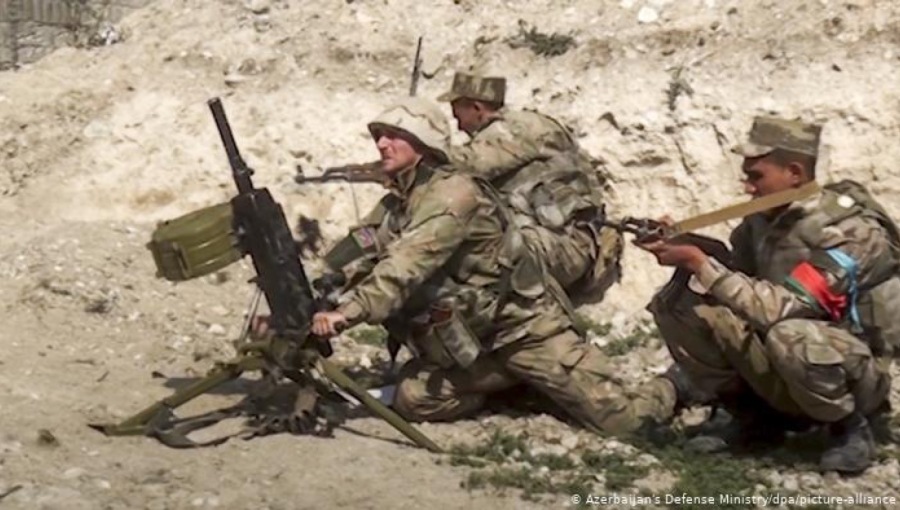
The tense and often-violated ceasefire that had governed the region since the end of the 2020 Second Karabakh War was overwhelmingly violated by Azerbaijan around 1pm local time on Tuesday. Azerbaijani military units, which had been gathering near the line of contact in Nagorno-Karabakh and on the borders of Armenia for weeks, launched a massive assault across all areas of the Nagorno-Karabakh frontline.

Artillery, precision missile strikes and airstrikes struck the beleaguered units of the Artsakh Defence Army, as the breakaway region’s military forces are known, while Azerbaijani infantry launched an offensive on the ground.

24 hours later, it was all over. Weakened by nine months of siege and starvation, without any supply lines to the outside world and hopelessly outmatched by Azerbaijan’s modern military, the president of the Republic of Artsakh, Samvel Shahramanyan, announced that his government had accepted the demands of Azerbaijani President Ilham Aliyev. The Artsakh Defence Army would be dissolved, its weapons would be handed over, and the region would, finally and definitively, come under Azerbaijani control.

In a sense, all of this was expected. Nagorno-Karabakh and its ally, Armenia, had suffered a devastating defeat in the 2020 war. Much of Nagorno-Karabakh had been captured – around 75% of the lands held by Karabakh Armenians before 2020 were conquered by Azerbaijan or ceded to them in the ceasefire agreement. The Armenian army, reeling from its losses, had been forced out of the conflict, left struggling to repel even the Azerbaijani incursions into Armenia itself.

The nine months of Azerbaijani blockade that began in December 2022 had been met with indifference from the international community, with ‘urges’ and ‘calls’ for Azerbaijan to reopen the Lachin Corridor – Nagorno-Karabakh’s single lifeline to the outside world – but no consequences when Azerbaijan refused to do so, ignoring even the International Court of Justice ruling on the matter.

The Russian peacekeeping mission, entrusted with ensuring that road remained open and active, similarly demurred from any real attempts to unblock it. Aliyev clearly read these signals – that there would be no consequences for violating yet another tenet of the 2020 ceasefire – and sent his army in for the kill.

Massive casualties

At the time of writing, so much is still unclear. The 24-hour war involved massive casualties: Nagorno-Karabakh’s authorities have confirmed over 200 dead and 400 wounded from their side, a number that is sure to rise as more bodies are found, while Azerbaijani social media reports place the number of Azerbaijan casualties at over 150.

What exactly happens next is anyone’s guess, including the people of Nagorno-Karabakh themselves. In the wake of the Azerbaijani assault and subsequent capture of numerous villages and key roads, tens of thousands of the region’s 120,000 inhabitants have been displaced. Stepanakert is overrun, with every public building hosting dozens of families; the city’s airport, the site of the main Russian peacekeeping base, is an even more dire site, with thousands of civilians now encamped there in the open air, having fled from the Azerbaijani soldiers who captured their villages.

Other areas are entirely isolated: the towns of Martuni and Martakert, Nagorno-Karabakh’s second- and third-largest settlements, are surrounded by Azerbaijani forces, their populations unable to escape and with little known about their condition. 

In this near-total information blackout, with no independent media access and limited internet connectivity, rumors of Azerbaijani atrocities have spread. One woman claimed that Azerbaijani troops had beheaded her three young children in front of her; another said that the same had happened to a Karabakh Armenian soldier. A woman named Sofik, from the Karabakh village of Sarnaghbyur, described in video testimony how Azerbaijani artillery bombardment of her village had killed at least five children and wounded 13 more.

There is little verification or ability to confirm these claims, but there is ample precedent for them: Azerbaijani troops have previously filmed themselves beheading elderly Karabakh Armenian civilians, have executed groups of POWs, and indiscriminately bombarded Karabakh settlements. In the coming days, videos of atrocities committed over the past few days are likely to come to light.

The ultimate fate of the population of Nagorno-Karabakh is similarly unclear. While Azerbaijani officials have said that civilians will be allowed to stay there unharmed, few, if any, of the locals believe them.

Armenian Prime Nikol Pashinyan stated in a speech on Thursday that a mass evacuation was “not plan A nor plan B,” and that he hoped the Karabakh Armenians would still be able to live a “safe and dignified” life there, but that Armenia was ready and able to accept 40,000 families if the need arose.

More despair than revolution

The view of Nagorno-Karabakh’s residents is a sharply different one. Ashot Gabrielyan, a local teacher who has documented life in Nagorno-Karabakh under the blockade, summed up the local community’s views in an Instagram post on Friday. “We, the people in Artsakh, need a humanitarian corridor to leave [to Armenia],” he wrote. “We are not ready to live with a country [Azerbaijan] which starved us, then killed us. We NEED to leave.”

The catastrophic situation has understandably led to political unrest in Armenia itself. On Tuesday night, as the Azerbaijani offensive into Nagorno-Karabakh was still going strong, thousands gathered in Yerevan’s Republic Square, a common spot for demonstrations in the capital. The clashes reached a rare level of violence, with police deploying stun grenades against the crowd at one point; 16 policemen and 18 civilians were wounded in the event.

But the mood was more despair than revolution. While many of those in attendance demanded the resignation of the government, few had any suggestions for what should be done differently.

“Nikol [Pashinyan] led us to this horrible situation, this catastrophe,” said Tigran, one of those in attendance. “He must resign.” Another attendee, Daniella, a 20-year old student from Nagorno-Karabakh, had a different take. “I don’t know what [the government] can even do [about this],” she said. “My family are still there [in Karabakh] and I’m very worried for them, but I don’t know that violence here [in Yerevan] will help anything,” she said.

The public paralysation is exacerbated by Russia, which has come out staunchly against the Armenian government and sought to pin the entire blame for the present tragedy in Nagorno-Karabakh on Pashinyan. A series of Kremlin media guidelines for Russian state media was leaked to the Russian opposition outlet Meduza, in which Russian government publications are instructed to blame the Azerbaijani assault on “Armenia and its Western partners”.

Mass public outrage at Russia and its absent peacekeepers in both Armenia and Nagorno-Karabakh has been fanned further by posts by top Russian propagandists such as Margarita Simonyan and Vladimir Solovyov, who shared identical Telegram posts suggesting that Armenians should overthrow the Pashinyan government.

Armenian journalist Samson Martirosyan summed up the mood succinctly in a Twitter post. “Most people in Armenia don’t know what to do, caught between Pashinyan and [the] opposition. By going to protests, you would stir up chaos, which serves Russia and Azerbaijan. Not going would mean silently agreeing with Pashinyan’s disastrous policies,” Martirosyan wrote.

Meanwhile, the 120,000 inhabitants of Nagorno-Karabakh await the outcome of the surrender negotiations currently taking place between their leadership and that of Azerbaijan in the Azerbaijani city of Yevlakh.

There are few reasons for optimism: Nagorno-Karabakh presidential advisor David Babayan said on Friday that there were “no concrete results” from Baku on either security guarantees for the population of Karabakh or regarding amnesty for its soldiers and leaders, all of whom Azerbaijan regards as criminals and terrorists.

The Azerbaijani army currently sits at the entrances to Stepanakert, poised to enter. It is difficult to imagine the scenes that will result when that happens.


Categories
Audio Review - South Caucasus News

Georgia ready to involve Armenia and Azerbaijan in government’s Peaceful Neighborhood Initiative


default.jpg

During his address at the 78th UN General Assembly, Georgian Prime Minister Irakli Garibashvili announced his country’s commitment to fostering lasting peace in the South Caucasus. He unveiled Georgia’s “Peaceful Neighborhood Initiative” and extended an invitation to Armenia and Azerbaijan to participate in this effort.

Launched by Prime Minister Garibashvili in late 2021, the “Peaceful Neighborhood Initiative” seeks to create a platform for informal dialogue among regional neighbors. Its primary goal is to facilitate cooperation and peaceful relations in a historically complex and conflict-prone region. In July 2022, the first meeting of the foreign ministers of Armenia and Azerbaijan took place in Tbilisi.

One of the central elements of the initiative is the invitation for Armenia and Azerbaijan to join the process. By engaging these neighboring countries, Georgia aims to work collaboratively to achieve enduring peace in the South Caucasus.

Prime Minister Garibashvili also emphasized Georgia’s transformation into a multifaceted regional hub. The country’s financial sector has gained global recognition, attracting international investors and capital. Georgia is prioritizing investments in infrastructure, aiming to strengthen connectivity and bolster the logistics and energy sectors.

Furthermore, Georgia is actively developing strategic transport corridors that will serve as vital links between Asia and Europe. These corridors are crucial for facilitating trade and economic development in the Black Sea region.

!

This text available in   Հայերեն and Русский

Print


Categories
Audio Review - South Caucasus News

Pashinyan, Blinken discuss humanitarian situation in Nagorno-Karabakh


Prime Minister Nikol Pashinyan had a phone conversation with US Secretary of State Antony Blinken.

The interlocutors discussed the humanitarian situation in Nagorno-Karabakh, issues related to the agenda of protecting the rights and security of the Armenians of Nagorno-Karabakh.

The perspectives of the Armenia-Azerbaijan peace process, regional security, and issues of the Armenia-US bilateral agenda were also addressed.


Categories
Audio Review - South Caucasus News

Crowd Roars as Xi Opens Hangzhou Asian Games


Chinese President Xi Jinping opened the COVID-19-delayed 19th Asian Games on Saturday in the city of Hangzhou during a shiny and at times raucous opening ceremony on Saturday.

Spectators in the city’s 80,000-capacity stadium let out a huge roar as Xi was introduced and walked in to sit with visiting dignitaries, including International Olympic Committee President Thomas Bach and Syrian President Bashar al-Assad.

The Games, delayed a year because of China’s measures to combat the COVID-19 pandemic, will be the country’s biggest sporting event in over a decade in several metrics, with around 12,000 athletes from 45 nations competing in 40 sports.

After the Chinese flag was brought out, the first team out was Afghanistan, whose female athletes, based abroad due to sport for women being banned by the Taliban, walked together with their male counterparts. Their flag-bearers carried the tricolor flag for Afghanistan which is used by international resistance movements and shunned by the Taliban.

Several teams, including Chinese Taipei, were vocally welcomed by the spectators, but none more so than the home team, whose athletes are expected to dominate the medals table once again.

They also mark a stark contrast to the cheerless Beijing 2022 Winter Olympics, which took place under China’s strict zero COVID conditions.

“I feel excited, particularly as a Hangzhou local,” said a man surnamed Zhao on his way into the stadium. “It’s a great chance to show the world how nice our city is. It was … delayed by a year, but that gave us a chance to prepare even better.”

Roads in a sizable “traffic control area” around the city’s Olympic stadium were blocked off, at least one metro station was shut, other Games centers were closed, and deliveries were disrupted on Saturday.

Some locals felt the security measures, always tight when Xi makes a visit, were overdone.

“I think it shows they’re too nervous, right?,” said Hangzhou resident Li Jian. “I think we should be a little more confident.”

One local social media user was told due to safety rules surrounding the Games that a pencil sharpener they had ordered could not be delivered.

“How dangerous is the sharpener?” the user wrote. “Will I be able to use it to kill foreign country leaders?”

Organizers have not disclosed spending on the Games, although the Hangzhou government has said it spent more than $30 billion in the five years through 2020 on transport infrastructure, stadiums, accommodation and other facilities.

Organizers hoped a high-tech opening ceremony on Saturday would help drum up excitement for the Games. Interest at home has been muted as the economy sputters and some question the cost of hosting the mega-event.

Dozens of smiling volunteers greeted journalists arriving in Hangzhou this week, with some expressing relief the event was finally getting started.

The official slogan of the event, “Heart to Heart, @Future,” represents the goal of uniting the people and countries of Asia through these games, officials have said, but geopolitical tensions and rivalries threatened to overshadow that effort this week.

Xi called on the West to lift sanctions on Syria and offered Beijing’s help in rebuilding the war-shattered country on Friday during rare talks with the long-ostracized Syrian leader al-Assad.

Also on Friday, India protested over a visa issue that affected three of its athletes at the games, leading India’s sports minister Anurag Thakur to cancel his trip.

Japan’s top government spokesperson said on Tuesday that Tokyo would do its utmost to ensure the safety of Japanese nationals in China as the release of treated radioactive water from the Fukushima nuclear power plant into the sea has chilled ties.

“We should promote peace through sports, adhere to the principle of goodwill towards neighbors and mutual benefit and … resist the cold war mentality and confrontation between camps,” Xi told dignitaries at a banquet before the ceremony on Saturday, state news agency Xinhua reported.