The Lemkin Institute says it will never allow today’s world leaders to forget their complicity in destroying a 4000 year old people and civilization in Artsakh.
“There’s no “genocide prevention” in the US, the EU, NATO, or the UN, despite all the trainings, symposia, books, and speeches. We had hope that in this one instance, this perfect storm for Genocide Prevention, there would be that one courageous voice in a position of serious power who would do the right thing,” the Institute said in a statement.
“But, of course, we have no real leaders in the world today. They have no fear that they will one day be targeted by this horror, so they don’t much care. They go to sleep in smug comfort. It’s really up to the ordinary people of the world to unite and bring an end to this never ending lust for power and resources that destroys everything in its wake,” it added.
“No ordinary people benefit from genocide. Not one ordinary person in the world benefits from the heartbreak of the old man in this photo. Even if their criminal leaders tell them they do, they don’t. What did they trade for this great chance to participate in genocide? Freedom? Dignity? Rights? Transparency? Good governance? Morality? All of the above? No, they do not profit,” the statement reads.
“But there are many people in global capitals, at BP, in governments who are already reaping the benefits! And wow, what benefits! Resources, access, power! Who cares if a 4000 year old civilization is lost forever?! Armenians be damned!” the Lemkin Institute said.
“We must all unite to change this equation — and we must do so fast,” it concluded.
This is a carousel. Use Next and Previous buttons to navigate
1of32Azerbaijan’s Foreign Minister Jeyhun Bayramov, center, listens during a United Nations Security Council meeting on the conflict between Armenia and Azerbaijan, Thursday Sept. 21, 2023 at U.N. headquarters.Bebeto Matthews/APShow MoreShow Less2of32Azerbaijan’s Foreign Minister Jeyhun Bayramov address a United Nations Security Council meeting on the conflict between Armenia and Azerbaijan, Thursday, Sept. 21, 2023, at U.N. headquarters.Bebeto Matthews/APShow MoreShow Less4of32Germany’s Foreign Minister Annalena Baerbock, left, listens as Armenia’s Foreign Minister Ararat Mirzoyan address a United Nations Security Council meeting on the conflict between Armenia and Azerbaijan, Thursday Sept. 21, 2023 at U.N. headquarters.Bebeto Matthews/APShow MoreShow Less5of32Armenia’s Foreign Minister Ararat Mirzoyan, center, listen as Germany’s Foreign Minister Annalena Baerbock, second from left, as she address a United Nations Security Council meeting on the conflict between Armenia and Azerbaijan, Thursday Sept. 21, 2023, at the United Nations headquarters.Bebeto Matthews/APShow MoreShow Less7of32United Nations Security Council holds a meeting on the conflict between Armenia and Azerbaijan, Thursday, Sept. 21, 2023, at the United Nations headquarters.Bebeto Matthews/APShow MoreShow Less8of32Armenia’s Foreign Minister Ararat Mirzoyan listens during a United Nations Security Council meeting on the conflict between Armenia and Azerbaijan, Thursday, Sept. 21, 2023, at U.N. headquarters.Bebeto Matthews/APShow MoreShow Less10of32United Kingdom’s Minister of State Tariq Mahmood Ahmad, left, listens as United States United Nations Ambassador Linda Thomas-Greenfield, right, address a United Nations Security Council meeting on the conflict between Armenia and Azerbaijan, Thursday Sept. 21, 2023, at the United Nations headquarters.Bebeto Matthews/APShow MoreShow Less11of32Azerbaijan’s Foreign Minister Jeyhun Bayramov, center, listens during a United Nations Security Council meeting on the conflict between Armenia and Azerbaijan, Thursday Sept. 21, 2023 at U.N. headquarters.Bebeto Matthews/APShow MoreShow Less13of32Armenia’s Foreign Minister Ararat Mirzoyan speaks during a United Nations Security Council meeting on the conflict between Armenia and Azerbaijan, Thursday Sept. 21, 2023 at U.N. headquarters.Bebeto Matthews/APShow MoreShow Less14of32In this photo taken from a video released by Russian Defense Ministry Press Service on Thursday, Sept. 21, 2023, Russian peacekeepers help ethnic Armenians to get a camp near Stepanakert in Nagorno-Karabakh. Thousands of Nagorno-Karabakh residents flocked to a camp operated by Russian peacekeepers to avoid the fighting, while many others gathered at the airport of the regional capital, Stepanakert, hoping to flee the region. (Russian Defense Ministry Press Service via AP)APShow MoreShow Less16of32A local government worker, right in red, tries to calm residents down during shooting in the vicinity, in Stepanakert, Nagorno-Karabakh on Thursday, Sept. 21, 2023. Azerbaijan President Ilham Aliyev declared victory in a teleAuthorities in Nagorno-Karabakh accused Azerbaijan on Thursday of violating the cease-fire agreement by firing on Stepanakert, the capital of the disputed region, according to the Russian news agency Interfax. Azerbaijan’s Defense Ministry denied there had been any attack, the Azerbaijan news agency reported.Siranush Sargsyan/APShow MoreShow Less17of32Local residents gather near a local government building after reports of shooting in Stepanakert, Nagorno-Karabakh on Thursday, Sept. 21, 2023. Azerbaijan President Ilham Aliyev declared victory in a teleAuthorities in Nagorno-Karabakh accused Azerbaijan on Thursday of violating the cease-fire agreement by firing on Stepanakert, the capital of the disputed region, according to the Russian news agency Interfax. Azerbaijan’s Defense Ministry denied there had been any attack, the Azerbaijan news agency reported.Siranush Sargsyan/APShow MoreShow Less19of32A woman cooks on makeshift stove in a yard in Stepanakert, Nagorno-Karabakh on Thursday, Sept. 21, 2023. Azerbaijan President Ilham Aliyev declared victory in a teleAuthorities in Nagorno-Karabakh accused Azerbaijan on Thursday of violating the cease-fire agreement by firing on Stepanakert, the capital of the disputed region, according to the Russian news agency Interfax. Azerbaijan’s Defense Ministry denied there had been any attack, the Azerbaijan news agency reported.Siranush Sargsyan/APShow MoreShow Less20of32Representatives of the Armenian community of Nagorno-Karabakh leave the building after the talks in the Azerbaijani city of Yevlakh, Azerbaijan, Thursday, Sept. 21, 2023. Talks are expected between Azerbaijan and separatist officials from Nagorno-Karabakh a day after Baku and Armenian forces reached a cease-fire agreement to end two days of fighting in the separatist region that has been a flashpoint for decades.APShow MoreShow Less22of32Representatives of the Armenian community of Nagorno-Karabakh, Azerbaijan’s government and a representative of the Russian peacekeeping contingent attend the talks in the Azerbaijani city of Yevlakh, Azerbaijan, Thursday, Sept. 21, 2023. Talks are expected between Azerbaijan and separatist officials from Nagorno-Karabakh a day after Baku and Armenian forces reached a cease-fire agreement to end two days of fighting in the separatist region that has been a flashpoint for decades.APShow MoreShow Less23of32Representatives of the Armenian community of Nagorno-Karabakh, Azerbaijan’s government and a representative of the Russian peacekeeping contingent attend the talks in the Azerbaijani city of Yevlakh, Azerbaijan, Thursday, Sept. 21, 2023. Talks are expected between Azerbaijan and separatist officials from Nagorno-Karabakh a day after Baku and Armenian forces reached a cease-fire agreement to end two days of fighting in the separatist region that has been a flashpoint for decades. (Roman Ismailov/Azerbaijan State News Agency AZERTAC via AP)Roman Ismailov/APShow MoreShow Less25of32In this photo taken from video released by Russian Defense Ministry Press Service on Thursday, Sept. 21, 2023, Russian peacekeepers guard a gate into a camp near Stepanakert in Nagorno-Karabakh. Thousands of Nagorno-Karabakh residents flocked to a camp operated by Russian peacekeepers to avoid the fighting, while many others gathered at the airport of the regional capital, Stepanakert, hoping to flee the region. (Russian Defense Ministry Press Service via AP)APShow MoreShow Less26of32In this photo taken from video released by Russian Defense Ministry Press Service on Thursday, Sept. 21, 2023, Ethnic Armenians arrive at a Russian peacekeepers’ camp near Stepanakert in Nagorno-Karabakh. Thousands of Nagorno-Karabakh residents flocked to a camp operated by Russian peacekeepers to avoid the fighting, while many others gathered at the airport of the regional capital, Stepanakert, hoping to flee the region. (Russian Defense Ministry Press Service via AP)APShow MoreShow Less28of32In this photo taken from video released by Russian Defense Ministry Press Service on Thursday, Sept. 21, 2023, Russian peacekeepers help ethnic Armenians to leave a truck at a camp near Stepanakert in Nagorno-Karabakh. Thousands of Nagorno-Karabakh residents flocked to a camp operated by Russian peacekeepers to avoid the fighting, while many others gathered at the airport of the regional capital, Stepanakert, hoping to flee the region. (Russian Defense Ministry Press Service via AP)APShow MoreShow Less29of32In this image made from video released by Russian Defense Ministry Press Service on Thursday, Sept. 21, 2023, a Russian peacekeeper speaks to ethnic Armenians as they walk through a gate into a camp near Stepanakert in Nagorno-Karabakh. Thousands of Nagorno-Karabakh residents flocked to a camp operated by Russian peacekeepers to avoid the fighting, while many others gathered at the airport of the regional capital, Stepanakert, hoping to flee the region. (Russian Defense Ministry Press Service via AP)APShow MoreShow Less31of32In this image made from video released by Russian Defense Ministry Press Service on Thursday, Sept. 21, 2023, a Russian peacekeeper guards a gate into a camp near Stepanakert in Nagorno-Karabakh. Thousands of Nagorno-Karabakh residents flocked to a camp operated by Russian peacekeepers to avoid the fighting, while many others gathered at the airport of the regional capital, Stepanakert, hoping to flee the region. (Russian Defense Ministry Press Service via AP)APShow MoreShow Less
UNITED NATIONS (AP) — Azerbaijan regained control of its breakaway region of Nagorno-Karabakh in a deadly two-day military offensive and held initial talks with representatives of its ethnic Armenian population on reintegrating the area into the mainly Muslim country, Azerbaijan’s top diplomat told the U.N. Security Council on Thursday.
Foreign Minister Jeyhun Bayramov reaffirmed Azerbaijan’s determination to guarantee Nagorno-Karabakh residents “all rights and freedoms” in line with the country’s constitution and international human rights obligations, including safeguards for ethnic minorities.
He said the talks with Nagorno-Karabakh in the Azerbaijani city of Yevlakh will continue.
Azerbaijan’s president, Ilham Aliyev, declared victory in a televised address. Bayramov said there is now “a historic opportunity” to seek better relations with Armenia after 30 years of conflict.
Nagorno-Karabakh came under the control of ethnic Armenian forces backed by the Armenian military in separatist fighting that ended in 1994. Armenian forces also took control of substantial territory around the Azerbaijani region.
Azerbaijan regained control of the surrounding territory in a six-week war with Armenia in 2020. A Russia-brokered armistice ended the war, and a contingent of 2,000 Russian peacekeepers was sent to the region to monitor it.
The agreement left the region’s capital, Stepanakert, connected to Armenia only by the Lachin Corridor, along which Russian peacekeepers were supposed to ensure free movement. But a blockade by Azerbaijan deprived Nagorno-Karabakh of basic supplies for the last 10 months, until Monday, when the International Committee of the Red Cross was able to make a delivery through another route.
Armenian Foreign Minister Ararat Mirzoyan, who called for the emergency meeting of the Security Council along with France, accused Azerbaijan of an “unprovoked and well-planned military attack,” launched to coincide with this week’s annual meeting of world leaders at the U.N. General Assembly.
“Literally the whole territory of Nagorno-Karabakh,” including Stepanakert and other cities and settlements, came under attack from intense and indiscriminate shelling, missiles, heavy artillery, banned cluster munitions, combat drones and other aircraft, he said.
Mirzoyan said the offensive targeted critical infrastructure such as electricity stations, telephone cables and internet equipment, killed more than 200 people and wounded 400 others, including women and children. More than 10,000 people fled their homes to escape the offensive, he said.
Electricity and phone service were knocked out, leaving people unable to contact each other, and “Azerbaijani troops control main roads in Nagorno-Karabakh, which makes it impossible to visit and get information on the ground,” he said.
“The Azerbaijani social media is full of calls to find the missing children and women, to rape them, dismember them and feed them to dogs,” Mirzoyan told the council.
He said the “barbarity” of Azerbaijan’s aggression and deliberate targeting of the civilian population “was the final act of this tragedy aimed at the forced exodus of the people of Nagorno-Karabakh.”
What Armenia has seen, Mirzoyan said, “is not an intent anymore but clear and irrefutable evidence of a policy of ethnic cleansing and mass atrocities.”
Bayramov strongly denied the allegations of ethnic cleansing. He said representatives from Nagorno-Karabakh asked during Thursday’s talks for humanitarian aid, including food and fuel for schools, hospitals and other facilities that government agencies will provide soon.
Russia’s deputy U.N. ambassador, Dmitry Polyansky, told the council: “We need to develop a gradual roadmap to integrate the population of Nagorno-Karabakh into the constitutional order of Azerbaijan, with clear guarantees over their rights and security,”
Russia’s peacekeepers will support these efforts, he said, adding that “the security and rights of Nagorno-Karabakh Armenians are of key importance.”
The quick capitulation by Nagorno-Karabakh separatists reflected their weakness from the blockade.
“The local forces, they were never strong. The Azerbaijani army is much better prepared, much better equipped. … So it was quite obvious, you know, that any military action that was to take place in that area, it would lead to the defeat of the local Armenian side,” Olesya Vartanyan, an analyst at the International Crisis Group, told The Associated Press.
Bayramov said Armenia kept more than 10,000 “armed formations” and heavy military equipment in Nagorno-Karabakh after the 2020 agreement. During the operation that started Tuesday, more than 90 of their outposts were taken, along with substantial military equipment, he said.
He held up photos of equipment he claimed was seized.
Mirzoyan urged the Security Council to demand protection for civilians in Nagorno-Karabakh; to immediately deploy a U.N. mission to monitor the human rights, humanitarian and security situation; to seek return of prisoners of war; and to consider deploying a U.N. peacekeeping force to the region.
Azerbaijan’s move to reclaim control over Nagorno-Karabakh raised concerns that a full-scale war in the region could resume. The 2020 war killed over 6,700 people.
White House national security spokesman John Kirby said the U.S. was “deeply concerned” about Azerbaijan’s military actions and was closely watching the humanitarian situation in Nagorno-Karabakh.
In a phone call Thursday with Aliyev, Russian President Vladimir Putin also urged that the rights and security of the Armenians in Nagorno-Karabakh should be guaranteed, according to the Tass news agency.
Aliyev apologized to Putin during the call for the deaths of Russian peacekeepers in the region Wednesday, the Kremlin said. Azerbaijan’s prosecutor-general’s office later said five Russian peacekeepers were shot and killed Wednesday by Azerbaijani troops who mistook them amid fog and rain for Armenian forces. One other Russian was killed by Armenian fighters.
Meanwhile, protesters rallied in the Armenian capital of Yerevan for a third day Thursday, demanding that authorities defend Armenians in Nagorno-Karabakh and calling for the resignation of Armenian Prime Minister Nikol Pashinyan. At least 46 people were arrested in a large protest outside the main government building in the city center, police said.
The conflict has long drawn powerful regional players, including Russia and Turkey. While Russia took on a mediating role, Turkey threw its weight behind longtime ally Azerbaijan.
Russia has been Armenia’s main economic partner and ally since the 1991 collapse of the Soviet Union and has a military base in the country.
Pashinyan, however, has been increasingly critical of Moscow’s role, emphasizing its failure to protect Nagorno-Karabakh and arguing that Armenia needs to turn to the West to ensure its security. Moscow, in turn, has expressed dismay about Pashinyan’s pro-Western tilt.
While many in Armenia blamed Russia for the defeat of the separatists, Moscow pointed to Pashinyan’s own recognition of Nagorno-Karabakh as part of Azerbaijan.
“Undoubtedly, Karabakh is Azerbaijan’s internal business,” said Kremlin spokesman Dmitry Peskov. “Azerbaijan is acting on its own territory, which was recognized by the leadership of Armenia.”
French Foreign Minister Catherine Colonna condemned Azerbaijan’s offensive and said it is essential that the ceasefire announced Wednesday is respected.
What is at stake, Colonna said, is whether the ethnic Armenians in Nagorno-Karabakh can continue living there with their rights and culture respected by Azerbaijan. “Today they have the responsibility for the fate of the population,” she said.
If Azerbaijan wants a peaceful and negotiated solution, Colonna said, “it must here and now provide tangible guarantees” and commit to discussions and to not using or threatening the use of force.
German Foreign Minister Annalena Baerbock also condemned Azerbaijan’s military assault, which she said was launched despite the government’s assurances to refrain from the use of force.
She called for a complete cessation of violence and lasting peace between Armenia and Azerbaijan that “can only be achieved at the negotiating table.”
Baerbock urged both countries to return to European Union-mediated talks.
___
Associated Press writers Emma Burrows in London; Avet Demourian in Yerevan, Armenia; Aida Sultanova in London; Jim Heintz in Tallinn, Estonia; and Siranush Sargsyan in Stepanakert contributed to this report.
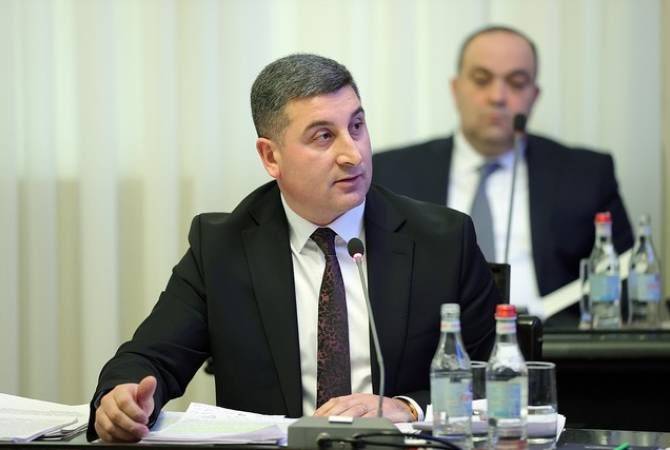
YEREVAN, SEPTEMBER 25, ARMENPRESS. Armenia never agreed and will never agree to any extraterritorial corridor logic, the Minister of Territorial Administration and Infrastructures Gnel Sanosyan told ARMENPRESS in response to a query.
ARMENPRESS: Mr. Sanosyan, recently Turkish and Azerbaijani officials have been more frequently speaking about the so-called Zangezur Corridor. How would you comment on this, and has the position of Armenia changed after the latest events?
Sanosyan: Armenia never agreed and will never agree to any extraterritorial or corridor logic. On the other hand, we are committed to the agreements reached at the high level. During the latest meeting of the Armenian and Azerbaijani leaders, which took place on July 15 this year in Brussels, the following agreements were reiterated:
Armenia and Azerbaijan recognize each other’s territorial integrity, with the territory of 29,8 and 86,6 thousand square kilometers respectively.
The border delimitation between Armenia and Azerbaijan shall take place based on the 1991 Alma-Ata Declaration.
Regional connections shall be unblocked based on the principle of sovereignty, jurisdiction and reciprocity of the parties.
These agreements are public and have been published by the President of the European Council Charles Michel after the meeting. Within the framework of this agreement, the Republic of Armenia not only is ready for the unblocking of connections, but also desires it to happen as soon as possible, because it stems from our interests.
Urgent works are underway to address the issues discussed in the meeting held with the representatives of the Armenian residents living in the Karabakh region of the Republic of Azerbaijan on September 21, 2023, in the city of Yevlakh, according to Azerbaijan in Focus, reporting Trend.
According to the Presidential Administration of Azerbaijan, as a next step, the city of Khankendi will be separated from the energy grid of Armenia and connected to the energy grid of Azerbaijan. Reserve slots for Khankendi were installed in the “Shusha” substation, which was built by “Azerenergy” in 2021 and inaugurated with the participation of President of the Republic of Azerbaijan Ilham Aliyev. Beginning on September 19, 2023, “Azerenegy” started the installation of additional 110 kV high-voltage poles near the “Shusha” substation and connecting them with the Khankendi transmission line. As a result of the works, the process has already been completed. At the same time, “Azerenergy” and “Azerishiq” employees inspected the transmission and distribution network and protection systems, and then transmission lines were provided with electricity. From now on, Azerbaijan is providing electricity to Khankendi.
The International Islamic Trade Finance Corporation (ITFC) has provided a total of $83.4 million to Azerbaijan between 2009 and 2013, Eng. Hani Salem Sonbol, Chief Executive Officer of the International Islamic Trade Finance Corporation and Acting Chief Executive Officer of the Islamic Corporation for the Development of the Private Sector (ICD), said in an interview, according to Azerbaijan in Focus, reporting Trend.
“Over the years, ITFC has been a steadfast partner in contributing to Azerbaijan’s economic development. Between 2009 and 2013, ITFC demonstrated its commitment to Azerbaijan by providing a total financing commitment of US$ 83.4 million. This substantial financial support was strategically allocated to bolster the private sector and empower small and medium-sized enterprises (SMEs) within Azerbaijan. One of the key highlights of our support has been the facilitation of Sharia-compliant trade solutions through our partner banks in Azerbaijan. This enabled businesses in the country to access innovative and ethical financial instruments, aligning with Islamic finance principles,” he said.
Hani Salem Sonbol noted that the visit to Azerbaijan carried significant importance, as it underscored the deepening collaboration between the International Islamic Trade Finance Corporation and the Republic of Azerbaijan.
“Azerbaijan is a valued member country of ITFC, and we attach great importance to strengthening our partnership. The primary purpose of our visit was to engage in meaningful discussions with representatives of the government of Azerbaijan. Together, we aimed to assess the current state of our cooperation and chart a course toward further enhancement within the framework of ITFC’s trade financing solutions and our Flagship Program, Trade Connect Central Asia+ (TCCA+),” he said.
Hani Salem Sonbol went on to add that during this visit, ITFC was poised to achieve several key outcomes, including signing a trade finance agreement with a local bank.
“This agreement will serve as a testament to our commitment to supporting the growth of trade and economic activities in Azerbaijan. In addition to this, we also organized a three-day Islamic Finance Workshop, which was set to provide valuable insights into Islamic finance mechanisms and their applicability in Azerbaijan. This workshop is a testament to ITFC’s dedication to capacity-building and knowledge sharing. From the Islamic Corporation for the Development of the Private Sector (ICD), our sister organization, we explored opportunities to expand lines of finance that can bolster the development of small and medium-sized enterprises (SMEs) in Azerbaijan. SMEs play a crucial role in driving economic growth and creating employment opportunities, and our efforts align with Azerbaijan’s vision for sustainable economic development,” he said.
Hani Salem Sonbol noted that this visit to Azerbaijan was not only about strengthening the bilateral relationship but also about facilitating tangible, on-the-ground initiatives.
“We are eager to continue working closely with our Azerbaijani partners to realize these goals,” he added.
On September 24, in New York, Minister of Foreign Affairs of Armenia Ararat Mirzoyan had a meeting with Subrahmanyam Jaishankar, Minister of External Affairs of India.
According to the press service of the Ministry of Foreign Affairs of Armenia, issues of security and stability in the South Caucasus were discussed.
Ararat Mirzoyan stressed that Azerbaijan’s continuous aggression and the large-scale military attack against the people of Nagorno-Karabakh unleashed on September 19, that was preceded by the 9-months-long blockade of the Lachin corridor and total siege of Nagorno-Karabakh, once again demonstrated the importance of concrete steps by international partners.
The imperative of restraining the steps aimed at destabilisation of the region was emphasised.
Bilateral agenda between Armenia and India was touched upon.
As of Monday morning, 2906 forcibly displaced persons from Nagorno-Karabakh have arrived in Armenia.
2,100 of them have already been registered, the needs assessment for 794 is in process.
Out of 2,100 registered, about 1,000 people went to their preferred laces of residence, and the government provided the other 1,100 with accommodation.
The flow of forcibly displaced persons continued throughout the night.
Acts of civil disobedience started in Yerevan early in the morning. A number of streets have been blocked, traffic is paralyzed in some areas.
A number of participants of the action have been detained by Police.
The opposition announced during a rally on Sunday that the acts of disobedience would last until 11:00. In the evening they will again gather for a rally in the Republic Square.
On the sidelines of 78th United Nations General Assembly, External Affairs Minister Dr S Jaishankar met the Armenian foreign minister Ararat Mirzoyan in New York on Sunday, September 24, as the two leaders affirmed a strong bilateral partnership. The meeting comes amid thousands of Nagorno-Karabakhs’s ethnic Armenians who have started crossing over to Armenia after Azerbaijan’s military offensive.
Indian External Affairs Minister Dr Jaishakar took to social media platform X (formerly Twitter) to announce New Delhi’s strong relationship with Armenia after meeting Mirzoyan. “On the sidelines of UNGA78, met with Ararat Mirzoyan FM of Armenia. Appreciate his sharing assessment of the current situation in the Caucasus. Affirmed our strong bilateral relationship,” said Jaishankar on X.
The Armenian foreign minister also informed that he discussed the security situation in South Caucasus, referring to the region comprising Armenia, Azerbaijan and Georgia. He said that during the meeting he asserted that ethnic cleansing needs to be prevented in the region. “On sidelines of #UNGA78 met w/my colleague, FM @DrSJaishankar. Discussed security situation in #SouthCaucasus & Azerbaijani aggression in #NagornoKarabakh. Stressed imperative for clear steps to restrain efforts to destabilize the region & prevent another ethnic cleansing,” said the Armenian Foreign Minister in a post on X.
India and Armenia share a bilateral relationship, after New Delhi recognised the country in 1991. In recent times, New Delhi has been strengthening its relationship with Armenia as an attempt to look beyond its traditional allies like Russia and Iran in the region. India has been supplying weapons to Armenia, thus, strengthening its defence against Azerbaijan, with which it has been locked into a conflict in the Nogorno-Kharabakh region.
In July this year, India exported the Multi-Barrel Rocket Launcher System (MBRLS) Pinaka, designed and developed indigenously. Pinaka strengthens Armenia, given Azerbaijan’s constant use of drones. In addition to the Pinaka system, Armenia acquired four indigenous Swathi weapons-locating radars from India in 2020.
New Delhi-Armenia ties raises eyebrows
However, India’s growing ties with Armenia have evoked strong reactions from Azerbaijan. In January 2023, Azerbaijan’s President Ilham Aliyev had criticised India’s burgeoning military cooperation with Armenia calling it an unfriendly step. Further, Azerbaijan is a part of an informal arrangement with Pakistan and Turkey where all three vow to support each other.
Jaishankar also held separate bilateral meetings with his counterparts from other countries including Mexico, Bosnia, Herzegovina. The Indian external Affairs Minister is on a nine-day visit, beginning from the UN General Assembly. The minister is scheduled to address the General Debate from the UN General Assembly hall on Tuesday. He would also be hosting an event on Global south as well.
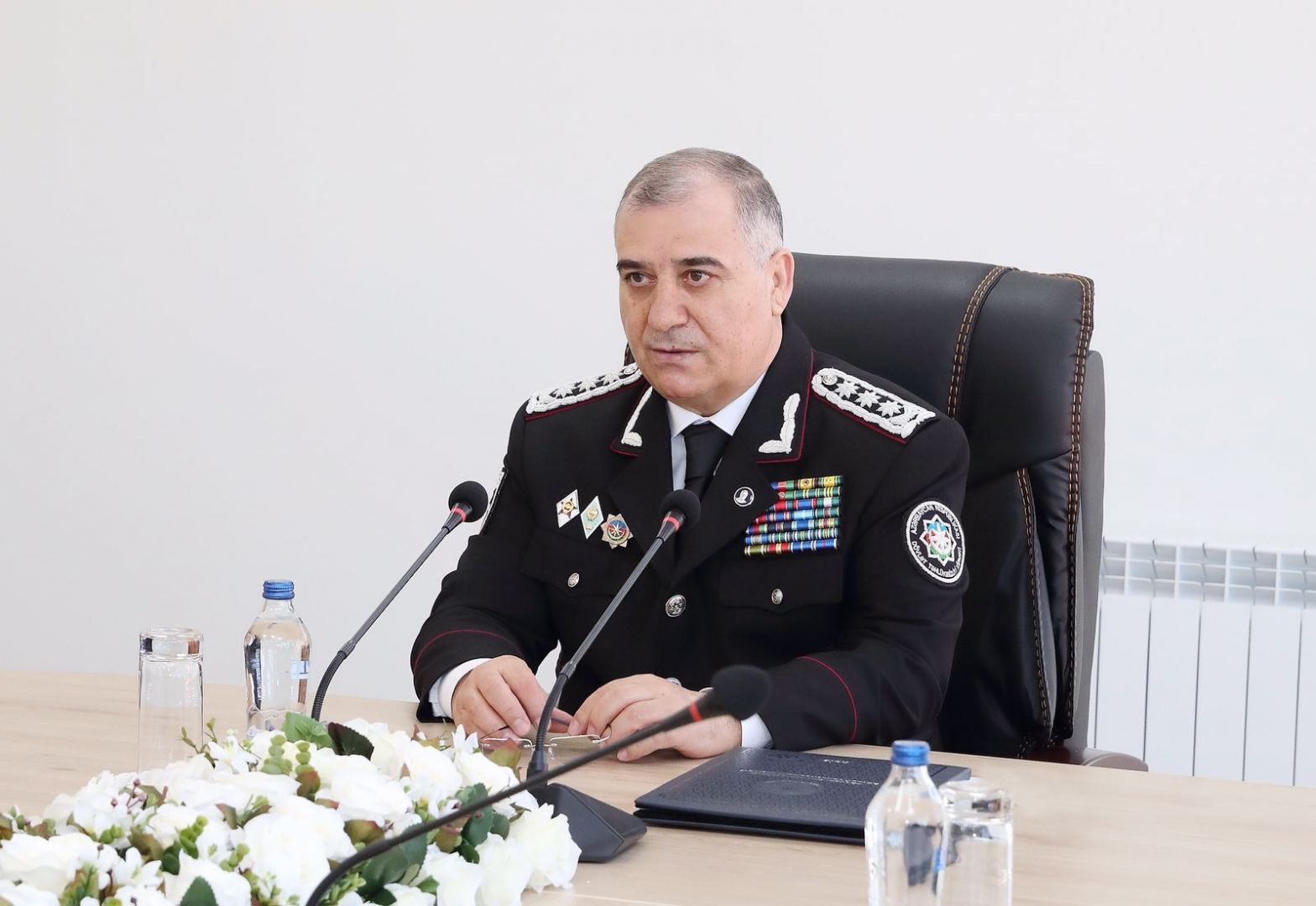
The revanchist forces in Armenia and the foreign circles
patronizing them must accept the new realities that have formed in
the region, Chief of the State Security Service (SSS) of
Azerbaijan, Col-Gen Ali Naghiyev said, Azernews reports.
He made the remarks in an article published in the Azerbaijan
newspaper.
Ali Naghiyev underlined that if Armenia does not refrain from
all dirty actions which can pose a threat to Azerbaijan’s security,
adding that “it must take into account, as the president said, that
the Iron Fist is still there”.
He also added that the Armenian fascism had been destroyed, but
its signs remain.
“This is a very dangerous trend, first of all, for the Armenian
state. I said this, and I say it again, if we see that Armenian
fascism raises its head and a new source of danger emerges for our
people and state, we’ll crush it again immediately. Let everyone
know! The Iron Fist is there, and no one should forget that!” the
SSS chief emphasized.
Moreover, he highlighted that large-scale cyber attacks by
Armenia were successfully prevented during the second Karabakh
War.
“Azerbaijan’s State Security Service, mobilizing all forces and
means to prevent terrorist and provocative plans and intentions of
the enemy, provided comprehensive support within the limits of its
authority, contributing to the victory of the Azerbaijani army,” he
said.
Ali Naghiyev stated that the timely obtained intelligence played
a crucial role in preventing the enemy’s attacks, conducting
successful combat operations by the Azerbaijani Armed Forces, and
liberation of certain settlements with minimal losses.
Further, he stressed that the tasks arising from the service
activities are successfully carried out by local bodies and
departments of the State Security Service established in the
liberated lands.
“For the employees of the State Security Service, who always
feel the attention and care of President Ilham Aliyev, all
conditions for the effective, flexible, and operational
organization of service in the territorial bodies in the liberated
from occupation lands, as well as in other cities and regions of
Azerbaijan, the material and technical support is provided at the
highest level,” Naghiyev said.
He noted that this is yet another vivid embodiment of the
president’s confidence in the personnel of the State Security
Service.
“We assure the president and our people that the personnel of
the State Security Service will continue to resolutely prevent any
threats aimed at the territorial integrity, sovereignty of our
state, public and political stability, and security atmosphere in
the country, and will continue to mobilize all forces and means,
performing their official duties with dignity and integrity, will
always be vigilant on guard of our statehood and independence!”
Nagiyev said.
—
Sabina Mammadli is AzerNews’ staff journalist, follow her on
Twitter: @SabinaMmdl