
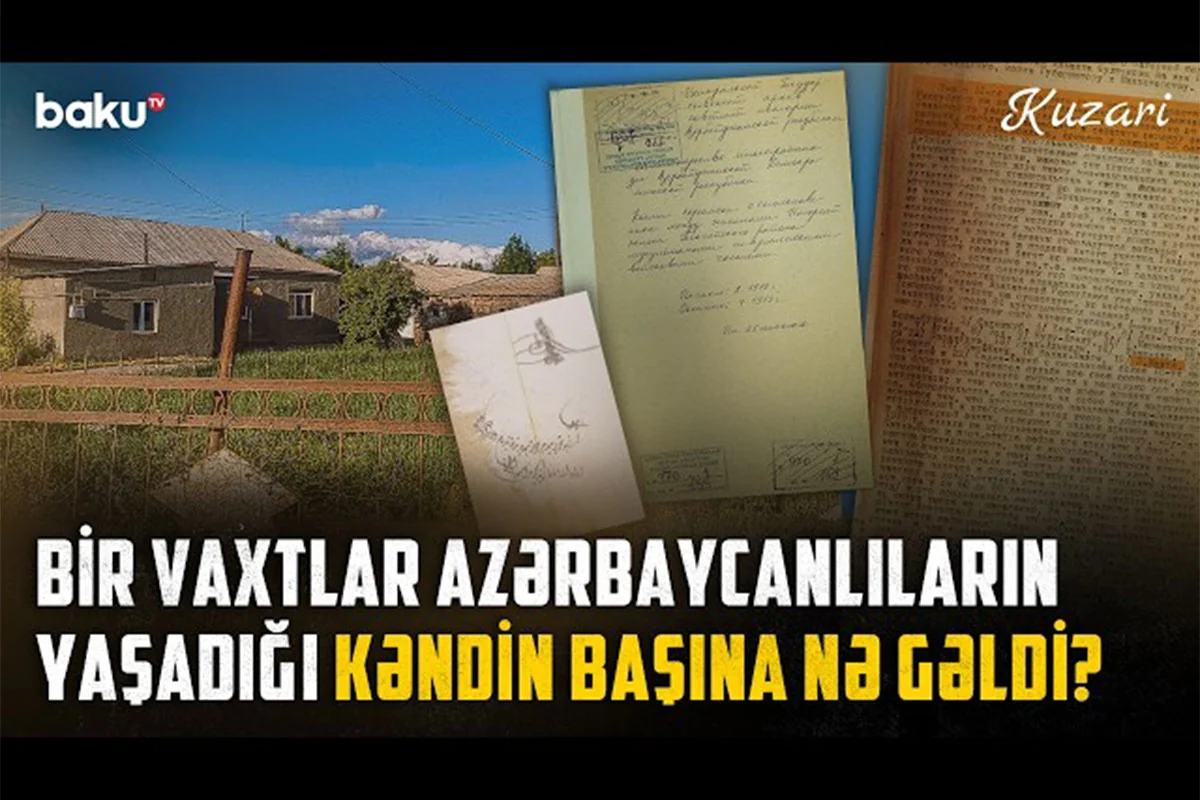
As part of the “Sites of Memory of Western Azerbaijan” project, research has been published on the history of Boyuk Mazra (present-day Mets Masrik), an Azerbaijani village in Armenia where Armenian armed groups carried out a massacre of the native population.
According to Report, the article was published on Perished Civilization.
The village was known as Mazra Bolshaya and Kuli-Agalu during the Tsarist period and as Mets Mazra during the Soviet period. Sources predating the early 19th century mention a single village named Mazra, while later documents identify two separate settlements: Boyuk Mazra (present-day Mets Masrik) and Kichik Mazra (present-day Pokr Masrik).
In April 1991, Boyuk Mazra was renamed Mets Masrik as part of what the project describes as a policy of Armenianization and the erasure of Azerbaijani heritage in Armenia.
Since 1995, the village has been part of Gegharkunik Province of the Republic of Armenia.
Under the 1724 Russo-Ottoman Treaty of Constantinople, the territory of the present-day Republic of Armenia was recognized by Russia as part of the Ottoman Empire.
In 1728, Ottoman officials drew up the Summary Register of the Iravan Eyalet, which recorded the names of settlements. The document mentions a single village named Mazra.
From the mid-18th century until the Russian conquest, the territory of the village formed part of the Goycha mahal of the Iravan Khanate.
Russia occupied the territory of the Iravan Khanate in 1827, and its incorporation into the Russian Empire was formalized by the 1828 Treaty of Turkmenchay. During the Tsarist period, the village formed part of the Novobayazet Uyezd of the Erivan Governorate.
Between 1829 and 1832, an administrative census of the territories of the former Iravan and Nakhchivan khanates was conducted at the direction of the Russian authorities. According to the census, Boyuk Mazra had 293 inhabitants, all of whom were ancestors of present-day Azerbaijanis.
Tsarist-era statistical records, also cited in Armenian sources, indicate that at various times before 1915, the village was inhabited exclusively or predominantly by ancestors of present-day Azerbaijanis.
In 1873, the village had 956 inhabitants, all of whom were ancestors of the Azerbaijanis. In 1906, it had 1,842 inhabitants, predominantly ancestors of the Azerbaijanis. In 1915, the village had 1,970 inhabitants, predominantly ancestors of the Azerbaijanis.
Between 1918 and 1920, Dashnaktsutyun, the nationalist party that held power in the Republic of Armenia, carried out what the project describes as ethnic cleansing of the Turkic population in the Erivan Governorate and other areas, particularly in Zangezur, Karabakh and Nakhchivan.
According to archival documents cited by the project, Armenian troops carried out a massacre in Boyuk Mazra in mid-April 1919, and the village itself was destroyed. The project says the consequences of the ethnic cleansing can be seen by comparing the number of Turkic inhabitants living in the village in earlier years with their number recorded in the 1922 census of Soviet Armenia.
In 1959, the village had 2,697 inhabitants, predominantly Armenians.
Between 2021 and 2024, extensive fieldwork was conducted across the territory of Armenia, including in remote mountainous regions, in preparation for the book The Perished Civilization. The research focused on identifying and documenting Azerbaijani heritage sites. During the fieldwork, an Azerbaijani cemetery with several dozen gravestones, some of which have survived, was discovered in the village.
The “Sites of Memory of Western Azerbaijan” project is described as a unique research initiative. During field studies conducted across the territory of present-day Armenia, information on nearly 600 villages once inhabited by ancestors of present-day Azerbaijanis was collected and systematized for the first time. Fragments of Turkic cultural and historical heritage, including cemeteries, sacred sites and mosques, remain in some of them.