Categories
South Caucasus News

US carrier deployed to Middle East over Iran tensions


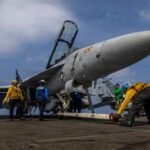
The aircraft carrier USS Abraham Lincoln and three accompanying warships have arrived in the Middle East, heightening concerns that President Donald Trump might consider ordering airstrikes on Iran in response to its crackdown on protesters.
The carrier, along with three destroyers, “is currently deployed to the Middle East to promote regional security and stability,” U.S. Central Command said Monday on social media, News.Az reports, citing foreign media.
The strike group was in the Indian Ocean, Central Command said, and not in the Arabian Sea, which borders Iran. It will bring thousands of additional service members to the region, which has not had a U.S. aircraft carrier since the USS Gerald R. Ford was ordered in October to sail to the Caribbean as part of a pressure campaign on then-Venezuelan President Nicolás Maduro.
Trump told reporters last week that the ships were sent to the region “just in case.” “We have a massive fleet heading in that direction, and maybe we won’t have to use it,” he said.
Trump earlier had threatened military action if Iran carried out mass executions of prisoners or killed peaceful demonstrators during a crackdown on protests that began in late December. At least 5,973 people have been killed and more than 41,800 detained, according to activists. The official Iranian death toll is far lower, at 3,117 dead.
More recently, Trump appeared to have backed away from possible action, claiming Iran halted the hangings of 800 detained protesters. He has not elaborated on the source of the claim, which Iran’s top prosecutor called “completely false.”
However, Trump appears to be keeping his options open. On Thursday aboard Air Force One, he said his threatened military action would make last year’s U.S. strikes on Iranian nuclear sites “look like peanuts” if the government proceeded with planned executions of some protesters.
In addition to the aircraft carrier, the U.S. military said the Air Force F-15E Strike Eagle fighter jet now has a presence in the region.
Analysts who follow flight-tracking data have noticed dozens of U.S. military cargo planes also heading to the region.
The activity is similar to last year when the U.S. moved in air defense hardware, like a Patriot missile system, in anticipation of an Iranian counterattack following the bombing of three key nuclear sites. Iran launched over a dozen missiles at Al Udeid Air Base days after the strikes.



Categories
South Caucasus News

Amid market sell-off, Michael Saylor buys 2,932 Bitcoin


Michael Saylor’s strategy, through MicroStrategy, the world’s largest public Bitcoin holder, revealed new BTC purchases as prices dipped amid a broader market sell-off.
Strategy acquired 2,932 Bitcoin for $264.1 million last week, according to a US Securities and Exchange Commission filing on Monday, News.Az reports, citing foreign media.
The acquisitions were made at an average price of $90,061 per BTC, with Bitcoin starting the week above $93,000 and briefly tumbling below $87,000, according to CoinGecko.
The purchase brought Strategy’s total Bitcoin holdings to 712,647 BTC, purchased for about $54.19 billion at an average price of $76,037 per coin.


Categories
South Caucasus News

US and Armenia discuss TRIPP project implementation


On Monday, Sargis Khandanyan, the chair of the Standing Committee on Foreign Relations of the Armenian National Assembly, met with a U.S. delegation led by Lance Kokonos, a member of the U.S. Congressional Staff.
Welcoming the guests, Khandanyan lauded the development of the Armenia-US strategic partnership, News.Az reports, citing Armenian media.
The interlocutors spoke about the importance of implementing the Trump Route for International Peace and Prosperity (TRIPP) project and to exchange views on the work to be done in that regard in the near future.
Also, the chair of the NA Standing Committee on Foreign Relations touched upon the recent developments in the processes of normalization of Armenia’s relations with Azerbaijan and Türkiye.


Categories
South Caucasus News

“Surrender or die”- Disastrous end of the Russians hiding in basements and stone bunkers in Kupiansk


Categories
South Caucasus News

Trump praises return of final captive remains from Gaza


On Monday, U.S. President Donald Trump praised the return of the remains of the last Israeli hostage from the besieged Gaza Strip, commending his officials for their role in facilitating the release.
“Just recovered the last hostage body in Gaza. Thus, got back all 20 of the living hostages, and all of the dead! Amazing job! Most thought of it as an impossible thing to do. Congratulations to my great team of champions!!!” Trump said on his Truth Social platform, News.Az reports, citing foreign media.
The Israeli military announced earlier Monday that it had located and recovered the body of its last captive in the Gaza Strip. A military statement said that the body of Sgt. 1st Class Ran Gvili was identified and would be returned for burial.
“With this, all hostages have been returned from the Gaza Strip,” it added.
The announcement came a day after Israeli Prime Minister Benjamin Netanyahu said Sunday that Israel will reopen the Rafah border crossing between Gaza and Egypt after the return of Gvili’s body.


Categories
South Caucasus News

Why extreme weather is redefining global risk planning


Extreme weather is no longer viewed as a series of isolated natural events, News.Az reports.
It has become a structural factor shaping economic planning public policy security assessments and social resilience worldwide. Floods heatwaves droughts storms and wildfires increasingly occur with greater intensity frequency and geographic reach. Understanding why extreme weather now carries permanent global significance requires examining systemic drivers impacts across sectors and the long term adjustments societies must undertake.
From rare events to recurring patterns Historically extreme weather was treated as exceptional. Planning assumptions relied on averages and historical norms. Today those assumptions no longer hold. Communities experience repeated shocks within short timeframes eroding recovery capacity. What was once described as unusual is becoming statistically expected. This shift changes how risk must be measured insured and governed.
Climate dynamics and system feedbacks Extreme weather emerges from interacting climate systems rather than single causes. Rising temperatures alter atmospheric circulation ocean currents and moisture distribution. These changes reinforce one another through feedback loops. For example warmer air holds more moisture intensifying rainfall while higher sea temperatures fuel stronger storms. Such dynamics increase volatility across multiple regions simultaneously.
Economic exposure and cascading losses The economic cost of extreme weather extends beyond immediate damage. Disrupted supply chains production delays infrastructure repair and lost productivity accumulate over time. Agriculture energy transportation and manufacturing all face heightened exposure. When major production hubs are affected ripple effects spread through global markets influencing prices availability and inflation expectations.
Insurance markets under pressure Insurance systems are designed to spread risk over time and geography. Repeated extreme weather events strain this model. Premiums rise coverage contracts and some regions become uninsurable. These trends transfer risk from private insurers to households governments and financial systems. Insurance availability increasingly influences where people live invest and build.
Urban vulnerability and infrastructure limits Urbanization amplifies weather related risk. Dense populations aging infrastructure and impermeable surfaces increase exposure to floods heat and storms. Many cities were not designed for current climate conditions. Retrofitting drainage cooling systems and transport networks requires large investment and long planning horizons.
Public health consequences Extreme weather directly affects public health. Heatwaves increase mortality among vulnerable populations. Floods contaminate water supplies and spread disease. Wildfire smoke degrades air quality over large areas. Health systems must adapt to surges in demand while managing chronic impacts that persist long after events subside.
Food security and water stress Agricultural systems depend on stable climate patterns. Extreme heat drought and unpredictable rainfall reduce yields and increase volatility. Water stress intensifies competition between agriculture industry and households. Food security concerns are no longer confined to traditionally vulnerable regions. Globalized food markets transmit local shocks worldwide.
Energy systems and reliability challenges Energy infrastructure faces growing stress from extreme weather. Heat increases electricity demand while reducing generation efficiency. Storms damage transmission networks. Drought limits hydropower output. Reliable energy supply becomes harder to guarantee precisely when demand is highest. This mismatch challenges both traditional and renewable systems.
Migration and social pressure As living conditions deteriorate in affected regions populations may relocate temporarily or permanently. Weather driven migration places pressure on receiving areas influencing housing labor markets and public services. Social cohesion can be tested when displacement occurs at scale. Managing migration requires proactive planning rather than reactive response.
Security implications and governance stress Extreme weather can exacerbate existing political and social tensions. Resource scarcity economic disruption and displacement increase the risk of instability. Governments face higher demands for disaster response while managing fiscal constraints. Effective governance becomes critical to maintaining trust during repeated crises.
Technology and early warning systems Advances in forecasting monitoring and communication improve early warning capabilities. Data driven models help anticipate risks and guide evacuation or adaptation measures. However technology alone cannot eliminate vulnerability. Its effectiveness depends on institutional capacity public trust and equitable access to information.
Adaptation as a strategic priority Mitigation efforts aim to address underlying causes but adaptation is increasingly unavoidable. Adaptation includes resilient infrastructure diversified agriculture water management and heat tolerant urban design. Strategic adaptation recognizes that some level of extreme weather is now locked into the system regardless of future emissions pathways.
Financing resilience and adaptation gaps Funding adaptation remains a challenge. Benefits are long term and diffuse while costs are immediate. Public budgets private investment and international finance mechanisms must align to close gaps. Without adequate financing adaptation efforts risk lagging behind accelerating impacts.
Why extreme weather reshapes global planning Extreme weather forces a reevaluation of how risk is understood and managed. It affects defense planning corporate strategy urban development and international cooperation. Decision makers increasingly integrate climate risk into models that once focused solely on economic or geopolitical variables.
Long horizon impacts on development Development trajectories are influenced by exposure to extreme weather. Countries with limited resources face compounded challenges as repeated shocks divert funds from education health and growth. Inequality between regions may widen unless resilience building becomes central to development strategy.
Conclusion and forward outlook Extreme weather has moved from the margins of planning to its center. It is a persistent driver of risk that intersects with every major policy domain. Societies that recognize this shift and invest in resilience adaptation and governance capacity will be better positioned to navigate uncertainty. The question is no longer whether extreme weather will shape the future but how prepared the world is to live with it.


Categories
South Caucasus News

Vuori’s Best Cold-Weather Gear is On Sale, Just In Time for the Snowstorm


Vuori’s Best Cold-Weather Gear is On Sale, Just In Time for the Snowstorm

Deals include the editor-tested Sunday joggers…
Read More


Categories
South Caucasus News

The Best Cardigans for Men, Tested by Style Experts


The Best Cardigans for Men, Tested by Style Experts

Abercombie and Uniqlo offer some of the sharpest options…
Read More


Categories
South Caucasus News

3 Cheap Ultrawide Monitors Actually Worth Buying


3 Cheap Ultrawide Monitors Actually Worth Buying

Ultrawide monitors are great, but they can be expensive. Fortunately, we found a few inexpensive options that will deliver a quality viewing experience…
Read More


Categories
South Caucasus News

Kia Is Coming Out With Its Cheapest EV Yet


Kia Is Coming Out With Its Cheapest EV Yet

Kia has unveiled its new EV2 hatchback, which is stylish, tech-forward, and affordable. But for many consumers, this vehicle will remain out of reach…
Read More