
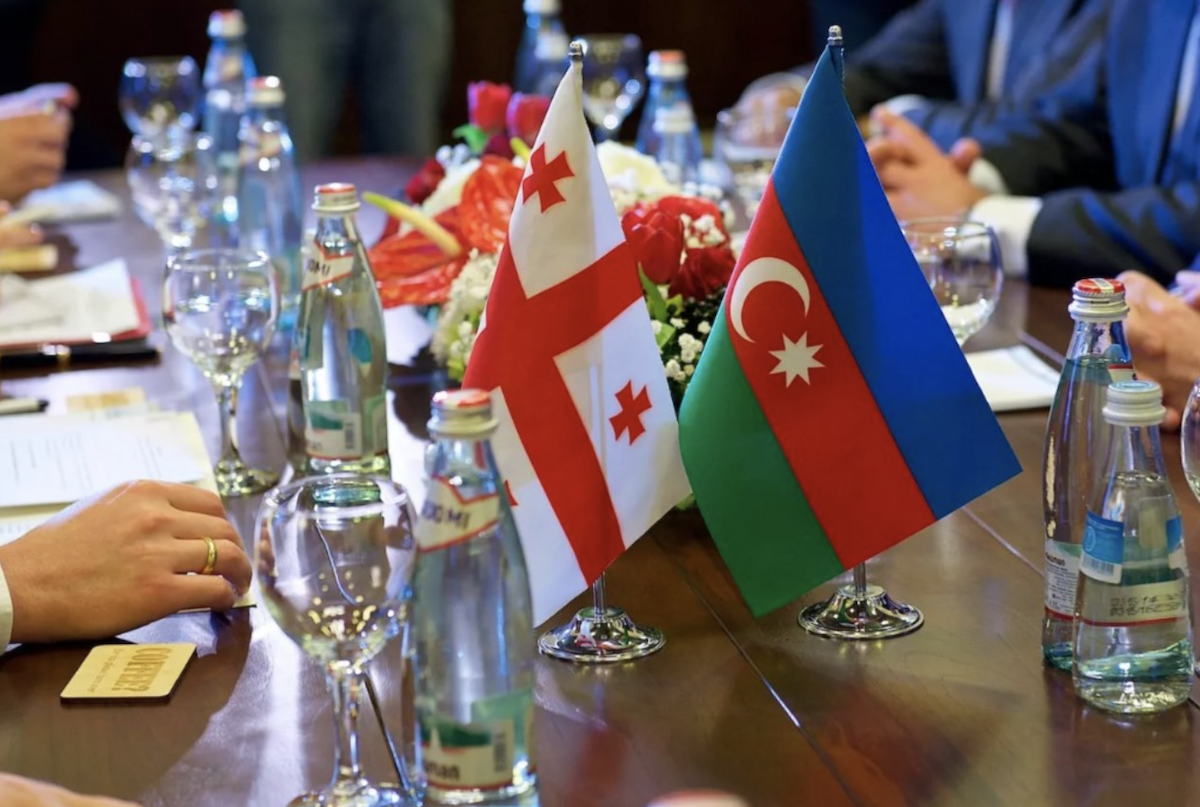
Tension between Azerbaijan and Georgia
Pro-government Azerbaijani outlet Minval Politika has published a sharply critical article about the Georgian authorities titled “Georgia is playing against peace: Tbilisi is testing Baku’s patience.”
The author, Maksud Salimov, speaks of “alarming changes” in relations between Tbilisi and Baku and highlights two negative developments:
1.
Economic ties between Azerbaijan and Armenia are rapidly developing as the peace process accelerates. A new milestone is that Baku is ready to begin supplying petroleum products to Yerevan.
Because direct rail links between the two countries have been cut for more than 30 years, the only possible transit route would run through Georgia.
However, according to Minval Politika, Georgia has suddenly demanded an unreasonably high tariff for this transit.
2.
Since September, Azerbaijani drivers at the Georgia–Azerbaijan border have faced harsh treatment from officials; cargo trucks are held up for weeks or even months without any real explanations.
“The Georgian authorities show neither political will nor administrative competence to solve this problem. Instead of efficiency, we see only ritual promises,” the outlet writes.
Details from the publication follow.
- Azerbaijan’s pro-government media lash out at Georgia over ‘deteriorating treatment’ of Azerbaijani truckers
- Trump Route: Western illusion or turning point in South Caucasus?
- A Tbilisi perspective on the historic Aliyev–Pashinyan meeting
Publication by Minval Politika (abridged)
“In recent months, relations between Baku and Tbilisi have shown a troubling shift, stemming not from isolated bureaucratic failures but from a series of decisions that suggest a change in Georgia’s political logic.
As Minval Politika has already noted, the situation on the Georgian border remains tense: Azerbaijani drivers have been facing systematic delays since September. Some trucks have been stuck at customs for months, and Georgian authorities have shown neither the political will nor the administrative capacity to resolve the problem.
Tellingly, instead of effective action, we see only ritual assurances.
Against this backdrop, Tbilisi’s new move looks even more unexpected, coming as regional transport architecture is being discussed.
A week ago, on 28 November, the 12th meeting of the joint commissions on border delimitation between Azerbaijan and Armenia was held in Gabala, chaired by the two deputy prime ministers — Shahin Mustafayev and Mher Grigoryan. In addition to technical matters, the sides also discussed opportunities for economic cooperation.
According to Minval Politika sources, one of the issues raised was the prospect of exporting Azerbaijani oil and oil products to Armenia — a project that could bring economic dividends to both Baku and Yerevan and strengthen the space for peaceful development in the region.
However, the lack of a direct rail connection between the two countries makes transit through Georgia the only available route. For that reason, Azerbaijan asked Tbilisi for a transit tariff for the Gardabani–Sadakhlo section.
Georgia’s response became a kind of indicator — not only of its commercial position but also of its political thinking.
According to our information, the Georgian side proposed a tariff of $92 per ton for the 111-km section, which amounts to $0.82 per ton per kilometer.
At first glance this might look like a normal tariff, but a comparison shows the opposite.
For comparison:
● In Azerbaijan, similar cargo is transported over 680 km — from Yalama to Beyuk-Kesik — for $17, which is $0.02 per ton per kilometer.
This is 40 times lower than Georgia’s proposed rate.
A fortyfold difference suggests intentions rather than market logic.
● Moreover, within Georgia itself, similar cargo is transported to the ports of Batumi, Poti and Kulevi at a rate of $17 for 360–396 kilometers — that is, $0.04–0.05 per kilometer.
In other words, when transit is advantageous for Tbilisi, the tariff is 20 times lower than what was proposed for shipments to Armenia.
Here, economic logic gives way to a political signal.
Such behavior inevitably raises questions. Georgia is a country that, in critical periods of its modern history, depended on Azerbaijan’s support.
Today, Georgia is demonstrating behavior that contradicts its own long-term interests.
Not only because it undermines the trust of a key partner, but also because Georgia’s current logistical monopoly is no longer irreplaceable.
Regional connectivity projects are developing, and attempts to preserve the old architecture through pressure only accelerate its erosion.
Today, Georgia is effectively acting against the formation of a stable regional architecture of peace and mutually beneficial economic ties.
At a moment when the South Caucasus has a unique opportunity to shift from a logic of conflict to one of development, Tbilisi’s behavior looks like an attempt to slow this transition. It is difficult to describe such a policy otherwise: it undermines the overall dynamic of regional normalization and shows an unwillingness to participate in creating a space of shared prosperity.

Tbilisi must understand that a policy of unjustified barriers will inevitably lead to reciprocal measures.
A country whose economy Baku has consistently invested in and supported for decades cannot afford to disregard Azerbaijan’s interests.
Responsibility is a key measure of a state’s maturity, and Georgia is now being tested on that maturity.
The historical memory of relations between our countries makes this even more significant.
At the height of tensions between Georgia and Russia, Baku did not exploit Tbilisi’s vulnerability as a tool of pressure and did not impose inflated tariffs, even though Georgia was in deep crisis and seemingly ready to accept any conditions.
Azerbaijan chose a different path – the path of a partner, not an opportunist.
That is why today a legitimate question arises: how will Tbilisi respond to the current situation? Will it remain silent and continue to act behind the scenes, or will it show political maturity by openly acknowledging the problem and moving toward cooperation rather than confrontation?”
News in Georgia
News in Azerbaijan