
The number of users registered on “myGov,” Azerbaijan’s primary digital government platform, has exceeded 2 million, marking a sharp rise in engagement across both the web and mobile applications in 2025, Azernews reports, citing the Innovation and Digital Development Agency.
Day: November 24, 2025
On November 24, 2025, in Paris, during the 25th session of the General Assembly of the States Parties to the 1972 Convention on the Protection of the World Cultural and Natural Heritage, the Republic of Azerbaijan was elected as a member of the UNESCO World Heritage Committee (WHC) for the 2025-2029 term, Azernews reports.
Categories
Зеленский поблагодарил Трампа
Court proceedings continue in Baku on criminal cases opened against several well-known Azerbaijani bloggers and internet channel leaders living abroad. In recent weeks, reports have been consistently published both about trials in absentia at the Baku Serious Crimes Court and calls for foreign-based journalists and activists to appear for questioning by the General Prosecutor’s Office.
New case at Baku Serious Crimes Court: Trial in absentia of 8 people
On November 21, the Baku Serious Crimes Court began a trial in a criminal case against bloggers living abroad: Tural Sadigli, Elshad Mammadov, Gurban Mammadov, and Suleyman Suleymanli. The sessions are being held in absentia under the chairmanship of Judge Huseyn Huseynli.
According to the announced charges, three more individuals are also included as defendants: Ordukhan Teymurkhan (Babirov), Orkhan Aghayev, and Rafael Piriev. They are accused under several serious articles of the Criminal Code, including fraud, calls for terrorism, open agitation against the state, and forgery of official documents.
Since all the defendants are outside the country, the court has imposed preventive measures in the form of arrest in absentia, and the trial is proceeding in absentia.
The wave that began in June: In absentia arrest of 7 bloggers
This case is considered part of a broader process that has continued since the beginning of the year against activists living abroad.
In June, the Binagadi District Court granted the General Prosecutor’s Office’s request and imposed preventive measures in the form of arrest in absentia for several bloggers residing outside Azerbaijan: Imameddin Alimanov, Suleyman Suleymanli, Elshad Mammadov, Mohammed Mirzali, Gabil Mammadov, Orkhan Aghayev, and Gurban Mammadov.
According to the Investigative Department of the General Prosecutor’s Office, they have been charged under several serious articles — fraud, calls for terrorism, calls for mass riots, and agitation against the state.
New decisions on arrests in absentia: Osmangizi, Gafarov, Manafov
In recent weeks, the General Prosecutor’s Office has reported the initiation of criminal cases against journalists and bloggers living abroad — Sevinj Osmangizi, Abid Gafarov, and Beydulla Manafov.
According to official data:
- Journalist Sevinj Osmangizi is charged under Articles 220.2 (calls for disobedience to lawful demands of authorities, mass disorder, and violence against citizens) and 281.2 (public calls against the state, committed repeatedly or by a group). An arrest in absentia has been issued for her. She has been placed on the international wanted list.
- Blogger Abid Gafarov is charged under the same articles; he has also been declared wanted and arrested in absentia by the decision of the Binagadi District Court.
- Journalist Beydulla Manafov is facing a criminal case under Articles 281.2 and 283.1 (incitement of hatred and enmity using the media), and an arrest in absentia is also in effect for him.
Among those summoned for questioning are also historian Altay Goyushov, political scientist Arastun Orujlu, the exiled editor-in-chief of the newspaper Azadliq, Ganimat Zahid, founders of various internet channels, and other socio-political activists; many of them have also been subjected to arrest in absentia or placed on the wanted list.
The case of Manaf Jalilzade and Switzerland’s refusal of extradition
The General Prosecutor’s Office is also pursuing criminal proceedings against blogger Manaf Jalilzade, who lives abroad. He has been charged under Article 281.2 of the Criminal Code (public calls against the state committed repeatedly or by a group) and summoned for questioning. Azerbaijan has submitted a request for his extradition.
The Swiss Federal Ministry of Justice rejected Azerbaijan’s extradition request for Jalilzade. The statement noted that the request was denied because, if the blogger were handed over to Azerbaijani authorities, there would be a risk of torture and a potential violation of his right to a fair trial.
Authorities’ position: “Legal response to anti-state campaigns”
Milli Mejlis deputy Mushfig Jafarov previously accused foreign-based bloggers of conducting an “anti-Azerbaijani smear campaign” in an interview with pravda.az and stated that these individuals would be brought to the country “in accordance with the law.”
In official statements, the General Prosecutor’s Office links trials in absentia and arrest decisions to “acts directed against state security, the constitutional order, and public order,” as well as allegations of calls for violence and unrest through the media.
Critical views and political assessments
Public discussions have produced several perspectives:
- Opposition representatives, human rights defenders, and some political commentators consider arrests in absentia and successive criminal cases as a strategy of political pressure. They argue that these decisions aim both to intimidate critics abroad and create an atmosphere of fear domestically.
- Politicians close to the authorities and official circles present these measures as “responses to calls against the state” and a “legal stance against campaigns discrediting Azerbaijan.”
Economist and chairman of the Political Committee of the ReAl Party, Natig Jafarli, suggested on social media that decisions regarding certain foreign-based “provocative bloggers” might also serve as a strategic tool for the authorities. He presented four general arguments:
- Such decisions are more likely to keep these individuals in Europe than to result in actual extradition.
- They provide additional protection for some migrants with weak legal status or incomplete integration into European society.
- These bloggers, by spreading compromising information that harms the opposition’s image, effectively perform a function beneficial to the authorities.
- Therefore, in some cases, their activities may align with the interests of certain intra-governmental groups.
Exile blogger Gabil Mammadov rejected most of these claims in an interview with Meydan TV but did not rule out that there may be “a grain of truth” in them. According to him, criminal cases against him and other bloggers are not related to offensive rhetoric but are based on charges such as terrorism, fraud, and resistance to authorities — and are politically motivated.
Political commentator and founding council member of the “III Republic” platform, Elman Fattah, described arrests in absentia as a “typical strategy of authoritarian systems,” noting that the mechanism is used both to instill fear domestically and, even if immediate results are unlikely, to create a façade of legitimacy internationally.
These statements have not been commented on by official institutions; the General Prosecutor’s Office emphasizes that the charges are based solely on criminal procedural and legal grounds.
Legal basis: Expansion of the in-absentia mechanism
Lawyer Fariz Namazli recalls that in December 2023, amendments to the Criminal Procedure Code allowed law enforcement authorities to conduct in-absentia proceedings for individuals living abroad, prepare indictments, submit cases to court, and issue verdicts. This mechanism is later used as an additional legal basis for extradition requests.
Lawyer Ruslan Aliyev notes that European countries’ extradition decisions in politically motivated cases are usually negative, and such in-absentia trials “remain primarily a tool of political pressure.” Investigative actions and other procedural measures can be conducted abroad using alternative methods.
Current situation
The Baku Serious Crimes Court continues the in-absentia trial of Tural Sadigli, Gurban Mammadov, Elshad Mammadov, Suleyman Suleymanli, Ordukhan Teymurkhan, Orkhan Aghayev, and Rafael Piriev; the next session is scheduled in the coming days.
The Binagadi District Court and the General Prosecutor’s Office confirm that arrest-in-absentia and wanted-list decisions for Sevinj Osmangizi, Abid Gafarov, Beydulla Manafov, and other journalists, political scientists, and activists remain in effect.
Switzerland’s decision regarding Manaf Jalilzade and the positions of other European countries are considered precedents for future extradition requests.
Some Azerbaijani bloggers and activists living abroad reject the charges and consider the trials politically motivated, while authorities deny this and assert that the decisions are made “strictly in accordance with legal requirements.”
The post Authorities expand criminal prosecution of Azerbaijani bloggers and journalists abroad appeared first on MEYDAN.TV.
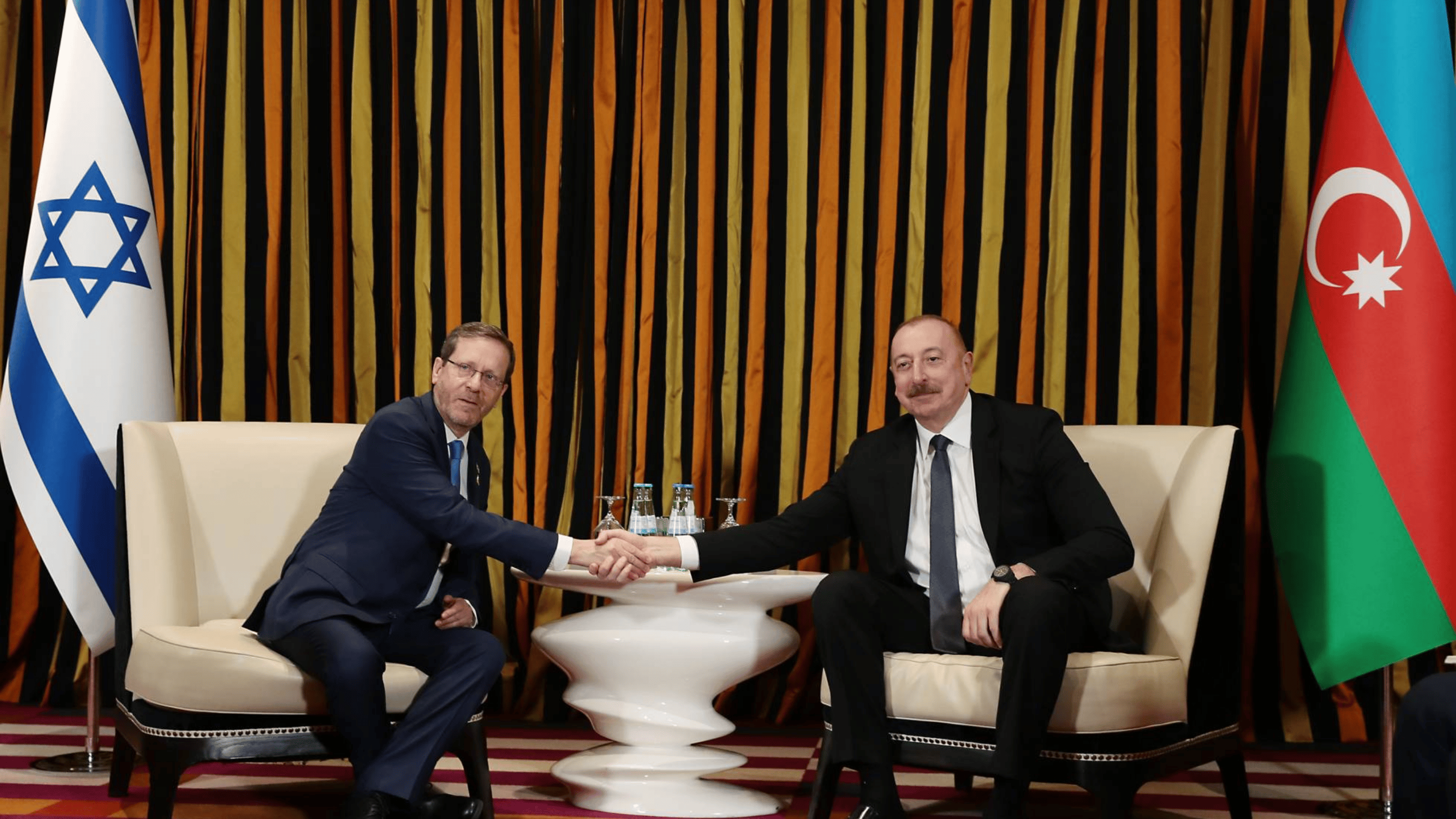
Azerbaijan–Israel relations
Since the 1990s, Baku and Tel Aviv have built a partnership centred on defence and intelligence. For years, Azerbaijan has been a major supplier of oil to Israel, while Israel has become one of the key sources of high-tech weaponry for the Azerbaijani military.
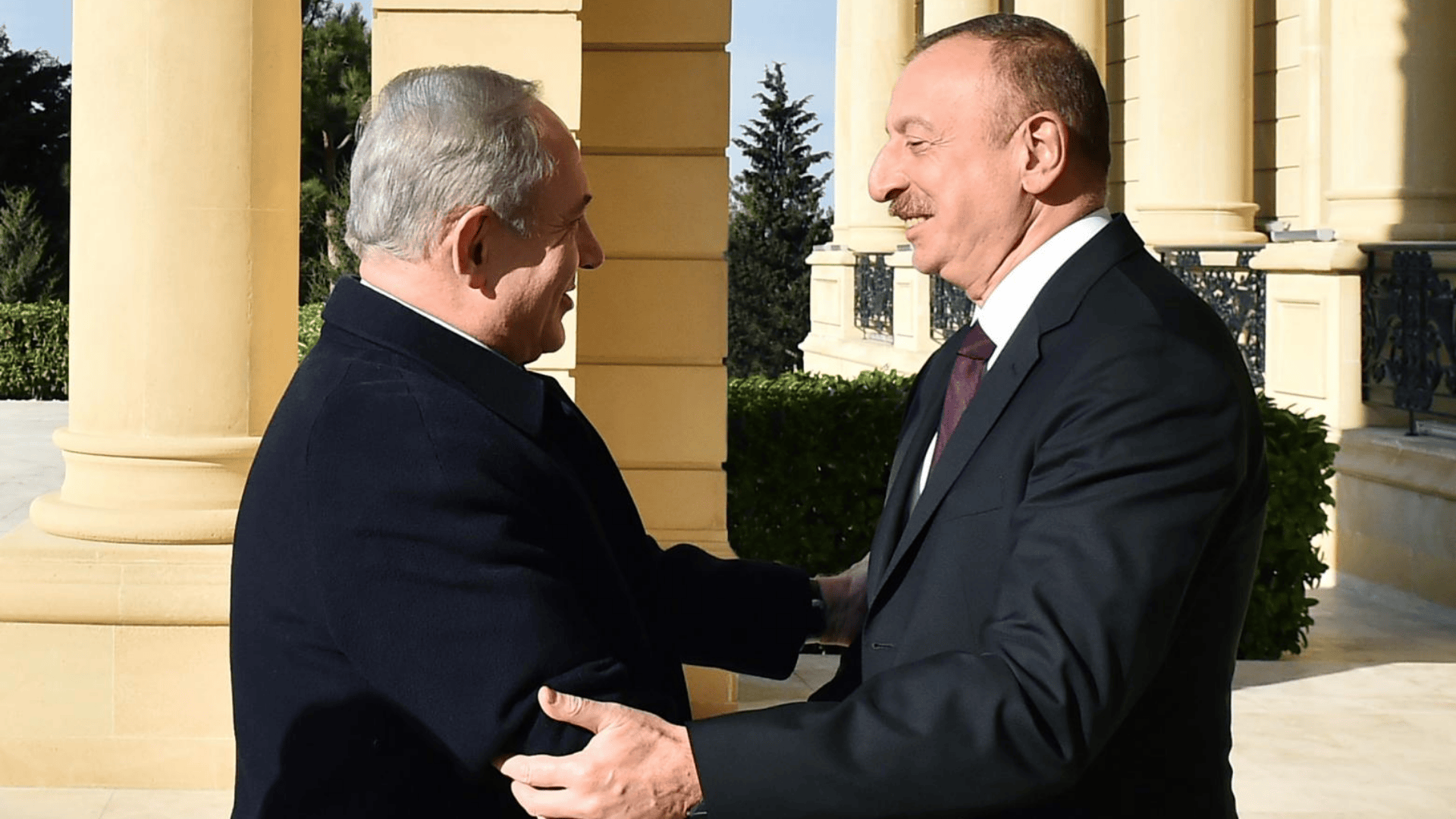
Azerbaijani President Ilham Aliyev once compared the relationship to an iceberg, saying that “90 percent of our ties are hidden from view.” Over the past decades, those ties have gradually emerged from the shadows and reached the level of a strategic partnership. Their importance became especially clear after the success of Israeli drones and other weapons during the Second Karabakh War in 2020.
By 2023, Azerbaijan’s oil exports to Israel had sharply increased, reaching 1.4 billion dollars a year—around 65 percent of Israel’s total oil imports. Between 2023 and 2025, as Israel’s actions in Gaza triggered a humanitarian catastrophe, relations between the two countries intensified further and expanded into new areas of cooperation.
The commentary was prepared by a regional analyst. The terms and place names used, as well as the opinions and arguments presented, reflect solely the author’s or a specific community’s perspective and do not necessarily represent the views of JAMnews or its staff.
Analysis of current situation
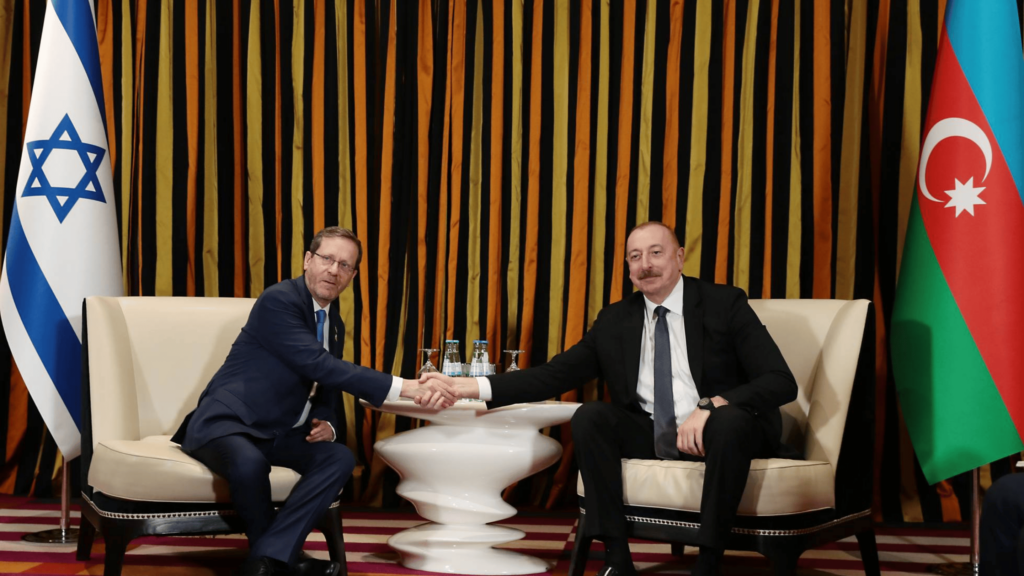
The year 2023 marked a turning point in Azerbaijan–Israel relations. In March, Azerbaijan opened its first official embassy in Israel, becoming the first Shia Muslim country to establish a diplomatic mission there. At the same time, it set up a representative office in Ramallah under the Palestinian Authority.
This step signalled that a partnership long kept in the shadows had shifted into open diplomacy. It was followed by an increase in high-level bilateral visits. In 2024, Hikmet Hajiyev, the head of foreign policy affairs at the Azerbaijani presidential administration, held several meetings with Israeli officials in Tel Aviv. Earlier that year, Azerbaijan’s economy minister visited Israel and signed strategic agreements in the energy sector.
In September 2023, Azerbaijan carried out an “anti-terror operation” in Karabakh, re-establishing full control over the region. Part of the weaponry used by Azerbaijani forces was produced in Israel and helped secure a military advantage. In restoring its territorial integrity, Azerbaijan saw the practical value of its defence cooperation with Israel.
The war between Israel and Hamas, which began in October the same year, became a diplomatic test for Baku. While countries such as Turkey and Iran sharply condemned the killing of civilians in Gaza, Azerbaijan adopted a more cautious stance. President Aliyev did not attend the extraordinary summit of the Organisation of Islamic Cooperation on Gaza in November, limiting himself to a statement expressing the country’s concern over the conflict.
Baku did not condemn Israel, but it also did not designate Hamas as a terrorist organisation (Hamas representatives had congratulated Baku on its 2020 victory in Karabakh). In other words, Azerbaijan sought to preserve its strategic ties with Tel Aviv while avoiding damage to its image in the wider Islamic world.
These bilateral relations continue to evolve against a backdrop of several factors, which will be examined further.
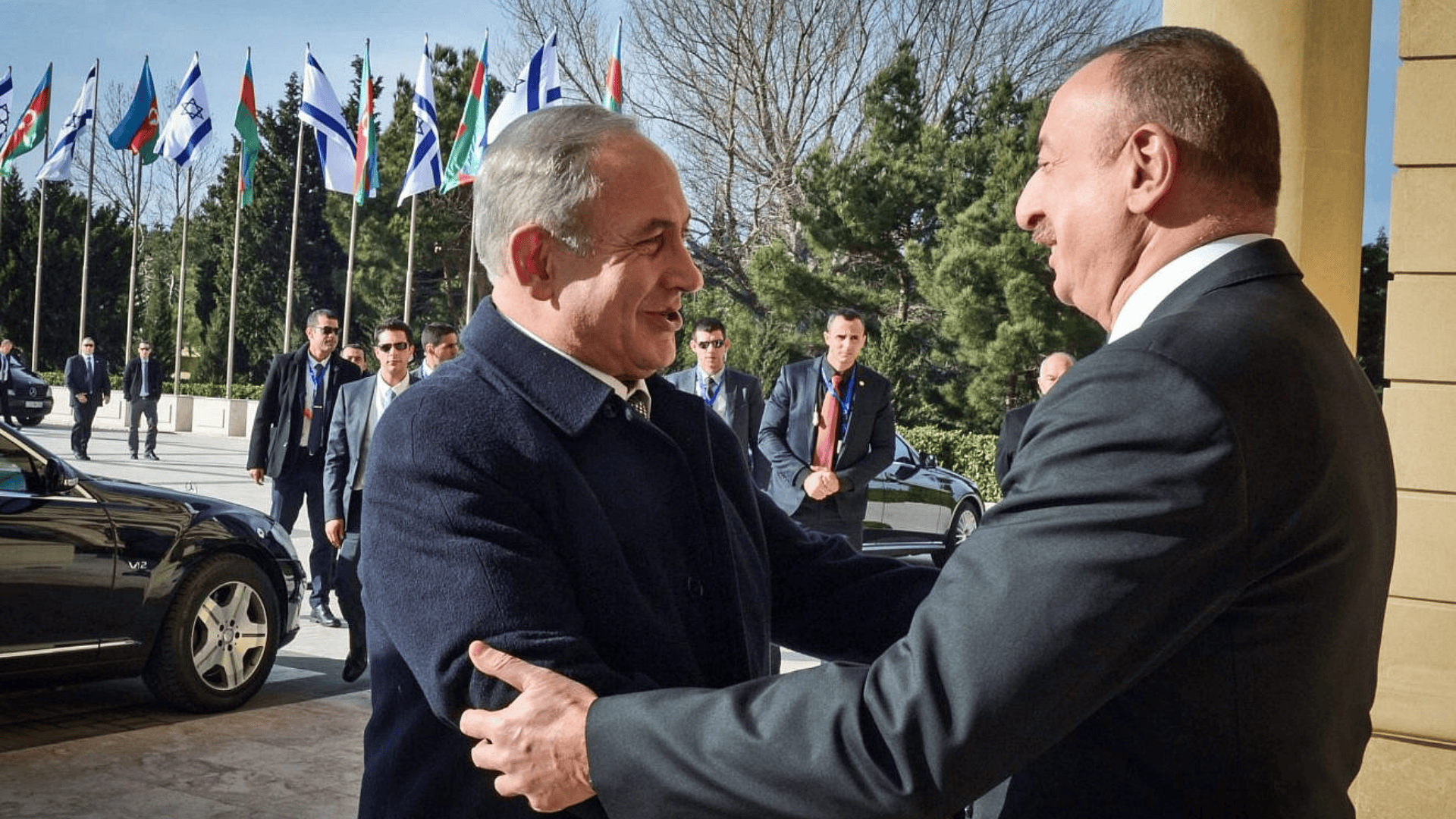
Energy cooperation: a new phase in the strategic partnership
Energy cooperation between Azerbaijan and Israel reached a new level in 2023–2025. Traditionally, Azerbaijani Caspian oil was transported to the Mediterranean via the Baku–Tbilisi–Ceyhan pipeline and then shipped by tanker to Israel. During this period, Azerbaijan strengthened its position as a key supplier of crude oil to Israel.
In the first four months of 2024 alone, over 1 million tonnes of Azerbaijani oil were exported to Israel, a 28 percent increase compared with the previous year. Azerbaijan remains one of the most reliable sources of crude for Israel’s refineries in Haifa and Ashdod, reinforcing the political interdependence between the two countries.
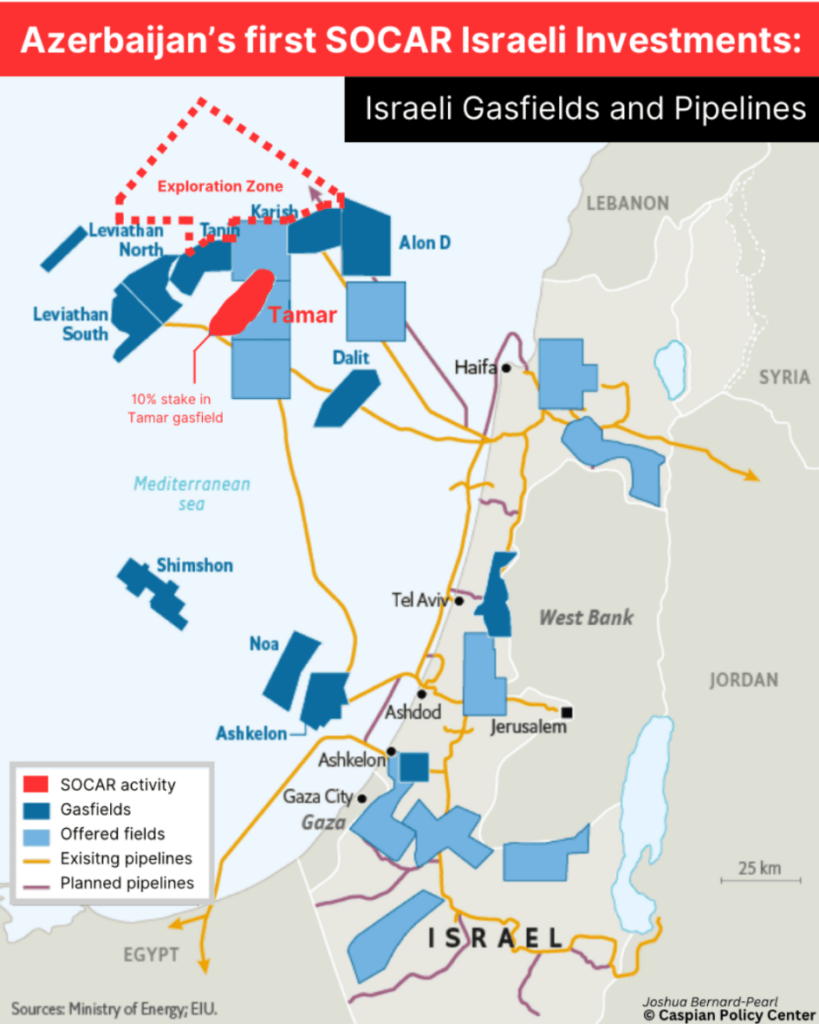
Energy cooperation in 2023–2025 went beyond oil trade. Azerbaijan began making direct investments in Israel’s gas sector. In October 2024, SOCAR, the State Oil Company of Azerbaijan, acquired a 10 percent stake in the strategic Tamar gas field.
The Tamar field is a key source of gas, supplying about 70 percent of Israel’s electricity production. SOCAR’s involvement represents a significant step in strengthening Azerbaijan’s economic presence in the Middle East. It is the first such stake for SOCAR in the Mediterranean region, reflecting Baku’s aim to “enhance soft power and find additional revenue sources beyond its own gas reserves.”
The investment also contributes to Israel’s energy security and was positively received in Washington. Following the 2023 war, the US has encouraged strategic investments aimed at ensuring stability in Israel’s energy sector.
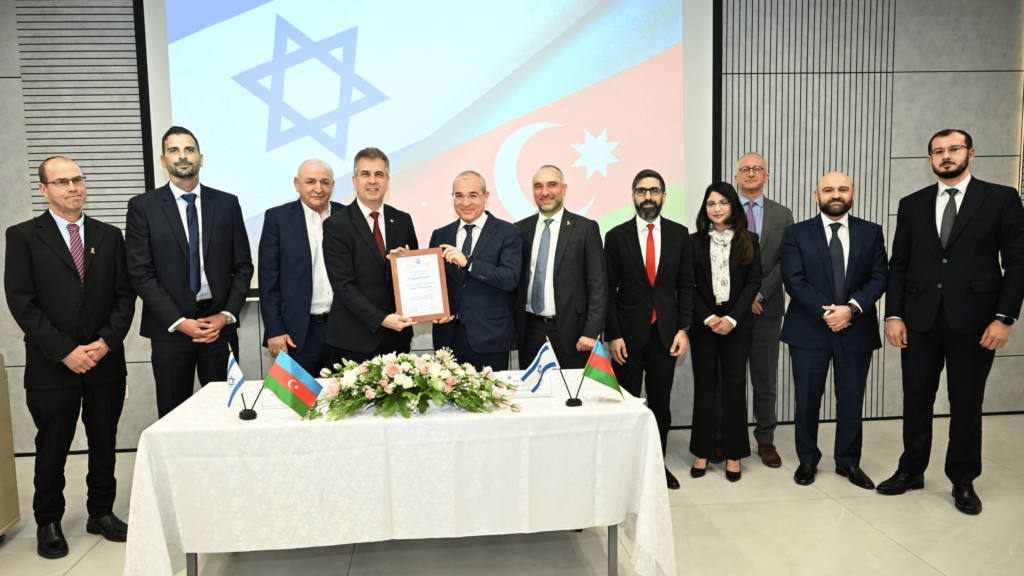
In March this year, the two countries signed another historic agreement. SOCAR was granted a license by the Israeli government to explore natural gas in “Zone I” in the northern Mediterranean, near the Leviathan field. Under the agreement, SOCAR will conduct exploration as part of a consortium with BP and the Israeli company NewMed Energy within Israel’s exclusive economic zone.
SOCAR was appointed consortium operator and holds a 33.3 percent stake. In fact, SOCAR and its partners had already won the tender for the exploration rights in October 2023, but the project’s implementation was delayed due to the outbreak of the war between Israel and Hamas.
Finally, during Economy Minister Mikayil Jabbarov’s visit to Israel in March, the licensing agreement was officially signed. According to the document, SOCAR must drill at least one exploratory well by autumn 2026 to assess the field’s potential reserves. If successful, the license could be extended for up to seven years.
The gas agreement is strategically important for Israel. Foreign investment helps diversify the country’s energy sector and expands opportunities for developing new fields. Israel’s energy minister described the cooperation as “excellent news for the state,” noting that partners such as SOCAR and BP strengthen both the political and economic position of the country.
For Baku, the deal offers not only economic returns but also geopolitical advantages. Azerbaijan is extending its energy influence into the Middle East while deepening strategic ties with both Israel and the West.
Experts even see this trend as a potential signal of Azerbaijan joining the broader process of normalising Arab–Israeli relations, such as the Abraham Accords. While official authorities remain cautious, the intensification of energy cooperation also points to closer political alignment.
Military cooperation: the role of security partnership
Defense and security are considered the foundation of Azerbaijan–Israel relations. Over the past 20 years, Israel has become one of the largest foreign suppliers of weapons to the Azerbaijani army. Between 2016 and 2020, around 69 percent of Azerbaijan’s imported military equipment came from Israel.
These supplies include drones, precision missile systems, artillery munitions, and air defense complexes. During the 2020 Second Karabakh War, Israeli Harop loitering drones and Spike anti-tank missiles played a crucial role, significantly affecting the course of the fighting.
Access to advanced Israeli military technology helped Azerbaijan achieve a swift victory over Armenia. In the September 2023 operation, Azerbaijani forces also relied heavily on Israeli-made weapons, giving them an advantage over Russian systems in Armenian service.
The partnership extends beyond arms sales to intelligence sharing and personnel training. For many years, reports have indicated that Israeli and Azerbaijani intelligence services exchange information, particularly regarding Iran. Azerbaijan shares a 700-kilometre border with Iran, which is home to more than 20 million ethnic Azerbaijanis.
For Tel Aviv, Azerbaijan is a strategic partner, not only as a neighbour of Iran but also for intelligence gathering and demonstrating military presence in the region. This explains Israel’s interest in strengthening Azerbaijan’s defense capabilities and continuing to supply it with advanced weaponry.
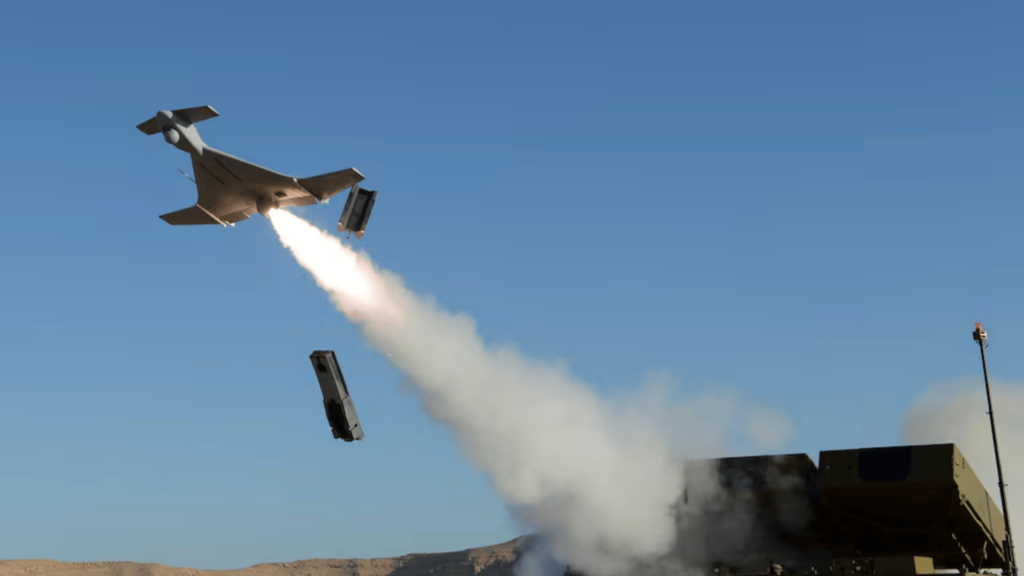
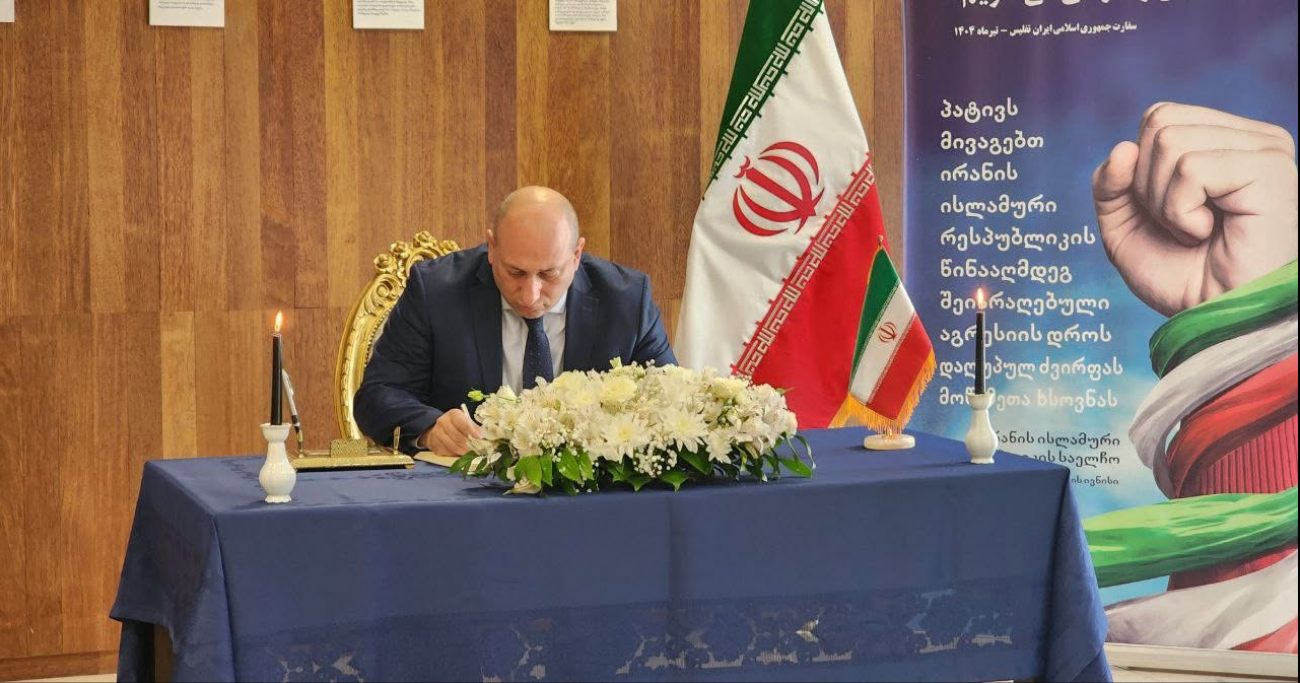
There are also unofficial areas of military-technical cooperation between the two countries. Tehran has repeatedly accused Baku of allowing Israel to establish military capabilities on its territory. Iranian officials have claimed that Israeli intelligence conducts operations in Iran via Azerbaijan and suggested that Israeli aircraft might use Azerbaijani airports.
Baku strongly denies these allegations, but Iran’s concerns highlight the sensitive nature of the bilateral security relationship. According to international media reports, secret facilities in Azerbaijan may support Israeli intelligence operations in the region, though there is no official confirmation.
Azerbaijan has also shown interest in high-tech Israeli defense systems, such as the Iron Dome missile defence system and modern air-defence equipment. In the future, there could be joint production of some components or expanded cooperation in personnel training.
It is believed that during the 2020 war, one of the missiles fired at Mingachevir and Baku (not officially confirmed) was intercepted by such a system. While Azerbaijan’s possession of these systems is not officially confirmed, military experts frequently reference them.
Overall, between 2023 and 2025, military cooperation, though smaller in scale than energy collaboration, intensified and reinforced Israel’s role in Azerbaijan’s security strategy.
Contextual factors: psychological and regional aspects
Azerbaijan–Israel relations should be viewed not only bilaterally but also in a broader regional context and within the socio-political discourse. This section first analyzes the regional backdrop, focusing on Israel’s relations with Turkey and Russia, and then examines symbolic elements in public perception and official rhetoric of both countries.
Regional context
Until 2023, Israel–Turkey relations were relatively normalized. By September of that year, consecutive visits by Israeli President Isaac Herzog to Turkey and Azerbaijan were planned. However, the outbreak of war in Gaza in October reignited tensions between Ankara and Tel Aviv.
President Recep Tayyip Erdoğan labeled Israel a terrorist state and in November 2024 announced a break in diplomatic relations. Caught between a strategic ally (Turkey) and a long-term partner (Israel), Azerbaijan prioritized its own interests, choosing not to halt economic and military cooperation with Israel despite Turkish pressure.
For instance, in early 2024 Turkey announced it would stop trade with Israel, yet Azerbaijani oil continued flowing to Israel via the Ceyhan port. Ankara was aware but remained silent, prioritizing transit revenues and strategic relations with Baku.
Still, public opinion in Turkey showed discontent, with some commentators calling for “pressure on Baku over Gaza.” These calls did not translate into official policy, but if tensions between Ankara and Tel Aviv persist, Azerbaijan could face a risky dilemma.
Regarding Russia, its relations with Israel are also complex. On one hand, after the outbreak of the war in Ukraine, Russia viewed Israel as partly neutral, since it did not openly join the Western camp. On the other hand, during the 2023 Gaza conflict, Moscow criticized the West and issued statements accusing Israel of civilian casualties.
Despite Russia’s strategic ties with Tehran and its concerns over Israel’s growing regional influence, it has so far not hindered Azerbaijan–Israel cooperation. One reason is Azerbaijan’s balanced approach toward Moscow: Baku maintains neutrality on the Ukraine issue, does not join sanctions against Russia, and in 2022 signed a declaration on allied cooperation with Russia.
Azerbaijan seeks to ensure that its closer ties with Israel do not damage its strategic relationship with Russia. Overall, tensions between Israel and Turkey and Russia are seen in Baku as factors that could indirectly affect Azerbaijan–Israel relations. The country aims to maintain its cooperation with Israel while avoiding conflict with these two key regional players.
Psychological and symbolic aspects
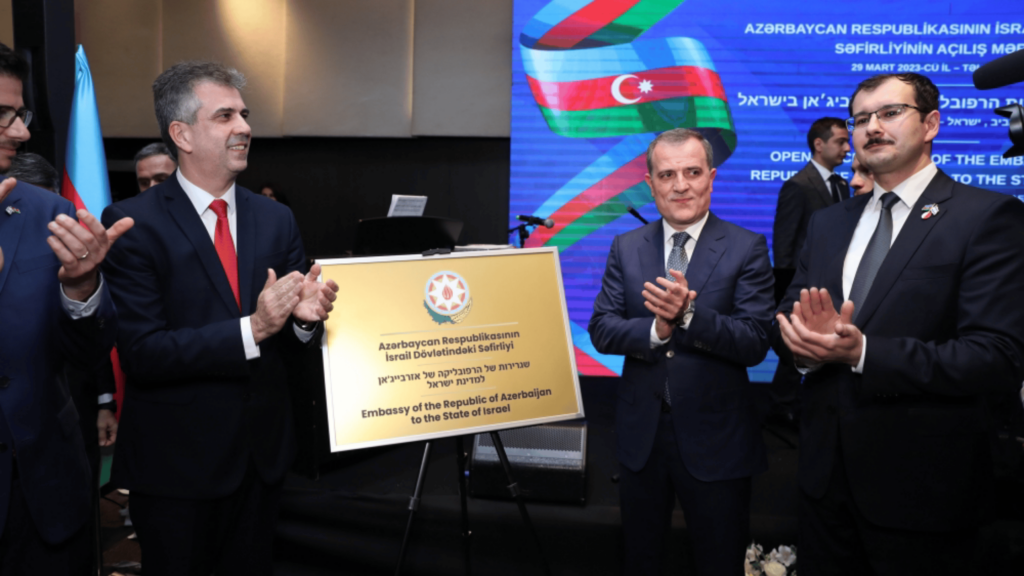
Public perception and official rhetoric around Azerbaijan–Israel relations also merit attention. Azerbaijani state propaganda regularly highlights the country’s historical friendship with the Jewish community and the Jewish people at large. References are made, for example, to the restoration of synagogues confiscated during the Soviet period and the opening of Jewish schools.
In 2024, popular foreign bloggers were invited to Azerbaijan to produce videos promoting the message of “peaceful coexistence between Muslims and Jews” in the country. Through such PR initiatives, Baku aims to present itself as a model of tolerance, legitimizing its ties with Israel both domestically and internationally.
Although Azerbaijan’s Jewish community is historically established, it remains relatively small (around 6,000 people). Official rhetoric, however, leverages this to portray Azerbaijan as a “rare Muslim country where Jews live comfortably.” In the information space, this narrative supports Baku, particularly in its propagandistic contrast with Yerevan, positioning itself as multiethnic and tolerant while framing its opponent as monoethnic.
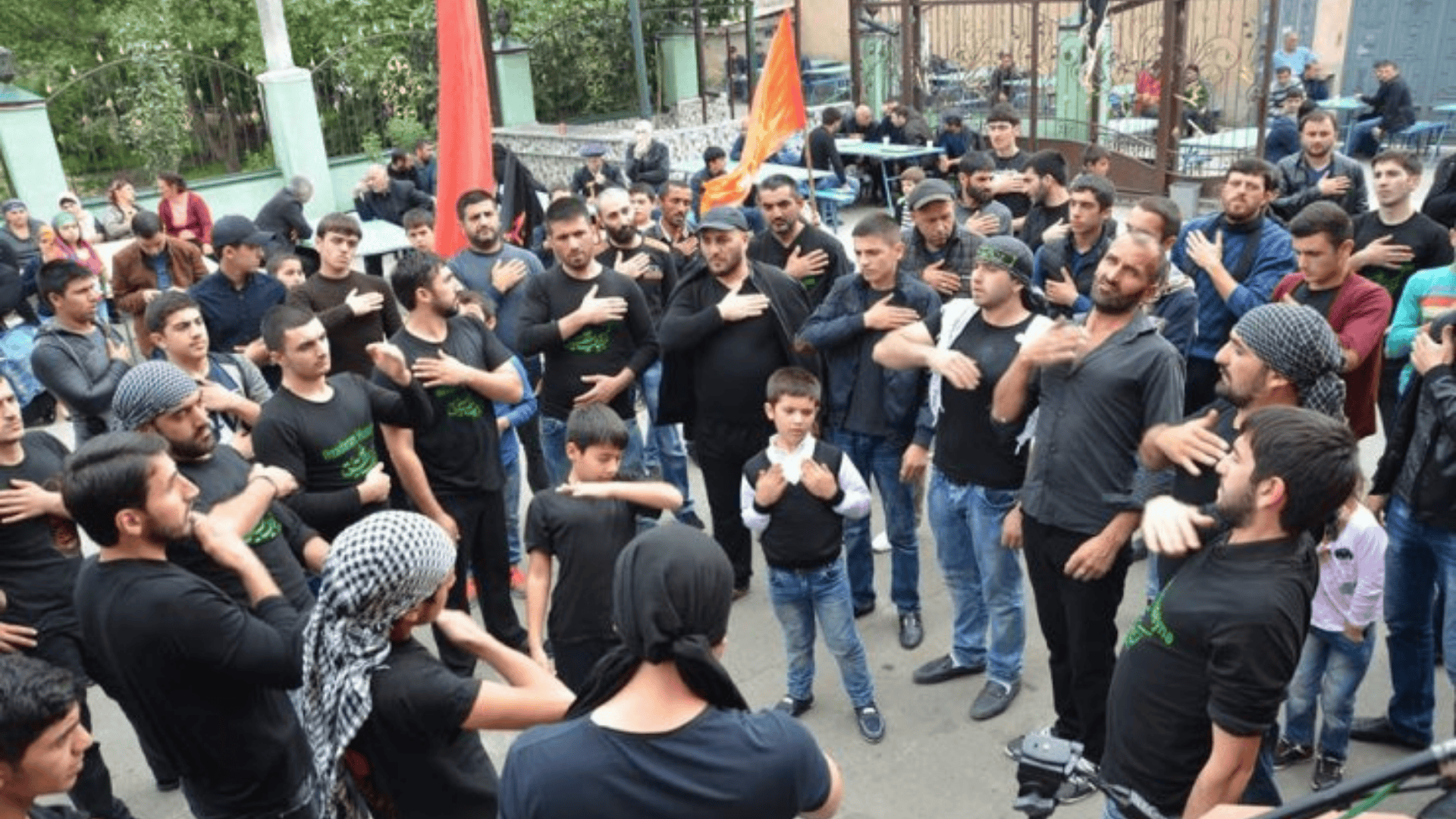
In Azerbaijani public opinion, attitudes toward Israel can be mixed, but the government carefully manages potential risks in this area. During the Gaza war, mass protests against Israel occurred across many Muslim-majority countries and in Western capitals, including rallies in Ankara in support of Hamas.
In Azerbaijan, no large-scale protests were observed. This reflects both the secular nature of governance and the regime’s low tolerance for public dissent. Authorities also aim to prevent the conflict from strengthening radical religious movements. Social media often features pro-Israel commentary, aligning with the official state line.
As a result, public discourse in Baku largely mirrors official policy. While some media criticism of Israel exists, the overall governmental stance remains consistent. The Ministry of Foreign Affairs expressed “deep concern” over the humanitarian situation in Gaza, yet cooperation with Israel continues to expand rapidly.
In Israel, relations with Azerbaijan carry symbolic significance. Azerbaijan is a rare ally: a predominantly Shiite Muslim country maintaining a close partnership with Israel. Israeli officials frequently describe Azerbaijan as a “friend of Israel in the Muslim world,” presenting the partnership as an example of possible peaceful coexistence.
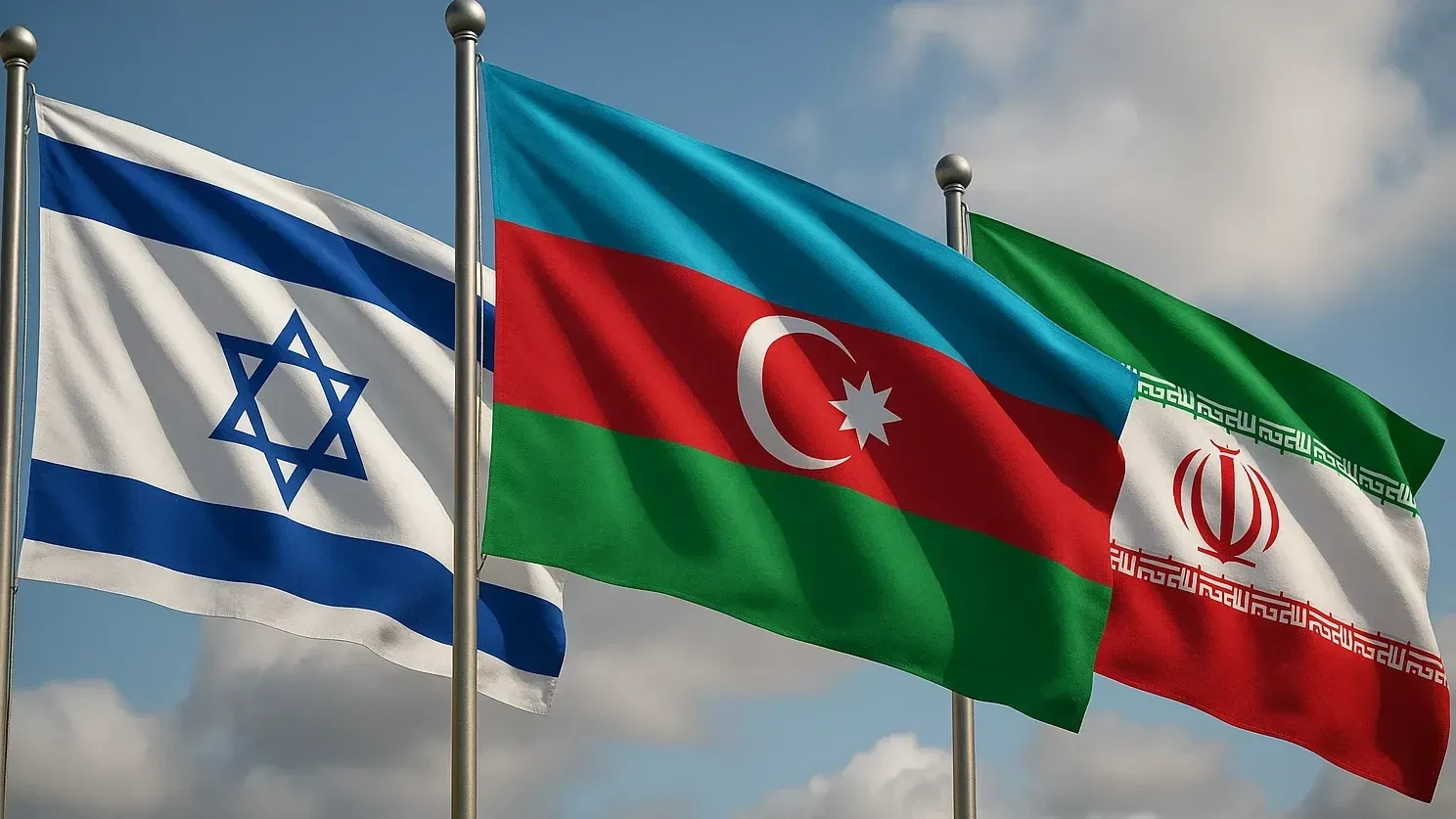
Azerbaijan–Israel relations