
The below data was drawn from the upcoming South Caucasus Banking and Investment Review 2025, which has been produced by Global Source Partners. It will be published on Friday 21 November. Read more: https://t.co/GaWDQVwVD4#FDI #SouthCaucasus #Armenia #Azerbaijan #Georgia pic.twitter.com/G97Bwheny3
— South Caucasus Banking Review (@SCBankingReview) November 19, 2025
Day: November 19, 2025
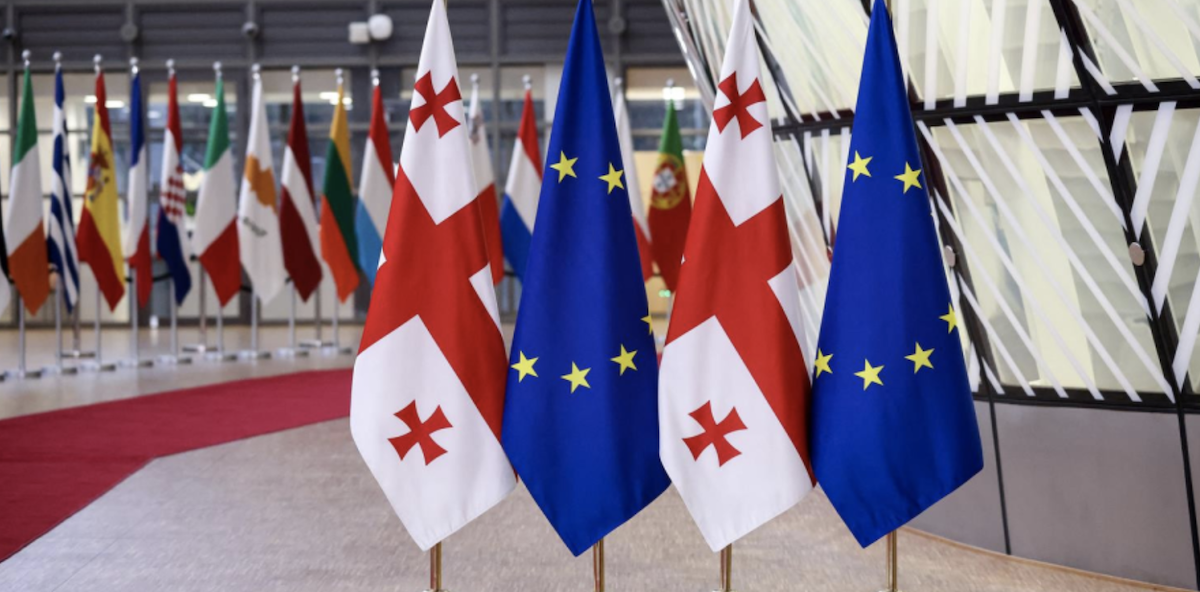
Postponed Georgia–EU talks
Postponed Georgia–EU talks became the main political development on 18 November. The Georgian government confirmed that the annual human-rights dialogue scheduled for 21 November had been cancelled, with reports suggesting that an EU-sanctioned member of the Georgian delegation triggered the decision.
The TV channel Formula reported that the individual in question is Deputy Interior Minister Aleksandre Darakhvelidze. Despite repeated questions from journalists, Darakhvelidze neither confirmed nor denied that he was part of the delegation, but he dismissed the report.
Following the cancellation, Georgia’s Foreign Ministry said the EU had postponed the meeting for “completely unacceptable” and unfounded reasons.
The ministry suggested that the European External Action Service had little genuine interest in holding the dialogue, arguing that Brussels was unwilling to hear Georgia’s position — including on issues cited by the EU as grounds for suspending political dialogue with Tbilisi.
Georgian foreign ministry statement
“The Human Rights Dialogue meeting between Georgia and the EU, scheduled for 21 November 2025 in Brussels, was postponed just days before it was due to take place, following a decision by the EU.
At a time when, on the basis of the EU Council conclusions of 27 June 2024, the European side has suspended dialogue with Georgia at all levels, the Georgian side viewed this meeting as an opportunity to engage with the European Union — including on issues for which our society often hears criticism from Brussels.
Georgia carried out substantial preparatory work to provide the European side with accurate information on all agenda items, and the Georgian delegation was formed accordingly, with the involvement of the relevant state agencies.
Unfortunately, despite Georgia’s readiness to hold a Human Rights Dialogue meeting with the EU, the European side decided to postpone it under a completely unacceptable and unfounded pretext.
The use of this issue for further speculation raises justified doubts and creates the impression that the European External Action Service was not genuinely interested in holding the meeting, and that Brussels is not prepared to hear Georgia’s reasoned position — including on issues used as grounds for suspending the political dialogue with our country.
Georgia remains committed to a constructive approach and believes that dialogue has no alternative in relations with partners. Once the political dialogue suspended by Brussels is fully restored, we will consider participating in dialogue formats with the European Union across various areas.”
Postponed Georgia–EU talks
U.S. Deputy Secretary of State for Political Affairs Allison Hooker met with Azerbaijan’s Foreign Minister Jeyhun Bayramov.
According to the information released by the Azerbaijani Ministry of Foreign Affairs on November 19, the current state of bilateral cooperation between the two countries was discussed during the meeting. The sides also exchanged views on prospects for development, the Azerbaijan–Armenia peace process, as well as regional and global security issues.
“The agreements reached during the historic Washington meeting on August 8 were recalled with satisfaction, and the importance of joint efforts toward the development of strategic partnership between the two countries was emphasized. It was noted that we are interested in accelerating work on the ‘Trump Route for International Peace and Prosperity,’ which will be implemented by the United States to ensure unhindered connectivity between the main part of Azerbaijan and its Nakhchivan Autonomous Republic,” the Ministry of Foreign Affairs statement said.
A statement from the U.S. Embassy in Azerbaijan noted that during the meeting, the U.S. Deputy Secretary of State reaffirmed Washington’s support for the peace process in the South Caucasus.
Relations between Azerbaijan and the United States have normalized after Donald Trump was elected president again. During the Biden Administration, the ties between the two countries were not considered “warm.” At the time, official Baku openly expressed dissatisfaction with Washington’s stance on regional developments, and additionally cited the Biden Administration’s increased criticism on human rights issues as a cause of strained relations. Washington’s statements regarding political prisoners and civil society caused discontent in Baku, with Azerbaijan stating that these matters were being unnecessarily politicized within the bilateral dialogue.
U.S. Deputy Secretary of State for Political Affairs Allison Hooker also met with the President’s Assistant and Head of the Foreign Policy Department of the Presidential Administration, Hikmet Hajiyev.
“Our discussions covered a wide range of issues, including progress on the Armenia–Azerbaijan peace agenda and the implementation of regional connectivity initiatives. We also exchanged views on key regional and global developments and reaffirmed the spirit of strategic partnership between Azerbaijan and the United States,” the President’s Assistant wrote on his “X” page.
The Deputy Secretary’s visit to the region began on November 15. Before arriving in Azerbaijan, she had visited Armenia.
During her visit to Armenia, it was announced that a joint working group had begun operating to implement the “Trump Corridor.” The working group will be led by Sonata Coulter, Deputy Assistant to the U.S. Assistant Secretary of State.
During her meetings in Yerevan, including with Armenian Prime Minister Nikol Pashinyan, the U.S. official presented details of the working group.
According to her, U.S.–Armenia cooperation, as well as progress in the normalization of Armenia–Azerbaijan and Armenia–Turkey relations, “creates new prospects for opening the South Caucasus as an important trade route.”
The post U.S. Deputy Secretary of State discusses peace process and the “Trump Corridor” with Azerbaijan and Armenia appeared first on MEYDAN.TV.
Categories
«Последняя война» Трампа
During the Gaza war, Azerbaijan and Kazakhstan supplied seventy percent of Israel’s oil through Turkey and Russia.
During that period, twenty five countries supplied crude oil and refined fuel to Israel.
A recent report by Oil Change International provides this information.
In the updated report, 323 tanker voyages carrying a total of 21,2 million tons of crude oil and refined products from twenty five countries to Israel were recorded between 1 November 2023 and 1 October 2025.
171 of these shipments consisted of crude oil, with a total volume of 17,9 million tons. According to the report, %70 of the crude oil entering Israel came from Azerbaijan and Kazakhstan.
Azerbaijan’s crude oil is delivered to the port of Ceyhan in Turkey through the Baku Tbilisi Ceyhan pipeline. The report notes that because the pipeline ends in Turkey, the country of origin is recorded as Turkey in official documents, although all oil carried through the pipeline is known as “Azeri BTC”.
Kazakhstan’s oil is documented in a similar way. Crude oil delivered to Novorossiysk on the Russian coast of the Black Sea through the Caspian Pipeline Consortium is recorded in documents as originating from Russia.
The report also shows that 17 countries sent a total of 3,3 million tons of refined oil products to Israel through 152 tanker voyages. %45 of these shipments came from Russia.
The United States sent 360,000 tons of JP-8, which is jet fuel used in military aviation, on nine voyages to Israel, along with two additional voyages carrying diesel fuel. The fuel was produced at the Bill Greehey refinery in Texas owned by Valero.
Dr. Irene Pietropaoli, author of a legal opinion concerning genocide in Gaza, reminded that in light of the provisional ruling issued by the International Court of Justice, states must consider that any support for Israel’s military operations may expose them to the risk of involvement in genocide.
The legal opinion raises questions about whether fuel exports to Israel by states violate the International Court of Justice requirement to prevent and punish genocide.
In September 2025, the United Nations Independent International Commission called on member states to halt the supply of weapons, equipment and also jet fuel to Israel or to third countries whenever there is suspicion that such items may be used in operations that could amount to genocide.
The post During the Gaza war, Azerbaijan and Kazakhstan supplied seventy percent of Israel’s oil appeared first on MEYDAN.TV.
Tbilisi City Court has sentenced former Defense Minister Irakli Okruashvili to seven years in prison after finding him guilty of exceeding his official powers in the 2004 killing of Amiran (Buta) Robakidze, when he briefly served as Interior Minister.
Okruashvili, who is already jailed after receiving an eight-month sentence in July for refusing to appear before the controversial parliamentary commission, will ultimately serve four years and five months, as the verdict was partly covered by amnesty and further reduced by ten months he served after the 2019 Gavrilov Night case, as well as his current detention, according to RFE/RL’s Georgian Service.
In this case, the court acquitted former Prosecutor General Zurab Adeishvili, who at the time oversaw the investigation into Buta Robakidze’s killing. Adeishvili left Georgia for Hungary after the Georgian Dream party came to power in 2012. He has been wanted by Georgian authorities since 2013 on various charges, although Interpol withdrew its red notice for him in 2015.
The charges against Okruashvili and Adeishvili in the case were brought in 2019, when the Prosecutor’s Office accused Okruashvili of directing officials to cover up the circumstances surrounding the 19-year-old’s death.
According to prosecutors, after learning that a patrol officer had fatally shot Robakidze during a late-night vehicle inspection, Okruashvili instructed senior Interior Ministry officials to protect the image of the patrol police and to classify the incident as an armed group’s attack on law enforcement. The prosecutors said ministry officials then planted firearms and ammunition in the car carrying Robakidze and his friends to support the fabricated narrative.
On November 23, 2004, Buta Robakidze was fatally shot by a patrol officer. Authorities initially claimed that Robakidze and his companions were an armed group and that the officers had acted in self-defense.
However, the self-defense claim unraveled after patrol officer Grigol Bashaleishvili admitted he had accidentally shot Robakidze, who was unarmed. Bashaleishvili was convicted in 2006 and sentenced to four years in prison for negligent murder.
The case was reopened in 2013, a year after Georgian Dream came to power. In 2018, the Tbilisi City Court convicted five former Interior Ministry Officials of exceeding their official powers in connection with the incident.
Buta Robakidze’s family repeatedly insisted that those responsible for fabricating evidence and orchestrating the misleading media coverage be held accountable. They pointed to senior officials in the Interior Ministry’s press service, including Guram Donadze, who managed the Patrol Police program, and Zurab Mikadze, then chief of the Patrol Police.
Also Read: