
Day: November 14, 2025
OSCE’s Office for Democratic Institutions and Human Rights (ODIHR) has called for the repeal of Georgia’s new stricter protest laws in its November 12 urgent opinion, warning that the amendments, fast-tracked in October, “raise serious concerns about Georgia’s lack of compliance with international human rights obligations.”
In the 43-page assessment, requested by Georgia’s Public Defender, the watchdog notes that the new rules that introduce administrative detention and eventual criminal sentences for several protest-related violations “directly contradict international standards that require sanctions to be necessary, proportionate, and non-discriminatory.”
By removing less severe alternatives for non-violent actions, the amendments “undermine the principle of proportionality,” the opinion says, adding that such practice is “punitive to an excessive degree.”
“This, compounded by the absence of effective remedies to challenge such detentions, exacerbates the potential for abuse and the risk of arbitrary deprivation of liberty violating Article 9 of the ICCPR and Article 5 of the ECHR,” the opinion states.
The document stresses that detention for assembly-related offenses “should be used only if there is a pressing need to prevent the commission of serious criminal offences and where an arrest is absolutely necessary (e.g., due to violent behaviour).”
OSCE/ODIHR also criticizes the amendment that introduces a 5,000 GEL (USD 1,800) fine for pregnant women, women with children under 12, minors, or persons with severe or significant disabilities who commit administrative offenses, calling the measure “clearly disproportionate” and urging that it “should be reconsidered entirely.”
According to the opinion, the amendments – including penalties for wearing a mask, peacefully participating in assemblies deemed “unlawful” or obstructing roadways – effectively make imprisonment the default sanction, “de facto resulting into disproportionate criminal penalties for the mere exercise of the right to freedom of peaceful assembly, including when guaranteed by the norms of international law.”
“Thus, imposition of criminal penalties in response to a conduct, which may be legitimate and lawful under the international law, would result in arbitrary deprivation of liberty in violation of Article 9 of the ICCPR and Article 5 of the ECHR,” it adds.
The document further argues that disproportionate penalties over protest-related offenses, “may deter the organization and participation in such events and chill the exercise of the rights to freedom of peaceful assembly and freedom of expression.”
The opinion flags the introduction of criminal penalties of up to one year in prison for children (under 18 years of age) for repeated violations of the amended administrative provisions, saying this “contravenes international obligations, which require that deprivation of liberty be used for children only as a measure of last resort, and call upon States to adopt non-custodial alternatives to detention as the default response to criminal offences allegedly committed by minors.”
The document also addresses the amendment criminalizing verbal insults against law enforcement and other officials, now punishable by up to two years’ imprisonment for repeated offenses, warning that “such vague and broad terminology,” which may lead to subjective interpretation, fails to meet the “standards of legality, clarity, and foreseeability.”
“It risks erroneous, overbroad, arbitrary and/or targeted enforcement against legitimate criticism of public officials, thereby undermining freedom of expression and further amplifying the chilling effect on civic activism,” the document argues.
Referencing its March 2025 Urgent Opinion, the organization reiterates that the “vague and broad wording” of certain assembly-related offenses makes them vulnerable to misuse against individuals expressing dissenting views, including human rights defenders, activists, and journalists. It argues that the cumulative effect of the expanded legal framework raises serious concerns that the October 2025 amendments “may be used for purposes beyond those permitted under the ECHR, in violation of Article 18 of the ECHR, in particular.”
“Overall, the October 2025 Amendments raise serious concerns about Georgia’s lack of compliance with international human rights obligations, especially Articles 9, 19 and 21 of the ICCPR and Article 5, 10, 11 and 18 of the ECHR and should be repealed,” the opinion concludes.
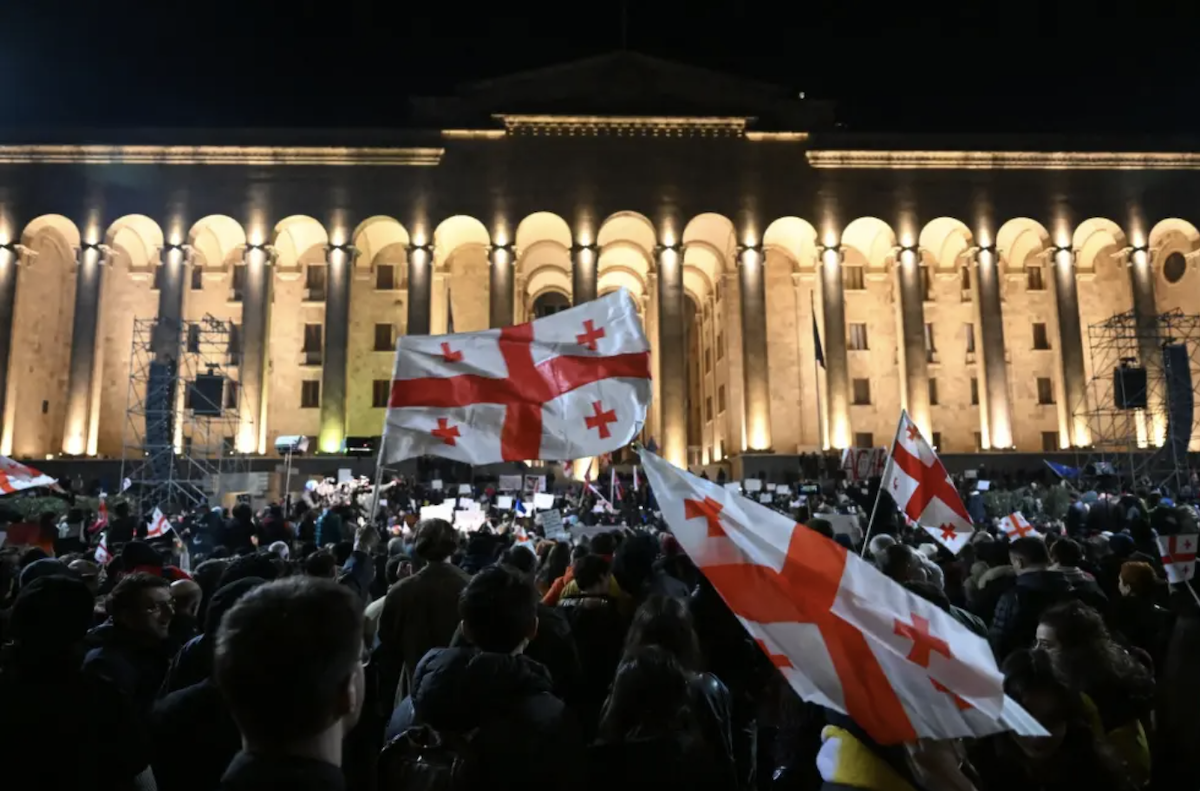
More than a hundred protesters have been detained since the disputed parliament fast-tracked stricter protest laws in mid-October. One protester, Zurab Menteshashvili, was placed in pre-trial detention under criminal charges as police allege he repeatedly “blocked the road” during the rally.
Until recently, Rustaveli Avenue has been blocked nightly since November 28, 2024, when the Georgian Dream government announced halting Georgia’s EU accession efforts. For nearly a week, police have physically prevented demonstrators from occupying the road, prompting them to shift to alternative forms of protest, including loud marches through downtown Tbilisi.
Also Read:
Spoke live on #ARB24 about Armenia’s approach to the TRIPP project and what this means for regional dynamics and the peace agenda.
📌 https://t.co/bdf54KtMxi#Azerbaijan #SouthCaucasus #Diplomacy #RegionalSecurity pic.twitter.com/1MsbTLiovk— Sevinj Fataliyeva (@SevinjF) November 14, 2025
OSCE on laws in Georgia
The Organization for Security and Co-operation in Europe has published a report on the “Georgian Dream” laws that restrict freedom of expression, stating that they should be repealed.
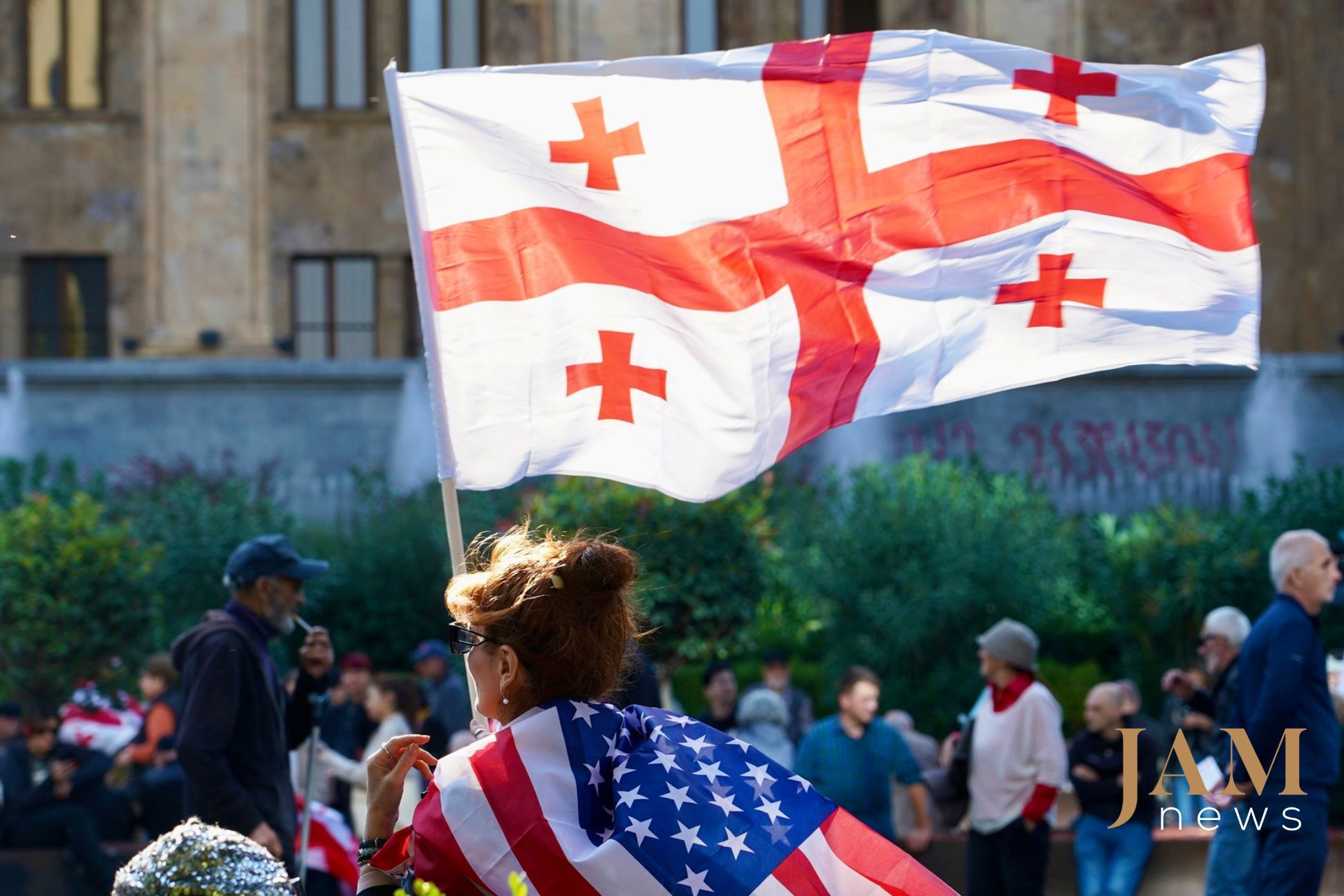
In its 12 November 2025 report, the OSCE concluded that legislative amendments passed in Georgia in October 2025 violate the right to freedom of expression enshrined in international law.
The report highlights amendments under which blocking a road or wearing a mask at a protest can result in detention for up to 15 days, with repeat offences potentially leading to criminal prosecution.
The OSCE’s critical assessment states that detaining citizens for taking part in peaceful protests breaches Georgia’s international human rights obligations.

“The amendments adopted in October 2025 raise concerns over Georgia’s failure to comply with its international human rights obligations, in particular Articles 9, 19, and 21 of the UN Covenant on Civil and Political Rights and Articles 5, 10, 11, and 18 of the European Convention on Human Rights. These amendments should be repealed,” the OSCE concluded.
The OSCE said that the Georgian Dream government’s policies directly contradict international standards, which require respect for proportionality and non-discrimination when imposing penalties for offences.
“Criminalising conduct that may be lawful under international law amounts to arbitrary deprivation of liberty, which violates Article 9 of the UN Covenant on Civil and Political Rights and Article 5 of the European Convention on Human Rights,” the OSCE assessment states.

On 17 October, the ruling Georgian Dream party approved new repressive amendments targeting protest participants.
Amendments to the administrative code
They supplement Article 174, Part 10 of the Administrative Offences Code, under which a protest participant can face administrative arrest for the following actions:
- covering the face with a mask or other means;
- possession of tear gas, nerve agents, or other toxic substances;
- deliberately obstructing the movement of people or vehicles;
- hindering public order and security maintained by police officers;
- partially or fully blocking a roadway when the number of demonstrators allows the protest to proceed without blocking the road.
Violating these prohibitions carries the following penalties:
- administrative arrest of up to 15 days for participants;
- administrative arrest of up to 20 days for organizers.
Administrative arrest of up to 60 days applies if participants:
- carry firearms, explosives, flammable substances, radioactive materials, cold weapons, or pyrotechnics;
- carry items or substances that can be used to harm the health or life of protesters or others;
- take part in a protest banned by the Ministry of Internal Affairs under Article 13, Paragraph 1 of this law.
Amendments to the criminal code
Repeated violations of the above actions within a year are punishable under criminal law:
- imprisonment of up to one year;
- up to two years’ imprisonment for a repeated offence;
- fines or imprisonment of up to one year for minors;
- up to four years’ imprisonment for organizers if their actions lead to serious consequences.
A third violation of Article 173 of the Administrative Offences Code (“Failure to obey a lawful police order or insulting an officer”) will be considered a criminal offence and punished by:
- imprisonment of up to one year;
- up to two years’ imprisonment for a repeated offence;
- fines, corrective work, or imprisonment of up to one year for minors.
The international human rights organization Amnesty International stated that the adoption of these repressive laws threatens the rights to freedom of assembly and expression..
OSCE on laws in Georgia