
Day: October 16, 2025
The Georgian Dream parliament has approved, in its final reading, a legislative package that would strip individuals “associated” with parties declared unconstitutional of their passive voting rights, including the right to found or join political parties, run in elections, or hold public office.
The amendments, feared to enable arbitrary targeting of a broad range of political parties and individual opponents of the ruling party, follow repeated signals from Georgian Dream that it intends to use the damning report of the one-party parliamentary commission in its Constitutional Court appeal to ban the United National Movement (UNM), the former governing party, as well as virtually all major opposition forces it labels as the “collective UNM.”
Under the amendments to Article 23 of the Law on the Constitutional Court of Georgia, which provides for the annulment of a party’s registration if its establishment or activities are declared unconstitutional by the Court, the restrictions will now extend to “individuals associated with this political party.” Such individuals will be prohibited from founding, leading, or joining a political party; serving in its executive or supervisory bodies; holding state-political or political office; or assuming leadership positions in constitutional bodies.
The amendments also allow for the termination of mandates in parliament or other representative bodies, as well as the removal of such individuals from party lists in general elections, if requested by the plaintiff in the constitutional claim.
The Criminal Code was also amended as part of the package to introduce fines for parties that fail to comply with, or obstruct, the execution of Constitutional Court decisions banning such persons from numerous political activities.
Relevant changes were also made to the Law on Citizens’ Political Associations and Georgia’s Electoral Code. These changes allow authorities to deny registration to parties that include such individuals as leaders or members, bar those individuals from running in local or parliamentary elections, and disqualify parties or revoke party lists containing them during relevant elections. The amendments to the Law on Political Associations of Citizens further prohibit such persons from making donations to political parties.
The new changes follow the earlier legislative package adopted in May, which granted the Constitutional Court authority to ban opposition groups whose leadership, goals, or activities are deemed identical to those of an already-banned party. The changes authorized the Court to ban a political group whose aim is to “overthrow or change Georgia’s constitutional order by force, undermine the country’s independence, violate its territorial integrity, engage in war or violence propaganda, incite national, regional, religious, or social strife.”
Fears of Arbitrary Application
Announcing the changes, Georgian Dream officials pledged that they will be submitting a claim to the Constitutional Court “in the near future.” The ruling party figures have also repeatedly indicated that while the claim is directed at the UNM, all other major forces, including Lelo for Georgia and Gakharia for Georgia, will be affected.
Georgian Dream Prime Minister Irakli Kobakhidze told Georgia’s Public Broadcaster on October 15 the appeal would ultimately target “up to ten parties, including smaller ones.” The criterion, he explained, was that “whoever has been continuously involved in sabotage against the state together with this bloody party or force will, of course, also be affected by this appeal,” adding that “the exact list will be made public in a couple of days.”
As for the individual members facing a ban from political activities, according to Gorduladze, they will also include individuals who are not necessarily members of the relevant parties. “These are members, representatives of the ruling circle, or they could just as well not be party representatives, not have party tickets in their pockets, but through their activities be fully aligned with the party’s goals or ensure that the party’s politics are put into practice,” Gorduladze told parliament on October 15.
The Georgian Young Lawyers’ Association (GYLA), one of the country’s key human rights watchdogs, warned that the changes risk “significant democratic erosion,” arguing that the line between safeguarding democracy and suppressing political pluralism “is extremely fragile.” GYLA said the proposed restrictions on individuals associated with banned parties contradict both the Georgian Constitution and international standards, “disproportionately and indefinitely limit individual rights, which, in the long term, could lead to the disappearance of the political spectrum.”
The new laws have sparked concern across the opposition spectrum, with even UNM’s fiercest opponents, including Irma Inashvili of the nativist Alliance of Patriots, warning they could be used to target all political groups. “Can’t you understand that, with the supposed motive of fighting the already dissolved and vanished Natsebi [UNM party], in the end they will come after all of us?!” – Inashvili wrote on Facebook.
Also Read:
The Georgian Dream parliament has rubber-stamped a legislative package that further toughens penalties for protest-related offenses.
The package, endorsed unanimously by Georgian Dream MPs, amends the Administrative Offenses Code and the Criminal Code to increase fines and allow immediate detention for some of the protest-related violations.
The move comes after unrest in the capital on October 4, election day, and follows the ruling party’s pledge to end the anti-government and pro-EU protests on Tbilisi’s main Rustaveli Avenue, where demonstrators have been blocking the street nightly for more than 320 days.
Civil society organizations have warned that the changes aim to “ban peaceful protest,” while Georgian Dream PM Irakli Kobakhidze and other ruling party officials defended the amendments, saying a small group of people on Rustaveli Avenue should not be allowed to “oppress” the majority by blocking the street every night and that the previous fines were ineffective.
The Changes:
Violating rules on assemblies and demonstrations, including covering faces during protests, carrying pyrotechnics or intoxicating substances, “artificially” blocking roads, or erecting “temporary structures,” will now result in immediate administrative detention of up to 15 days for participants and up to 20 days for organizers, whose unlawful materials will also be confiscated.
Previously, first-time offenders faced only a fine of GEL 5,000 (about USD 1,800), which itself had been increased tenfold from GEL 500 (USD 180) last December, during the first month of the ongoing protests. Hundreds of people have already been fined for allegedly blocking Tbilisi’s central Rustaveli Avenue near Parliament, where anti-government protesters have been gathering and blocking traffic for more than 320 days. Georgian Dream members, however, have argued that the fines proved ineffective.
Repeating the above offenses, or taking part again in protests that the Interior Ministry has ordered to disband, will now be treated as a criminal offense. Offenders can face up to one year in prison, or up to two years for repeated violations. Organizers whose actions cause “serious consequences” can be sentenced to as much as four years in prison. As for participation in a protest that has been ordered to disband, it will be treated as an administrative offense for the first time and punishable by up to 60 days of detention.
Disobedience to a lawful order or demand from law enforcement, or committing another unlawful act against them, which is punishable under the Administrative Code for the first two offenses, will now be treated as a criminal offense on the third violation, carrying up to one year in prison and up to two years for subsequent offenses.
Furthermore, protesters who carry firearms, explosive, flammable, or radioactive substances, cold weapons, or who carry such items or substances that are or may be used to injure the life and health of participants of the assembly or other persons, will result in 60 days of detention. The same penalty will be on participation in assemblies disbanded by the Interior Ministry.
In the case of pregnant women, minors, women with children under 12, and individuals with disabilities, administrative detention will be replaced with a fine of GEL 5,000 (about USD 1,800), or GEL 15,000 (USD 5500) for organizers.
Banning Peaceful Protests?
Civil society organizations have warned that the amendments amount to the ruling party’s “attempt to ban peaceful protest” and “another step toward dismantling democratic institutions” in Georgia.
“With these changes, the government sends the same threat to everyone: ‘If you raise your voice, you will be arrested,’” 25 CSOs said on October 14, the day after the proposals were announced and before they were rushed through the one-party legislature in an accelerated procedure.
The Georgian Young Lawyers’ Association (GYLA), a local human rights watchdog, said in a separate statement that the changes aim to “restrict the ongoing daily protests on Rustaveli [Avenue].” The group added that with these amendments, the Georgian Dream government “establishes ‘legalized injustice,’ thereby undermining the principles of the rule of law.”
Georgian Dream officials have expressed their intention to end the ongoing protest rallies on Rustaveli Avenue, which will mark one year in about a month. Some members, including PM Irakli Kobakhidze, said the fines for road blockages have proved ineffective in ending Rustaveli protests.
Also Read:
OSCE chair visit Georgia
The Georgian foreign ministry has expressed concern over the visit of the current OSCE chair, Finnish foreign minister Elina Valtonen, and has filed a formal protest with the organisation.
In a note sent to the OSCE secretariat, Tbilisi described Valtonen’s visit to Rustaveli Avenue — a central thoroughfare where protests are regularly held — as “joining a street rally organised by a small group of anti-government activists,” accusing her of attempting to mislead the international community about the situation in Georgia.
The note also warned that Valtonen’s actions could be seen as an abuse of her powers as OSCE chair.
Background
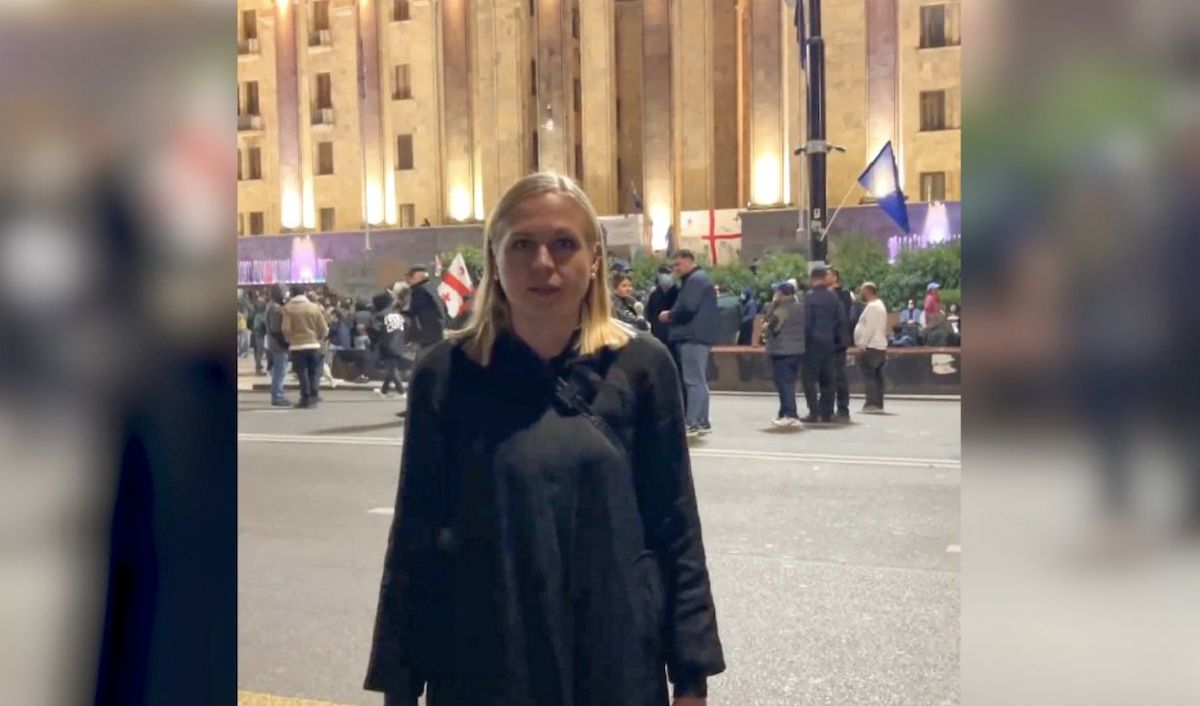
Elina Valtonen was on an official visit to Georgia and on 14 October 2025 went to Rustaveli Avenue, where she met protesters and recorded a video message.
“Peaceful protesters gathered in front of the parliament building in Tbilisi, Georgia, to express their opposition to the country’s repressive policies. They have every right to democracy, freedom of speech, and basic human rights. We are here to support them,” Valtonen said.
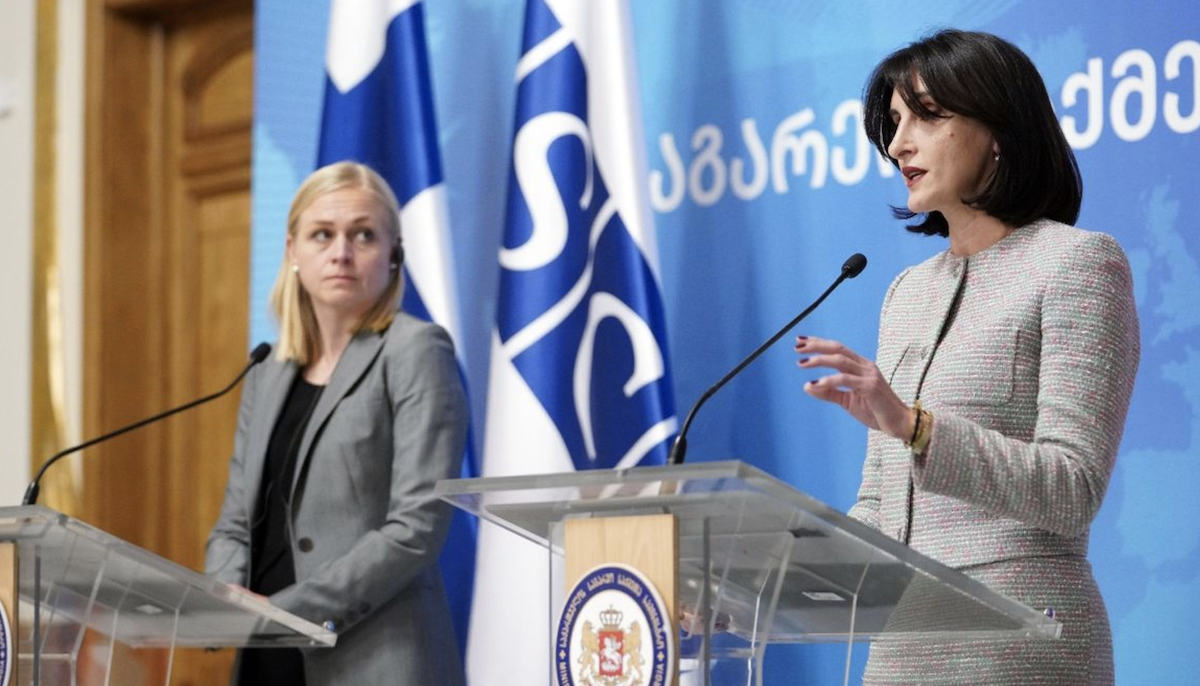
Earlier, the OSCE chairperson met with Georgian Dream’s foreign minister, Maka Bochorishvili, where she criticised the ruling party’s anti-democratic policies. However, the Georgian foreign ministry made no mention of Valtonen’s criticism in its press release about the meeting.
On 15 October, the Georgian Dream government issued a statement saying Prime Minister Irakli Kobakhidze had cancelled a meeting with Valtonen “due to her participation in an illegal protest,” although it later emerged that the meeting had been cancelled by the Finnish foreign ministry itself.
On 16 October, Valtonen publicly invited Kobakhidze to visit Finland, meet representatives of independent media, and attend any demonstration there. She also stressed that Georgia’s future depends solely on its own people.
The same day, the Georgian Interior Ministry fined Valtonen 5,000 lari (around $1,800) for “illegal road obstruction” during her presence on Rustaveli Avenue.
Note of protest
“Outside the official programme of the current OSCE chair, which included a meeting with Georgia’s foreign minister Maka Bochorishvili, a visit to the occupation line, and meetings with several civil society representatives, Minister Elina Valtonen joined a street protest organised by a small group of anti-government activists, who on 14 October blocked Tbilisi’s main avenue without hindrance, albeit illegally.
The minister’s public statement, which does not reflect the facts, is a deliberate attempt to mislead the international community about the current situation in Georgia.
These actions contradict the spirit of cooperation within the OSCE and may be regarded as an abuse of the mandate of the sitting chair, undermining trust and the appearance of neutrality.
Such actions are incompatible with international law. They violate OSCE rules and procedures, the Vienna Convention on Diplomatic Relations, and widely recognised principles, including respect for sovereignty and non-interference in internal affairs, as set out in the Helsinki Final Act and UN Resolution A/RES/20/213,” the note states.
OSCE chair visit Georgia
Leading bishop among Armenian clerics arrested in government crackdown on church ABC News – Breaking News, Latest News and Videos