
Day: October 13, 2025
Armenia at a Crossroads: The Church-State Rift Is Testing the Nation’s Future National Catholic Register
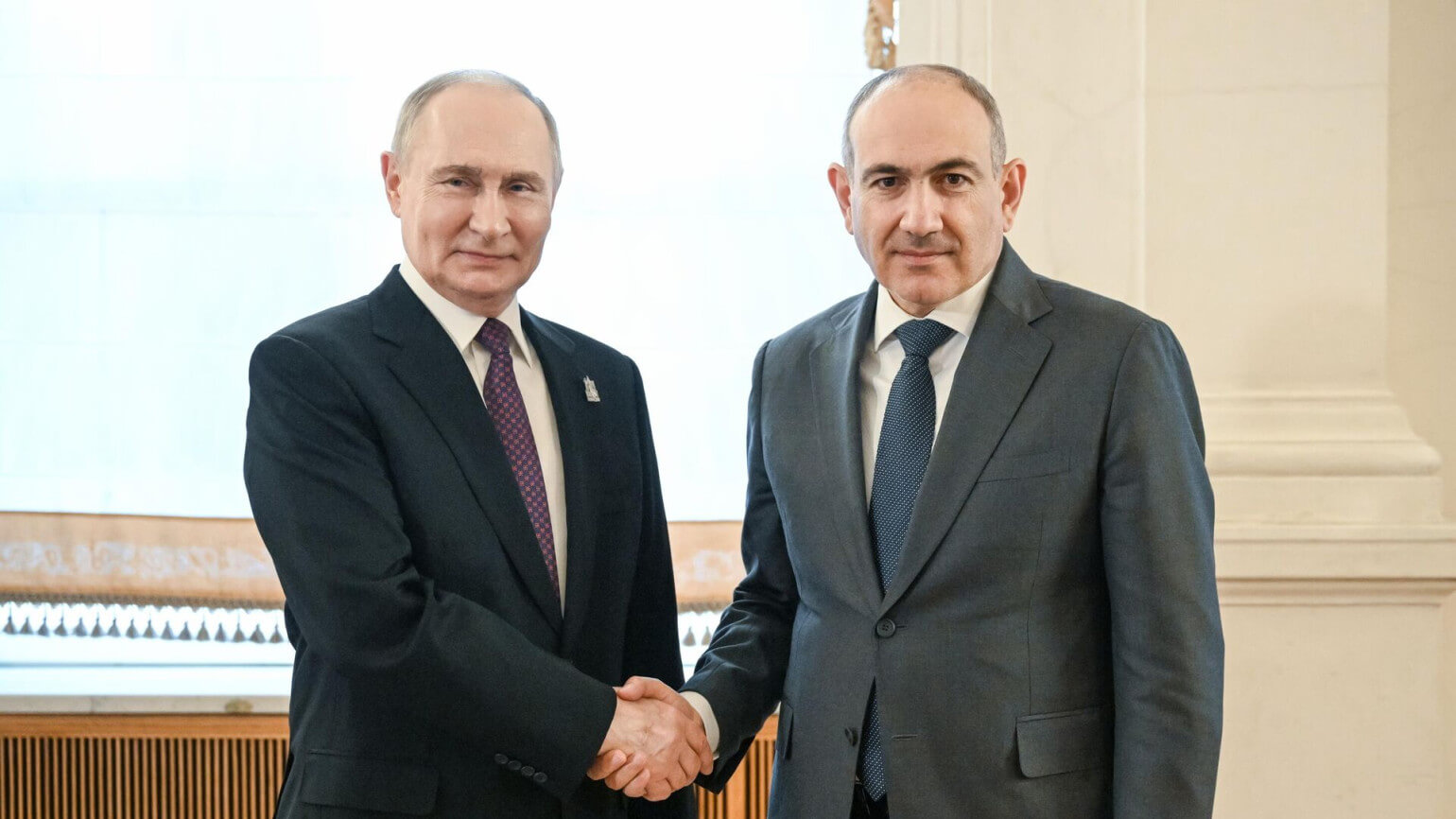
Putin–Pashinyan public dispute
During a meeting of the CIS Heads of State Council in Dushanbe, Russian President Vladimir Putin disagreed with the figures presented by Armenian Prime Minister Nikol Pashinyan regarding trade turnover between Russia and Armenia.
Putin asked what the current volume of bilateral trade was.
“This year — four billion dollars,” Pashinyan replied, referring to the period from January to August 2025.
Putin immediately objected: “No, it’s higher.” Pashinyan clarified that he was speaking about 2025, not the first eight months of 2024, when trade turnover had reached around nine billion dollars. Putin continued to insist that the figure had been higher last year — and would be even higher this year, adding: “That’s obvious.”
Armenian media later sought to determine who was correct. Obtaining figures from Russia proved impossible. As Radio Azatutyun (Radio Liberty) reported, “statistical data in Russia have been closed” since the start of the war in Ukraine.
However, the data remain publicly available in Armenia. According to the State Revenue Committee, Armenia’s foreign trade turnover with Russia totalled $4.5 billion between January and August 2025 — compared to $9.2 billion during the same period in 2024. In fact, the Armenian prime minister was right.
This means that trade between Armenia and its main economic partner, Russia, has not increased but dropped sharply — by 51.3%. At the same time, Armenia’s trade with the European Union is growing steadily. Between January and August 2024, it stood at $1.4 billion, while over the same period in 2025 it reached $1.5 billion.
- Armenia between the West and Russia: risks of the government’s ‘balanced’ policy
- “Azerbaijan has always been as much a brotherly state for the CSTO as Armenia,” says Pashinyan
- Moscow banks on ‘new faces’ to push its interests in Armenia
‘Pashinyan is absolutely right‘
“Armenian Prime Minister Nikol Pashinyan was absolutely right about the country’s trade statistics”, Economy Minister Gevorg Papoyan wrote on Facebook, citing official data from Armenia’s Statistical Committee.
Babken Tunyan, deputy chair of the parliamentary economic committee, also backed Pashinyan’s figures, noting that “while the numbers cited by the prime minister are not perfectly precise, they reflect reality. When comparing, one must look at the same period of the previous year [and not the full year].”
Tunyan pointed out that, according to data for the first eight months of 2025, trade between Armenia and Russia has halved:
“It’s obvious that by the end of this year, trade turnover cannot exceed last year’s figure—unless a miracle happens between September and December. Putin’s forecast for 2025 is simply wrong.”
He also noted that trade statistics between Armenia and Russia over the past two or three years should be treated “with serious reservations,” as they include re-exports:
“If we filter out re-exports and try to determine the real trade volume, the numbers will be significantly lower.”
‘Statistical deviations possible‘
Following the exchange between Putin and Pashinyan, Armenian media outlets began looking into the possibility of discrepancies in trade statistics. Member of the State Statistical Council Lilit Petrosyan referred to international experience, noting that in the field of foreign trade statistics, differences between export and import data reported by partner countries are not unusual.
Petrosyan explained that although all countries use the same UN-recommended methodology for compiling foreign trade statistics, discrepancies still arise due to “objective and subjective factors.”
These deviations generally fall into three categories:
- Methodological differences
- Technical causes
- Deliberate data manipulation
For example, methodological differences may occur in how customs value is determined — whether by transaction price, market value, or another approach. Technically, discrepancies can also result when goods shipped by an exporting country fail to reach their final destination because of damage or reprocessing in a transit country.
In cases of deliberate data manipulation, several scenarios are possible:
- “Importers may declare goods under false codes or deliberately understate their value in order to minimize customs duties.
- Exporters may intentionally overstate the volume and value of exported goods to increase the amount of VAT refunds.
- And in some cases, trade participants may deliberately provide incorrect information about the partner country.”

Putin–Pashinyan public dispute