 The South Caucasus News - SouthCaucasusNews.com
The State Security Service of Georgia (SSSG) announced the arrest of two Ukrainian citizens after seizing 2.4 kilograms of hexogen (RDX), a powerful explosive, concealed in a truck that entered the country from Turkey through the Sarpi checkpoint.
Lasha Maghradze, the first deputy head of the SSG, said at the September 11 briefing that the Mercedes-Benz truck with Ukrainian license plates crossed into Georgia on September 10 after traveling from Ukraine via Romania and Bulgaria. He said the explosives were hidden in compartments of the vehicle and belonged to M.S., a Ukrainian citizen and the driver, who allegedly received them in canisters from an unidentified person in Ukraine with instructions to hand them over to their contact after crossing into Georgia. Another Ukrainian citizen, identified as D.Zh., was detained after meeting the driver and taking possession of the explosives, Maghradze said.
The announcement came a month after Russia’s Federal Security Service (FSB) claimed it had prevented a “terrorist attack” on the Crimean Bridge, alleging the plot was planned by Ukraine and involved a car with explosives that crossed into Russia from the Larsi checkpoint on the Georgia–Russia border.
“Naturally, the investigation will continue to determine the final destination of the large amount of explosives brought into Georgia – whether a terrorist act was being prepared in Georgia, whether the country was being used as a transit point, or something else,” the SSG said, adding that the legal qualification will be clarified accordingly.
Maghradze said that during searches, the officers seized eight mobile phones, a computer, electronic storage devices, a large sum of cash, SIM cards from foreign mobile operators, and cocaine.
As of now, the investigation is being conducted under Article 236 of Georgia’s Criminal Code, which relates to the “illegal purchase, storage, carrying, manufacturing, transportation, forwarding or sale of firearms, ammunition, explosives or explosive devices.” Maghradze said it is also opened under Article 260 on the “illegal purchase and/or storage of drugs, their analogues, precursors or new psychoactive substances.”
Also Read:
Pashinyan on the “Trump Route” and the Minsk Group
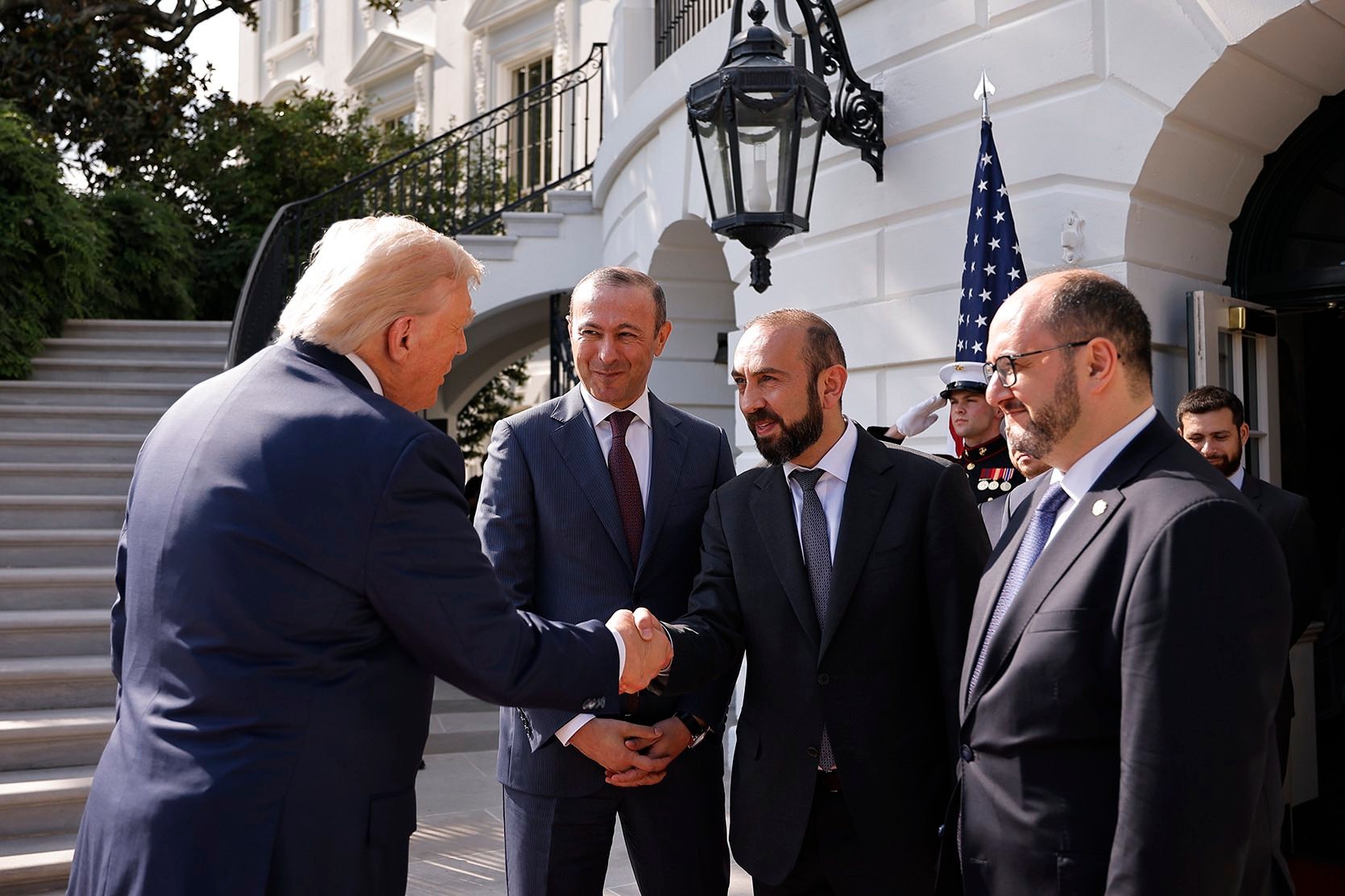
“In point 4 of the Washington Declaration, which concerns the ‘Trump Route,’ it is stated that the TRIPP project [Trump Route for International Peace and Prosperity] is a subject of bilateral discussion between Armenia and the U.S. The question arises – what does Azerbaijan have to do with this?” – Armenian Prime Minister Nikol Pashinyan said in parliament on September 10. He continued:
“The connection is as follows: Armenia and Azerbaijan’s communications must be linked.”
Members of parliament asked why Baku continues to call the road connecting to Nakhichevan the “Zangezur Corridor” instead of the “Trump Route.” They remain concerned about Azerbaijan’s demand for an extraterritorial route through Armenian territory.
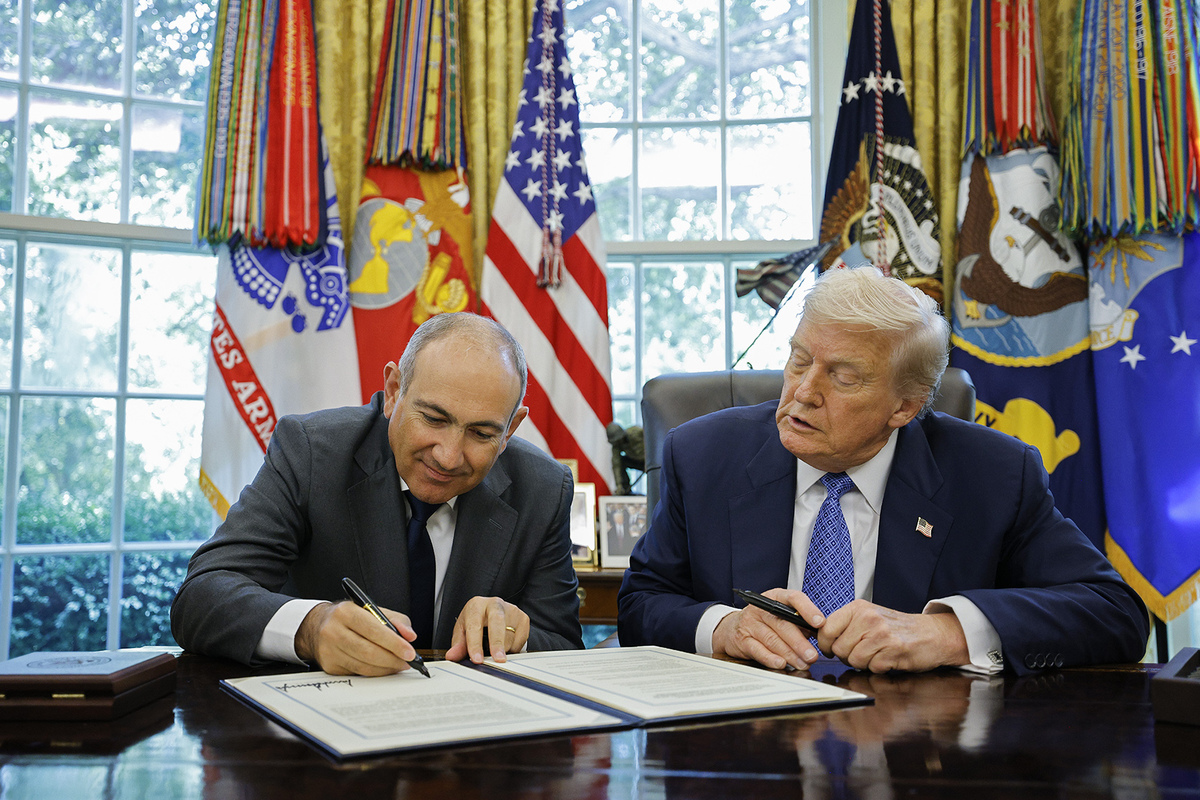
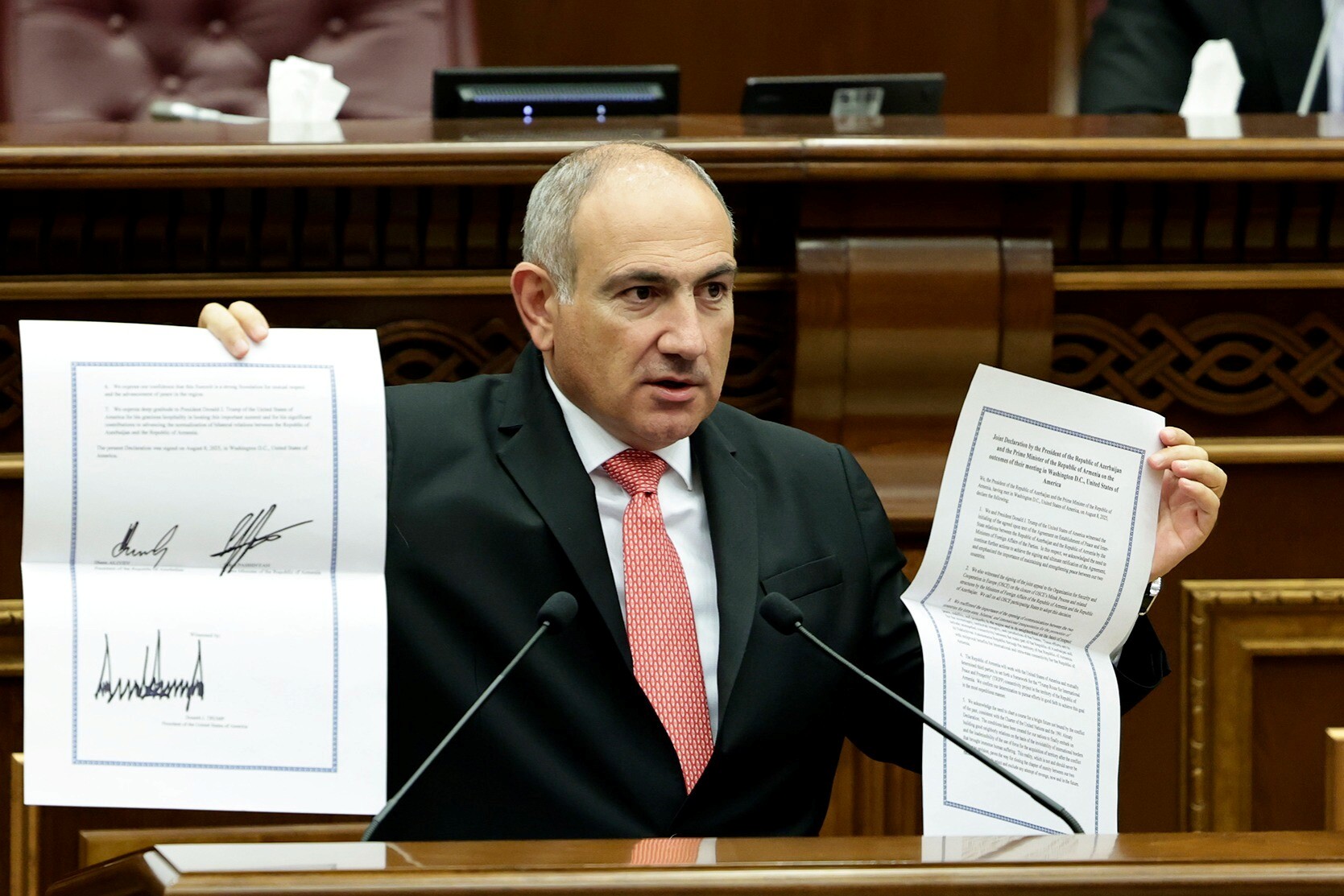
Pashinyan has consistently ruled out the possibility of granting Azerbaijan a road that Armenia would not control. This time, from the parliamentary podium, Pashinyan displayed a copy of the declaration signed at the White House.
“According to this document, there will be infrastructure called TRIPP on Armenian territory. Communications may exist on Armenian territory only if Armenia decides so. Infrastructure called the ‘Zangezur Corridor’ cannot exist on Armenian territory,” the Prime Minister emphasized.
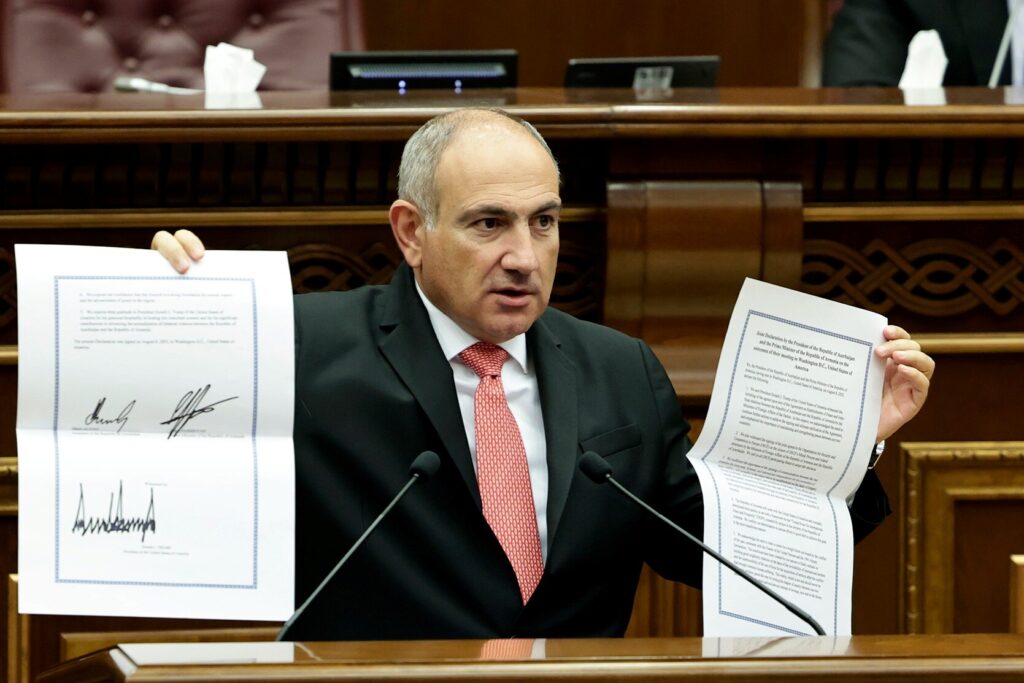
At the same time, he stated that Azerbaijan can call infrastructure running through its own territory whatever it wants, including that which is meant to connect to the ‘Trump Route.’
The Armenian Prime Minister stressed that this “has nothing to do with Armenia’s sovereign territory, its agenda, or the agreements reached in Washington.”
Answering MPs’ questions, Nikol Pashinyan also addressed other pressing topics – from the Washington agreements on ending the activities of the OSCE Minsk Group to the reduction of Armenia’s defense spending.
“There were issues that were not addressed within the framework of the [Armenia-Azerbaijan] peace agreement. However, in the Washington Declaration, they received solutions acceptable to Armenia.
I believe you have noticed that the peace agreement does not regulate regional communications. When we saw that, in the declaration, a number of issues not settled in the text of the peace agreement were receiving solutions acceptable to us, we understood – we could not miss this opportunity.”
“We do not have a legal framework for road leasing; our legislation does not provide for such an option. We cannot do that.
From the negotiation stage, we told our American partners: what you call a ‘lease’ in the U.S. is, under our legislation, a construction right.
And it has limits. There is the possibility of granting a construction right for up to 99 years, which we did not accept.
The feature of this institution is that, at the end of this period, everything on this territory – including investments – becomes the property of Armenia.
Investors are concerned about the term. They say: I need to understand the duration of my investment to recover my money. This is very simple business logic.
I am telling you responsibly – the terminology used in the declaration, from the perspective of our legal framework, did not create a single new term. The only new name is the ‘Trump Route.’”
“Jurisdiction and sovereignty issues concern the state institutions of Armenia—regardless of the nationality of the people involved.
In the republic’s legislation, there is no distinction; there is not a single article that applies to an Azerbaijani and does not apply to a Japanese citizen.
However, we must implement modern border control mechanisms, already used in the U.S., the U.K., and the United Arab Emirates. Human contact will occur only if the system detects a problem.
For Armenia, access to the latest technologies is crucial. On August 8, a very important event took place: we gained access to all these [American] cutting-edge technologies.
This will not be only for Azerbaijanis. These technologies will primarily serve Armenian citizens – at all borders and airports. Border and customs control will meet 21st-century standards.”
“Memoranda of understanding are usually concluded for one or two years, with the possibility of extending for three more years, since the intention is expected to become reality within that period.
Imagine a memorandum of understanding with a term of 25 years. That would mean the intention would never become reality. This is why such a format exists: for the parties to agree that, within a year, the memorandum should result in a concrete project, contract, agreement, or investment.
Over the past month, working discussions have taken place in various formats. These discussions are ongoing and are continuing today as well.”
As a result of the bilateral talks in Washington, Armenia and the U.S. signed three memoranda:
“In 2025, compared to the 2024 budget, we had a disproportionately large increase in defense spending. We incurred substantial defense expenditures. Part of these expenses was directed toward repaying future debts and obligations, including in the defense sector.
The government considered it reasonable to repay debts that were scheduled, for example, in 2030 or 2035, earlier in order to reduce the debt burden. If we exclude this portion and look at the figures without debt servicing, we see the natural growth in defense spending that we initially planned—possibly even slightly higher.
According to the medium-term expenditure program for 2026, defense spending reflects natural growth compared to 2024.
If there had not been a sharp, disproportionate increase of 115 billion drams (almost $303 million) in 2025, we would have seen the same natural growth in all years – 2023, 2024, 2025, and 2026. The fact that in 2026, compared to 2025, we do not foresee an increase in defense spending, but rather a reduction, is primarily due to this.
There are other factors contributing to the reduction of defense expenditures, which I can share with parliament in a closed session.
The policy we are pursuing not only poses no threat and does not make our security system vulnerable, but also does not create problems. On the contrary, we are in a process of natural development, and it will continue.”
“Looking back over the past years, I must say that I see nothing useful in the work of the OSCE Minsk Group. There was never anything useful in the activities of this group.
This international structure was involved in mediating the Karabakh conflict since 1992. Disagreements among the co-chair countries – the U.S., France, and Russia – arising in the context of the Russia-Ukraine war, led to the group effectively ceasing to function in February 2022. In September 2025, the OSCE Council of Ministers decided to dissolve it.
The group’s activities were aimed at deepening the conflict and using it as a lever to keep not only Armenia but the entire region in a puppet-like position.
The Karabakh issue had long been resolved. We were not told about it. If it was resolved, why was it not disclosed? Because the agenda focused on the Armenian issue.
How should the Armenian issue be resolved? What was supposed to be the result for Armenia?
It would have meant the dismemberment of Armenia’s territorial integrity, the loss of sovereignty, and the loss of independence.
All negotiations conducted in the Minsk Group format aimed to double, triple, quadruple, quintuple, and tenfold Armenia’s dependencies. Following that path would have meant, de facto, giving up Armenia’s independence.
Today, Armenia is independent – more than ever. It is a state – more than ever. Sovereign – more than ever.”
News in Armenia
The ruling Georgian Dream party’s mayoral candidates are running unchallenged in 25 of a total of 64 municipalities nationwide, while in three others their only rivals are independent candidates named by so-called “initiative groups” or a minor party, leaving GD without mainstream opposition challengers in a total of 28 municipalities, according to September 9 data from the Central Election Commission (CEC).
The main opposition forces in the October 4 municipal vote are Lelo/Strong Georgia alliance and former Prime Minister Giorgi Gakharia’s For Georgia party, which, unlike other mainstream opposition forces, decided to take part in what was widely seen from the outset as an unfair race. The two have joined forces in the run-up to the vote, presenting joint candidates including in Tbilisi. However, even together, their mayoral candidates cover only 36 municipalities, leaving the ruling party uncontested in 28 as the deadline to field candidates has expired.
Lelo/Strong Georgia and For Georgia, which had explained their participation as an effort to challenge Georgian Dream and leave no race uncontested, have faced backlash from boycotting opposition groups and ridicule from the ruling party for failing to field candidates throughout the country, as local elections usually require broader party resources.
“There are 28 municipalities where the two parties together could not select even one person,” Georgian Dream Prime Minister Irakli Kobakhidze told journalists on September 11, adding “These are not [political] parties. These are radical groups of agents funded from abroad. Accordingly, they have no public support, which is reflected in the fact that in 28 cases the two parties together could not find a single candidate.”
“This is a capitulation,” Tengo Tevzadze of the boycotting opposition Coalition for Change said, adding that Lelo and Gakharia’s party have failed to stand as “systemic” opposition.
Tevzadze also said Lelo and For Georgia failed to staff many precinct commissions. “Of 3,055 polling stations, Lelo does not have a member in 253 precinct commissions, while Gakharia’s party lacks representatives in 1,337,” he noted, adding that in the regions Gakharia’s party has no members in 41% of precinct commissions.
Lelo/Strong Georgia’s Lana Galdava said the “mine of the opposition votes” lies in big cities, where the party is betting on winning. Large cities, particularly Tbilisi, where Georgian Dream’s support is lower than in the regions, have been Lelo’s focus since the start of its campaign in the partially boycotted vote.
“We know, don’t we, where the biggest rating is and where it is lower. Therefore, Tbilisi, Batumi, the big cities, are indeed the mine of the opposition votes. And I ask you, when they [GD] have only 22% support in Tbilisi, how could we give it up as a gift to Georgian Dream,” Galdava said on air on Formula TV.
Georgia’s October 4 local elections are being widely boycotted by mainstream opposition parties, who say participation would lend legitimacy to the disputed Georgian Dream government and normalize its rule amid ongoing anti-government protests and state repression. The vote will also lack scrutiny, as the OSCE/ODIHR will not observe as it received a last-minute invitation from Georgian Dream, and leading local watchdog ISFED will not deploy a monitoring mission, citing “largely unmet” conditions to ensure a free and fair vote.
In Tbilisi, Georgian Dream nominated incumbent Mayor Kakha Kaladze to seek a third term, while Lelo and For Georgia named Lelo’s Irakli Kupradze as their joint candidate. Others in the capital’s race include right-libertarian Girchi leader Iago Khvichia and Zurab Makharadze of the far-right Conservatives for Georgia.
Also Read: