
Categories
Day: September 1, 2025
In the second quarter of this year, Turkiye’s economy grew by an impressive 4.8 percent. According to estimates from the national statistical agency, this marks the 20th consecutive quarter of economic growth in the country, highlighting a sustained period of resilience and development, Azernews reports.
March 28, 2017 – EU flags flutter above Tbilisi International Airport, and the terminal is abuzz with excitement. Prime Minister Giorgi Kvirikashvili, along with Georgian Dream cabinet ministers and a group of students, boards a celebratory flight to Athens, marking the start of visa-free travel with the European bloc. “Today is a historic day,” Kvirikashvili tells the reporters before the departure, adding that visa-free travel serves as a chance for Georgian citizens to better “learn” the values that the EU stands for.
Eight years and countless visa-free entries later, not everyone in Tbilisi seems to have embraced those values, as Georgia now faces the prospect of losing the vital benefits of its most tangible achievement in decades of EU integration.
The EU’s deadline for GD authorities to report to Brussels on progress with key reform and human rights–related demands passed on August 31. The bloc has warned that failure to deliver progress could trigger suspension of visa-free travel for Georgians – a step that, unlike many EU sanctions, requires only a qualified majority of member states.
On September 1, Georgian officials confirmed that they had sent their responses to the European Commission, which had, among other conditions, demanded that the government uphold human rights and repeal the controversial foreign agents and anti-LGBT laws. The responses were not made public, but given the ruling party’s rhetoric and actions over the summer, many fear there was little progress to report, making the loss of visa-free travel now seem nearly inevitable.
Levan Makhashvili, chair of Georgian Dream Parliament’s European Integration Committee, described the submitted document as containing “statistics, legislative processes, all the data related to the reforms carried out by Georgia.” He insisted that “by objective assessment,” Georgia fully meets its obligations and poses no threat to EU citizens. “We are not asking anything from the European Union, neither money, nor humanitarian aid, nothing except fair and equal relations,” Makhashvili claimed.
Defiance and Denial in Tbilisi
With the EU deadline now expired, GD leaders don’t seem to be changing their confrontational rhetoric.
“They refuse all kinds of communication,” Georgian Dream Prime Minister Irakli Kobakhidze told reporters late on September 1, noting Tbilisi is awaiting what EU has to say on the matter and once again comparing Brussels’ stance to that of “Soviet Moscow.” Kobakhidze went on to hint that the EU was demanding the legalization of same-sex unions, among others. “When they ask you without any discussion to establish that a same-sex couple must adopt an underage child, this is unacceptable.”
GD officials have routinely responded to warnings from Brussels by brushing off the potential loss of visa liberalization as a tolerable sacrifice. “If it comes to a choice between peace and stability or visa liberalization, of course, we will prioritize peace and stability,” Kobakhidze said in July, downplaying visa-free travel as “not existential.” He went on to dismiss the concern as a mere discomfort having to stand in visa lines, further implying visa-free travel has only boosted exodus from Georgia, and arguing that suspending the eased travel may actually boost the Georgian economy by keeping the labor force inside the country.
But among the Georgian Dream critics, there is a broad agreement that visa-free travel has brought crucial benefits to Georgians across economic and regional divides, helping families stay connected amid continued labor migration, sustaining the economy through remittances, boosting academic and business exchange, and giving Georgian patients access to life-saving healthcare abroad.
Migration and Remittances
European countries have been a popular destination for Georgian labor migrants for decades.
According to the Foreign Ministry, 1.5 million Georgians currently live abroad, nearly a third of the country’s total population. Up to 400,000 Georgians are estimated to be living in major EU countries, including 200,000 in Greece and about 50,000 each in Italy and Germany.
Labor migration has affected Georgia since the early 1990s, when economic hardship and political turmoil drove many to seek livelihoods abroad. Women who had to leave their families to take careworker jobs in Europe became a prominent group among these emigrants. The lifting of travel restrictions in 2017 is believed to have made a crucial difference for families separated by emigration, allowing them to reunite through regular visits.
Official statistics also show an increase in the number of Georgian nationals emigrating since the introduction of visa-free travel in 2017. Between 2014 and 2019, annual emigration hovered between 65,000 and 82,000, while immigration lingered around 47,000–55,000. Pandemic-related travel restrictions led to a temporary drop in emigration in 2020-2021, but once restrictions were lifted, the imbalance again widened dramatically.
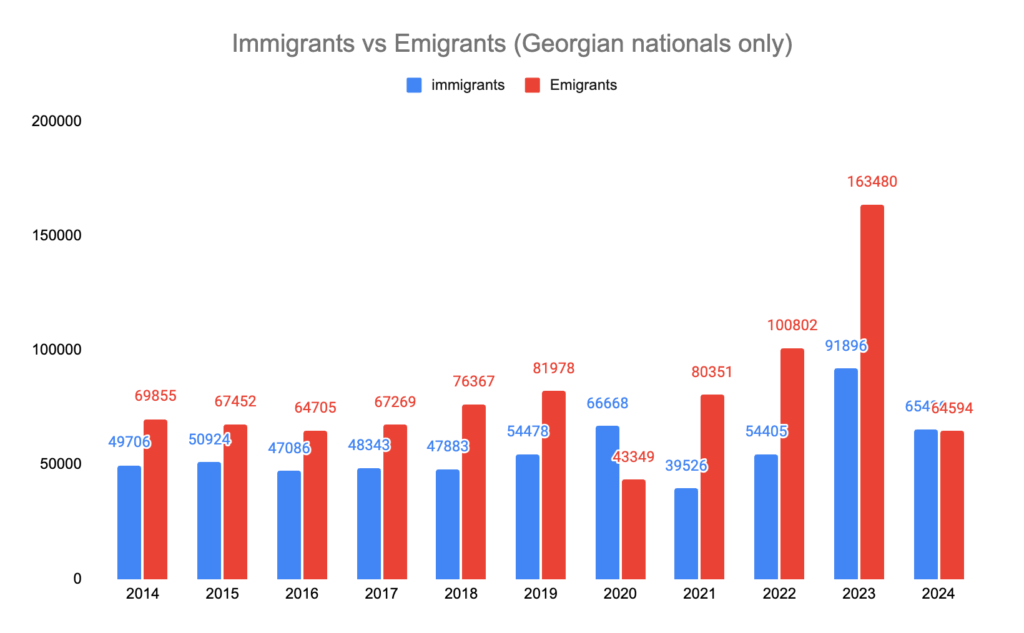
Preliminary census data suggests that while Georgia’s overall population may have grown over the past decade, this increase appears to come largely from foreign residents, as the number of Georgian citizens living in the country may have slightly declined since the 2014 census.
The effect of EU migration has been particularly profound on the Georgian economy. In 2013, Georgia received just under $1.5 billion in remittances. By 2022, that figure had nearly tripled, reaching $4.4 billion, according to the Policy and Management Consulting Group (PMCG). And the sources of those remittances had shifted, too.
In 2013, EU countries accounted for only 26% of all money sent back to Georgia. In June 2025 alone, Georgians abroad sent home $315.5 million. Of that, nearly 45% came from EU member states, with Italy, Germany, and Greece leading the way. As of 2024, remittances account for 11.8% of Georgia’s GDP, more than double the rate of neighboring Armenia.
With the visa-free regime and the removal of consular obstacles, thousands have also begun traveling to Europe for short-term job opportunities, a trend that Georgian Dream itself once encouraged.
‘Death Sentence’
Visa-free travel is also believed to have been life-saving for many critically ill Georgian patients who have sought medical help in the EU countries after being unable to afford or access vital healthcare at home. Revaz Bochorishvili, a prominent Georgian surgeon based in France, estimated that between 7,000 and 10,000 Georgian patients travel to Europe for treatment each year.
“For many critically ill patients, this is a godsend,” Bochorishvili wrote on Facebook in April, responding to earlier remarks by GD officials downplaying the perks of the eased travel with the EU. “The suspension of visa liberalization […] will be equivalent to a death sentence for countless Georgian patients.”
Georgian nationals have been known to use asylum systems to access healthcare abroad, with France standing out as a particularly popular destination. France was among the top three destination countries for Georgian asylum seekers in Europe in 2024. Georgia was among the top 20 nationalities applying for asylum in the EU in 2024, even if the recognition rate for Georgian asylum claims remains among the lowest, at 4%. In 2023, more than 25,000 Georgians applied for asylum across the EU. That number dropped to 15,000 in 2024.
GD Prime Minister Irakli Kobakhidze has waved off concerns that losing visa-free travel would impact access to medical care, calling such arguments “speculation.”
“If you seek high-quality medical care in a specific field, there are other countries [besides EU states] that can provide it,” he stated in July.
With the deadline for a progress report – and actual progress – now passed, Georgia finds itself thus suspended in limbo, yet to confront the magnitude of what may soon slip away.
The decision, however, may not come until late in October, when EU foreign ministers are set to hold their first formal meeting.
Luka Gventsadze/Civil.ge

Hyundai Motor and Kia have officially launched a new public-private consultative body aimed at advancing cooperation in the future mobility sector, uniting government agencies, private companies, and research institutions to tackle the growing challenges of modern transportation, Azernews reports, citing Korean media.