Categories
South Caucasus News

Speaker of Georgia’s one-party parliament again expresses disappointment to EU ambassador


Georgian Parliament speaker addresses EU envoy

Georgian Parliament speaker addresses EU envoy

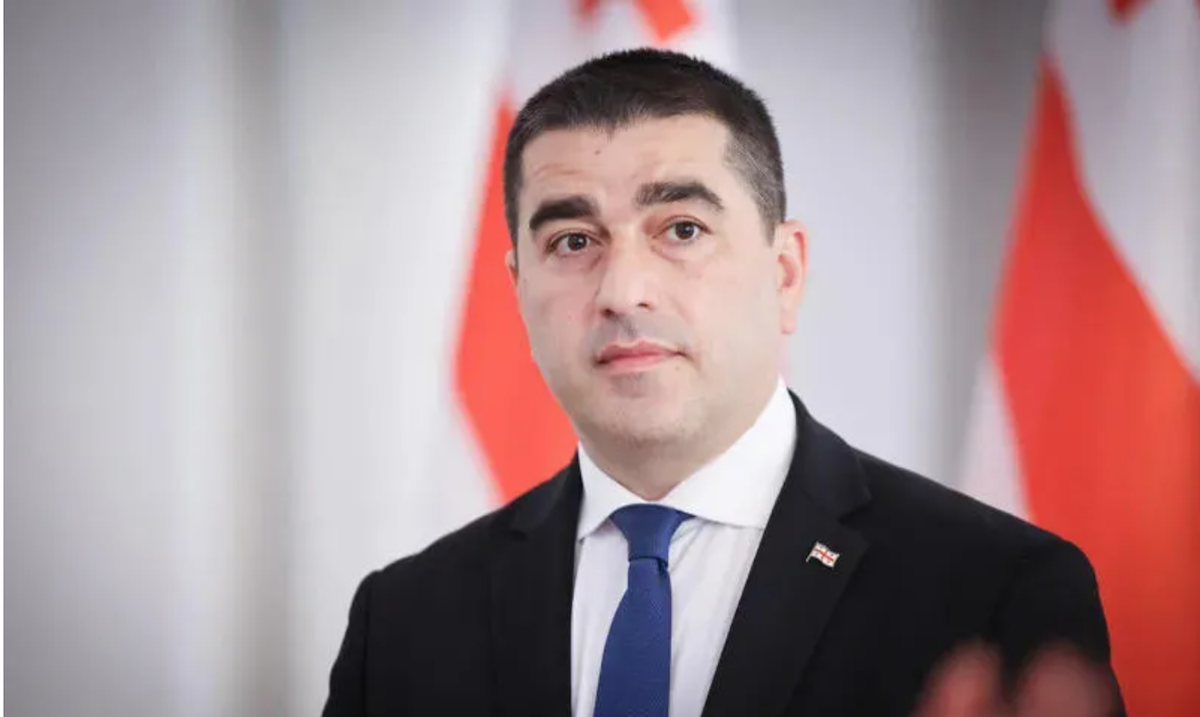
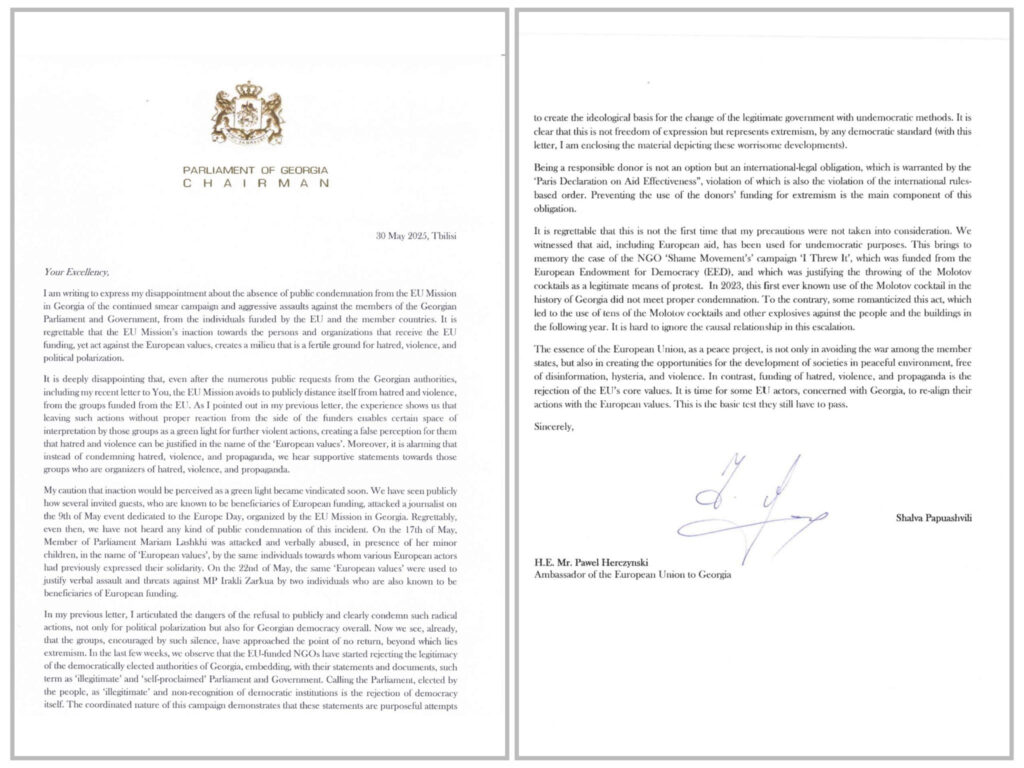
Georgian Dream parliamentary speaker Shalva Papuashvili announced that on 30 May he sent a second letter to the EU Ambassador to Georgia, Pawel Herczynski, once again raising concerns about “the alarming situation in which the name and funding of the European Union are being used to promote hatred, violence, and propaganda.”

Papuashvili’s letter to Herczynski:

Here is an abridged version of Papuashvili’s letter to Herczynski:

“I would like to express my disappointment that the EU Mission in Georgia has not publicly condemned the ongoing campaign of insults and aggressive attacks against members of Georgia’s parliament and government by individuals funded by the EU and its member states.

It is regrettable that the EU Mission’s inaction toward certain individuals and organisations—who, despite receiving EU funding, act contrary to European values—creates an environment that fosters hatred, violence, and political polarisation.

It is deeply disappointing that, despite repeated calls from Georgian authorities, including my previous letter, the EU Mission continues to refuse to distance itself from the hatred and violence coming from EU-funded groups. As I stated before, experience shows that when donors ignore such behaviour, these groups interpret the EU Mission’s silence as a green light for further violent actions. It creates the impression that hatred and violence can be justified in the name of ‘European values’. Even more concerning is that, instead of condemning hatred, violence, and propaganda, we hear statements of support for groups that are their very organisers.

“We are already witnessing how groups emboldened by this silence are approaching a line beyond which lies extremism—one from which there may be no return. In recent weeks, EU-funded NGOs have begun using terms such as ‘illegitimate’ and ‘self-proclaimed’ when referring to Georgia’s parliament and government, openly denying the legitimacy of a democratically elected government in their statements and reports.

Calling a parliament elected by the people ‘illegitimate’ and refusing to recognise democratic institutions is a denial of democracy itself. The coordinated nature of this campaign suggests we are facing an attempt to lay the ideological groundwork for replacing lawful authority through undemocratic means. By any democratic standard, this is not freedom of speech—it is extremism.

Responsible donor behaviour is not a choice, but a binding international obligation, as guaranteed by the Paris Declaration on Aid Effectiveness. Breaching this obligation also constitutes a violation of the rules-based international order. Avoiding the use of donor funds for extremist purposes is a core element of that obligation.

The European Union, as a peace project, is not only about preventing war between member states, but also about creating environments in which societies can develop peacefully—free from disinformation, hysteria, and violence.

Conversely, funding hatred, violence, and propaganda represents a betrayal of the fundamental values of the European Union. It is time for certain EU representatives engaged with Georgia to conduct themselves in line with those European values. This is a basic test—one they have yet to pass.”


Categories
South Caucasus News

Ukraine shares unique footage of Spider Web operation in which it destroyed 41 aircraft


Categories
South Caucasus News

UN General Assembly adopts resolution on status of internally displaced persons in Georgia for 18th time


UN General Assembly adopts resolution

UN General Assembly adopts resolution

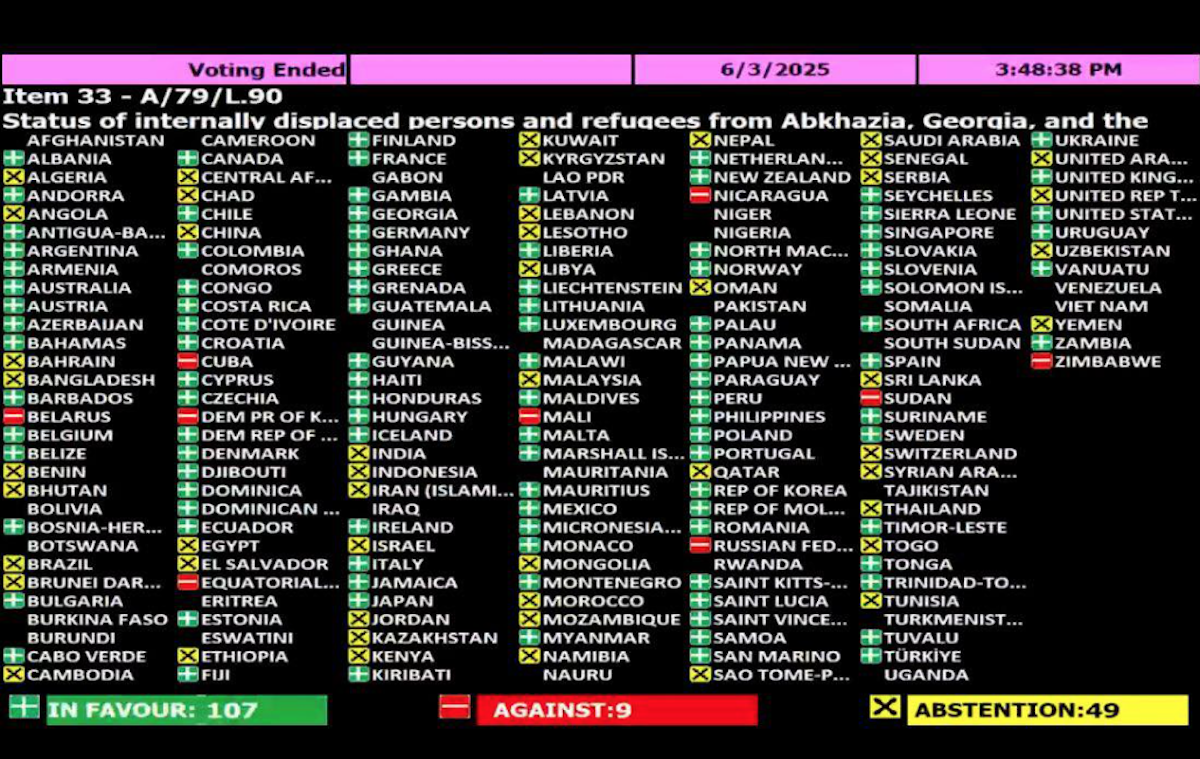
The UN General Assembly has adopted, for the 18th time, a resolution titled “Status of Internally Displaced Persons and Refugees from Abkhazia, Georgia, and the Tskhinvali Region/South Ossetia, Georgia,” reaffirming the right of all refugees and internally displaced persons (IDPs) to return to their homes.

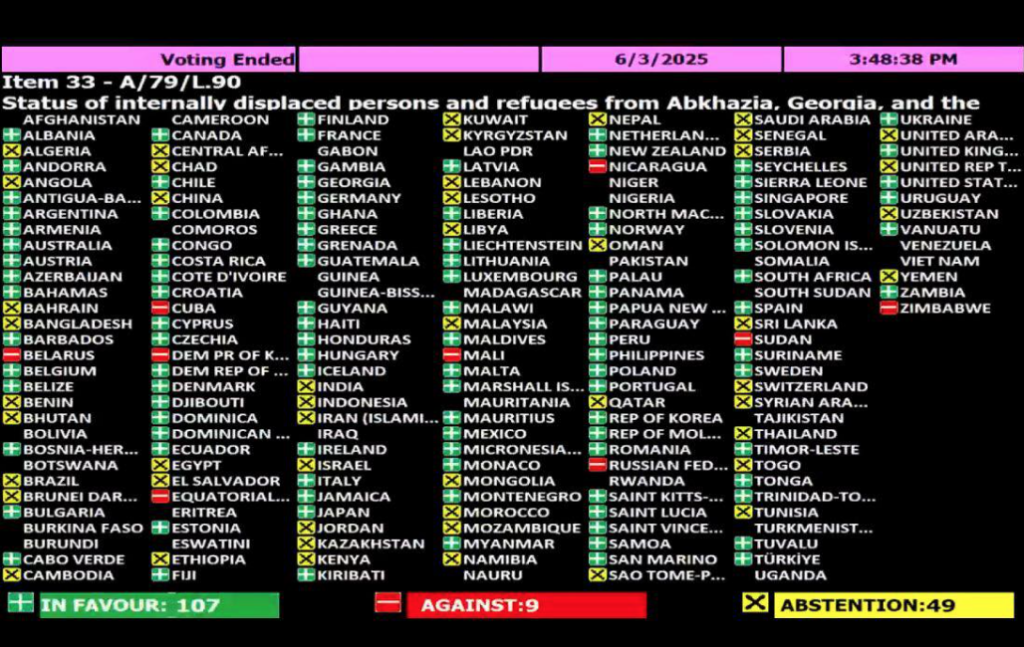
The resolution was supported by 107 countries—four more than last year.

Forty-nine states, including China, the United Arab Emirates, and Iran, abstained from the vote.

Nine countries voted against the resolution: Russia, Cuba, North Korea, Mali, Nicaragua, Sudan, Zimbabwe, Equatorial Guinea, and Belarus.

The resolution emphasises the right of all internally displaced persons and refugees—regardless of their ethnic background—to return to their homes. It also highlights the importance of respecting property rights, the need to work towards safe and voluntary return, and calls for peacebuilding through international negotiations.

Georgia’s Foreign Minister Maka Bochorishvili described the adoption of the resolution as “unprecedented.”

“I would like to express my deep gratitude to all the states that co-sponsored our initiative and supported the resolution,” Bochorishvili wrote on social media.

UN General Assembly adopts resolution

UN General Assembly adopts resolution

UN General Assembly adopts resolution


Categories
South Caucasus News

«Это ультиматум!» Украина грозится выйти из переговоров с Россией в Стамбуле


Categories
South Caucasus News

Armenian Military Still ‘Ignoring Azeri Gunfire’ – Ազատություն Ռադիոկայան


Armenian Military Still ‘Ignoring Azeri Gunfire’  Ազատություն Ռադիոկայան

Categories
South Caucasus News

Azerbaijan sharply increases petroleum bitumen exports to Georgia


Azerbaijan significantly ramped up its petroleum bitumen exports to Georgia in the first quarter of 2025, marking a major year-on-year increase both in volume and value, Azernews reports citing data from the State Statistical Committee.
Azerbaijan exported 2,044 thousand tons of petroleum bitumen to Georgia from January through March this year, generating revenue of…

Categories
South Caucasus News

Elvin Mustafayev is not allowed to meet with his lawyer


Elvin Mustafayev, a member of the “Workers’ Table” Trade Union Confederation, who is currently being held in a punishment cell at Correctional Facility No. 6, has been denied permission to meet with his lawyer, Zibeyda Sadigova.

Zibeyda Sadigova provided this information to Meydan TV.

“I went to Correctional Facility No. 6 this morning to find out what happened to Elvin. All my documents were in order, and I submitted them. They told me that the matter had been reported to the warden and to wait for a response. I waited for more than 45 minutes, and it turned out that the warden had refused and would not allow the meeting. They decided that since Elvin is in solitary confinement, his lawyer is not allowed to meet with him.”

The lawyer stated that she will appeal the decision to the Penitentiary Service.

Elvin Mustafayev’s father informed Meydan TV on June 4 that his son has been kept in solitary confinement since May 6 and is expected to stay there until June 29.

Lawyer Zibeyda Sadigova had earlier stated that she reached out to the Penitentiary Service to obtain information and documentation about the decision to place Elvin Mustafayev in solitary confinement, but did not receive any reply.

After starting a hunger strike on May 6, 2025, to demand the release of opposition politician Tofig Yagublu and other political prisoners, Elvin Mustafayev was placed in solitary confinement at the facility.

He was subsequently moved to another facility, but his family was not notified of the transfer.

Elvin Mustafayev was taken into custody on August 4, 2023, and accused under Article 234.1-1 of the Criminal Code for illegal drug trafficking. On January 31, 2024, the Baku Serious Crimes Court sentenced him to three years in prison.

Elvin Mustafayev rejects the accusations and asserts that the drugs were planted on him.

Currently, four members of the “Workers’ Table” Trade Union Confederation, which was founded in Azerbaijan in 2022 to protect workers’ rights, are imprisoned: chairman Afiyyaddin Mammadov, Aykhan Israfilov, Elvin Mustafayev, and Mohyaddin Orucov.

Although each is charged with different offenses, they all maintain that the allegations are politically driven and false.

The post Elvin Mustafayev is not allowed to meet with his lawyer appeared first on MEYDAN.TV.


Categories
South Caucasus News

Ombudsman highlights human rights values at “Silenced Voices” event in honor of Huseyn Javid


Azerbaijan’s Commissioner for Human Rights, Sabina Aliyeva, took part in the “Silenced Voices” event held at the Huseyn Javid House Museum, organized within the framework of “Human Rights Month”, Azernews reports.

Categories
South Caucasus News

EP’s Foreign Affairs Committee Calls for Targeted Sanctions against Bidzina Ivanishvili


The European Parliament’s Foreign Affairs Committee adopted a report regarding political developments in Georgia in 2023-2024, with 55 votes in favor, 14 against, and four abstentions. The rapporteur of the document is Lithuanian MEP Rasa Juknevičienė, a member of the European People’s Party. The committee approved the report with amendments, but the EP has not yet released its final version.

Presenting the report, MEP Juknevičienė said it is “regrettable” that the document assesses not the progress of the country, but its “huge decline from a democratic state, from a leader of the European partnership countries, to a brutal autocracy.”

“This is an example of how a country can be taken over from within by a pro-Russian government, without firing a shot. The rigged elections, the ruling party’s decision to block the EU, the arrest of journalists and opposition politicians, attacks on the EU and its representatives, these are just some of the facts mentioned in the report,” she said.

EU Path Assessment

The document mentions the recent political developments in Georgia, including the ruling government’s decision on November 28, 2024, to abandon Georgia’s EU path, “disregarding the country’s constitutional commitment to European integration and effectively undermining Georgia’s sovereign Euro-Atlantic aspirations.”

The Committee expresses “deep regret” that the ruling party “failed to use the historic opportunity” to advance EU integration, despite wider public support. “Georgia has not moved forward, and has in fact even regressed” on the key nine steps spelled by the Commission. The report says that the EU integration process has been suspended due to “continued democratic backsliding” and “the adoption of anti-democratic legislation.”

Reiterating “unwavering” support for the Georgian people’s pro-European aspirations, the report condemns “brutal crackdowns” on protests and “violent repression of peaceful protesters, political opponents, and media representatives.” It demands that Georgian authorities “refrain from using force, respect the freedoms of assembly and of expression, and annul the recently adopted draconian legislation aimed at stifling popular protests.” In addition, it calls for the investigation of violent acts.

Necessary Steps

The document calls for a reassessment of the EU’s policy toward Georgia and warns of “the conditional suspension” of economic cooperation and privileges under the EU-Georgia Association Agreement.

The report deplores senior GD officials and government-affiliated media for spreading “manipulative narratives, disinformation and conspiracy theories about the EU and European integration.”

The document “underlines” the role of GD’s founder and honorary chairman, Bidzina Ivanishvili, “in the deterioration of the political process in Georgia by enabling democratic backsliding and by acting against the country’s constitutionally declared interests of Euro-Atlantic integration,” thus calling for “immediate and targeted sanctions” against him, his family members, his companies and his known assets in the EU to be frozen.

Non-Recognition of One-Party Parliament

The Committee says only new parliamentary elections can resolve the “political and constitutional crisis” in Georgia. It notes that the elections should be held in the “next few months” in an “improved electoral environment, overseen by an independent and impartial election administration and monitored through diligent international observation to guarantee a genuinely fair, free and transparent process.”

The document calls GD authorities “self-proclaimed,” does not recognize them, and calls the October 26, 2024, parliamentary elections “rigged.” It says “one-party parliament” is “incompatible” with pluralistic parliamentary democracy.

The document says the policy of non-recognition of the Georgian Dream parliament and President Mikheil Kavelashvili, “appointed” by it, should continue until there is “tangible change” in the country’s course. Calling on the EU and member state representatives to refrain from meetings with what it calls the “representatives of the regime,” it urges continued recognition of Salome Zurabishvili as the “legitimate President of Georgia” and “representative of the Georgian people.”

The report also condemns “continuing and deliberate destruction” efforts to suppress Georgia’s civil society through restrictive laws, intimidation, and physical assaults on activists and journalists. It urges the EU Commission to boost support “without delay” for independent media and NGOs, amid the suspension of the USAID.

The Commission reiterates that the measures taken by the EU so far “do not reflect the severity” of the situation in Georgia. It calls on the EU and member states to introduce personal sanctions against “key political leaders, officials and the regime’s enablers in the administration, business, media, justice system and law enforcement agencies, who are responsible for democratic backsliding, electoral fraud, human rights violations and the persecution of political opponents and activists.”

Alignment on Foreign Policy Matters

The document regrets that Georgia made “no progress” in implementing the EU’s recommendations, while noting that the level of Georgia’s alignment with the EU’s common foreign and security policy remains “remarkably low.”

The Commission is “deeply concerned” with what it claims is the GD government’s “collaboration and rapprochement with Russia” despite the country being occupied. It additionally deplores GD’s “promotion of Russian disinformation and manipulation.”

The Commission notes that the support of EUR 30 million from European Peace Facility was suspended in 2024 “in response to the democratic backsliding in Georgia,” adding “no support in planned for 2025.”

Local Elections

Following the committee vote, the European Parliament released a statement that said the upcoming local elections are “another test of the resilience of Georgia’s democracy and political pluralism.” MEPs called on the opposition parties “to seize this opportunity to reflect the unity of the Georgian people in support of democracy and the rule of law, as already demonstrated by the peaceful protests that followed October’s elections.”

The release quoted Juknevičienė as saying, “The EU and its member states must take strong action before it is too late. We owe it to the brave Georgians fighting for a free and pro-European future.”

“After decades of democratic reforms, MEPs now consider Georgia to be a victim of state capture, repeating their calls for new parliamentary elections in the country,” the release added.

Also Read:


Categories
South Caucasus News

NATO chief reaffirms EU’s commitment to Ukraine in its defence against Russia