Arrest of Ivanishvili’s former adviser Bachiashvili
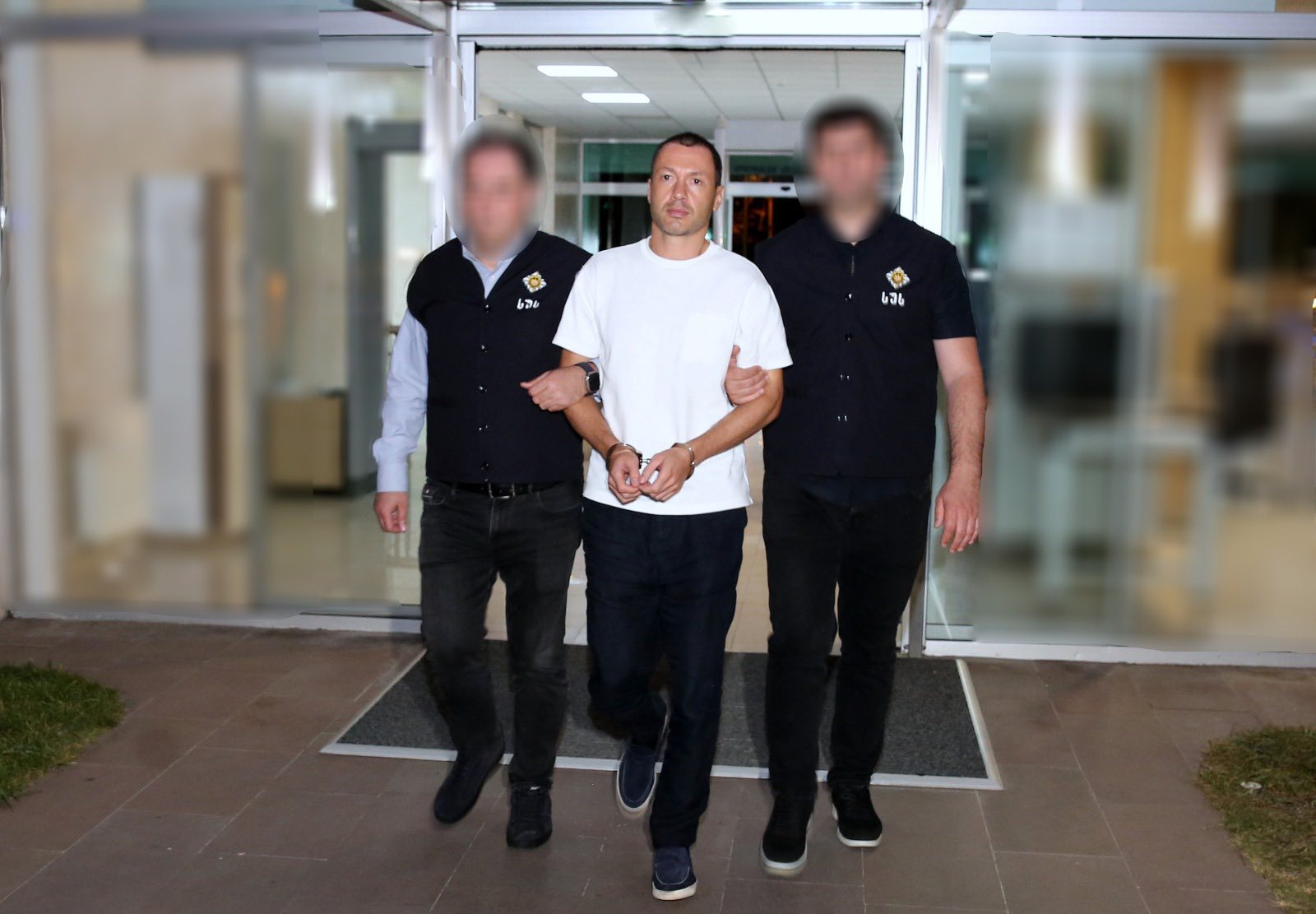
On 27 May 2025, it was reported that Giorgi Bachiashvili, former financial adviser to Bidzina Ivanishvili and former head of the Co-Investment Fund, had been arrested by Georgia’s State Security Service (SSG) near the Georgian-Armenian border. He is accused of embezzling up to $42 million.
Bachiashvili’s international lawyers claim he was forcibly returned to Georgia and argue that the arrest is driven by the personal vendetta of Georgia’s de facto ruler, Bidzina Ivanishvili.
Arrest at the border
According to Georgia’s State Security Service (SSG), Bachiashvili was arrested on 26 May in the area between the “Red Bridge” and “Sadakhlo” checkpoints. It is unclear which country’s border he was approaching — Armenia or Azerbaijan. The SSG said his whereabouts were revealed by an anonymous informant.
Bachiashvili was wanted by Interpol under a red notice — the closest instrument to an international arrest warrant — and holds dual citizenship: Georgian and Russian.
The case against Bachiashvili was launched in 2023 based on a complaint by Bidzina Ivanishvili. Prosecutors accused him of embezzling up to $40 million in cryptocurrency. On 6 July 2023, Tbilisi City Court imposed bail of 2.5 million lari.
On 2 March 2025, Giorgi Bachiashvili secretly left Georgia. According to the SSG, he crossed the Georgian-Armenian border illegally, bypassing the checkpoint while hidden in a special compartment of a vehicle.
Following his escape, reports circulated that Bachiashvili was in Qatar and/or the United Arab Emirates.
The prosecution declared him wanted. On 10 March 2025, Tbilisi City Court sentenced Giorgi Bachiashvili in absentia to 11 years in prison over the cryptocurrency case. The former Ivanishvili associate was found guilty of “major embezzlement” and “legalisation of illicit income” — i.e., money laundering.
Bachiashvili and his lawyers maintain that the case is politically motivated.
He now also faces two additional criminal charges: illegal border crossing and failure to fulfil official duties in connection with the Mtkvari HPP project during his tenure as head of the Co-Investment Fund.
How did Bachiashvili end up at the border?
Bachiashvili’s lawyers claim he was forcibly returned to Georgia. They point to serious risks of torture, ill-treatment, and an unfair trial in the case against him.
In a statement issued in Washington, his legal team stressed that the detention should be viewed not only from a legal but also from a political perspective.
Lawyer Robert Amsterdam accused the Georgian government of abusing international legal mechanisms and stated that Bachiashvili is the target of political persecution by Bidzina Ivanishvili.
Theories surrounding Bachiashvili’s arrest
Media reports suggest that the Georgian government may have signed a secret agreement with the United Arab Emirates. Allegedly, in exchange for Bachiashvili’s extradition, Tbilisi agreed to support the UAE’s candidate for Secretary-General of the World Tourism Organization.
This theory followed a recent scandal — just days earlier, the Georgian government had withdrawn its support for the reappointment of the organisation’s current head, Zurab Pololikashvili. At the time, rumours circulated that Georgian Dream had “traded” its longtime ally Pololikashvili for someone else.
The Guardian interview: Ivanishvili, voodoo, and more
A few days before his arrest, Giorgi Bachiashvili gave an interview to the British newspaper The Guardian, in which he claimed that intelligence services from two countries had warned him of an order for his assassination — allegedly to be carried out by groups operating out of the North Caucasus.
“For over a decade, Bachiashvili worked with Bidzina Ivanishvili, the secretive billionaire and honorary chairman of Georgian Dream, widely regarded as the de facto leader of Georgia,” the article states. The Guardian also notes that in December of last year, the United States imposed sanctions on Ivanishvili for “undermining Georgia’s democratic and Euro-Atlantic future in favour of Russia.”
For security reasons, Bachiashvili asked the outlet not to disclose his location. His story, despite being marked by personal grievance, offers a revealing portrait of Ivanishvili’s mindset. “He would sacrifice the country and its interests for the sake of his own comfort and safety,” said Bachiashvili of his former ally.
Relationship with Bidzina Ivanishvili and Panama Papers
The article recounts how Giorgi Bachiashvili became Ivanishvili’s right-hand man. It details how Bachiashvili began working on real estate deals in Moscow for one of Ivanishvili’s companies — a position he obtained thanks to his mother, who was the ophthalmologist of Ivanishvili’s mother.
It was with Bachiashvili’s assistance that Ivanishvili sold his Russian assets prior to becoming Georgia’s prime minister.
The 2016 Panama Papers revealed that Ivanishvili had concealed his ownership of a company managed by the now-defunct Panamanian firm Mossack Fonseca. The company’s activities were controversial. However, Bachiashvili told The Guardian that it was this very company that managed Ivanishvili’s $1.3 billion art portfolio, stored in New York and London. Bachiashvili was responsible for overseeing Lynden Management Ltd, a company linked to Mossack Fonseca.
“In 2022, fearing sanctions, Ivanishvili moved the artworks he had acquired to Georgia. To avoid import duties, property tax, and capital gains tax on the sale of these works, he passed the so-called ‘offshore law’. As a result, he stole around $400 million from Georgia,” Bachiashvili alleged.
Ivanishvili’s lawyer, in comments to The Guardian, denied Bachiashvili’s claims, calling them lies and adding that the use of offshore assets is not a crime.
“Sultan and his servants”
According to Bachiashvili, the relationship between Ivanishvili and his prime ministers resembled that of “a cruel boss and a bunch of idiot employees.”
“I think I was the most frequent guest at Ivanishvili’s residence,” he said, adding that he regularly witnessed prime ministers, judges, the prosecutor general, and the interior minister coming and going. “Sometimes he yelled at them, sometimes he called them useless. It was like the relationship between a sultan and his servants.”
Ivanishvili’s lawyer dismissed these remarks as a baseless attempt to discredit the billionaire.
Ivanishvili is also known for his collection of exotic animals, including zebras and peacocks. According to Bachiashvili, he also keeps dolphins and sharks. The Guardian noted Ivanishvili’s passion for rare trees. “He has to own something in order to love it — that’s how his worldview works,” Bachiashvili explained.
He believes Ivanishvili is obsessed with the fear of death and subjects himself to all sorts of experimental procedures — from stem cell transplants to voodoo rituals. Bachiashvili claims Ivanishvili’s voodoo practitioner, Yulia Krushanova, lives with him.
The Guardian reports that Krushanova calls herself an anti-ageing specialist and is reportedly married to a Russian intelligence officer.
Ivanishvili’s lawyer rejected Bachiashvili’s claims about Krushanova as absurd: “I can assure you no doctor lives with Ivanishvili and no experiments are being conducted on him.” Krushanova herself did not comment to the British outlet.
Talks of “Georgia’s involvement in war” and fallout
Bachiashvili told The Guardian how Ivanishvili began speaking about Georgia’s potential “involvement in the war [with Russia]” — a narrative that was later echoed publicly by senior figures in the Georgian Dream party.
“He told me that the whole Credit Suisse story wasn’t really about Credit Suisse, but rather that foreign forces (the Americans) were trying to transfer him money in exchange for Georgia joining the war against Russia.
Sometimes he’d talk to me for 30–40 minutes, especially when I was in the U.S. He shared his thoughts on the war. He said he’s the kind of person who would never obey such orders — even with a gun to his head.
I wondered why this man was calling me for 40 minutes a day to talk about it. Then I realised he thought our calls were being monitored. Sometimes he’d say: ‘Tell your friends this is what I think,’” Bachiashvili recounted, adding that until 2022, Ivanishvili held the illusion that Georgia could join the EU under his shadow rule — but later it became clear the EU would not accept Georgia under such a system.
Bachiashvili believes this was the turning point that led Ivanishvili to shift toward Russia. Ivanishvili’s lawyer dismissed the claim as baseless, noting that it was during Ivanishvili’s time in power that Georgia gained EU candidate status.
The former head of the Co-Investment Fund says his relationship with Ivanishvili worsened after the war in Ukraine began, when Bachiashvili openly expressed support for Ukraine.
According to him, Ivanishvili even phoned him over his pro-Ukraine posts on Instagram: “It was the first time he was angry. He yelled and threatened me. The main message was: ‘You’d better shut up and know your place.’” Ivanishvili’s lawyer denies such a conversation ever took place.
The Guardian article also details how a cryptocurrency deal between Ivanishvili and Bachiashvili led to their fallout and subsequent legal prosecution.
Detention and threats
Bachiashvili told The Guardian that a Georgian State Security Service officer informed him that Ivanishvili had threatened to have him killed in prison. Ivanishvili’s lawyer dismissed the claim as “tabloid-level nonsense.”
Bachiashvili said that the decision to leave Georgia had been difficult: “I left everything behind and didn’t know if I would make it, but I knew for certain that prison meant death for me.”
According to him, after charges were brought against him in Georgia, both his Georgian and Russian passports were confiscated. When the latter expired, he was able to renew it in Russia without issue. He used that passport to cross the border into Armenia and then flew to Qatar. His whereabouts after that remain unknown.
Bachiashvili said he was warned that a kill order had been issued. He does not believe it came directly from Ivanishvili:
“I fear it might have come from intelligence services or other forces in a certain country that want to weaken Ivanishvili. If they succeed in framing him for my murder, it would destroy his chances of any meaningful dialogue with the U.S. and tighten the grip foreign powers have on him.”
Bachiashvili believes that Ivanishvili may have come to see him as a Western spy, and that’s why he turned against him. “For Ivanishvili, holding onto power is existential. For him, the fight for it is literally a fight for survival.”