
Day: May 16, 2025
On May 16, Georgian Dream prime minister Irakli Kobakhidze attended the European Political Community (EPC) summit in Tirana, Albania. He was accompanied by GD foreign minister Maka Botchorishvili and GD government administration head Levan Zhorzholiani.
It was Irakli Kobakhidze’s first appearance alongside European leaders since the highly contested 2024 October general elections and the subsequent protests sparked by the ruling party’s decision in November, 2024 to halt the country’s EU accession.
The EPC’s sixth summit brought together 45 heads of state and government from across the European continent, 25 of whom were from EU member states. The informal, one-day gathering included three South Caucasus countries – Georgia, Armenia, Azerbaijan, as well as Turkey, Ukraine and Moldova.
Kobakhidze’s Address at the Roundtable Discussion
The GD prime minister participated in a roundtable discussion, “Securing Europe and Strengthening Democratic Resilience.”
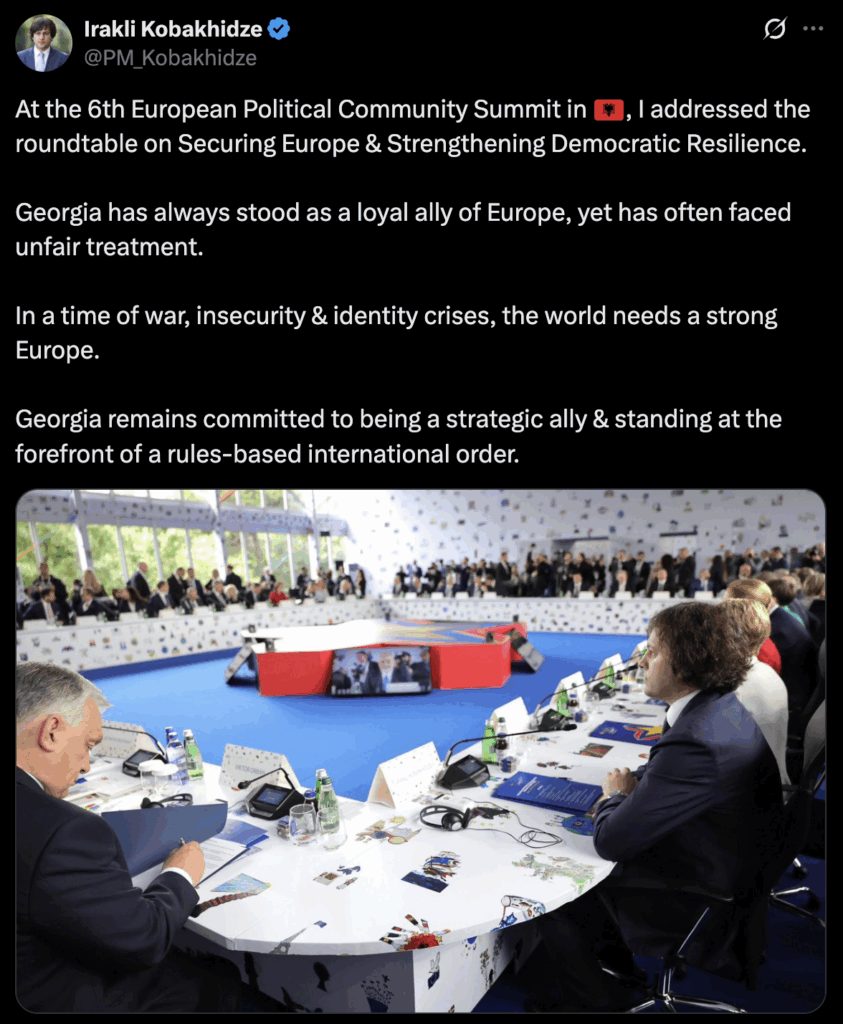
According to the official press release from the GD government administration, in his remarks, Kobakhidze emphasized “the importance of a strong Europe for a strong world,” and described “recent trends” as “alarming.”
“He noted that many European countries are facing the threat of losing their identity, while Europe is also weakening in its ability to act as a strong global player and protect its partners,” the press release notes.
“In this context,” the press release continues, Kobakhidze “referred to the devastating consequences of the war in Ukraine, stressing that in such circumstances, other countries cannot count on security guarantees.”
He also highlighted “Georgia’s achievements” and underscored the need “to change the unjust attitude toward the country.” Kobakhidze said that “Georgia outperforms several EU candidate countries in many key areas, and such unfair treatment damages the reputation of European institutions.”
“The Prime Minister of Georgia expressed hope that meaningful changes will take place in Europe and that the continent will grow stronger – something essential for safeguarding a rule-based international order,” the press release concludes.
The roundtable discussion was co-chaired by the Prime Ministers of the U.K. and Sweden, and attended by the prime ministers of Luxembourg, the Netherlands, Poland, Slovakia, Armenia, and Estonia, as well as the presidents of Greece, Ukraine, the European Council, and the European Parliament, along with the OSCE Secretary General.
Meetings
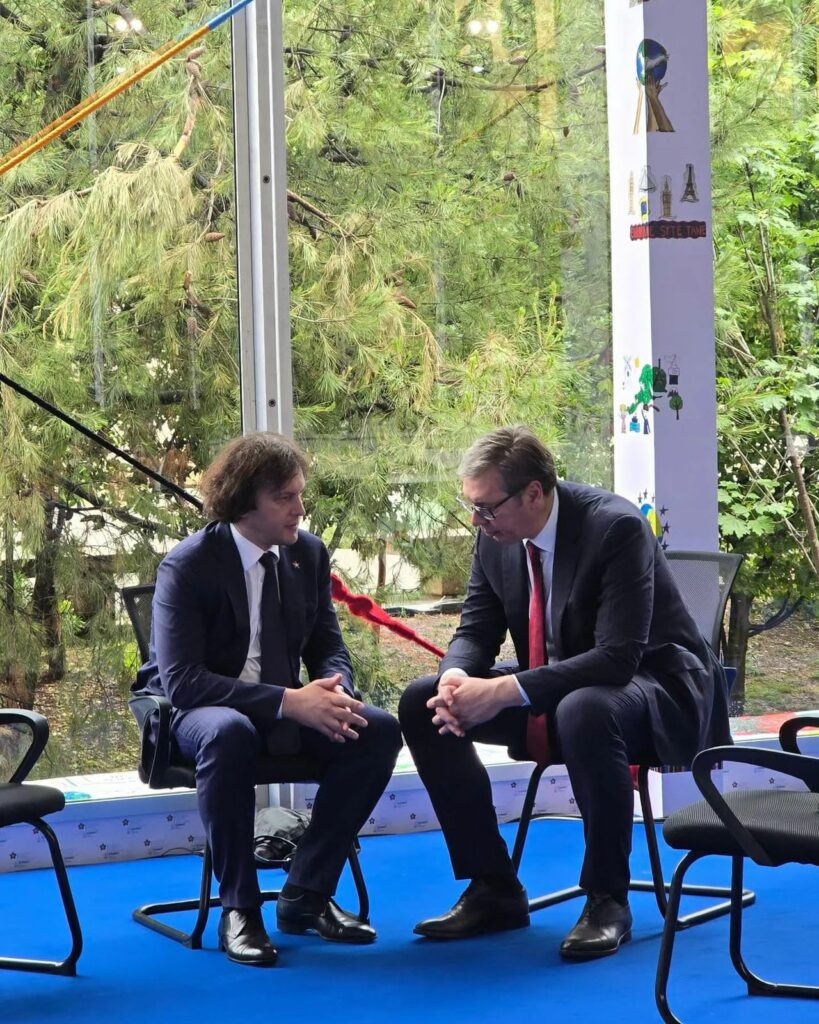
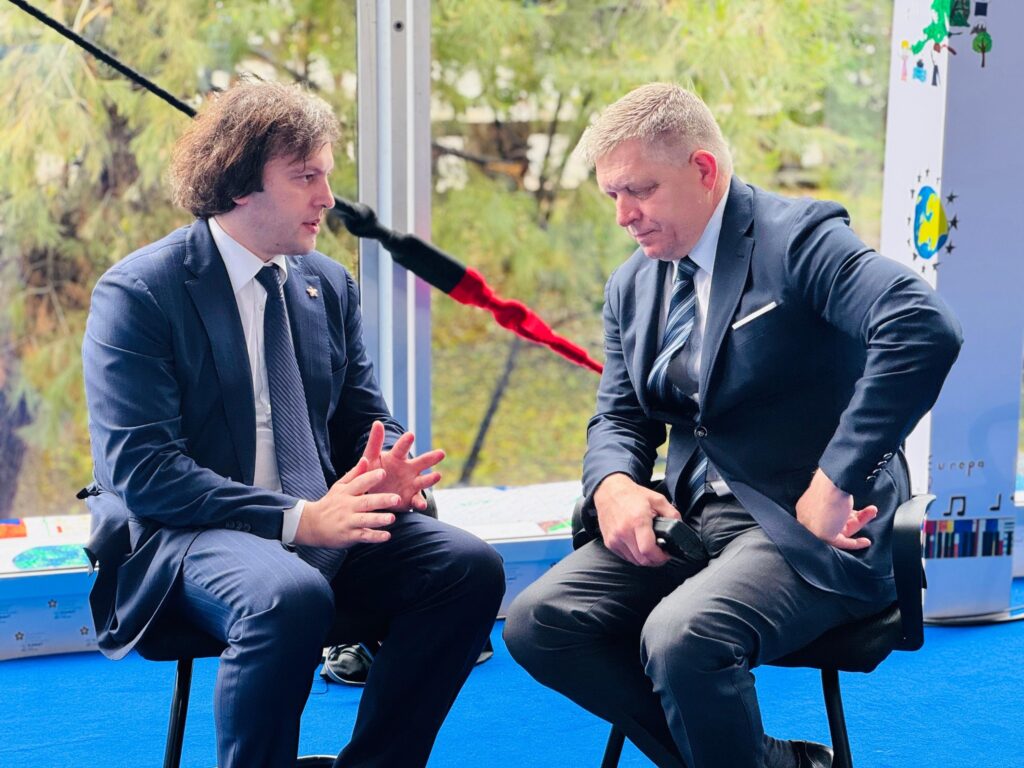
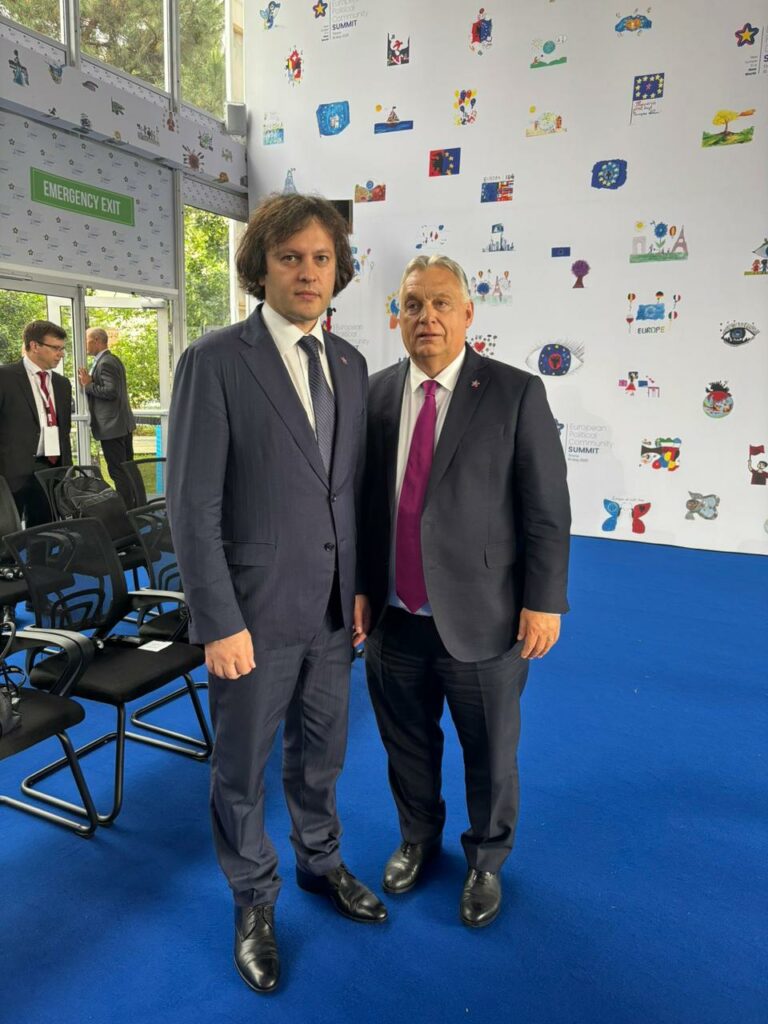
Kobakhidze’s met with Serbian President Aleksandar Vučić, Slovak Prime Minister Robert Fico, and Hungarian Prime Minister Viktor Orbán.
Photos: Irakli Kobakhidze/Facebook
On the meeting with Serbia’s Aleksandar Vučić, the GD government administration reports: “The parties discussed prospects of further deepening bilateral cooperation across a variety of spheres, along with challenges facing the two countries and Europe. Special attention in the meeting was paid to the importance of fair treatment, a key precondition of rules-based order.”
On the meeting with GD’s KSlovakia’s Robert Fico, the official press release says: “The conversation at the meeting focused on the bilateral and multilateral cooperation between the two countries and challenges facing them. The prime ministers reiterated their commitment to further deepening their partnership.”
On the meeting with Hungary’s Viktor Orbán, the GD’s press release says: “The two leaders discussed the close political and economic cooperation between their countries. It was noted that the upcoming session of the Georgia-Hungary Intergovernmental Commission on Economic Cooperation, to be held soon in Budapest, will contribute to further strengthening bilateral economic ties.”
Pro-government Media Reporting on the Event
Despite the Georgian Dream and its media’s attempts to present Kobakhidze as embraced by Western leaders, who have unprecedentedly isolated the ruling party over contested elections and ongoing repression, his meetings, all in informal settings, were apparently limited to just three leaders.
The pro-government media tried to portray the event as a breakthrough in the international isolation that the GD government has faced for months. The GD-controlled media circulated a video of Kobakhidze briefly interacting with French President Emmanuel Macron, who pats Kobakhidze on the back at the roundtable and engages him in brief chat.
At the roundtable, Kobakhidze sat between European Parliament President Roberta Metsola and Luxembourgish Prime Minister Luc Frieden. The GD government also shared pictures of face-to-face exchanges between them.
“I had the opportunity to speak with up to 30 leaders,” Kobakhidze told Georgian media at the summit.
“With President Macron, as with other leaders, I discussed topics related to Georgia’s development, European perspective, our role in the region, and so on,” he said, adding that he could not disclose specifics. “But generally, I can tell you that these conversations were about sharing our messages about Georgia’s interests.”
“As you know, there were some limitations in communication, [however] it seems that our European partners are thirsty for a relationship with Georgia,” Kobakhidze quipped.
Also Read:
- 15/05/2025 – U.S., European Lawmakers Urge Portugal to Bar GD Officials From OSCE Parliamentary Assembly Session
- 15/05/2025 – Kobakhidze Describes Current US-Georgia Relations as “Active-Negative”
- 14/05/2025 – EU Ambassador Comments on Sanctions, GD’s Planned Opposition Ban
- 09/05/2025 – Georgia Not Invited to Informal EU Meeting in Warsaw
The International Democracy Union (IDU) adopted a resolution at a forum in Brussels on May 16, attended by 80 parties from around 60 countries, condemning the Georgian Dream government’s continuing decline into authoritarianism, repression of civil society, and alignment with Russia. The resolution calls for coordinated international sanctions against GD’s patron Bidzina Ivanishvili, and his enablers. IDU urges the GD government to set “a specific date for free and fair parliamentary elections.”
The resolution, tabled by Georgia’s opposition United National Movement (UNM), reaffirms the IDU’s solidarity with the Georgian people and their just fight for democracy and European integration. It denounces the GD-led government’s “drift toward the Russian orbit” and demands a “halt to all repressive legislation”.
The IDU urges the GD government to “immediately halt all repressive legislation” and to cease the “use of terror against its own citizens, civil society organizations, independent media, and political opponents.”
The resolution also calls for holding accountable “perpetrators of brutality” involved in the violent crackdown on protesters and calls on the international community to investigate the actions of all officials and police officers responsible for targeting civil society and political opponents.
The resolution directly targets Ivanishvili, the GD’s honorary chairman and principal powerbroker, urging democratic governments to suspend financial cooperation with the GD government “until new parliamentary elections are held.” Most notably, it calls for coordinated sanctions on Ivanishvili, his family, companies, and enablers, including freezing all of his assets.
“The IDU calls on democratic governments to immediately introduce coordinated sanctions against Bidzina Ivanishvili and his family, companies, and networks of enablers,” the resolution states. It further urges the international community to disconnect Ivanishvili’s Kartu Bank from SWIFT and Visa/Mastercard systems, and to impose sectoral sanctions on businesses supporting the GD regime—particularly those in the copper ores and non-ferrous metals sectors.
Georgia is increasingly facing international isolation. On May 15, a group of European lawmakers and members of the U.S. Helsinki Commission, issued a letter to Portugal’s Prime Minister urging a ban on Georgian Dream officials from attending the upcoming OSCE Parliamentary Assembly session. The letter argued that participation by GD representatives would “legitimize their repressive governance and provide them with a platform they do not deserve.”
Earlier this month, GD officials were excluded from the EU’s informal “Gymnich” meeting of foreign ministers held in Warsaw on May 7–8, which was attended by other EU candidate countries. The EU ambassador to Georgia cited the country’s democratic regression and recent repressive developments as the reason for the exclusion.
Following the violent dispersal of protests in November and December 2024—which involved arbitrary detentions and alleged abuse of demonstrators—the EU suspended visa facilitation agreement for Georgian diplomatic and service passport holders.
Western partners have increasingly resorted to targeted financial sanctions and travel bans against Georgian officials deemed responsible for undermining democratic norms. In the United States, the House of Representatives recently passed the bipartisan MEGOBARI Act, which mandates sanctions on GD officials involved in significant corruption or violence intended to obstruct Georgia’s Euro-Atlantic aspirations. The bill is now to be considered in the U.S. Senate. The bill also envisages extension sanctions to immediate family members of sanctioned individuals.
The IDU includes the European People’s Party (EPP) and the European Conservatives and Reformists (ECR) from Europe.
Also Read:
- 2025 | Chronicle of Repression
- 16/05/2025 – CSOs Report Reveals Human Rights Crisis in Georgia Following 2024 Elections
- 15/04/2025 – UPDATE: Estonia, Latvia, Lithuania Expand Sanctions on Georgian Officials
- 10/04/2025 – PACE Condemns Rapid Democratic Backsliding in Georgia, Urges Repeal of Controversial Laws
- 10/04/2025 – UK Sanctions Georgia’s Prosecutor General, Three Security Officials for Human Rights Abuses
- 09/04/2025 – Zurabishvili: “We are Watching Our Democracy Being Dismantled in Real Time”, Urges Europe to Act
- 24/03/2025 – Germany Introduces Further Entry Bans on GD Officials
- 01/05/2025 – EPP’s Resolution Calls for Sanctions on Ivanishvili and New Elections
Employees at over 120 Starbucks locations in the United States have gone on strike in protest of the company’s newly implemented dress code. According to Starbucks Workers United, the union representing U.S. employees of the coffee giant, more than 2,000 baristas nationwide are participating in the strike, Azernews reports.