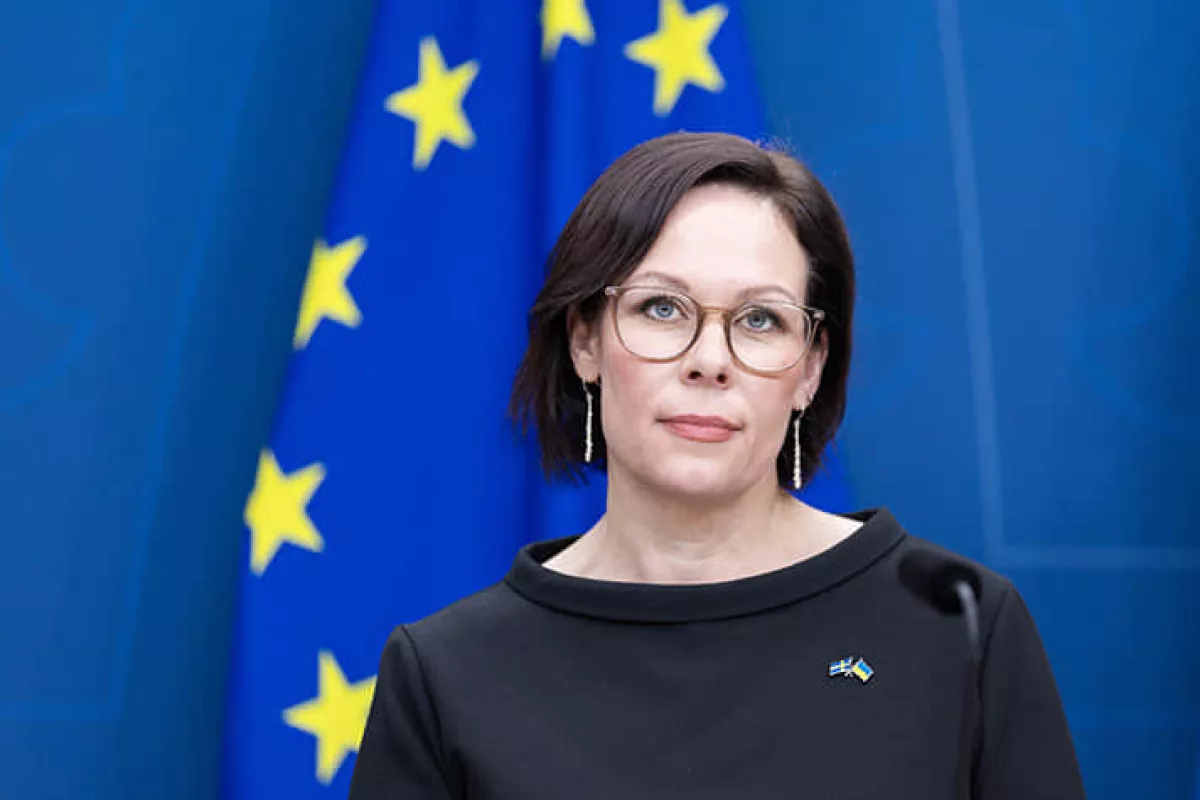
Swedish Minister for Foreign Affairs Maria Malmer Stenergard has said that frozen Russian assets in Europe must be confiscated, as Russia shows no intention of ending…
 The South Caucasus News - SouthCaucasusNews.com
iskander missiles targeting system vulnerability to mistargeting by means of Electronic Warfare – Google Search https://t.co/y3ytQfUUHC https://t.co/bnIxXK4jhE
— Michael Novakhov (@mikenov) April 14, 2025
Sumy attack – Google Search https://t.co/Q832DZKw77 https://t.co/WBKsxUPTy7
— Michael Novakhov (@mikenov) April 14, 2025
Russia claims its deadly attack on Ukraine’s Sumy targeted military forces as condemnation grows | AP News https://t.co/swsvg4tvVm
BRUSSELS (AP) — Russia on Monday claimed its deadly missile attack on Ukraine’s Sumy that killed and wounded scores including children had targeted a…— Michael Novakhov (@mikenov) April 14, 2025
 |
Michael_Novakhov shared this story . |
BRUSSELS (AP) — Russia on Monday claimed its deadly missile attack on Ukraine’s Sumy that killed and wounded scores including children had targeted a gathering of Ukrainian troops, while European leaders condemned the attack as a war crime.
Ukrainian officials have said two ballistic missiles on Palm Sunday morning hit the heart of Sumy, a city about 30 kilometers (less than 20 miles) from Ukraine’s border with Russia, killing at least 34, including two children, and wounding 119. It was the second large-scale attack to claim civilian lives in Ukraine in just over a week.
Asked about the attack, Kremlin spokesman Dmitry Peskov said Russia’s military only strikes military targets. Russia’s Defense Ministry said the strike targeted a gathering of senior military officers and accused Kyiv of using civilians as shields by holding military meetings in the city’s center.
The ministry claimed to kill over 60 troops. Russia gave no evidence to back its claims.
Ukrainian President Volodymyr Zelenskyy has called for a global response to the attack, saying the first strike hit university buildings and the second exploded above street level. “Only real pressure on Russia can stop this. We need tangible sanctions against those sectors that finance the Russian killing machine,” he wrote Monday on social media.
Polish Foreign Minister Radek Sikorski, whose country holds the European Union’s rotating presidency, called the attacks “Russia’s mocking answer” to Kyiv’s agreement to a ceasefire proposed by the U.S. over a month ago.
“I hope that President Trump, the U.S. administration, see that the leader of Russia is mocking their goodwill, and I hope the right decisions are taken,” Sikorski told reporters in Luxembourg, where EU foreign ministers met.
Finnish Foreign Minister Elina Valtonen noted that the attack on Sumy came shortly after President Donald Trump’s envoy, Steve Witkoff, was in Saint Petersburg for talks with Russian President Vladimir Putin. It demonstrates that “Russia shows full disregard for the peace process, but also that Russia has zero regard for human life,” Valtonen said.
Lithuania’s foreign minister, Kestutis Budrys, echoed Ukraine’s assertion that the Russian strike used cluster munitions to target civilians, calling it “a war crime by definition.” The Associated Press has been unable to verify that claim.
French Foreign Minister Jean-Noël Barrot said the attack shows that Putin has no intention of agreeing to a ceasefire, and called for the European Union to “take the toughest sanctions against Russia to suffocate its economy and prevent it from fueling its war effort.”
The EU has imposed 16 rounds of sanctions on Russia and is working on a 17th, but the measures are getting harder to agree on because they also impact European economies.
Germany’s chancellor-designate, Friedrich Merz, described the Sumy attack as “a serious war crime” during an appearance on ARD television.
Merz made clear he stands by his past calls to send Taurus long-range cruise missiles to Ukraine, something that outgoing Chancellor Olaf Scholz refused to do. He said the Ukrainian military needs to be able to “get ahead of the situation” and that any delivery of long-range missiles must be done in consultation with European partners.
Asked about Merz’s statement, the Kremlin spokesman said such a move would “inevitably lead only to further escalation of the situation around Ukraine,” telling reporters that “regrettably, European capitals aren’t inclined to search for ways to launch peace talks and are inclined instead to keep provoking the continuation of the war.”
Russian forces this month have dropped 2,800 air bombs on Ukraine and fired more than 1,400 strike drones and nearly 60 missiles of various types.
The attack on Sumy followed a April 4 missile strike on Zelenskyy’s hometown of Kryvyi Rih that killed some 20 people, including nine children.
Trump has previously described the strike on Sumy as a “mistake.” On Monday, he said the mistake was allowing the war to start in the first place, criticizing former President Joe Biden, Zelenskyy and Putin.
“Biden could’ve stopped it and Zelenskyy could’ve stopped it and Putin should’ve never started it,” Trump said in the Oval Office. “Everybody’s to blame.”
Late Sunday, Russian exploding drones attacked Odesa, injuring eight people. Regional head Oleh Kiper said a medical facility was among the buildings damaged.
Russia fired a total of 62 Shahed drones over Ukraine late Sunday and early Monday, Ukraine’s air force said, adding that 40 were destroyed and 11 others jammed.
Two Chinese nationals, who were captured by Ukrainian forces while fighting on the Russian side, said at a news conference in Kyiv on Monday that they had joined the war voluntarily after seeing recruitment announcements on TikTok. They said they weren’t encouraged or supported by Chinese authorities, who had warned them about the danger of participating in the conflict.
One of the men, speaking through an interpreter, said he did not intend to take part directly in combat but was sent to the front lines anyway. Another said that Russian recruiters abused his trust and put him in what he described as a “trap.”
They said they were given orders through gestures and hand signals, and Russian personnel constantly accompanied them, leaving no chance for escape. Both said they hope to be included in a future prisoner exchange and return to their families.
It was impossible for the AP to corroborate their statements or independently verify under what circumstances the two men spoke.
When he first announced the capture of the Chinese nationals last week, Zelensky said there were more than 150 other Chinese fighting for Russia. Beijing responded that it always asks its citizens to avoid participating in any military operations.
While China has provided strong diplomatic support for Russia since it launched its full-scale invasion of Ukraine in February 2022, it is not believed to have knowingly provided Russia with troops, weapons or military expertise.
U.S. officials have accused Iran of providing Russia with drones, while American and South Korean officials say North Korea has sent thousands of troops to help Russia on the battlefield.
___
Associated Press writers Chris Megerian in Washington, Geir Moulson in Berlin, Sam McNeil in Barcelona, Spain, Hanna Arhirova and Illia Novikov in Kyiv, Ukraine, and Dasha Litvinova in Tallinn, Estonia, contributed to this report.
___
Follow AP’s coverage of the war in Ukraine at https://apnews.com/hub/russia-ukraine
#Greece will purchase a batch of #French Exocet anti-ship missiles, according to The Associated Press.
According to the source, Greek Minister of National Defense Nikos Dendias signed an agreement for the acquisition of 16 Exocet missiles with his French counterpart Sébastien… pic.twitter.com/AT2ZkZDeyy
— Robert Ananyan (@robananyan) April 14, 2025
В результате нового удара баллистической ракетой по Сумам, по предварительным данным, пострадавших нет. Об этом сообщают местные власти. По данным ОВА, удар пришелся по окраине Сум. Другие последствия атаки уточняются. https://t.co/AoC3i4MgD5
— Радио Свобода (@SvobodaRadio) April 14, 2025
We have never been closer to final stability and peace, Armenian Foreign Minister Ararat Mirzoyan said in an interview with Turkish NTV. Below is the full text of the interview:
Journalist: I’m going to talk about the peace agreement that the two sides have agreed. But I would like to start with the session (panel discussion) that you already had with the Azerbaijani Foreign Minister.
We understand that both sides tried to put their positions on that. But how do you evaluate that session? Was it a little bit tense, or you put your positions, what was it?
Ararat Mirzoyan: Well, I would say that it was a constructive discussion. You know, we have had many opportunities with my counterpart, Mr. Bayramov, to exchange thoughts behind closed doors, during negotiations, but also in open public deliberations. So, this was another opportunity to exchange thoughts.
Obviously, there are differences in perceptions, and most probably, we will now elaborate a little bit more on that as well. But also, it’s an opportunity to make an attempt to bring the positions closer. So, the discussions are always a good idea.
Journalist: Okay. That’s the best way to take it. I would like to talk about that peace agreement. The two sides agreed on the paper. But right now, everybody wonders when it’s going to be signed. What is your best call when you’re looking at the two sides’ positions?
Ararat Mirzoyan: Well, indeed. Let’s, first of all, evaluate what has happened. It’s an unprecedented thing, a historic thing. Armenia and Azerbaijan agreed over the text of a draft agreement between Armenia and Azerbaijan. A text in which Armenia and Azerbaijan mutually recognized each other’s territorial integrity. Within borders which existed between them as Soviet Socialist Republics at the moment of dissolution of the Soviet Union.
They agreed not to intervene in each other’s internal affairs and several other very important things. They also, in this document, if ratified and entered into force, they also established a bilateral commission which will oversee the implementation of the agreement and also will handle and manage the misinterpretations that may arise, any concrete situations that may arise on the ground. So, this is indeed a historic event. Now, we think that we can immediately start consultations to define the venue and the time, the concrete date of signing of this agreement.
Journalist: Would it be in a third country? What are your options on that?
Ararat Mirzoyan: It could be the border between Armenia and Azerbaijan, it could be any other third country which could be acceptable for the two countries, for Yerevan and Baku. So, we can discuss it. But we also know that immediately after the announcement of the fact of agreeing over the text, the Azerbaijani side came up with several preconditions regarding the Minsk group, regarding the Constitution. There are several other ideas in the air, as I understand the situation.
Journalist: That’s what Mr. Bayramov said during the session as well.
Ararat Mirzoyan: Yes. So, our approach is that we can start the process by putting a brick and then another brick and then another brick. And sometime later, we can see that we have together built a very solid bridge, for instance. Or we can sit and wait for a couple of hundred of years to see whether these approaches are irreversible or not, whether the conflict is over in reality or not, whether there are other obstacles. So, our suggestion is to focus on the constructive side of the issue, to focus on the opportunity, to focus on the future, rather than continue digging in the past and seeing only obstacles.
But I can also comment on the concrete ideas of the Azerbaijani side. On the Minsk group our approach is very well known: if there is no conflict and there is an institutional proof of it, a signed peace agreement, there is no need for Minsk group and Minsk structures as well. So, we just proposed to the Azerbaijani side to sign the two documents on the same day – the Peace treaty and the joint application to OSCE or to member states saying that we initiate this process of dissolution of the Minsk group.
Journalist: Okay. What about the European Union mission in that sense?
Ararat Mirzoyan: Again, we now have the European Union civilian mission monitoring the border between Armenia and Azerbaijan. The mandate, the ultimate goal of the mission is to support the stability and peace between Armenia and Azerbaijan. If there is a signed peace, if we continue the delimitation of the border, there is stability, the people living on the border regions, on two sides of the border feel secure and they can safely organize their daily life, then there is no need for a monitoring mission as well. So, whatever problem you mentioned or our Azerbaijani colleagues mentioned, the shortest way to address the issue is the signing and ratification of this Peace treaty.
Journalist: Azerbaijani Foreign Minister mentioned the Constitution of Armenia and, as you said, you call it as a precondition. Azerbaijan has an expectation that there is an amendment that needs to be changed, and you said that during the session, that there is no such amendment in your constitution, but it was a reference to the Independence Declaration.
So, what you said was so valuable, we need to put bricks and bricks and then move afterwards. And it’s a law discussion. So, when you move it, when you end up with a law problem, then how is it going to end? What would you like to say about it?
Ararat Mirzoyan: Well, if the question is about the Constitution, again, we don’t see any territorial claim in our Constitution against territorial integrity of Azerbaijan. We do have a reference to our Declaration of Independence in the preambular part of our Constitution saying that based on our Declaration of Independence, aiming this, that, that, that, and then the main body provisions of the articles of the Constitution. The Azerbaijani side thinks that in our Declaration of Independence, we have a claim.
As I said, and I don’t want to go too deep into details now, but this can be easily proved by lawyers. The documents are public. In parallel, we do think that they, we have concerns, we do think that they have claims in their constitution. And I can explain. In their Constitution, they have a reference to their Act of Independence, in which they say that this Azerbaijani Republic is the successor of the First Azerbaijani Republic, which existed before the Soviet Union. So, the First Azerbaijani republic declared its sovereignty over much larger territories than today’s Azerbaijan. It’s more than 60% of today’s sovereign territories and recognized territories of the Republic of Armenia. Is this a problem? If we dig into the Constitution, this is definitely a problem. But in the agreed peace agreement, which we suggest to sign, there is a solution to this issue. First, we, as I said, recognize each other’s territorial integrity within the borders that I mentioned. And this formulation, this solution is acceptable for two countries, otherwise we couldn’t agree over the text. So, during the process of ratification, after signing, this document should go and get a positive conclusion from our Constitutional Court.
Journalist: Are you confident about that?
Ararat Mirzoyan: Sure, absolutely. If the Constitutional Court says that this agreement, including the acknowledgement of territorial integrity of two countries with that exact understanding, with that borders, complies with the Constitution, that means the issue is solved. The issue is addressed. If, theoretically, our Constitutional Court says that this agreement does not comply with our Constitution, then that would be another situation. Then we will gather again to understand what to do next.
But it’s just a theoretical consideration because last September we had another opportunity to understand the approach of the Constitutional Court. If you remember, two border commissions of Armenia and Azerbaijan, which work together jointly on the delimitation, they signed a regulation, the first ever Armenian-Azerbaijani international agreement, by the way, and this regulation, again, says that the delimitation should take place on the basis of our Alma-Ata declaration, which is almost the same which I mentioned: the borders of the two countries, which became international borders after the dissolution of the Soviet Union. So, this document again went to the Constitutional Court, and the Constitutional Court gave a positive conclusion, saying that this provision and the whole document, the regulation, complies with the constitution. So, we are discussing the same subject. It’s not that likely that the Constitutional Court gave a positive conclusion to the same issue several months ago, and now they are going to change their opinion. But anyway, there is still a theoretical chance.
So, again and again, whatever aspect we discuss, the shortest way to address the issue – signing and ratification of the peace treaty.
Journalist: Okay, we will see that. Before going to the Türkiye-Armenia relations, please don’t take it offensive, but about the “Zengezur Passage”, I know that you, in Armenia, don’t use that wording, but the Turkish public is very well known with this word. That’s why I’m referring to this “Zengezur” route. Türkiye is closely following up that when it’s going that passage, that route will be open. What is your call in that? I mean, will it be in the near timeline, do you think?
Ararat Mirzoyan: Well, first of all, we don’t have any problem with passage, with route, in general, with opening the infrastructures.
Journalist: No, I mean the wording that I was telling about the “Zengezur”.
Ararat Mirzoyan: The whole world now speaks about new transport transit corridors, and we are fully okay with that. Moreover, we understand that we are going to be one of the first beneficiaries if the infrastructure is being unblocked. The problem is that in Azerbaijani perspective of that passage, we see some signs of an extraterritorial control, an extraterritorial corridor, which is, of course, unacceptable for us. For instance, and I think this could be interesting for the Turkish society also to know the details. So, we just proposed to Azerbaijan to open the whole railway infrastructure of both countries for both sides, so that they can use our railways, we can use their railways. In that part, which is the shortest possible connection between main Azerbaijan and the Nakhijevan Republic, we suggest the following. We suggest using modern technologies, for instance, electronic scanners, which will allow us not to avoid the physical check of the goods.
We suggest submitting electronic declarations, which again will allow us to avoid physical check, to speed up the transit, etc. We suggest using some insurance or reinsurance tools to make sure that the passage is safe, and many others. Our understanding was that the first reaction of the Azerbaijani side was very positive. Now we see that they continue to hesitate. Why? I cannot say for sure, because I don’t see any rational reason to reject this issue, this proposal. So, we suggest to immediately start this, to open the transport infrastructure. At first stage, railway passage, at first stage for cargo, and then if it runs smoothly, we can proceed to passengers, etc.
And we understand that this unblocking of the communications will eventually end up with unblocking the communications and reestablishing the railway connection between Armenia and Türkiye as well. And we are interested in it. And we see that this project has the potential to completely change the logistical picture of at least this part of the world.
I don’t see any negative influence, any negative impact for any of the sides involved.
Journalist: Okay, we’ll see when this is going to be solved, but I would like to come to the Türkiye-Armenia relations. In 2021, the two countries put some special representatives to make the process for the normalization of the bilateral relations. They have been working for about four years now. They basically took some good steps and agreed on a couple of terms to start the first agreement, if I am not mistaken, which was to start the cargo flights. And the second step was the decision to open the border for the citizens of third countries. However, we don’t see any progress in that sense. Is that what we are seeing, or what is your perception, what is your standing point in this normalization process?
Ararat Mirzoyan: Well, indeed, special envoys, special representatives have been appointed, Serdar Kılıç from the Turkish side and Ruben Rubinyan from the Armenian side. In parallel, the two ministries also joined the discussions. Now we’re going to have another meeting with Minister Fidan tonight, and this is not going to be our first meeting, first discussion. So we do have a very active contact, a very active Armenian-Turkish dialogue. And this is not even limited to the two Ministers and also the two special representatives. Some other respective agencies also gradually joined this conversation. Meetings are taking place between several agencies.
You mentioned cargo flights. I can also add the joint study of the infrastructure on Margara-Alijan ground passage. The joint study of infrastructure on Gyumri-Kars railway passage. Now, just several days ago, our representatives met from different agencies and discussed the joint project of reconstruction of Ani bridge on the border. Several other projects. So the things are moving, the things are happening on the ground.
Journalist: How far have you moved about that infrastructure, like restoring.
Ararat Mirzoyan: So far, we are evaluating the current state from the Armenian side. We also reconstructed our part of the ground passage on Margara checkpoint. But I’m saying this to show that things are happening and we have very normal and intense dialogue with our Turkish counterparts. On the other hand, we also see that the final normalization, final establishment of diplomatic relations and opening of the border between Armenia and Türkiye is not still happening. And this is, of course, connected with the Armenian-Azerbaijani normalization. Our approach is that if we have success on the Armenian-Turkish track and open the borders, this will have a very positive impact on Armenian-Azerbaijani normalization.
Journalist: That’s an important idea, because when you said that, I first thought that the Armenia-Azerbaijan signature on that peace agreement may positively affect the Turkish-Armenia normalization process. So you’re saying the other way.
Ararat Mirzoyan: Basically, yes. But I mean, any movement on any of the tracks will positively affect the other one.
Journalist: Okay. Does it matter which one is the first path?
Ararat Mirzoyan: Is that important?
Journalist: No, I’m asking you.
Ararat Mirzoyan: I mean, you know, we now have a real, tangible window of opportunity. It’s a matter of political leadership. What we suggest to our societies, what future we suggest to our countries and to the region as a whole. We can be good neighbors. We can increase our trade. We can have joint energy projects. The whole world is now seeking for new possible energy connections. We have this potential together. Moreover, if you look at regional politics, for instance, in the Middle East, you know, our positions are often very close. So, the cooperation can go even beyond the simple trade on the border. There is a potential, and we have this window of opportunity. Can we use this opportunity or not? This is the issue. We believe also that from our side, from the Armenian side, we are doing the best possible constructive things in this process, in this context.
Journalist: My last question will be about the region. When I’m saying region, I’m talking about the whole world, kind of, because Russia has a huge problem with the West. The West has a huge problem with Russia. So it’s pretty much the Ukrainian war trying to be solved. We don’t know how it’s going to happen. And also the transatlantic alliance is kind of cracking after the Trump administration. As Armenia, how do you see the whole global conflict in that sense? How do you follow it and how do you evaluate it?
Ararat Mirzoyan: To put the long story short, you’re completely right describing this process. It’s a complete mess. There is a potential for global stability. There is also the possibility for another deepening of the conflicts and continuation of the conflicts. I don’t think anyone in the world is very confident in this sense.
Now, coming back to our region, are we contributing to these possible conflicts and possible deepening and enlarging of the mess, or are we becoming an island of stability? It’s in our hands. We can decide. We think that we have a unique opportunity to build the future, to focus on the present and build the future for a more secure, more comfortable, more prosperous future for our generations, for our citizens, our societies. Or we can continue the same things. It’s even easier than building a better future. We can endlessly mention obstacles, and why we can’t build good neighborhoods. You can mention 10 things, I can bring another 15, our Azerbaijani colleagues can bring another 20, I don’t know. And you know, all the reasons could be very grounded. So if we want to continue the conflict, the hostility, intolerance, that would be very easy to do.
Journalist: When you look at the timing and the whole conflicts and all around, when you compare with the past, is it different today, or is the time suitable today to make peace and sign the agreement with Armenia and Azerbaijan and normalization with Türkiye and Armenia? Is it much easier, do you think? I mean, is it a suitable time for that when you compare it with the past?
Ararat Mirzoyan: I will answer, if you don’t mind, in a little bit another way. I’m not sure whether the time is suitable or not. Probably, time is never suitable. But I’m confident, and you know, I will have the courage to say that I think that this consideration could be shared by my Turkish and Azerbaijani colleagues as well. So I’m confident that we have never gone this far towards each other. So I don’t know whether the time is suitable or not. Moreover, I think that it can never be suitable. But if we evaluate where we are now, we can say that we have never been here, we have never been closer to final stability and peace.
Journalist: Thank you very much, Mr. Foreign Minister, for your comments.
Ararat Mirzoyan: Thank you very much.