
🚗 🔌 Проблемы развития инфраструктуры для электромобилей в Азербайджане.#электромобили #зарядныестанции #электроснабжения #новостиазербайджана #mediaazhttps://t.co/FvEgJuGkWp
— Media.Az (@MediaAz1) March 25, 2025
Day: March 25, 2025
My new novel The Burning Heart of the World is the fourth in a series of works focused on the post-genocide Armenian diaspora experience. Zabelle, published in 1998, is a fictionalized account of my grandmother’s life as a genocide survivor and immigrant bride. Dreams of Bread and Fire, from 2003, tells the story of a half-Armenian girl of my generation who comes to terms with the unspoken family and community trauma of the genocide. All the Light There Was, published in 2013, is set in the Armenian community of Paris during the Nazi occupation. My latest novel tells the story of a Beirut Armenian family before, during and after the Lebanese Civil War.
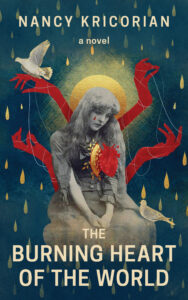 Each of these novels grew organically out of the work that preceded it. Zabelle was inspired in part by a series of poems I wrote in the voices of my grandmother and her friends while I was a creative writing MFA student at Columbia. Dreams of Bread and Fire returned to Watertown, where I grew up, and to Paris, where I had studied, and featured a character who emerged from my fascination with modern fedayee Monte Melkonian, about whom I had previously written a poem. While researching non-state actors who used political violence for Dreams, I came across a documentary film called Terrorists in Retirement, which was about the Manouchian Group, a Paris-based communist resistance network led by Armenian genocide survivor and poet Missak Manouchian. This interest then led me again to Paris and All the Light There Was. But as with all my novels, my motivation was not in portraying the heroic, but in illuminating the lives of Armenian women and the daily, domestic acts they undertake to sustain and protect their families in the face of mass violence.
While I was researching All The Light There Was, my “fixer” in Paris was Hagop Papazian, an Armenian who was born and raised in the municipality of Bourj Hammoud, just outside the city limits of Beirut. Hagop introduced me to Armenians who had lived through the Nazi occupation, among them was Arsène Tchakarian—one of the last surviving members of the Manouchian Group—and a woman whose father had been a cobbler in Belleville. Her family had briefly sheltered one of her Jewish schoolmates after the child’s parents were arrested during the Vélodrome d’Hiver roundup. Hagop also introduced me to his circle of Lebanese Armenian friends, who had fled Bourj Hammoud during the Civil War for various reasons.
Hagop was a playwright, two of his friends were folk singers and another, an actor. I was compelled by their stories—the children of genocide survivors who had rebuilt their lives and communities in Lebanon, forming part of an Armenian cultural renaissance in Beirut. They talked about their golden years in the early seventies—before the civil war blew it all to smithereens. My interest in their stories turned my attention to Beirut and resulted in the research and writing that produced The Burning Heart of the World.
When I went to Beirut for the first time in 2012, Hagop’s sister picked me up at the airport. His good friend Bedig was my guide. I met friends of friends and built a larger host community, so that when I returned in 2016, I had the help of a broad network of contacts to navigate and map Armenian Beirut. In my work, I try to create an immersive world that a reader enters the way you would walk into a neighborhood, so that the place’s smells, sounds, alleyways and byways are palpable, and if you had been there before, it would be immediately recognizable. I did that in Watertown and in Paris. I wanted to be able to do that in Beirut.
After my stays in Beirut, I was deep in the writing. I had my characters and the basic plot trajectory sketched out, but I was still struggling to securely and specifically situate Vera Serinossian and her family.
I try to create an immersive world that a reader enters the way you would walk into a neighborhood, so that the place’s smells, sounds, alleyways and byways are palpable…I did that in Watertown and in Paris. I wanted to be able to do that in Beirut.
As someone with a poor sense of direction, Bourj Hammoud was too big with too many different neighborhoods to map and recreate in my head. I returned to Beirut in 2017, and it was then that I found the Serinossians’ village in Nor Hadjin, a small Armenian neighborhood within Beirut city limits just across the bridge from Bourj Hammoud. It was about four blocks long and three blocks deep. It had a church, a social club, two schools, a candy shop and a watch repair shop, with mostly single-family houses and some multi-unit buildings.
Another reason that Nor Hadjin appealed to me was that my grandmother’s family came from Hadjin. My grandmother herself was born in Mersin, but her parents and grandparents hailed from Hadjin. I wrote about Hadjintsis in Zabelle. Returning to this lost Armenian town in the Taurus mountains and placing my characters in a new—Nor—Hadjin in Beirut would in a way bookend the project I started years ago—creating an Armenian diaspora quartet.
The title for my new novel comes from a quotation in Leon Surmelian’s bestselling 1945 genocide memoir, I Ask You Ladies and Gentlemen, a story of survival and a lost world. When Susan Pattie asked me to write a quotation for the back cover of the Armenian Institute’s 2019 reissue of this book, I was too embarrassed to admit that I had never read it before. From the first page, I was awed by Surmelian’s writing, bowled over by its warmth and intelligence and by the fluidity of the prose. Late in the book, when Surmelian was on a ship taking him to exile and to a new life in America, he wrote,
My heart is a hard red shield, I said. My heart is a star upon my breast. And my breast is the world. I am sailing on to America, to the great future, on the raft of my thought. A lighthouse—the burning heart of the world—my guide through the starry night.


I was so taken with this phrase “the burning heart of the world” that I wrote to Susan to suggest using it as the title for the new edition of the book, which I thought would have more appeal for today’s reader. When she consulted with the committee and they decided to stick with the original, I realized that I had found the title for my own novel.
April 2025 is the 50th anniversary of the start of the Lebanese Civil War and the 110th anniversary of the Armenian Genocide. My novel reverberates with both of these cataclysms, and it appears at a time when Lebanon and Armenia have just experienced more paroxysms of violence, suffering under existential threats to their sovereignty and territorial integrity. My novel is a journey through these histories and into this burning heart of the world. The title evokes both illumination and conflagration. The world is on fire, and while there is much darkness in the book, there is also humor, empathy and a commitment to amplifying that which is humane in the human. This last is central to my literary project.
Author information

The post The Making of “The Burning Heart of the World” appeared first on The Armenian Weekly.
В то время как правящая партия «Грузинская мечта» заявляет, что принимает аналог американского закона FARA, её представители уклоняются от прямого ответа на вопрос: будет ли их закон распространяться на такие независимые НПО, как «Международная прозрачность — Грузия» (TI), которые получают финансирование из-за рубежа, но при этом не подпадают под американский FARA. FARA в США требует […]
Warsaw said it would funnel the equivalent of €7.2bn from its share of the Covid-era funding to build shelters and roads and to invest in domestic arms makers https://t.co/KstQD7pNw7 pic.twitter.com/KedJueocsM
— Financial Times (@FT) March 25, 2025
The Armenian Relief Society (ARS) is honored to once again participate in a series of events at the distinguished United Nations Commission on the Status of Women (CSW) / Beijing 30+, organized by U.N. Women. This significant assembly was held at the United Nations Headquarters in New York from March 10 to March 21, 2025.
The ARS delegation had the privilege of attending the opening ceremony of the 69th session of the Commission on the Status of Women (CSW 69), where they met and conversed with Lebanon’s First Lady, Mrs. Nehmat Aoun. Since its accreditation as a non-governmental organization at the United Nations in 1975 with the Department of Global Communications (DGC), the ARS has demonstrated steadfast commitment to advancing its mission. In 1998, the ARS further elevated its status by becoming a consultative member on the Roster of the Economic and Social Council (ECOSOC).
Throughout the U.N. CSW69 proceedings, ARS representatives from New York, New Jersey, California, Washington and Canada actively engaged in the annual Town Hall Meeting with the United Nations Secretary-General (UNSG), his Excellency António Guterres and civil society representatives. They also participated in various intellectually enriching panels convened by the U.N. CSW, Permanent Missions and other ECOSOC-accredited NGOs, followed by thought-provoking discussions and question-and-answer sessions.


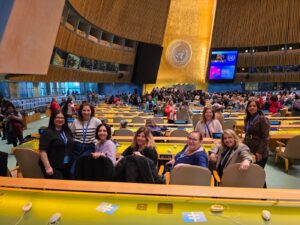

On March 12, 2025, the ARS, in collaboration with the Armenian Legal Center, hosted a distinguished parallel event entitled, “Resilience and Recovery: The Role of Women in Conflict Zones and Health Advocacy” at the United Nations Church Center (UNCC) in New York City.
The event commenced with a welcoming address delivered by Mrs. Arousyak Melkonian, Chairperson of the ARS Central Executive Board. The session featured a profound presentation by Ms. Tereza Yerimyan on the challenges faced by women in conflict zones and an address by Kevork Hagopjian, Ph.D., Esq., on strengthening legal protections for women in these areas. Joining virtually from Armenia, Dr. Lorky Libaridian offered insightful commentary on health advocacy in conflict zones. Dr. Nyree Derderian shared compelling stories that showcased ARS initiatives in conflict zones such as Armenia/Artsakh, Syria, Lebanon and Jerusalem, while also serving as the panel moderator.


The event concluded with an engaging question-and-answer segment and welcomed attendees including representatives of member states, United Nations agencies, ARS members, NGO leaders and other participants. It was streamed live on ARS’s social media platforms, with the recording still available for viewing on their Facebook and Instagram pages.
This parallel event was organized to unite individuals committed to empowering women in conflict zones and advocating for health through targeted programs and initiatives designed to support their recovery and resilience. As an esteemed participant in the CSW, the Armenian Relief Society reaffirms its dedication to fostering the empowerment of women in Armenia and across the globe.
Author information

The post The Armenian Relief Society at the United Nations CSW 69 appeared first on The Armenian Weekly.

The Hamazkayin Armenian Educational and Cultural Society of Providence held its cultural night on Saturday, March 15, 2025, at the Sts. Vartanantz Church Aramian Auditorium. More than 80 eager attendees filled the hall to hear the talented performers sing, play instruments and dance.
The program began with welcoming remarks from Sarkis Minassian, chairman of the Providence Hamazkayin chapter. Maral Kachadourian served as emcee, introducing the performers, reading the English translations of the songs and describing the musical numbers.
The opening song, “Bingyol,” was beautifully harmonized by Taleen Donoyan and Lorie Simonian. Tenor Rosdom Mkrtschjan followed with a passionate performance of “Lerner Hayreni” and “Hayots Mardigner,” accompanied by Raffi Rachdouni on the piano. The next performance featured pianist Raffi Avakyan, a young talent who charmed the audience. Taleen Donoyan sang “Makhmour Aghchik” followed by Lorie Simonian singing “Pari Arakil.” These two gifted ladies are sure to have bright futures as soloists, as their lilting voices mesmerized the audience.


The Artsakh Dance Ensemble, instructed by Shushan Avakyan, performed “Hzor Hayastan” and “Ambi Dagits.” The younger group, ages five to 10, danced with joy while the older girls, ages 11 to 15, danced with elegance and poise.
Suzie Chakmakian wrote and performed a portion of her skit called, “There Was and There Was Not: Telling Armenian Stories.” Her humorous stories about how it takes hours for Armenians to say goodbye and how they clean their houses meticulously before guests arrive left the audience laughing and nodding in understanding.
Raffi and Bethany Rachdouni offered a moving performance of “Groong” on the piano and violin, respectively. Their rendition of this familiar song by Gomidas Vartabed rang with passion and perfection. Soprano Joanne Mouradjian offered a heartfelt performance of “Kisherayin Megheti,” featuring lyrics by the late Archpriest Fr. Mesrob Tashjian and music by Maestro Konstantin Petrossian, who was also in attendance. Mouradjian, who has performed as a soloist in recital, oratorio and operetta throughout New England, was accompanied on piano by Rachdouni, and concluded with “Im Yerke.”


The final performer was Gregory Ayriyan, a professional violinist and son of the famous kamancha player David Ayriyan. His stunning performance of two original pieces as well as “Kani Vor Jan Em” by Sayat Nova and “Men’s Dance” by Alexander Spendiaryan left the audience breathless.
The evening concluded as Rev. Fr. Kapriel Nazarian led the singing of the “Hayr Mer” with the audience. Refreshments followed.
Hamazkayin is proud of the talented performers whose artistry made the cultural night a resounding success. We also extend our heartfelt gratitude to the audience for their support and enthusiasm in celebrating Armenian culture in Providence.
Author information

The post Hamazkayin Providence cultural night appeared first on The Armenian Weekly.