
My Opinion: Russia is the Cover, Mossad is the Doer.
–
Operation Trump: Russian Spies Conquer America https://t.co/MrGgPe35Da via @YouTube— Michael Novakhov (@mikenov) February 24, 2025
Month: February 2025
My Opinion: Russia is the Cover, Mossad is the Doer.
–
Operation Trump: Russian Spies Conquer America https://t.co/MrGgPe35Da via @YouTube— Michael Novakhov (@mikenov) February 24, 2025
WASHINGTON — The U.S. Supreme Court declined Monday to hear a challenge to the legality of buffer zones used to protect access to abortion clinics and limit harassment of patients in a challenge brought by anti-abortion activists who have argued that their free speech rights were being violated.
The justices turned away appeals by self-described “sidewalk counselors” in New Jersey and Illinois of lower court decisions to throw out their lawsuits that had claimed that the buffer zones violate free speech protections under the U.S. Constitution’s First Amendment. The activists had been asking the Supreme Court to overturn its 2000 ruling allowing a Colorado buffer zone law.
Conservative Justices Clarence Thomas and Samuel Alito said they would have taken up the appeals.
The legality of so-called buffer zones that create a perimeter around abortion facilities, or “floating” zones that put distance between demonstrators and a clinic’s patients or staff, has been legally contested for decades. The issue pits free speech rights against concerns over harassment and violence by anti-abortion protesters.
The Supreme Court has a 6-3 conservative majority. In 2022, the court overturned the 1973 Roe v. Wade ruling that had legalized abortion nationwide, ending its recognition of a woman’s constitutional right to terminate her pregnancy. Since that ruling, the issue of buffer zones has regained prominence.
While numerous Republican-led states have banned or severely restricted abortion, some municipalities in states where it remains legal have adopted buffer zone ordinances to limit intimidation and harassment, drawing legal challenges.
In Carbondale, Illinois, a group called Coalition Life that organizes sidewalk counselors sued after the local city council passed such an ordinance in 2023. The measure established a floating 8-foot (2.4 meters) buffer that prevents people from approaching people without their permission in the vicinity of health care facilities, in response to increased threats and disorderly acts at abortion clinics. The ordinance has since been repealed.
It had been modeled after a nearly identical Colorado law that the Supreme Court upheld in 2000 in a case called Hill v. Colorado.
The Chicago-based 7th U.S. Circuit Court of Appeals dismissed the coalition’s case in March 2024, noting that the challengers cannot prevail so long as the Hill ruling remains in place.
Thomas, in his dissent on Monday, criticized the court’s Hill decision and expressed regret that the justices had declined “an invitation to set the record straight on Hill’s defunct status.”
“I would have taken this opportunity to explicitly overrule Hill,” Thomas added.
The coalition’s lawyers had asked the Supreme Court to overrule the Hill ruling because in places where “anti-abortion views are disfavored,” buffer zones are a “ready tool to try to silence those who advance them — and to do so precisely when and where their speech may matter most.”
In New Jersey, a sidewalk counselor named Jeryl Turco sued the city of Englewood for adopting a 2014 ordinance that created an 8-foot buffer zone protecting the entrances and driveways of healthcare facilities.
The buffer was set after reports of people associated with an evangelical Christian ministry engaging in aggressive and hostile protests outside Metropolitan Medical Associates, a local abortion clinic. Turco was not associated with the ministry, and said she delivered only peaceful counseling.
The Philadelphia-based 3rd U.S. Circuit Court of Appeals threw out Turco’s complaint in January 2024, saying a buffer zone can help protect an individual’s health, safety and access to pregnancy-related services, and “does not place a substantial burden on Turco’s speech.” The 3rd Circuit said its ruling was in line with the Hill precedent.
Alexis McGill Johnson, president and CEO of Planned Parenthood Federation of America, said after the Supreme Court acted on Monday that buffer zones “help to create a safer environment for patients, providers and staff.”
“No patient should have to encounter threats, intimidation and attacks while seeking health care — and no medical provider or health center staff should be threatened because of their work to deliver abortion care to patients in need,” Johnson said.

Macron is a charmer.
–
The Complete History of Trump and Macron’s Long and Intense Handshakes – Newsweek https://t.co/JAQnLeDnic— Michael Novakhov (@mikenov) February 24, 2025
Macron is a charmer.
–
The Complete History of Trump and Macron’s Long and Intense Handshakes – Newsweek https://t.co/JAQnLeDnic— Michael Novakhov (@mikenov) February 24, 2025
A ‘High Risk Jurisdiction’: FATF Keeps Iran on Blacklist, Calls for Countermeasures Foundation for Defense of Democracies
Categories
Our unyielding voices
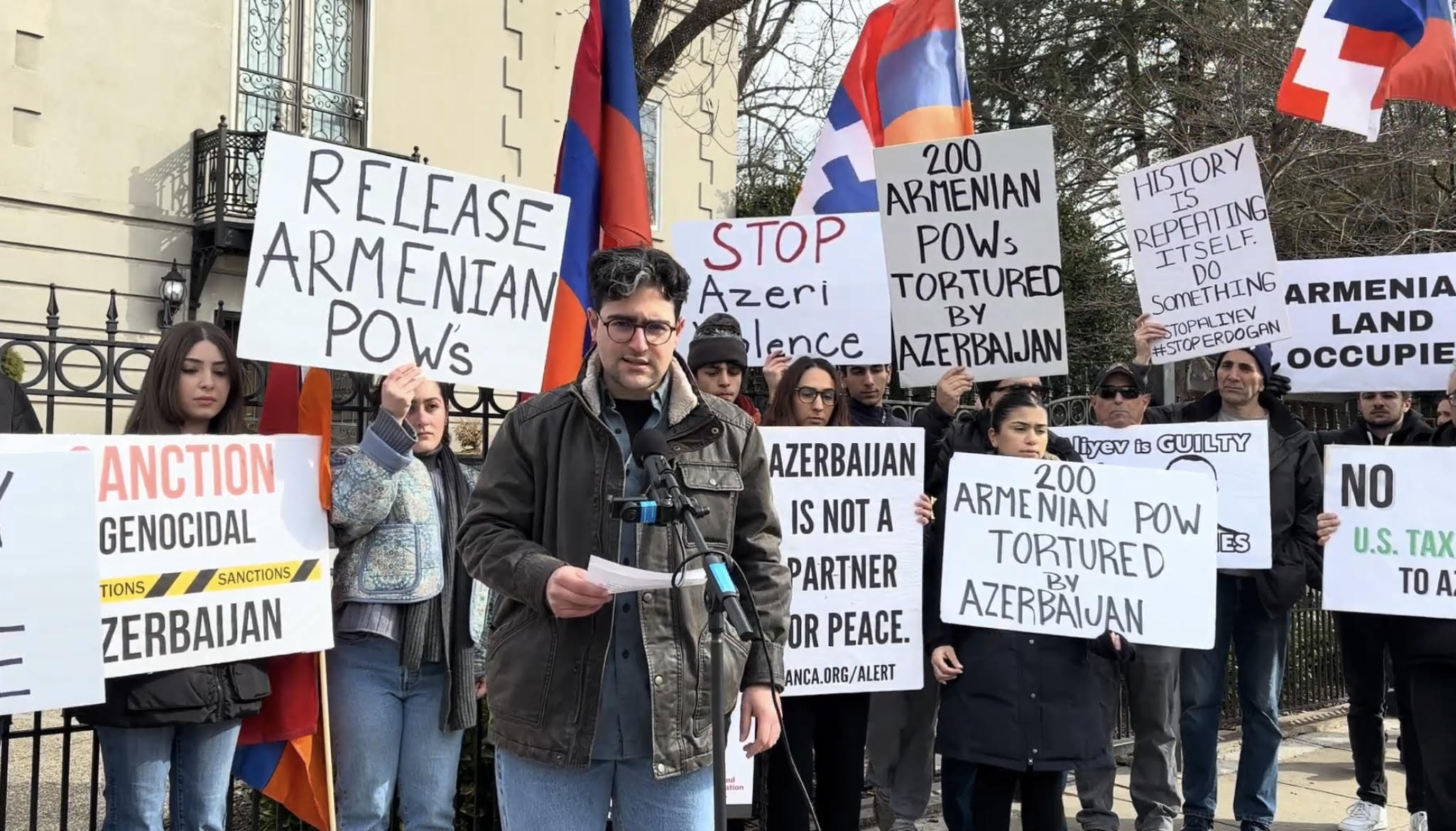
The following remarks were delivered at the AYF-led protest in front of the Azerbaijani Embassy in Washington D.C., held on February 22, 2025, commemorating Azerbaijan’s anti-Armenian massacres in Sumgait-Baku-Maragha-Kirovabad (1988-1992), along with demanding justice for the 2023 Artsakh genocide and release of Armenian prisoners of war.
Mgrdich Khrimian, Patriarch of Constantinople from 1869 to 1873, was known as Khrimian “Hayrig”, meaning “father”. As father to all Armenians, he led the Armenian Delegation to the Congress of Berlin after the Russo-Turkish War, where he attempted to seek greater autonomy for the Armenians living under Ottoman rule. Khrimian Hayrig was unsuccessful in doing so, explaining that the Armenians were met only with empty promises and diplomatic platitudes.
After the Congress of Berlin, the debate on the fate of the Armenians in the region would be termed, “The Armenian Question”. In 1894, the question was answered—with the wholesale massacre of Armenians at the hands of Sultan Abdul Hamid II—killing 300,000, because they dared to have a voice.
There can be no question. As long as Armenians exist, they will always face the threat of total annihilation. Reared now is the axe of Azerbaijan, executioner of the Pan-Turkic state, ready to continue the legacy of aggression. The Azerbaijani response to the Armenian Question, to the desire of Armenians to breathe free, was to make sure they don’t breathe at all.
In 1988, tired of repression under the Azerbaijani SSR, the Armenians of Nagorno-Karabakh voted to request that the region be transferred to the Armenian SSR. They received an immediate response—hundreds of thousands of Armenians living in Baku, Sumgait and Kirovabad, targeted by state-organized mob violence, were killed, beaten and forced to flee Azerbaijan—made into another example of what happens should the Armenians dare speak.
There has been no cessation of this practice, and with every effort of Armenians to secure their natural rights and self-determination, the tactics of Azerbaijan have only grown more depraved. For 10 months, 120,000 Artsakhtsis were starved and bombed out of their homes, not in another lifetime, but in 2023. The next target—Tavush and Syunik—sovereign territories within the Republic of Armenia, lie occupied today by Azerbaijani troops, used as the strategic staging ground for the next campaign of annihilation.
I am here speaking for the Washington D.C. Chapter of the Armenian Youth Federation, to share on their behalf, in our nation’s capital, the questions that are formative to their identities as young Armenian Americans, questions whose answers will inform their votes—the ultimate exercise of democratic speech. As youth, we have grown up asking, why not our people? Why is their right to exist not innate? When did we decide that injustice anywhere was no longer injustice everywhere? In the face of resounding global silence, how can we not then ask, “Why is my life not worth as much as another’s?”
As youth, we will continue to ask these questions, though we know some of the answers: people died because of the names they had, the songs they sang and the God they worshiped. And we will continue to tell their stories, sing their songs and have faith in each other. To be here today as we have in years past, and in years to come. To remember what happened and to renew in our hearts our efforts to stop it from ever happening again because we will not let our dreams be deferred, nor our voices silenced.
Author information

The post Our unyielding voices appeared first on The Armenian Weekly.