
Categories
South Caucasus News Review

Our unyielding voices


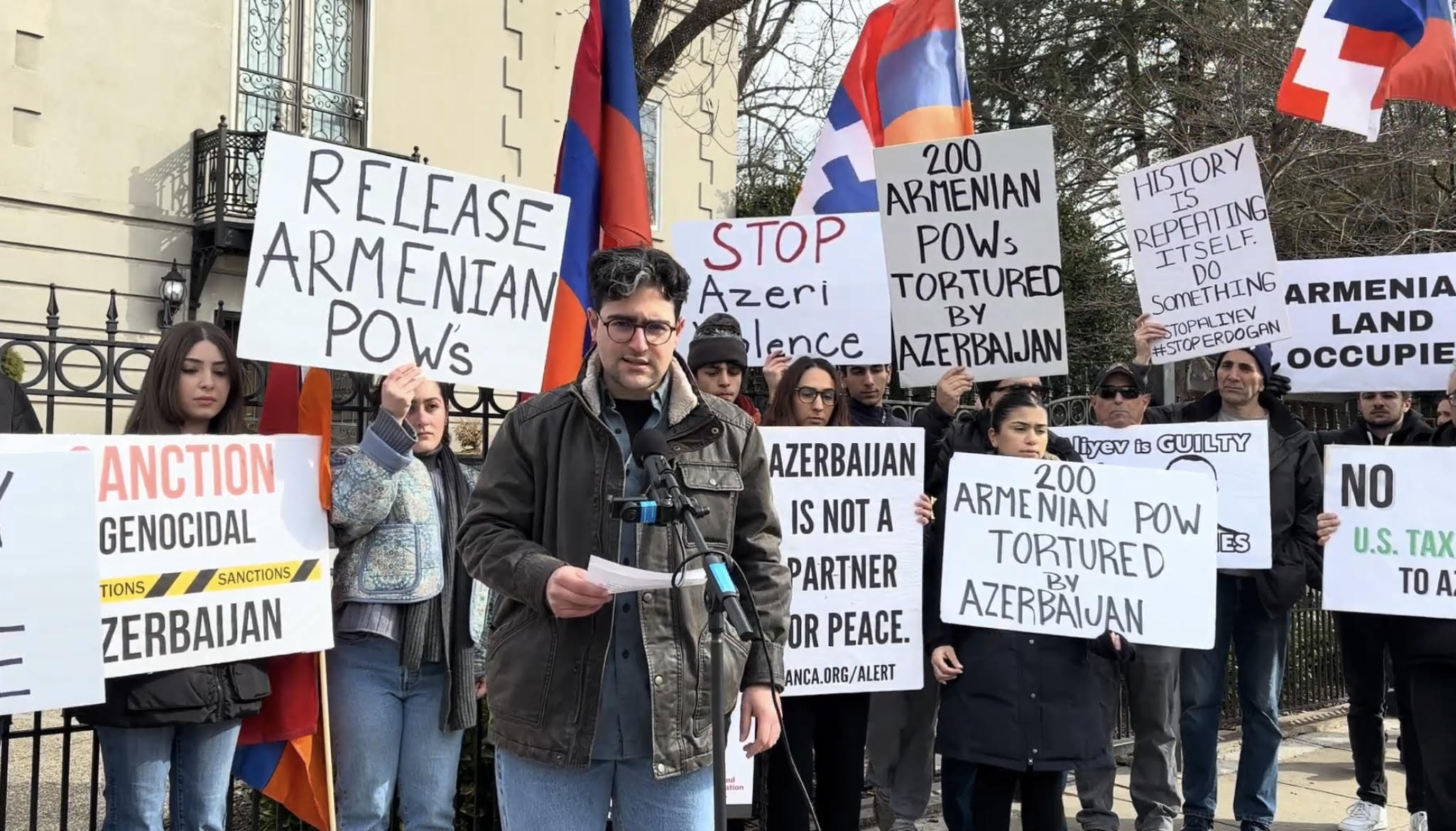
AYF D.C. “Ani” Chapter vice-chair Nareg Sakayan delivering his remarks

The following remarks were delivered at the AYF-led protest in front of the Azerbaijani Embassy in Washington D.C., held on February 22, 2025, commemorating Azerbaijan’s anti-Armenian massacres in Sumgait-Baku-Maragha-Kirovabad (1988-1992), along with demanding justice for the 2023 Artsakh genocide and release of Armenian prisoners of war. 

Mgrdich Khrimian, Patriarch of Constantinople from 1869 to 1873, was known as Khrimian “Hayrig”, meaning “father”. As father to all Armenians, he led the Armenian Delegation to the Congress of Berlin after the Russo-Turkish War, where he attempted to seek greater autonomy for the Armenians living under Ottoman rule. Khrimian Hayrig was unsuccessful in doing so, explaining that the Armenians were met only with empty promises and diplomatic platitudes. 

After the Congress of Berlin, the debate on the fate of the Armenians in the region would be termed, “The Armenian Question”. In 1894, the question was answered—with the wholesale massacre of Armenians at the hands of Sultan Abdul Hamid II—killing 300,000, because they dared to have a voice. 

There can be no question. As long as Armenians exist, they will always face the threat of total annihilation. Reared now is the axe of Azerbaijan, executioner of the Pan-Turkic state, ready to continue the legacy of aggression. The Azerbaijani response to the Armenian Question, to the desire of Armenians to breathe free, was to make sure they don’t breathe at all. 

In 1988, tired of repression under the Azerbaijani SSR, the Armenians of Nagorno-Karabakh voted to request that the region be transferred to the Armenian SSR. They received an immediate response—hundreds of thousands of Armenians living in Baku, Sumgait and Kirovabad, targeted by state-organized mob violence, were killed, beaten and forced to flee Azerbaijan—made into another example of what happens should the Armenians dare speak. 

There has been no cessation of this practice, and with every effort of Armenians to secure their natural rights and self-determination, the tactics of Azerbaijan have only grown more depraved. For 10 months, 120,000 Artsakhtsis were starved and bombed out of their homes, not in another lifetime, but in 2023. The next target—Tavush and Syunik—sovereign territories within the Republic of Armenia, lie occupied today by Azerbaijani troops, used as the strategic staging ground for the next campaign of annihilation. 

I am here speaking for the Washington D.C. Chapter of the Armenian Youth Federation, to share on their behalf, in our nation’s capital, the questions that are formative to their identities as young Armenian Americans, questions whose answers will inform their votes—the ultimate exercise of democratic speech. As youth, we have grown up asking, why not our people? Why is their right to exist not innate? When did we decide that injustice anywhere was no longer injustice everywhere? In the face of resounding global silence, how can we not then ask, “Why is my life not worth as much as another’s?”

As youth, we will continue to ask these questions, though we know some of the answers: people died because of the names they had, the songs they sang and the God they worshiped. And we will continue to tell their stories, sing their songs and have faith in each other. To be here today as we have in years past, and in years to come. To remember what happened and to renew in our hearts our efforts to stop it from ever happening again because we will not let our dreams be deferred, nor our voices silenced.

Author information

Nareg Sakayan

Nareg Sakayan

Nareg Sakayan is a summa-cum-laude graduate of Virginia Polytechnic Institute and State University, where he received a Bachelor’s Degree in Environmental Policy and Planning. He is a member of the AYF-YOARF Washington D.C. “Ani” Chapter, where he serves as vice-chair.

The post Our unyielding voices appeared first on The Armenian Weekly.


Categories
South Caucasus News Review

Artsakh’s history is yet to be written


AYF D.C. “Ani” Chapter member and ANC D.C. Chapter chairperson Matt Girardi giving his speech

The following remarks were delivered at the AYF-led protest in front of the Azerbaijani Embassy in Washington D.C., held on February 22, 2025, commemorating Azerbaijan’s anti-Armenian massacres in Sumgait-Baku-Maragha-Kirovabad (1988-1992), along with demanding justice for the 2023 Artsakh genocide and release of Armenian prisoners of war.   

Today, we once again gather to mark the anniversary of the Baku, Sumgait, Maragha and Kirovabad massacres. Year after year, we have come before this embassy, before the world, to shout out that our people deserve recognition. That we deserve dignity. That we deserve the same human rights as anyone else. However, I must also note that we come not out of blind national chauvinism nor care only for Armenians. We come to ensure that, as the chant goes, genocide denied does not become genocide continued. So recently, so sadly, that has indeed been the case. And so often, genocide continued spreads—from one part of the world to the next. 

Nearly two years ago, I said that “we have come to honor those lost, to seek restitution for those who survived and to fight for those under brutal siege.” I, for one, am proud that we showed up and spoke out. I am proud that in the face of a world that sought to forget and to erase, we stood steadfast. But I have come to deliver a hard truth: there is much more work to do. That starts with a clear diagnosis of how we got to this crossroads and a plan for action. 

In February 1988, 37 years ago, the Artsakh liberation movement began. Instead of allowing the people of Artsakh their rights to self-determination and self-government, officials in the Azerbaijani SSR responded with fanning the flames of hate. On February 27, 1988, rioters fueled by poison from local Azeri authorities began a brutal two-day riot in Sumgait. Thereafter, that unpunished and unadulterated violence spread to Kirovabad. 100,000 people fled for their lives. Then, in Baku, the quarter million strong and centuries old Armenian population faced  increasing discrimination. Although many left, authorities yet again sought to erase the Armenian population from existence there. For nearly a week, violence spread unabated. 

In the years since, we have seen Azerbaijan escalate this violence again and again. In Maragha, more innocent civilians were massacred in 1992. In the second Artsakh war, we saw illegal cluster munitions deployed. We saw videos and pictures of civilians beheaded, of service women’s bodies desecrated, of prisoners of war being executed. Then, in September 2023, we were forced to watch over 120,000 innocent men, women and children be forcibly removed from their homeland. Their leaders have been kept as hostages for show in kangaroo courts. It was painful. It was cruel. It was wrong. 

Yet, the people of Artsakh, strong and resolute, are not yet confined to the pages of history books. Families who found love and joy in Stepanakert still live. Babies born in a free Shushi still are diligent scholars and playful children. Veterans who fought for the right to live in peace and with self-determination still fill our churches and community centers. It is our obligation to stand in solidarity with them now and forever. 

However, we also come before this embassy for the people of Azerbaijan, who still have their doubts, fears and frustrations with a dictatorship funneled into hate for their fellow man. To them, I ask: is your child happier than they were before the war? Are you more free than before your government initiated a genocide in Artsakh? Do you have more opportunities to lead a dignified life? Has this filled the gap that Ilham Aliyev has burned into the heart of your country? 

To the previous Department of State, to USAID, to the former Biden administration, I must ask: was it worth turning your backs on human rights? Was it worth sacrificing credibility and faith in the United States? The promise of a rules-based order with guarantees of dignity, self-determination and freedom for all lay as homeless as the thousands of refugees forced to flee in the face of annihilation; they lay buried under the rubble of bombed out buildings and shelters. 

To those who opine that losing Artsakh was somehow necessary to the survival of the Armenian nation, I ask, do you feel safer now than you did in 2018? Do you feel more confident in the security and future of the Armenian state? How much of Armenia are you prepared to give up? How much do you think Aliyev, Erdogan and their enablers will be satiated by? Are we content with accepting injustice and appeasement instead of fighting for collective liberation? 

We must recognize as well that this struggle is not an Artsakhtsi struggle. It is not an Armenian struggle. It is not an Azeri or Turkish struggle. Rather, it is a critical juncture for human rights and collective power. The unpunished, unrecognized and unfinished genocide of the Armenian people continues to serve as an example to autocrats and racists around the world. The words of Adolf Hitler asking “who remembers the Armenians?” before embarking on a war of catastrophe for the world echo in the tragedies of today. 

So, we come here to shout back. To say that there is another way. And as I said before and as I say now, that way is solidarity. Solidarity is strength. Solidarity is power. Solidarity is love. Our binding stretches across generations, across oceans, across mountains through which armies of empires have marched and who have always—always—fallen to our collective strength. That is what is needed: a commitment to a common cause and a shared future. For in the end, we are one people with one homeland and one history. 

The beauty of today is that such a history is one on which the ink has not yet dried. We, together, are masters of our own fates. So, let us love our people enough to remember the taste of blood every time we bite into an apricot. Let us love our people enough to hear the ringing of  church bells of Van in our music. Let us love our people enough to feel the warmth of children’s smiles playing in liberated Shushi in the sun that shines on our faces. A better world is possible, my friends. But we must choose that today. 

We must choose to take our energy today and come back tomorrow and the next day, and the day after that, and every day until we have breathed our last. But most of all, let us do it together. For I still believe that while the weight of destiny rests upon us, below us, we stand on the shoulders of giants. Let us not let them down now.

Author information

Matthew Girardi

Matthew Girardi

Matthew Girardi is a resident of Washington, DC and a proud member of the AYF DC “Ani” Chapter. He serves as a political and communications organizer for the Amalgamated Transit Union Local 689. He graduated from the George Washington University Magna Cum Laude with a Bachelors of Arts in Political Science and International Relations and a Masters of Professional Studies in Legislative Affairs.

The post Artsakh’s history is yet to be written appeared first on The Armenian Weekly.


Categories
South Caucasus News Review

Kyrgyzstan’s imports of passenger cars from China drop


Categories
South Caucasus News Review

… “poor” terrorist state ‘wanting peace’


Categories
South Caucasus News Review

AP Headline News – Feb 24 2025 16:00 (EST)


Categories
Starred posts

As Donald Trump upends geopolitics what happens to Five Eyes and AUKUS? – ABC News


As Donald Trump upends geopolitics what happens to Five Eyes and AUKUS?  ABC News

Categories
Starred posts

Trump’s ‘radical’ plans for the FBI come into focus – The Week


Trump’s ‘radical’ plans for the FBI come into focus  The Week

Categories
Starred posts

Trump’s ‘radical’ plans for the FBI come into focus – The Week


Trump’s ‘radical’ plans for the FBI come into focus  The Week

Categories
Starred posts

The ruling established that presidents cannot fire the appointed leaders of the alphabet soup of federal agencies without cause. brooklyneagle.com/articles/2025/…


Categories
Starred posts

Stonewall, UK’s Largest Trans Rights Organization, Turned Out to Be a USAID Front