
Day: December 30, 2024
Content by JAMnews’ partner Donbas News
The histories of Ukraine and Georgia (Sakartvelo) share much in common. Since recognizing their independence, Russia has used every means to try to subjugate both Ukrainians and Georgians once again. Yet, both countries not only resist but also support one another.
In 1993, during the Georgian-Abkhaz conflict in Sukhumi, Ukraine organized a humanitarian mission to rescue 8,000 Georgian refugees stranded in the mountains. At the same time, a Ukrainian legion fought alongside Georgians. In 2008, during the Russo-Georgian War, Ukraine supplied Georgia with air defense systems, and Ukrainian fighters again stood shoulder to shoulder with Georgians. During Ukraine’s Revolution of Dignity, Georgians came to support Ukrainians. In 2014, when the war in Donbas began, Georgians joined the fight alongside Ukrainians and formed the Georgian Legion. After Russia’s full-scale invasion in 2022, dozens of Georgians enlisted in the Legion and went to fight in Ukraine. Meanwhile, in Tbilisi, large amounts of humanitarian aid were collected for Ukrainians, even as the Georgian government remained silent. According to a survey by the Georgian research company ATS, 87% of Georgians consider the war in Ukraine to be their own war. Ukrainians and Georgians understand each other like no one else.
Currently, anti-government and pro-European protests have been ongoing in Georgia (Sakartvelo) for the fourth consecutive week. A journalist from Donbas News who regularly attends the rallies in Tbilisi has prepared a report, speaking with two Georgians and a Ukrainian about mutual support, war, and protests.
How protest began
After the elections in Georgia (Sakartvelo), which, according to the opposition Coalition for Change, were falsified, the pro-Russian party Georgian Dream emerged victorious. In the days that followed, tension simmered in Tbilisi, with no clear outlet. There were protests and tents were set up, but the demonstrations remained relatively small. That changed on 28 November when Georgian Prime Minister Irakli Kobakhidze announced that Georgia would postpone negotiations for EU membership until 2028. As Georgians jokingly say, “The opposition couldn’t bring people to the streets, but Kobakhidze managed to do it for them.” The country erupted.
That evening, a massive crowd gathered in front of the parliament in Tbilisi. I joined the protest, making my way closer to the building through the crowd. But I couldn’t get too near—the throng was too dense. I tried to make sense of what was happening when I suddenly heard someone shout:
– გაზი! Gazi! (Gas!)
The crowd started fleeing from the riot police—nicknamed “Robocops” in Georgia—who had fired tear gas capsules at us. My vision blurred, and my throat tightened, a familiar feeling from when the Robocops dispersed protests against the foreign agents’ law in 2023. The crowd, filling much of Tbilisi’s main avenue, Rustaveli, surged forward. Some people stumbled.
– ნელა! Nela! (Slowly!) – Georgians shouted to one another to prevent injuries in the crush. The word means “slowly” in Georgian.
The crowd slowed down. I moved further away to catch my breath in cleaner air. Each inhalation after the gas was excruciating. Around me, people coughed uncontrollably as we stopped by the Opera House. A few people had come prepared with saline solution to rinse eyes affected by the gas. Those with the solution were embraced by others in gratitude.
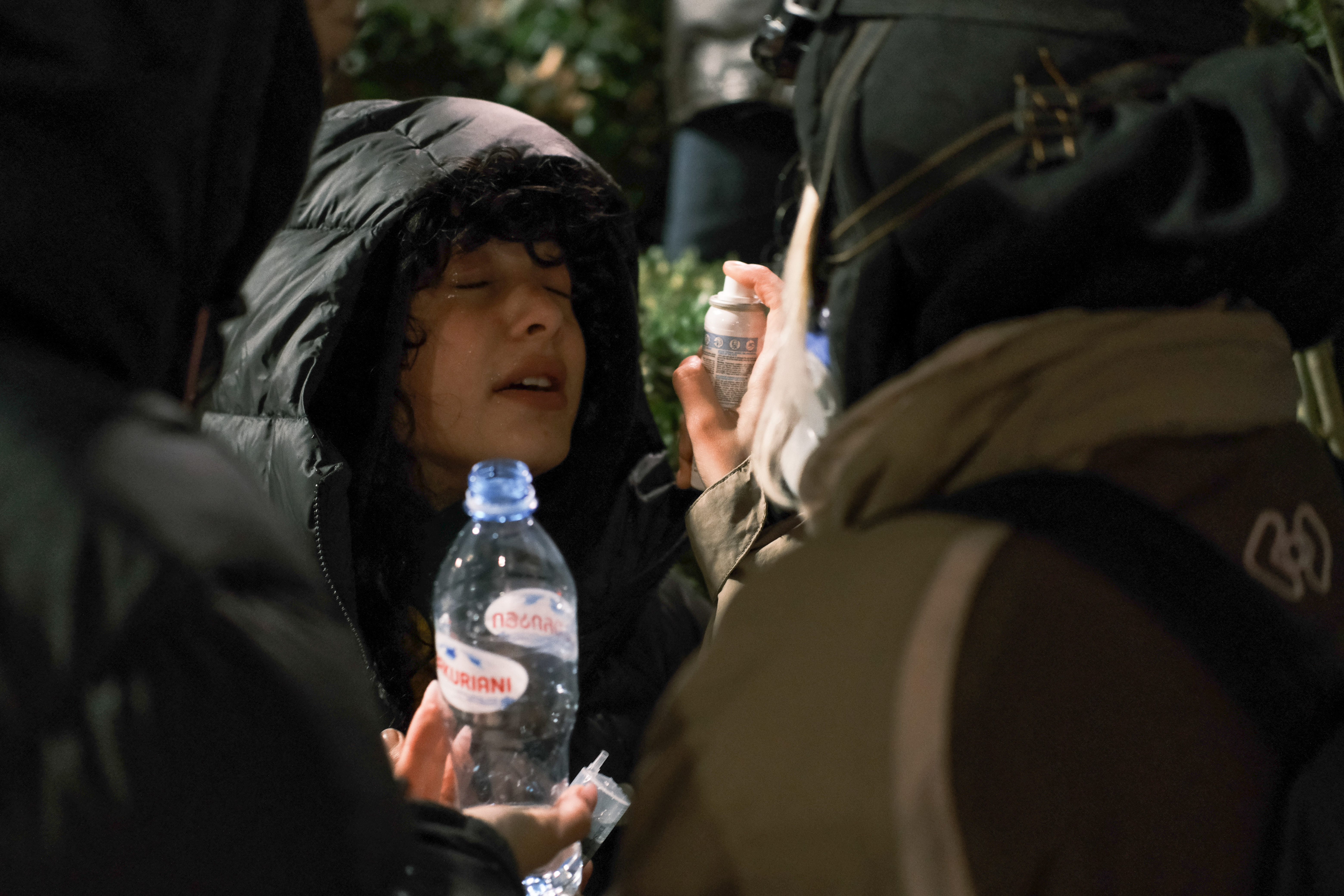
I wipe away my tears and try to figure out what’s happening at Parliament. I open Telegram: someone was taken away by ambulance after the gas attack, someone else was beaten by the riot police. Even in towns with populations under 3,000, people have joined the protests. The whole country is protesting. I subscribe to new Georgian Telegram channels where admins are reporting on what’s happening at the sites of clashes with the authorities.
Photographer Zurab
We return to Parliament, but from the middle of the crowd, it’s impossible to see anything. I check Telegram again for updates. “Javakhadze!” reports that serious clashes between security forces and protesters have already begun near Parliament, with water cannons being used. We shout, “Sakartvelo Gaumarjos!” (“Long Live Georgia!” – ed.). We stood until morning, and it became clear: the authorities are determined to suppress the protest forcefully, while the Georgians are determined to stand their ground until the very end.
At home, I write to a close friend in Kyiv. I know she’ll understand my decision to stand with Georgians at the protests like no one else. She asks me to be careful and sends a list of items that might come in handy—protective gear and medicines she always carried with her on the Maidan. If anyone has received a “Maidan manual,” it’s me. The adrenaline keeps me awake, so I decide to look up the author of the “Javakhadze!” channel. It’s run by Zurab Javakhadze, a photojournalist. Until the age of 10, Zurab lived in Tbilisi before his parents moved him to Moscow. He worked in Russia for many years, covering protests and events in the Caucasus. Later, he went to document the Maidan and the frontlines at the beginning of the war in 2014. In 2022, he returned to Tbilisi with his family. Now, he photographs protests in Georgia (Sakartvelo) for his Telegram channel.
Zurab shares what he witnessed on the Maidan ten years ago and what is happening now in Tbilisi:
“It’s hard to imagine now, but in 2014, you could work for TASS in Ukraine—I even had accreditation from the SBU. I arrived in Kyiv before the first crackdown on protesters, right when everything was just beginning. I literally slept through the first dispersal—came out of the Hotel Ukraina at 7 a.m., and the whole area was cordoned off, with no one around. After that, everything escalated quickly. The clashes on Bankova Street happened next—that’s where I was photographing.A Berkut officer ran up to me and shouted, ‘Get down!’ I instinctively lay on the ground, using my camera lens to shield the back of my head. Five of them started beating me. I was saved by some guys from the Internal Troops—they were conscripts. Nearby was Evgeniy Maloletka, and they broke his wrist that day. I got back up and started taking photos again, finding myself behind the police lines. The officers brutally beat a huge number of people—anyone they could reach—women, the elderly, everyone. I captured them dragging a woman by the neck, choking her. One of my photos from that day made The Times’ top 20 images of 2013.”
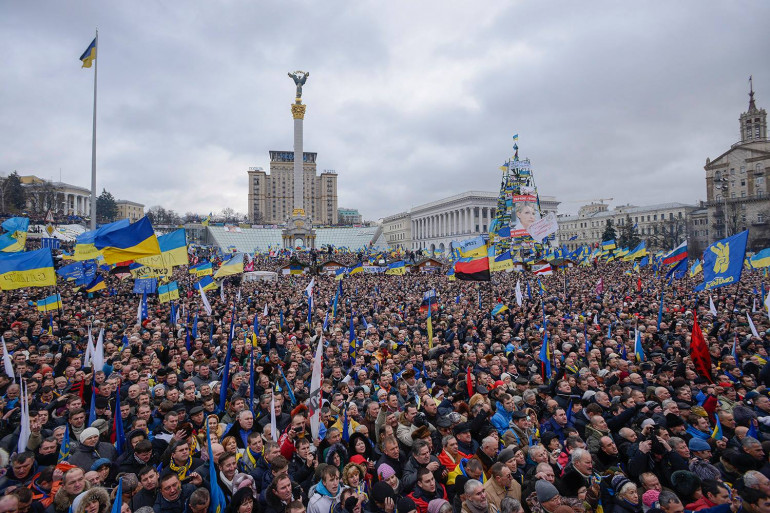
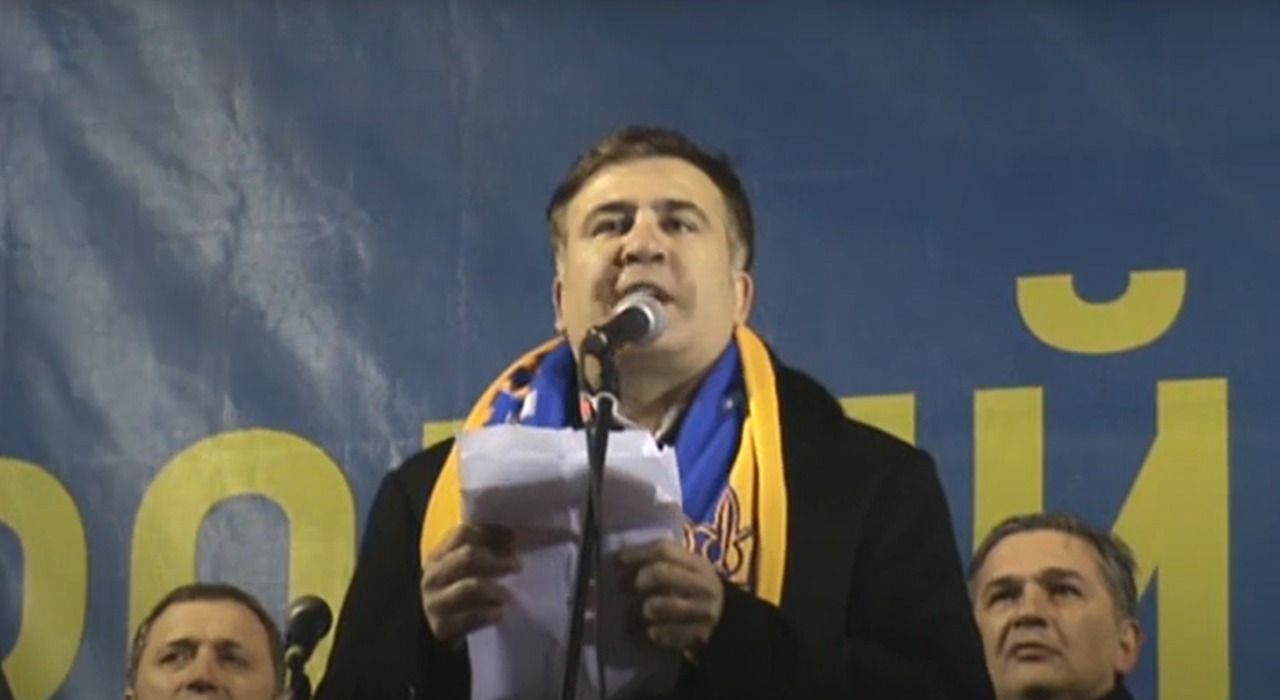
After the first crackdown, Ukrainians didn’t just come back—they came out in a massive wave, about half a million people. When I saw that, I became a Ukrainophile. The freedom-loving spirit of the Ukrainian people amazed and inspired me. I always tell my wife that if not for Tbilisi, I would have moved to Kyiv. I went to the Maidan several more times. I was in Ukraine when Saakashvili gave a speech there. He stood on the Maidan and said, “Russia is going to start a war.” I looked at the faces of the people around me—they were deeply frightened, whispering to each other, asking, “What is he talking about? What war?” Ukrainian society didn’t want a war, and it wasn’t prepared for one.
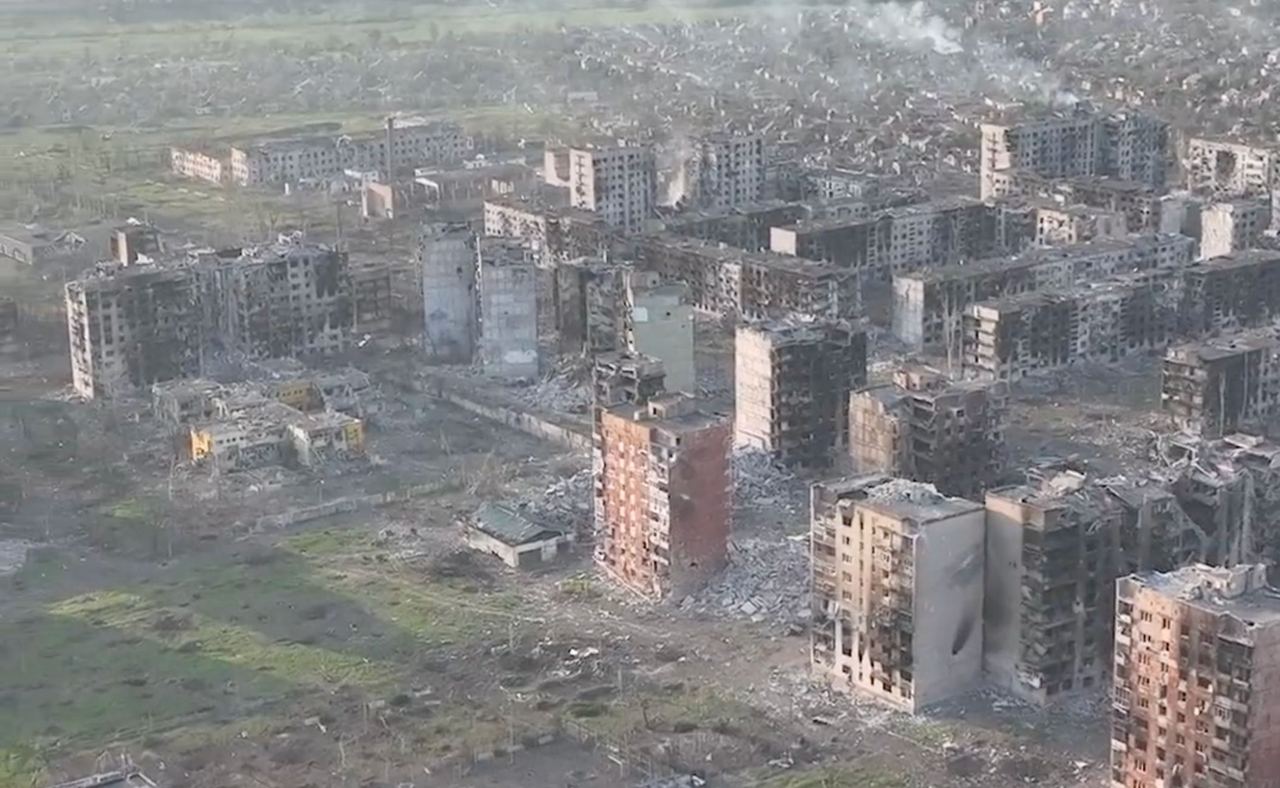
Then the war began, and I went to the frontlines. Once, I was right on the line of contact and ended up in a bomb shelter with civilians. Everyone fell asleep except for me and one woman who couldn’t sleep either. We started talking, and she told me she had moved to Donetsk from the Rostov region. Back when nothing had yet happened in Donetsk, her relatives started calling her, saying that “Banderites” were killing people in Ukraine. That’s when, she said, she realized who was behind it all. She told me she and many others in Donbas didn’t understand where the referendum would lead. “If I had known how it would all end,” she said, “I would have taken an axe and killed those who initiated that referendum.”
I witnessed an incident where a militant approached an elderly Ukrainian vendor at a market. The man in uniform started talking about how they had come to defend the “DNR” there. The Ukrainian man looked him in the eye and said, “I don’t know any ‘DNR.’ I’m Ukrainian, I was born in Ukraine, and this will always be Ukraine. I don’t know who you’re protecting here, but it’s definitely not me.” But I also want to point out that in Donbas, many people reacted differently. Donbas was one of the places where the Soviet Union most actively shaped the “Soviet person,” and the decades of propaganda bore fruit. I’ll never forget a miner from Luhansk region who joined the “USSR Battalion.” He told me, “These khokhols forced me to learn Ukrainian, but why the hell do I need their Ukrainian?” This was a man who had lived his entire life in Ukraine and was outraged that he was made to learn Ukrainian.
When I left, I was sure the separatists would be driven out within two weeks and everything would return to normal. I saw the mood of the people—many were pro-Ukraine. The separatists were few in number. But then the Russian army arrived, and a terrible tragedy unfolded. I felt deep sympathy for the Ukrainians because I knew what would come next—my country had already gone through this. It felt like someone had dusted off the “Abkhazia-Georgia” folder, changed the geographic names, and replayed the exact same scenario.
After the war in Ukraine began, censorship appeared in the newsroom. Zurab didn’t hide his stance, and in 2015, he was fired from TASS for it. He stayed in Moscow with his wife and child, as his child needed constant medical treatment that wasn’t available in Georgia (Sakartvelo) at the time. Zurab kept working as a photographer—first shooting weddings, then sports events. But after the full-scale war started, they sold their property in Russia and moved to Georgia (Sakartvelo).
“I saw the start of the full-scale war as a new invasion of my own country by Russia. We see our fate mirrored in what’s happening in Ukraine. In Sakartvelo, people immediately began collecting massive amounts of humanitarian aid, hosting refugees, and donating to the Ukrainian army. Back in the day, Ukrainian volunteers fought in Abkhazia, and many of them gave their lives to stop Russia. Likewise, many Georgian volunteers went to Ukraine to fight in 2022, and they’re still there today. ‘Georgian Dream’ claims, ‘If we don’t stay in power, there will be war.’ But the reality is, as long as Ukraine holds back this horde, there won’t be any war here.”
Zurab has joined the pro-European protests in Georgia (Sakartvelo), attending daily demonstrations on Rustaveli Avenue and reporting on them through his Telegram channel:
“Today, the entire country has taken to the streets because we know that Russia means war and ethnic cleansing. We have seen nothing from them but blood and pain. Only EU membership can save us from Russia, which is why these protests have been going on for four weeks and, I hope, will not stop. Otherwise, we will perish as a nation.Right now, the authorities are acting very similarly to how the pro-Russian authorities acted during the Maidan. There are titushky—thugs without uniforms—who are detaining people, as well as the use of tear gas and rubber bullets. The Robocops [riot police] are ready to resort to violence for money. A friend of mine in the police told me that they’re paid 1,000 lari per day for dispersing protests—that’s a lot of money for Georgia (about 15,000 hryvnias—ed.)
We’re all sick and tired of Russia’s attempts to drag us back into the Soviet Union—it’s been thirty years, and we’re still struggling against it. I’m very proud of my country, which has taken to the streets to defend its future.”
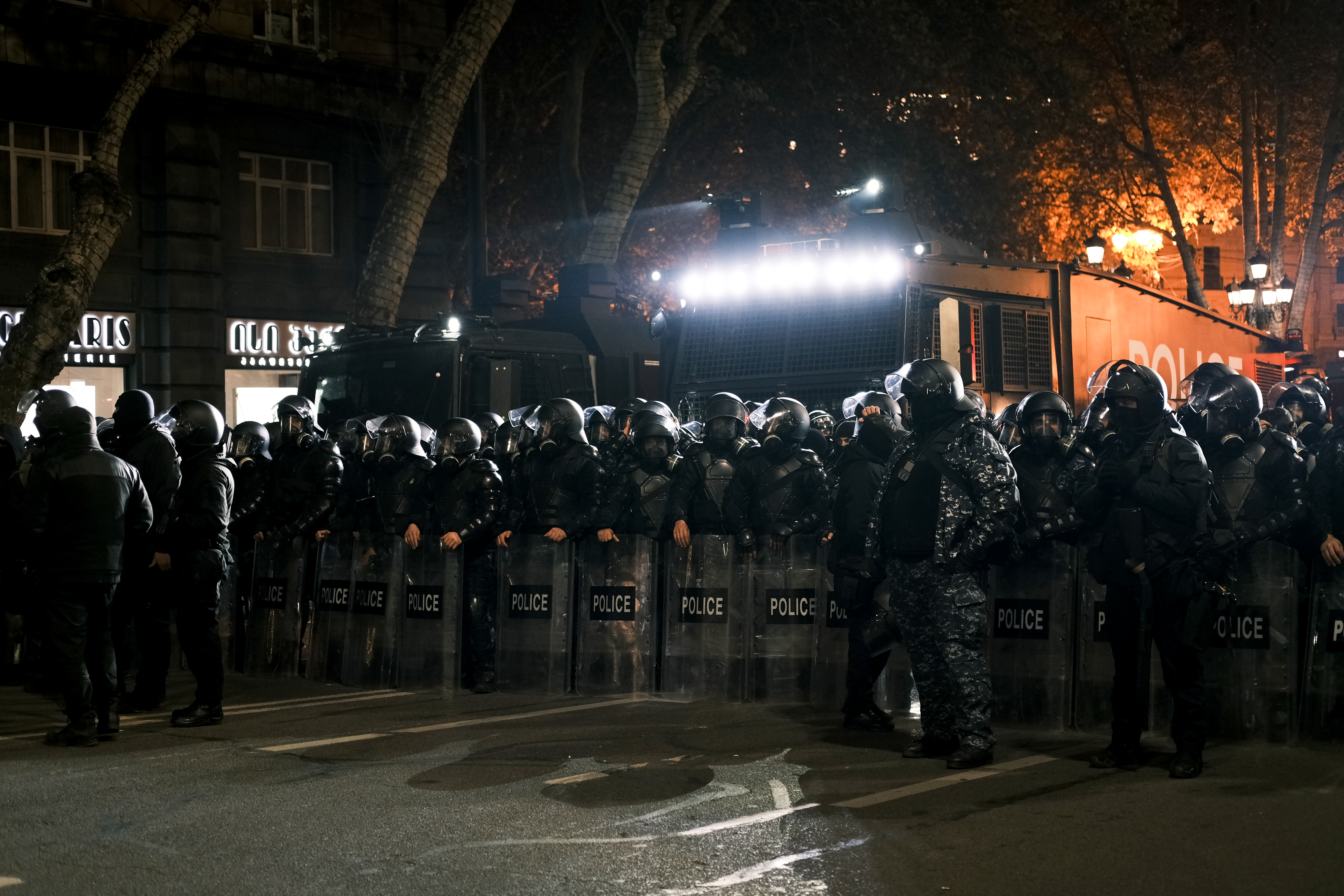
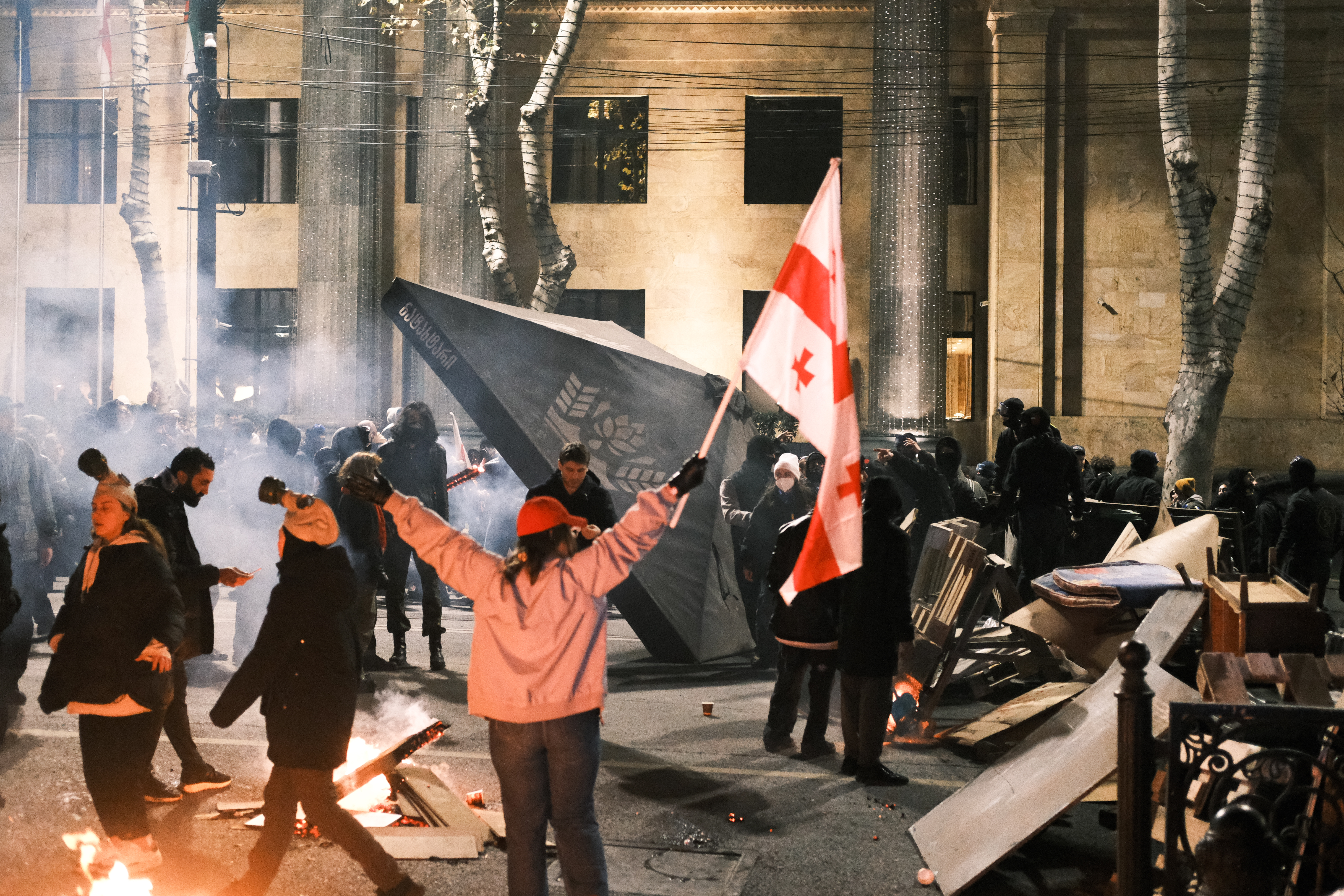
Almost from day one, barricades started rising on Rustaveli Avenue and nearby streets, built from garbage bins and anything else protesters could find nearby. Each new section of the barricades is met with applause. The people on the barricades stand on the front lines, facing the Robocops, and suffer the worst burns from the gas. Running between the barricades to deliver saline solution for people’s eyes, I hear “Bez Boyu” by Okean Elzy—we sang it at the top of our lungs together with the Georgians. The security forces constantly try to tear down the barricades, but for every one they destroy, three more appear. People keep bringing new materials, using whatever is at hand. Fires burn both near the barricades and all along the avenue—it’s already cold at night, and we warm ourselves by them. This is especially vital for those pushed away from the Parliament building by water cannons. Around the fires, people are always drying clothes, and those who managed to stay dry immediately take off their own clothes to give to those soaked. All this, even though the temperature has already dropped below zero.
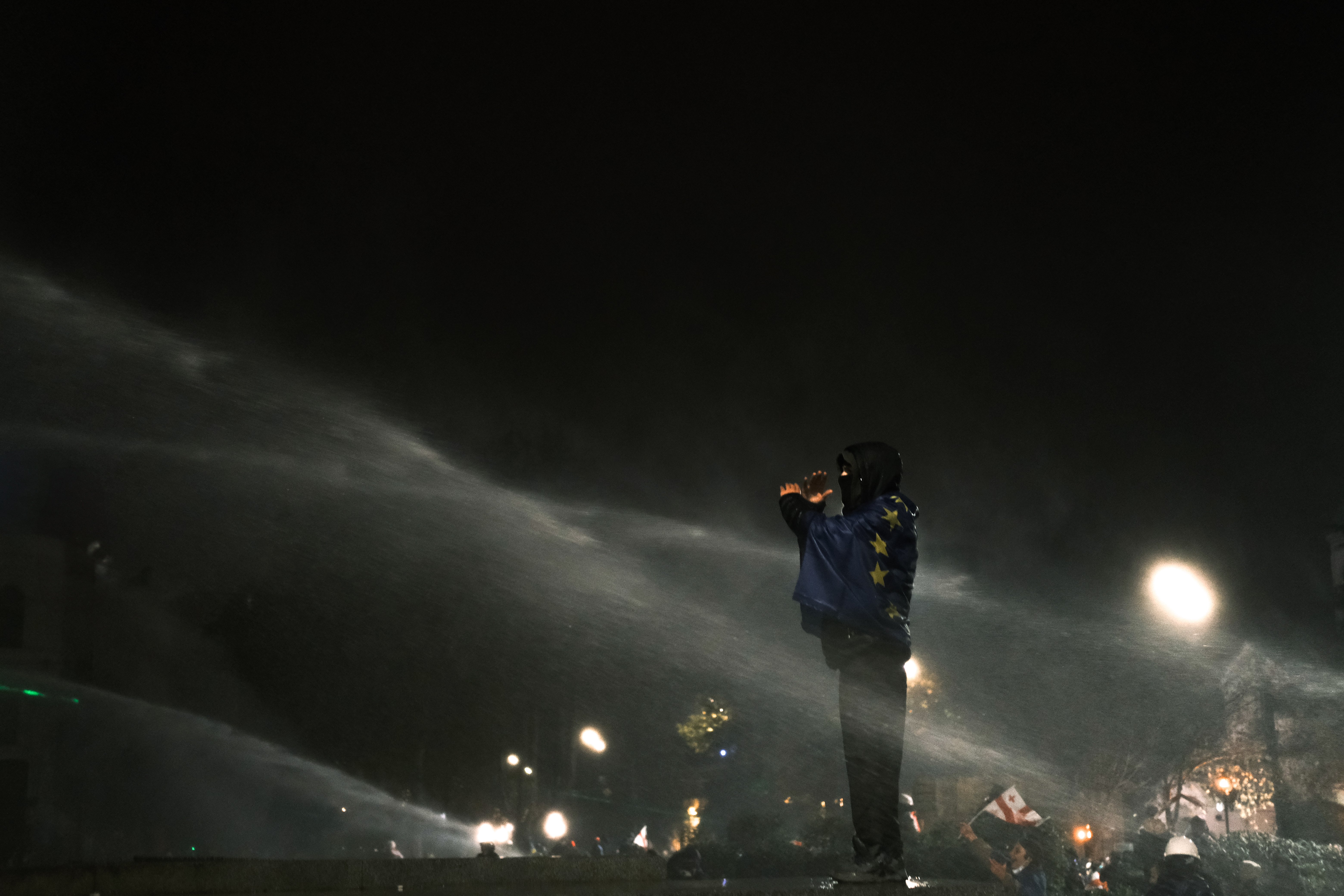
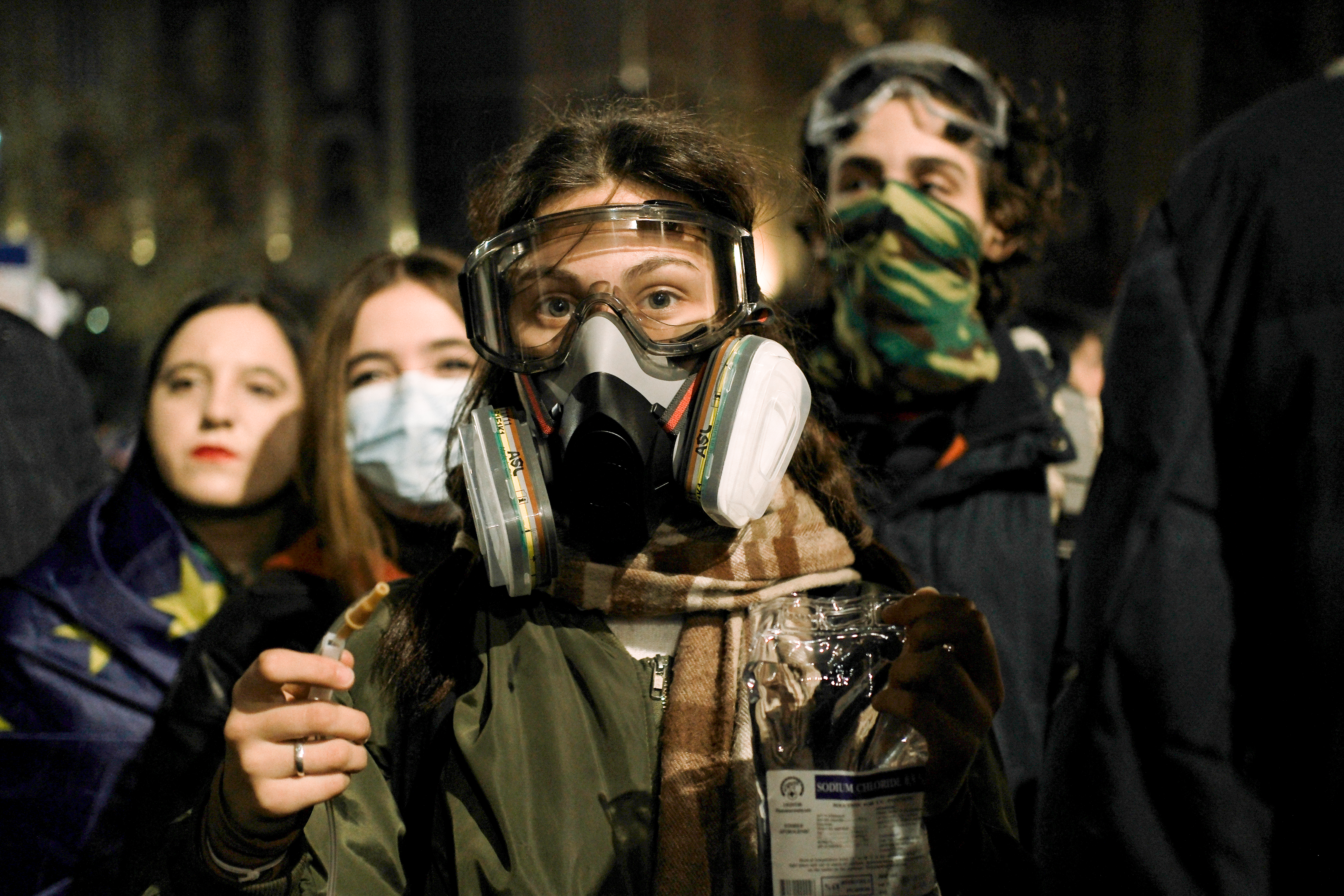
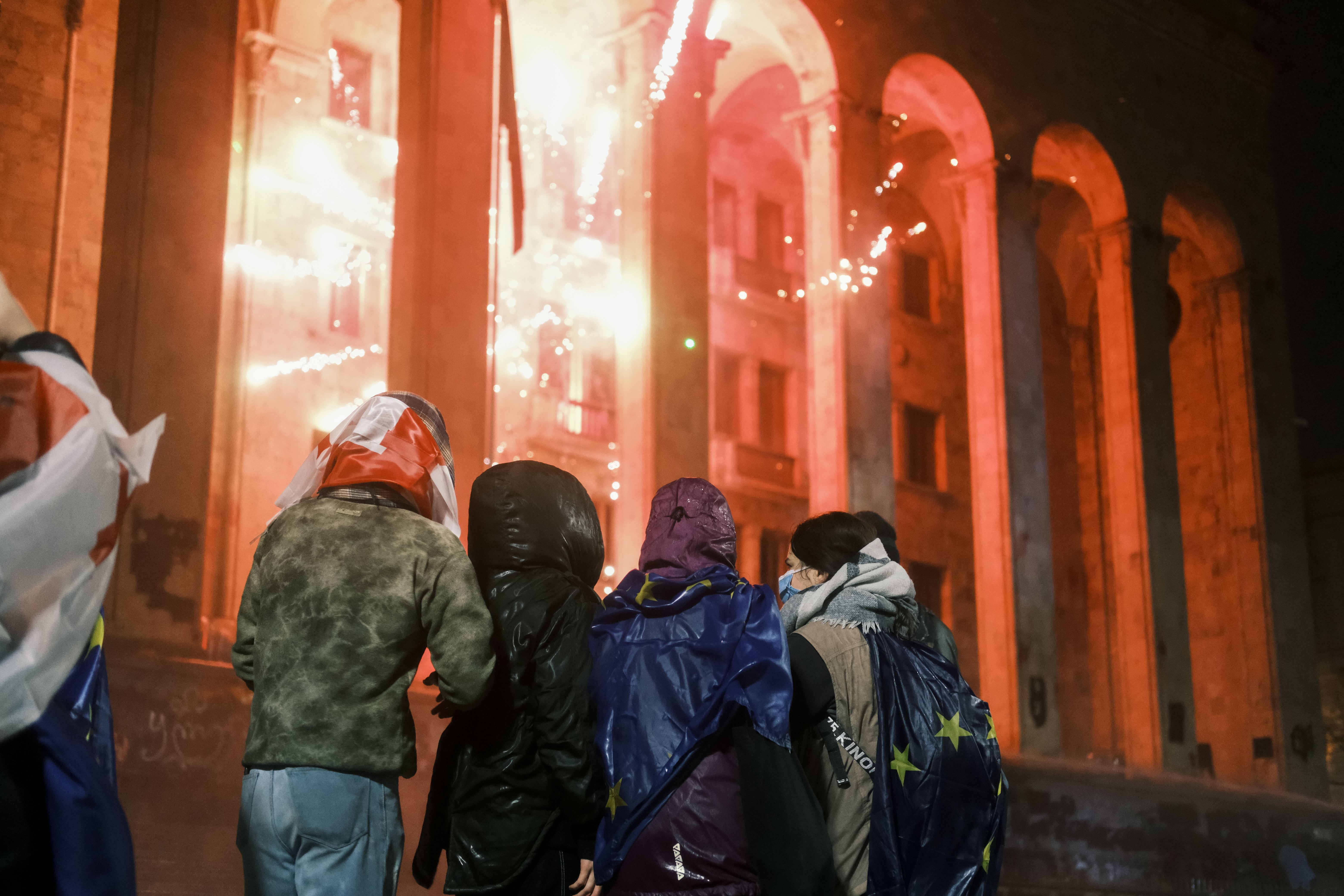
The Robocops are getting angrier by the day. Every evening, they bombard the protesters with an overwhelming amount of chemical agents—smoke grenades, gas capsules, and water from cannons that burns the skin. There’s so much gas it looks like a thick fog has settled over the avenue. Many people, myself included, are wearing construction masks and respirators—I can’t even imagine how those without protection are managing to stay here. As I run between people with saline solution, many shake their heads and show me their own bottles. The gas feels different now; it’s not just hard to breathe—it makes your head spin for quite a while after the attacks. In response to the gas, Georgians started using fireworks. At first, they launched them at the Parliament building, then began “firing back” at the security forces.
This doesn’t happen all the time. Usually, in the evenings, when people are just starting to gather, the protest remains peaceful. But you never know when the crackdown will begin. During one quiet moment, I walk close to the Parliament and notice a familiar flag with the insignia of the “Georgian Legion,” which fights in Ukraine. I approach it, and the flag is being held by Zurab—he lost both legs after stepping on a mine in the Kharkiv region. We manage to exchange a few words in a mix of Ukrainian and Georgian. I thank him, and he smiles warmly, saying, “This is our shared enemy.” Then the crackdown begins, and I lose sight of Zurab.
The arrests grow harsher with each passing day. Robocops have started detaining even random passersby. Titushky—just like the ones from the Maidan—have appeared. At night, protests are dispersed on the streets, while during the day, people are beaten near their homes or offices, with waves of arrests taking place. The titushky also show up at protests, and when they start beating people, the police simply stand by. They don’t react to cries for them to stop the violence. On 4 December, titushky fractured the skull of Kobe Khabazi, another fighter from the Georgian Legion, in the main office of the “Akhali” party. A week later, he was back on the streets with his head bandaged. The violence from the authorities isn’t working as a method of intimidation—the more people are injured or detained, the more take to the streets.
Georgian Legion fighter: Miro
The fighters of the Georgian Legion were ready to return to Georgia (Sakartvelo) in full force, but President Salome Zourabichvili stated that this would lead to military escalation by the illegitimate government. One of the most well-known fighters of the Legion, Miro Vanadze, moved from Georgia (Sakartvelo) to Ukraine in 2018 to train as a professional MMA fighter.
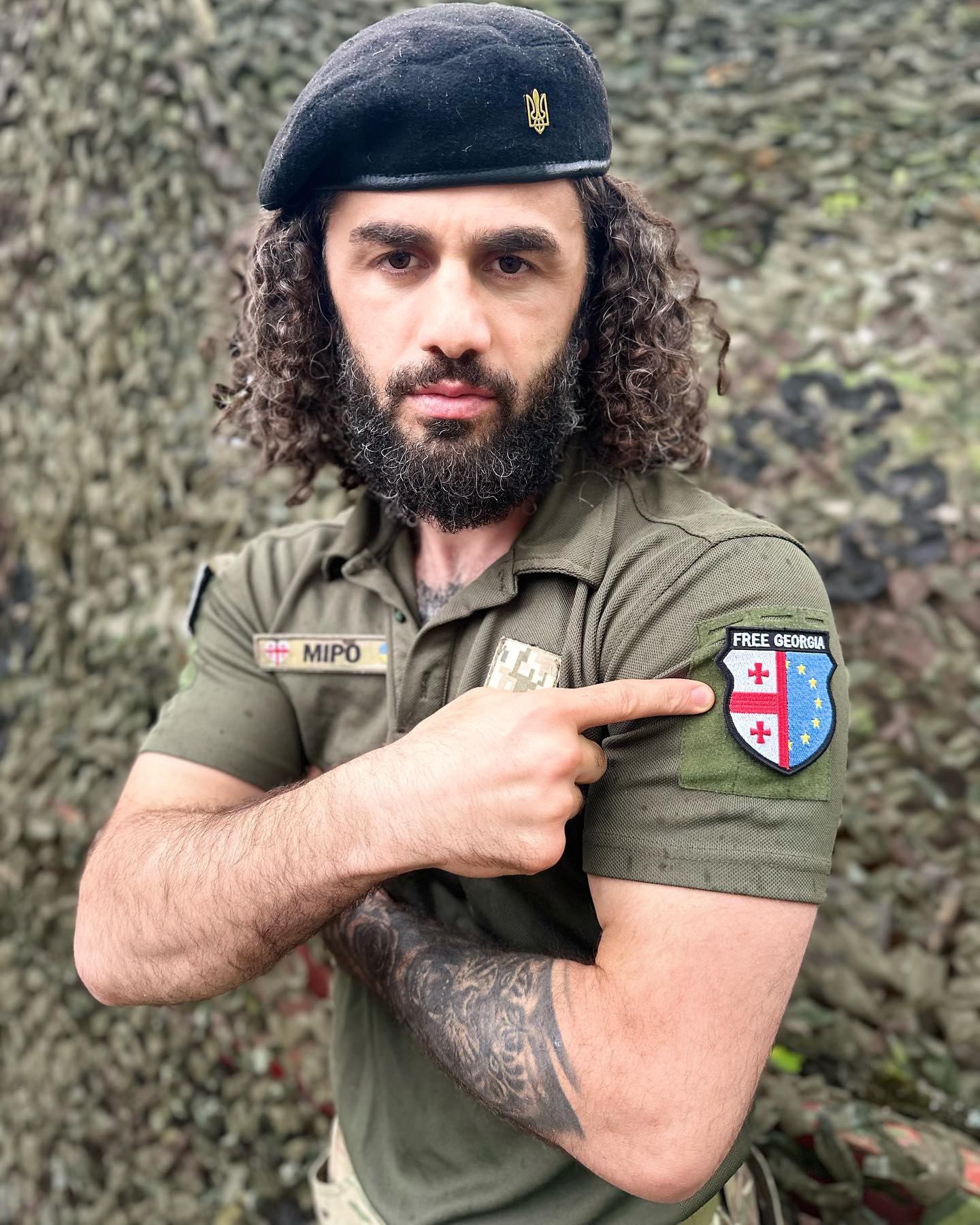
Miro became a two-time world champion in mixed martial arts under WGFC and the president of the International Assembly of the Georgian People. At the start of the full-scale war, he baked free Georgian shoti bread for Kyiv residents, then helped with evacuations and joined the Georgian Legion as a fighter. He is currently undergoing rehabilitation in Kyiv. He shared his thoughts on the protests in Georgia (Sakartvelo) and the war in Ukraine:
“Ukraine has become my second home. When the war began, I didn’t hesitate to join the Legion. I believe this: when your country is at war, a man’s conscience should not allow him to hide while others die in battle. I’m proud to have taken part in liberating Kyiv Oblast—I was in Irpin and Bucha. Russian terrorists killed countless civilians there, people who had no connection to the military. These were simply residents of Bucha, lying dead in the streets with their hands tied. It’s a true genocide of the Ukrainian people.
When I went to war, I knew what Russian scum were capable of. Sakartvelo experienced the same in 1992-1993 and in 2008—the scenarios are identical. I’ve heard stories of how, in Sukhumi, Russian soldiers cut off a Georgian fighter’s head and played with it like a ball, how they raped 13-14-year-old girls. In 1992, the Russians killed my uncle while he was a prisoner. Back then, it wasn’t possible to document and share Russian crimes as widely as we can now, but today the whole world sees what Russia is capable of.
We have a common enemy. More than 100 Georgians have already given their lives for Ukraine. Just as we’re fighting now, Ukrainians helped us fight in Abkhazia—fighters from UNA-UNSO (Ukrainian National Assembly – Ukrainian People’s Self-Defence) stood with us. I defended Kyiv alongside one of those fighters. Thirty years ago, he helped my country, and now I’m helping his. It was a great honour for me to fight alongside him.”
When the protests began, Miro wanted to return to Georgia (Sakartvelo), but he currently cannot leave Ukraine. Moreover, he says he learned from acquaintances that he is on a list for arrest due to his stance and participation in the Georgian Legion. From Ukraine, he continues to speak out about the situation in Georgia through his social media and various media appearances:
“I feel pain for my country. This so-called government is doing everything it can to sever ties with Europe and align with those who occupy 20% of our land, who killed our people. As the president of the International Assembly of the Georgian People, on behalf of all its members, I do not recognise this government.
This pro-Russian regime is terrorising Georgians. I look with pride at how protests are taking place not only in Tbilisi but also in Zugdidi, Kutaisi, Batumi, Gori, and many other cities. I also see Ukrainian women joining our rallies—I am deeply grateful to them.
I believe in my country, in my people. I see thousands of people fighting for freedom. Together, we will win—Ukraine and Sakartvelo. Our histories are very similar; we’ve constantly fought against this cursed empire. And we will continue to fight—both on the frontlines here and on the streets of Sakartvelo. Our countries will undoubtedly become EU members.”
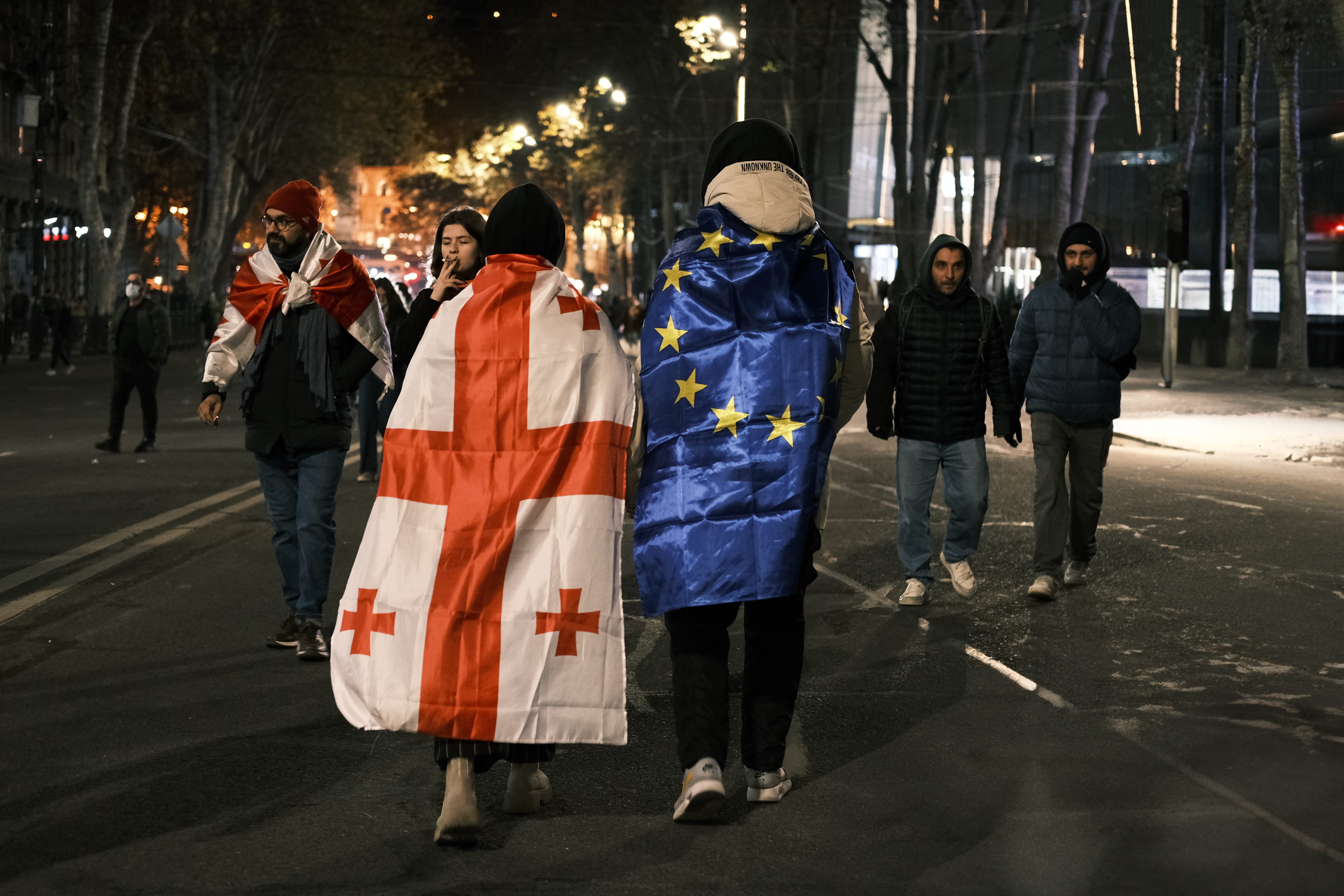
The first ten days of protests were truly a battle. The authorities tried everything to drive people off the streets, but they failed. With every act of violence, more and more people joined the protests. Now, fireworks explode far less frequently, and the protesters have shifted into a marathon phase—everyone is prepared for a long fight for their freedom.
During the day, some buses return to Rustaveli Avenue, but most of the avenue has been blocked off for over 20 days. Cafes have removed their outdoor tables—half of them were dismantled to build barricades. The theatre doors bear marks from rubber bullets, and the windows of nearby buildings are shattered. City workers try to scrub away the endless graffiti on the walls, but it’s futile—everyone knows what’s hidden under the black squares, and new slogans keep appearing beside them.
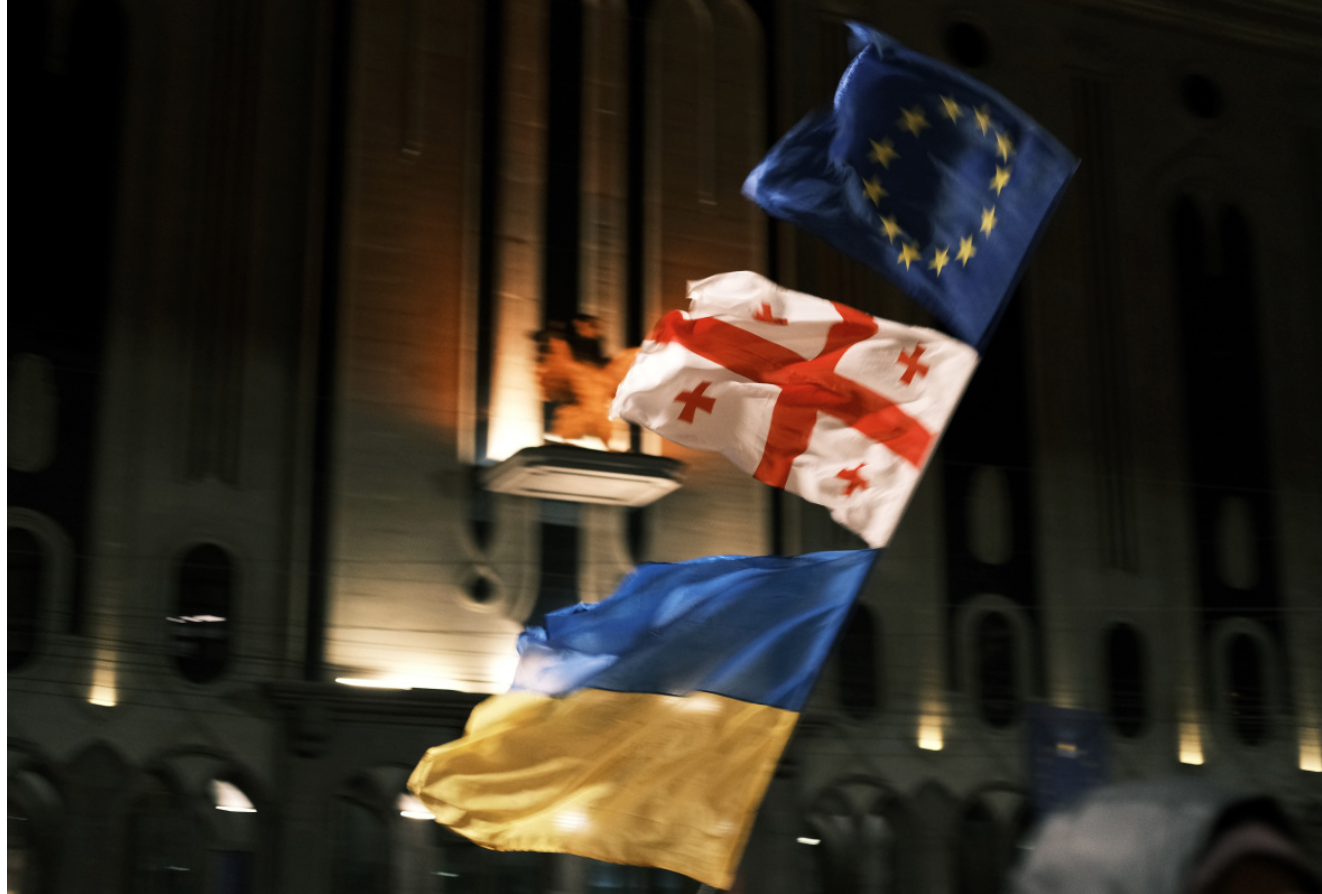
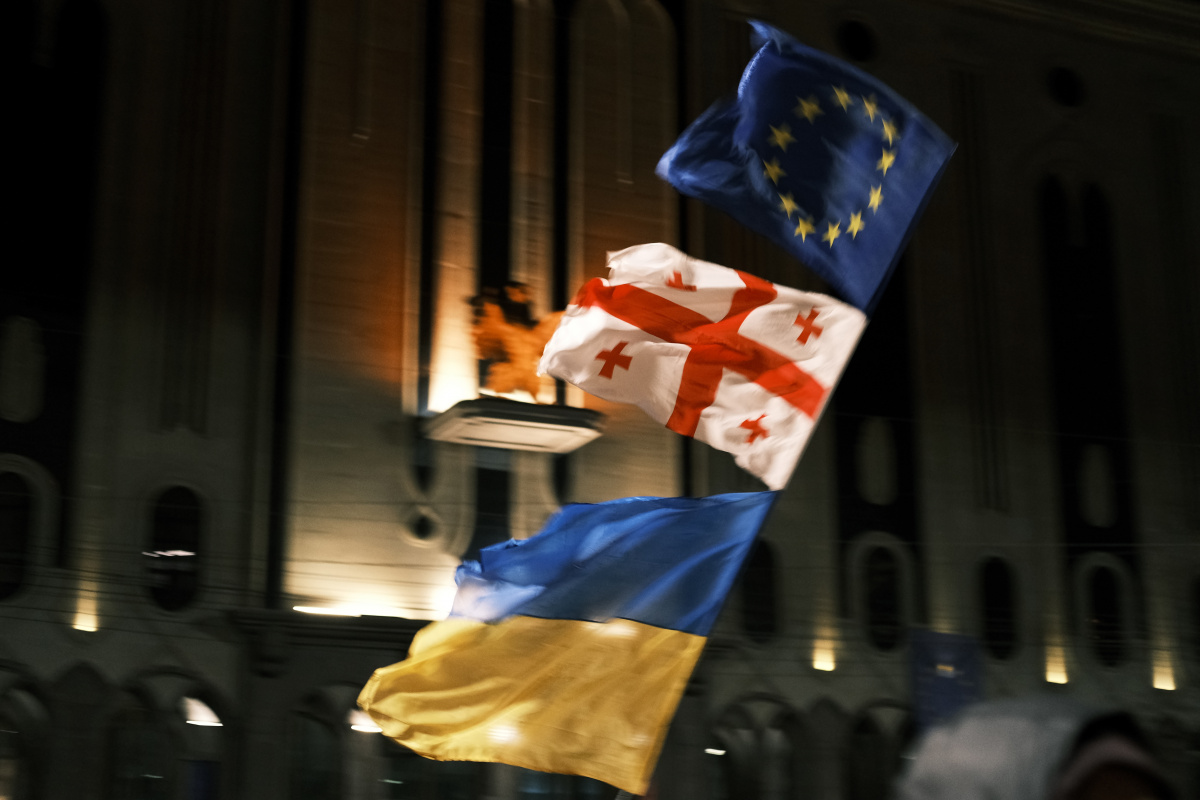
Every day, different marches take place—union marches, regional marches, student marches. They all end at Parliament, merging into one large, continuous protest. By evening, Rustaveli settles into its now-familiar rhythm: protesters gather, surrounded by people waving the flags of Georgia (Sakartvelo) and the European Union
Ukrainian from Crimea: Sofia
Rustaveli has become a city within a city. A medical station in a red tent is run by volunteers. Near the Opera House and closer to the metro, hot tea is distributed every evening, and soup is served near the hotel. While waiting in line for hot tea—it’s already below freezing in the evenings—I hear Ukrainian. Several Ukrainian women are volunteering at this station. In fact, many Ukrainians living in Georgia (Sakartvelo) attend the protests almost like going to work. One of them is Sofia Atamanova, who was born and raised in Crimea. After the war began in 2014, her family made a principled decision not to leave the occupied peninsula—they didn’t want to surrender their home to the occupiers. At home, they always spoke Ukrainian, a flag hung on the wall, and a bust of Taras Shevchenko stood nearby. A few years later, Sofia moved to Kyiv but regularly visited her mother and brother. When the full-scale invasion began, her mother finally fled to Kyiv, her brother joined the Ukrainian Armed Forces, and Sofia moved to Georgia (Sakartvelo):
“The first thing I saw in Sakartvelo was a huge number of Ukrainian flags. I remember just standing and crying that first day. I felt like I had come home. Whenever Georgians heard Ukrainian, they would immediately shout, ‘Slava Ukraini!’Almost everyone here has experienced their own war. When Georgians find out I’m Ukrainian, they start sharing their stories about Abkhazia. Over nearly three years, the level of support from people hasn’t changed. I always feel this support. But the Sakartvelo government has done almost nothing to help us. They provided temporary housing at the beginning of 2022 but suddenly evicted everyone soon after. All the aid Ukrainians receive comes from independent foundations and volunteers.
I don’t need assistance because I work in IT, so I immediately started helping those who arrived from Ukraine. I volunteered at humanitarian aid distribution points and later assisted in houses rented by volunteers for displaced people. I helped Ukrainians adapt and find jobs. Then I began creating content for social media. One day, I went to record the story of a woman from Mariupol whose son had died in captivity during the Olenivka (Yelenivka) terrorist attack. Later, she called me and said she needed to travel to Ukraine to take a DNA test—without it, she couldn’t reclaim her son’s remains. She just asked me to find tickets for her. I wanted to pay for them myself, but a Ukrainian foundation helped her instead.”
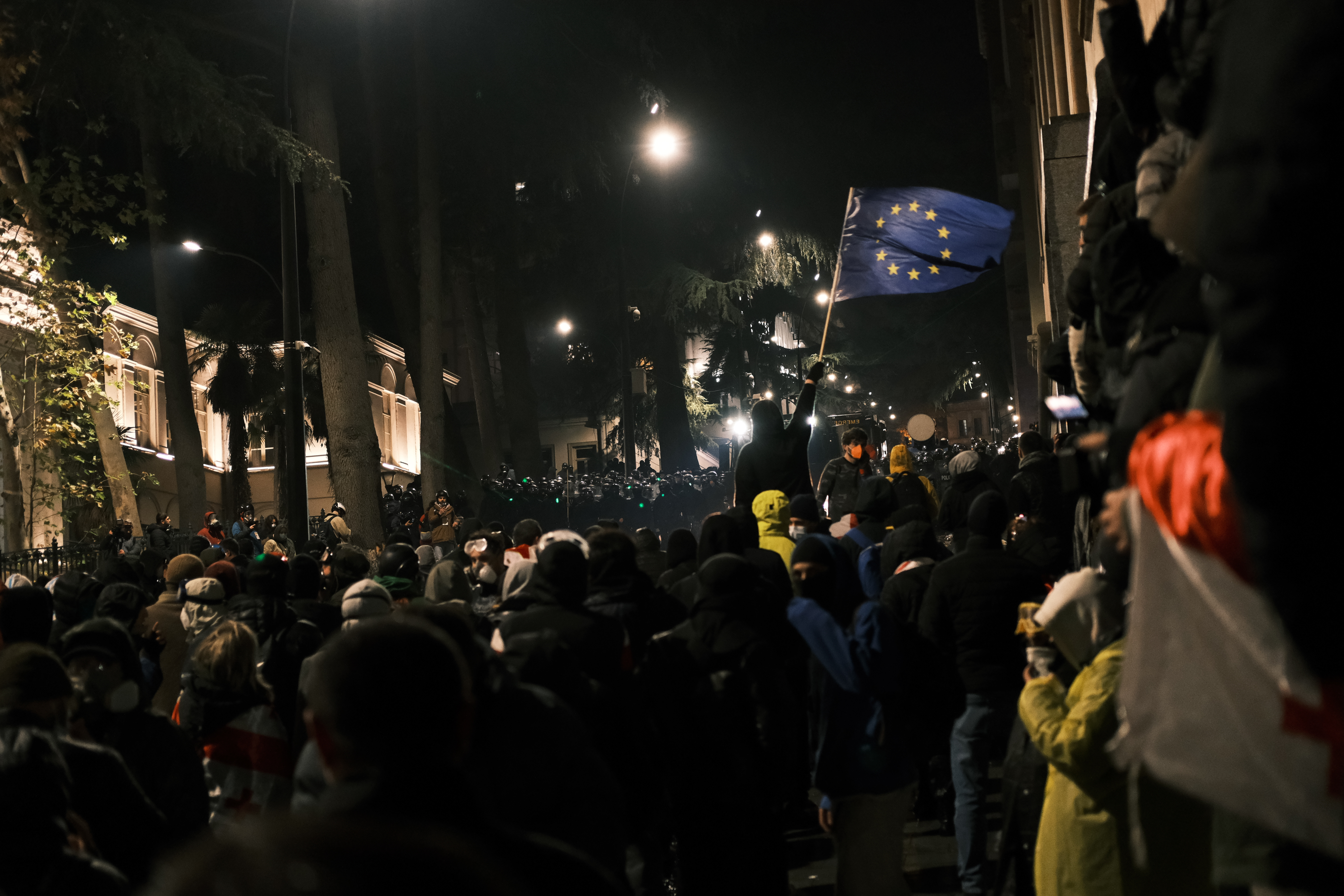
Sofia didn’t only help Ukrainians forced to flee the war. When protests against the foreign agents’ law began in Tbilisi in 2023, she took to the streets to support the Georgians. Having previously worked in photography, she decided the best way to help was by documenting the protests and the violence from the authorities:
“I went out to photograph all the protests that happened here. After posting my first photos, I realised that people from different countries wanted to know what was happening in Sakartvelo. The more interest, the more support. I remember a moment when protesters were trying to get onto the Parliament grounds through a side gate—I was photographing everything. We were hit hard with tear gas that day. A few days later, there was a situation where two priests stood between the police and the protesters. Riot police began advancing, and they sprayed one of the priests directly in the face with pepper gas. That was the moment when I truly started feeling scared.”
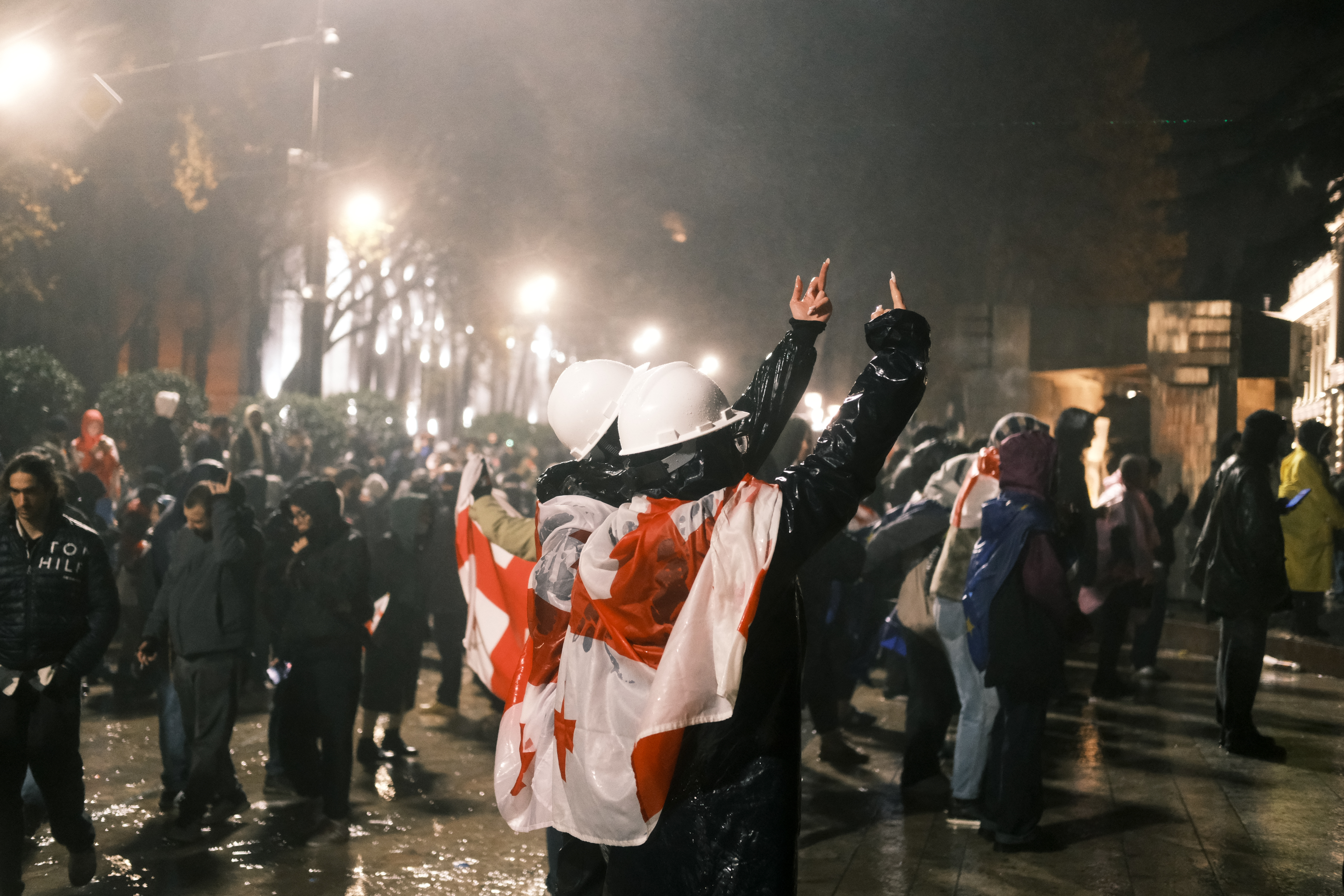
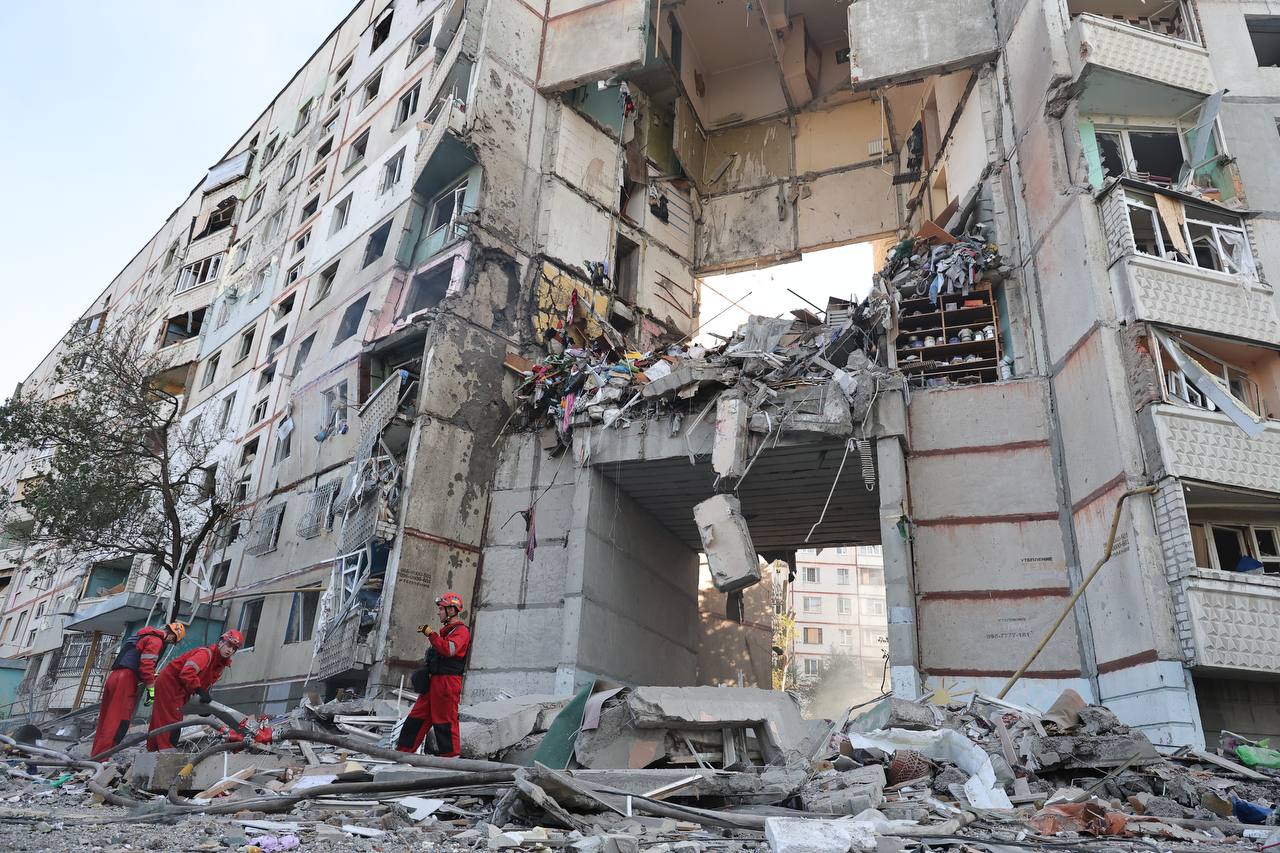
In Crimea, I didn’t experience violence from security forces. At the start of the war, I was only 16, and after that, nothing like protests happened in Crimea—just reinforced concrete occupation. However, I have firsthand experience of how deeply Russian propaganda affects people. In Sakartvelo, I see very similar methods being used to influence the population. In 2014, in Crimea, people were manipulated into believing that if we didn’t choose Russia in the referendum, a war would start. Here, “Georgian Dream” is doing the same thing. During their election campaign this year, they used photos of bombed-out houses in Ukraine with the caption: “If you don’t choose us, Sakartvelo will have war.” Many Georgians were genuinely frightened. Taxi drivers often tell me that if Georgia chooses Europe, war is inevitable, but if we restore relations with Russia, we’ll be safe. And taxis are the best way to understand what’s happening in a country and what people believe.
In 2014, Russia took my home; in 2022, it forced me to flee Kyiv under shelling; and now, this empire is trying to drive me out again, but this time from Sakartvelo. It’s clear that Ukrainians will be pushed out if the ruling party stays in power. Compared to last year’s protests, it’s truly terrifying to go out now—every day feels like a real fight.
On the very first day, I found myself in the middle of the crowd. Rustaveli is a straight and relatively narrow avenue, and at one point, I felt like the crowd was carrying me along. We were hit with tear gas, and everyone was choking. People were literally collapsing to the ground from inhaling so much gas. We made it to the Opera House, where we could finally catch our breath. I ran into the landlord of the apartment I’m renting here—he’s over 80! He told me that while his age no longer allows him to be in the thick of the protest, on 9 April 1989, he was in the front lines.
The security forces have become harsher, and the amount of tear gas has increased significantly. They’re mixing some kind of chemical into the water used by the cannons. My friend and I were hit by a water cannon once, and the white soles of his sneakers turned green afterward. If I get arrested, at best, I’ll be deported. But I will continue to stand with the Georgians and document what’s happening. When you’re there, you feel such unity, such strength. Georgia has become my second home. I feel like no one in the world loves Ukrainians as much as Georgians do. We have so much in common in our histories—our countries know what war is, what occupation is. When I feel scared to go to a protest, I always remind myself that my brother is on the frontlines right now, fighting for our freedom—how can I not protest in Sakartvelo? Both here and in Ukraine, we are fighting the same enemy.”
Police officers, officials, and journalists from propaganda channels are abandoning their positions. Georgia’s (Sakartvelo) two largest banks have joined forces, allocating five million lari to support businesses and those affected. Small and medium-sized businesses are refusing to collaborate with the Tbilisi City Hall, removing themselves from the list of participants in the city’s Christmas market. In response, activists are compiling lists of these businesses so people can support them with their purchases. Theatres have closed, concerts are being cancelled—Georgians are buying tickets to events that won’t take place.
The Robocops and police are currently just standing on Rustaveli Avenue. It seems the authorities hope the protests will die down if they don’t actively disperse people. But the demonstrations aren’t limited to Tbilisi—protests continue across all of Georgia (Sakartvelo). ბრძოლას ყოველთვის აქვს აზრი – “The fight always has meaning.”
According to Georgian human rights advocates, over 450 people have been detained so far, and approximately 300 of them have been subjected to torture by security forces.
Supported by Mediaset.
The past year in Georgia has been marked by an unprecedented number of physical and verbal attacks on the opposition, CSOs and media representatives, and activists. The ruling Georgian Dream party has subjected the active part of the Georgian society to systematic repression, carried out both by official state bodies and by thugs, who attack activists not only during the violent dispersal of rallies, but also during the day, in their homes and offices.
Repression intensified after what local observers described as rigged parliamentary elections on 26 October, and became even more brutal after popular protests began following Irakli Kobakhidze’s announcement on November 28 that the government would halt EU accession negotiations until 2028.
According to our count, at least 11 members of the opposition have been beaten this year; there are multiple reports of attacks on activists, and the exact number is unknown. The Public Defender reports that at least 85% of those detained from November 28 to December 6 were physically abused.
The Public Defender’s Office has described the actions of the riot police as ‘acts of torture’, while the Georgian Young Lawyers’ Association (GYLA has stated that the systematic and violent repression of the civilian population should be considered a crime against humanity, which may be grounds for an application to the International Criminal Court. Human rights observers said that the police’s inhuman and degrading treatment of the demonstrators is criminal in nature and amounts to torture.
According to Transparency International Georgia, from November 28 to December 6, more than 400 people were arrested – more than 350 people on administrative charges and 26 people on criminal charges. Of these, more than 300 reported being physically assaulted and/or tortured. More than 80 detainees have been hospitalized. Of the detainees, 7 are foreigners. Punished policemen – 0.
Based on the official statistics from the Minister of Internal Affairs, from November 28 to December 8, more than 30 individuals were detained on criminal charges. 372 were detained on administrative charges, of which 62 have already been subject to administrative imprisonment. More than 100 people were fined.
Based on Mediachecker’s count, from November 28 to December 6, during the pro-EU protests, more than 80 incidents of interference with the journalists’ professional duties were reported. Several journalists, including Guram Rogava, Lekso Keshelashvili, Mariam Gaprindashvili, Maka Chikhladze, and Giorgi Shetsiruli, were subjected to targeted physical assault by either riot police or thugs, requiring medical assistance and surgery. In numerous cases, journalists were verbally abused by riot police, and some of their equipment was damaged or confiscated.
We have created this blog to keep you updated on cases of intimidation, violence, and threats.
December 29
The police have released all six citizens detained earlier in the day a rally near the parliament following Mikheil Kavelashvili’s inauguration – they were arrested for administrative offenses at 2:30 p.m. on December 29. The police claimed that the citizens were not obeying their lawful orders and were illegally blocking the road for vehicles. Human rights activists and eyewitnesses spoke of violence during the arrest and say there was no blocking of street.
Several protesters have been detained at Rustaveli avenue, not far from the Parliament building. The witnesses say the police detained them without any reason, as they were not blocking the traffic or engaging in any illegal activity.
December 27
Zurab Japaridze, one of the leaders of the Coalition for Change, has been fined 2,500 GEL by the Tbilisi City Court for administrative offenses. The sentence, issued by Judge Lela Tsagareishvili, also includes a three-year ban on Japaridze’s right to carry firearms. The charges against Japaridze are based on Articles 173 and 174 prima, Part 4 of the Code of Administrative Offenses, which deal with disobeying the police and artificially blocking roads. Japaridze was detained on December 2.
Judge Zviad Tsekvava of Tbilisi City Court has fined Saba Skhvitaridze 2,500 GEL for administrative offenses, including blocking a roadway, minor hooliganism, and disobedience to law enforcement orders. In addition to the administrative ruling, Skhvitaridze is facing criminal charges for allegedly assaulting a police officer with a baton. The court hearing on these charges is pending. If convicted under Article 353 prima, part 2 of the Criminal Code, he could face 7 to 11 years in prison.
December 23
The Tbilisi City Court has found Saba Kevkhishvili guilty of a misdemeanor and issued a verbal warning. Kevkhishvili was accused of violating Article 173 of the Administrative Offenses Code, which pertains to disobedience to lawful orders from law enforcement officers. Kevkhishvili was arrested on December 1 and allegedly beaten while in custody. According to Kevkhishvili, a member of the special police unit questioned him during the arrest, asking what he was protesting. In response, Kevkhishvili showed the officer a video on his phone depicting the beating of protester Zviad Maisashvili during the demonstrations.
Sanctioned judge Nino Enukidze that was sanctioned by Estonian government, has issued a verbal warning to actor, Giorgi Bakhutashvili. He faces administrative charges of petty hooliganism and disobedience to a lawful order by the police (Articles 166 and 173). Bakhutashvili was detained in the early hours of November 30. At the court hearing, Bakhutashvili stated that: “I categorically disagree with the accusation. I arrived at the protest quite late, around 5:30 AM, and I did not hear any orders [from the police]. The only interaction I had was with a police officer who was dragging an unconscious person”. He also added that: “I did not block the road… I did not physically engage in any way. At that moment, I heard shouting behind me and was struck by an object, likely a baton. Then I was taken along the same path as the young man I had been pleading for them not to detain.”
Nika Gvaramia, one of the leader of the opposition Coalition for Change, was fined 5000 GEL [1780 USD] by Judge Zviad Tsekvava on administrative charges for blocking Chavchavadze Avenue.
The Georgian Young Lawyers’ Association (GYLA), along with other non-governmental organizations actively assisting rally participants, has issued a joint statement addressing concerns over the treatment of detainees. Nona Kurdovanidze, the head of GYLA, highlighted that representatives of special forces seized private items from arrested individuals without following legal procedures. She emphasized that the seized items were not documented during the detentions, leaving the detainees unable to retrieve their belongings or even know when they might be returned.
December 20
Eduard Sharashidze, an activist arrested on December 6 and reportedly beaten by special forces, resulting in a broken hand, was fined 2,200 GEL [782 USD] by Judge Nino Enukidze under the administrative charges for disobeying police lawful order. Merab Chikashvili, another protester, who was beaten so badly by the employees of the Special Task Department, that demonstrators initially thought he had died, was also fined 2,200 GEL by Judge Zviad Tsekvava with the same allegations.
December 19
Another activist, Gia Jvarsheishvili, who was severely beaten by riot police and arrested on December 2, has been fined 2,200 GEL [782 USD]. Jvarsheishvili revealed in court that he suffered broken ribs and recounted how black-masked officers had threatened to rape him. However, the judge Lela Tsagareishvili interrupted him, stating that such issues would not be addressed during the trial.
December 17
Representatives from the embassies of the EU, Czech Republic, Estonia, Denmark and the Netherlands attended the trial of Davit Gogilashvili, who was arrested on 30 November while buying a piece of bread on his way home. After his arrest, he was severely beaten by police officers. Following nine hours of detention, Gogilashvili was examined by a doctor and urgently transferred to the hospital due to the severity of his injuries.
December 16
The Tbilisi City Court sentenced activist Niko Managadze to four days in prison. His friend Niko Kalandadze, who was arrested with Managadze on December 13, was fined GEL 2,000 (USD 711).
December 14
According to his lawyer, civil activist Niko Managadze was detained at 22:30 as he was returning home from the rally; one person who was with him at the time of the detention, was also detained. Both of them have been transferred to the third isolator in Digomi.
According to his lawyer, the reason for the detention may be that a day earlier Managadze refused to be questioned at the police precinct and requested to be questioned in the presence of a magistrate judge.
December 13
The Tbilisi City Court’s Judge Nino Enukidze, has found actor Giorgi Nakashidze guilty of disobeying police and imposed a fine of 2,000 GEL. The court dismissed the administrative proceedings related to petty hooliganism, but found him in violation regarding noncompliance with police orders. Nakashidze was arrested on December 3 on Rustaveli Avenue. He was accused of committing acts under Article 166 and 173 of the Code of Administrative Offenses, which refers to petty hooliganism and disobedience to police orders.
December 12
The Ministry of Internal Affairs has detained G.K., born in 1998, charged with group damage to Property. MIA claims that on December 4, G.K., along with accomplices, vandalized “seven surveillance cameras belonging to the Public Safety Management Center 112.” The charges fall under Article 187 of the Criminal Code, with a potential sentence of up to six years in prison. The investigation to identify and apprehend other individuals involved is continuing.
December 10
Tbilisi City Court has sentenced Lasha Gogebashvili to 7 days of administrative imprisonment. While the petty hooliganism charges against him were dropped, he was found guilty of disobeying police orders. Additionally, Nika Svanidze was partially found guilty but received only a verbal warning. The court also issued verbal warnings to Tornike Berishvili, Davit Okruashvili, and Beatris Gazdeliani. The detainees were charged under Articles 166 and 173 of the Administrative Offenses Code, which deal with petty hooliganism and disobedience to police orders.
11 Georgian CSOs released information about the arrested demonstrators from November 28 to December 9. According to the data, over 450 individuals have been arrested in connection with recent protests, including approximately 430 on administrative and 31 on criminal charges. More than 300 protesters have been subjected to violence or ill-treatment, with over 80 requiring hospital treatment. Detainees face overcrowded conditions, lengthy wait times in police vehicles, and limited access to legal representation.
MIA detained 1 Person (V.T.), for group violence. The crime carries a potential sentence of up to 6 years of imprisonment. that the accused participated in group violence during the ongoing actions on Rustaveli Avenue, did not obey law enforcement officers, and threw various objects in their direction. The case is being investigated under Article 225, Part 2 of the Criminal Code.
Doctor Giorgi Akhobadze has been remanded in custody on drug-related charges for two months. The decision was made by Tbilisi City Court Judge Lela Maridashvili during today’s hearing. The prosecutor Shmagi Gobejishvili alleged that Akhobadze illegally acquired over 3 grams of “alpha PVP” and claimed there are risks of him committing new crimes, destroying evidence, or fleeing. Akhobadze was arrested on December 7 following a protest on Rustaveli Avenue. He is charged under Criminal Code Article 260, Part 6 for illegal drug acquisition and possession, which carries a potential sentence of 8 to 20 years or life imprisonment. The judge, Lela Maridashvili rejected the defense side’s proposed bail of 30,000 GEL and political figures (including Zurab Japaridze) offers as guarantors. The defense, represented by lawyer Lasha Tsutskiridze, contested the charges, claiming the arrest warrant and detention protocol are illegal and lack video evidence. Akhobadze denies the charges and is on a hunger strike. Akhobadze suggests his arrest is politically motivated, connected to his civil and political activism.
Nona Kurdovanidze, the Chairperson of GYLA, stated that the NGOs’ hotline received calls last night in Tbilisi, reporting the possible detention of 10 people. Among them, one person is reported to have been detained on criminal charges.
December 9
The Adjara Police Department of the MIA arrested five people for group violence in Batumi. They face 2 years in prison for violating the first part of Article 126 prima of the Criminal Code. According to the police, during the December 3 protest, a group of demonstrators entered the Batumi University of Arts to hang a banner near the rector’s office, but were prevented from doing so by a lecturer at the same university. As a result, the dean of the same university verbally abused the lecturer. The investigation also revealed that the dean and his students later physically assaulted the lecturer’s wife and her friend in the university building.
The Tbilisi City Court sentenced 18-year-old activist Sandro Kinkladze to 12 days in prison for disobeying police orders. He was arrested on December 8 on the street after visiting a friend. According to him, some of the police who arrested him weren’t wearing uniforms.
Zviad Ratiani was released from the temporary detention facility after serving an 8-day sentence. He was charged by Tbilisi City Court under articles 166 and 173 of the Administrative Offences Code of Georgia, which refers to petty hooliganism and disobedience to police officers.
Saba Chankvetadze, a peaceful demonstrator who was arrested on December 2 and beaten so severely that he had to be taken to a medical center for treatment, was fined 2200 GEL for petty hooliganism (Article 166) and disobeying a lawful order (Article 172). Another demonstrator, Luka Kotiashvili, was also subjected to police brutality, beaten in a police car, resulting in serious head injuries, got fined 2000 GEL on administrative charges of disobeying lawful orders.
Police in Adjara have arrested five individuals in connection with a group violence incident at the Batumi Arts University on December 3, following the pro-EU protests. According to the Interior Ministry, the detainees attempted to hang a banner near the rector’s office, which led to a series of confrontations involving university staff and students. All five suspects were detained based on a court warrant. The ages of the detained range from 19 to 45 years old. The investigation is ongoing under the Criminal Code’s article related to group violence, with potential prison sentences of up to two years.
December 8
Deputy Minister of Internal Affairs, Aleksandre Darakhvelidze held a briefing and announced the official numbers of detainees. Darakhvelidze said that 372 individuals have been detained under the Administrative Offences Code of Georgia and legal proceedings have been initiated, of which 62 individuals have already been subjected to administrative imprisonment.
“From November 28 until today, more than 30 individuals have been identified and prosecuted under the criminal code of Georgia”
Administrative fines have been imposed on more than 100 individuals as a form of punishment. “Court hearings are actively continuing for the remaining individuals” – he added.
A Tbilisi City Court judge has ordered pretrial detention for activist Revaz Kiknadze. He has been on a hunger strike for three days and required medical aid during the process hearing. He is accused of organizing, leading, and participating in group violence. According to Kiknadze’s lawyer, police officers attempted to coerce him into giving false testimony. “He was taken to Lisi [Lake] and assaulted there. In his words, the police officers have threatened him by saying: ‘We’ll bring a tractor, dig a hole, and bury you here. Tell us everything and name the people involved. We know you were being paid 500 GEL daily”. The activist detained on December 6 for his participation in pro-EU demonstrations, handed over a letter from the detention center stating that he is being forced to testify in court that he received money and orders from opposition leaders Zurab Japardze, Elene Khoshtaria, Nika Gvaramia, and others, which he refused to do.
“Giorgi Akhobadze, who was detained during the protest, has begun a hunger strike. This information was shared by Zurab Japaridze, one of the leader of the “Coalition for Change”. According to his information, Giorgi Akhobadze claims that drugs were planted on him, which is why he declared a hunger strike in protest. According to the available information, Giorgi Akhobadze has been arrested under Article 260 of the Criminal Code of Georgia, which refers to the “illegal manufacture, production, purchase, storage, transport, transfer or sale of drugs, their analogs, precursors or new psychoactive substances” and carries a prison sentence of 8 to 20 years.
Tbilisi City Court held a hearing for detainees, among which were the participants of Public Broadcaster of Georgia’s project, “Bookshelf”. The Judge released Nika Beridze and Tengo Svanidze with a verbal warning, while Sandro Metreveli was fined 2,300 GEL. Nika Beridze recalled the moment of his detention with IPN, stating that: “I was standing on the sidewalk when, without any warning, about 10 individuals approached us quickly. Their aim was to detain someone. I did nothing wrong”. He also added: “The police presented testimonies that were inconsistent with each other. As a result, the judge released me from the courtroom with a verbal warning”.
Nino Lominadze, the lawyer of another detainee, Sandro Metreveli, stated that he had injuries and was being “physically assaulted during the arrest”. As she said, Metreveli is accused of “resisting police and committing petty hooliganism”.
On December 7, the journalist and TV presenter of Mtavari Arkhi, Beka Korshia was detained on felony charges. One day later, the Tbilisi City Court fined him 2,200 GEL. Korshia recalled his detention process, stating: “The police officer confirmed in court that he recognized me, and that was ultimately the reason he decided to detain me. Mostly, the discussion revolved around my reports — why I was doing them, why I called this person, or why I called that person”.
December 7
In another case of targeted violence on journalists and the opposition took place, titushky (government-paid thugs) raided the office of the opposition Coalition of Change alliance on Besiki Street and beat up its members – Koba Khabazi and Data Petridis.
The titushky attacked TV Pirveli journalist Maka Chikhladze and a cameraman, Giorgi Shetsiruli on Besiki street, adjacent to Rustaveli avenue. The witnesses say the patrol police who were nearby, had no reaction to the violent attack, and left together with titushky. The footage taken minutes before the incident shows smooth coordination between the police and titushky as they apparently discuss the course of action, with police cars blocking the way into the street while giving way to titushky to enter freely.
Tbilisi City Judge Tamar Mchedlishvlii sentenced actor Andro Chichinadze, comedian Onise Tskhadadze, Zviad Tsetskhladze, Andro Chichinadze, Jano Archaia, Luka Jabua, Guram Mirtskhulava, Ruslan Sivakov to two months’ pre-trial detention, was followed by a protest by actors who gathered near the City Court building.
December 6
Tbilisi City Court Judge Lela Maridashvili sentenced Saba Skhvitaridze, a member of the opposition Coalition for Change, to pre-trial detention. Skhvitaridze is charged with the second part of Article 353, which refers to harming the health of a police officer during his official duties. The next hearing in the case will be held on January 28. During the trial, Saba Skhvitaridze stated that he had been abducted and tortured. According to him, during the arrest the police did not even explain to him why they were detaining him, but simply handed him over to an unknown operational group in the Gori region.
Tbilisi City Court Judge Irakli Khuskivadze sentenced eight members of the Dafioni organization to pre-trial detention on charges of organizing, leading and participating in group violence. The detainees are: Zviad Tsetskhladze, Vasil Kadzelashvili, Vepkhia Kasradze, Irakli Miminoshvili, Insaf Aliyev, Tornike Goshadze and Giorgi Giorgadze.
Three of the defendants – Zviad Tsetskhladze, Vepkhia Kasradze, and Vasil Kadzelashvili – are accused of organizing and directing group violence. They face 6 to 9 years in prison.
Five of the defendants – Irakli Miminoshvili, Insaf Aliyev, Tornike Goshadze, and Giorgi Giorgadze – are accused of participating in group violence. They face between 4 and 6 years in prison.

Aleko Elisashvili, one of the leaders of the opposition coalition Strong Georgia, was sentenced to two months in pre-trial detention by Tbilisi City Court Judge Tamar Mchedlishvili. Aleko Elisashvili is charged under Article 156, Part 2, Subparagraph “a” of the Criminal Code of Georgia, which provides for up to three years’ imprisonment.
Nika Gvaramia, one of the leaders of the opposition alliance Coalition for Change, was sentenced to twelve days’ imprisonment after being charged with violations of Articles 166 and 173 of the Code of Administrative Offences, including petty hooliganism and disobeying a lawful order of a police officer.
The case took a dramatic turn when Gvaramia was unexpectedly transferred from Marneuli Detention Center to Tbilisi City Court without prior notification to his lawyer or family. Following his request for legal representation, the judge called for a break. Gvaramia’s lawyers subsequently requested a postponement of the trial, arguing that they had not been given access to the court records, which had reportedly been provided by the Ministry of Internal Affairs hour before the trial. Despite these concerns about the fairness of the trial, it went ahead.
Gela Khasaia, a member of the Coalition for Change opposition alliance, who was arrested on 4 December during a police raid in the office of the opposition party Droa, has been released on parole.
Aleko Elisashvili, one of the leaders of ‘Strong Georgia’, has been transferred back to Dusheti detention facility after receiving ambulatory treatment at Vivamed clinic, the hospital confirmed to IPN. His lawyer, Giorgi Rekhviashvili, awaits a court hearing on preventive measures, expected later today. Elisashvili was detained on December 4 near Courtyard Marriott following an opposition meeting, in connection with alleged violence against Ali Babaev, chairman of the National Congress of Azerbaijanis in Georgia.
December 5
Police arrests a 15-year old demonstrator during the protest in Kutaisi. A video footage depicts him lying on the ground and semi-conscious after a confrontation between police and protesters. Other protesters can be heard accusing the police of using violence against a “kid”.
One of the leaders of the opposition coalition Strong Georgia, Aleko Elisashvili, has been transferred from the Dusheti detention center to the Vivamedi clinic for medical examination. The press service of the coalition told Interpressnews that Elisashvili has injuries on his face and may have a broken rib. He was physically assulted and arrested yesterday, the Prosecutor charged him for political discrimination today.
Police has detained actor Andro Chichinadze and comedian Onise Tskhadadze. The details about why they have been detained are unknown. Both of them have been actively protesting against the government’s u-turn from the EU path.
The Prosecutor General’s Office has charged one of the leaders of the opposition coalition Strong Georgia, Aleko Elisashvili, with political discrimination against Ali Babaevi, the chairman of the Georgian-Azerbaijani National Congress and one of the founders of the ruling Georgian Dream party. The Prosecutor said Elisashvili verbally and physically assaulted Babaevi on December 2. He is charged with violating the second part of Article 156 (a) of the Criminal Code (persecution of a person in connection with political activity, committed by violence) and faces up to 3 years in prison.
Nana Malashkhia, one of the leaders of the opposition Coalition for Change party was fined 500 GEL [USD 176] for blocking the road during protests near Tbilisi State University on 19 November.
The Ministry of Internal Affairs (MIA) has arrested three individuals, including a 20-year-old, on charges of organizing and directing violent group activities against police officers under the Georgian Criminal Code; the 20-year-old is accused of systematic violence against police officers, while two others, aged 25 and 31, have been charged with assaulting police officers under Article 353 Prima. These offences carry a penalty of up to 9 years’ imprisonment. The MIA is investigating various criminal acts committed by “violent groups” during ongoing protests, leading to the arrest of 9 individuals under Articles 187(Damage or destruction of property) and 353 Prima (Attacking a police officer, employee of the Special Penitentiary Service or other representative of authority or a public institution) and 8 more under Articles 225 (Organization, management or participation in group violence) and Article 239 (Hooliganism).One individual has also been arrested for preparing an explosion.
On December 5, Tbilisi police department of the Ministry of Internal Affairs said it arrested an individual, S.J., born in 2006, on charges of assaulting a police officer. The crime carries a penalty of up to 7 years of imprisonment.
The police reports that on November 30, 2024, during a protest on Rustaveli Avenue, “the accused, armed with a knife, attacked an employee of the Ministry of Internal Affairs with the intent to cause harm”. The investigation is being conducted under the first part of Article 353 of the Criminal Code. Additionally, 7 individuals have been arrested under Articles 225 and 239 of the Criminal Code, which relate to organizing, leading or participating in group violence and publicly inciting violent actions. One person was also arrested for preparing an explosion.
December 4
In front of the Marriott Hotel on Freedom Square, mobilized thugs attacked opposition leaders who were meeting at the hotel to discuss their plans of action following the police raids earlier in the day. During the physical confrontation, the police joined the thugs in their attack and arrested the athlete and one of the leaders of the opposition party Ahali, Zurab Davitashvili.
Police also arrested one of the leaders of the “Strong Georgia” coalition, Aleko Elisashvili, for allegedly assaulting Ali Babaevi, the chairman of the Georgian-Azerbaijani National Congress. Babaevi claimed yesterday that Elisashvili had verbally and physically abused him, forcing him to be hospitalized.
During the confrontation the police damaged the camera of TV Pirveli.
Following police raids on opposition offices and activists’ homes, Georgian citizens took to the streets in protests in four major cities – Tbilisi, Batumi, Kutaisi and Zugdidi. The situation in Tbilisi quickly became tense, with police waiting for demonstrators in metro stations, searching them and taking away their gas masks and other protective equipment. Two people have already been arrested after a physical confrontation in front of the Freedom Square metro station.
- 04/12/2024 – Police Raids, Arrests Opposition, Activists
Several members of the Unity-UNM youth organization have been arrested, but the charges for their detention are not yet known. Arrested individuals include: Davit Gedenidze, Vakhtang Gagnidze, Irakli Ardia, Saba Birkaia, and Mishiko Janikashvili.
One of the leaders of the opposition alliance Coalition for Change Nika Gvaramia and Gela Khasaia of the same coalition have been arrested by the police.
Police initiated a search of the home of Ilia Ghlonti, a leader of the public group “Daitove.” The group has been prominent in mobilizing protest movement on social networks. Police have charged him with “organization or management of a group activity accompanied by violence, raids, damage, or destruction” and participation in disorder. Notably, the search began before Ghlonti’s lawyer arrived at the scene.
The Ministry of Internal Affairs (MIA) has arrested a 42-year-old man for “intentionally damaging a video surveillance camera in Mziuri Park” after leaving the protest on Rustaveli Avenue; If convicted, he will be facing up to five years in prison. The individual has been charged under Article 187 of the Criminal Code of Georgia, which pertains to the damage or destruction of property.
Public Broadcaster journalist Giorgi Chagelishvili has been fined 2,000 GEL (697 USD) after being arrested during the dispersal of a rally near Metro Rustaveli on December 2. Despite Chagelashvili stating that he was carrying out his professional duties, the police proceeded with his detention.
December 3
Prime Minister Irakli Kobakhidze commented on the decision of some civil servants to leave their jobs after the GD’s U-turn from the EU path, saying that these people were the “last resource” of the “foreign agents” and their patrons, which they were saving for this moment in order to use it to start “UNM’s Maidan”. He explained that even this attempt was unsuccessful and that the people who had called on the officials to resign were now calling on them to stay in their jobs. “The self-cleansing process has been very interesting, of course we’ve been watching everyone’s actions, and we’re going to react to everyone’s actions. This reaction will be in accordance with the Constitution and the law, but there will be a reaction, I say this with full responsibility,” Prime Minister Kobakhidze said.
MIA arrested a 25-year-old demonstrator on charges of preparing an explosion, which is a violation of the first part of 18-229 (e) prima of the Criminal Code and provides for imprisonment up to 7 years. According to MIA, the demonstrator was first arrested for artificially blocking a road and disobeying police orders, and after the police searched him, they found so-called Molotov cocktail on him, which was submitted to eximination and the experts found traces of petroleum products.
Deputy Interior Minister Aleksandre Darakhvelidze reported that 5 demonstrators had been arrested on criminal charges of assaulting police and damaging property. Other cases of violation of Articles 187 and 353 of the Criminal Code are under investigation. As for the persons arrested for administrative offenses, their number has reached 293. Of them, the Tbilisi City Court has already sentenced 89 persons, imposed fines on 43, administrative detention on 41 and warnings on 5.
Activist Dodo Kharkheli‘s house was searched by police who took all the electronic devices belonging to her, her husband and their child, including laptops, phones, flash drives, etc. She was not arrested.
Dodi Kharkheli, a blogger and activist, was detained by the police near her child’s kindergarten. According to the reports, the police had been mobilized near activist’s home for search.
The Ministry of Internal Affairs (MIA) has arrested a 37-year-old individual facing up to 7 years in prison. The individual is charged under Article 353 of the Criminal Code for assaulting police officers and public institutions, specifically for using a Molotov cocktail against the police. So far, five people have been detained, and the MIA continues to investigate “criminal acts committed by violent groups” under Articles 187 (Damage or destruction of property) and 353 (Assault on police officers or other representatives of the authorities or on a public institution).
Alexy Tirkia was injured during the December 3 protest and is currently under medical anesthesia at Ingorokva Clinic, in a comatose state. He sustained an open scalp wound, a fracture to the frontal bone and orbital wall, and a contusion injury to the frontal lobe. His eyeballs were not damaged, but he has traumatic hemorrhage in the membranes. Despite undergoing surgery and repeated CT scans showing no negative changes, he remains unconscious and cannot recall the incident. According to his doctor, Tirkia was struck in the face by a gas capsule, likely fired by special forces. His uncle, Ioseb Chanadiri, reported that Alexey had spoken to his grandmother before losing consciousness, explaining that he was under siege, and during the conversation, his girlfriend was shot in the leg while he was hit in the eyebrow area by the gas capsule. Tirkia’s parents are both in emigration.
Lado Todadze was beaten during the protest in Batumi, with “all the cruelty of Russian malice,” recounting strikes to his head, face, and body. “They tried to make me kneel, to drag me out that way, but they couldn’t,” he said. The incident began when unrest broke out as riot police arrested a protester, causing a woman, reportedly the mother of the arrested, to faint. Todadze intervened to prevent the arrest but was seized himself, suffering head injuries during the violent encounter.
Actor Giorgi Nakashidze reported being severly beaten and detained when he tried to rescue a friend during protest dispersal.
Ioseb Babaev, the owner of an anti-occupation resto bar and an activist, was detained during a protest rally in Tbilisi, where he was physically assaulted.
Vakhtang (Vato) Gvazava, a doctor, was beaten while providing medical care to the injured protesters. Activist Jaba Zarkua reported on Facebook that the robocops not only beat the doctor, but also stole from him his cross, mobile phone and car keys.
Translator Data Kharaishvili was arrested and brutally beaten by Special Forces
during a protest. Kharaishvili shared his experience with TV Pirveli, recalling the arrest and the violence he allegedly endured at the hands of law enforcement officers in a police vehicle
Dato Abuladze, was detained by riot police during a demonstration, beaten, and is now receiving treatment at Ingorokva Clinic. According to Ekaterine Tortladze, chairwoman of the Auresi Foundation, Abuladze was at the protest with a friend when three riot police officers attacked them, took their belongings, and beat them. He was initially taken to a police station without an interpreter, despite the fact that Abuladze’s only language is sign language. Abuladze is currently being treated for bruises around his eyes, a concussion, and injuries to his legs. With the help of activists, arrangements were made for him to contact a lawyer. His rights are being defended by a lawyer from the Partnership for Human Rights.
December 2
Tbilisi City Court Judge Nino Enukidze found Shota Narsia, senior researcher for the International Society for Fair Elections and Democracy (ISFED), guilty of an administrative offense and fined him GEL 2,800 (USD 984). Narsia was arrested during the early morning dispersal of the December 1 rally. According to his lawyer, Narsia was physically abused by the police, although he did not disobey their orders.
Tbilisi City Court Judge Zviad Tsekvava sentenced poet Zviad Ratiani to 8 days in prison. Ratiani was arrested during the dispersal of a peaceful rally on November 29. He was brutally beaten during his arrest, and his medical report states that he has “a fracture of the fifth vertebra, a fracture of the nasal bone and septum, hematomas and bruises of varying severity on the head and throughout the body.” He underwent surgery this morning and is still in the hospital.
Gela Khasaia, a member of the Coalition for Change, was attacked by three thugs near his home while on the way to the rally. He was violently beaten, dragged, and verbally abused.
Lazare Maghlakelidze, a citizen who was beaten during a protest on December 2, shared his experience with media. He was detained at dawn and subjected to multiple beatings by riot police. Maghlakelidze described how the riot police waited until no journalists were nearby, then began assaulting him. Initially, two officers restrained him, but soon others joined in. They covered his head with a raincoat, and he was punched in the face by several officers. He lost consciousness during the beating and, when he regained awareness, the assault continued. He recalled being placed in a minibus with three other detainees, where they were beaten again by five special forces officers in the dark. Maghlakelidze recounted being subjected to horrific abuse, including threats and what he described as “rape with a baton.” Despite his injuries, he asked the officers to remove his blood-soaked raincoat.
Giorgi Chutkerashvili recounted being severely beaten by special forces during his detention. He was thrown to the ground, struck in the head, and threatened with death. Despite being in intense pain, the officers continued to assault him, including attempts to break his arm and finger. They also took a photo of him and questioned his involvement in organizing protests, which he denied, stating he was simply a participant.
On the night of December 2, Nodar Aroshinadze, a historian of architecture, was detained on Rustaveli Avenue in front of the Tbilisi Marriott hotel. That night, Nodar stood on Rustaveli Avenue alongside dissatisfied citizens, facing special forces. Law enforcement officers were gradually advancing, pushing the demonstrators toward Republic Square. That day, the police began dispersing the protest earlier than usual. He was severly beaten while being arrested.
On the night of December 2, anthropologist Irakli Piphia was arrested on Rustaveli Avenue in front of the Tbilisi Marriott Hotel. Earlier in the day, he had given lectures to students of the Medical University as part of his anthropology course, joined the march of teachers and lecturers from Ilia University, and eventually reached Rustaveli Avenue. When the “Robocop” cordon opened and masked units moved forward, Irakli was standing near the exit to Chanturia Street. Masked individuals grabbed him, pulled him through the barricades and immediately began beating and insulting him.
Protest participants Salome Zandukeli and her friend Natia Arabuli were beaten by several
special forces officers during their escape on the night of December 1-2. The girls were
hit on the head, had their phones taken, their nails broken, and were subjected to verbal
abuse.
Gia Jvarsheishvili, a disability rights defender and activist, was among the participants of the December 1 demonstration. He was detained around midnight and subsequently beaten severely by special forces. As a result, he suffered broken ribs, a concussion, breathing difficulties, and injuries to his face and body. His mobile phone and wallet, containing money and documents, were taken from his pocket, and his backpack was confiscated.
December 1
Tbilisi Mayor Kakha Kaladze said he was not surprised by the statement by some Tbilisi City Hall employees distancing themselves from the ruling party’s U-turn on the EU path. He explained that the City Hall had announced a reorganization a week earlier, and the employees made their decision after the news of big changes. He said it was understandable to him and that “everyone has their own way”.
According to Levan Khabeishvili of Unity-UNM, opposition party, special forces attacked him when 15 masked men rushed out of Chichinadze Street and attempted to detain him. However, with the public intervention, the special forces were unable to arrest him. Khabeishvili stated that the special forces were deliberately searching for him, adding that a journalist reported hearing this information while livestreaming. During the April 30 rally against the Foreign Agents Law, Levan Khabeishvili was severely beaten by police.
Luka Dzidziguri was arrested and beaten. The young man, who had attended the protest with his sister and her friend, was preparing to leave for home when the police once again used tear gas to disperse demonstrators. He was captured by masked man, beaten and later arrested.
Actress and TV presenter Natia Bunturi was picked up by three robocops who claimed they were helping her escape danger. However, they took her to a side street, where she was surrounded and questioned. Suddenly, one of the officers hit her twice in the head, causing bleeding and leaving her unable to speak. She was later led back to her friends. Despite the incident, Bunturi expressed relief for not being alone and urged others to be cautious.
Tornike Beradze was severly beaten and detained along with his friend and brother on Zubalashvili street on the night of December 1 protest.
On December 1, Radio Liberty producer Beka Beradze was detained near the protest site by special forces and transferred to the Sagarejo temporary detention facility. He recounted to his lawyer that while walking near the protest, he suddenly found himself surrounded by police officers. Despite informing them that he was a journalist, he was detained. Upon realizing he was from Radio Liberty, the officers became more aggressive and began beating him. He was then thrown into a minivan with other detainees and subjected to approximately an hour of beatings. The vehicle held about eight people. According to Beradze, special forces members would periodically open the door, ask detainees, “Do you want a revolution?” hit them, and then leave.
According to Social Justice Center, on the morning of December 1, after the arbitrary dispersal of a peaceful mass gathering on Rustaveli Avenue, special forces violently assaulted Saba Kevkhishvili. The brutal physical assault by masked special forces officers resulted in severe injuries, including fractures to his facial bones (nose, jaw, and eye socket) and a concussion.
Detained demonstrator Davit Jaliashvili says that special forces severely beat him during and after his arrest, and even threatened to rape another detainee. According to Jaliashvili, the police took his shoes as well. In an interview with Formula, he described being arrested at 4:00 am while trying to help others. Initially, he thought he was being arrested by someone in disguise. He resisted, explaining he wasn’t aggressive, but was dragged away. Jaliashvili described the abuse he endured as beyond human boundaries: “I’ve never seen anything like it, not even in movies.” He was beaten multiple times by officers in a corridor before being taken to a minibus where the beating intensified. He was thrown to the ground and kicked in the face and head by around 20 officers, with up to 50 involved in total, taking turns. He also said that his shoes were taken and he was further threatened and beaten with a club. Despite sustaining injuries—including a broken head, stitches, black eyes, and a slightly broken nose—Jaliashvili expressed that, while hurt, he felt lucky they weren’t worse.
MIA said it arrested one person for damaging an object, which carries a penalty of up to six years in prison. The man, born in 1997, “who is a member of a political party”, MIA said, allegedly set fire to the electric wires and power supply unit of the surveillance camera at the parliament building during a rally on Rustaveli Avenue on 29 November this year, “thereby damaging the said device and rendering it inoperable”. The case is being investigated under Article 187, Part 2 of the Criminal Code.
November 30: Police surrounded the demonstrators on Rustaveli Avenue and physically assaulted them. Several citizens were arrested, including Mikheil Zakareishvili, Tornike Chelidze, Lekso Machavariani, Andrey Tsitsvidze, Giorgi Bakhutashvili, Gigi Kiladze, Giorgi Lomidze (15 years old), Saba Baindurashvili, Evgeni Murevitski, and Irakli Narmania. The police severely beat the protesters, dragging them to the Rustaveli metro station, where they also entered the station. Abusive language was directed at the detainees. Several individuals required medical attention.
November 30: A demonstrator – Zviad Maisashvili was severely beaten by multiple police officers on Rustaveli Avenue. The violence occurred after he and his brother arrived at a rally, witnessing a chaotic situation where police were attacking protesters and journalists. Zviad, who had no equipment other than a mask, fled towards the Rustaveli metro station but was surrounded by police and kicked multiple times in the face and groin. He lost consciousness, and by the time he regained awareness, he was in a medical facility.
November 30: A protester from Gori, Avtandil Tvitinidze was severely beaten during the November 30 rally, resulting in a fractured nasal bone and an open wound. Local NGO, Rights Georgia reports that, despite being in intense pain, he was not given proper medical attention at the detention center. His trial began at 00:30 on December 2, but when his condition worsened, an ambulance could not transport him until the judge separated his case and postponed the hearing. After being transferred to Ghudushauri Clinic, Titvinidze’s injuries, including the fractured nasal bone, were diagnosed. He underwent surgery, with the wound sutured and the nasal bones reset. Titvinidze stated that special forces officers beat him with a baton, causing the fracture. When he requested medical assistance, officers gave him a used sock to stop the bleeding.
November 30: Judge Koba Chagunava sentenced two citizens, Giorgi Tsakatze and Zurab Tsiklauri, to five and four days of administrative sentence today. They were detained on the night of November 28-29. A total of 150 people were detained on that night and are being accused of disobeying police and minor hooliganism. The Special Investigation Service is investigating the excessive use of police force during that demonstration.
November 30: At least four persons have reportedly been arrested in Batumi, including one underage, where the rally is taking place near the Constitutional Court building in central Batumi. The Rustaveli street is closed to traffic.
November 30: Mariam Gaprindashvili, a journalist from TV Pirveli was severely injured in the head. The journalist was hospitalized and has undergone a surgery. The operator who worked with her on that night, Papuna Khachidze, was also injured.
November 30: Demonstrator Erekle Loladze was severly beaten by masked man. He had to be hospitalized.
November 30: Lawyer Tato Kelbakiani’s 17-year-old son, Demetre Kelbakiani, was beaten and arrested.
November 29: Irakli Tsulaia and Irakli Diasamidze, detained during the November 28 protest, were fined for allegedly disobeying police and petty hooliganism, with Tsulaia fined 3,000 GEL (USD 1,068) and Diasamidze 4,500 GEL (USD 1,600). Despite being arrested at different times, their cases were handled together. Both claim they were beaten by riot police. Diasamidze, who skipped the hearing, criticized the court’s location and expressed distrust in the system. Tsulaia, also beaten during his arrest, voiced skepticism about seeking justice, citing government control over institutions. Both lawyers criticized the trial for ignoring key evidence and inconsistencies in police testimonies, suggesting bias and intimidation.
November 29: During a protest on Rustaveli Avenue, Saba Brachveli, a lawyer with the Open Society Foundation, was injured by a rubber bullet fired by special forces. He sustained injuries near his eye and facial area. Brachveli recalls standing approximately 100 meters away from the special forces when he was struck by the rubber bullet.
November 29: Davit Okruashvili was beaten and later detained by special forces behind the Parliament building.
November 29: Levan Odishelidze, who was participating in a protest, was brutally beaten on Chichinadze Street. He suffered multiple fractures of the nasal bones. According to the police report, he was found beaten. Levan Odishelidze later described that after being detained, he was physically assaulted in the detention vehicle.
November 29: Two women politicians, Elene Khoshtaria and Nana Malashkhia (woman with an EU flag from the 2023 anti-Foreign Agents’ law rally) of the Coalition for Change were reported to have been injured during the protests: Khoshtaria has broken arm, and Malashkhia has a broken nose.
November 29: Guram Rogava, a journalist from Formula TV, who was covering the overnight protest, was physically, in a targeted manner, assaulted by one of the unidentified people dressed in black, wearing helmets and gas masks, have been operating in tandem with the riot police line, chasing and beating peaceful protesters. He was injured and hospitalized with head and suspected back trauma.
November 29: Journalist Lekso Keshelashvili, of Publika, was reportedly beaten and arrested while carrying out his professional duties. Lekso went online and said that he probably had a broken nose and head injuries, his colleague wrote on FB. He is now being taken to hospital. His camera was taken from him.
November 29: Media reports indicate that members of the Coalition for Change have been injured – one of its leaders, Elene Khoshtaria, became sick after inhaling tear gas and standing under the water cannon (which reportedly has some gas mixed in), while Boris (Chele) Kurua suffered a head injury from allegedly a rubber bullet. Another Coalition member Vakho Tsereteli, was beaten and received hear injuries.
November 28: Police arrested Misha Mumladze in Kutaisi. He was peacefully demonstrating with locals in Kutaisi when he called for people to cross the street and the police attacked him, dragged him, tore his clothes and despite calls to stop and that he was unwell, they took him to the police car and arrested him. The police said that Mumladze didn’t respect their order and verbally assulted them.
November 28: Guram Chukhrikidze, an observer for “My Vote“, was fined 500 GEL [182 USD] for blocking the road during protests against rigged elections. He had observed the election process in Marneuli on 26 October. Chukhrikidze said, “This is another manifestation of the regime’s law. They are trying to intimidate us so that we cannot speak out.”
November 28: Judge Zviad Tsekvava fined all ten activists 500 GEL [182 USD] each for blocking an embankment road during a November 10 protest denouncing the election results. Authorities said they had violated the law on assembly and demonstrations. The list of activists who have been fined is as follows: Lasha Parulava, Nikoloz Kuchukhidze, Nodar Chikviladze, Nona Kiuregiani, Tinatin Meskhi, Baniamin Kasimov, Vakhtangi Maghradze, Archil Museliantsi, Sopiko Berulava, Nino Liparteliani.
November 28: Lasha Parulava, a member of the Unity-UNM, was expelled from the courtroom and fined 200 GEL [73 USD] for disrespecting the court, in particular by claiming that both the judge and the court were complicit in a Russian “special operation” and explicitly stating that “there is a Russian regime in the country”. Parulava stated that the Judge Tsekvava’s actions were influenced by the political instructions from the Georgian Dream (GD) party, a claim that led to his expulsion from the Courtroom. Judge Zviad Tsekvava is jointly reviewing the cases of 10 people, including Parulava’s, who were subjected to administrative proceedings for blocking the embankment road on November 10 protest, arguing that the activists had violated law on assembly and demonstration. Parulava stated that “the Ministry of Internal Affairs is accusing us of the offense we did not commit.”
November 27: Vano Gomurashvili, another activist, was fined 2000 GEL [733 USD] on 27 November. He was arrested for blocking the road during the rally on 16 November near the CEC building; Representatives of the Ministry of Internal Affairs claimed that Gomurashvili had insulted the policeman and disobeyed his requests. However, there is no evidence to support this, as the body camera of the officer involved in the arrest was set to an automatic deletion mechanism.
November 27: Ilia Seturi, one of the participants in the November 10 protest, was fined 500 GEL. He has been the subject of administrative proceedings for the blocking of the embankment road. Although Seturi admits his participation in the rally, he denies being depicted in the videos presented by the Ministry of Internal Affairs‘ lawyers.
After Seturi was fined, his supporters planned to hold a protest in the court yard. However, security guards did not allow them to do so, forbidding the use of banners and expelling them from the yard. The guards also closed the gates. The activists argue that they have the right to protest within 20 metres of the court building under the Law on Assembly and Demonstration.
November 27: Isako Devidze and Davit Tsotsoria, two activists sentenced to 8 days in prison, have been released. They were arrested on 19 November during the violent dispersal on Melikishvili Avenue. “We are writing the history of a new Georgia. We will definitely win,” said Isako Devidze, who was on a dry hunger strike, after leaving the isolation ward.
November 26: The Tbilisi City Court has sentenced Anatoli Gigauri to pretrial detention as a preventive measure- the decision was announced by Judge Lela Maridashvili. Gigauri was arrested during the November 25 and was charged under Article 353 Prima of the Criminal Code, which refers to assault on the police officer. Gigauri’s lawyer said that his client had been severely beaten by police during his arrest and had sustained physical injuries.
November 26: Anatoli Gigauri, born in 1980, has been charged by the Prosecutor’s Office of Georgia for allegedly assaulting a police officer during a protest on November 24 at the intersection of Rustaveli Avenue and Chanturia Street. Gigauri was arrested on November 25 and is facing charges under the first paragraph of Article 353 Prima of the Criminal Code of Georgia, which pertains to “Assault on police officers or other representatives of the authorities or on a public institution.” According to Gigauri, he was allegedly physically abused by policemen and responded by using force to defend himself. The lawyer is requesting “a forensic medical examination to determine the extent of the injury”. If convicted, Gigauri could face a prison sentence ranging from four to seven years. The Prosecutor’s Office will soon apply to the Tbilisi City Court for a preventive measure for the accused, and the investigation into the case is ongoing.
November 23: Activist Isako Devidze, who was arrested on November 19 during the violent dispersal of a 48-hour peaceful rally, was taken to the hospital and then returned to the ward because his four-day-long dry hunger strike has damaged his health. His lawyer says that Isako needs 24-hour medical attention because he won’t even drink water in protest, however the doctor he was taken to the Vivamedi clinic refused to even talk to Isako’s family and inform them about his health.
November 23: Natia Dzidziguri, who was arrested during the 19 November protest on Melikishvili Avenue in Tbilisi, said she was verbally and sexually abused by police officers. She told Formula TV that she was forced to kneel down in the police car and wasn’t allowed to sit down while the police officers made derogatory comments.
November 22: The Tbilisi City Court remanded 21-year-old Mate Devidze in pre-trial detention. Devidze was arrested on charges of attacking police on November 19 during a protest rally on Melikishvili Avenue and faces up to seven years in prison. The Prosecutor’s Office sought his remand in custody. The court rejected the lawyers’ request to release Devidze on bail.
November 22: Members of the student movement Dapioni, who have spent the night in the first building of Tbilisi State University in protest against the elections, were confronted by the security guards and an unknown thug during the night. According to the students, the clash broke out after the guards restricted their freedom of movement inside the building. Several students reportedly became unwell during the confrontation.
November 21: Mate Devidze, 21, was arrested on charges of attacking police, the Interior Ministry said today, November 21. The young man faces up to seven years in prison.
November 21: Aleksandre Kavtaradze, a citizen who was arrested during protests on November 19 and released on November 21, was summoned for questioning by the Special Investigation Service. RFE/RL’s Georgian Service was told that the SIS opened an investigation under Article 33 of the Criminal Code, which deals with exceeding official powers through violence. Kavtaradze, who was detained on charges of petty hooliganism and disobeying a lawful police order, describes police violence against him during his detention.
November 20: According to the decision of the Tbilisi City Court Judge Koba Chagunava, activist Isako Devidze, who was detained on November 19 during the violent dispersal of a 48-hour peaceful rally, was sentenced to 8 days in prison.
November 20: According to media reports, activist Irakli Andguladze, who was detained on November 19 during the violent dispersal of a 48-hour peaceful rally, has been fined GEL 2,700 (USD 984) by Tbilisi City Court Judge Lela Tsagareishvili. The trial of two other detained activists is currently underway.
November 20: Davit Kirtadze, UNM’s representative in CEC, was fined 500 GEL ($182) for splashing black ink on the chairman of the CEC, Giorgi Kalandarishvili during the announcement of the final summary protocol. The judge considered the case on an expedited basis.
According to Article 10 of Election Code of Georgia, “a person who has been discharged from his/her post at the election commission of Georgia by the election commission or court due to the violation of the electoral legislation of Georgia, – within 4 years from the date he/she was discharged from post.” Therefore, Davit Kirtadze is ineligible to be appointed as a member of the CEC for the next four years.
November 19: The Ministry of Internal Affairs confirmed to Civil.ge that it arrested 16 people at the rally for violating Articles 166 and 173 of the Administrative code, of which 3 people were released on parole.
November 19: Sergi Baramidze, a cameraman for Mtavari TV was released after being arrested by police while carrying out his journalistic duties. He was reportedly beaten and physically abused during the protest crackdown.
November 19: Protests in Tbilisi have escalated, with reports of unlawful detentions, injuries, and obstruction of journalists. According to the Coalition for Change, police detained its several members, including Manuchar Chachanidze and Saba Tskhvitaridze, during the crackdown on Melikishvili Avenue. Another member of the Coalition, Rezi Dumbadze, was also arrested, while Nika Kvitatiani, one of the members, suffered injuries, reportedly due to pepper spray, and was hospitalized.
Simultaneously, journalists faced violence and interference, with media organizations reporting physical assaults and detentions. According to The Media Ombudsman, “special forces prevented OC Media journalist Mariam Nikuradze from her journalistic activities; Law enforcement officers did not allow Netgazeti correspondent Givi Avaliani to film; Mtavari Arkhi cameraman Sergi Baramidze was arrested while performing journalistic activities; Law defenders physically assaulted Publika journalist Mindia Gabadze.”
November 18: Giorgi Liponava, co-founder of the Formula TV channel, along with two other citizens, has been released after 48 hours in detention. The three were violently arrested during a peaceful protest on November 16, as the Central Election Commission (CEC) announced the summary protocol. Vano Gomurashvili, a member of the “Coalition for Change,” also got released, as he confirms on Facebook.
November 16: The MIA said it had opened an investigation under Article 118 of the Criminal Code, which refers to the intentional infliction of less serious damage to health, following a complaint from the Central Election Commission. The case relates to the fact that David Kirtadze of the United National Movement threw an unknown liquid at the chairman of the CEC, Giorgi Kalandarishvili, during the November 16 meeting of the CEC.
November 11: Niko Managadze, a young activist, says he was summoned for questioning by the Special Investigation Service (SIS) on allegations of obstructing a pro-government Imedi TV crew during protests in Tbilisi.
November 11: According to the decision of the Tbilisi City Court on November 20, Isako Devidze and Davit Tsotsoria, two Georgian citizens who were arrested during the violent dispersal of the rally on Chavchavadze and Melikishvili Avenues, were sentenced to 8 days imprisonment.
November 7: The civic movement For Freedom, which is a member of the local observer mission My Vote, has been fined 3000 GEL (1100 USD) for hanging a banner on the wall of its office building, that reads “Russian Dream Stole Elections.”
October 30: Sopo Gelava and Eto Buziashvili, two Atlantic Council researchers whose houses were searched by the financial police two days before the election, say they now have no access to their bank accounts, with banks citing no legal justification or court order for freezing their accounts.
October 27: The Coalition for Change office in Zugdidi was targeted by alleged government-paid thugs who threw metal objects and pots at the office and attempted to enter, but left the area as media arrived on the scene. Police and ambulances are now seen in the area. This was reportedly the second attack on the same office today.
October 24: The house of one of the leaders of newly established party Federalist’s, Giorgi Noniashvili and his wife, Sopo Gelava was searched. Police took away all electronic gadgets, including their children’s laptops. According to some reports, the search is connected to an investigation on NGO Atlantic Council’s contractor company. Sopo Gelava is Atlantic Council’s employee.
October 22: Social Justice Center (SJC), a rights watchdog, issued an assessment of the battering case of Giorgi Mumladze, a politician and lecturer at Ilia State University, saying that the MIA is deliberately dragging out the case. Mumladze was beaten by four people on May 9 in the Kvemo Kartli region near his home, in the presence of his parents, bride, and two minor children, for his involvement in protests against the Foreign Agents Law in the spring. The SJC says that the investigation is not underway, despite many details provided by eyewitnesses to the relevant authorities.
September 27: Education expert Simon Janashia said that Ilia State University received only “conditional accreditation,” raising concerns given the positive evaluation by accreditation experts. The Accreditation Council has not explained its decision. A “conditional accreditation” is expected to delay the university’s full accreditation process for one year. Janashia warned, “Georgian Dream is trying not only to terrorize every member of society but to take over the institutions that are still free; not only Ilia State University, but the entire higher education system.” Ilia State University is considered to be independent of state influence.
September 25: Gela Khasaia, a member of the opposition Coalition for Change, reported that his bank accounts were frozen for failure to pay a court-ordered fine, although he claims he never received the court order. According to Khasaia, police arrested and physically assaulted him during protests against the Foreign Agents Law, and later the court fined him GEL 2700 (USD 990). He notes that he called and asked where he could pay the fine, but was told to just wait for the order.
September 25: The leader of “Vote for Europe” movement, Khatuna Lagazidze reported that one of the banks illegally gave the Anti-Corruption Bureau access to financial statements of the organization and its founders on September 17, without waiting for the decision of the Appeals Court. The Tbilisi City Court authorized the Anti-Corruption Bureau to access the personal data – bank account information and information related to the activities, of the founders of the newly launched “Vote for Europe” movement and the organization itself on September 13.
September 24: The Anti-Corruption Bureau declared Transparency International Georgia, a local watchdog, and Vote for Europe, a public movement, along with their leaders, as political actors with respective election-related “declared” goals, and demanded from them to submit financial statements.
September 24: Boris Chele Kurua, member of Girchi More Freedom, reported that his bank accounts were frozen for failure to pay a fine ordered by the court, although he claims that he had never received the court order. He was fined in May this year for artificially blocking the road during protests against the Foreign Agents Law. He was originally ordered to pay GEL 500 (USD 185), but now reports that GEL 50 (USD 18) has been added to the fine because he did not pay it on time.
September 16: The main opposition party in Georgia, the United National Movement, reports to the media that one of its members, Zurab Abaevi, has been arrested and physically assaulted by police. He has been charged under Article 166 of the Code of Administrative Violations of Georgia for petty hooliganism. According to his lawyer, he was arrested on his way to work at the UNM’s Nadzladevi office in Tbilisi.
September 16: The Tbilisi City Court Judge Mikheil Kinkolia found Giorgi Shanidze, an activist against the Foreign Agents Law and the former soldier fighting for Ukraine in the war against Russia, guilty under the Article 265 of the Georgian Criminal Code, which provides for punishment for the illegal cultivation of plants containing narcotics, and Article 187 – damaging surveillance cameras. Shanidze was sentenced to four years in prison.
September 11: The Tbilisi City Court fined Aleko Elisashvili, one of the leaders of the opposition coalition “Strong Georgia,” GEL 2000 (approximately USD 742) for petty hooliganism (Article 166 of the Code of Administrative Offenses of Georgia) and disobedience to the police (Article 173 of the Code of Administrative Offenses of Georgia). Elisashvili was charged with cursing at a policeman on April 17, when he was physically assaulted by police and later detained for several hours.
September 10: The Tbilisi City Court fined Saba Meparishvili GEL 2000 (approximately USD 742) for petty hooliganism (Article 166 of the Code of Administrative Offenses of Georgia) and disobedience to the police (Article 173 of the Code of Administrative Offenses of Georgia). Meparishvili is also charged under the second part of Article 187 of the Criminal Code, which deals with damage to or destruction of property, with “deliberately damaging” the iron protective barrier placed near the Parliament building.
September 9: The Tbilisi City Court has fined citizen Aleksandre Samkharadze GEL 1000 (approximately USD 371) for calling MP Viktor Japaridze, a supporter of the Foreign Agents Law, a “slave” and giving him the middle finger on May 28. Samkharadze was fined under Part One of Article 166 of the Administrative Code of Georgia, which provides for punishment for swearing in public places, harassment of citizens, or similar actions that disrupt public order and the peace of citizens.
August 6: The Tbilisi City Court ordered Vitali Guguchia to pay GEL 5,000 (USD 1,900) bail.
August 5: The Prosecutor General of Georgia charged Vitali Guguchia, the person who, in a video that went viral, reprimanded Georgian Dream spin-off People’s Power MP Viktor Japaridze for the adoption of the Foreign Agents Law, with obstructing the journalistic activities of the journalist and cameraman of PosTV. Guguchia is charged with the first part of Article 126 (beating causing physical pain) and the first part of Article 154 (unlawful obstruction of a journalist in his professional activity) of the Criminal Code of Georgia, which are punishable by up to one year in prison. The Prosecutor General’s Office plans to apply to the court within the time limit established by law, requesting the use of bail as a preventive measure.
July 26: Another defendant, Giorgi Shanidze (Shano), remains in custody. A judge denied him bail. He is accused under the first part of Article 187 of the Criminal Code of damaging surveillance cameras during the protest against the Foreign Agents Law. He is also charged under second part of the Article 265 of the Criminal Code of Georgia, which envisages punishment for illegal sowing, growing or cultivating of plants containing narcotics. This article envisages a more severe punishment, so if the defendant is found guilty of both charges, he will be sentenced under Article 265 to 4 to 7 years in prison.
July 26: Judge Zviad Shavadze rejected the defense’s appeal to release Pridon Bubuteishvili, a 20-year-old youth arrested on May 9 for allegedly damaging the Parliament gate and inflicting harm on a firefighter during the May 1 protest against the Foreign Agents Law. The defense had proposed a bail of GEL 3000 [approximately USD 1,111]. Bubuteishvili faces up to seven years in prison.
July 24: Judge Natia Gudadze once again rejected the defense’s appeal to release Saba Meparishvili (23) and Omar Okribelashvili (19), so they remain in custody. The two were arrested for damaging a temporary iron fence during a protest against the Foreign Agents Law. The damage caused to the state is estimated at GEL 400 (approximately USD 150), an amount which has already been paid.
July 24: U.S.-Georgian citizen and well-known lawyer Ted Jonas, who was beaten and arrested by police during demonstrations against the Foreign Agents Law, was found guilty by the Tbilisi City Court of administrative charges of petty hooliganism (Article 166) and disobeying a lawful request of the police (Article 173). He was fined 2000 GEL (approximately 730 USD).
July 23: Davit Katsarava, the leader of the anti-occupation movement Power is in Unity, who was severely beaten by the law enforcement on May 14 and had to be hospitalized and underwent surgery, was found guilty of the administrative charge of disobeying the lawful request of the police (Article 173). Katsarava was fined GEL 2000 (approximately USD 730) and his right to bear arms was restricted for two years.
July 10: Lazare Grigoriadis, who was among those arrested and beaten on May 14, the day the ruling party passed the Foreign Agents Bill in its third reading, was fined 2300 GEL by the Tbilisi City Court.
July 5: Davit Katsarava stated that after being brutally beaten and on his way to the hospital, the police told him that he was arrested on administrative charges of petty hooliganism (Article 166) and disobeying the lawful request of the police (Article 173).
July 3: Davit Katsarava, the leader of the anti-occupation movement Power is in Unity, who was beaten so badly on May 14 that he had to be hospitalized and underwent a surgery, received a letter from the court summoning him to appear before a judge on July 5, most likely for administrative offenses. Katsarava reports on social media that he expects the court hearing to be another “kangaroo court,” with police officers testifying that they had turned off their body cameras when Katsarava allegedly began swearing at them.
July 2: The Tbilisi City Court remanded in custody Omar Okribelashvili and Saba Meparishvili, who were arrested on May 14 during protests against the law on foreign agents. The two individuals are charged under the second part of Article 187 of the Criminal Code, which deals with damage to or destruction of property, and is punishable by three to six years’ imprisonment when committed in groups. According to the Georgian MIA, they deliberately damaged the iron protective barrier placed near the Parliament building.
June 25: The UNM office in Poti (western Georgia) was vandalized. Davit Khomeriki, Chair of the UNM regional organization in Poti, said the double-glazed windows were apparently broken by several blows with heavy objects.
June 25: Kote Abdushelishvili, another activist involved in planning the June 30 protest rally against the Georgian Manganese mining company, ნ member of the movement to save the village of Zodi, was attacked by three masked men in daylight in central Tbilisi.
- On June 30, residents of the Chiatura municipality (Imereti region) plan to rally against the “Georgian Manganese” mining company. They say the company’s work threatens to destroy their village.
June 22: Activist Niko Gaprindashvili was ambushed by three men who physically assaulted him with batons, leaving him with a concussion and other physical injuries. He was attacked after the announcement of the June 30 protest rally against the Georgian Manganese mining company.
June 17: Leri Darjania, a friend of civic activist Datuna Danelia, was attacked and severely beaten by about seven men around 8 a.m. Danelia wrote about this in social media saying: “At 8 o’clock this morning, my friend and comrade-in-arms Leri Darjania was met by the “Titushkys” of the Georgian Dream and was physically assaulted by about 7 people”. According to him Darjania was hospitalized with a broken nose and other facial injuries.
June 14: Ivane Chkhikvadze, EU Integration Program Manager at the Civil Society Foundation and Georgia Country Consultant at the European Endowment for Democracy, who was one of the witnesses testifying at the June 4 U.S. Congressional Hearing, was confronted by propagandist TV representatives and government loyalists at the airport upon his arrival in Georgia on June 14. The video footage shows them, including one allegedly a member of the GD youth organization, calling him “Sergo Orjonikidze,” “slave,” “agent sold with Soros money,” and “traitor without motherland ” and hassling him: “Weren’t you ashamed to make statements against your country ..?” “Doesn’t it make you uncomfortable that you asked for sanctions against the country?”
June 13: Activist Beqa Papashvili was beaten for calling Georgian Dream MP Beqa Odisharia a “Russian slave” and a “traitor” in a grocery store. According to Papashvili, Odisharia was in the store with his bodyguards, who wouldn’t let Papashvili get close to the MP, and after Papashvili came out of the store, three men surrounded him within minutes and started beating him. Papashvili says that one of the men proudly announced that he was Odisharia’s son.
June 11: Zuka Berdzenishvili, an activist and a son of Davit Berdzenishvili, one of the leaders of the opposition Republican party, was brutally assaulted by three people near his home. Recalling the incident, Berdzenishvili says that while he was being beaten, one of the attackers also threatened his life, saying, “I promise I’ll shoot you in the head.” The incident occurred about two hours after a social media post by Shalva Papuashvili, the Speaker of the Georgian Parliament, in which he named Berdzenishvili among other individuals representing EU-funded media or NGOs, accusing them of an “organized and politically motivated terror campaign” against members of the parliamentary majority. The Parliament Speaker referred to recent cases of citizens confronting MPs who voted in favor of the foreign agents law.
June 10: Several men dressed in black gathered around the apartment complex of Zurab (Girchi) Japaridze, leader of the opposition party Girchi-More Freedom allegedly waiting to physically attack him. The suspicious figures were spotted by the politician’s neighbors. Gia Japaridze (who was himself ambushed last month by government-paid thugs), the brother of Zurab Japaridze, reported about them in social media. When the crew of TV Pirveli reached the area and inquired, the men said they were there to protect public order and quickly left. Zurab Japaridze was targeted three times in the last month, and once had to fire a warning shot from his gun into the air to scare off the attackers.
June 9: Mariam Tsitsikashvili, a researcher with GRASS-Georgia’s Reforms Associates, was detained at the airport on administrative charges of petty hooliganism (Article 166) following a verbal confrontation with People’s Power MP Viktor Japaridze over his vote in favor of the foreign agents law. She and her companion, Irina Gurgenashvili, who was not involved in the incident, had their passports seized and were denied boarding.
June 7: Niko Managadze, an activist, representative of the Student Movement for Freedom and one of the students protesting Prime Minister Irakli Kobakhidze’s lecture at Tbilisi State University, was attacked by several men on the street in daylight. He shared to online media outlet Publika that he had just left the university and was waiting for the light to turn green to cross the street when he suddenly felt a blow from behind. Suddenly, others joined the attacker and several men surrounded him and began beating him. Managadze started bleeding and the men let him go only after the passers-by joined the fight. The witnesses recorded a video in which the attackers can be clearly identified.
June 6: Nino Kalandia, an activist and representative of the organizations Talgha and Georgian Down Syndrome Association, reported that when she came home to her apartment complex, she was met in the lobby by a man who asked her when she was going to stop what she was doing and then threatened her. She actively and loudly confronted him and the man taken aback had to leave her alone. Kalandia has also reported receiving threatening phone calls.
June 5: Khatuna Beridze, an activist and head of the NGO Alternative, was arrested and released on parole after calling Prime Minister Irakli Kobakhidze and the Head of the Adjara region’s Government Tornike Rizhvadze “slaves” and “traitors” as they walked down Batumi Boulevard.
June 4: Ioseb Babaevi, a civic activist and businessman, owner of the anti-occupation “Resto Bar,” who, according to media reports, often sends humanitarian aid to Ukraine, was controversially arrested in the city of Gori. He was arrested under Article 236 of the Criminal Code, which provides for the illegal purchase or storage of firearms. However, Babaevi’s lawyer, as well as the local people protesting his arrest, say that the police planted guns on him. The lawyer also said that Babaevi was physically and verbally abused by the police during his detention. In fact, on June 6, when Babaevi appeared before the Gori City Court, several physical injuries were visible on his head. Judge Levan Darbaidze found Ioseb Babaevi not guilty and ruled that the investigation was conducted illegally.
June 2: Tsotne Koberidze, a young politician from the opposition party Girchi-More Freedom, was confronted near his apartment in Tbilisi by two unknown assailants wielding electric shock devices. Koberidze resisted, and bystanders shouted at the attackers, who then fled the scene, leaving Koberidze physically unharmed. Ana Subeliani, a civic activist and co-chair of Tbilisi Pride, received a strange call from someone she didn’t know. The caller tried to trick her by saying he had 150 GEL (about 55 USD) worth of strawberries to give her, hoping to meet up. When Ana refused to meet him, the caller started cursing and verbally abusing her.
June 1: Around 2:30 a.m., 30-40 thugs vandalized the central office of the United National Movement. Levan Khabeishvili, UNM leader, shared the video of the destroyed office on Facebook Live. The night guards had to shoot into the air several times to scare off the intruders. According to Khabeishvili, the men worked in coordination with the police and the Georgian State Security Service. The MIA opened an investigation into the case under Article 187 of the Criminal Code, which deals with damage to or destruction of property.
May 31: Vitali Guguchia, a man seen in the viral video giving GD MP Viktor Japaridze a well-reasoned explanation of why the law on foreign agents is a “Russian law,” became the target of an intense smear campaign by a pro-government POSTV crew that showed up in Guguchia’s village in the western Georgian region of Samegrelo. POSTV journalist Natia Beridze accused Guguchia of secret operations under the UNM government, and the encounter escalated into a physical confrontation between Guguchia and the POSTV cameraman. The Special Investigative Service opened an investigation under Article 154 of the Criminal Code, which deals with obstruction of journalistic activity.
May 31: Giorgi Ushikishvili, a singer and an open critic of the government and the foreign agents law, was chased and verbally abused while driving the car. The next day, the same person texted him on Facebook, reminding him of the incident and telling him that “he does not like his [Ushikishvili’s] position on the country’s Euro-integration.”
May 31: Several opposition politicians and their family members continued to receive threatening phone calls. Among them were Tina Bokuchava and Ani Tsitlidze of the UNM, the mother of For Georgia member Ana Buchukuri, the mother of Droa member Tata Khundadze, and several members of Girchi-More Freedom. The Deputy Mayor of Tsalenjikha, Tamar Belkania, reported that her child had also received the threatening call.
May 31: GD MP Dimitri (Dito) Samkharadze publicly announced that he and his thugs were behind the campaign of intimidation against the government’s opponents and civil society. His Facebook video shows a man leaving abusive, obscene writings on the walls of the offices of protesters against the foreign agents’ law. Samkharadze said this was a response to “neo-fascists,” as he calls them, to those who earlier left writings on the walls of the homes of some GD MPs, calling them “slaves” and “traitors.”
Samkharadze also shared the list of prospective targets. NGOs: Georgian Young Lawyers’ Association (GYLA); Tbilisi Pride; Sapari; Movement “Step”; “Shame” movement; Courtwatch; Mtis Ambebi; Studio Monitor; Movement “Talga”; Civil Society Foundation; International Society for Fair Elections And Democracy (ISFED); Transparency International – Batumi; Green Sector. Opposition parties: Lelo For Georgia; Girchi – More Freedom; Droa; Lelo For Georgia – youth wing; United National Movement – central office; Ahali; UNM – Batumi; Lelo – Batumi; Ahali – Batumi.
MP Dito Samkharadze’s announcement of repression was openly supported by People’s Power MP Guram Macharashvili, another GD MP Davit Kacharava, and pro-government POSTV co-founder and TV host Shalva Ramishvili, who on their part endorsed and warned of further repression.
May 31: An orchestrated campaign of intimidation against opposition politicians, media, civil society organizations, and critics of the foreign agents law has resumed.
MAY 28: Parliament Overrides President’s Veto, Finally Adopts Foreign Agents Law
May 28: Zviad Kharazishvili, alias “Khareba,” the notorious head of the MIA’s Special Tasks Department, admitted to battering protesters during peaceful demonstrations against the foreign agents law and said he had a special “list” of people to be targeted by riot police. “I don’t beat young people, I beat scoundrels… We have a list,” Kharazishvili told a journalist.
MAY 27: Legal Issues Committee Endorses Overriding Presidential Veto on Foreign Agents Law
MAY 18: President Salome Zurabishvili Vetoes Foreign Agents Law
May 15: Police arrested Giorgi Okmelashvili, head of the Limoni creative agency, on charges of assaulting a police officer, amid broader concerns that authorities are cracking down on individuals and organizations critical of the government. The MIA said Okmelashvili “physically assaulted” its employees during the May 13 rally at the Parliament building. Prior to his arrest, his home and the agency’s pavilion were searched by police. According to social media reports, at least four other creative and media agencies – AdFlex, H0lymotors, Ogilvy and Betterfly – have been subjected to surprise audits by tax authorities.
May 14: Several people were arrested and beaten during rally near the Parliament building against the foreign agents law when it was adopted in its third and final reading. Among them was Davit Katsarava, the leader of the anti-occupation movement Power is in Unity, which regularly patrols the occupation line and reports on the situation on the ground. Katsarava was standing peacefully on Rustaveli Avenue, when he was grabbed by the special forces, severely beaten and later hospitalized in serious condition. Lazare Grigoriadis, who was pardoned by the President, was among those arrested and beaten.
MAY 14: Parliament Passes Foreign Agents Law 84-30 in Third and Final Reading
MAY 13: Legal Issues Committee Passes Foreign Agents Law in Third Reading
May 11: The 73-year-old father of Ana Subeliani, civil activist and co-chair of Tbilisi Pride, was beaten. Rati Amaghlobeli, a writer and one of the organizers of the rallies against the foreign agents law, said that several people ambushed his house and covered his entrance with writings and posters.
May 10-11: Zurab Japaridze, leader of Girchi-More Freedom, was ambushed three times, twice at midnight near his home and once at noon near his party office; in all three cases, he successfully evaded the attackers. In the second case, Japaridze who is a former MP and is legally carrying a weapon, fired a warning shot, causing the masked men to flee in their car.
May 10: A man was severely beaten in his car by a group of police in the presence of his wife. The incident took place in Tbilisi, on Leonidze Street. It occurred when the man was driving up a street and encountered a police bus moving in the opposite direction on a one-way street. When he refused to yield to the bus, a number of policemen got out of the bus and physically assaulted him, relentlessly punching and kicking him, targeting his head. The Special Investigation Service opened an investigation under Article 333 (3b) of the Criminal Code, which deals with exceeding official authority by using force or a weapon.
May 9: Two opposition politicians, Boris (Chele) Kurua of the Girchi-More Freedom party and Nodar Chachanidze of the Ahali party, were attacked and physically assaulted by a group of Titushky (a word that originates from Ukraine’s Maidan protests and denotes thugs paid for by the government to intimidate protesters – both practice and the term are now being re-used in Georgia). Both were attacked near their homes as they were returning from a talk show in which they had participated on Formula TV.
May 9: Ucha Abashidze, a prominent pro-Ukrainian military blogger and activist against the foreign agents’ law, was controversially arrested for allegedly illegally purchasing and storing weapons and ammunition after his house was searched by a group of police who did not allow anyone to enter the property, including his lawyer and family members. The manner in which his house was searched by the police raised fears of the deliberate planting of guns. A few days later, Ucha Abashidze and his wife, Mariam Iashvili, who was arrested on 11 May, were charged under Article 157 Prime (unlawful obtaining and storage of private life secrets) and Article 236 (illegal purchase and storage of firearms and ammunition).
May 9: An orchestrated campaign of intimidation against opponents of the foreign agents law took on a new dimension, with insulting and discrediting posters and writings appearing on the offices and homes of civil society, media, and opposition politicians, calling these people “agents,” “enemies of the country,” “UNM hired,” and so on. This process continued on May 10 and 11.
May 9: Giorgi Oniani, a member of the opposition Ahali party, told Formula TV that after he and his wife left home late at night to visit the hospital and see Dimitri Chikovani, who had been beaten by unknown assailants earlier that day, individuals ambushed his home, aggressively stomping on the floors and verbally assaulting his 14-year-old son, who was alone at the time. He also said that he and his family members had been receiving abusive phone calls for two days.
May 8: Dimitri Chikovani of the UNM, Lasha Ghvinianidze, an activist and one of the organizers of the bikers’ marches, and Gia Japaridze, a former career diplomat, professor at the University of Georgia, researcher at the Chavchavadze Center think tank, and brother of Zurab Japaridze, leader of the opposition Girchi-More Freedom, were attacked and beaten by pro-government thugs. Following the attack on Lasha Ghviniashvili, he told Formula TV that he had received an unknown call on his phone prior to the attack, suggesting that the attackers may have used this method to pinpoint his location. He also mentioned that his 72-year-old father had received a call earlier in the day warning him that “his son should stop.” On the same day, DJ Gio Shengelia, a public critic of the foreign agents law, was physically assaulted by two people as he left the club.
May 8: Koba Pipiashvili, who attacked Lado Apkhazava and his son on May 5, was released on GEL 4000 (about USD 1440) bail. He was issued a restraining order against Apkhazava and his companion. Before releasing the attacker on bail, prosecutors charged him under Part C of Article 126 (violence against two persons) of the Georgian Criminal Code, which carries a two-year prison sentence.
May 8: Parliament Speaker Shalva Papuashvili announced that the Political Council of Georgian Dream has decided to create a database containing information on all individuals “who are involved in violence, blackmail, threats, and other illegal acts,” or “who publicly endorse these actions.”
Since May 7: Hundreds of civil activists, opposition politicians, participants in the protests against the foreign agents law, as well as their family members have been receiving phone calls from foreign and Georgian phone numbers, and after picking the phone they are verbally abused and intimidated.
May 7: Giorgi Kldiashvili, Executive Director of the Institute for Development of Freedom of Information (IDFI), a watchdog, was verbally and physically assaulted while speaking to journalists near the Swedish Embassy in Tbilisi. The opposition-leaning Formula TV crew interviewing Kldiashvili was also attacked. The assailant, whose face and car could be identified, pointed at people near the Embassy as he passed by, swearing at those who “support these people.”
May 5: Lado Aphazava, a teacher from the Guria region of western Georgia and winner of the National Teacher Award, and his son were attacked and physically assaulted by several men near his home in the town of Lanchkhuti. Aphazava claimed that he was targeted because of his public criticism of the foreign agents’ law and his participation in protest rallies.
MAY 1: Parliament Passes Foreign Agents Law 83-23 in Second Reading
May 1: Levan Khabeishvili, leader of the United National Movement (UNM), was severely beaten by police during the April 30-May 1 rally against the foreign agents law. He had multiple bruises and lacerations on his face, a severely injured eye, and a broken nose. Recalling his detention, Khabeishvili said that he was told that he has a “long tongue” and that he is “constantly criticizing the government.” Almost a month after the incident, the Prosecutor’s Office officially recognized Khabeishvili as an injured party.
APRIL 29: Legal Issues Committee Endorses Foreign Agents Law in Second Hearing
April 17: Online media journalists Aleksandre Keshelashvili of Publika, Giorgi Badridze of Tabula, and Giorgi Baskhajauri of April were reportedly chased and beaten by police while covering a story during a protest rally against the foreign agent’s law near the Parliament building.
To be updated…
Considering the principled approach of the Republic of Azerbaijan, a decision has been made to send the black boxes from the Embraer 190 passenger plane that crashed near Aktau to the Brazilian Center for the Investigation and Prevention of Aviation Accidents (CENIPA), according to the Azerbaijan Ministry of Digital Development and Transport, Azernews reports citing Trend News Agency.