
Indian astronomers using the James Webb Space Telescope have discovered a massive spiral galaxy with distinct arms, named A2744-GDSp-z4. This galaxy was formed when the universe was only 1.5 billion years old. The preprint of the study has been published on the arXiv portal, Azernews reports.
Day: December 18, 2024
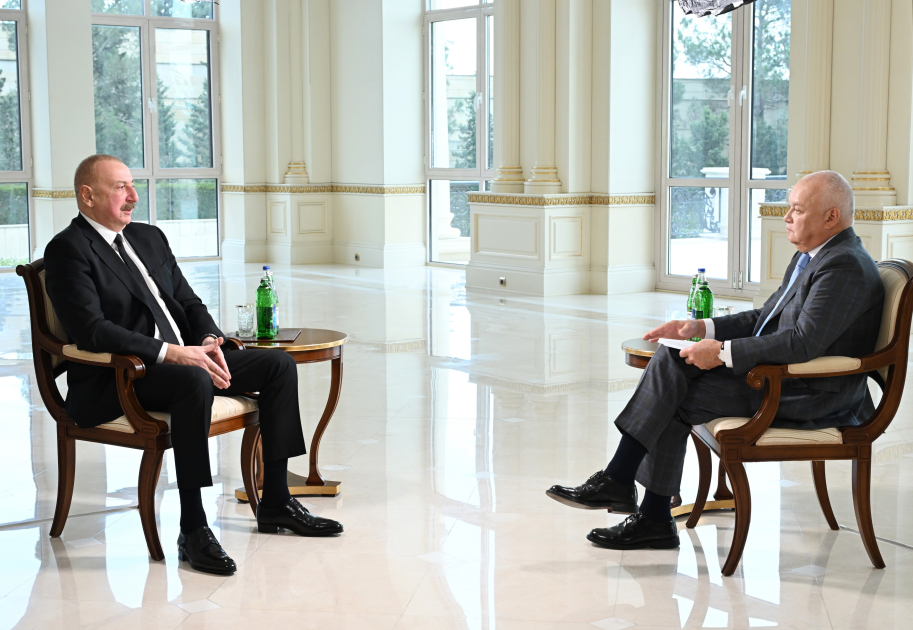
Ilham Aliyev’s interview with RIA Novosti
Azerbaijani President Ilham Aliyev, in an interview with Russian news agency RIA Novosti, announced that the country’s military budget for 2025 will reach a record $5 billion. He attributed this increase to an ongoing arms race, stating, “Armenia cannot sustain an arms race with us, despite receiving most of its weapons from the West either for free or on credit, which will, of course, eventually be forgiven.”
- Opinion: Baku could become venue for Ukraine negotiations
- “It feels like 1921, and everything is repeating” – Zourabichvili addresses European Parliament
- Dirty toothbrushes, expired medications: what inspection found at children’s home in Armenia
Azerbaijani President Ilham Aliyev was interviewed by Dmitry Kiselyov, the director-general of the Russian media group Rossiya Segodnya, for VGTRK and RIA Novosti.
On NATO-Russia Relations
Aliyev expressed hope that relations between Russia and NATO would not escalate into open conflict:
“Imagining a scenario where NATO and Russia engage in a full-scale war is akin to envisioning a global apocalypse. It’s clear there would be no winners in such a conflict. No country, even those far from NATO’s region or Russian territory, would feel safe. I believe there is enough political wisdom in Washington, Moscow, and other capitals to prevent such a nightmarish scenario.”
The Azerbaijani president also mentioned his country’s potential role as a venue for dialogue between opposing sides:
“Given the unique nature of Azerbaijan’s foreign policy and the fact that Azerbaijan is seen as a completely independent player by both the West and the East, we are in a unique position. Azerbaijan is the only country that is simultaneously an ally of Russia and Turkey, a NATO member. There is no other country like this in the world.”
Aliyev added that Azerbaijan is among the few countries trusted by the West, Russia, and the East:
“We are ready to contribute to easing tensions if such a need arises.”
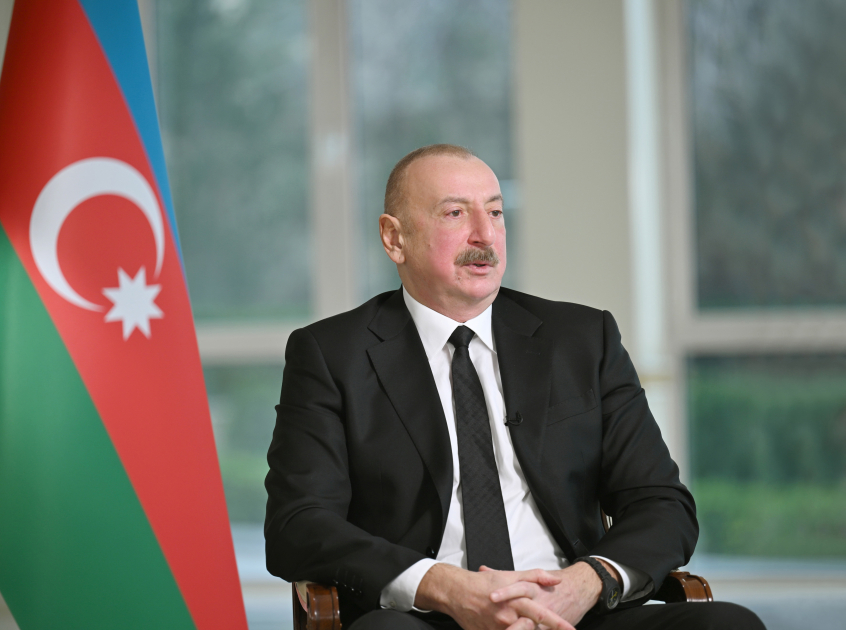
On possibility of Turkish military base in Azerbaijan
When asked, “Does Azerbaijan need a Turkish military base?” President Aliyev responded succinctly: “No, it does not.”
He explained that the Declaration on Alliance between Turkey and Azerbaijan, signed in 2021 in Shusha, includes a clause that ensures mutual military assistance in the event of a threat or aggression:
“This means it is a commitment for both Azerbaijan and Turkey to assist each other if either country faces an external threat or aggression. Therefore, this clause in the declaration essentially eliminates the need for the establishment of any permanent military infrastructure on either territory.”
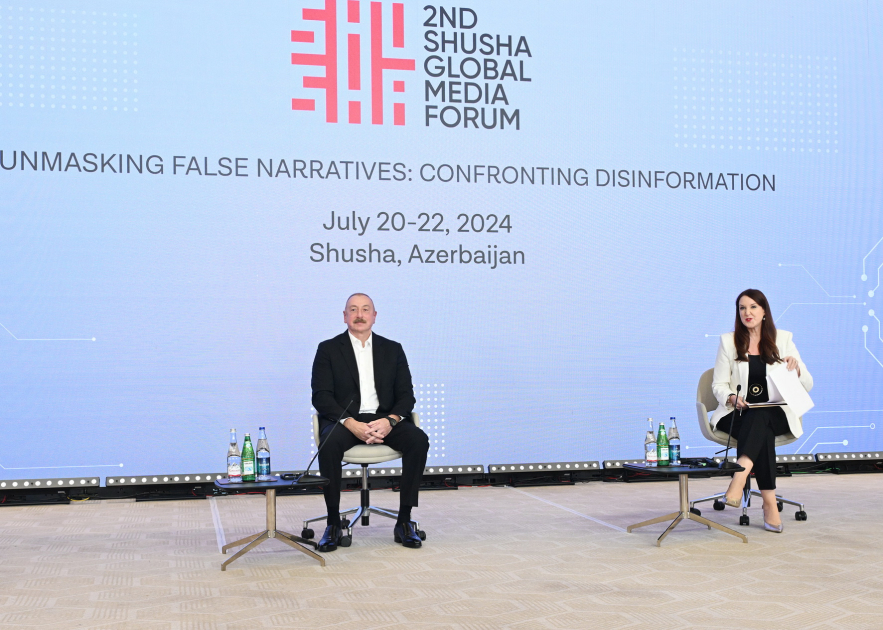
On Azerbaijan’s record military budget
Speaking about Armenia’s armament by third countries, President Aliyev emphasized that the threats are “quite serious”:
“The weapons supplied to Armenia by Macron’s government are offensive and lethal, posing a real threat to Azerbaijan.”
According to the Azerbaijani leader, Armenia’s rapid militarization has led to a record-high military budget for Azerbaijan in 2025:
“This amounts to approximately five billion dollars. We have no choice. At least 60 percent of this sum would not have been spent if these threats did not exist. We would have allocated it to rebuilding Karabakh, social benefits, and other needs. But we are compelled to do this, and we will do it.”
Aliyev added that he considers the arms race a destructive path:
“I believe this is a harmful course. First of all, Armenia cannot sustain an arms race with us, even though they receive the majority of their weapons from the West for free or on credit, which will, of course, eventually be forgiven. But even under these circumstances, they cannot keep up with us.”
“The results of the second Karabakh war and the counter-terrorism operation of September 2023 should not be forgotten by them. They must also understand that despite maximum support from Macron’s regime and the U.S. State Department, if they dare provoke us again here on the ground, no one will come to their aid.”
“Well, how did Macron help them in 2020 or 2023? He held their hand, maybe more—I don’t know in what other way. That’s all. We know perfectly well what he is capable of.”
“We are making it clear—and will continue to do so—both within the negotiation process and through the delimitation commission working between Armenia and Azerbaijan, as well as to Armenia’s sponsors, the so-called Sorosites in Washington, that this must stop. But if it continues, let there be no complaints about our response,” Aliyev concluded.
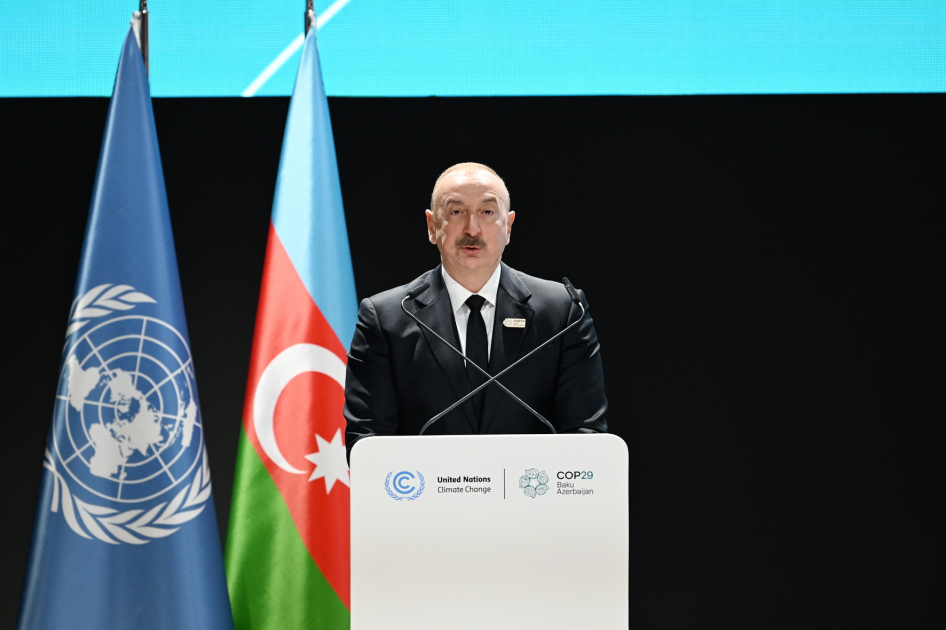
On conditions for signing peace treaty
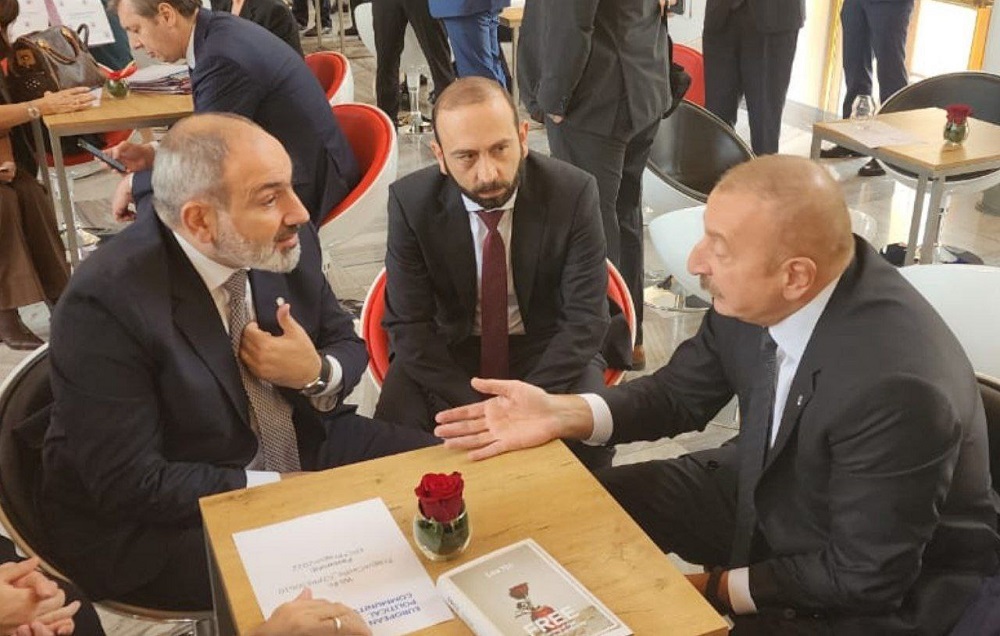
Aliyev noted that significant progress has been made on the peace treaty between Azerbaijan and Armenia, with 15 out of 17 articles already agreed upon.
“During my most recent meeting with Armenia’s Prime Minister in Kazan, what I heard and felt was that these two unresolved articles could also be accepted by Armenia,” the Azerbaijani president emphasized.
He added that one of the unresolved articles pertains to refraining from filing international claims against one another: “We recently completed a detailed analysis of the damage inflicted, which took four years to document. The total exceeds $150 billion—damage caused during the years of occupation. Therefore, mutual abstention from claims would, I believe, be mutually acceptable.”
“The other unresolved article concerns the non-deployment of representatives from other countries on our border,” Aliyev stated.
“There are also two additional steps that Armenia must take. The first is to amend its constitution. The Armenian constitution references the Declaration of Independence, which includes territorial claims against Azerbaijan, declaring the former Nagorno-Karabakh Autonomous Region as part of Armenia. Therefore, amending the constitution is not our whim; it is simply an objective condition.
Our second condition is the formal dissolution of the OSCE Minsk Group. Since this requires consensus, it is formally impossible without Armenia’s agreement. Although the OSCE Minsk Group has long been non-functional, it still formally exists. Our question is simple: if Armenia has recognized Karabakh as part of Azerbaijan, and the Minsk Group was created to resolve the Karabakh issue, then what is its purpose?”
On situation in Georgia
“In Georgia, I see the situation stabilizing, and we are pleased about this. Georgia is an essential partner and close friend for us,” said Ilham Aliyev.
“Returning to the topic of external influence, it has become evident that thousands of non-governmental organizations operate in Georgia, funded by the West. The number of people working in these organizations or receiving salaries must be tens of thousands, if not more. We know what this means.
There was a time here in our country when grant recipients and grant providers also felt free to act, but we put an end to that. Now, any grant from any organization, whether Azerbaijani or foreign, must go through registration, and the relevant authorities decide whether to approve it,” emphasized the Azerbaijani president.
He also pointed out that Azerbaijani media cannot be funded from foreign sources, even by one percent:
“They cannot. Why should they? We don’t fund media in the U.S., do we? So why should they fund ours? And even without direct funding, through their resources like ‘Voice of America’ and ‘Radio Free Europe,’ they spread slander about our people and our country, casting a shadow on our victory [in the war] with Armenia.
I feel that in Georgia, some time was lost in bringing order to this matter. By the time it was addressed, as the saying goes, the train had already left the station. But it’s good that the situation is now moving toward stability.
And once again, you can see Macron’s ears sticking out. He just can’t stay within his own country; he has to meddle in Georgia as well.”
Sevinj Vagifgizi dedicated her award to all journalists fighting against corruption.
On December 10, Sevinj Vagifgizi, the editor-in-chief of “Abzas Media,” who is currently in prison, was declared the “Global Anti-Corruption Champion.” In light of this achievement, she addressed the public in a heartfelt appeal.
The journalist expressed her gratitude to those who deemed her deserving of the award, as well as to everyone who remains loyal to democratic principles:
“I would like to thank everyone who remains loyal to democratic principles for deeming me worthy of this prestigious award.”
As part of “Abzas Media,” Sevinj Vagifgizi and her team have uncovered a wide range of corruption. They exposed the criminal activities of the family members of the country’s leader, Ilham Aliyev, and how the officials appointed by him misused state funds. Reflecting on the situation, she said, “Unfortunately, instead of opening criminal cases against these officials based on these facts, state agencies accused the journalists who uncovered these crimes of ‘dirty money’ and imprisoned them.”
According to Vagifgizi, after Ilham Aliyev took control of the judiciary and the legislative bodies, he has now shifted his focus to eliminating independent media. “However, I believe that everyone who remains loyal to democratic principles will not allow the destruction of the country’s only breathing entity, the free media. This award is an achievement of all journalists who have uncovered corruption crimes.”
The Global Anti-Corruption Champions Award, established in the U.S. in 2021, is designed to recognize individuals who have taken extraordinary steps in the fight against corruption. It also aims to demonstrate solidarity with these heroic partners.
Along with Sevinj Vagifgizi, nine other individuals were honored with this prestigious award.
Sevinj Vagifgizi was arrested on November 21, 2023, as part of the “Abzas Media Case.” She, along with five other imprisoned staff members of the media organization, has been accused of smuggling.
The journalists have denied the charges, asserting that their arrests are directly linked to their investigations into corruption.
The post A Journalist’s Public Appeal: Aliyev Wants to Destroy the Media That Investigates Him appeared first on MEYDAN.TV.

Georgia faces economic crisis
After Georgia’s ruling party-appointed Prime Minister Irakli Kobakhidze officially announced the suspension of EU integration on November 28, the country’s economic stability came under serious threat.
For instance, the lari’s exchange rate immediately began to decline, losing 13 tetri in just a few days.
For over three weeks, the streets of Tbilisi and other Georgian cities have been filled with pro-European protests. Tens of thousands of people are demanding protection of the constitution, which enshrines the country’s course toward EU integration, and the holding of new parliamentary elections to lawfully change the government.
The opposition, the president, and civil society consider the October 26 parliamentary elections fraudulent, refusing to recognize the legitimacy of the parliament, its government, or the newly elected president.
In response, authorities have resorted to violent crackdowns on peaceful demonstrations, beatings, and arrests of activists. Police violence has added another key demand to the protests—the release of detained activists.
This escalating political crisis poses an increasing threat to the country’s economy. Police brutality and blatant violations of the law have significantly heightened the likelihood and scope of Western sanctions against Georgian government officials.
What’s next for Georgia’s economy? JAMnews put this and other questions to Beso Namchavadze, an economic analyst at Transparency International Georgia.
Are there signs of economic crisis in Georgia?
“At present, Georgia is not experiencing an economic crisis, but the risks have grown so significantly that one could erupt at any moment.
The situation is highly volatile. Paradoxically, Georgia’s recent years of high economic growth are largely a byproduct of the Russia-Ukraine war.
The war has brought billions of dollars into Georgia from Russia and boosted the country’s role as a transit hub.
Around 100,000 Russians, Ukrainians, and Belarusians have relocated to Georgia, bringing considerable financial resources. Many of them are highly skilled professionals who have established businesses in Georgia, contributing to economic growth.
However, the “war effect” is finite, and its impact on the economy will weaken from next year.
Whether this situation evolves into an economic crisis depends entirely on Western sanctions.
If sanctions are absent or minimal, economic growth rates will decline, the lari will experience some depreciation, but a full-blown crisis is unlikely.
A crisis, in economic terms, means contraction of the economy, rising unemployment, increasing public debt, and potentially a sharp spike in prices, among other issues.”
The past few months have revealed the vulnerability of Georgia’s economy to sanctions. A mere mention of sanctions by the U.S. State Department, followed by measures targeting a few individuals, was enough to trigger a sharp depreciation of the lari and a decline in TBC Bank and Bank of Georgia’s stock prices on the London Stock Exchange.
This reflects the deeply anxious expectations among the population and especially within the business community. Many believe that sanctions could plunge the country into a crisis.
In brief, events could unfold as follows:
- If Ivanishvili’s government fails to ease the political crisis by taking appropriate measures, sanctions are inevitable.
- These sanctions would swiftly lead to economic problems.
How severe these economic issues become and whether they escalate into a full-blown crisis that collapses Georgia’s economy depends entirely on the scope and severity of the sanctions.
What could sanctions and Western isolation mean for Georgia?
 Today, the U.S. and the EU possess all the tools to push Georgia’s economy into crisis and force the government to pay a high price.
However, they continue to believe sanctions should be designed to directly punish those responsible—those who perpetrate violence, corruption, and illegitimately seize state institutions—without harming the Georgian population.
Georgia’s small, open economy is heavily reliant on the West. Each year, $8–9 billion flows into the country from Western nations. This figure includes remittances from migrants, exports, tourism, investments, public and private sector loans, grants, and more.
This amounts to nearly one-third of Georgia’s economy.
This sum cannot be entirely replaced. But even a 20–25% reduction would make an economic crisis in Georgia unavoidable.
The stability of Georgia’s economy heavily depends on the lari’s exchange rate, as the country is highly import-dependent.
The level of dollarization is significant. Half of all bank deposits and loans are in foreign currency, and 75% of the national debt is denominated in foreign currency.
If severe sanctions are imposed, the sequence of events could unfold as follows:
● Sanctions would lead to significant lari depreciation, making imports more expensive.
● High inflation would ensue.
● Loans taken by the population and government in foreign currency would become costlier. The National Bank would be forced to raise interest rates, making borrowing more expensive and stalling economic growth.
● Stock prices of major Georgian companies listed on the London Stock Exchange would drop as the value of their assets, denominated in foreign currency, declines. Investor expectations would worsen, prompting them to sell off shares.
● These simultaneous negative processes would spark panic among the population, worsening the crisis. For instance, many might withdraw their bank deposits out of fear, dealing a significant blow to the banking sector.
● A mass shift to converting savings into dollars, including by members of the ruling Georgian Dream party and affiliated businessmen, would further strain the exchange rate and exacerbate existing issues.
● Currently, Georgian banks hold 28 billion lari in deposits. Imagine the fallout if depositors began withdrawing or converting this sum into dollars.
● Additionally, over the past year, the National Bank has depleted $1.6 billion of its foreign reserves, leaving it with far fewer resources to stabilize the lari.
However, much depends on the type of sanctions imposed. Simple visa restrictions on top Georgian Dream officials are unlikely to trigger a crisis.
This might create some economic challenges but not enough to collapse the system.
A different scenario arises if individual sanctions become intolerable for some officials, forcing them to make concessions—though this remains speculative.
Financial sanctions, however, alongside visa restrictions, would present much greater challenges for both the sanctioned individuals and the country as a whole.
For instance, if financial sanctions were applied to the prime minister and other top officials, the repercussions would extend beyond individuals to the overall economic landscape:
● Georgia could be categorized as a high-risk country, driving investors away.
● Grants from foreign governments might cease entirely, and loans could also be halted.
● The banking sector would face immense pressure, complicating international transactions.
● The new rule introduced by the National Bank, which prevents Georgian banks from enforcing Western sanctions on Georgian citizens without a Georgian court decision, would worsen the situation. This would place banks in an extremely precarious position, especially as bankruptcies rise.
Belarus is withstanding sanctions for now due to its economy’s dependence on Russia. For Georgia, sanctions would be far more devastating.
What restrictions have Western partners implemented so far?
● The U.S. imposed financial sanctions on five individuals and visa restrictions on several dozen others.
● The Baltic states introduced visa restrictions.
● The EU, the U.S., and several European countries have suspended grants to the Georgian government.
For now, that’s the extent of the measures. The more impactful sanctions, particularly individual ones, are likely yet to come.
Processes in Georgia are often compared to Belarus, but the two nations are worlds apart when it comes to sanctions. Belarus faces stringent measures, most linked to its support for Russia’s war in Ukraine. This is unlikely to be Georgia’s scenario.
Belarus, however, has been less dependent on the West, relying instead on Russia, which has allowed it to endure sanctions—albeit in a stagnant economy over the past decade.
If Georgia were to face even a fraction of the sanctions imposed on Belarus, its economy would collapse. The government would have no choice but to make concessions.
A crisis could become so severe that the government would struggle to pay salaries and pensions.
Belarus’s sanctions at a glance:
● Prohibited from using central bank reserves on international markets.
● International state banks, such as the World Bank and EBRD, ceased financing Belarus.
● Four major Belarusian banks were disconnected from SWIFT.
● Western companies are barred from providing services to Belarusian state-owned enterprises.
● The U.S. imposed sanctions on the Belarusian Ministry of Internal Affairs, the Central Election Commission, and other government bodies.
These are extremely strict measures. Georgia’s economy would not withstand such pressure.
In the worst-case scenario, Georgia’s government might seek to replace Western funds with money from Russia or other Asian countries. However, this would only further inflame public discontent. Moreover, Asian countries are unlikely to cooperate with a nation under sanctions.
Such an alternative would take a significant amount of time to implement and is far from a quick solution.
Sevinj Vagifgizi dedicated her award to all journalists fighting against corruption.
On December 10, Sevinj Vagifgizi, the editor-in-chief of “Abzas Media,” who is currently in prison, was declared the “Global Anti-Corruption Champion.” In light of this achievement, she addressed the public in a heartfelt appeal.
The journalist expressed her gratitude to those who deemed her deserving of the award, as well as to everyone who remains loyal to democratic principles:
“I would like to thank everyone who remains loyal to democratic principles for deeming me worthy of this prestigious award.”
As part of “Abzas Media,” Sevinj Vagifgizi and her team have uncovered a wide range of corruption. They exposed the criminal activities of the family members of the country’s leader, Ilham Aliyev, and how the officials appointed by him misused state funds. Reflecting on the situation, she said, “Unfortunately, instead of opening criminal cases against these officials based on these facts, state agencies accused the journalists who uncovered these crimes of ‘dirty money’ and imprisoned them.”
According to Vagifgizi, after Ilham Aliyev took control of the judiciary and the legislative bodies, he has now shifted his focus to eliminating independent media. “However, I believe that everyone who remains loyal to democratic principles will not allow the destruction of the country’s only breathing entity, the free media. This award is an achievement of all journalists who have uncovered corruption crimes.”
The Global Anti-Corruption Champions Award, established in the U.S. in 2021, is designed to recognize individuals who have taken extraordinary steps in the fight against corruption. It also aims to demonstrate solidarity with these heroic partners.
Along with Sevinj Vagifgizi, nine other individuals were honored with this prestigious award.
Sevinj Vagifgizi was arrested on November 21, 2023, as part of the “Abzas Media Case.” She, along with five other imprisoned staff members of the media organization, has been accused of smuggling.
The journalists have denied the charges, asserting that their arrests are directly linked to their investigations into corruption.
The post A Journalist’s Public Appeal: Aliyev Wants to Destroy the Media That Investigates Him appeared first on MEYDAN.TV.