The National Commission of Azerbaijan for UNESCO, with the support of the Embassy of Azerbaijan to the Kingdom of Belgium and the Grand Duchy of Luxembourg Mission to the European Union, has donated unique exhibits of tar kamancha and gaval to the Museum of Musical Instruments under the auspices of the Royal Museums of Art and History of Belgium.
In the Conclusions on Enlargement issued on December 17 the EU General Affairs Council, while reaffirming its “full and unequivocal commitment” to the EU membership perspective of the Western Balkans, Ukraine and Moldova, recalled that “the course of action taken by the Georgian government jeopardizes Georgia’s European path, de-facto leading to a halt of the accession process.” The Council reiterated “the EU’s steadfast solidarity with the Georgian people” and readiness to continue supporting Georgians on their European path, and regretted the Georgian government’s recent statement on suspending the EU accession process until 2028.
The conclusions stressed that “respecting and committing to promote the values on which the EU is founded, and meeting the obligations required for EU membership, continue to be essential for all partners who aspire to join”, stressing the importance of the “sustained” and “irreversible” reforms on the fundamentals, such as rule of law and fundamental rights, the functioning of democratic institutions, public administration, etc.
While reaffirming the EU’s readiness to support the Georgian people on their European path, the Council reiterates the EU’s “serious concern” regarding the GD government’s actions, including the adoption of the Foreign Agents’ and laws, which represent “backsliding on the steps set out in the Commission’s recommendation for candidate status.”
The Council regretted the Georgian government’s recent decision to suspend the country’s EU accession process until 2028.
It also strongly condemned the violence against peaceful protesters, media representatives and politicians, adding that the Georgian authorities “must respect the right to freedom of assembly and of expression, and refrain from using force.” It further said that “all acts of violence must be investigated and those responsible held accountable.”
The Council called on the Georgian authorities to urgently revert to the EU path and adopt democratic, comprehensive and sustainable reforms, including the implementation of the nine steps set in the 2023 Enlargement communication of the Commission.
“Georgia needs to guarantee the full respect for fundamental rights, including the freedom of expression and assembly, and the freedom, independence and pluralism of the media, as well as the rights of LGBTI persons,” the document reads. It says that “the intimidations, violence and discrimination against Georgia’s civil society representatives, political leaders, civil activists and journalists in Georgia need to cease.”
The Council also noted “with serious concern” the preliminary findings by OSCE/ODIHR, “which indicate that the parliamentary elections on 26 October were characterised by several shortcomings and a tense and highly polarised environment.”
The Council strongly encouraged Georgia to investigate and address electoral irregularities and allegations and to address these and other OSCE/ODIHR and Council of Europe bodies’ recommendations, and conduct electoral reform, which is also part of the nine steps.
The Council further noted the need of reform in judiciary, in line with EU standards and Venice Commission recommendations, in fighting corruption and organized crime, and implementation of deoligarchization actions.
On the economic criteria, the Council noted the moderate level of preparation and limited progress in developing a functioning market economy.
The Council commended the continued implementation of sound fiscal and monetary policies and encouraged Georgia to strengthen the independence of the central bank and implement other necessary structural reforms.
The Council called on Georgia to urgently fulfill the outstanding visa liberalization benchmarks including by aligning with the EU visa policy, addressing unfounded asylum applications and ensuring compliance with the fundamental rights requirements.
It reaffirmed the EU’s support to Georgia’s sovereignty, independence and territorial integrity within its internationally recognized borders.
The General Affairs Council reiterated its “strong expectation for Georgia to substantially step up its efforts towards full alignment with EU CFSP positions and restrictive measures as a matter of utmost priority, including those against Russia and Belarus, and in line with the principles of sovereignty and territorial integrity of all states.”
The Council called on Georgia’s authorities to refrain from actions and statements against the EU positions on foreign policy and encouraged Georgia to continue its cooperation on preventing the circumvention of EU restrictive measures.
Legal proceedings have begun in Azerbaijan over the Abzas Media case, with all those involved facing charges of smuggling and other economic crimes. The media figures on trial deny the accusations, linking their arrest to the corruption investigations they carried out.
On December 17, a preparatory hearing for the Abzas Media case took place at the Serious Crimes Court in Baku, presided over by Judge Rasim Sadikhov. Among the accused were Ulvi Hasanli, the director of the independent online publication Abzas Media, deputy director Mahammad Kekalov, editor-in-chief Sevinc Vagifgizi, reporters Nargiz Absalamova and Elnara Gasymova, investigative journalist Hafiz Babali, and economist Farid Mehraliev, who has no connection to the publication.
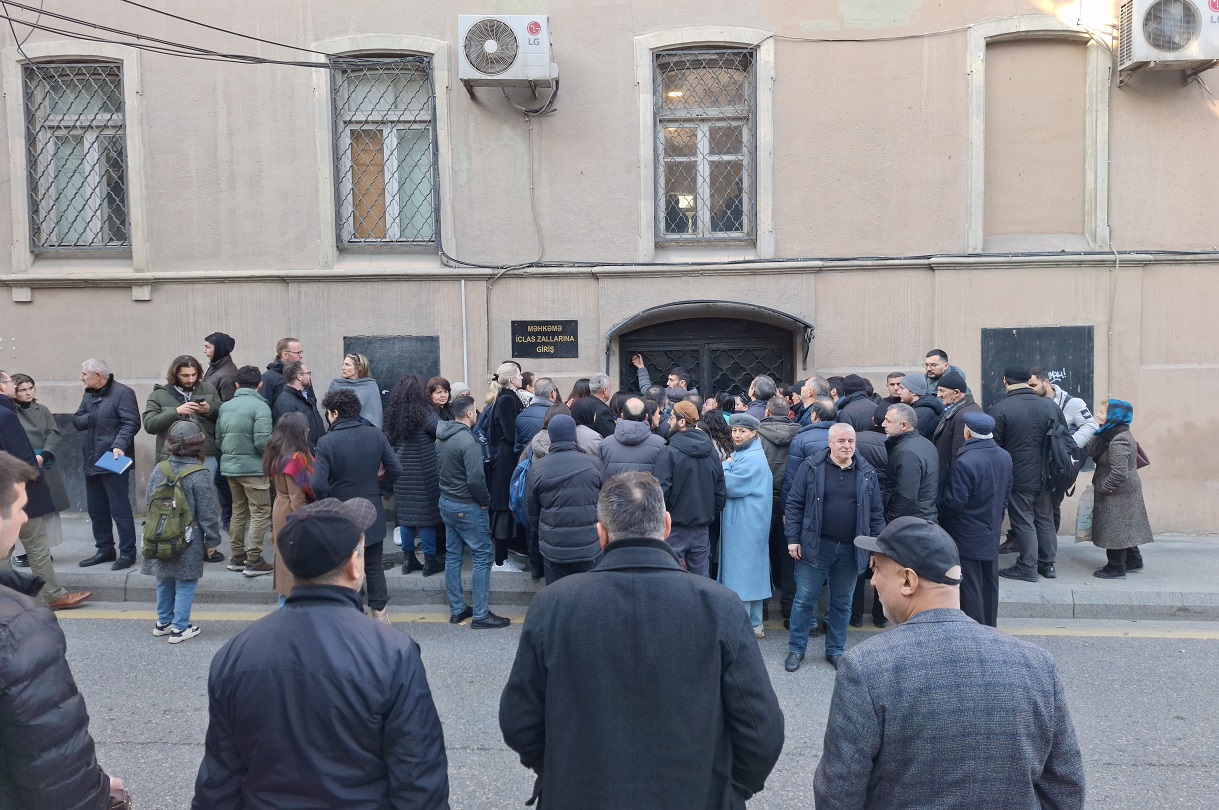
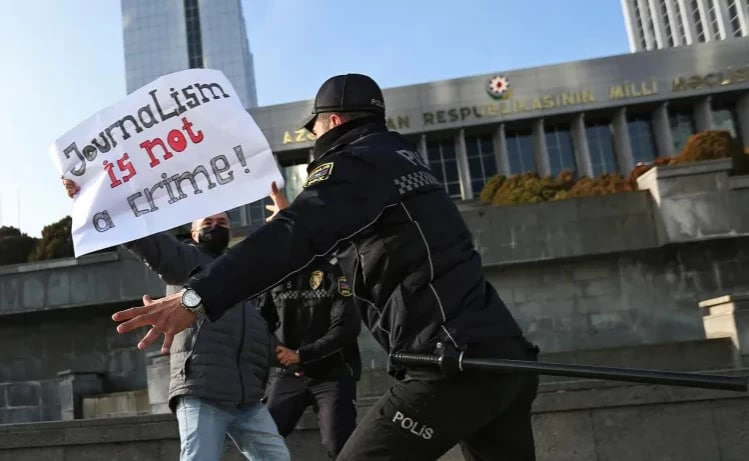
Journalists were not allowed into the courtroom on the grounds that “there was no space.” As noted by the journalists who were unable to attend the hearing, the room was already filled with people unrelated to the defendants.
“Family members of the arrested journalists struggled to get in, while colleagues who wanted to cover the trial were simply turned away, being told the room was already full,” said a JAMnews staff member who was also denied entry.
Both the lawyers and the defendants raised a motion in this regard.
“We filed motions on four or five issues. One motion was about the fact that journalists and family members of the defendants could not enter the courtroom. Ulvi pointed out that there were many people in the courtroom who had nothing to do with the case and asked the court to remove them to ensure that the defendants’ friends, family, and especially journalists, who should have covered the trial, could attend,” said Zibeyda Sadygova, Ulvi Hasanli’s lawyer.
According to the lawyer, the court rejected the motion for allowing journalists into the trial and filming the proceedings.
Courthouse where the ‘Abzas Media’ case is being heard. December 17, 2024. Photo: Fatima Movlamly/JAMnews
In other petitions, the defense asked the court to drop the criminal charges and transfer the arrested journalists to house arrest.
“The petition to dismiss the charges was not considered, and the petition for house arrest was rejected. Despite the fact that my client Nargiz and others have been in custody for over a year without any grounds,” said Rovshan Rahimli, the lawyer for Nargiz Absalamova.
According to her, only one petition from all the lawyers was granted: the defendants were allowed to leave the glass cage and sit next to their lawyers.
The trial on the merits is scheduled for December 28.
According to the relatives of the journalists, they have rejected all charges in court and remain in high spirits. Accused journalist Hafiz Babali urged Judge Rasim Sadykhov “not to carry out a political order and to consider the case objectively.”
Representatives from several Western embassies accredited in Baku were present at the hearing.
Abzas Media case
The criminal prosecution in the “Abzas Media” case began on November 20, 2023. On that day, the publication’s director, Ulvi Hasanly, and his deputy, Mahammad Kekalov, were detained. The following day, upon returning to the country, the chief editor, Sevinc Vagifgizi, was arrested at the airport.
Arrests in connection with the case continued until January 2024, when reporters Nargiz Absalamova and Elnara Gassymova, as well as investigative journalist Hafiz Babali, were detained.
On June 1, economist Farid Mehralizadeh was arrested in relation to the “Abzas Media” case. However, he denies any connection to the media outlet. Abzas Media also issued a statement asserting that they never collaborated with the arrested economist.
Initially, all the accused faced charges of smuggling. Later, they were also charged under seven more serious articles of Azerbaijan’s Criminal Code – 192.3.2 (illegal entrepreneurship with significant profit), 193-1.3.1 and 193-1.3.2 (money laundering by an organized group), 206.4 (smuggling by an organized gang), 320.1 and 320.2 (document forgery and the use of counterfeit documents), and 213.2.1 (group tax evasion).
For these charges, they face up to 12 years in prison, as opposed to the 8 years initially expected.
The journalists deny all charges and link their arrests to the corruption investigations published by Abzas Media.
According to human rights defenders, the independent outlet Abzas Media “faced repression due to its publication of corruption investigations involving high-ranking officials and their relatives.”
Unsanitary conditions at children’s home in Armenia
Showers in front of other children, shared care for boys and girls, lack of sanitary conditions”—these are just some of the issues discovered by Armenia‘s human rights defender office staff during an inspection at a children’s home in Gyumri, where children are under state care.
“Children’s toothbrushes were dirty, there was a problem with the individualization of personal hygiene items, cups, and plates. There were instances when nannies confused children’s towels,” states the ombudsman’s report.
The unannounced visit took place in late November, and the report has now been published. The ombudsman’s office experts report that the results of the inspection were presented to the director of the care home. All issues were discussed with him, and solutions were proposed.
Additionally, a more detailed report will be presented to the relevant authorities shortly. Primarily, this concerns the Ministry of Labor and Social Affairs, which oversees the institution. The ministry has yet to respond to the ombudsman’s office report.
Violations at the children’s home in Gyumri were the focus of public attention and actively discussed on social media back in August. At that time, the Investigative Committee received reports of child abuse by a nanny and a nurse. They were charged with causing “severe physical pain and mental suffering to helpless children.” Home arrest and a travel ban were imposed as preventive measures, and the preliminary investigation is ongoing.
Staff from the ombudsman’s office reviewed the conditions of the building where the children live, including communal facilities and sanitary conditions. They also investigated the level of care provided to the children, including their access to first aid, food, and clothing. Special attention was given to the relationships between the staff at the “Children’s Home” and the children, as well as to the protection of their rights and interests.
The report highlights the following issues:
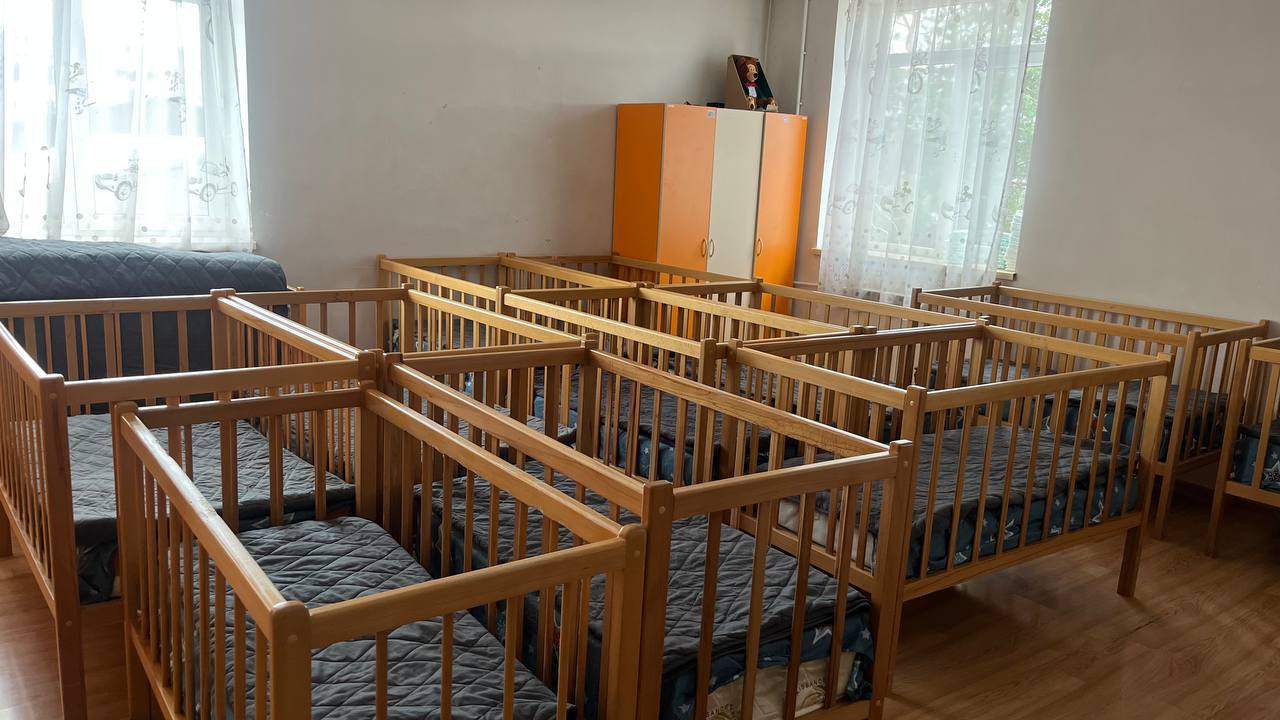
Children do not have the necessary personal space, as the beds in the rooms are positioned very close together or are shared. Due to the lack of space, there was a case of joint care for boys and girls.
The ability to meet personal needs (hygiene) in private settings is not ensured. For example, most of the bathrooms are not separated from the bedrooms, and the children take showers in the presence of other children.
A dirty toothbrush at children’s home in Gyumri. Photo by the Ombudsman’s office.
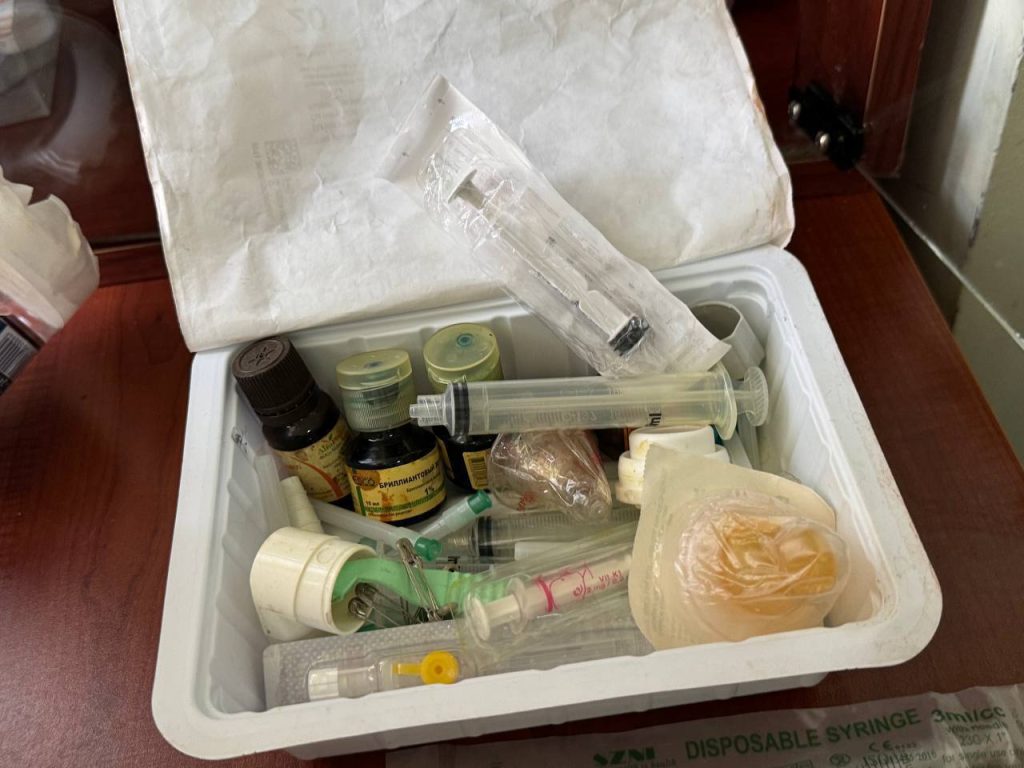
Staff from the ombudsman’s office noticed that the first aid kits in the shared rooms were dirty. They contained both used and unused medications, all stored in various boxes without any labeling.
First aid kit at the children’s home. Photo by Ombudsman’s office.
A syringe stored with spoons and a screwdriver. Photo by Ombudsman’s office.
Additionally, expired medications and food, including porridges, were found. Meat products lacked labeling that would allow verification of their expiration dates.
“Due to difficulties in attracting the appropriate specialists, the institution did not assess the individual medical needs of the children, including palliative care.
Children were fed through syringes and feeding tubes (nasogastric tubes), which were disinfected and reused without individualization,” the report states.
The baby bottles had damaged surfaces. A medical journal was absent. The documentation of confirmed cases of abuse, both between children and by adults, was incomplete, and reports on these cases were not submitted to the competent authorities. The children’s clothing at the “Children’s Home” was worn out.
In addition, experts noted serious issues related to the educational process. The problem is that the educational process is not adapted to the individual characteristics, abilities, and needs of each child:
“A child with visual impairments, attending a regular school, was not provided with Braille books or necessary accessible learning materials.”
The ombudsman’s office staff pointed out that the institution needs to:
Ensure the availability of accommodations for children with disabilities and the ability to use transportation,
Implement mechanisms for identifying, preventing, and responding to cases of violence against children,
Involve a team of specialists and improve the qualifications of existing staff,
Enhance communication skills of staff when interacting with children.
It was also discovered that the institution lacks a mechanism to ensure “real and accessible participation of children in matters concerning them, and their right to be heard.”
Another issue found by the ombudsman’s office experts is that, throughout 2024, the institution accepted new residents, including children under 3 years old, but no child was returned to their family or placed with a foster family.
Social media outcry
“I was shocked by every point in the report. This is a blatant crime against such vulnerable children. Honestly, I don’t understand why we should even discuss anything with the director after all of this. I thought in such cases, people are immediately held accountable.”
“These children already have such a difficult life. How can anyone treat them this way?”
“This is the result of negligence by oversight bodies and a lack of conscience among the staff.”
“We hope that the issues uncovered will not remain just on paper, that you will make them solve all the problems as soon as possible, and that you will be consistent in this. I don’t understand how the director hasn’t been fired after all of this.”
The war in Ukraine is nearing a stage where ceasefire talks may be possible. U.S. President-elect Donald Trump has met with Ukraine‘s president, and his representatives have engaged with Ukraine’s leadership. Meanwhile, Hungarian Prime Minister Viktor Orban, following his visit to Trump, has held discussions with RussianPresident Vladimir Putin.
“It is clear that in the early days of his presidency, Trump will present his own formula for resolution and promote it through pressure tactics.”
This was suggested by analysts from the South Caucasus Research Center (CSSC). Azerbaijani experts also discussed potential mediation prospects and Baku’s role in achieving peace in Ukraine in their article.
“The military-political leadership of Ukraine and Russia are each presenting their own visions for a potential ceasefire, making maximal demands and expectations both from each other and third parties. For example, Ukraine’s expectations include NATO membership, while Moscow links a ceasefire to the reduction of sanctions against Russia.
It can be said that, at this moment, Trump’s team is organizing the negotiation agenda, determining the locations and formats for talks. Let’s consider the range of countries vying to host negotiations:
Turkey – has experience organizing talks between Russia and Ukraine, maintains constant contact with Moscow and Kyiv, and is deeply involved in the details of the negotiation process.
However, it is a NATO member, and after events in Syria and the collapse of the Astana format, the nature of its interactions with Russia has changed. There is also the temptation to manipulate the negotiation process, both in its relations with Russia and the U.S./EU.
China/Brazil – have proposed a negotiation initiative, but neither Kyiv nor Moscow valued it, as the framework was too general and lacked specifics. Additionally, the issue of the war in Ukraine is expected to become a key topic in the relations between Beijing and Washington.
Hungary – Prime Minister Orban has attempted to mediate between Trump and Putin, with some success. However, he has struggled to establish contact with Zelensky, as Orban is not welcomed in Kyiv.
Group of countries– Saudi Arabia, UAE, and India have participated at different times in delivering messages and facilitating prisoner exchanges. These countries maintain balanced relations with Moscow, Washington, and Kyiv. However, the Trump administration will set its own agenda for relations, and it’s uncertain if Ukraine-related negotiations will be included. Though, anything is possible.
It should be noted that the negotiations could take place in various formats:
Russia-Ukraine
Russia-U.S.-Ukraine
Russia-U.S. on Ukraine without Ukraine
U.S.-China on Russia without Russia
The seriousness of the negotiation topic involves preparatory elements—shuttle diplomacy and secret diplomacy—which include direct contacts in capitals or third countries, aimed at preparing for the main meeting.
Azerbaijan has experience organizing meetings at all levels, and Baku has hosted meetings between the Chiefs of Staff of Russia, the U.S., and NATO.
Azerbaijan is not a member of military-political blocs like NATO or the CSTO.
Official Baku has built trustful relations with both Moscow and Kyiv. In early 2022, Azerbaijani President Ilham Aliyev visited Kyiv (on January 14) and Moscow (on February 22), elevating the level of relations with both Ukraine and Russia.
Recently, Azerbaijan was considered as a potential mediator for resolving the issue of Russian gas supplies to Europe. In February, Ukrainian President Volodymyr Zelensky, during a meeting with President Ilham Aliyev in Munich, requested Azerbaijan to mediate the gas issue. Following this meeting, consultations took place between Azerbaijani and Ukrainian experts. While the issue remains unresolved, this does not mean it is closed. The key point is that Baku has taken on the role of mediator, and both sides have trusted Azerbaijan in this capacity.
On December 17, 2024 the European Court of Human Rights (ECHR) has published its judgment in the case of Taganova and Others v. Georgia and Russia,holding Russia fully responsible for the violations of property rights in Georgia’s occupied region of Abkhazia.
The case concerned complaints filed by six applicants—four Georgian (Ketevan Mekhuzla, Ksenia Sanaia, Souliko Dvali and Marina Gogia) and two Russian (Galina Alekseevna Taganova and Tariel Apolonovich Esartia) nationals who were denied access to their homes and property in Abkhazia following hostilities in the region. In its unanimous ruling, the Court found violations of Article 1 of Protocol No.1 (protection of property) and Article 8 (right to respect for private and family life) of the European Convention on Human Rights.
The ECHR reiterated that Russia exercises effective control over Abkhazia and has failed to secure the property rights of individuals, particularly Georgian citizens, in the occupied territory. “They should have taken steps to protect those rights, such as providing an easily accessible and flexible legal mechanism. They had failed to do so. Accordingly, the breach of these applicants’ rights was attributable to the Russian Federation”, the Court’s press release stated.
The Court also emphasized that Georgian authorities have been unable to exercise effective control over the region since the 1990s due to Russia’s military, political, and economic interference. The Court held that Georgia had made sufficient efforts to re-establish State control over the territory, mentioning in particular the 2008 Law on Occupied Territories, which had voided all real-estate transactions carried out in contravention of Georgian law and reiterated property rights in the occupied territories.
The ECHR rejected arguments from both the Georgian and Russian governments concerning domestic remedies, stating that no effective legal mechanisms were available for the applicants to secure their property rights in either jurisdiction.
In addition, the Court also ruled that: Russia has to pay Mr. Esartia EUR 25,000 in respect of pecuniary and nonpecuniary damage; and EUR 35,000 each to Ms. Mekhuzla, Ms. Sanaia, Ms. Dvali and Ms. Gogia in respect of pecuniary and non-pecuniary damage. It ordered payment of EUR 18,000 to the Human Rights Advocacy Centre in respect of costs and expenses for all the applicants jointly, apart from Ms. Taganova”.
The Court decided that it had jurisdiction to deal with the case, as the facts giving rise to the alleged violations of the Convention had taken place before 16 September 2022, the date on which Russia ceased to be a party to the European Convention.
Briefing at the Ministry of Justice
In a briefing following the judgment, Georgian Dream’s Minister of Justice Anri Okhanashvili, welcomed the decision and stated that “the Strasbourg Court’s ruling once again confirms that Russia bears full responsibility for human rights violations in the occupied territories, as it continues to exercise effective control over Abkhazia.” The Ministry highlighted that the judgment underscored Georgia’s efforts to protect its citizens’ property rights, even in regions beyond its control.