
Azerbaijan leader accuses France of colonial ‘crimes’ in COP29 speech Al Jazeera English
Day: November 13, 2024
Will Georgia revise the “foreign agents” law?
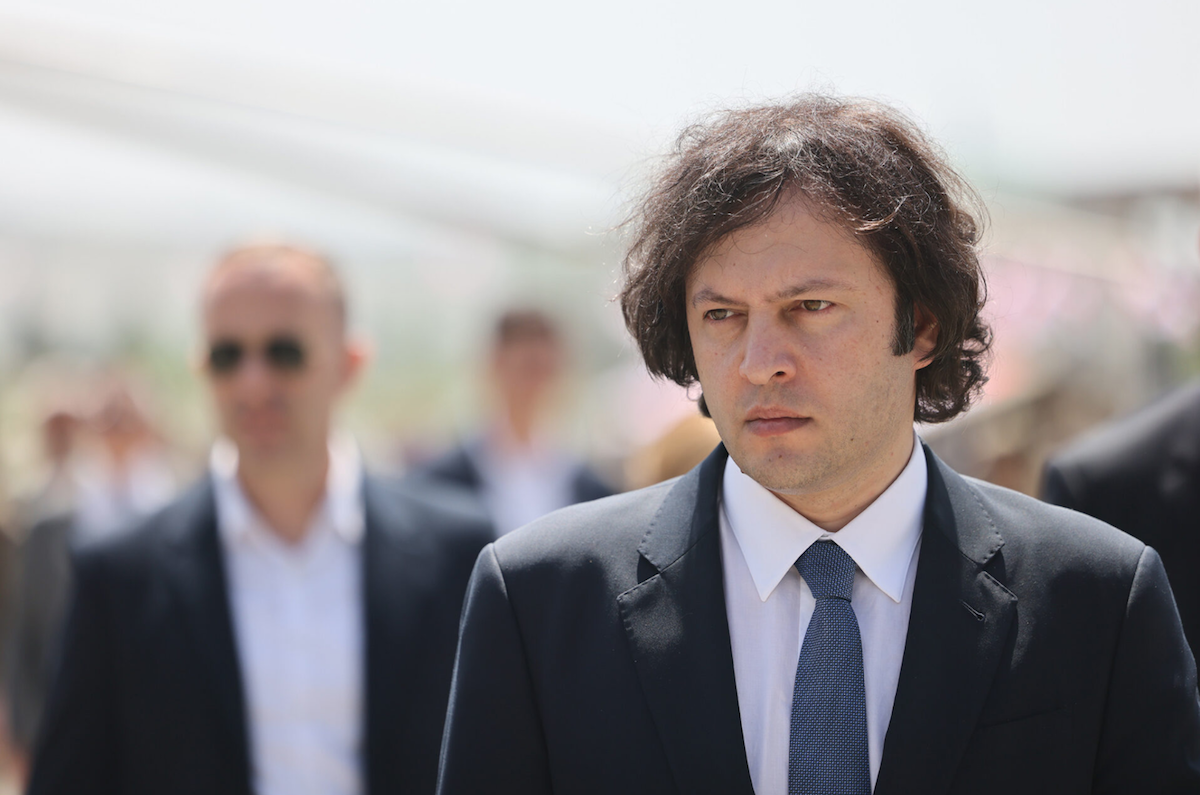
Georgia’s Prime Minister Irakli Kobakhidze said authorities are “fully open to reasoned public discussion” on the laws “On Transparency of Foreign Influence” (the so-called “foreign agents” law) and “On Family Values and the Protection of Minors” (targeting “LGBT propaganda”).
Kobakhidze made the remarks while speaking to journalists on the sidelines of the COP29 environmental summit in Baku on 13 November.
“Thorough discussions on these two laws are essential,” Kobakhidze added.
What did Irakli Kobakhidze say?
“We have a very clear position regarding the ‘Transparency of Foreign Influence’ and ‘Family Values and Protection of Minors’ laws.
If it can be proven to us that a lack of transparency in NGO operations is better than transparency, then let’s discuss that.
The same goes for the ‘anti-LGBT propaganda’ law. If it’s shown that anything in it contradicts legal principles or shared values, we are also open to a deep discussion on that.
We are always open to in-depth public debate. Ideally, this discussion should happen in front of an audience. We are fully open to all viewpoints, as long as they are well-reasoned,” said Irakli Kobakhidze.
How Georgia’s ‘foreign agent’ law differs fundamentally from similar laws in Western countries
Georgian authorities often claim that the country’s new law is comparable to similar legislation in the U.S. and Europe. However, this assertion is inaccurate, as highlighted by three key points:
1. The U.S. Foreign Agents Registration Act (FARA), cited by the ruling Georgian Dream party, was passed in 1938, on the eve of World War II. Its purpose was to protect the American public from Nazi propaganda. Then, as now, FARA has not applied to allies or friendly nations.
The same is true in France, where legislation on foreign state influence exists. The law specifically lists countries—Russia, China, Turkey, and Iran—that France considers potential threats. It also contains a provision explicitly exempting EU countries from its reach.
The Georgian law lacks any such provision, directly impacting organizations funded by Georgia’s allies and partners, like the U.S. and the EU, which contribute to democratic development in the country.
2. In foreign influence regulations in Western countries, such as FARA in the U.S., it is clearly specified that these laws do not apply to media and non-governmental organizations but are limited to lobbyist groups.
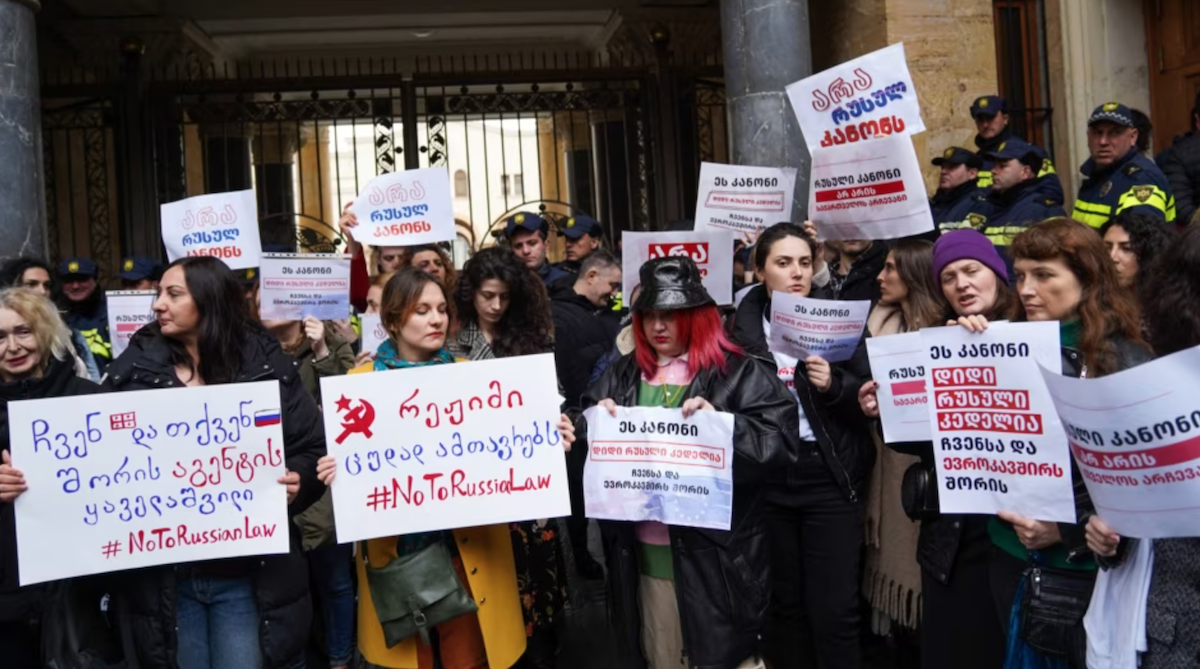
The law adopted in Georgia, however, is explicitly aimed at media and non-governmental organizations. In this way, it resembles Russian legislation, which has led to it being labeled the “Russian law” in Georgian society.
Notably, in Russia today, all independent NGOs and media organizations not controlled by the Kremlin have already been shut down.
3. The Georgian law contradicts EU legislation. A similar situation occurred in Hungary, but when the European Court ruled that Hungary’s law was directly intended to silence media and NGOs, Hungarian authorities repealed it.
The imposition of such restrictions on organizations funded by partner nations has led to speculation that Georgia may be shifting its foreign policy direction. This concern is voiced by politicians, independent experts, and civil society representatives both in and outside of Georgia.
Western community reaction
● The “transparency of foreign influence” law was passed by the ruling Georgian Dream party in a third reading on May 28.
● Under the law, organizations receiving more than 20% of their funding from abroad must register in a special registry established by the Ministry of Justice as “organizations acting in the interests of foreign powers.” The registration deadline was September 2, with 476 organizations voluntarily registering, according to the ministry.
● From September 3, the Justice Ministry’s financial monitoring department gained the authority to inspect and fine organizations that fall under the law but failed to register.
● The government enacted the law despite massive street protests and strong appeals from Georgia’s Western partners to abandon the initiative. The law received a strongly negative assessment from the Council of Europe’s Venice Commission.
● On May 23, U.S. Secretary of State Antony Blinken announced plans to impose visa restrictions, financial sanctions, and a comprehensive review of all aspects of bilateral cooperation in response to actions undermining democracy in Georgia.
● On June 6, the State Department announced a sanctions package, including visa restrictions affecting around 30 Georgian officials and members of parliament, along with their family members.
● On September 16, the U.S. Treasury Department imposed sanctions on Zviad Kharazishvili, head of Georgia’s Special Forces Department, known as “Khareba,” his deputy Miller Lagazauri, and leaders of the pro-Russian “Conservative Movement” Alt-Info, Koka Morgoshia and Zura Makharadze. Khareba and his deputy were added to the Magnitsky List for violence against peaceful protesters opposing the “foreign agents” law.
● Simultaneously, the State Department imposed visa restrictions on over 60 additional Georgian government and parliament members, including their families.
● The European Union also plans countermeasures, with EU officials repeatedly warning that the law distances Georgia from the European Union.
Arguments from civil society
All organizations whose income comes from more than 20% of grants from foreign countries will be declared as foreign agents. In a small, poor country like Georgia, this applies to almost the majority of non-governmental organizations.
With the help of the European Union and the U.S., vital projects have been implemented in the country over the past 33 years, ranging from healthcare and infrastructure to strengthening civil society.
Many non-governmental organizations and media outlets are refusing to register as “acting in the interests of a foreign power” or “foreign agents,” as required by the law. Such a label is insulting to these organizations and individuals: “We are working honestly in our country; why should we be called ‘carriers of foreign interests’?” they ask.
Those interested in the effects of daily walks on one’s mental health need to look no further than Georgia, where we’ve been doing it collectively for some time. With the research experiment still underway, preliminary results suggest that such walks can indeed lift one’s spirits, at least in the short term. Experts warn, however, that if done repeatedly and too obsessively, walking could only increase overall stress levels and put people at greater risk of developing depression in the long run. But why care about long runs when you have short walks? Because, as scientists fear, for those who suffer from more deeply rooted and unarticulated forms of anxiety, these walks can even turn out to be counterproductive: research has shown that in Georgia, the popular activity is often misused to simply walk away from facing the truth.
Here is Nini and the Dispatch newsletter trying to figure out the possible destinations of the endless biblical walks that Georgians are taking these days.
Be careful what you wish for!
Apparently, if you fantasize too much about turning your country into various kinds of “international hubs,” you might live to see it become an actual hub of international protest. We knew that Tbilisi had become a new Casablanca when Georgians gathered in front of the Parliament on November 11 to be joined by two foreign groups walking from opposite directions.
First to arrive – from the left – was a group of Georgian, Azerbaijani, and Armenian activists led by well-known Swedish climate activist Greta Thunberg. Thunberg, who stopped in Tbilisi for a few days, had announced a rally in Freedom Square that evening to oppose “a wave of authoritarianism and exploitation” in the Caucasus, partly in response to the UN climate conference in Baku (COP29), which activists feared was being used by Azerbaijan’s authoritarian leaders to greenwash and whitewash their rule.
Next to join the rally – from the right – was a group of senior European lawmakers visiting Tbilisi and eager to address the pro-EU crowd after being predictably snubbed by officials of the ruling Georgian Dream party. The eight lawmakers walked down Rustaveli Avenue to join the “We Are Europe” rally, which was organized in their honor, as crowds cheered their welcome. During the rally, at which the Georgian and EU anthems were played at least three times, one could hear everything from the boldest anti-Russia statements by MPs from what once represented the most cautious European parties – to the inevitable (but misplaced) “Free Saakashvili” call by a Polish lawmaker.
(Don’t) Play it, Sam
The European MPs may have drawn ire from more prudent fellow Westerners, who could feel uneasy about their representatives addressing opposition crowds in a foreign country – no matter how legitimate their concerns were. And, of course, they received all the hatred from Georgian Dream officials who see them as a bunch of “idle men” meddling in their affairs. But none of this bothered the pro-EU Georgians, who, alone against their rogue government (and their aggressive neighbor), were desperate for vocal European support to the protest against what they see as stolen parliamentary elections.
And while nothing could have made the pro-opposition Georgians hate the visiting European MPs, nothing could have made some of them love Greta Thunberg.
A litany of accusations against Thunberg that surfaced from local critics included (but was not limited to) her using the Tbilisi protest venue to push her personal climate agenda, being a Russian pawn, being anti-Semitic, spreading “wokeism,” or, simply, existing. All of that even as the 21-year-old Swedish activist did her best: she attended rallies, from standing patiently at the opposition-led meeting on November 4 to being present at the activist-led march six days later; she carried the “Democracy for Georgia” banner at the November 11 rally; she repeatedly expressed solidarity with Georgians’ struggle against authoritarianism in her countless media statements, and later produced a long supportive social media post that drew the attention of millions of her followers to developments in Georgia.
But the activist could just as easily have persuaded billionaire Bidzina Ivanishvili to willingly surrender his power and schedule new elections and still fail to impress those Georgians whose highly (geo)politicized, oversimplified, and increasingly crumbling worldview had no room for tolerating Thunberg’s persona, let alone agreeing with her views.
But was it her mere presence at the rallies that unsettled the protesting Georgians? Or perhaps was it the conspicuous absence of Greta’s Georgian peers that frightened them?
Fall of Spring
Georgians, known for their tradition of hospitality, still managed to do the visiting climate activist a favor: in recent weeks, car-dependent Tbilisi has become remarkably environmentally friendly as more and more Georgians prefer to take (protest) walks despite the cold temperatures. As evidence of fraud in the October 26 elections mounts, the country is trying to shake off the shock and apathy of the election night through daily rallies, many of which end in dynamic protest marches.
Some of these marches are large, and some are smaller. Still, as long as they are sustainable, size may be less of a concern for now: the common understanding is that a higher turnout will be necessary once the Central Election Commission announces the final results, which are expected within the next week. It could be another ten days before the new Georgian Dream parliament convenes, which opposition leaders and activists plan to prevent through mass protests. And then there’s the big question of whether Georgian youth, including students, are ready to turn up.
While GenZ activists can still be seen in the current protests, their participation is hardly comparable to the spring, when students were the driving force in keeping the opposition to the Foreign Agents Law alive. If earlier some complained that the youth needed leadership from political figures, today the picture is reversed, and opposition leaders sometimes seem at a loss, as if they could use some guidance from younger activists.
One reason for their absence, however, is not that the youth don’t feel cheated by the government, but something much darker: whether in personal discussions or on social media, younger Georgians report a nagging feeling that they gave it their all, walking miles in the months of spring and traveling longer distances in October to vote and observe the elections, only to see that opposition politicians didn’t do their best to detect fraud in time and to protect the votes.
It’s all different now
There are, of course, excuses that it took time to document the complex fraud and that the fight is not about the opposition parties but the whole country’s future, but nobody knows whether this will be enough to convince young Georgians. While Georgian youth remain the most vibrant group when it comes to political change, they are also one of the most vulnerable: as life has become increasingly expensive in recent years, many have to work full-time jobs while remaining full-time students. To risk their academic performance, health, and employment for activism requires much more than believing that the vote was rigged – it requires faith in their own victory and in those who ask for their help.
Things this fall and winter won’t be the same as they were in the spring. Unlike in April-May, there is no Plan B such as elections to look forward to if the street protests fail to produce results. Unlike in the spring, activists in the coming months are likely to lose an ally in the Orbeliani Palace who used her presidential pardon powers to get them out of jail when they were detained on trumped-up charges. Two young protesters currently face up to six years in prison for damaging a temporary iron fence worth 400 lari ($150) during the spring protests. The ruling party has tightened laws enough to put other young people behind bars for years for even less serious offenses. Police have also reiterated their threats to issue hefty fines for those who block traffic in protest.
Taking risks requires a strong belief that one is not alone and that fellow fighters on the political front recognize that sacrifice.
It is hard to say whether such faith exists: mistrust continues to infect Georgian society, and the infection seems to extend far beyond the government-versus-opposition polarity.