In October 2024, Georgia’s foreign exchange reserves decreased by a record USD 627 million according to the latest information released by the Bank. The four foreign exchange interventions made immediately before the parliamentary elections mark a significant decline in the country’s foreign exchange reserve, which fell from USD 4.71 billion to USD 4.08 billion. This is the largest one-month decline in the history of the NBG.
The main reason for this decrease was the four foreign exchange interventions carried out by the NBG in the pre-election period, including the sale of 213 million dollars, and the implementation of additional interventions allegedly through the Bmatch platform. The detailed statistics on the volume of reserves sold this way [through the Bmatch platform], will be available on November 25.
“In August 2023, the country’s foreign exchange reserves stood at 5.44 billion dollars. However, as has been observed, this figure has since decreased to 4.08 billion dollars. This represents a decline of 1.36 billion dollars in the period spanning a bit more than a year, placing the reserves significantly below the critical threshold. Compared to the volume of foreign payments, no country with a BB rating has reserves of this volume. The issue of revising this rating will soon be on the agenda,”- stated Roman Gotsiridze, the former president of the National Bank of Georgia, on Facebook.
In an interview on November 8, Arvind Ramakrishnan, the head of the analytical team at Fitch Ratings, addressed the current decision of the National Bank of Georgia. He highlighted that as of the end of September, the level of reserves covers only 2.6 months of current account payments. This is below the minimum level of three months recommended by the International Monetary Fund.
The weather is expected to be occasionally rainy with possible showers and lightning in Baku and the Absheron Peninsula on November 12, Report informs, citing the National Hydrometeorological Service of Azerbaijan.
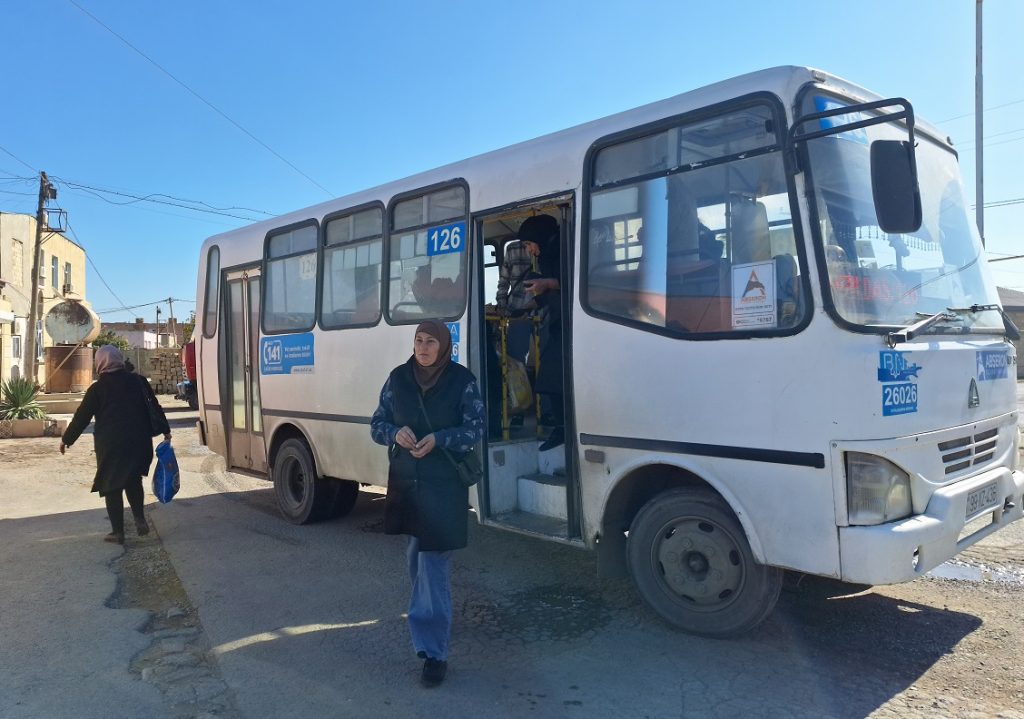
There is only one bus route, number 126, to the village of Shongar in the Garadagh district, located 30 kilometers from Baku. Dirty and broken buses departing from the Elite shopping center in the Darnagul area take about two hours to reach the village. The intervals between buses at the stops are also very long.
There is only one route to Shongar village, located 30 km away from Baku. Photo Fatima Movlamly/JAMnews
The first thing you see upon entering the village are the stone quarries. Shongar residents mostly make a living working in these quarries or at the Sadarak and Bina markets in the neighboring village of Lokbatan.
Shongar has no school, kindergarten, medical center, pharmacy, or park—in short, none of the infrastructure that any settlement should have.
According to residents, there are also problems with the water supply. Water supply interruptions are frequent, and sometimes residents are left without this “source of life” for days.
“If you knock on any door in the village, everyone will talk about different problems. The village feels like a godforsaken place. Government agencies show no interest in our problems and ignore our complaints. Aside from the main road, there is no asphalt anywhere in the village,” laments one Shongar resident.
Children deprived of education, desperate parents
There is a small shop in the center of the village. Residents say that there isn’t a single family in Shongar without at least one member whose name is written in the shop’s “debt notebook.” People buy groceries on credit.
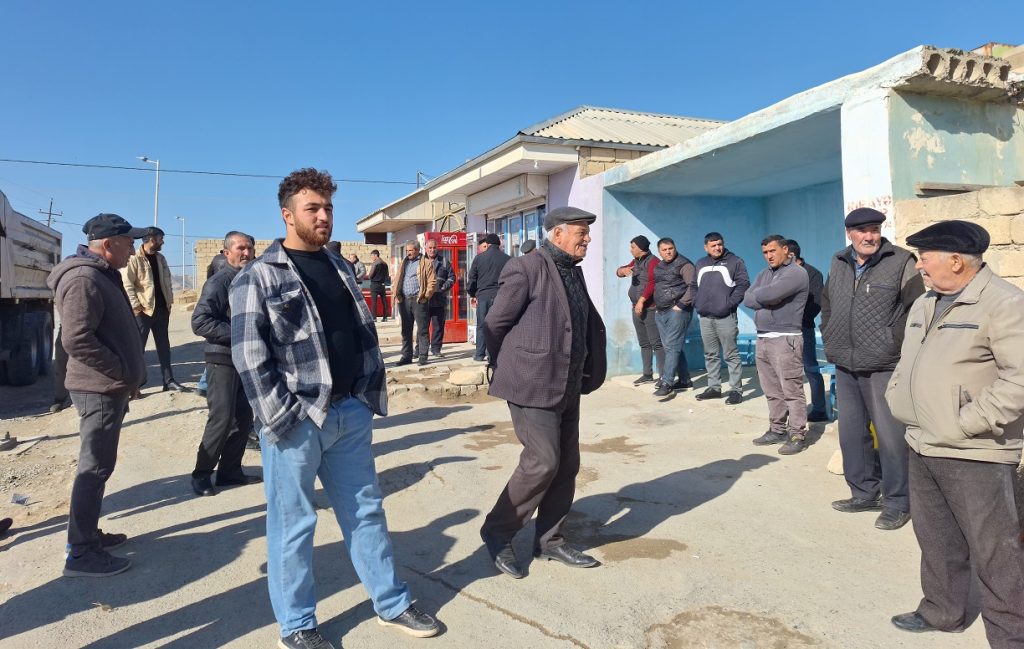
The money they earn doesn’t allow them or their families to live at least one carefree day. Every day, Shongar residents gather near the bus stop in front of this small shop to discuss the endless problems of their daily lives.
Shongar residents demand the construction of a school in the village. Photo: Fatima Movlamly/JAMnews
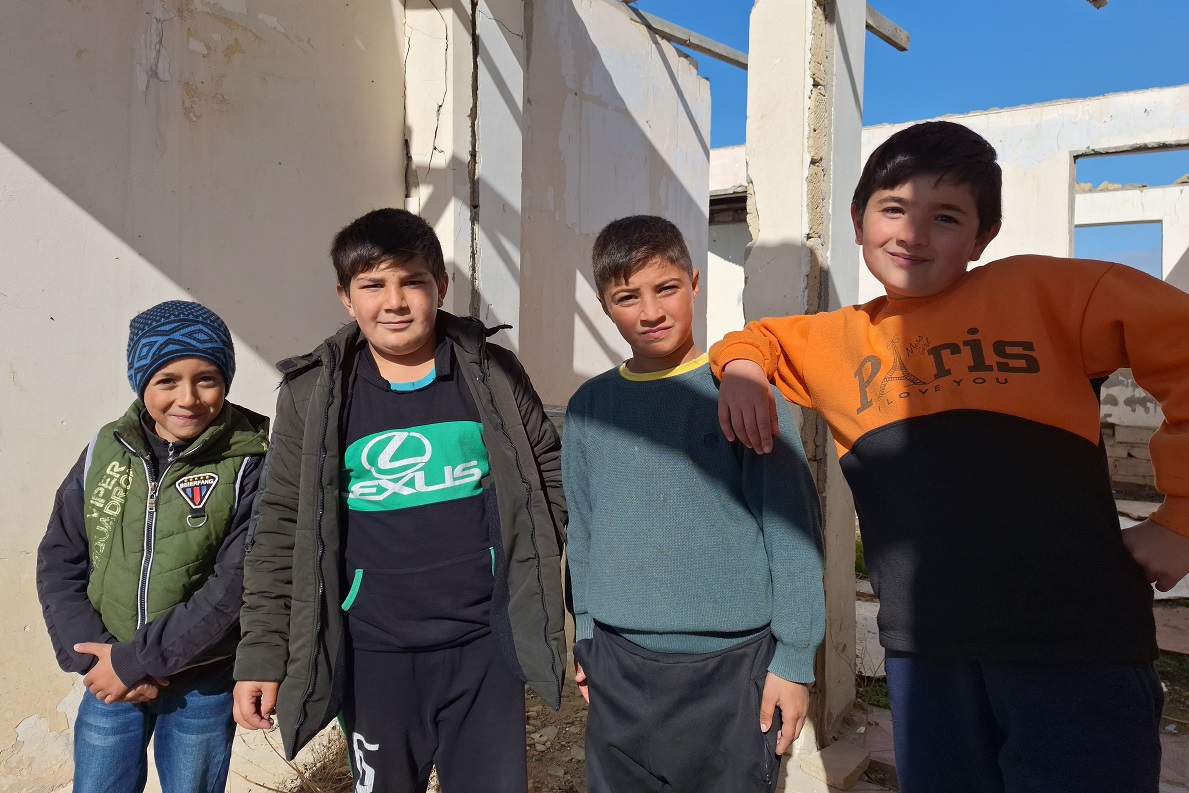
But today, there are especially many people in front of the shop. A desperate crowd is gathered to protest. According to participants, they haven’t been able to send their children to school for two weeks. The reason is that village residents cannot afford transportation costs for their school-aged children.
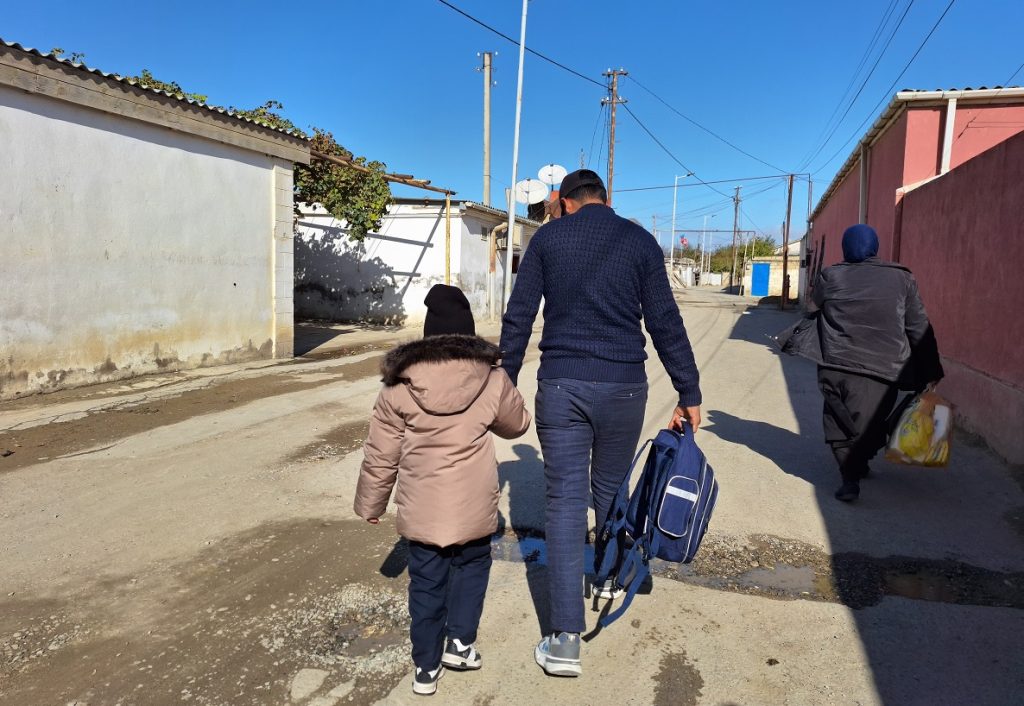
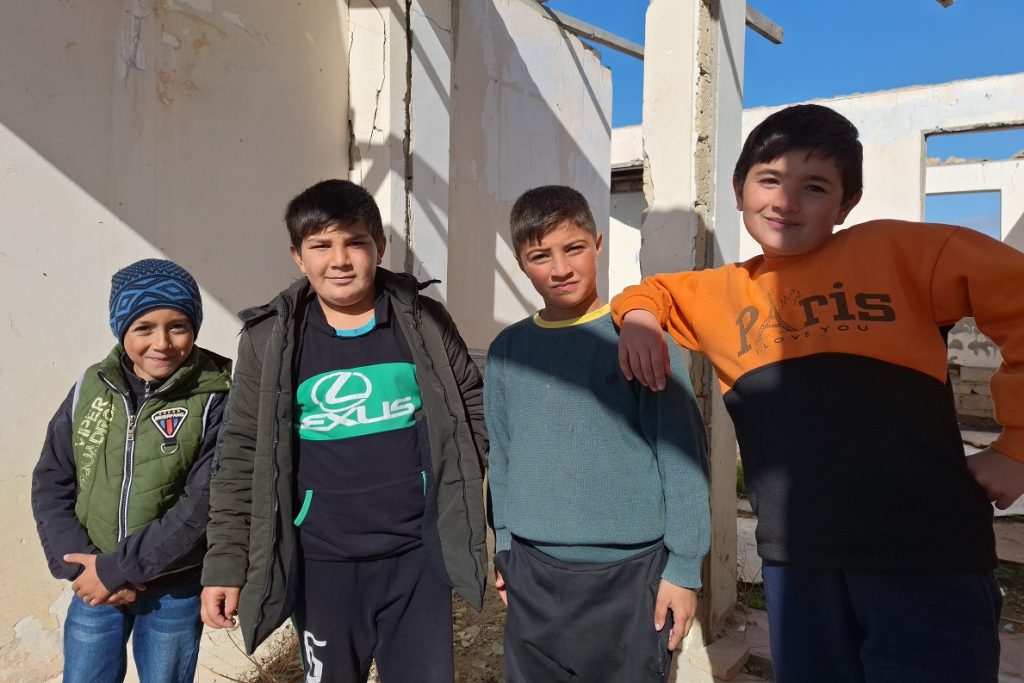
Around 300 school-aged children live in the village, but there is no school here. For more than twenty years, children from Shongar have had to travel to School No. 180 in the neighboring village of Gyzyl Dash, located several kilometers away.
For over 20 years, children from Shongar have been traveling to study in the neighboring village of Gyzyl Dash. Photo: Fatima Movlamly/JAMnews
A month ago, bus drivers on the route from Shongar to Gyzyl Dash did not charge schoolchildren for the ride. However, drivers now say that this is no longer possible due to increased fuel and fare costs, and they are forced to charge children as well.
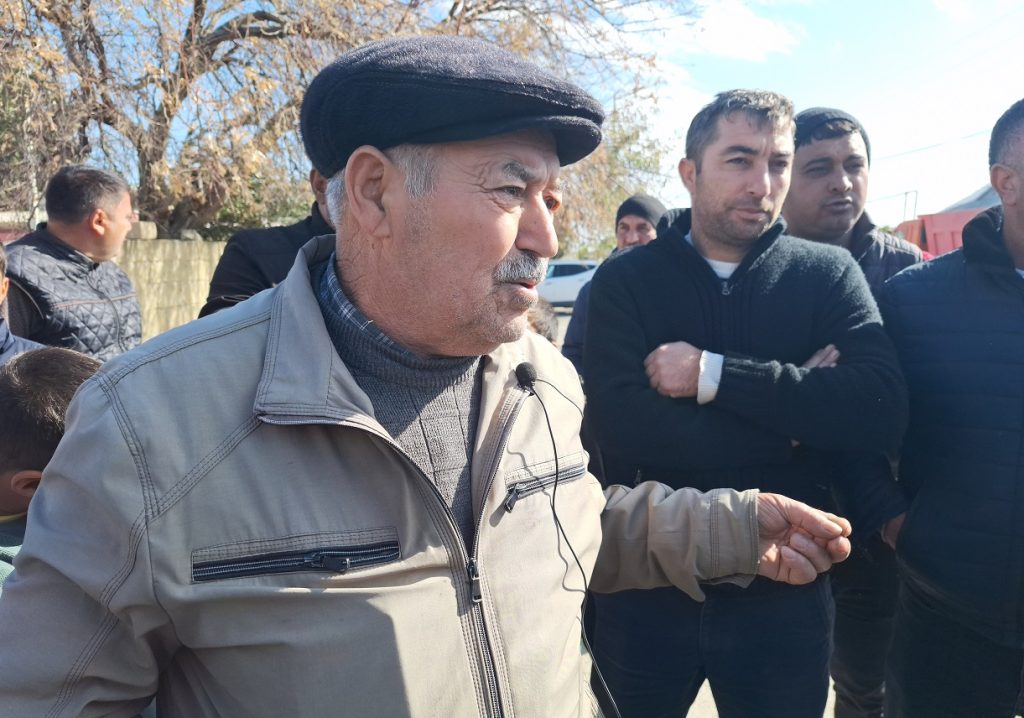
Nabi Muradov, resident of Shongar. Photo: Fatima Movlamly/JAMnews
“Each family has at least two or three children going to school. And parents have to travel with them as well. How much can we spend on transportation every day? How can people who work in the quarries and haul carts at the market afford this?” says Nabi Muradov, an elderly resident of the village.
Another resident, Elnur Rzayev, also cannot send his child to school because he lacks the money. He says that if a school were built in Shongar, transportation issues would no longer be a problem.
Children from the village haven’t attended school for two weeks. Photo: Fatima Movlamly/JAMnews
“My child is now out on the street, missing classes. They’re missing school because our budget doesn’t allow it—I’d have to pay 100-150 manats [about $58-88] per month just for transport to send my child to school. We don’t expect free bus rides. Let them build a school in the village. There’s no kindergarten, but we’re not even asking for that—at least let there be a school. We’ve suffered from this issue for years. Suppose we send the kids to school on foot. What will happen when it rains or snows?” says Rzayev.
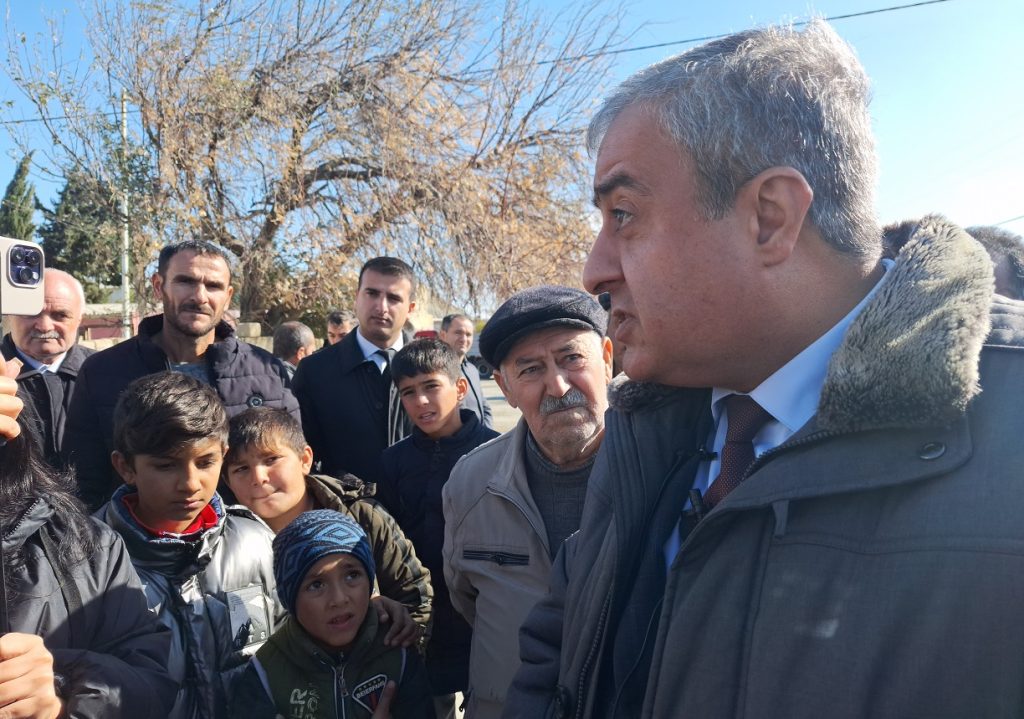
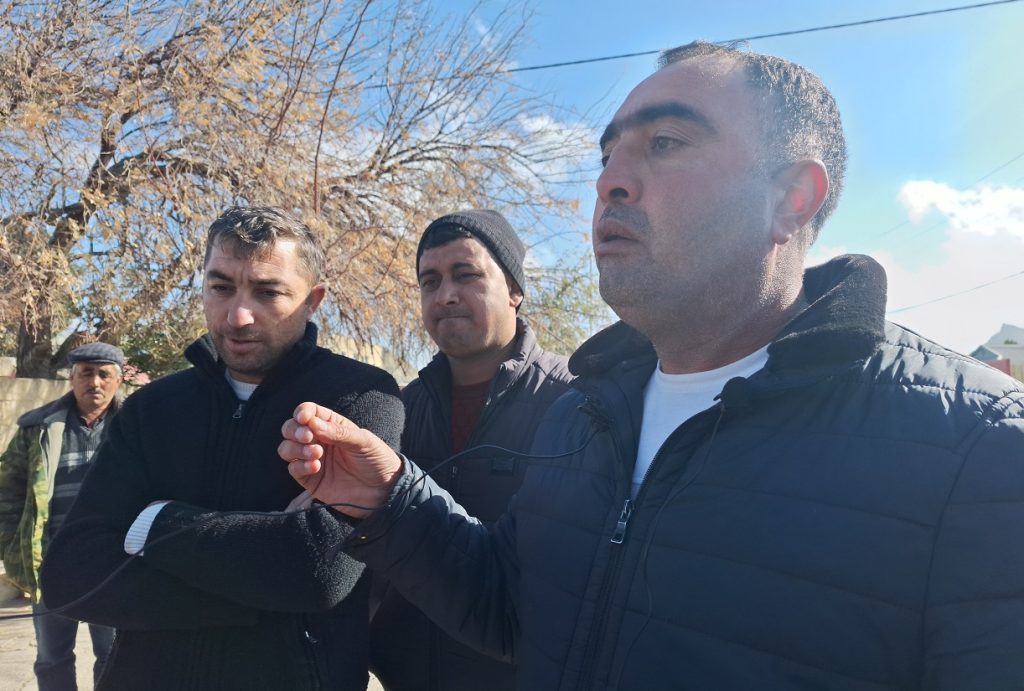
Soon, Imran Hasanov, the head of the Garadagh District Executive Authority’s department, approaches the crowd, accompanied by the police. Hasanov says that the executive authority does not have the power to build schools or kindergartens, and only the Ministry of Science and Education can resolve the issue. According to the response from the executive authority’s inquiry to the ministry, it can be assumed that the construction of a school in Shongar is not planned in the near future.
Imran Hasanov, representative of the Garadagh District Executive Authority. Photo: Fatima Movlamly/JAMnews
“Our residents have repeatedly raised this issue. We also sent a letter to the Ministry of Education, and I will now read their response to you. It states that since the funds allocated to the ministry for investment expenses from the 2023 state budget have already been directed to specific projects, these issues will be considered as part of upcoming state investment programs,” read Imran Hasanov from the Ministry of Education’s response.
No school built in Shongar in 20-25 years
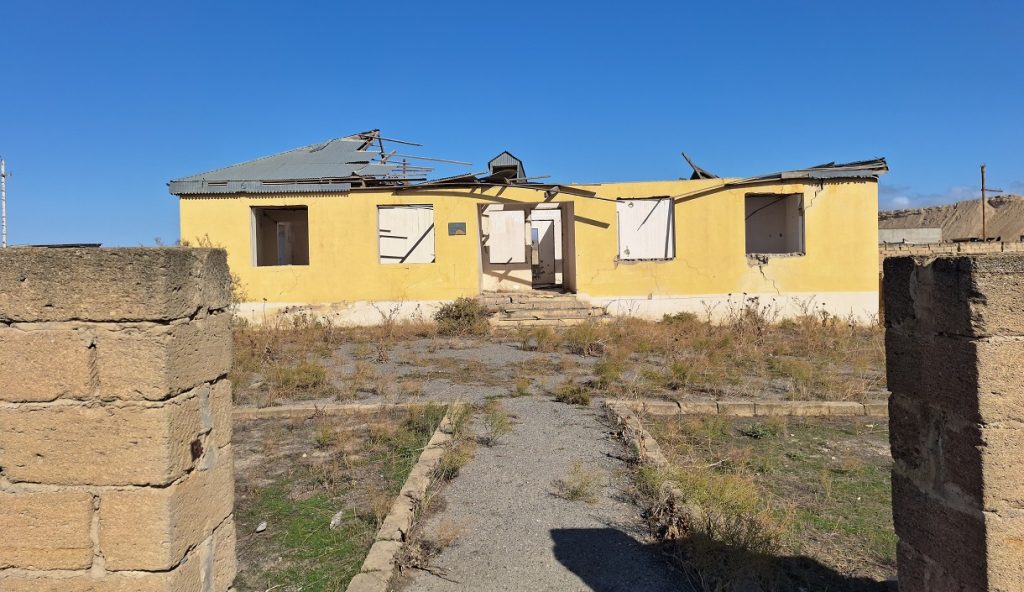
In the last 20-25 years, the government has not built a single school in Shongar. In 2009, the British oil company BP built a four-year primary school in the village, but it operated for only four years. In a short time, the school building fell into disrepair, and classes were suspended.
The school, funded by BP, soon became unsafe. Photo: Fatima Movlamly/JAMnews
According to the state program for the socio-economic development of Baku and its settlements for 2014-2016, the construction of a secondary school with 196 seats was planned in the village of Shongar, but this commitment has yet to be fulfilled.
From time to time, residents have raised the issue of the school. Two years ago, when they protested about it, a representative of the Garadagh District Executive Authority stated, as they do now, that they had appealed to the Ministry of Education and Science on this matter.
At that time, the Baku City Education Department told the press that if there was a pressing need for a school in Shongar, the issue could be considered accordingly. But since then, nothing has changed.
‘I lost my father and mother because they didn’t receive medical help in time’
Forty-two-year-old Zakir Nasirov was born and raised in the village of Shongar. He now lives here with his wife, two daughters, and son. He says that since his childhood, the same issues have been on the agenda in Shongar—school, kindergarten, clinic, roads, water, and unemployment.
Zakir Nasirov, a resident of Shongar. Photo: Fatima Movlamly/JAMnews
According to Zakir Nasirov, he lost his father and mother due to the lack of a medical center.
“If someone gets sick, falls, or is injured, there’s no one to help. I lost my father and mother because they didn’t receive medical assistance in time. A few years ago, when my father’s health, and then my mother’s, worsened, the ambulance didn’t come. We couldn’t get them to a hospital in one of the nearby settlements in time, so both of them died. In this village, you can’t afford to get sick. And if you do, you just wait for death,” says Nasirov.
‘I want to become a computer engineer, but I can’t go to school’
The main concern for Zakir Nasirov and his wife now is that their children are being deprived of an education.
“I’m a laborer. Some months, I can’t even earn 300 manats [about $176]. What should I spend that money on—clothing, food, or transportation for three kids? It’s never enough. My children are very good students, and now they haven’t been able to attend classes for two weeks, falling behind in their lessons. They’re turning our children into ignorant people,” Nasirov laments.
His daughter Fidan, 16, is in the 10th grade. She is worried that as she misses school, she will fall behind in the curriculum, and her grades will suffer.
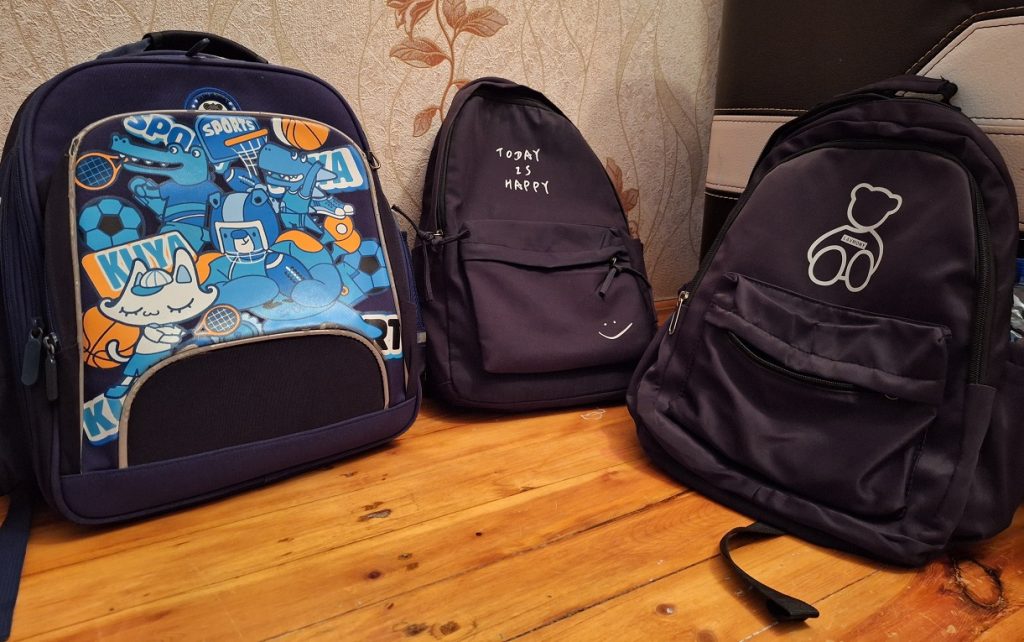
The Nasirov children cannot go to school. Photo: Fatima Movlamly/JAMnews
“Staying away from school is, of course, very upsetting for me. I’m missing classes, I have final exams coming up, and my grades will go down. I’m preparing for the first group of university entrance exams, and I dream of becoming a computer engineer. Now, with us not going to school, it’s going to be very difficult for me. Our principal came here to find out why we aren’t attending classes. We explained the reason, but he still insists that we go to school. But how? We don’t know. My sister is in the 9th grade, and my brother is in the 5th grade. All three of us are very worried,” says Fidan.
On November 7, the European Court of Human Rights (ECHR) published its judgment in the case of Bakradze v. Georgia, finding Georgia guilty of violating Article 14 of the Convention, in conjunction with Articles 10 and 11, and ordering the State to pay EUR 4,500 for non-pecuniary damage.
The case concerns Maia Bakradze, a former judge and current president of the non-governmental organization “The Unity of Judges of Georgia,” who brought her appeal to the Strasbourg Court after two unsuccessful attempts to secure a position at the Tbilisi Court of Appeal because of her NGO and critical statements about the judicial system in Georgia.
Bakradze was appointed as a judge at the Tsalka District Court in 2005 for a 10-year term, then transferred to the Tbilisi City Court until 2006, and then to the Tbilisi Court of Appeals, where she served until her term expired in 2015. In 2015 and 2016, she tried to secure another position at the Tbilisi Court of Appeals by participating in the judicial competitions held by the representatives of the High Council of Justice. The video footage of the interviews she had, showed that instead of being questioned about her ethics and professional experience, the questions focused on the activities of her NGO and her critical statements.
The state claimed that Bakradze was unsuccessful in securing the position because of “her performance in the relevant competitions.” However, based on the evidence provided, the ECHR found that HCoJ violated the European Convention on Human Rights’ Article 14 (Prohibition of discrimination), in conjunction with Articles 10 (Freedom of expression) and 11 (Freedom of assembly and association).
This Victory, achieved under your command as Commander-in-Chief, was a source of immense pride and inspiration for both Azerbaijan and the entire Turkic world, Turkish President Recep Tayyip Erdogan said in his congratulatory letter addressed to President
In an interview with Formula TV, Zurab Japaridze, leader of the Girchi-More Freedom Party and one of the leaders of the Coalition for Change, which passed the electoral threshold in the 26 October elections, said that in his opinion several steps should be taken to prevent the GD from legitimizing the new parliament, culminating in a mass protest rally to prevent the Georgian Dream party from legitimizing itself and officially forming the parliament.
Japaridze noted that there are concrete deadlines that put the political processes in a certain order for the coming month. At the moment, he said, the focus is on filing lawsuits against detected cases of fraud, and protests are concentrated on rallies in front of the courts and the CEC building. The next stage is the appeals process, which should go through the courts after the CEC publishes its final summary protocol.
The final vote tally must be announced by November 21. Before that date, Japaridze stresses, the focus must be on preventing the CEC and its Chairman, Giorgi Kalandarishvili, from writing the results that “Ivanishvili told them to write”. After that, however, the focus will be on the President, who, according to the constitution, has 10 days to convene Parliament. According to Japaridze, the president doesn’t intend to do so.
At the end of this 10-day period, Parliament will most likely convene anyway and proclaim its legitimacy. This will be the “culmination” and “the critical moment”, Zurab Japaridze stressed, when the whole of Georgia should take to the streets, and not allow the GD to legitimize new parliament. According to him, this should be achieved firstly by other parties refusing to enter the parliament, secondly by daily cooperation with international partners in order not to legitimize the results from abroad, and finally by holding the largest-ever rally in front of the building in order to physically prevent the GD MPs from entering the building and legitimizing themselves.
Japaridze said that if this doesn’t happen and the GD legitimizes the new parliament, events will unfold at a fast pace: The GD will fully enforce the law on foreign agents, the Anti-Corruption Bureau will resume its persecution of political parties and civil society organizations, the political field will be ‘cleansed’ and most of the citizens who are now protesting in the streets will leave the country. This would effectively turn Georgia into Belarus, the politician said. He stressed that this was the only realistic plan, and that the others would only waste time and divert the attention.